What is Budapest Thermal Bath Art Deco?
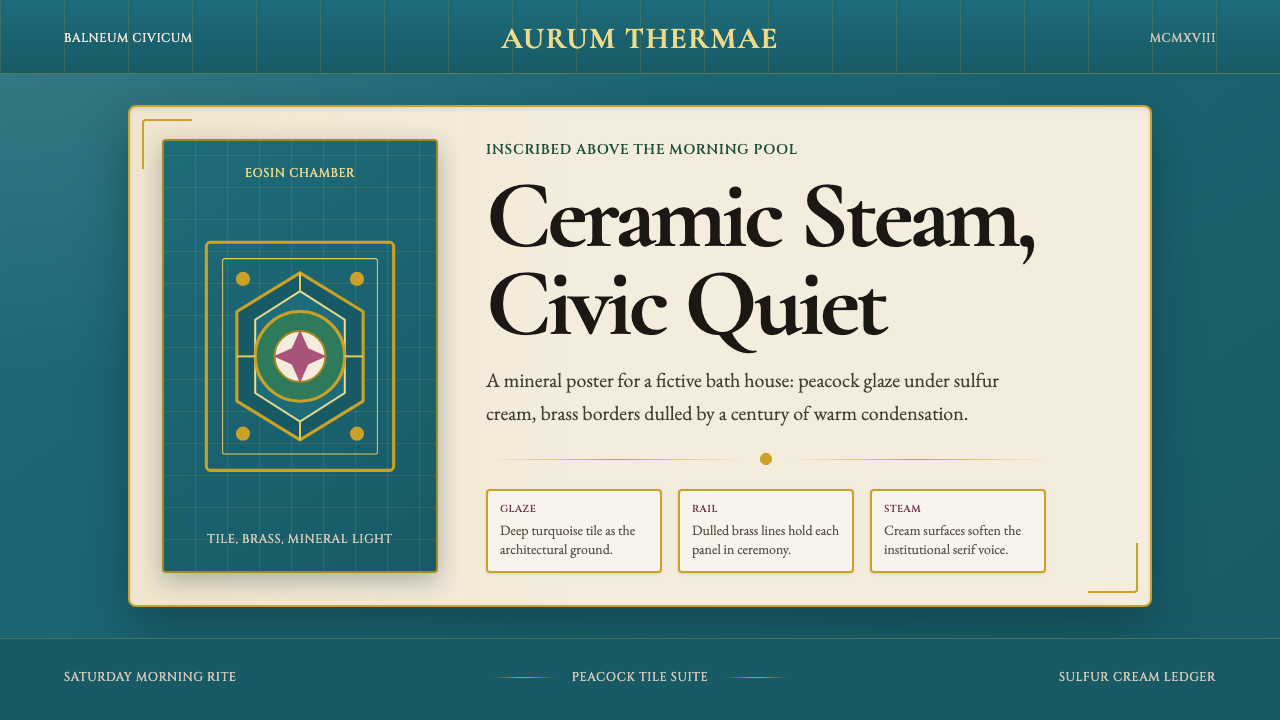
Budapest's grand thermal bathhouses — peacock-turquoise tile, sulfur-patinated brass, and barrel-vaulted steam — forged a ceremonial design language where civic infrastructure became sacred architecture.
Budapest Thermal Bath Art Deco in brief
Budapest Thermal Bath Art Deco is a design language distilled from the visual atmosphere of Budapest's great public bathhouses — Széchenyi, Gellért, and Lukács — built between the 1880s and 1930s at the intersection of Hungarian Secession, Art Nouveau, and late Art Deco. Its palette centers on the deep ceramic-glaze turquoise of Zsolnay tiles, set against sulfur-cream card surfaces and punctuated by the dulled warmth of brass and gilt detailing. Typography carries the weight of Habsburg-era inscription: serif letterforms set like Latin dedications above bath entrances, grave and ceremonial rather than editorial.
The style is not merely a regional curiosity. It represents a uniquely resolved tension between two normally opposing impulses — the organic, ornamental energy of Art Nouveau and the streamlined geometry of Art Deco — resolved through the mediating influence of Ödön Lechner's Hungarian Secession, which insisted on rooting Central European modernism in Magyar folk motif and Zsolnay ceramic craft. The result is richer than pure Art Deco and more structurally legible than pure Art Nouveau: tile patterns carry geometric discipline, columns bear foliate crowns, and vaulted ceilings breathe with both engineering confidence and decorative warmth.
In contemporary design application, this aesthetic functions as a system of controlled opulence: every element carries patina and ceremony without tipping into kitsch. The dominant ceramic turquoise grounds everything in mineral coolness; the cream and brass lift it with warmth; the serif typography anchors it in institutional gravity. Used well, the style conjures a sensation of stepping into a building that has absorbed a century of steam, light, and collective ritual.

Where does Budapest Thermal Bath Art Deco come from?
Budapest sits above one of the richest geothermal aquifer systems in Europe, with more than a hundred natural springs rising through the limestone bedrock beneath Buda's hills. The Romans, who called the settlement Aquincum, built their first thermal baths here in the second century. The Ottoman occupation (1541–1686) deepened this bathing culture, leaving behind domed hammams — Rudas, Veli Bej — whose spare geometry and filtered dome-light would echo through all subsequent Budapest bath architecture. By the mid-nineteenth century, as the twin cities of Buda and Pest moved toward the 1873 unification that created Budapest, thermal bathing was already woven into the city's civic identity.
The decisive aesthetic era began after 1881, when the Hungarian ceramicist Vilmos Zsolnay — building on eosin-lustre glazing techniques developed at his Pécs factory — began supplying the architectural establishment with tiles and façade elements of an iridescent, mineral intensity unavailable from any European competitor. Zsolnay's pyrogranite resisted frost and pollution, making it ideal for Budapest's climate; his eosin glaze produced the deep peacock turquoise and metallic shimmers that would define the Hungarian Secession palette. The architect Ödön Lechner was the first to understand that Zsolnay ceramics were not decoration applied to a building but a structural skin with its own logic — his Museum of Applied Arts (1896) and Postal Savings Bank (1901) demonstrated what an architecture grounded in Magyar ornament and Zsolnay material could achieve.
The great bath commissions arrived in this context. Győző Czigler's Széchenyi Baths (opened 1913, expanded 1927) introduced a neo-Baroque grandeur softened by Secession detail. Ármin Hegedűs's Gellért Baths (opened 1918) pushed further into Art Nouveau sensuousness — the main pool's barrel vault, its Zsolnay-tiled columns, and its stained-glass ceiling panels became the canonical image of Budapest bath luxury. The Lukács complex, older in origin but repeatedly renovated through the 1930s, absorbed the period's Art Deco rationalism into its arcade and pool surround. Together, these three institutions established the visual vocabulary that this design system codifies.
The cultural moment that produced these buildings was itself unstable. The Austro-Hungarian Compromise of 1867 had given Hungary nominal parity within the Dual Monarchy; the Hungarian Millennium of 1896 prompted an architectural building campaign meant to assert Magyar cultural identity on the European stage. The Trianon trauma of 1920 — which stripped Hungary of two-thirds of its territory — then turned this building stock into objects of intense nationalist feeling. The thermal baths survived as civic monuments precisely because they belonged to everyone: they were places of democratic intimacy, where class distinctions dissolved in the same mineral water. Their aesthetic carries this social memory — ceremonial but not exclusionary, ornate but communal.
What defines the Budapest Thermal Bath Art Deco look?
Ceramic Turquoise Ground
The dominant tone derives directly from the Zsolnay eosin glaze: a deep, mineral turquoise that reads as simultaneously cool and saturated, neither the pale aqua of seaside palette nor the electric teal of digital design. It functions as the primary structural ground — backgrounds, large field fills, and dominant blocks all draw from this register. Its depth absorbs other elements without competing; the surface feels glazed and solid, as if the color has been fired into the material rather than applied over it.
Sulfur-Cream Surfaces
Card surfaces, text panels, and secondary backgrounds take a warm cream tone that carries the faintest suggestion of mineral sulfur — not pure white, not ivory, but something slightly yellowed by decades of steam and light. This temperature creates the contrast necessary to read against the turquoise ground while maintaining warmth. It is the color of old marble, of aged plaster, of paper that has spent time in a humid reading room — it gives the system its sense of duration and authenticity.
Brass and Gilt Accents
Metallic warmth enters through dulled brass and gilt elements: borders, rules, ornamental dividers, and small decorative motifs. The brass reads as aged rather than polished — oxidized, patinated, carrying the impression of a handrail that has been grasped by tens of thousands of hands over a century. In two-dimensional applications, this translates to warm gold tones applied sparingly to borders, icon outlines, and typographic ornaments. The metallic element provides the style's only sense of luxury without making the overall palette feel precious or fragile.
Habsburg Serif Typography
Typography draws from the tradition of lapidary inscription — the carved Latin dedications above bath doorways, the tiled lettering of thermal pool names. Serif letterforms are preferred, with a classical, architectural weight: thick-thin contrast that suggests chisel work rather than calligraphic flow. Display text is set with gravitas and generous spacing, as if meant to last in stone rather than scroll past on a screen. Body text balances this monumental quality with legibility, maintaining the sense that every word has been considered before being committed to the surface.
Secession Ornamental Logic
Ornament is present and deliberate — this is not a minimalist system — but it follows Lechner's principle of structural decoration: every pattern element reinforces the architectural reading of the composition. Tile-like geometric repetition, foliate border motifs, and medallion-shaped focal elements derive from the Hungarian Secession repertoire. They appear at the edges and joints of compositions, framing content rather than overwhelming it. The ornamental density is high enough to signal richness but controlled enough to preserve readability.
Vaulted and Domed Spatial Reference
The barrel vault and dome are the defining architectural experiences of Budapest's thermal interiors. In flat design, this spatial memory translates into compositional structures that suggest enclosure and ceremony: arched frames around key content areas, subtle semicircular motifs, and layouts that concentrate visual weight at the top — evoking a crown or keystone — and let the composition breathe downward. The effect is of looking up at a ceiling rather than across a flat surface: content feels housed, not merely displayed.
Mineral Muting and Patina
No color in this system reads as fresh or saturated to a digital extreme. Every tone carries the impression of having been filtered through mineral water, steam, and time. Turquoise is deep rather than bright; brass is warm rather than golden; cream is aged rather than clean. This pervasive muting prevents the palette from reading as tropical or playful — it keeps the atmosphere grave and cumulative, the feeling of a place that has been accumulating meaning for over a century rather than designed last year.

Who shaped Budapest Thermal Bath Art Deco?
Lechner (1845–1914) is the founding theorist of Hungarian Secession and the architect who demonstrated that a distinctly Magyar modernism was possible. His central insight was that Central European architecture had been borrowing from Greek, Gothic, and Renaissance sources for centuries without developing a native formal vocabulary — and that the raw material for such a vocabulary existed in Hungarian folk embroidery, ceramic craft, and the geometric ornament of the ancient Magyar migration routes across the Asian steppe. By combining these sources with Zsolnay's industrial ceramic production and the structural lessons of contemporaneous French and British architecture, Lechner created buildings — the Museum of Applied Arts, the Postal Savings Bank — that remain the primary visual references for any designer working in this tradition.
Zsolnay (1828–1900) founded the Zsolnay porcelain manufactory in Pécs in 1853 and over the following decades transformed it into one of Europe's most technically innovative ceramic producers. His development of eosin-lustre glazing — an iridescent metallic surface achieved through a reduction-firing process — gave Hungarian architecture a material that could carry the density and shimmer of Byzantine mosaic at an industrial scale. The pyrogranite he introduced for exterior applications proved uniquely resistant to the freeze-thaw cycles of continental climates, ensuring that Zsolnay-tiled buildings could survive Budapest winters intact. Nearly every major building of the Hungarian Secession era — including all three of the great thermal bath complexes — bears his manufactory's mark.
Hegedűs (1869–1945) was the principal architect of the Gellért Baths (1912–1918), the building that most completely realized the Budapest thermal bath aesthetic as a total interior environment. Working with a brief that demanded both hygienic functionality and civic grandeur, Hegedűs synthesized the barrel-vault structure of Ottoman and Roman antecedents with the sensuous surface language of Viennese Secession and Hungarian folk ornament. The main thermal pool — with its Zsolnay-tiled columns, wave machine, and stained-glass ceiling — represents the high-water mark of the style's ambition: a secular bath that feels like a cathedral, a functional civic facility that reads as ceremonial architecture.
Czigler (1850–1905) designed the original Széchenyi Baths (begun 1881, opened 1913 after his death), the largest medicinal bath in Europe at the time of its completion. His approach represented the more academic, neo-Baroque strain within the Budapest bath tradition — classical column orders, symmetrical façades, and monumental domed pavilions — tempered by the decorative vocabularies emerging from the Hungarian Secession milieu. Széchenyi's outdoor pools and yellow Baroque exterior make it the most photographically iconic of the Budapest baths, while the interior's thermal pools established the spatial archetype — the high vaulted pool hall, the cabinet of smaller treatment rooms — that later architects including Hegedűs would develop and intensify.
Hauszmann (1847–1926) did not design a thermal bath, but as the architect who rebuilt and expanded the Royal Palace of Buda and directed some of the grandest civic commissions of the Millennium building campaign, he established the monumental visual register within which all the bath architects operated. His work defined what civic ceremonial architecture looked like in fin-de-siècle Budapest — the appropriate scale of a column, the weight of a cornice, the relationship between ornament and structural mass — and his influence on the shared atmosphere of Budapest's turn-of-the-century institutional interiors is pervasive even when he is not directly credited.
How do you use Budapest Thermal Bath Art Deco today?
Budapest Thermal Bath Art Deco is a style of controlled ceremonial richness: it works best when the brief calls for institutional weight, sensory warmth, and a sense of enduring quality rather than novelty. Understanding what the system is actually doing — grounding everything in ceramic mineral depth, lifting it with cream warmth, accenting it with aged brass, and anchoring it with lapidary typography — is the prerequisite for applying it coherently rather than merely decorating with its surface elements.
For presentation slides, this style rewards investment in atmosphere on the cover page. A strong cover places the title in weighted serif type at upper-center — echoing the inscribed names above bath entrances — against a deep turquoise ground, with a brass-toned rule or ornamental border framing the composition. Content slides should shift to cream grounds with turquoise used as a structural accent color: section headers, divider rules, and data highlights. Data slides benefit from treating charts as tile-like geometric objects — bar charts given solid turquoise or cream fills, framed by thin brass-toned borders — so that the data visualization feels continuous with the decorative system rather than dropped in from a different visual language.
For web interfaces, the style is well suited to premium service dashboards, spa and wellness booking platforms, heritage hospitality brands, and any context where the visual language should communicate longstanding quality rather than startup novelty. The approach: set a near-turquoise or deep cream background depending on section, use serif type for all display headings and section titles, and reserve brass-toned or gilt accents for interactive states, call-to-action borders, and navigational highlights. Card components should feel slightly weighted and solid — subtle inner shadows on their turquoise or cream fills rather than floating drop shadows. Pricing pages work particularly well in this register, where the ceremonial gravity of the style reinforces the perceived value of what is being offered.
For editorial and marketing applications, the style supports a distinctive poster sensibility: strong typographic hierarchy, ornamental framing, and the visual density of a public announcement rather than the airy lightness of contemporary minimalism. Feature pages and hero sections work well with full-width turquoise grounds bearing large serif headline type in cream. Pull quotes and testimonials can be framed with the Secession-derived ornamental border vocabulary, which lends credibility through visual weight without relying on photography or illustration. For marketing collateral — event programs, printed menus, institutional brochures — the style scales beautifully to print, where its mineral color depth and serif typography translate directly from screen to paper.
A common mistake when applying this style is treating the turquoise as a background-only color while allowing the other elements — typography, ornament, borders — to drift toward generic luxury conventions like pure gold, deep navy, or stark white. Authentic application maintains the ceramic mineral quality throughout: the brass reads as aged, not polished; the cream reads as warm stone, not clinical white; the serif type has architectural weight, not calligraphic elegance. A second mistake is over-ornament: because the historical sources are richly decorated, designers sometimes layer tile patterns, border motifs, and medallion elements simultaneously until the composition collapses into visual noise. The rule is that ornament should frame and articulate, never compete with content.

Budapest Thermal Bath Art Deco — FAQ
How is this style different from general Art Deco?
General Art Deco — as practiced in Paris, New York, or Miami — favors streamlined geometry, stepped forms, and a palette that often runs to black, gold, and accents of jewel-bright color. Budapest Thermal Bath Art Deco shares the period's interest in geometric order and material richness, but its specific palette and ornamental vocabulary are distinct: the Zsolnay ceramic turquoise has no equivalent in the French or American Art Deco tradition, the Hungarian Secession ornament draws from folk textile and Magyar migration-route patterns rather than Egyptian or Aztec sources, and the overall atmosphere is mineral and civic rather than glamorous and commercial. Think of it as Art Deco filtered through a Central European civic bathing culture rather than a Hollywood film set.
Can this style work for a digital-native product that has no connection to Budapest or spas?
Yes — the connection to the historical source is atmospheric rather than literal. What the style communicates is institutional permanence, sensory warmth, and earned authority: the feeling of a place or organization that has been trusted for a long time. Any digital product whose brand positioning depends on conveying trust, heritage, quality over novelty, or premium service — financial platforms, professional services, cultural institutions, hospitality and travel brands — can benefit from the style's visual registers without any explicit reference to baths or Hungary. The key is to apply the system as a coherent whole rather than borrowing individual elements (the turquoise alone, or the serif alone) without their supporting context.
Is this a light or dark style, and can it be inverted?
The canonical form is light-ground: the deep turquoise functions as the dominant accent and structural fill against cream surfaces, not as an all-over background. A full dark inversion — where turquoise covers the majority of the screen — is possible and can be effective for hero sections, event posters, or premium landing page moments, but it requires restraint with the brass and cream accents, which can quickly become overwrought against a saturated turquoise ground. The most successful dark applications use the turquoise at reduced saturation, letting cream and brass do more compositional work. A full dark-mode implementation of a dashboard or content-heavy interface in this style tends to feel oppressive unless the turquoise is shifted toward a deeper, almost teal-adjacent tone.
How should ornament be calibrated to avoid looking like a pastiche?
The distinction between authentic application and pastiche lies in how ornament relates to structure. In the historical bathhouses, ornament occurs at the junctions and boundaries of architectural elements: where a column meets a vault, where a tile field ends, where an arch springs from a wall. It marks the logic of construction. In two-dimensional application, the same principle holds: ornamental borders should appear at the edges of panels and sections, not floating in the middle of a composition; tile-pattern motifs should repeat with geometric regularity that references craft production; medallion or roundel elements should function as focal anchors at compositional centers or corners. Ornament applied without this structural logic — scattered as texture across a background, or layered over typography as decoration — reads as costume rather than architecture.
Which contexts are a poor fit for this style?
The style's mineral weight and ceremonial register make it a poor fit for products that need to communicate speed, playfulness, or approachable informality. Consumer social apps, youth-facing entertainment platforms, fast-casual food brands, and anything whose UX depends on the user feeling in casual control rather than reverentially attended to will find the style's gravity working against them. It is also a difficult fit for highly technical developer tools or scientific data applications, where the ornamental richness can undermine the impression of rigorous precision. And because the palette is cool-warm rather than warm-warm, it sits uneasily with categories that depend on appetite appeal — food photography backgrounds, cooking and recipe platforms — where the sulfur-cream can read as unpleasantly associated with heat rather than pleasantly associated with age.
Related design styles
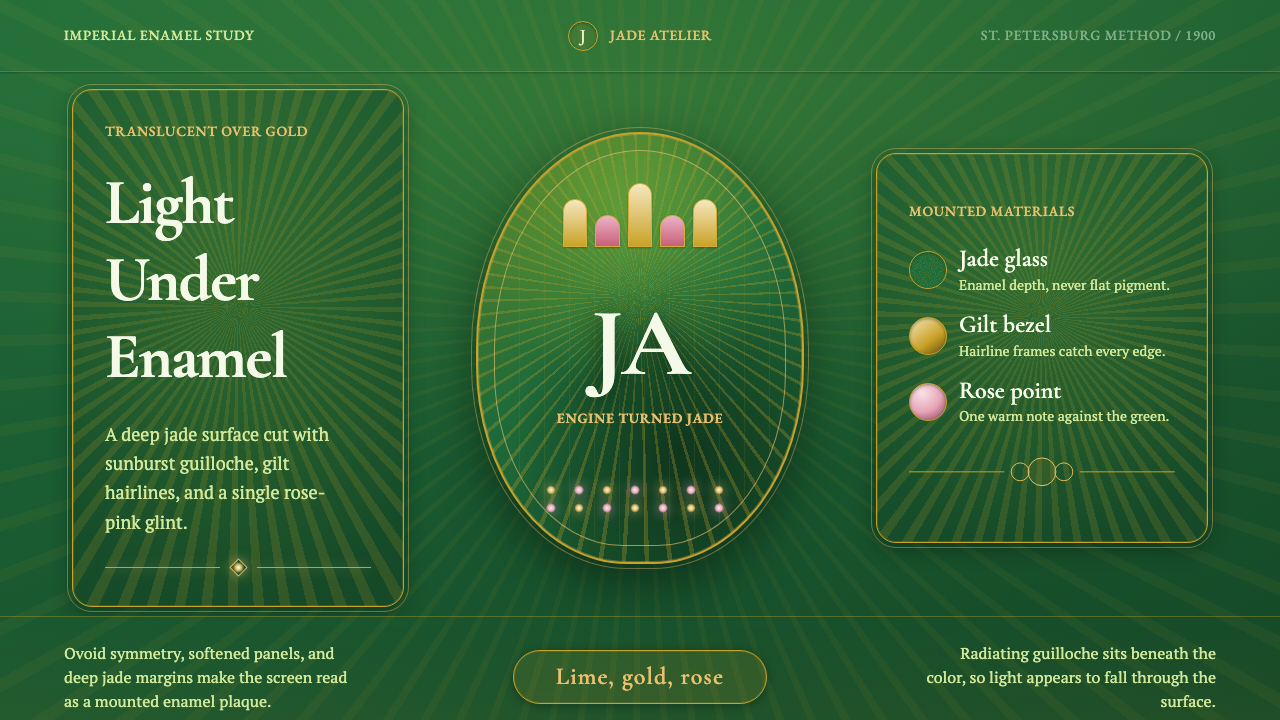 Faberge Guilloche EnamelImperial enamel glows. Jade guilloche, gilt hairlines, rose-pink points.
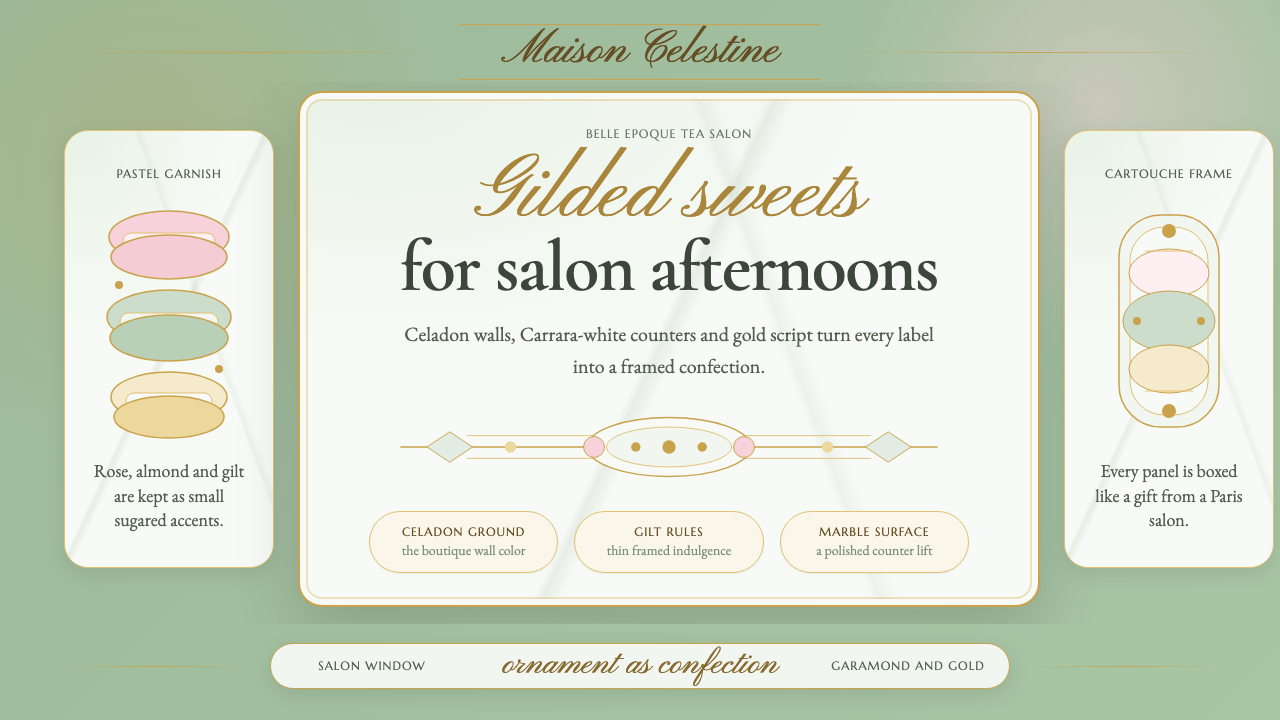 French PâtisserieOrnament is the luxury. Celadon ground, gilt cartouches, Garamond and script…
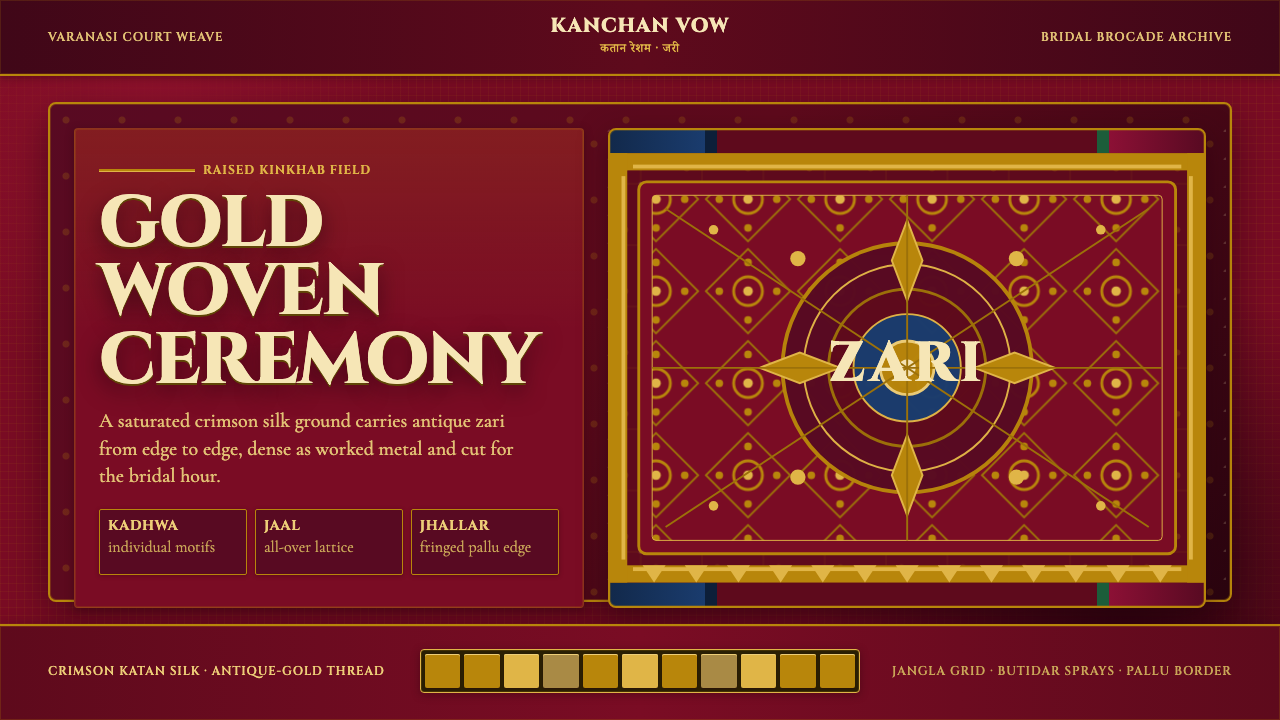 Banarasi Brocade SareeBridal maximalism, woven dense. Crimson silk grid carries raised antique-gold…
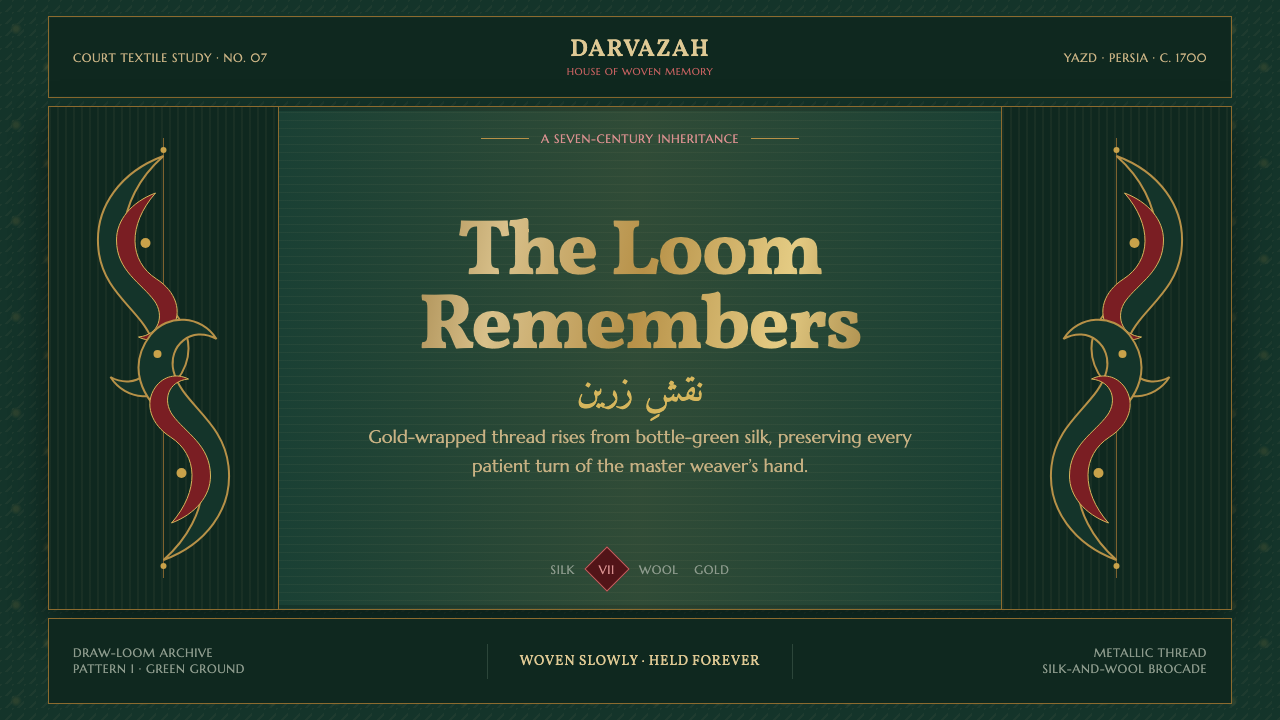 Persian Termeh BotehRoyal brocade, densely alive. Antique-gold boteh climbs across lustrous bottl…
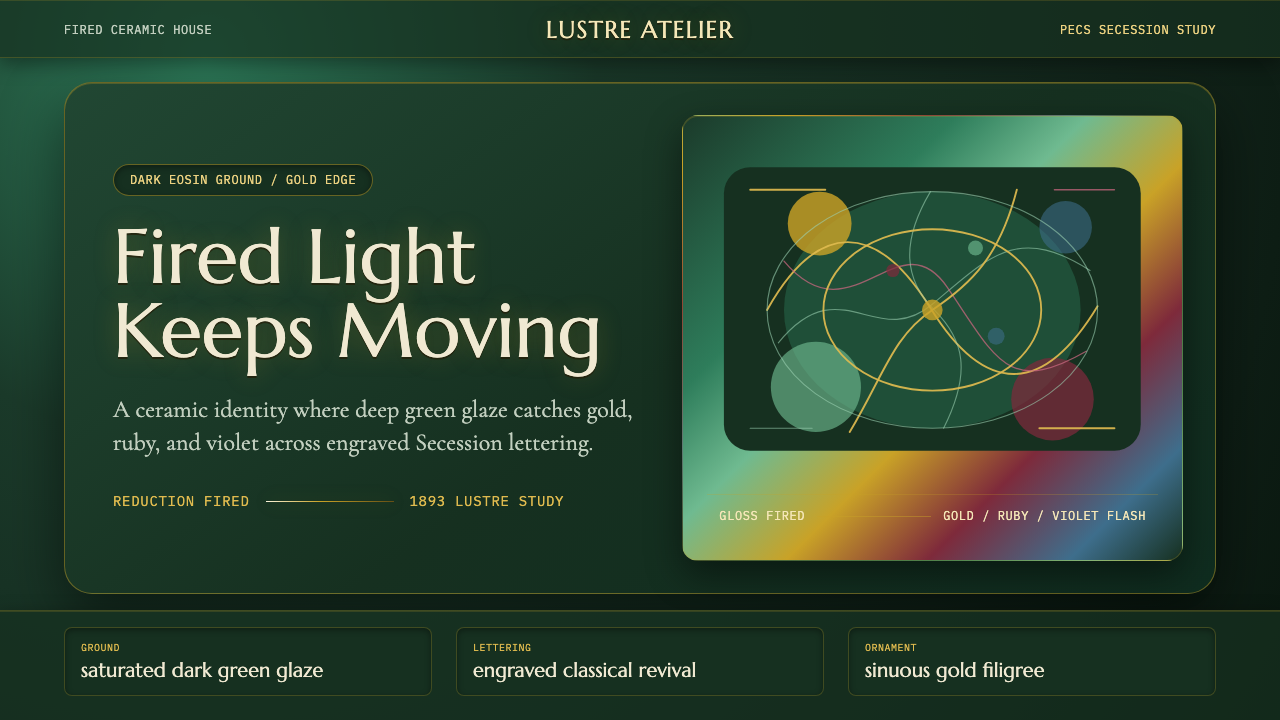 Zsolnay Eosin CeramicsGlaze becomes theater. Dark eosin green flashes gold, ruby, and violet throug…
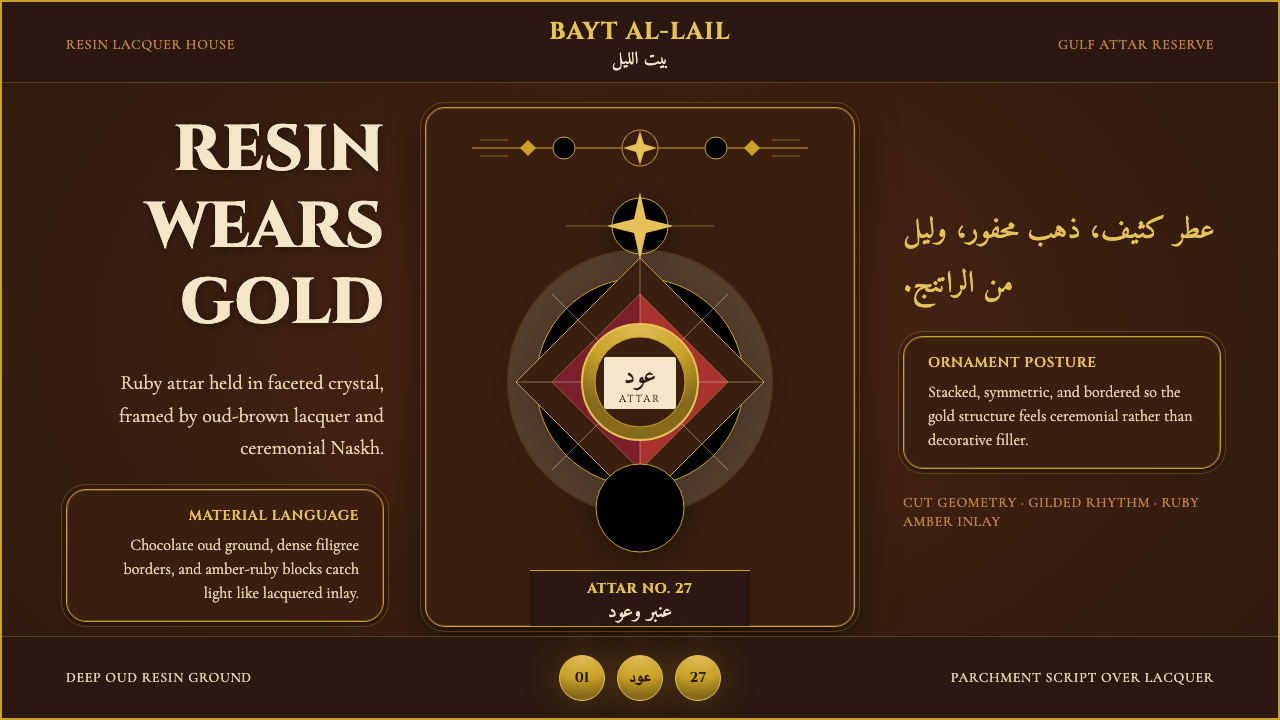 Arabian Oud Attar BottleResinous luxury, gilded. Chocolate oud lacquer frames Cinzel caps and ruby-am…