What is Georgian Pirosmani 1910?
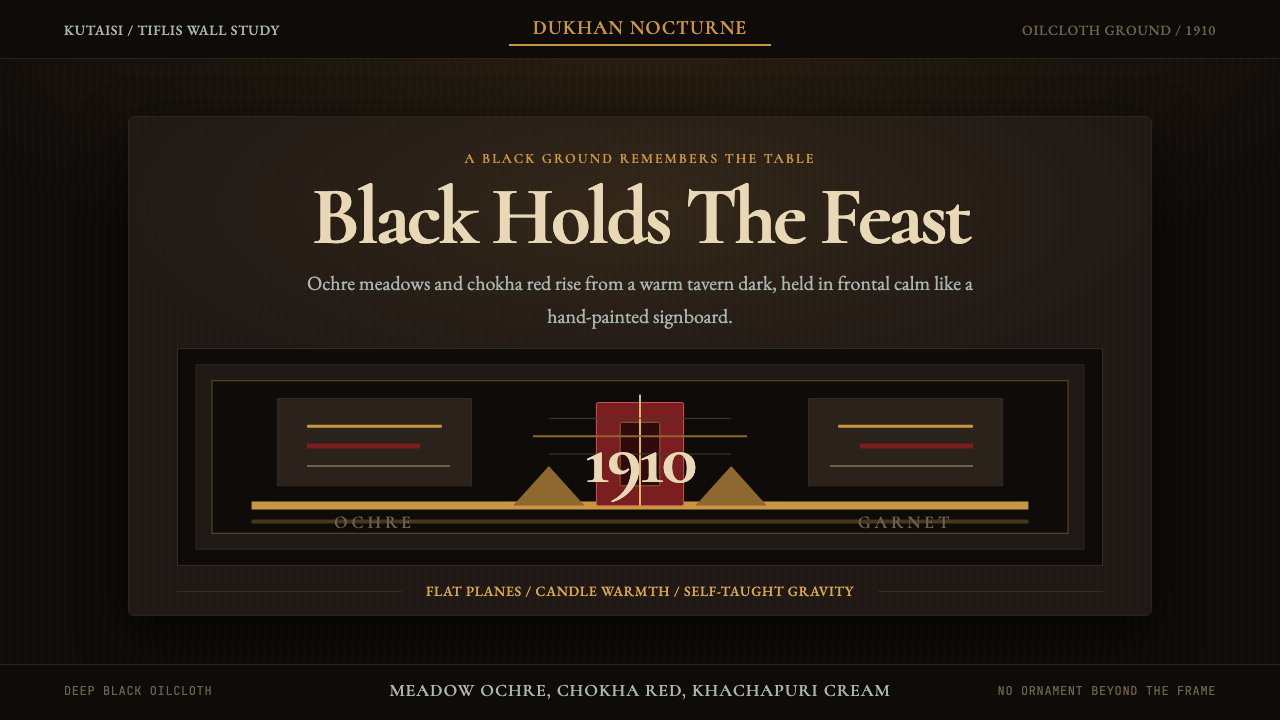
From the back walls of Tbilisi taverns, Niko Pirosmani painted a Georgia of stags, feasts, and candlelit warmth on black oilcloth — and left behind a visual language where darkness itself becomes sacred ground.
Georgian Pirosmani 1910 in brief
Georgian Pirosmani 1910 is a design system rooted in the signboard paintings of Niko Pirosmani, a self-taught Georgian artist who worked in Tbilisi at the turn of the twentieth century. Pirosmani painted tavern walls and merchant signs on black oilcloth — a cheap, durable surface that forced him to treat darkness as a positive material rather than an absence. The result was a visual tradition of luminous color planes emerging from deep black grounds, frontal and symmetrical compositions, and a spiritual gravity that owed more to Georgian icon-painting than to any European academy.
The system channels that tradition into a contemporary design vocabulary: oilcloth black as an infinite, absorptive background; meadow ochre and chokha red as the primary warmth tones that surface from the darkness; and serif type set with the measured weight of hand-lettered signboard inscriptions. Nothing in the palette competes for attention — each color is earned against the black ground the way a candle earns the dark around it.
What distinguishes this aesthetic from generic dark-mode design is its quality of restraint and ceremony. Pirosmani's paintings never feel dramatic for drama's sake; they feel solemn, like objects that know they will outlast their maker. The design system carries that solemnity forward — stillness rather than tension, warmth rather than excitement, and a flat frontal honesty that never performs depth it hasn't earned.
Where does Georgian Pirosmani 1910 come from?
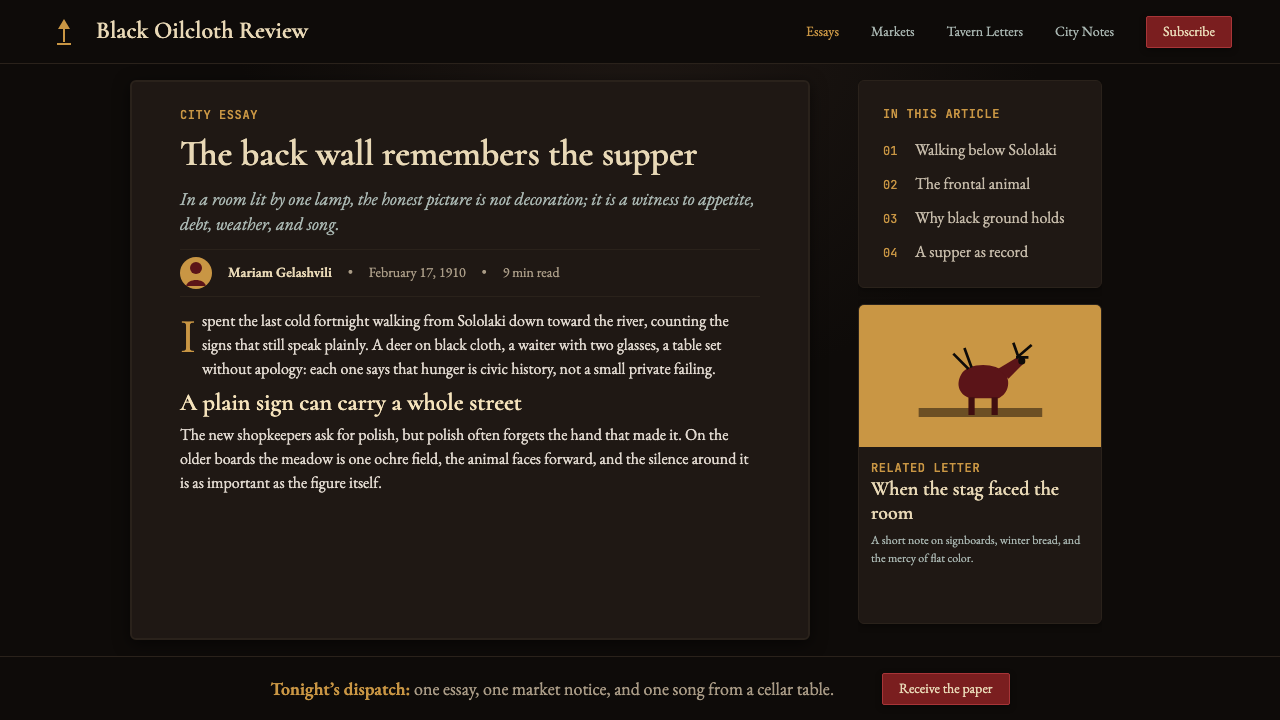
Niko Pirosmani was born around 1862 in Mirzaani, a village in the Kakheti wine region of eastern Georgia. He arrived in Tbilisi — then called Tiflis, a multilingual Caucasian city under Russian imperial administration — as a young man, and spent most of his adult life working as an itinerant signboard painter and occasional guest of the dukhan taverns whose walls he decorated. He traded paintings for meals and wine, sleeping in cellars and doorways, accumulating an extraordinary body of work while living in radical poverty.
The black oilcloth that defined his technique was not an artistic choice so much as a practical one: it was the cheapest available surface for outdoor signs, durable against rain and tavern smoke. But Pirosmani turned the constraint into a method. Working with house paints directly on black ground, he learned to build color not by mixing toward light but by laying warm tones against darkness — each ochre patch, each red field, each white highlight existed in relationship to the ground rather than against a neutral field. The effect was something between oil painting and illuminated manuscript: flat yet glowing, iconic yet intimate.
Pirosmani's subjects were the fauna and social life of Georgia: bears, deer, stags, and the famous Black Bear of the Georgian landscape; feasting scenes in dukhan taverns; portraits of merchants, fishermen, and the French actress Margarita de Sevres, for whom legend says he once filled a street with flowers. His compositions were almost always frontal, his animals alert and still, his humans posed with the grave dignity of folk icons. He borrowed the frontal symmetry of Georgian ecclesiastical painting without its theological program — producing images that felt sacred without making religious claims.
His rediscovery came through the Russian futurists. In 1912, the brothers Ilia and Kirill Zdanevich — then working in a circle of Moscow avant-garde artists — visited Tbilisi and encountered Pirosmani's work in situ, on tavern walls and shop fronts. They championed him in Moscow as an example of authentic primitive genius, organized an exhibition, and brought his name into the European avant-garde conversation. Pirosmani died in 1918, in poverty, before the recognition fully reached him — but the Zdanevich intervention ensured that his visual language survived as a conscious inheritance rather than disappearing with the dukhan culture that had sustained it.
What defines the Georgian Pirosmani 1910 look?
Ground Color
Oilcloth black is the absolute foundation: not a dark gray, not a textured blackboard, but a flat, light-absorbing black that reads as infinite depth. All other colors are understood as emergences from this ground, not placements on top of it. The black is never decorative — it is structural, the way night is structural to candlelight.
Warm Tone Palette
The foreground palette draws from the earthy warmth of Georgian landscape and folk dress: meadow ochre suggesting dried grasses and candlelight, chokha red evoking the traditional Georgian wool coat, and cream or warm ivory for figures and highlights. These tones work because they carry the specific warmth of oil-lamp and firelight — they glow rather than shine, radiate rather than reflect.
Frontal Composition
Subjects are presented face-on, with minimal foreshortening or perspectival recession. Animals face the viewer directly; figures stand with the alert stillness of folk icons. This frontality is not naivety — it is a deliberate compositional choice inherited from Georgian ecclesiastical painting, where the frontal gaze carries devotional weight. In design, it translates to centered or bilaterally symmetrical layouts with strong vertical axes.
Flat Color Planes
Color is applied in even, unmodulated fields — no blending, no soft gradients, no atmospheric haze. Each color area has a distinct boundary, creating shapes that feel cut and placed rather than painted and shaded. This flatness is not simplicity; it is a sophisticated choice that keeps each element visually sovereign, readable at a distance, and free from the distracting texture of surface variation.
Ceremonial Typography
Type in this system carries the measured gravity of hand-lettered signboard inscriptions. Serif letterforms are preferred — their bracketed strokes echo the deliberate hand of a painter who formed each letter as a discrete object. Weight is used for hierarchy, not for decoration; there is no casual type in this system. Even small labels carry a formality that treats every word as worth the space it occupies.
Austere Symmetry
The compositions are often symmetrical or near-symmetrical, but the symmetry is never mechanical. It has the quality of a handmade icon: almost perfectly balanced, with the small irregularities of a human hand rather than a geometric compass. This restrained symmetry produces a sense of solemnity without rigidity — the layout feels considered rather than computed.
Minimal Ornament
Decoration is sparse and purposeful. When borders or dividers appear, they are simple — a thin warm line, a narrow band of ochre — and they function as spatial organizers rather than embellishments. There are no flourishes, no filigree, no decorative fills. The restraint is not ascetic; it reflects the economy of a painter who worked fast, on cheap materials, for patrons who needed legible signs more than beautiful ones.

Who shaped Georgian Pirosmani 1910?
Pirosmani is the originating figure of this aesthetic tradition. Born in Mirzaani around 1862, he arrived in Tbilisi as a young man and spent his life painting tavern walls, merchant signs, and the animals and social scenes of Georgian life — trading his work for food and wine, living in poverty, accumulating an extraordinary body of paintings that were almost entirely unknown outside the Caucasus until the futurist rediscovery of 1912. His technique of building luminous color against black oilcloth ground, his frontal compositions, and his devotional gravity defined a visual language that was simultaneously naive and hieratic, local and universal.
Ilia Zdanevich and his brother Kirill visited Tbilisi in 1912 and encountered Pirosmani's work on tavern walls. Ilia, already connected to Russian futurist and primitivist circles in Moscow, immediately recognized the significance of what he saw and began championing Pirosmani within the avant-garde. He organized the first exhibition of Pirosmani's work in 1913 and wrote critically about him in terms that framed naive Georgian painting as a legitimate counterweight to European academicism. Without this intervention, Pirosmani's work might have dispersed and deteriorated with the buildings it occupied.
Kirill Zdanevich, a painter himself, traveled with his brother Ilia on the Tbilisi visit that led to Pirosmani's rediscovery. He was instrumental in the practical work of locating, documenting, and preserving Pirosmani's paintings — identifying which works still existed on tavern walls, persuading owners to allow the paintings to be studied, and beginning the archival process that would eventually make Pirosmani's legacy accessible. His painter's eye gave him insight into the technical specifics of Pirosmani's oilcloth method that Ilia's more literary approach sometimes missed.
Margarita de Sevres was a French actress who performed in Tbilisi in the early twentieth century and became the subject of one of Pirosmani's most celebrated portraits. According to Georgian legend, Pirosmani spent everything he had to fill the street outside her residence with flowers — a gesture of devotion that became one of the defining stories of his life and that underscores the intensity of feeling that ran beneath the surface of his seemingly simple paintings. Whether historically precise or embellished, the story captures something real about his relationship to his subjects: they were not merely observed but loved.
Though not a single individual, the Georgian ecclesiastical painting tradition — centered in the monasteries of Kakheti and Kartli from the early medieval period onward — is an essential figure in understanding Pirosmani's visual language. Georgian icons share with his work the frontal gaze, the gold-adjacent warm grounds, the hierarchical scale, and the gravity of a form that exists to be contemplated rather than merely seen. Pirosmani absorbed this tradition without religious intent, transposing its formal vocabulary into secular subjects — creating images that carry the weight of icons without their theological claims.
How do you use Georgian Pirosmani 1910 today?
Georgian Pirosmani 1910 is one of the few dark-ground historical styles that works for contemporary digital design without requiring heavy adaptation — because its darkness is already a material quality, not a mode inversion. The key principle when applying it is to treat black as ground, not as background: every element should appear to surface from depth rather than float in front of a dark panel. This distinction changes how you handle contrast, spacing, and the relationship between text and imagery.
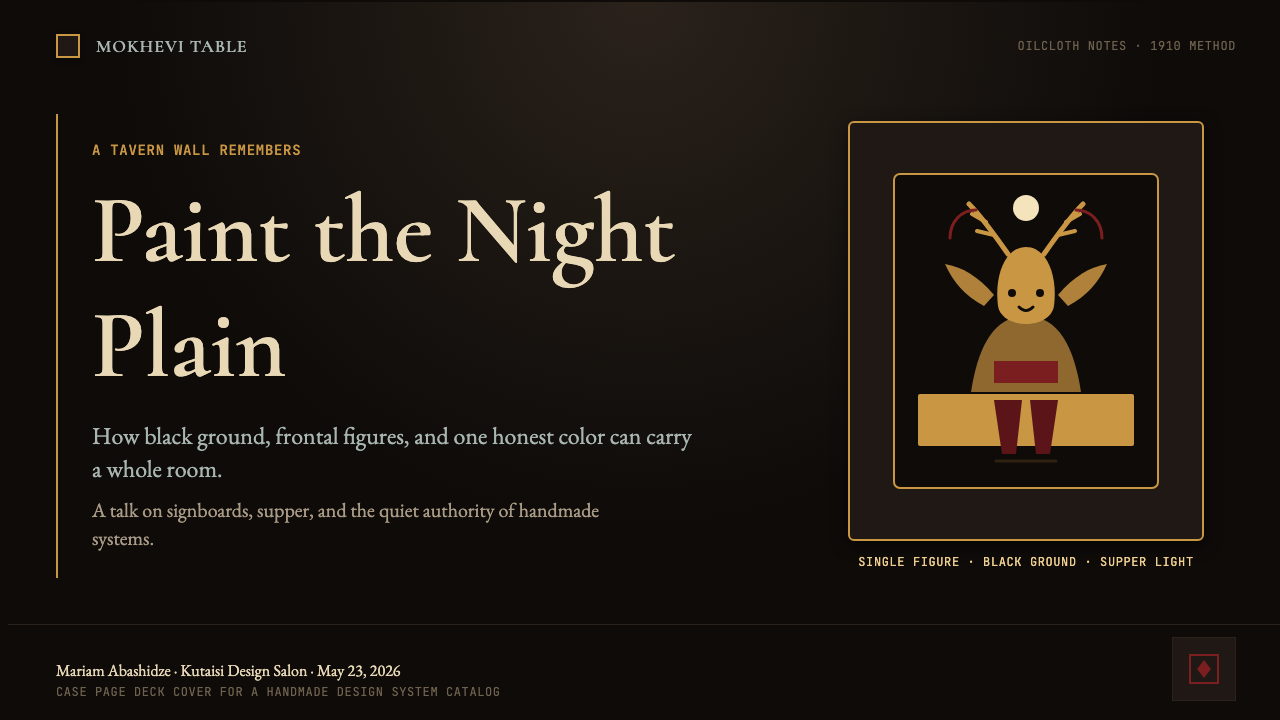
For presentation slides, the style works exceptionally well on cover slides and section dividers where ceremonial weight is an asset. A cover in this tradition places the title in warm-toned serif type against oilcloth black, with a single large illustrative element — an animal silhouette, a botanical form, a geometric field in ochre or deep red — set with the frontal symmetry of a tavern sign. Content slides should be treated with the same economy: generous dark ground, warm type, and a hierarchy defined by scale and weight rather than color variation. Data visualizations work best when bars and shapes are treated as flat color planes against the dark field — ochre for primary series, deep red for secondary, cream for labels.
For web interfaces and dashboards, this system is well-suited to editorial platforms, portfolio sites, arts institutions, and any product that wants the authority of darkness without the aggression of high-contrast tech aesthetics. The approach: commit fully to the dark ground, use warm serif type for headers and ochre or cream for body text, and reserve the deep red for interaction states or critical alerts. Card components should have soft, warm-toned borders or subtle warm glows rather than hard shadows — the depth here is painterly, not geometric. Navigation should be minimal and typographic.
For editorial and marketing work, the style carries a gravitas that suits cultural institutions, luxury goods, independent publishing, and any context where seriousness of purpose is a design value. A Georgian Pirosmani editorial layout uses the black ground as a full-page anchor, places pull quotes in ochre or cream at a scale that reads as a formal inscription, and treats images with the flatness of color planes rather than photographic naturalism. Marketing pages benefit from the poster-like quality of the tradition: a single strong focal image, a few words in weighted serif type, and the confidence of a layout that doesn't need to explain itself.
The most common mistake when applying this style is treating the warm palette as permission to be decorative. Pirosmani's paintings are austere — the warmth is structural, not ornamental. In design terms, this means resisting the temptation to add ochre texture overlays, decorative borders, or multiple warm accent colors simultaneously. One warm tone dominant, one in reserve, darkness everywhere else. A second common mistake is breaking the frontal principle with diagonal compositions or dynamic angles; the system's authority depends on stillness and symmetry. Introduce movement only where the content itself demands it, and never at the expense of the ground.
Georgian Pirosmani 1910 — FAQ
Is this style only suitable for dark-mode products?
The oilcloth black ground is central to the style's identity, so yes — this system is fundamentally a dark-ground aesthetic. A light-mode inversion is technically possible but would lose the defining quality: the sense that warm colors are emerging from depth rather than sitting on a surface. If you need a light-ground variant, you would essentially be working in a different tradition — perhaps a folk-art or icon-adjacent palette on cream — not Georgian Pirosmani 1910 proper. The darkness here is not a mode; it is the painting surface itself.
How does this style relate to other dark-ground historical aesthetics like Dutch Golden Age or Japanese lacquerware?
All three traditions use dark grounds to make warm tones luminous, but the mechanisms and effects differ significantly. Dutch Golden Age painting uses chiaroscuro — modeled lighting and three-dimensional depth — to produce drama. Japanese lacquerware uses the black surface as a luxury material, often with gold and highly refined surface detail. Georgian Pirosmani uses flat, unmodeled color planes on black in a way that is closer to Byzantine icon tradition than to either: no drama, no luxury signaling, no depth modeling — just the frontality and calm of a painter who trusted the ground to do its work. The design system inherits this flatness and frontality, distinguishing it from film-noir-influenced dark aesthetics or lacquer-luxury aesthetics.
Can this style work for data-heavy dashboards, or is it too ceremonial?
It can work, but it requires discipline. The ceremonial gravity of the style is an asset for single-metric displays, hero numbers, and status indicators where solemnity is appropriate. It becomes a liability in dense data grids where many competing elements need simultaneous differentiation. The warm palette — essentially ochre, deep red, and cream against black — limits the number of distinct color channels available for encoding data categories. If your dashboard has more than three or four data series requiring color differentiation, a richer palette would serve better. Where the style excels is in giving weight to the metrics that matter most: a single large number in warm type on a deep black ground communicates importance more effectively than a table of fine-print figures.
How do I avoid making this style look generic or goth rather than specifically Georgian?
The distinction lies in warmth, frontality, and restraint rather than in cultural markers. Generic dark aesthetics often rely on cool or neutral blacks, blue-tinged grays, angular dynamic compositions, and decorative flourishes — skull motifs, spiky borders, extreme contrast. Georgian Pirosmani's darkness is warm-adjacent: the black ground reads as earthy and absorptive, not cool and aggressive. The compositions are centered and still, not diagonal and kinetic. And the style is almost entirely free of surface decoration — no filigree, no ornamental borders. If your application maintains these three qualities — warm blackness, frontal stillness, bare surfaces — it will read as the painting tradition it draws from, not as a genre exercise.
What is the right way to handle imagery in this style — should photographs be avoided?
Photography is not prohibited, but it needs to be treated in a way consistent with the style's flatness. Naturalistic, full-color photographs with soft lighting and atmospheric depth will create visual dissonance against the flat, warm, dark-ground aesthetic. If photography is necessary, the right approaches are: high-contrast conversion that reduces tonal range to a few warm planes, heavy vignetting into deep black edges so the image fades into the ground rather than sitting in a frame, or duotone treatment using the ochre and black of the palette. Illustrative or graphic images — silhouettes, flat illustrations, stylized botanical or animal forms — work more naturally because they can share the system's commitment to flat color planes and frontal presentation.
Related design styles
 Jordanian Bedouin Black TentNight camp honesty. Goat-hair black, sadu crimson, brass lines.
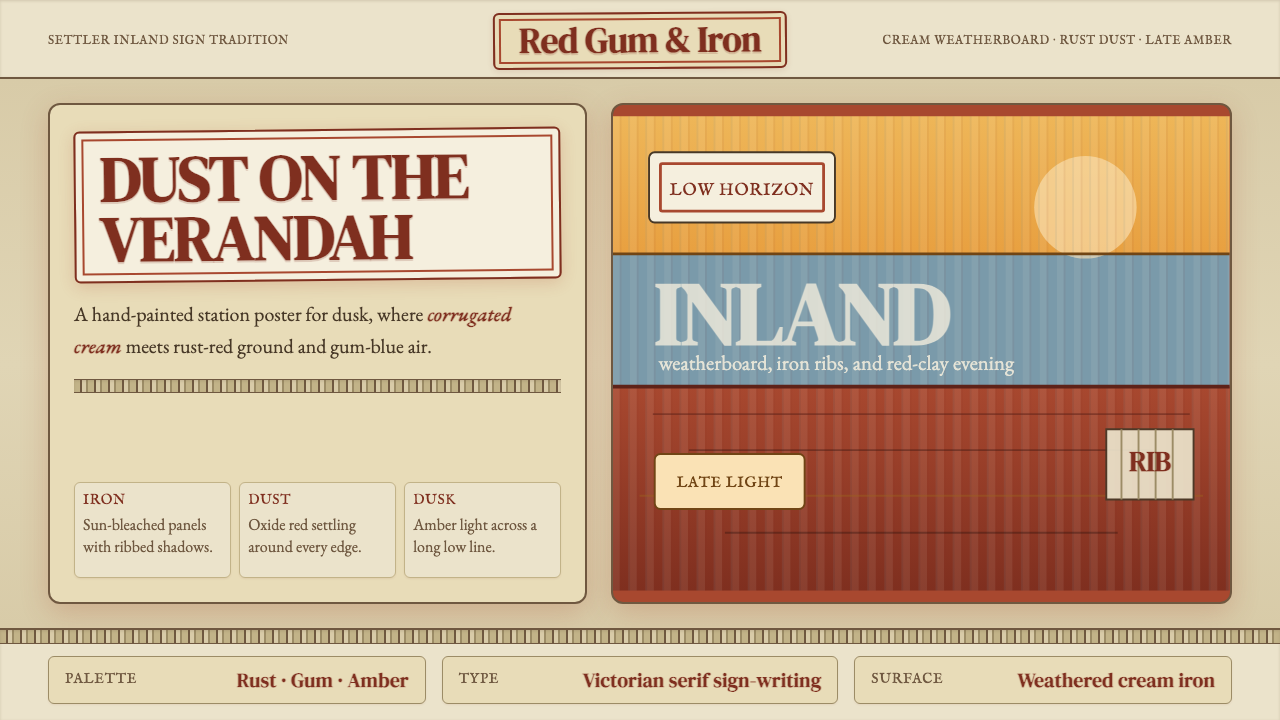 Australian Outback VernacularWeather is the voice. Rust dust, gum-blue bands, and serif sign-writing age t…
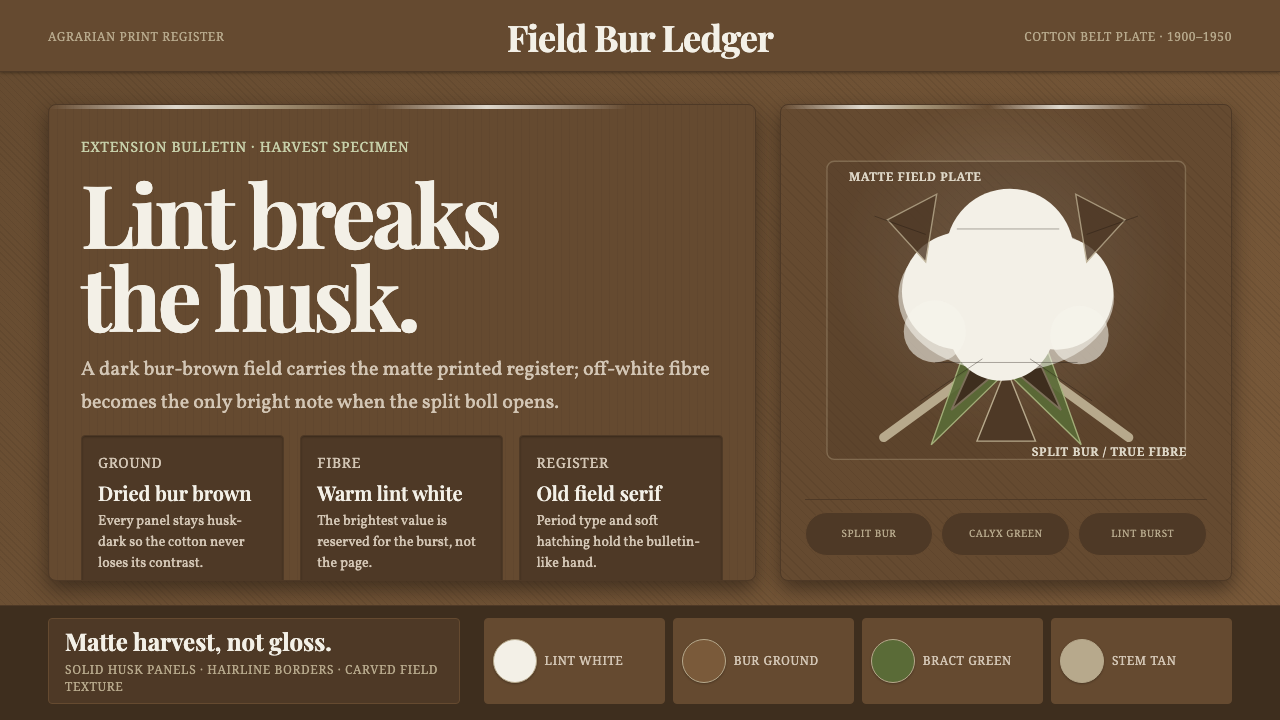 Cotton Boll HarvestHarvest contrast made matte. Off-white lint bursts from husk brown with field…
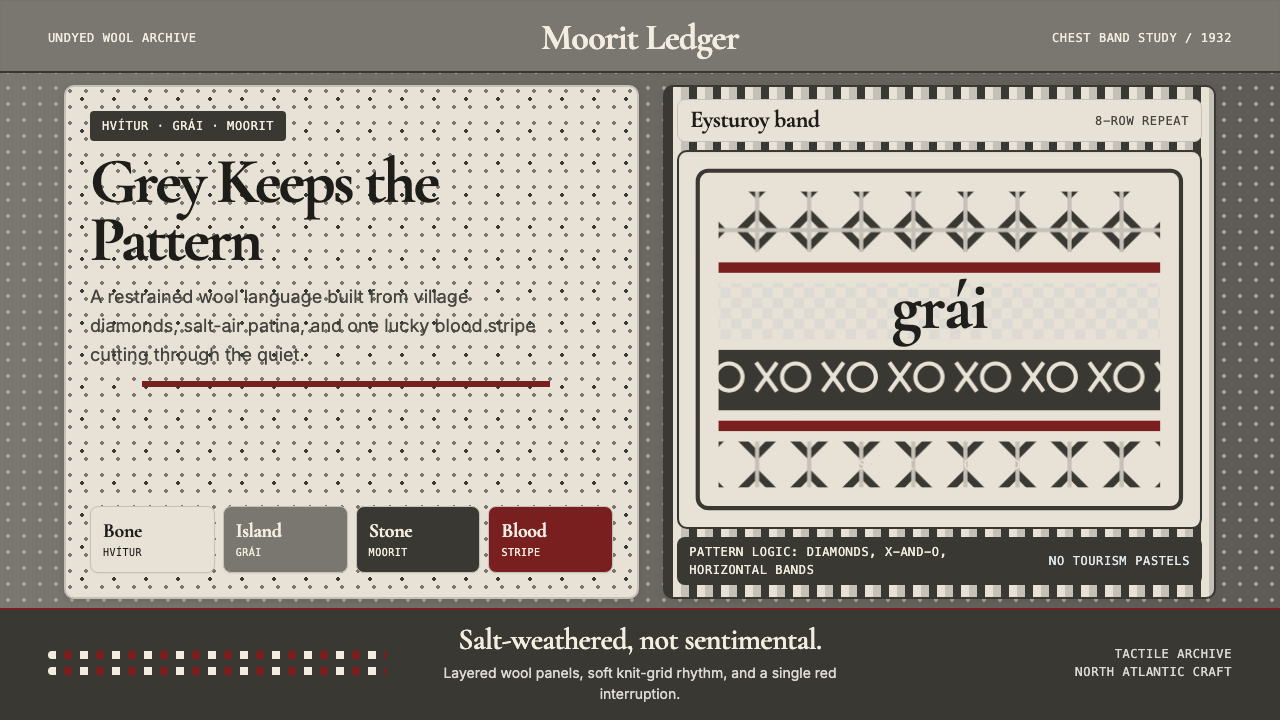 Faroese Knit Pattern Island GreyWeathered wool, not cozy kitsch. Island greys, Cormorant serif, one blood-red…
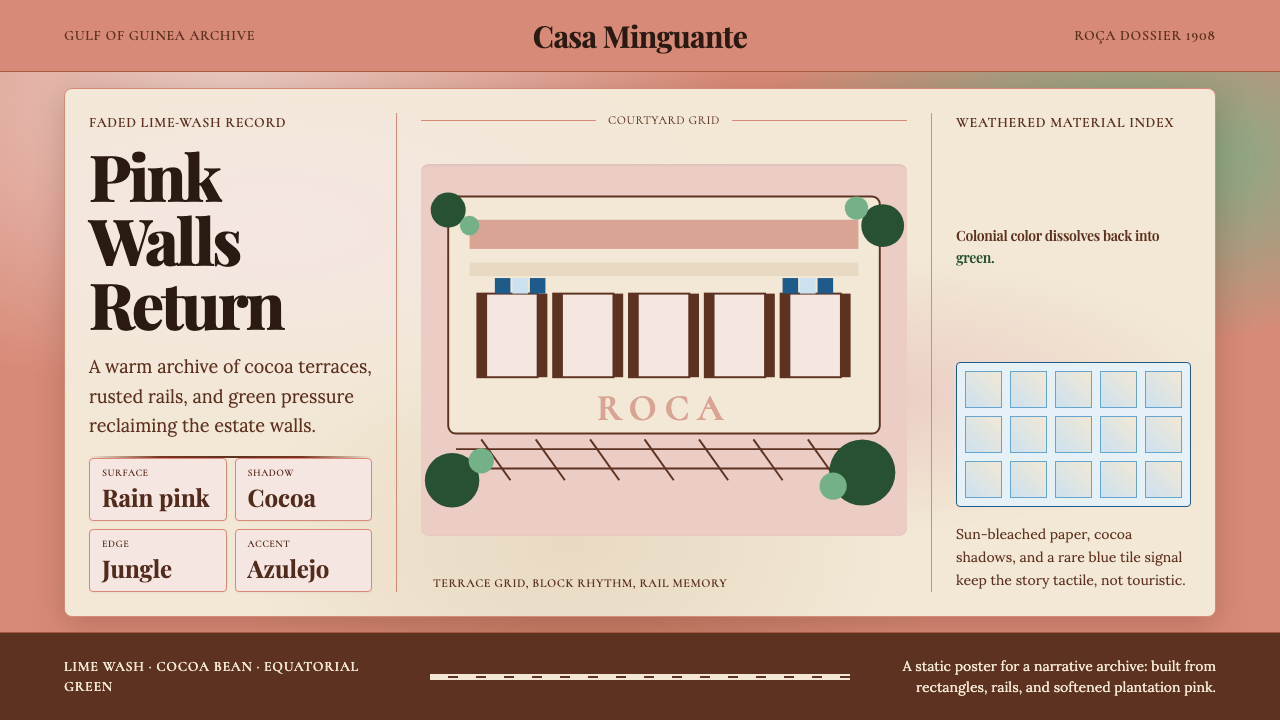 São Toméan Cocoa RoçaTropical ruin has weight. Faded pink, cocoa serif, and green edges frame the…
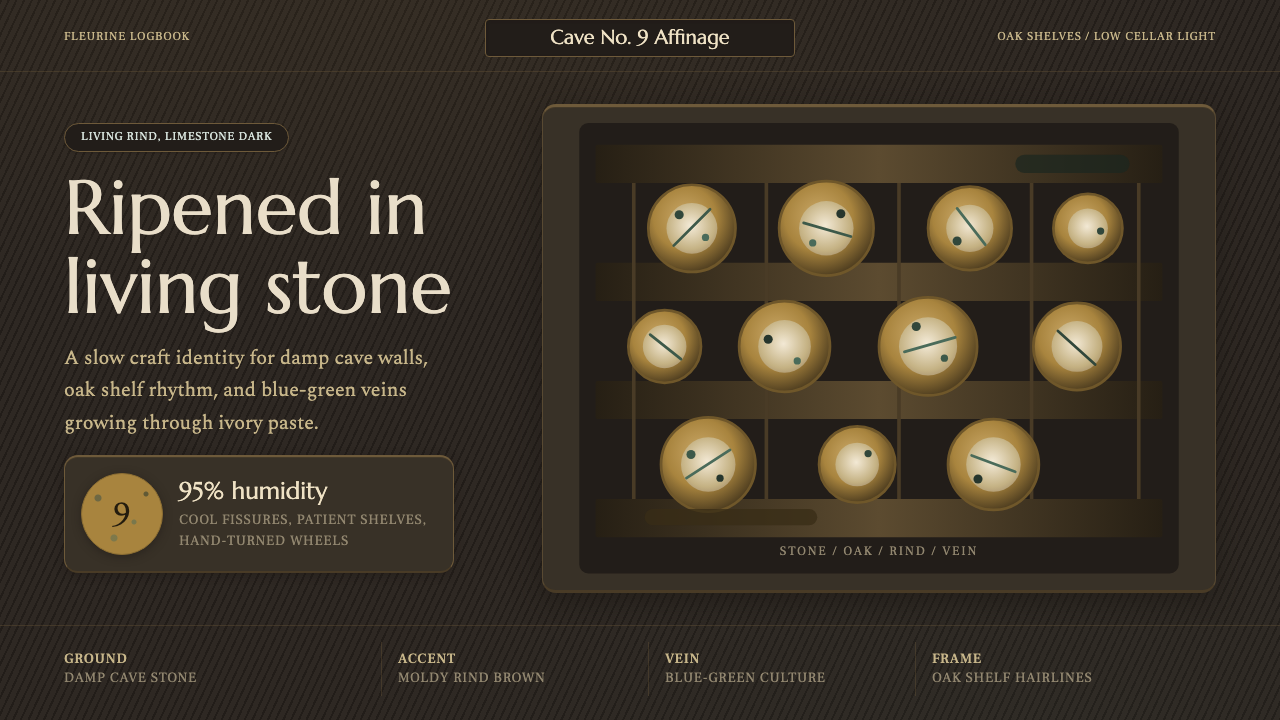 Cheese Affinage CavePatience reads as stone. Rind brown, mold green, and oak shelf grids glow in…