What is São Toméan Cocoa Roça?
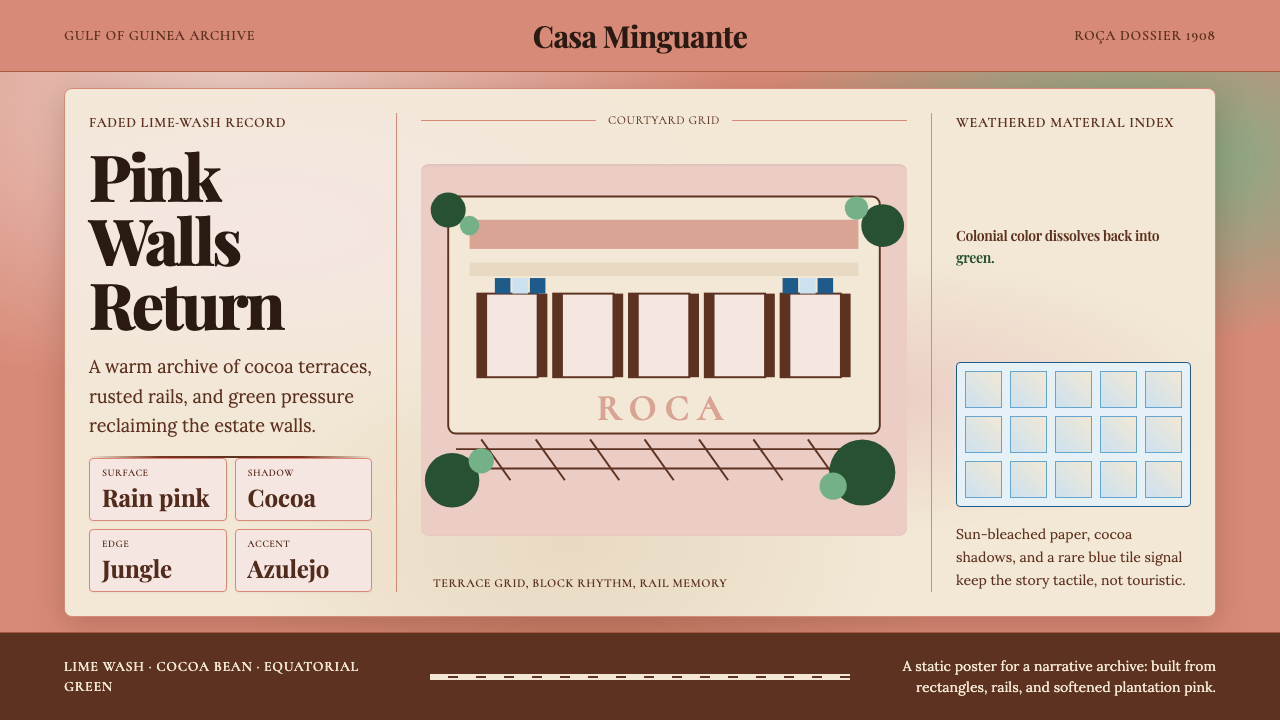
The roças of São Tomé let a tropical empire collapse back into the jungle, leaving behind a palette of faded pink walls, cocoa-brown shadows, and the persistent blue of Portuguese tile — a design system built on magnificent decay.
São Toméan Cocoa Roça in brief
São Toméan Cocoa Roça is a design aesthetic drawn from the plantation compounds — roças — that once powered the world's cocoa trade on the small equatorial island of São Tomé. These were not modest farmsteads. At their peak in the early twentieth century, the roças were self-contained colonial worlds: vast casarões with lime-washed walls in faded terracotta and rust-pink, cobbled terraces where cocoa pods dried in the sun, iron-rail tracks running through the jungle canopy, and chapels whose walls still hold fragments of Portuguese azulejo tile. The aesthetic captures the visual register of those compounds as they exist today — caught between their colonial past and an ongoing, generative decay.
What distinguishes this style from conventional tropical or colonial pastiche is its commitment to material honesty. The palette is not the bright pink of a restored heritage building; it is the pink of a wall that has been rained on for decades, where the lime wash has lifted and the color beneath has muted. The brown is not chocolate-box warmth but the specific darkness of fermented cocoa in shadow. The blue is not decorative accent but survivor — a fragment of glazed tile that outlasted the plaster around it. Every color in this system carries the memory of weathering.
The result is a visual language that feels simultaneously historic and contemporary: architectural in its weight, botanical in its softness, and quietly melancholic in its acceptance that beautiful things deteriorate. It is well-suited to brands and projects that want depth without drama — warmth without sentimentality, authority without formality.
Where does São Toméan Cocoa Roça come from?
São Tomé and Príncipe, a two-island nation in the Gulf of Guinea roughly three hundred kilometers off the coast of Gabon, was uninhabited when Portuguese navigators arrived around 1470. By the sixteenth century it had become a critical node in the Atlantic slave trade, serving as a transit point for enslaved people moving from the African mainland to Brazil. The island's equatorial climate and volcanic soil proved ideal for sugar cultivation, and later — with devastating historical symmetry — for cocoa.
The roças themselves were established in the nineteenth century and expanded dramatically during what historians call the cocoa boom years, roughly 1880 to 1908. At the peak of production, São Tomé was the world's largest cocoa exporter. The plantation compounds were built to function as complete colonial settlements: the casarão at the center, housing the estate owner or manager, surrounded by worker quarters, processing facilities, chapels, and schools. The Marquês de Valle Flor was among the most powerful of the plantation lords, controlling vast acreage and a labor force brought under conditions of debt bondage from other Portuguese colonies. The architecture of this period — substantial, Pombaline in influence, adapted for the tropics with wide verandas and high ceilings — gives the aesthetic its structural DNA.
The Cadbury boycott of 1909, triggered by investigative journalism exposing forced labor on the islands, began the slow commercial decline of the São Toméan roça system. Independence in 1975 hastened that decline: the newly formed Democratic Republic of São Tomé and Príncipe nationalized the plantations, many estate owners departed, and the compounds transitioned into managed disrepair. Some housed the families of former workers; others were simply left. The jungle began its reclamation. This is the visual moment the aesthetic captures — not the active plantation, but the compound in its second life, where colonial architecture and equatorial nature negotiate their borders.
Contemporary engagement with the roça aesthetic has come primarily through photographers, architects, and writers rather than through a design school or movement. Photographer Stan Engelbrecht has documented the compounds extensively, producing images that show the specific chromatic quality of the decay: the way lime wash creates a dusty pink that reads differently from any manufactured paint, the way rust bleeds through iron fixtures into surrounding plaster, the way chapels still feel occupied by the tiles that remain on their walls. Architect João Carrilho da Graça has engaged with Portuguese colonial heritage in a way that treats existing material culture as a generative resource rather than a problem to be solved. Poet Conceição Lima, the island's most prominent literary voice, has written about the roças as sites of memory — places where colonial violence and human endurance coexist in the same crumbling courtyard. These perspectives together constitute the intellectual atmosphere from which the design aesthetic draws.
What defines the São Toméan Cocoa Roça look?
Color: Weathered Tropical Palette
The palette is built on three dominant tones in deliberate dialogue: a faded lime-wash pink that reads as warm and dusty rather than bright or festive; a deep cocoa brown that ranges from the color of dried cocoa husks to the near-black of fermented beans in shadow; and a clear, slightly aged Portuguese blue derived from azulejo tile, carrying the specific quality of a glaze rather than a paint. A botanical green appears at the edges — the green of encroaching jungle rather than carefully tended foliage — soft, slightly yellowed, suggesting humidity and growth. These tones are muted across the board; none competes for attention at maximum saturation. The system rewards restraint: the most evocative combinations pair just two of these tones, using the third only as a trace.
Texture: Visible Material History
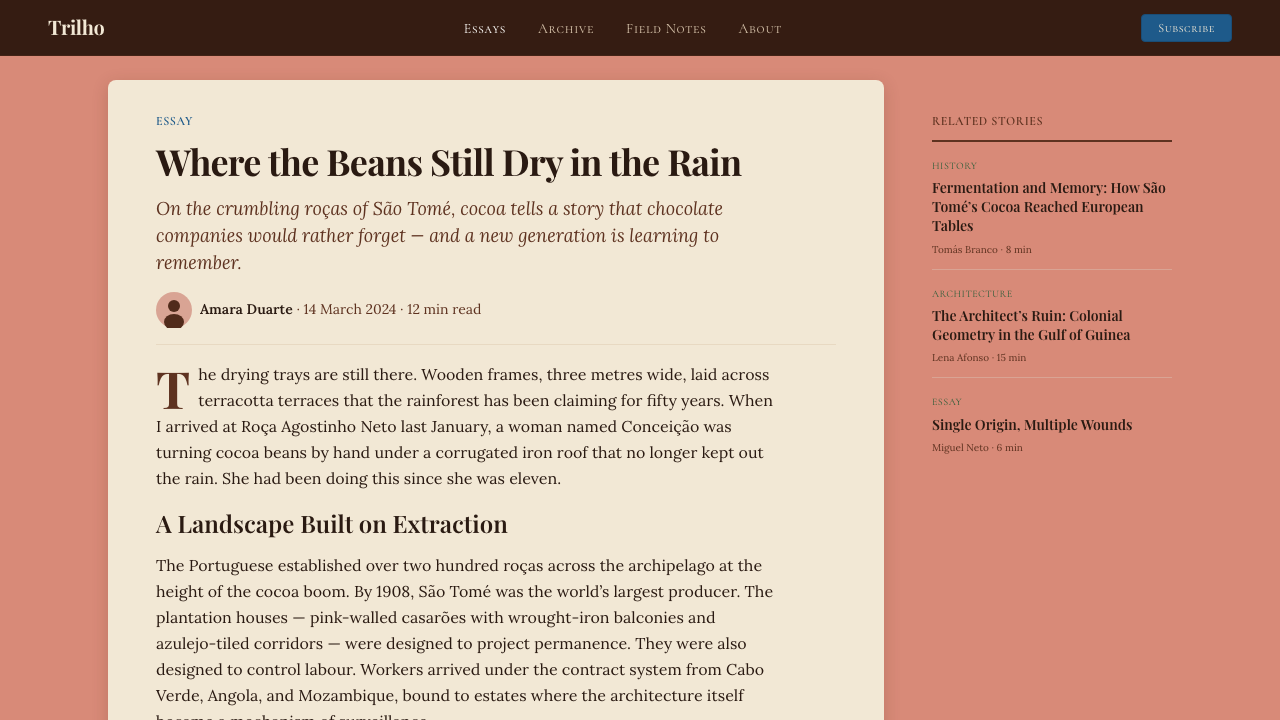
Unlike design systems that aim for flatness or gloss, this aesthetic celebrates evidence of time. Surfaces in this system should read as having been through something — not artificially distressed, but carrying the kind of subtle irregularity that comes from real weathering. This might manifest as a slightly uneven wash in a background field, a paper stock with tooth, or a print treatment that allows the substrate to show through color. The goal is texture that references material without simulating it clumsily. In digital contexts, this means favoring matte surface treatments and restrained use of effects, letting natural variation in photography carry the textural weight rather than applying artificial grain or overlays.
Typography: Serif with Colonial Weight
The typographic register of this style leans toward traditional serif letterforms — not the hairline serifs of fashionable editorial revival, but the sturdier, more humanist serifs associated with colonial-era printing and Portuguese administrative documents: letterforms with visible calligraphic origin and confident stroke contrast. Headlines can be set large and with generous leading, allowing the letters to breathe within the humidity of the overall palette. Body text works best at a modest size with a relaxed line rhythm. All-caps settings in a slightly compressed serif add an archival, documentary quality appropriate to the source material. Hierarchy should be established through weight and size rather than through decorative separation.
Composition: Asymmetric but Grounded
Layouts in this style favor asymmetric balance — not the dynamic tension of constructivist work, but a quieter stability, as if elements have settled into their positions over time. A wide margin might hold a caption or secondary element while the primary content occupies a narrower column; an image might bleed off one edge while generous white space holds the opposite side. The underlying logic is architectural: rooms have walls, doorways, and thresholds, and compositions should imply similar spatial divisions without gridding the page into clinical rigidity. Generous breathing room between elements prevents the palette's richness from feeling crowded.
Imagery: Documentary and Botanical
Photography and illustration in this system draw from two traditions: the documentary photographic legacy of recording colonial and post-colonial spaces — images that value the specific detail of a corrugated iron roof, a mossy brick threshold, or a painted wall with layers of different colors visible at its crumbling edge — and the tradition of botanical illustration, with its careful rendering of plant structure, leaf venation, and the geometry of a cocoa pod. These two modes share a quality of close attention. Imagery should never feel staged or commercial; it should feel observed. Color photography works best when its tones naturally align with the palette — heavily saturated fashion imagery will fight rather than support the system.
Negative Space: Generous and Unforced
This aesthetic does not rush. Negative space is used generously — not as a luxury signal in the contemporary minimalist sense, but as something closer to the silence inside a large, mostly empty room. The scale of open areas should feel proportional to the weight of the architectural and chromatic elements: a deep cocoa-brown headline needs room around it, not because of design convention, but because the color itself has mass. Crowded layouts undermine the melancholic spaciousness that is central to the aesthetic's emotional character.
Detail: Archival and Specific
Where other styles avoid clutter by eliminating detail, this one earns its spareness through the specificity of what detail it does include. A thin rule that references the iron rail lines of the original roças, a decorative motif derived from azulejo tile geometry, a caption set in a compressed serif that echoes the administrative typesetting of a colonial record — each such detail should be traceable to its source in the material culture of São Tomé. Arbitrary decoration is inconsistent with the aesthetic; historically grounded detail, used with restraint, reinforces it.
Who shaped São Toméan Cocoa Roça?
Among the most powerful of the great roça owners, the Marquês de Valle Flor controlled some of the island's largest plantation compounds at the height of the cocoa boom in the early twentieth century. His operations exemplify the scale and architectural ambition of the roça system at its peak: centralized casarões, industrial processing infrastructure, and a labor force drawn from other Portuguese colonies under conditions that attracted international scrutiny. The physical legacy of estates associated with this scale of operation — their proportions, their materials, their spatial organization — forms much of the architectural basis of the aesthetic.
São Tomé's foremost poet, Conceição Lima has written extensively about the island's history, its roças, and the layered experience of post-colonial identity. Her work approaches the plantation landscape as a site of memory and ambivalence — not celebrating it, not erasing it, but inhabiting it with the specificity of someone who knows the smell of a particular room and the weight of a particular silence. This literary sensibility — attentive, historically grounded, unwilling to resolve complexity into easy emotion — is the closest intellectual parallel to what the design aesthetic is attempting.
South African photographer Stan Engelbrecht has made extensive documentary work across the roças of São Tomé, producing images that reveal the specific chromatic and textural qualities that the aesthetic attempts to transpose into design language. His photographs are notable for their attention to the particular: the way tropical light falls differently on lime-washed pink than on painted plaster, the gradations within a single wall as its surface weathers unevenly, the visual coexistence of Portuguese tile and equatorial plant growth. His documentary method — close attention without sentimentality — is a model for how imagery in this aesthetic should be selected and used.
Portuguese architect João Carrilho da Graça has worked at the intersection of contemporary architecture and Portuguese colonial heritage in ways that directly inform this aesthetic's relationship to its source material. Rather than treating colonial-era structures as either monuments to be preserved unchanged or problems to be demolished, his approach engages with existing material — existing walls, existing proportions, existing materials — as generative constraints. This attitude of material respect without nostalgia, of working with existing cultural residue rather than against it, is fundamental to the São Toméan Cocoa Roça design ethos.
How do you use São Toméan Cocoa Roça today?
São Toméan Cocoa Roça is one of the more distinctive historical aesthetics available to contemporary designers precisely because it is not widely deployed. Its visual register — muted tropical tones, material texture, serif type with documentary authority — occupies a space that neither mainstream minimalism nor maximalist heritage revivalism covers well. Applying it well requires genuinely engaging with its source material rather than simply borrowing its color palette.
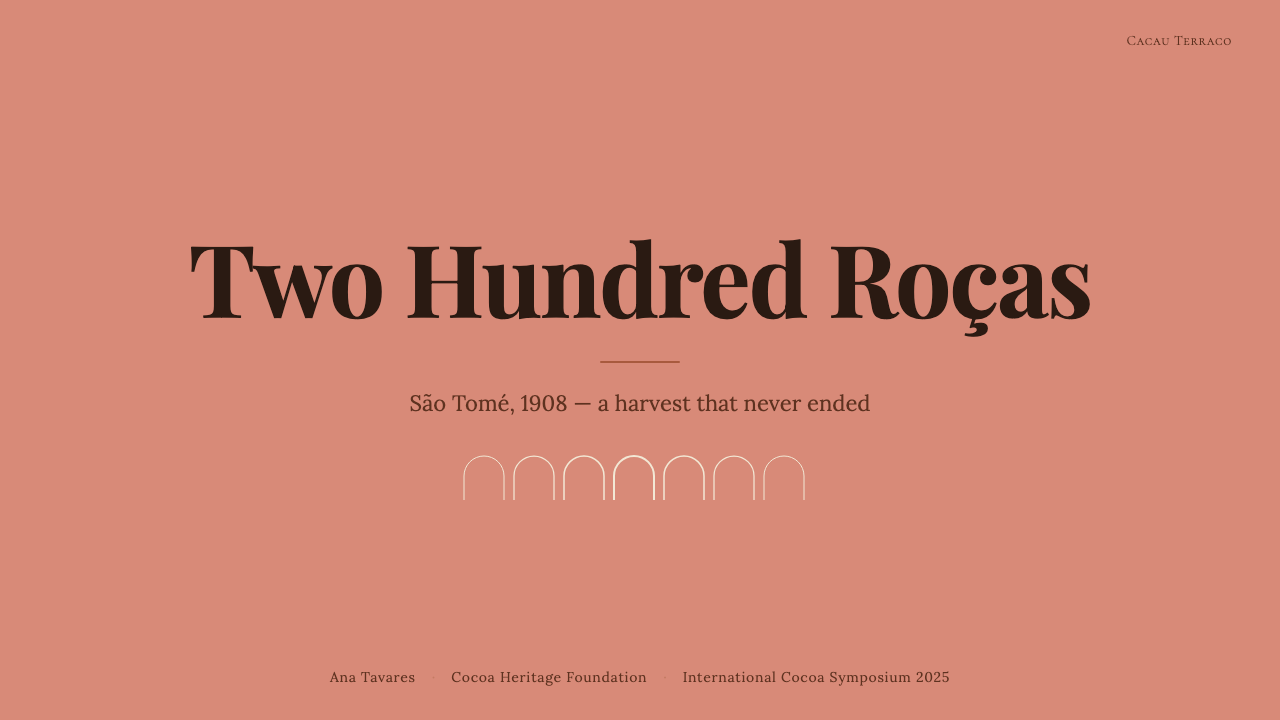
For presentation slides, the aesthetic works particularly well on covers and transitional pages where atmospheric impact matters. A cover using this system might pair the cocoa-brown as a dominant field with a faded pink headline set in a sturdy serif, with a botanical detail or fragment of tile geometry in the corner — sparse, weighted, immediately distinctive. Content slides benefit from its typographic logic: a clear hierarchy established through serif size and weight, generous margins used as holding areas for annotations or secondary information, and data elements treated with the same documentary restraint as the overall composition. Avoid filling slides densely; this is a system that needs room to register.
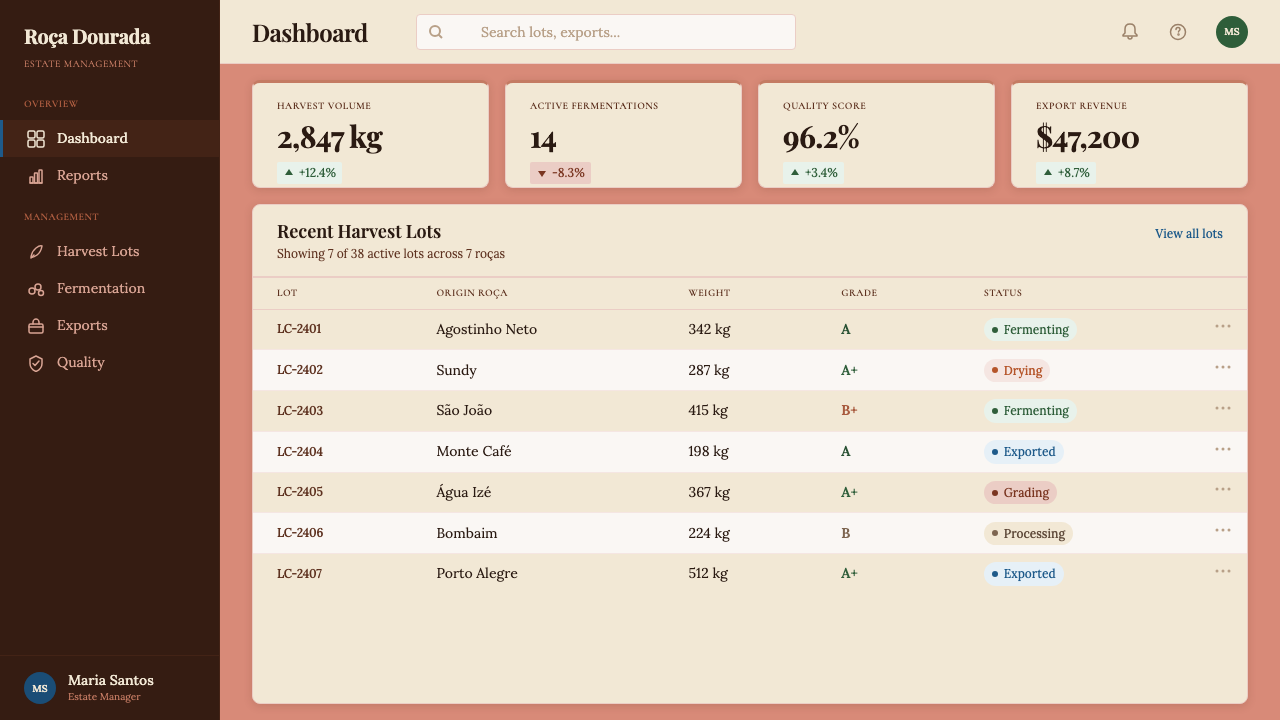
For web interfaces, the palette and texture approach are well suited to editorial sites, cultural institution pages, specialty food and beverage brands, and heritage-oriented projects where the product's provenance is part of its value proposition. Dashboard and product UI applications are possible but require careful adaptation: the muted palette works well against white or near-white backgrounds for data-heavy contexts, with the deeper cocoa tones reserved for navigation or structural framing rather than data encoding. Pricing pages can use the architectural composition logic — wide margins, strong typographic hierarchy, no decorative clutter — to great effect. The main risk in digital contexts is that the subtle texture register that makes physical or photographic applications of this style compelling can disappear entirely on screen; compensate by ensuring that photography and illustration carry sufficient textural weight.
For editorial and marketing work, the style excels in contexts where the brand needs to communicate craft, provenance, and depth without resorting to the clichés of luxury design. A magazine layout in this aesthetic uses a generous text measure in a humanist serif, with images that feel observed rather than produced, and section headings that reference archival typographic conventions. Marketing collateral — posters, packaging, event materials — benefits from the style's poster-like quality when color and scale are used decisively: a single cocoa-brown field behind cream type, a botanical diagram used as structural background, azulejo-blue used sparingly as the one element that holds the eye.
A common mistake when applying this aesthetic is reaching for the palette while ignoring the material logic behind it. Dropping the faded pink and cocoa brown into an otherwise conventional clean sans-serif tech layout produces pastiche rather than coherence — the colors signal one thing while the typography and composition signal another. Similarly, artificially distressing elements in an attempt to simulate weathered texture tends to read as contrived. This is an aesthetic that rewards working with genuinely textured photography and with typefaces that have real calligraphic weight; the system should feel earned rather than costumed.
São Toméan Cocoa Roça — FAQ
Is this style too niche or regionally specific to apply broadly?
The geographic specificity is actually what gives the style its coherence and distinctiveness — it is not trying to evoke a generic tropical mood but a very particular kind of place. That said, the visual system's core qualities (muted warm palette, material texture, serif typography, documentary restraint) are fully transferable to projects with no connection to São Tomé. What matters is whether the aesthetic's values — depth, provenance, the beauty of impermanence — align with the project's values. Specialty food and beverage brands, cultural institutions, heritage tourism, editorial publishing, and independent creative practices are all natural fits regardless of geography.
How does this style differ from other colonial or tropical heritage aesthetics?
Most tropical heritage aesthetics in design gravitate toward either the festive (bright saturated colors, bold patterns, celebratory energy) or the nostalgic (polished restoration, colonial elegance presented without critical distance). São Toméan Cocoa Roça occupies neither position. It engages with the colonial legacy of the roças without celebrating or sanitizing it — the muted palette, the evidence of decay, the archival typographic register all insist on history as something present and complex rather than picturesque. This makes it unusual among heritage-adjacent styles: it is atmospheric without being romantic, specific without being precious.
Can this style work in a dark-background or high-contrast layout?
With care. The canonical expression of this palette is light-ground — the lime-wash pink and cream tones are most legible and most evocative against a white or very light neutral. A dark inversion is possible: the deep cocoa brown can serve as a background, with the faded pink or azulejo blue used as the primary light tones above it, and cream or warm white for body text. However, the botanical green and the archival texture qualities that define the style can be difficult to maintain at high contrast. A dark version of this system tends to work better in print or photographic contexts than in digital UI, where the subtlety of the muted palette can collapse into simple dark mode.
What kinds of projects should avoid this style?
Projects that need to communicate urgency, technical precision, or contemporary dynamism will struggle with this aesthetic — the muted palette and documentary quietness that make it distinctive will work against those values. Consumer technology products, fintech dashboards, gaming interfaces, and high-energy entertainment brands all sit poorly with this system's emotional register. Similarly, brands targeting audiences who read the decayed aesthetic as neglect rather than as intentional depth should look elsewhere. The style requires an audience with enough visual literacy to recognize that the muted tones and archival references are choices, not defaults.
How should AI tools work with this design system?
This system gives AI image generation and layout tools unusually specific art direction through its palette and textural logic. For image generation, prompting toward the specific chromatic qualities — lime-wash pink, cocoa-fermentation brown, azulejo blue, equatorial botanical green — and toward the documentary photographic tradition (high-contrast, observed rather than staged, attentive to architectural and botanical detail) will produce more useful outputs than prompting toward generic tropical or colonial moods. For layout and content AI, the typographic register — sturdy humanist serif, generous white space, documentary restraint — provides clear decision parameters. The most important directive for any AI tool working with this system is to resist the temptation toward legibility through brightness or saturation; the depth of the system lives in its refusal to be immediately striking.
Related design styles
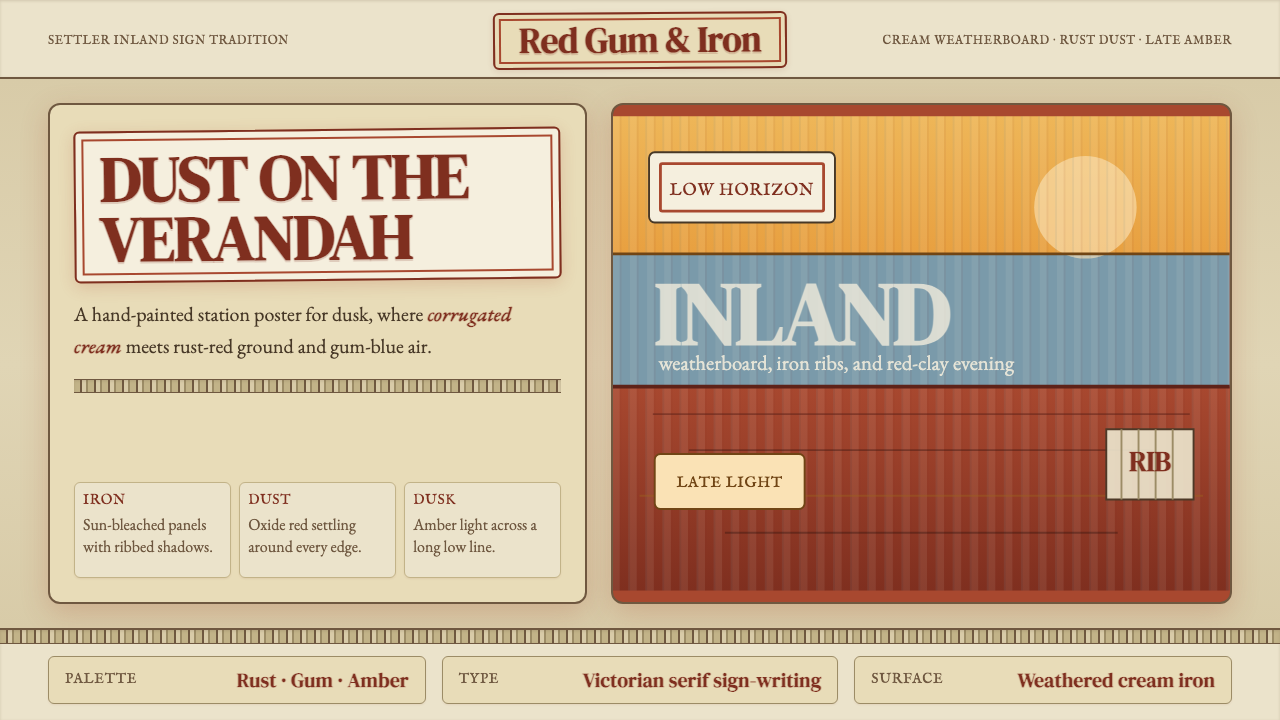 Australian Outback VernacularWeather is the voice. Rust dust, gum-blue bands, and serif sign-writing age t…
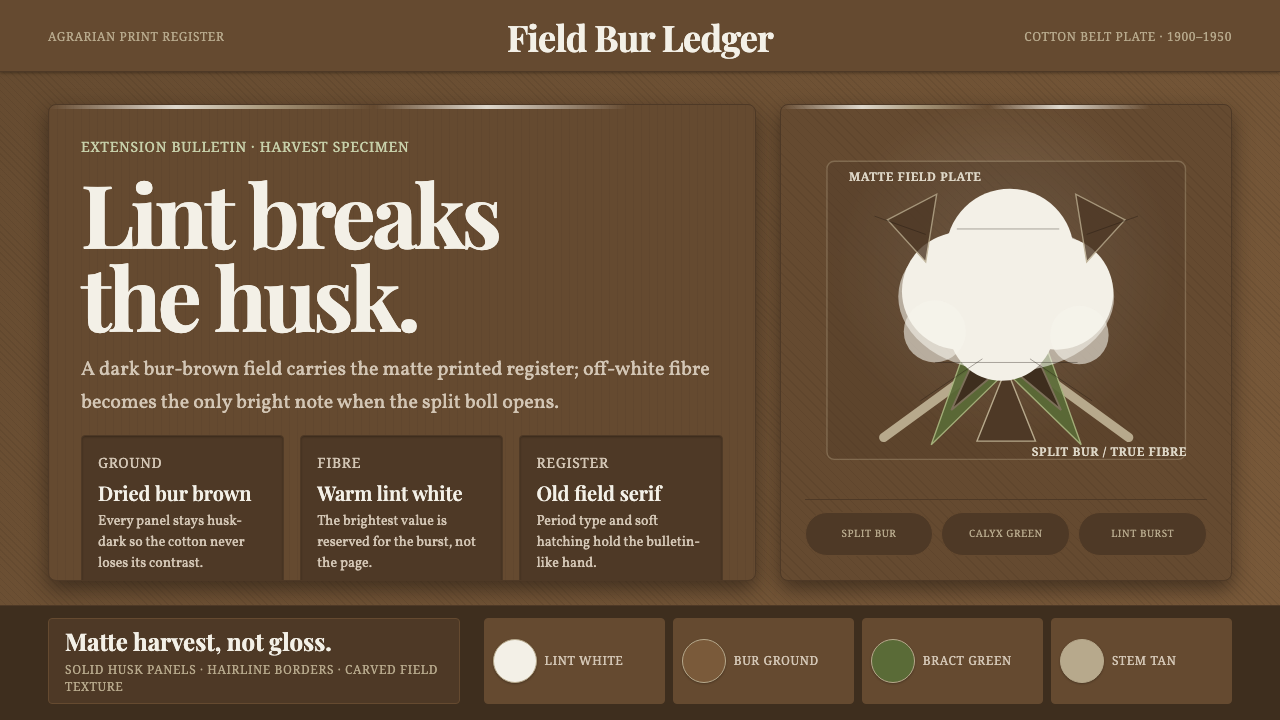 Cotton Boll HarvestHarvest contrast made matte. Off-white lint bursts from husk brown with field…
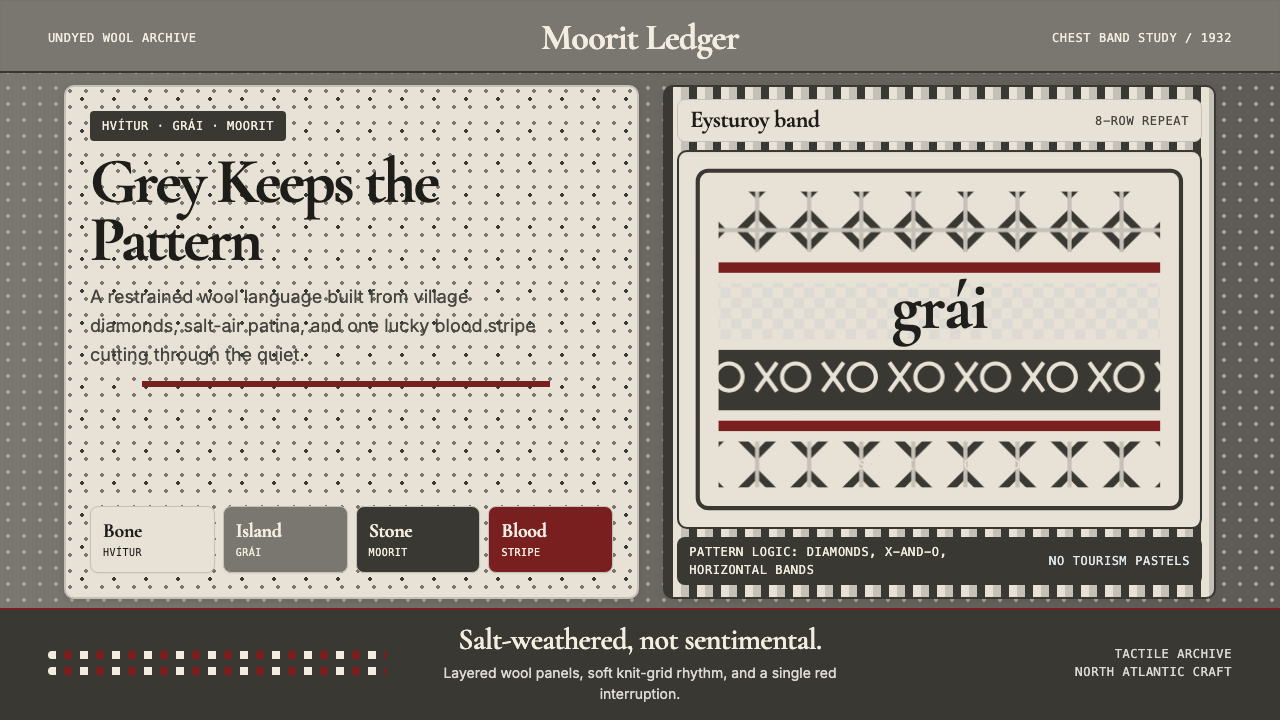 Faroese Knit Pattern Island GreyWeathered wool, not cozy kitsch. Island greys, Cormorant serif, one blood-red…
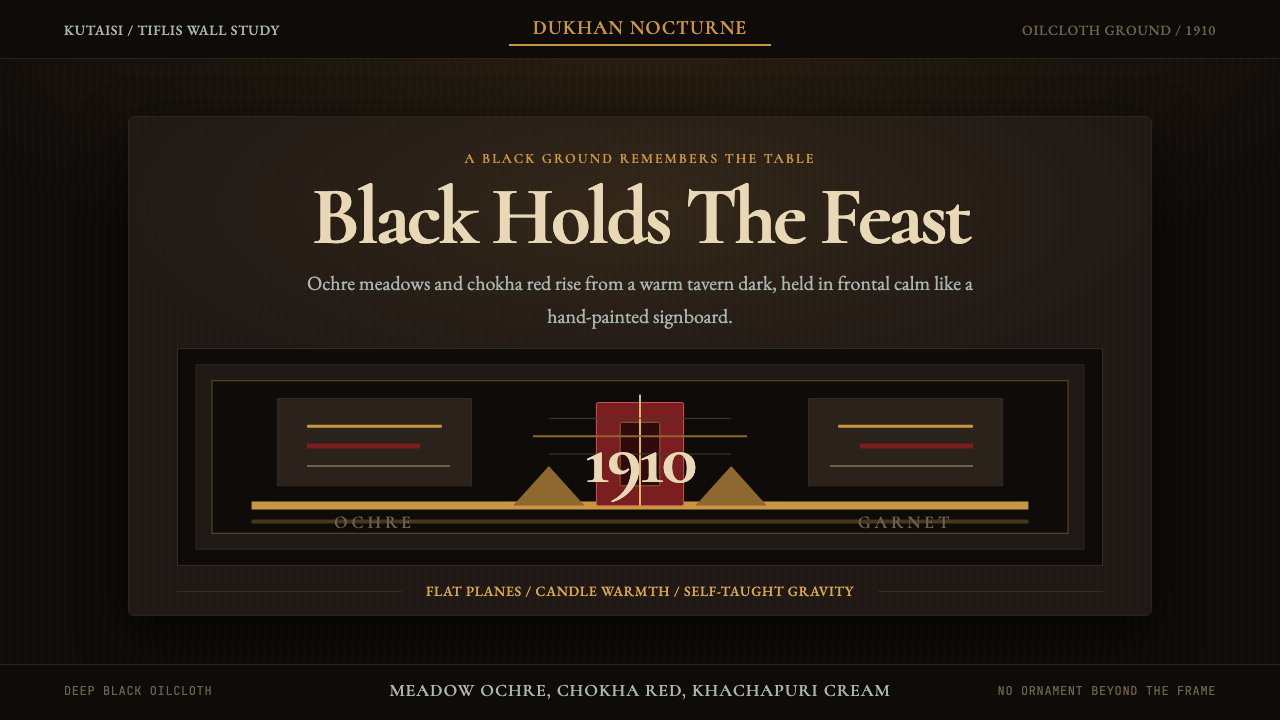 Georgian Pirosmani 1910Oilcloth black turns memory ceremonial. Ochre panels and Cormorant type hold…
 Jordanian Bedouin Black TentNight camp honesty. Goat-hair black, sadu crimson, brass lines.
 Botswana Coiled BasketThe pattern keeps travelling. Bark-brown stepped bands wind across a straw co…