What is Andean Chullo?
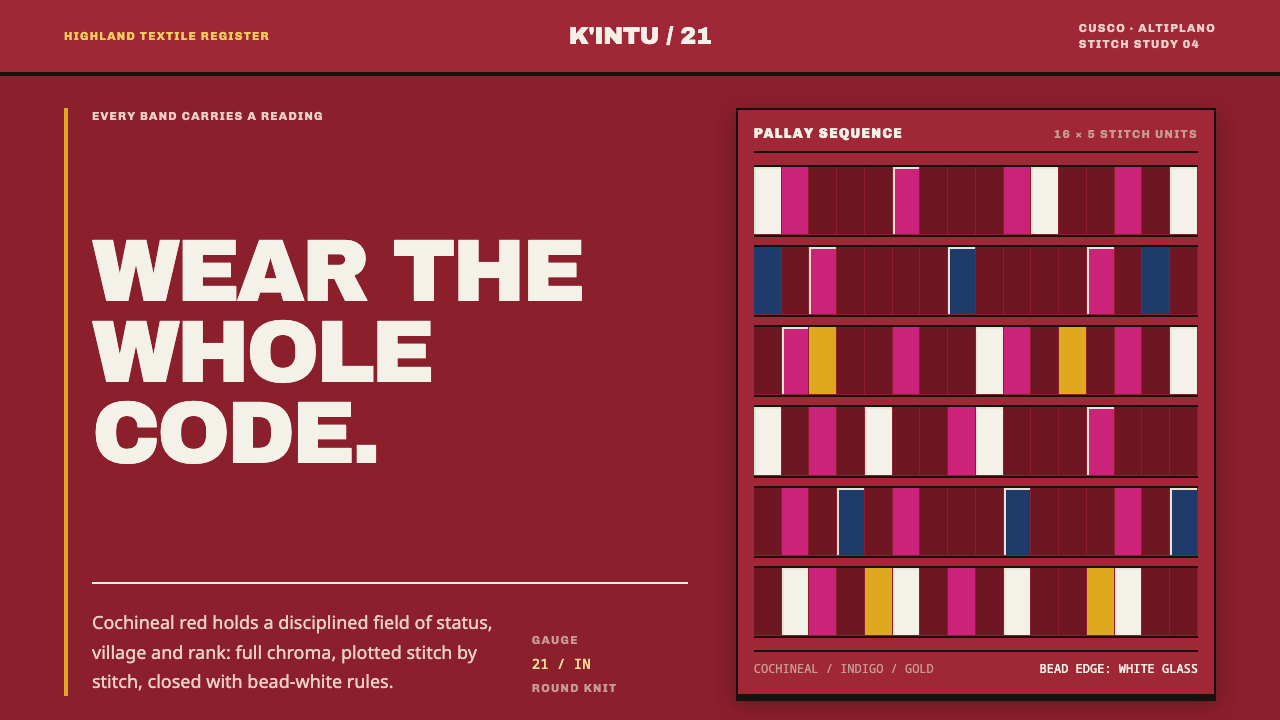
Andean Chullo turns a knitted ear-flap cap into a design system in which every band is a statement: deep cochineal red, tight stitch-grid motifs and bead-white rules.
Andean Chullo in brief
Andean Chullo is a design style drawn from the chullo, the ear-flap cap knitted in the round across the Andean highlands (in Quechua, ch'ullu). Its visual language is a deep cochineal-red field crossed by narrow horizontal bands, each band holding a row of small motifs built on a stitch grid: stepped diamonds, zigzags, birds and flowers. The finish is tassels, pompoms and white beads.
What separates it from ordinary pattern design is that its ornament carries a code. On the island of Taquile, red and white together mark an unmarried man, while a fully red cap marks a married one. A single cap can state a village, a rank and a marital status at a glance. The style keeps that discipline: colour is given at full strength, bands repeat strictly, and every motif lands exactly on the stitch grid, so nothing is vague and nothing is merely decorative.
For a designer this means a layout that is dense without being noisy. A chullo-derived page is rich in pattern yet orderly, because every band has a fixed role and a fixed rhythm. It is a style about information packed into texture, and the eye reads it band by band, the way a person in the community reads a hat.
Where does Andean Chullo come from?
The chullo belongs to the highlands of the southern Andes: the Q'ero and Ausangate area of Cusco in Peru, Taquile island in Lake Titicaca, and the Bolivian altiplano. The source dates the tradition to before 1900 and describes it as colonial knitting absorbed into a far older Andean textile practice. The technique, in other words, arrived through colonial contact, but it was folded into a culture of cloth in which pattern, dye and dress already carried social meaning.
The craft is exacting. Chullos are knitted in the round on needles filed down from bicycle spokes, at gauges that reach 21 stitches to the inch, a density fine enough to draw a motif at the scale of a single stitch. Natural dyes anchor the palette, above all cochineal, which gives the characteristic deep red. The multicolour work is done entirely by hand, row after row, with the pattern built stitch by stitch.
Finishing matters as much as knitting. Once the cap is complete, tassels and pompoms are added, and white glass beads, up to a kilo of them on the most elaborate pieces, are sewn on after the knitting is done. The beads are not part of the knitted structure. They are a second layer applied by hand, which is why the style treats white as crisp rules and edges laid over a field that has already been established.
Meaning lives in the communities that make and wear the caps. The source credits the Taquile community weavers, the Q'ero knitters and the knitters of Ocongate, and notes that Taquile was inscribed by UNESCO in 2008. The related traditions it lists are the Andean natural-dye tradition, multicolour hand knitting in the round, and community dress codes of village, rank and marital status. That last strand is the heart of the style: dress as a legible system.
What defines the Andean Chullo look?
Colour
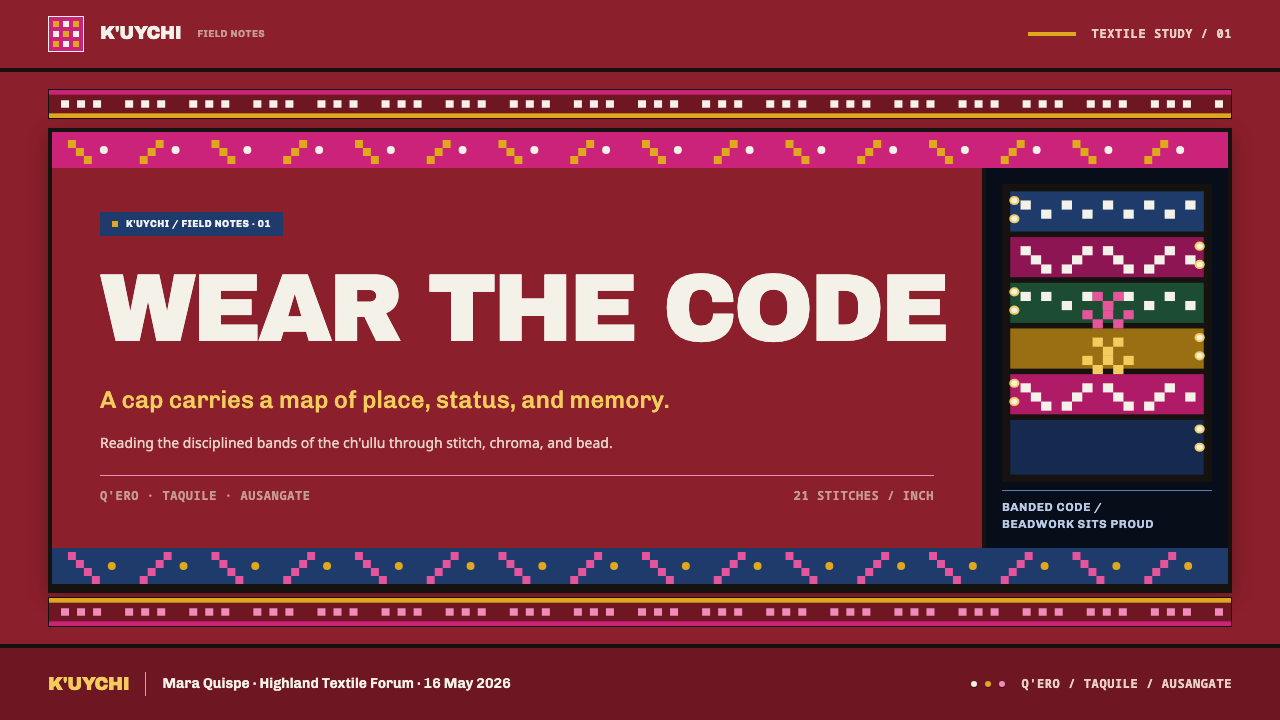
A deep cochineal red forms the field, applied at full chroma rather than softened into pastel. Motifs sit on it in contrasting yarn colours drawn from the multicolour knitting tradition, and white, the colour of the glass beads, is kept for rules and edges. Because the system is built on a dark-toned ground, brightness comes from small, vivid motifs set against the red.
Horizontal Bands
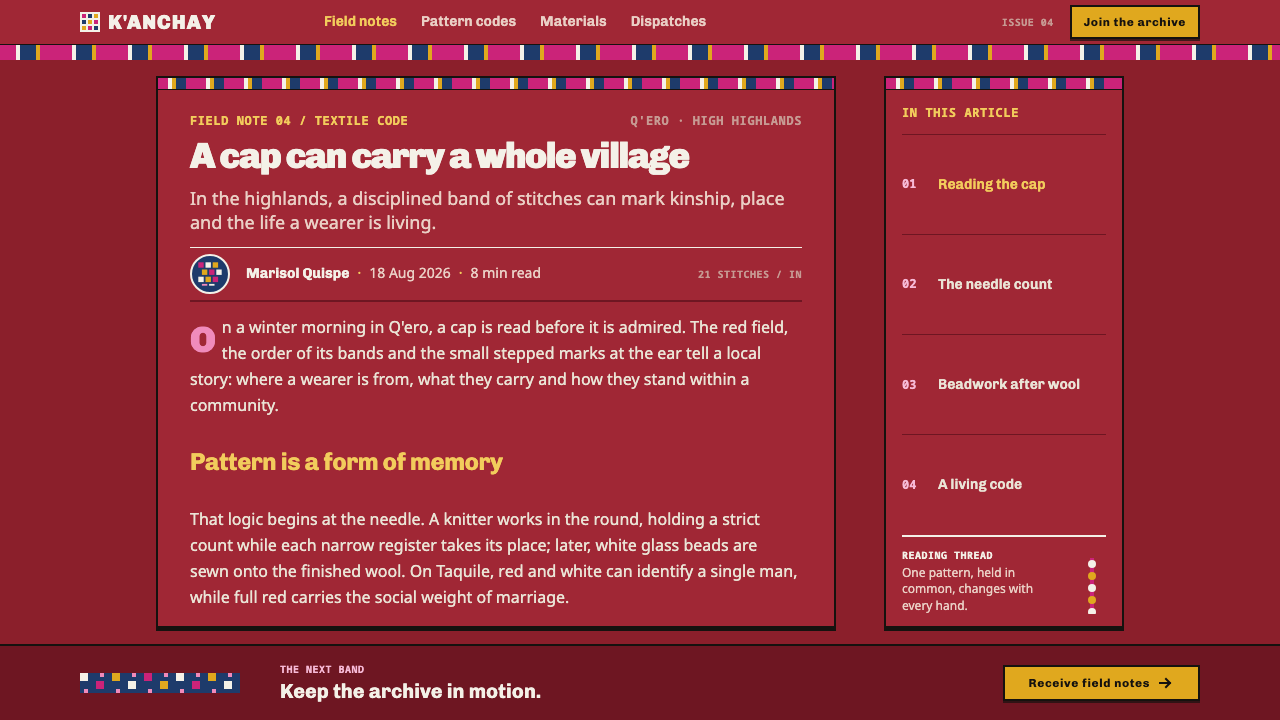
The composition is a stack of narrow horizontal bands, each holding a single row of motifs. The bands are the structure: a page is read from band to band, the way a cap is read from rim to crown. Bands may differ in what they contain, but not in discipline, with a steady height for each type and a strict repeat within it.
Stitch Grid
Every motif is built on a pixel-like grid, because knitting is a grid: one stitch is one unit of colour. Stepped diamonds, zigzags, birds and flowers (the t'ikas) are therefore drawn with stair-stepped edges, not smooth curves. Diagonals are staircases. A curve in this system is always an approximation made of squares.
Strict Repeat
Motifs repeat tightly and evenly within a band, with no random spacing and no mixing of motif types inside a row. The repeat is what makes the pattern read as a code rather than a texture. Breaking it is possible, but only deliberately, as a signal that something here is different.
Bead-White Rules
Thin white rules separate bands and edge the field, echoing the glass beads sewn on after knitting. The rules are crisp and used to divide, never to decorate, and they are the system's main device for keeping structure legible on a dense, saturated ground.
Tassels and Pompoms
Terminal elements such as pompoms and tassels finish the form. In interface terms they are the accent that ends something: an end cap, a badge, a closing flourish. They are used once and at the edge, never scattered through the body of a layout.
Meaning Before Ornament
No motif is free ornament. If a band is added, it should say something: a category, a status, a level, a place. This rule keeps the system disciplined and is the reason it suits information-heavy design far better than a generic folk-pattern fill would.
Who shaped Andean Chullo?
The community of Taquile island, in Lake Titicaca, is where the style's code is most clearly stated: red and white for an unmarried man, full red for a married one. Their dress system is the clearest illustration of why every band in this style must mean something, and the source records Taquile's inscription by UNESCO in 2008.
Knitters from the Q'ero and Ausangate area of Cusco, named in the source as one of the living centres of the tradition. Their work belongs to the multicolour hand knitting in the round that the style takes as its model, where a field of strict repeated bands is built entirely stitch by stitch.
The knitters of Ocongate in the Cusco region are the third community the source names. Together with Taquile and Q'ero they show that the chullo is not one style but a family of local variations on a shared grammar of bands, repeat and colour, which is why the design system defines rules rather than a single pattern.
The source notes that Taquile was inscribed by UNESCO in 2008, a recognition of the island's living textile practice. It matters to the style because it places the chullo among traditions that are actively practised and still carry meaning in the community, which is the standard a design system derived from it should respect.
How do you use Andean Chullo today?
Andean Chullo is a style for projects that want warmth, craft and density without losing order. It suits cultural brands, textile and fashion subjects, craft marketplaces, education about indigenous knowledge, and any interface where categories need to be told apart quickly. It works hardest where information can be mapped onto bands. It is a poor fit for minimal, airy products that want a lot of empty space.
In presentation slides, a cover can be built as a deep red field with two or three narrow bands of stepped motifs near one edge, thin white rules between them, and the title set plainly in a clear typeface beside or beneath. Content slides can use a single band as a running header or footer, so the deck feels like one continuous object. Data slides work well when each band is a data row: a band per category, with the motif repeat standing for quantity, much as a stitch count would.
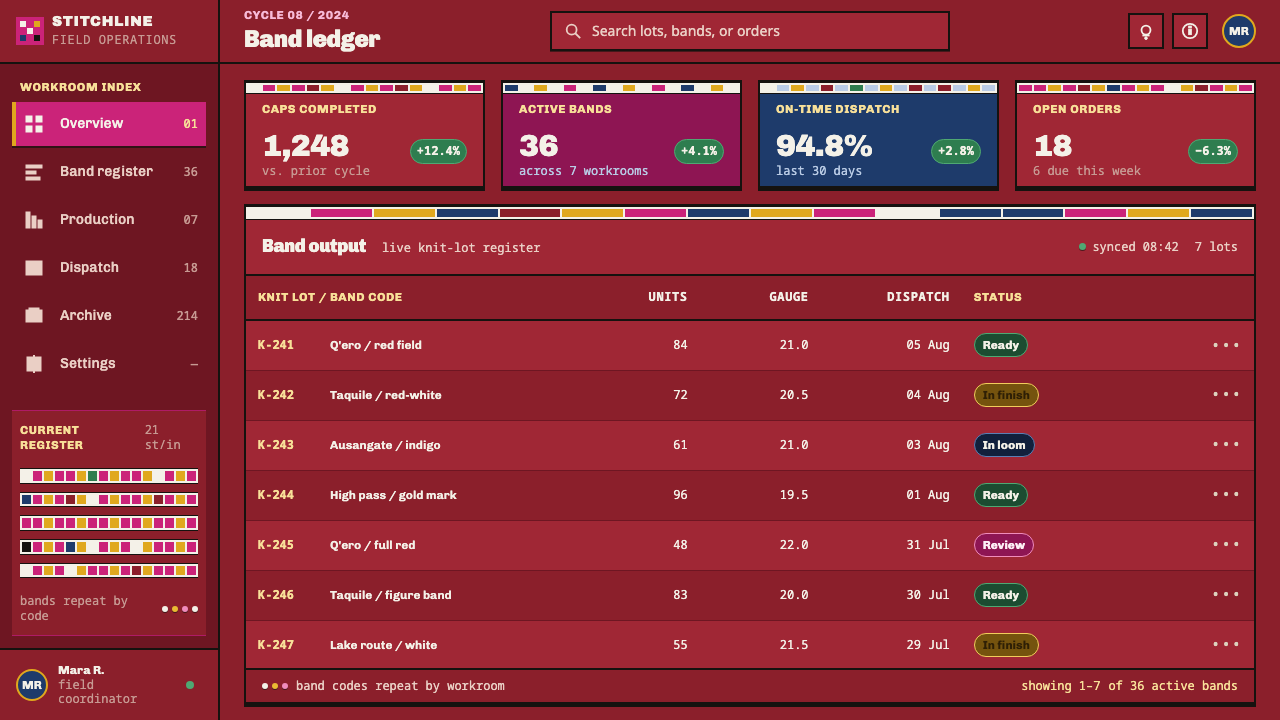
For web interfaces, the style suits profile pages, collection views, loyalty or membership tiers and status badges, where a band can show rank at a glance. Keep the red field to headers, hero areas or banners, and use a calmer, darker neutral for long reading areas so text stays comfortable. Buttons and inputs should stay simple, with white rules for borders. Pricing tiers can be told apart by band structure, not by extra colours, so each plan has its own legible pattern.
For editorial and marketing work, the style supports label design, packaging, event identities and long-form features about craft and community. A pattern strip works well as a section divider, a masthead or a card edge. Photography should be warm and respectful, showing the hands and the work rather than posing the object as an exotic ornament, and every pattern element should be traceable to a meaning you can explain in a caption.
The common mistake is to use the motifs as wallpaper: tiling stepped diamonds across whole backgrounds, curving them, or recolouring them at random. That removes the code and leaves only a folk-pattern costume. A second mistake is to soften the red, add gradients or put motifs on smooth curves, which breaks the stitch-grid logic. A third is to add more bands than there is information to carry.
Andean Chullo — FAQ
What is a chullo?
A chullo (ch'ullu in Quechua) is an ear-flap cap knitted in the round in the Andean highlands. Traditional examples are made on very fine needles filed from bicycle spokes, in strict bands of small motifs on a cochineal-red field, and finished with tassels, pompoms and sometimes a great many white glass beads. In communities such as Taquile the colours and bands also signal a wearer's village, rank and marital status.
Why are the motifs built from stepped, pixel-like shapes?
Because they are knitted. In knitting, one stitch is one unit of colour, so a diamond becomes a stair-stepped diamond and a diagonal becomes a staircase. The design system keeps that constraint on purpose: drawing the motifs with smooth curves would look like a pattern that merely imitates the tradition, while aligning every motif to the grid keeps the logic of the craft.
Is this a dark theme?
Yes, the system is built on a deep, dark-toned red ground, with small bright motifs and white rules standing out against it. Dark does not mean low contrast. Keep text and rules at full strength, give the long reading areas a calmer, darker neutral than the red, and use the saturated red for headers and banners. A light variant is possible, but you would lose the effect of the bright white rules.
Can I use these motifs for any product?
Use them with care. The motifs belong to living communities, and in some of them the bands carry real information about a person's village, rank and status. A design system can borrow the discipline of the code, such as strict bands, full-strength colour and meaning before ornament, without pretending to speak for those communities. Credit the tradition, avoid caricature, and be able to explain what each band in your design means.
How do I add the white bead detail without it looking like decoration?
Treat the beads as rules, not as sparkle. In the tradition they are sewn on after the knitting is done, as a second layer. In the system that translates to thin, crisp white lines that divide bands and edge the field. Keep them straight, evenly weighted and structural, and avoid scatter patterns, glow effects or rounded dots that read as confetti.
Related design styles
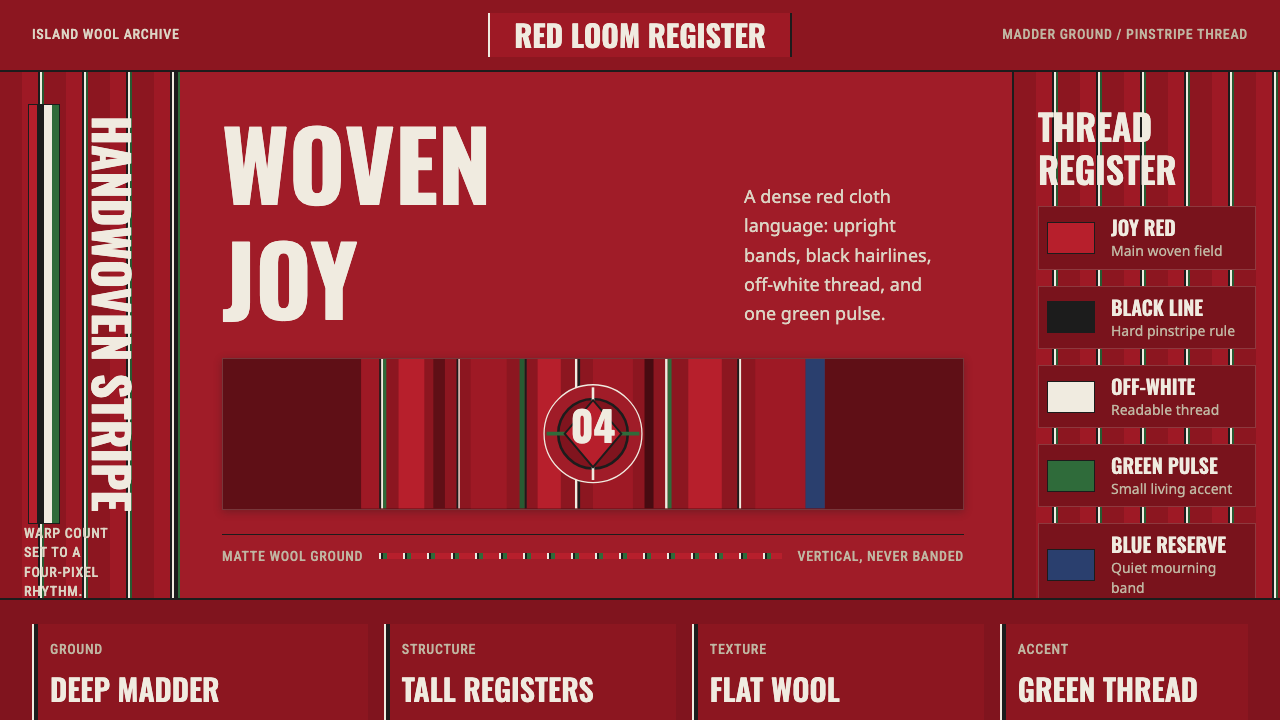 Estonian Kihnu Island SkirtJoy is woven vertical. Madder red ground, Oswald stripes, black and green pin…
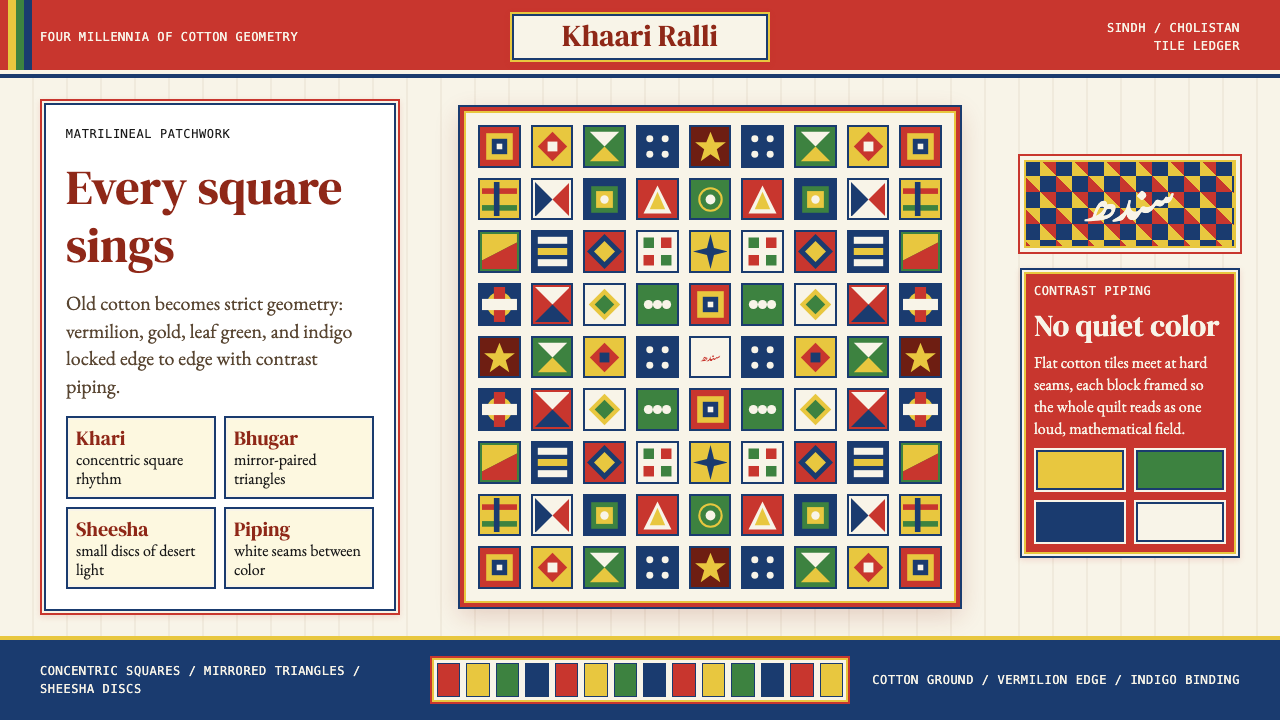 Sindhi Ralli QuiltSings in squares. Vermilion, gold, green, and indigo lock into piped tile rhy…
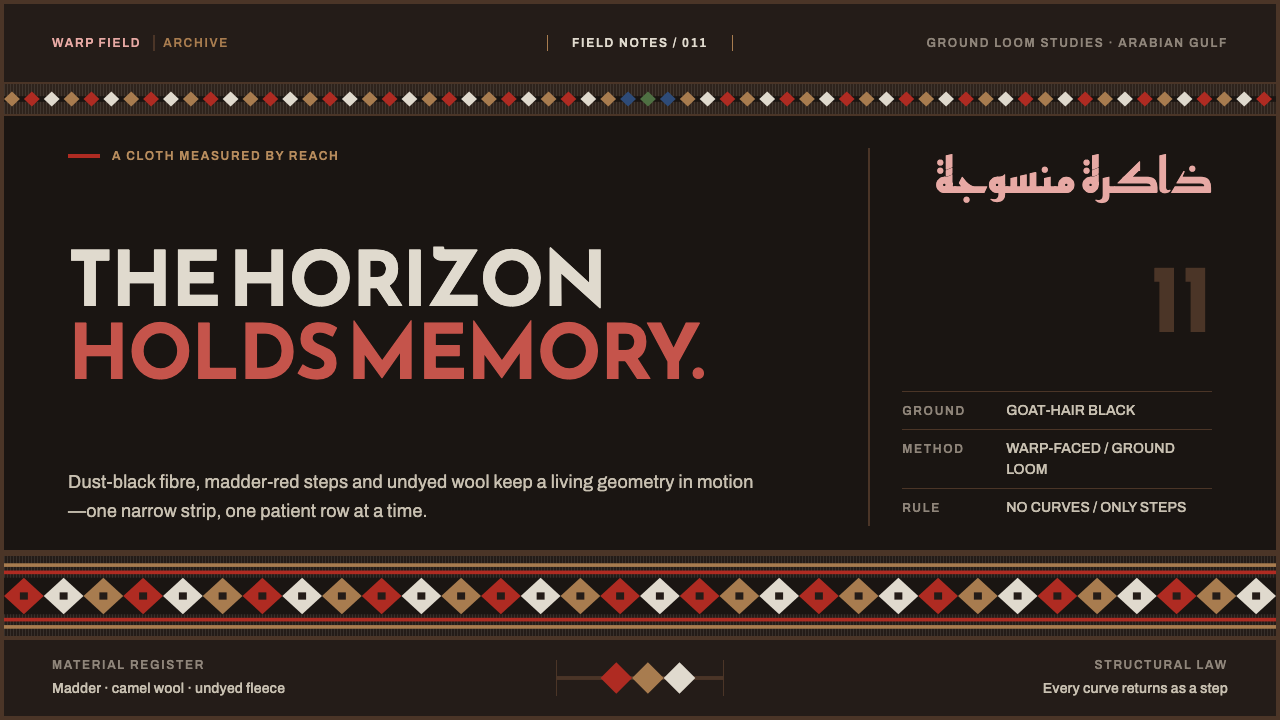 Emirati Sadu WeavingMemory runs in bands. Madder steps cross dusty goat-hair black with no curve…
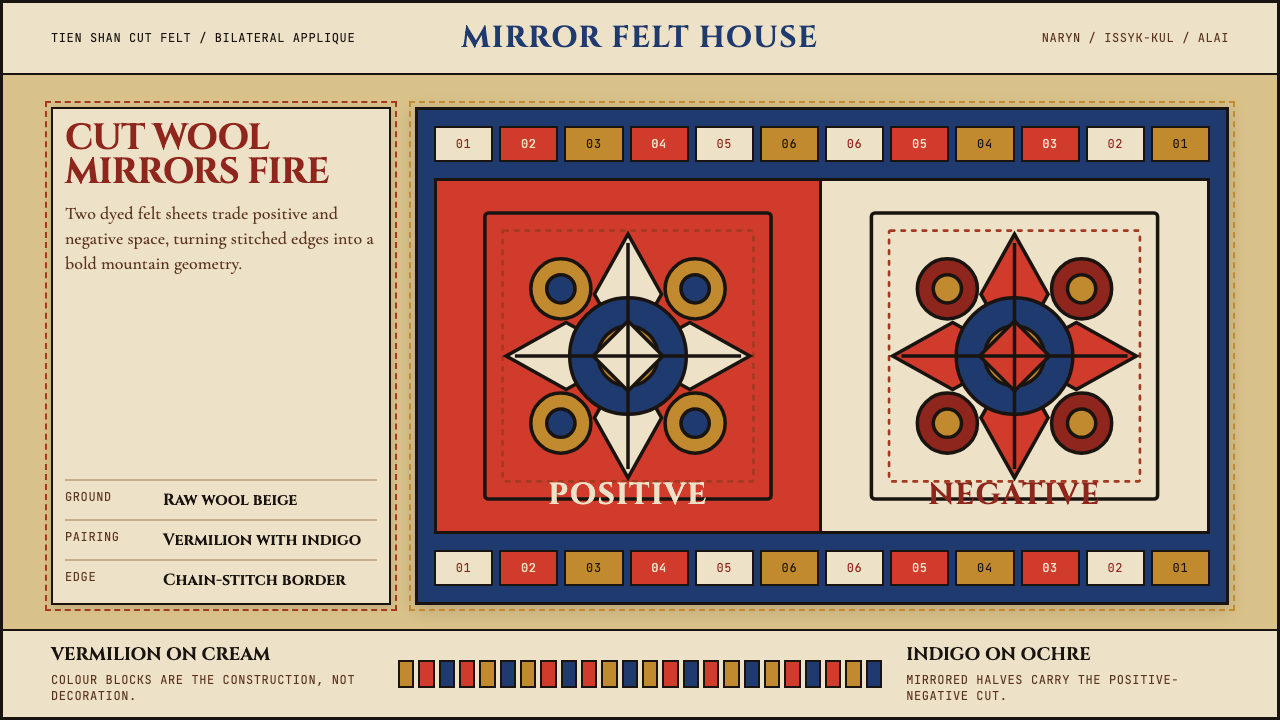 Kyrgyz Shyrdak Felt RugCut felt becomes structure. Vermilion-indigo mirror blocks stitch positive to…
 Marquesan PatutikiSoot meets skin without compromise. Solid black zones collide with comb-struc…
 Mossi Burkina Plank MaskCarved, not rendered. Charcoal fields, dust-red cuts, and kaolin bands stack…