What is Emirati Sadu Weaving?
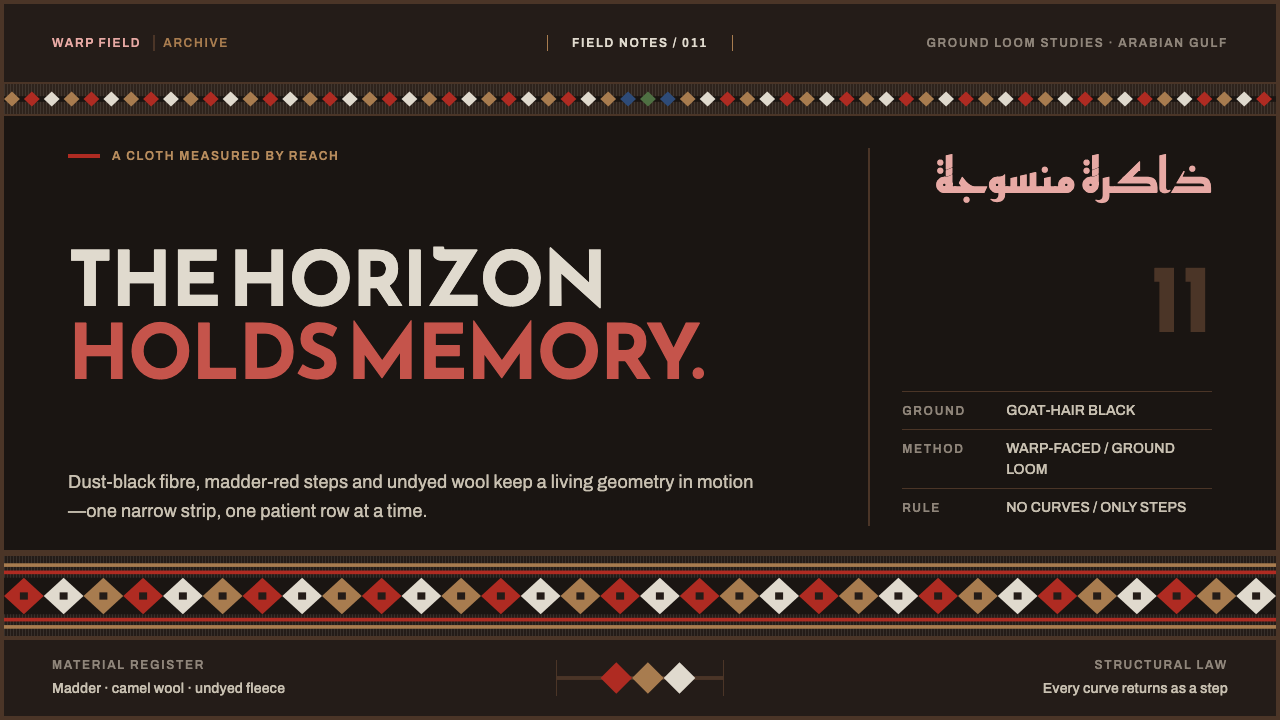
Al Sadu never curves — a ground-loom weave of banded, stepped ornament in dusty black goat hair, carried by Bedouin women across the Gulf.
Emirati Sadu Weaving in brief
Al Sadu is the traditional weaving practice of Bedouin women across the Arabian Gulf, most closely associated today with the United Arab Emirates and Kuwait. The weaving happens on the ground rather than on a raised loom frame: a ground loom is pegged flat, and a weaver works a strip no wider than her own arm's reach, producing lengths that can run up to seven meters. Finished strips are then sewn edge to edge to build the larger cloth panels used for tent walls, tent dividers, storage bags, and camel trappings.
The material sets the tone before any pattern is added. The base yarn is spun goat hair, worked in its natural, warm, dusty black — a color with texture and variation in it, never a flat printed black. Against this ground, the weaver works in bands: narrow rows of stepped geometric ornament alternate with plain stretches of undyed ground, building a rhythm down the length of the strip rather than a single continuous scene.
One band outranks the rest: the shajarah, meaning 'tree', a wider central band where the richest and most complex motifs are stacked. Because the ground loom has no mechanism for producing a curve, every motif in Al Sadu is built from steps and right angles — a visual logic closer to a woven grid than a drawn line, with diagonal and rounded forms always approximated as staircases of small rectangular steps.
Where does Emirati Sadu Weaving come from?
Al Sadu belongs to the broader Bedouin textile tradition of the Arabian Peninsula, practiced across the Gulf wherever Bedouin communities kept goats, sheep, and camels and needed cloth suited to a mobile, tented way of life. The recorded era for the craft runs from before 1900 to the present, reflecting both its deep roots in pre-modern pastoral life and its continued practice today, long after settled housing became the norm across the region.
The craft is women's work, passed down within families and encampments rather than taught through any formal school or workshop system. Skill in Al Sadu — spinning, dyeing, and weaving the stepped motifs from memory — was historically one of the primary forms of accumulated technical knowledge a Bedouin woman carried, and pattern names and meanings were held and transmitted orally alongside the technique itself.
As settled life replaced tent-dwelling across the UAE and Kuwait through the twentieth century, the practical need for handwoven tent cloth declined sharply, putting the tradition at real risk of disappearing within a generation. In response, institutions on both sides of the Gulf took up active documentation and teaching roles: Kuwait's Sadu House and the UAE's Abu Dhabi Al Sadu documentation programme, working alongside the broader Al Sadu Society network, recorded motifs, trained new weavers, and built public collections so the craft's vocabulary would survive the disappearance of its original everyday context.
That preservation effort culminated in the craft's inscription on UNESCO's Representative List of the Intangible Cultural Heritage of Humanity in 2011, formally recognizing Al Sadu as a living tradition worth active safeguarding rather than a closed historical style. The recognition has since supported a design revival: contemporary Gulf designers and brands now draw directly on Al Sadu's banded, stepped vocabulary, extending a technique born of ground looms and goat hair into architecture, product design, and digital interfaces.
What defines the Emirati Sadu Weaving look?
Color
The ground color is spun goat hair in its natural state — a warm, dusty, textured black, never a flat printed or ink black. Pattern colors come from natural dye sources: madder for red, onion skin for a tan or gold, indigo for blue, plus the undyed natural tones of sheep, goat, and camel fleece. Gold and turquoise, the colors associated with Gulf tourist souvenirs, have no place in an authentic Al Sadu palette.
Composition and Banding
The entire composition is organized horizontally into bands. Narrow rows of stepped ornament alternate with plain stretches of undyed ground, building a rhythm down the length of the strip. Pattern never scatters freely across a field the way it might in a printed textile; it is always disciplined into a band, with the plain ground between bands doing as much compositional work as the pattern itself.
The Shajarah Band
One band outranks the others: the shajarah, or 'tree', a wider central strip where the most elaborate motifs are stacked. In a finished panel, the eye is meant to find this band first — it functions as the compositional anchor of the whole piece, the way a title or hero element anchors a page, while the narrower bands around it function as supporting rhythm.
Geometry — No Curves
The ground loom cannot produce a curve, so nothing in Al Sadu curves. Every motif is built as a staircase of small rectangular steps, the same logic that governs pixel art or cross-stitch: diagonals and rounded forms are always approximated, never drawn smoothly. This is a structural consequence of the tool, not a stylistic preference, and it is what gives Al Sadu its distinctive angular, almost digital-looking rhythm.
Material Honesty
The undyed natural tones of sheep, goat, and camel fleece are treated as legitimate colors in their own right, not as a neutral backdrop waiting to be dyed. A design system drawn from Al Sadu should keep that same respect for raw material — texture and warmth in the neutrals, rather than flattening everything to pure white or pure black.
Application Discipline
Because pattern only ever lives inside a band, applying Al Sadu to a screen or a page means resisting the urge to spread motifs freely across a layout. Ornament belongs in defined strips — headers, dividers, borders — with generous plain ground between them, and the palette should stay within madder, indigo, tan, and natural black rather than reaching for the gold and turquoise of Gulf tourist branding.
Who shaped Emirati Sadu Weaving?
The Al Sadu Society is part of the broader institutional network that has worked to document and sustain Al Sadu weaving across the Gulf as the practical, everyday need for handwoven tent cloth disappeared. Its work sits at the base of the tradition's continued transmission — training weavers, recording motifs and their names, and building the public case that made international recognition possible.
Sadu House functions as Kuwait's dedicated institutional home for the Al Sadu tradition, part of the effort that kept the practical knowledge of ground-loom weaving alive as tent-dwelling gave way to settled housing across the Gulf. It operates as both a teaching space and a public point of contact for the craft, helping the vocabulary of bands, steps, and the shajarah motif remain legible to new generations.
The Abu Dhabi Al Sadu documentation programme represents the UAE side of the Gulf-wide effort to record Al Sadu before its living practitioners and their motif knowledge were lost. Systematic documentation of this kind — recording which steps and bands belong to which named pattern — is what allowed the craft to be presented internationally as a coherent, describable tradition rather than a loosely related set of regional habits.
How do you use Emirati Sadu Weaving today?
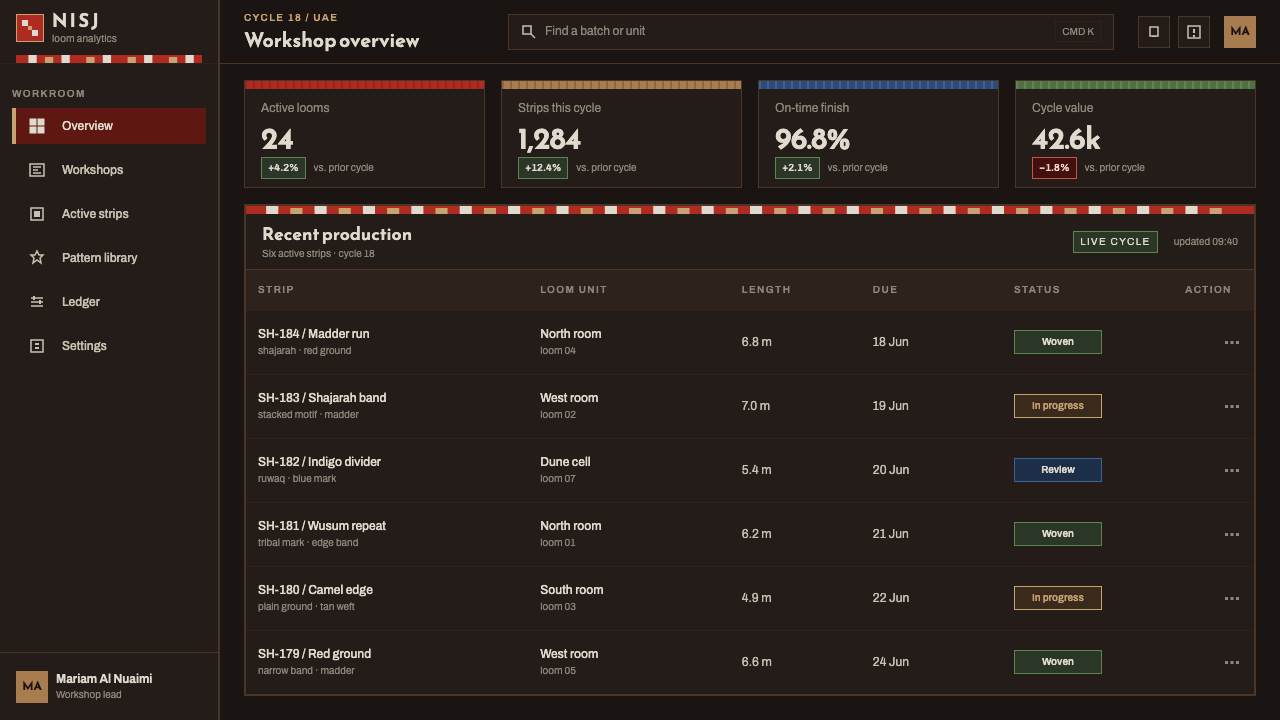
Al Sadu's discipline — banding, stepped geometry, a restrained natural palette — transfers well to any interface or document that needs rhythm and structure without curves or gradients: data-heavy dashboards, editorial layouts with strong horizontal sections, or brand systems built around a Gulf or Bedouin heritage story. The style rewards restraint: it is built from a genuinely narrow set of moves, and adding curves, gradients, or bright secondary colors breaks its logic immediately.
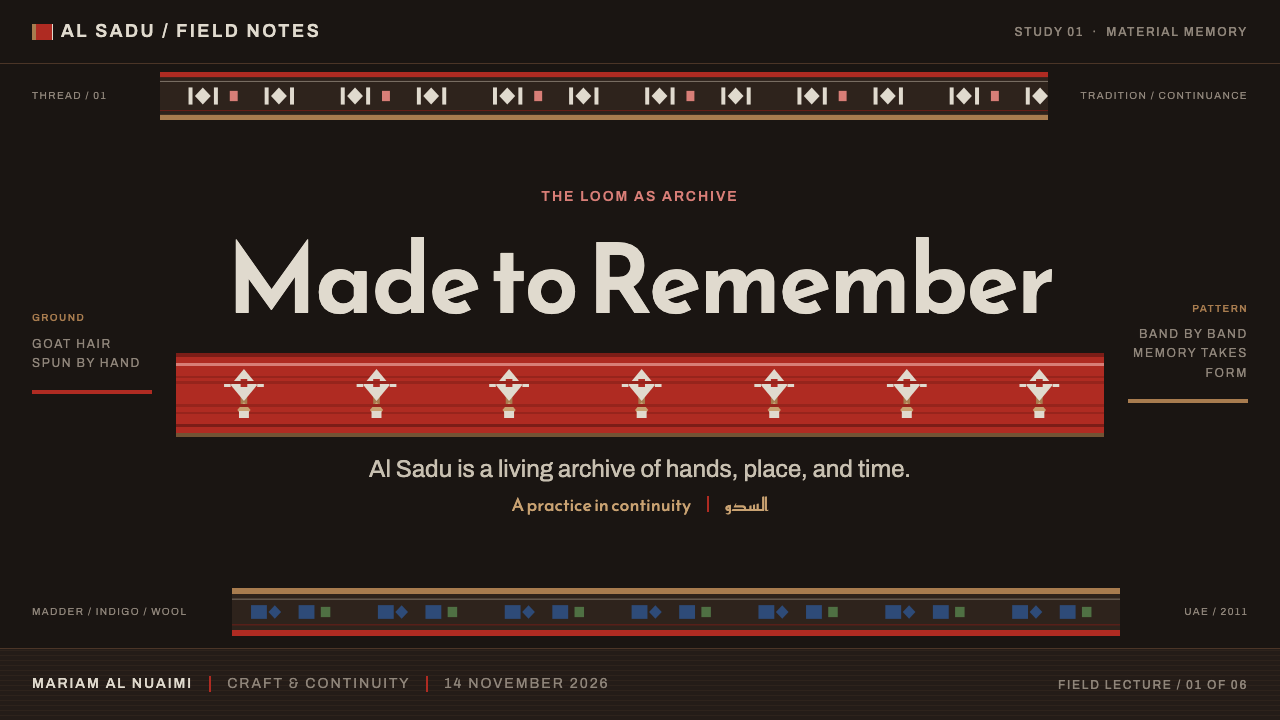
For presentation slides, treat the strongest band — the shajarah equivalent — as the visual anchor of a cover slide: a wide central strip of stepped ornament, framed above and below by narrower plain bands. Content slides can borrow the alternating rhythm directly, using a stepped divider pattern between sections instead of a plain rule, while keeping body content in plain, undecorated space.
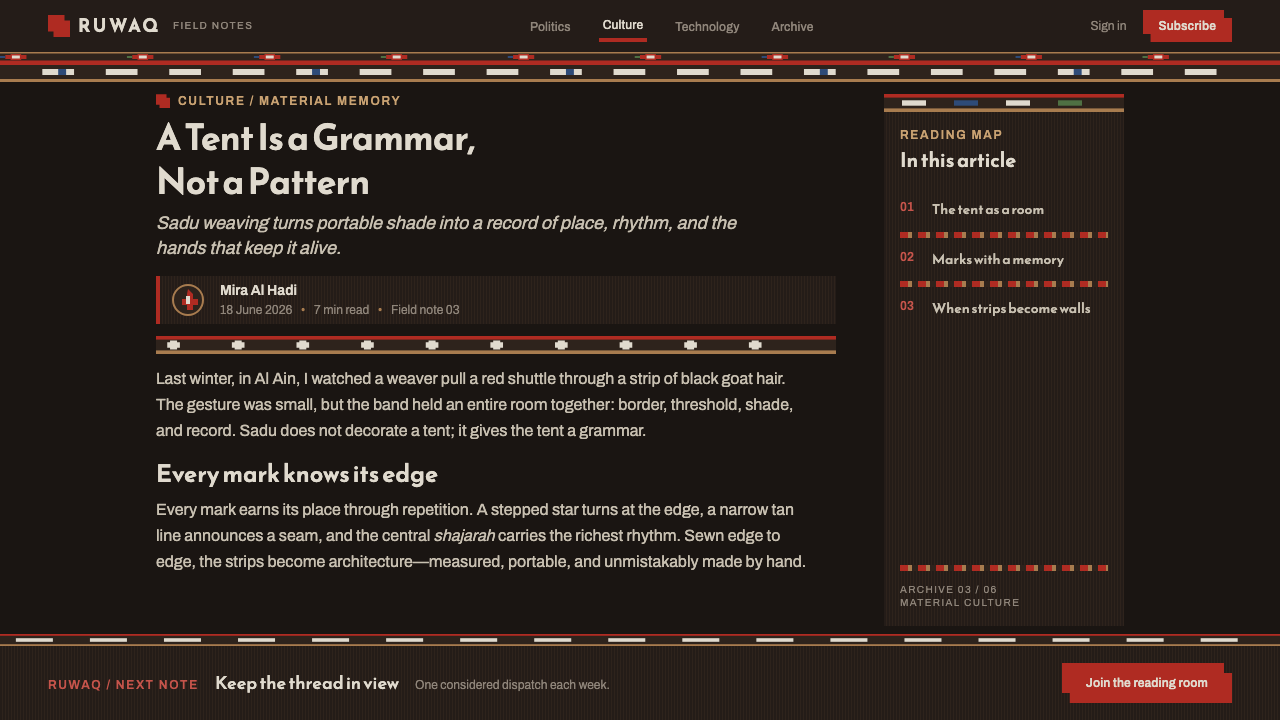
In web interfaces, the banding logic suits horizontal section dividers, table headers, and progress or status indicators particularly well — anywhere a design needs a repeating rhythm rather than a single decorative flourish. Cards and panels should stay flat and angular, built from right angles and stepped edges rather than rounded corners, and any accent color should come from the madder-indigo-tan set rather than a generic brand palette.
For editorial and marketing work, Al Sadu's alternating bands make a strong structural device for separating sections of a long page — a stepped-pattern rule between article sections reads as considered rather than decorative, especially in contexts already discussing craft, heritage, or the Gulf region. Marketing materials benefit from the same restraint the weavers apply: one dominant band of ornament, generous plain ground around it, rather than pattern spread evenly across the whole composition.
The most common mistake is treating Al Sadu as a generic 'ethnic pattern' and introducing curves, gradients, or a bright gold-and-turquoise palette to make it feel more decorative. Both moves break the tradition's actual logic: the angularity comes from a real structural constraint of the loom, and the palette is deliberately restrained to natural dyes and fleece tones. A second common error is scattering motifs freely across a layout instead of confining them to defined horizontal bands, which is the one rule Al Sadu never breaks.
Emirati Sadu Weaving — FAQ
Why doesn't Al Sadu use any curved shapes?
Because the ground loom used to weave it has no mechanism for producing a curve. Every motif is built by stepping — small rectangular movements that approximate a diagonal or a rounded shape as a staircase rather than a smooth line. This is a structural fact about the tool, not an aesthetic choice, and it is the single most defining visual trait of the tradition.
What is the shajarah, and how should it be used in a layout?
Shajarah means 'tree' and refers to the wider central band in a woven panel where the richest, most complex motifs are stacked. It functions as the compositional anchor of the piece. In a layout, the equivalent move is a single dominant band of pattern positioned centrally, with narrower supporting bands above and below it — not multiple competing focal points scattered across the composition.
Can gold or turquoise be added to make an Al Sadu-inspired design feel more 'Gulf'?
No — those colors belong to Gulf tourist-souvenir branding, not to the authentic Al Sadu palette. The tradition's real colors come from madder, onion skin, indigo, and the natural undyed tones of sheep, goat, and camel fleece, set against a warm dusty black ground. Introducing gold and turquoise replaces the tradition's actual material history with a decorative shorthand for 'Gulf' that has nothing to do with how the textile was actually made or colored.
Is Al Sadu still practiced today, or is it a historical style only?
It is a living tradition, not a closed historical style. Its era of practice runs from before 1900 to the present, and its 2011 UNESCO inscription specifically recognized it as intangible heritage worth active safeguarding — a designation reserved for practices still being taught and performed, not ones that have already died out. Institutions like Sadu House and the Abu Dhabi documentation programme actively train new weavers today.
Does Al Sadu only apply to physical textiles, or does it work as a digital design system?
Its logic translates cleanly to screens because it was already a structured, rule-based system before any digital translation: fixed bands, stepped geometry, a narrow natural palette. That structure maps naturally onto dividers, headers, and repeating UI rhythms, which is why a contemporary design revival now applies Al Sadu's vocabulary well beyond woven cloth, into architecture, product design, and interface work.
Related design styles
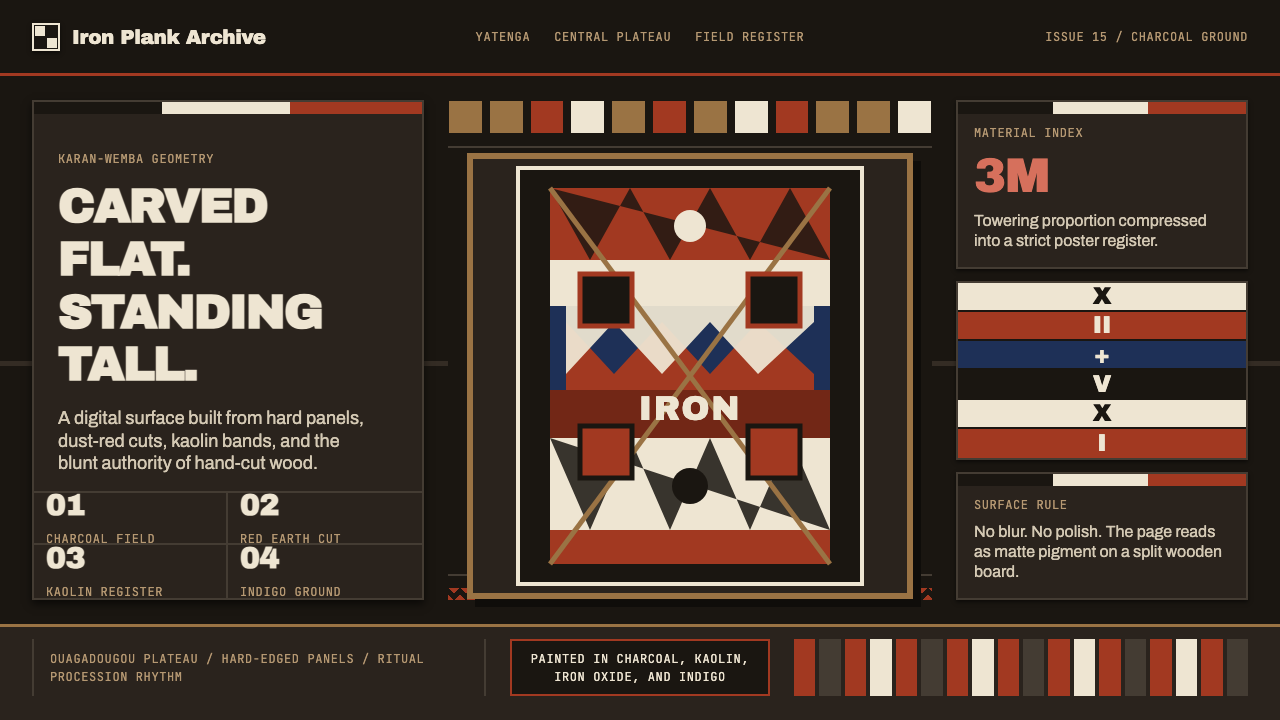 Mossi Burkina Plank MaskCarved, not rendered. Charcoal fields, dust-red cuts, and kaolin bands stack…
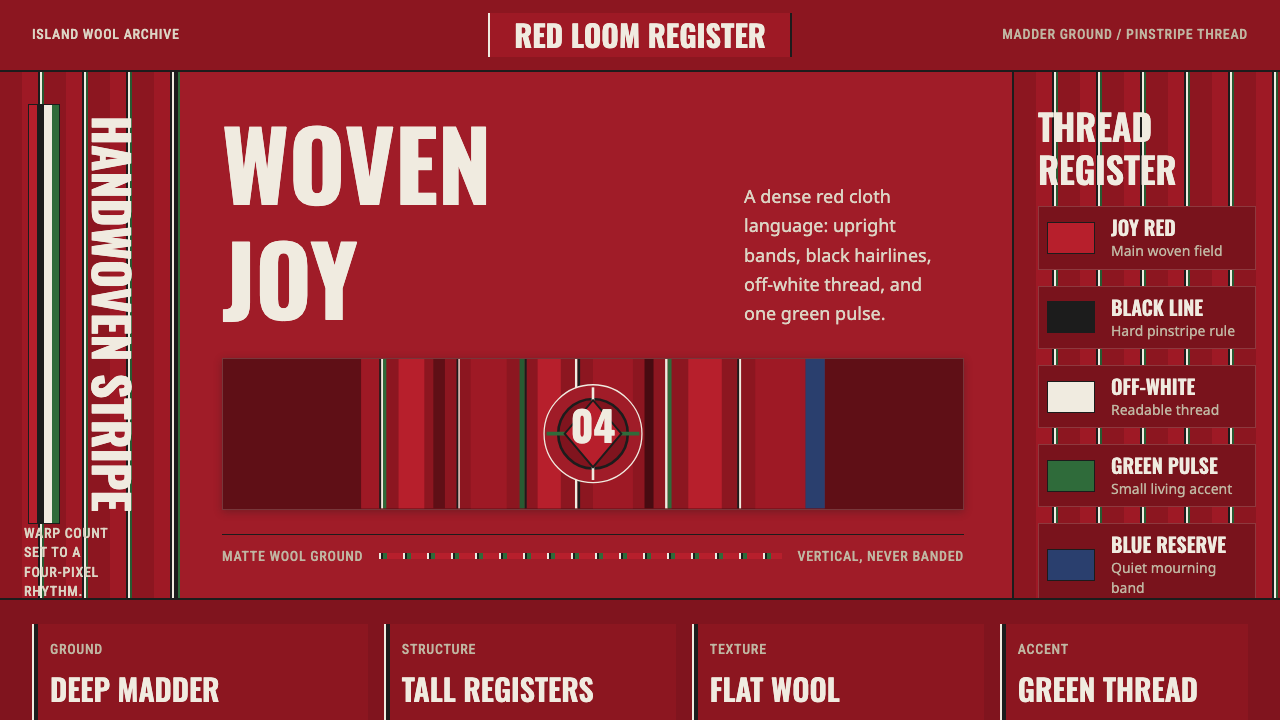 Estonian Kihnu Island SkirtJoy is woven vertical. Madder red ground, Oswald stripes, black and green pin…
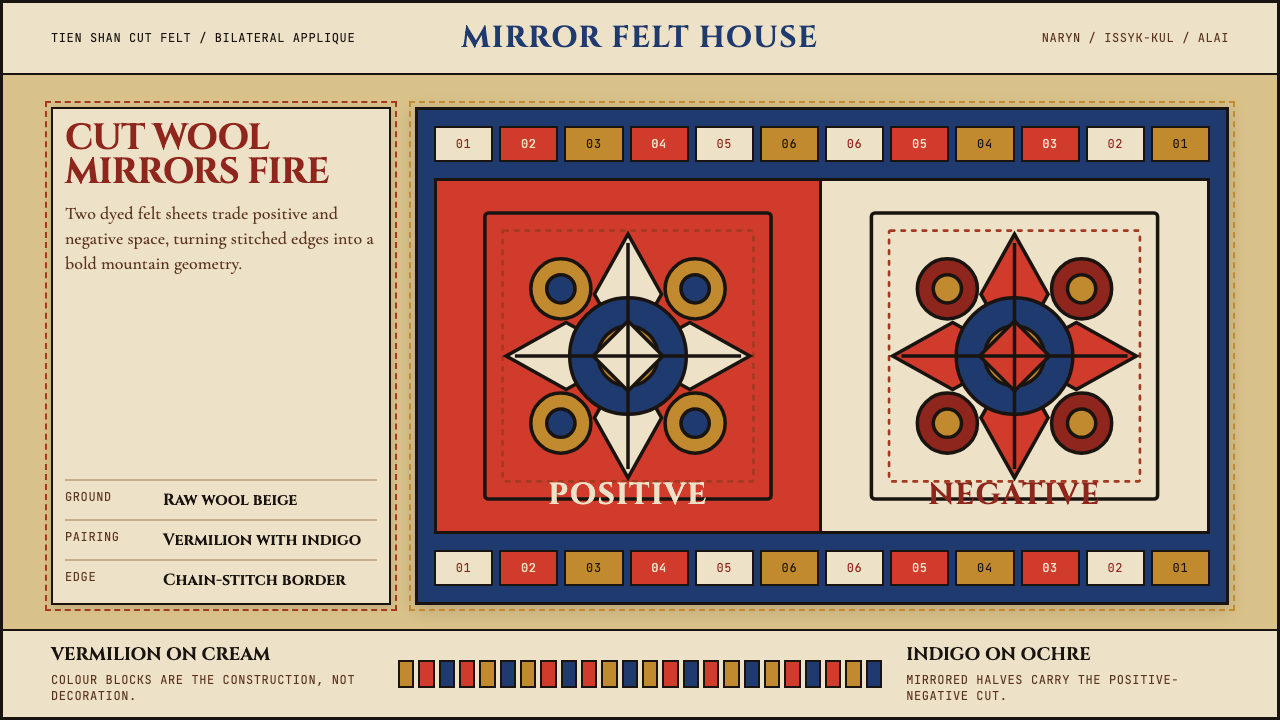 Kyrgyz Shyrdak Felt RugCut felt becomes structure. Vermilion-indigo mirror blocks stitch positive to…
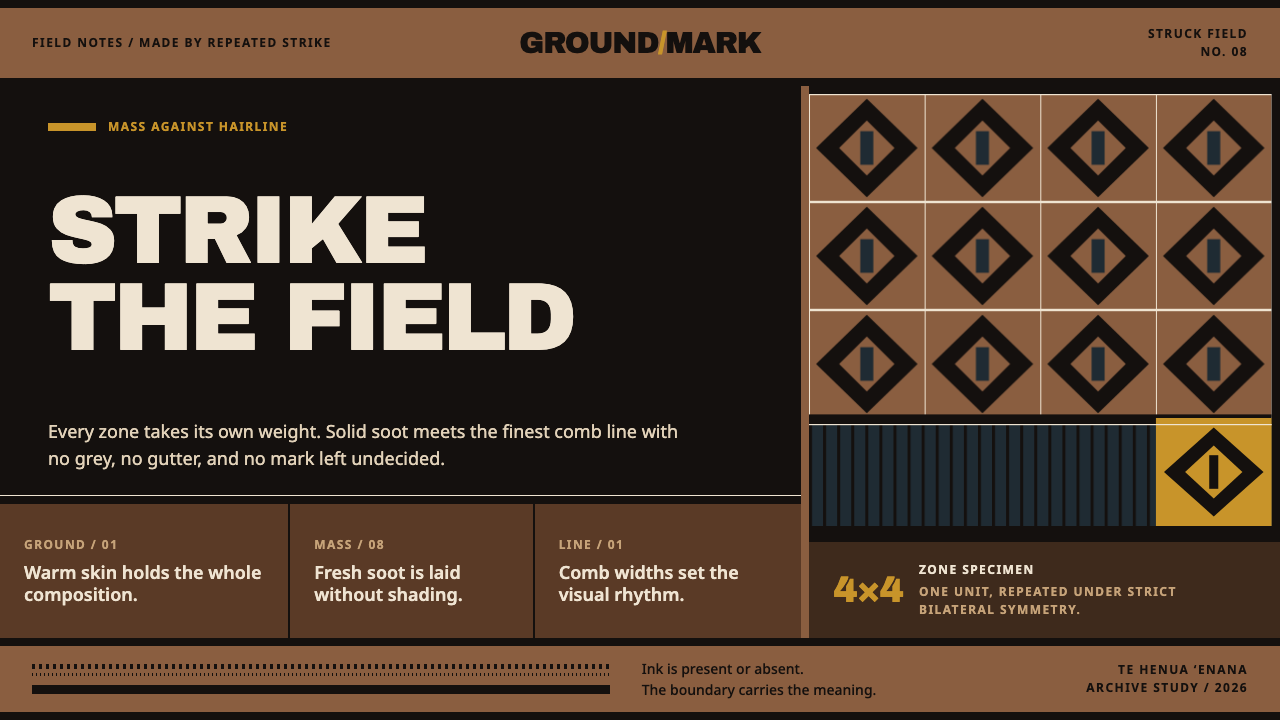 Marquesan PatutikiSoot meets skin without compromise. Solid black zones collide with comb-struc…
 Neapolitan PizzaHot, handmade abundance. Tomato red and basil green flare on charred oven bro…
 Punched Tin HojalataThe poor man's silver. Pierced tin on oxidized shadow, washed in chili, cobal…