What is Atlas Silk (Etles)?
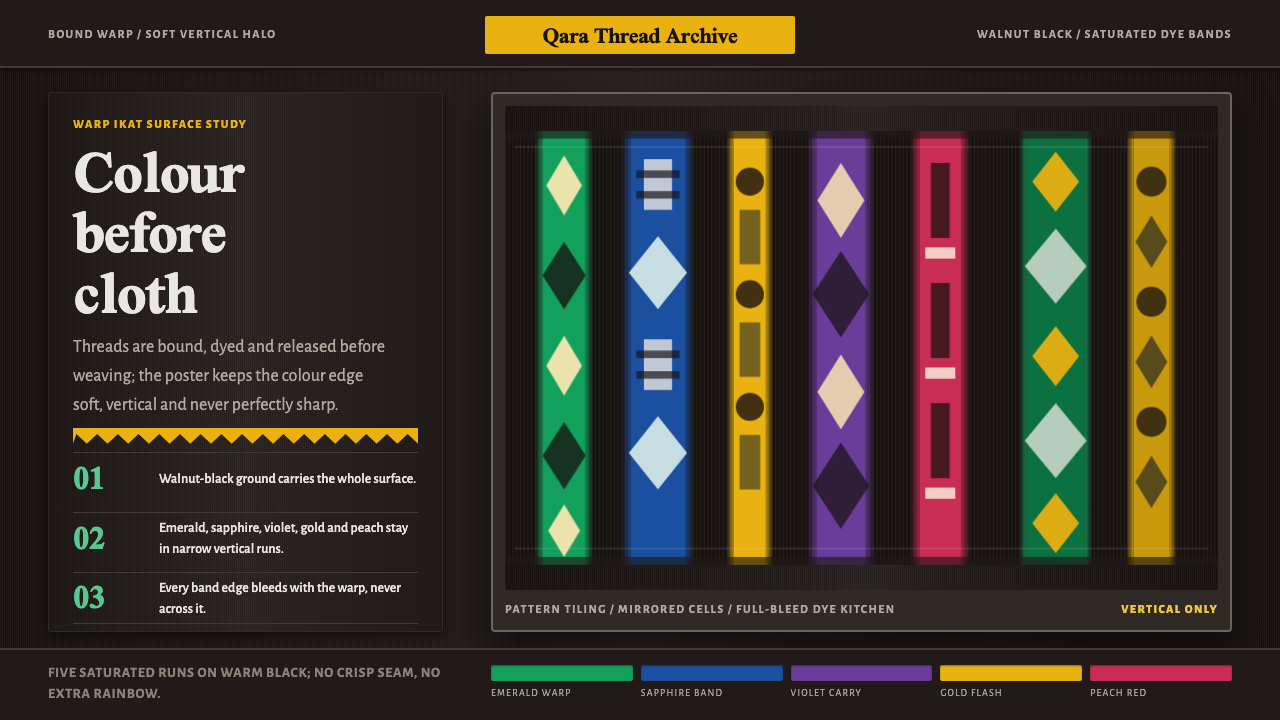
Atlas silk is warp ikat from southern Xinjiang: the threads are bound and dyed before weaving, so every colour edge arrives as a soft vertical halo instead of a drawn line.
Atlas Silk (Etles) in brief
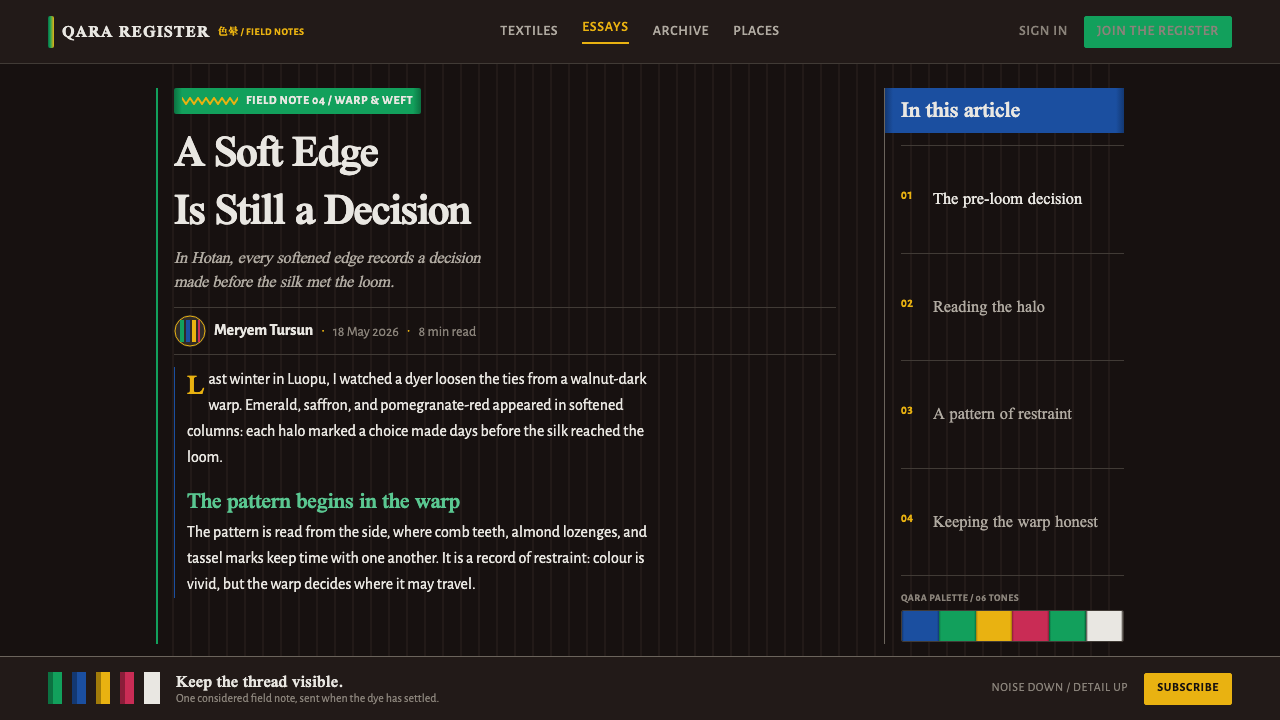
Atlas silk — etles in Uyghur, 艾德莱斯绸 in Chinese — is a warp ikat silk from southern Xinjiang, and Curio's Atlas Silk system takes its black-ground variety, the qara atlas, as its model. The cloth is walnut-black and carries narrow vertical bands of emerald, sapphire, violet, gold and peach-red, built from small mirrored motifs: comb teeth, almonds, tassels. Its signature is not a colour or a shape but an edge. Every boundary between colours is soft, blurred into a halo that runs up and down the length of the cloth.
That softness is a consequence of how the cloth is made. In warp ikat the warp threads are bound and dyed in layers before a single weft thread crosses them. The pattern is therefore dyed into the threads rather than woven over them, and each colour edge is already blurred before the cloth exists. The halo is the cloth's identity: soft before it is woven. It belongs to the vertical direction only, following the threads. A horizontal smear would no longer be atlas.
As a design language, Atlas Silk is dark, warm and rhythmic. The page behaves like a bolt of cloth unrolling down a loom: narrow vertical colour bands, motifs mirrored on a centre line and repeated segment after segment, and no sharp seams. Cards and buttons are treated as pieces cut from the bolt, with halos of colour on their left and right edges. Dividers are comb teeth rather than hairlines, and headings sit in full-width colour bands.
Where does Atlas Silk (Etles) come from?
To understand the style, start with the technique. Ikat is a resist-dyeing method in which threads are bound, dyed and only then woven; in warp ikat, the threads that run the length of the cloth are the ones treated. In atlas silk, bundles of warp are tied tightly, dipped in layers of dye, dried, untied and only then set on the loom. Every pattern element therefore exists as colour on the thread before it exists as cloth. Nothing can be sharpened afterwards. The soft vertical halo is built into the material.
Atlas silk belongs to southern Xinjiang, and its principal centres are Hotan and Luopu on one side and Kashgar and Shache on the other. It is a workshop craft that predates 1900 and has been produced continuously through the twentieth century and into the 2020s. That continuity is part of the style's meaning. The people credited with it are not individual masters but lineages: the dye-houses of Hotan and Luopu and the warp-tiers of Kashgar and Shache, groups whose skill lay in dyeing and binding yarn so that the pattern would appear correctly on the loom.
The black-ground version, the qara atlas, comes from the Hotan and Luopu area. Its ground is dyed with walnut husk and iron mordant, which gives a warm, brownish black rather than a pure one. Against it run the narrow vertical bands of emerald, sapphire, violet, gold and peach-red. The motifs come from everyday objects and ornaments: combs, almonds, tassels, earrings, gemstones, saws and sickles, and even the silhouettes of the rawap and the dutar, two stringed instruments. Each motif is mirrored on its centre line and repeated section by section down the length of the cloth.
Atlas silk is also part of a wider Central Asian ikat family, a group of cloths dyed and woven on the same bind-then-dye logic. Curio's system draws on this lineage directly. It treats the page as the bolt of cloth: a warm dark silk ground, bands of dyed colour, and an interface in which things repeat vertically and nothing is sharp at the seam. It is a dark system in which light comes from colour rather than from white, and it carries a specific cultural origin that is worth naming whenever the style is used.
What defines the Atlas Silk (Etles) look?
Vertical Halo
Colour edges in atlas silk are soft because the threads were dyed before weaving. The softness is directional: halos run along vertical edges, at the left and right of bands, panels and buttons, following the length of the cloth. Soft all-round glows or feathered tops and bottoms are not atlas; they read as generic blur, and they lose the specific look of dyed warp.
Walnut-Black Ground
The ground is dyed from walnut husk and iron mordant, which gives a warm, brownish black rather than a flat, cold one. It is the dark field against which every dye colour glows, and it makes this a dark style by nature. A neutral pure black would lose the warmth of the silk and read as an ordinary night theme.
Five Dye Colours
Emerald, sapphire, violet, gold and peach-red are the colours that run in narrow vertical bands across the ground. They are saturated and jewel-like, but they are used in strips, never as large floods of colour. Each is a dye, with the depth that dyed silk has, set against black, and the system needs no extra hues beyond them.
Mirrored Motifs
The motif vocabulary is concrete and domestic: comb teeth, almonds, tassels, earrings, gemstones, saws, sickles and the silhouettes of the rawap and dutar. Each motif is mirrored on a centre line, so it is symmetrical left to right, and strung along the band. The shapes are simple and bold enough to survive the soft edges of the dye.
Bolt Rhythm
Everything repeats down the page as a bolt repeats down the loom: segment after segment, with the same motif returning at a steady interval and no hard stop at the seam. Rhythm, rather than a single centrepiece, carries the composition. Long pages benefit most, because the repeat gives scrolling a woven, continuous feel.
Comb-Tooth Edges
Dividers and borders are drawn as comb teeth, a row of small repeating points, instead of a thin straight rule. The comb is one of the cloth's own motifs, so the zigzag belongs to the language rather than decorating it. A hairline rule would belong to a different, colder system.
Cut From the Bolt
Cards and buttons are treated as sections cut from the bolt: the body of the piece is cloth, and the left and right sides carry vertical halos of colour. Headings sit in full-width colour bands, like a stripe running across the whole width of the fabric. Components feel woven into the surface, not floating above it.
Who shaped Atlas Silk (Etles)?
The dye-houses of Hotan and Luopu are associated with the black-ground qara atlas on which this system is based. Their craft is the dyeing itself: the walnut-and-iron black and the saturated colours that stand against it. They stand for the continuity of a workshop tradition that predates 1900 and has run through the twentieth century into the 2020s.
Warp-tiers bind the warp threads so that dye reaches only where it should. Tying and layered dyeing are what make the soft halos possible, and the warp-tiers of Kashgar and Shache represent that hand skill. Their work is invisible in the finished cloth, yet it is the origin of every soft vertical edge.
Etles is the Uyghur name for the cloth, and its makers are the Uyghur dyers and weavers of southern Xinjiang. The tradition is carried by communities of makers rather than by famous individuals, which is why attribution in this style is collective. Designers who use the system borrow from a living craft and should name it as such.
How do you use Atlas Silk (Etles) today?
Atlas Silk is a dark, colourful and strongly rhythmic style. It rewards work with a warm, handmade, richly coloured identity, and it asks for some care, because it comes from a living textile tradition in southern Xinjiang rather than from a generic pattern library.
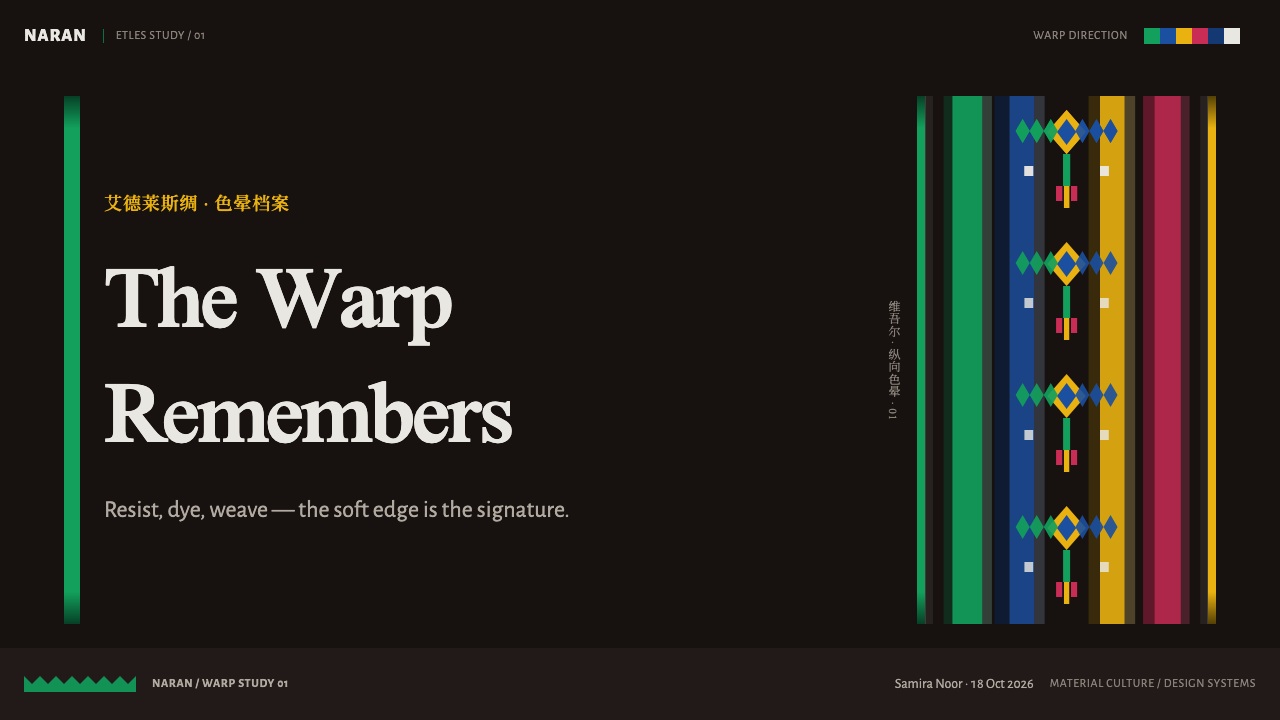
For presentation slides, the cover is the strongest move. Set the title on the walnut-black ground inside a full-width colour band, in emerald or gold, and let narrow vertical halos of dyed colour line the left and right edges. Content slides keep the dark warm ground, light text and one narrow dye stripe as a section marker. Data slides suit the style naturally: bar charts become narrow vertical bands, each bar one dye colour with soft vertical edges, and the five colours work as categories. Keep the soft edges on the vertical sides only, and keep labels crisp and plain.
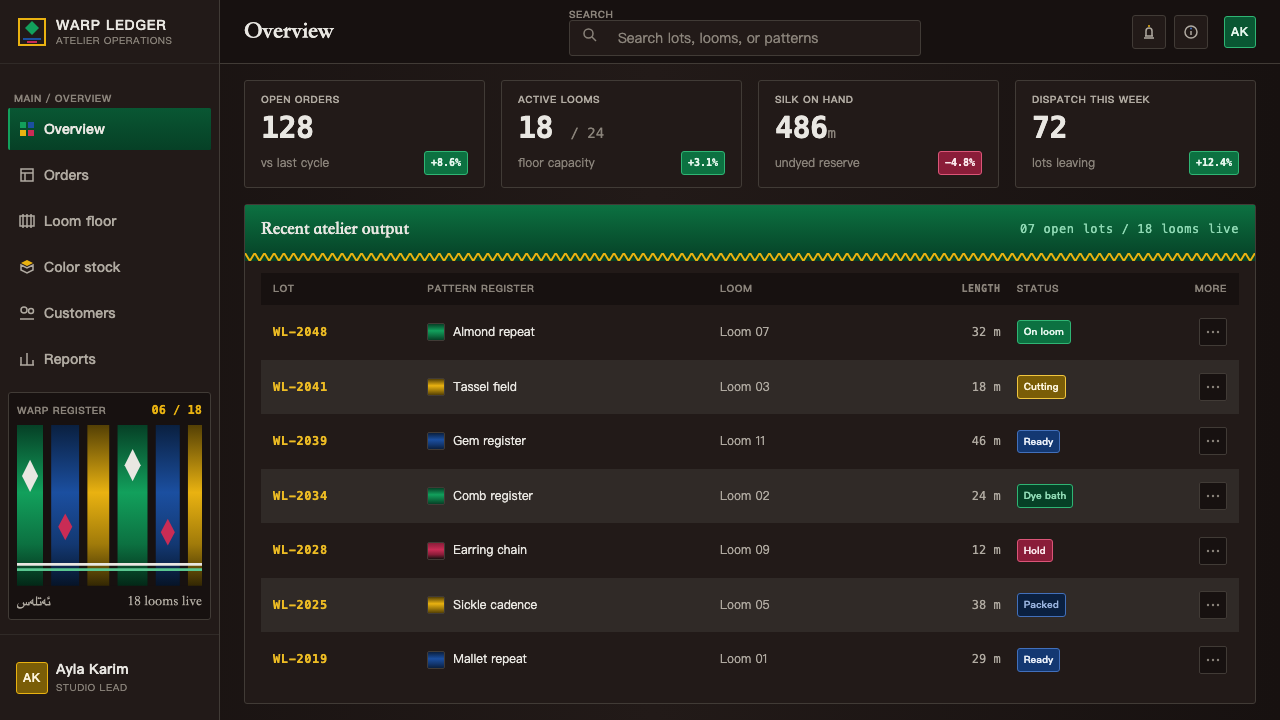
For web interfaces, the style suits craft and culture platforms, marketplaces, music and arts products, travel and hospitality, and fashion or textile brands, and it can carry a dark dashboard if the data is sparse. Build cards and pricing tiers as segments cut from the bolt, with halos of colour at the left and right edges, and place section titles in full-width colour bands. Use comb-tooth dividers in place of thin rules. Buttons are solid dyed colour set on the dark ground; hover states can intensify the halo along its vertical edges rather than adding a glow.
For editorial and marketing work, the style gives long pages a woven rhythm. A story can unroll like a bolt of cloth, with sections separated by comb-tooth rows, a full-width colour band for each heading and small mirrored motifs as markers. Campaign pages can repeat one motif in one dye colour as a vertical stripe running the length of the page. Wherever the style is used for a product tied to the tradition itself, credit the cloth by its name and origin: atlas silk, etles, from southern Xinjiang.
The most common mistake is to treat the halo as a general blur. Glows around every element, feathered top and bottom edges or a gradient sweeping across the page all lose the warp-dyed look. Other errors follow from the same misreading: pure black instead of the warm walnut ground, all five colours flooding full-width panels at once, motifs scattered at random instead of mirrored and repeated in a strip, and hairline dividers where comb teeth belong. Finally, avoid using the style as an anonymous exotic pattern. The more precisely it is named, the better it works.
Atlas Silk (Etles) — FAQ
What does ikat mean here, and how is atlas silk made?
Ikat is a resist-dyeing method in which the threads are patterned before they are woven. In warp ikat, the threads that run the length of the cloth are bound in bundles, dyed in layers, dried and untied, and only then set on the loom for the weft to cross. Because the pattern exists in the threads before the cloth does, its edges arrive soft instead of drawn. That softness is the visual trademark that the Atlas Silk style borrows.
Why is the ground walnut-black rather than pure black?
Because the black of the qara atlas is a dyed black. It is made with walnut husk and iron mordant, and it leans warm and brownish. A pure, neutral black would feel like a screen colour rather than a silk colour, and it would make the dye bands read as cold neon instead of warm jewel tones. Keeping the ground warm is what gives the whole system its fabric quality.
Why is the blur only vertical?
Because the softness is a trace of the threads. The warp runs along the length of the cloth, and the dye was applied to the threads before weaving, so the halos follow the threads. A blur in every direction, or a horizontal wash, would not be a trace of anything; it would just be an effect. Keeping the halo vertical keeps the cloth honest.
Can Atlas Silk work as a light theme?
It is dark by design. The walnut-black ground is part of what defines the qara atlas, and the dye colours are chosen to glow against it. A light inversion would need a different cloth altogether, and the result would stop being this style. If a product requires a light mode, it is better to keep the dark system for the brand surfaces, such as covers, headings and feature bands, and let neutral working areas stay plain.
How should the cultural origin be handled?
Treat it as a specific craft, not as generic ethnic decoration. Name it as atlas silk, or etles, from southern Xinjiang, and use motifs the tradition actually carries, such as combs, almonds, tassels, earrings, gemstones, saws, sickles and instrument silhouettes. Do not scatter them as random ornament. The logic of the cloth, with its bands, centre-line mirroring and steady repeat, matters as much as any single shape.
Related design styles
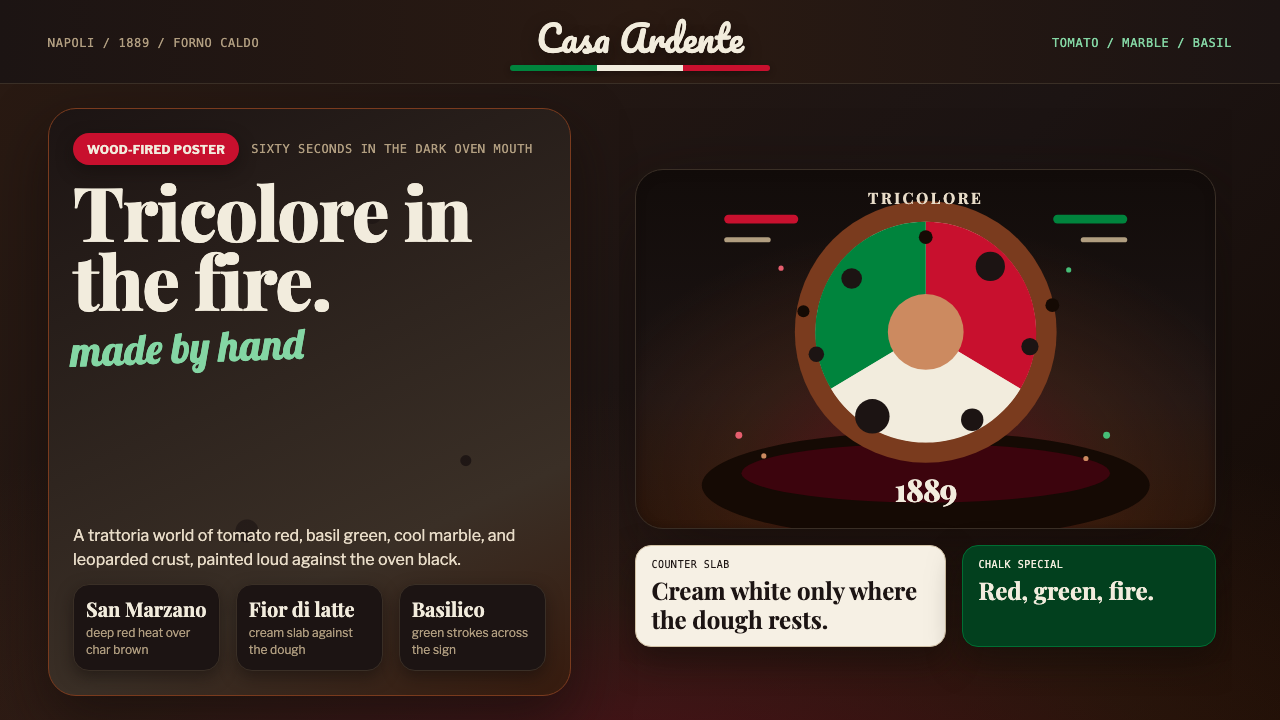 Neapolitan PizzaHot, handmade abundance. Tomato red and basil green flare on charred oven bro…
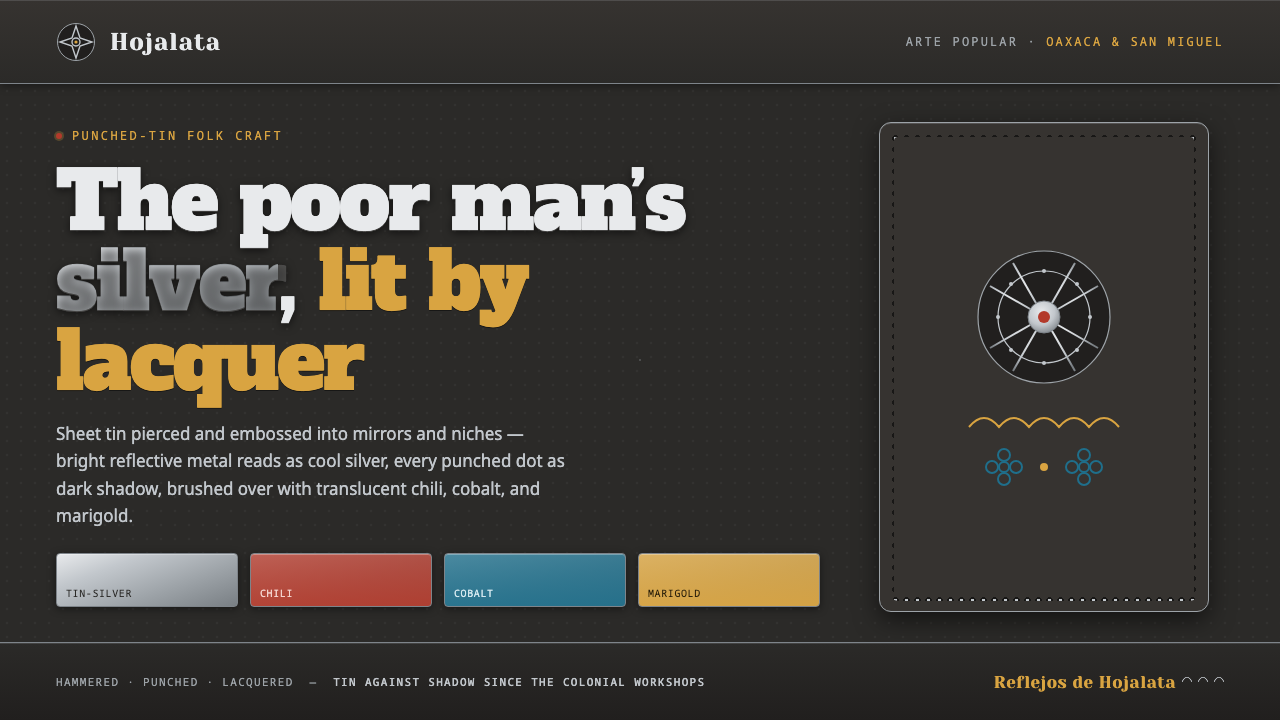 Punched Tin HojalataThe poor man's silver. Pierced tin on oxidized shadow, washed in chili, cobal…
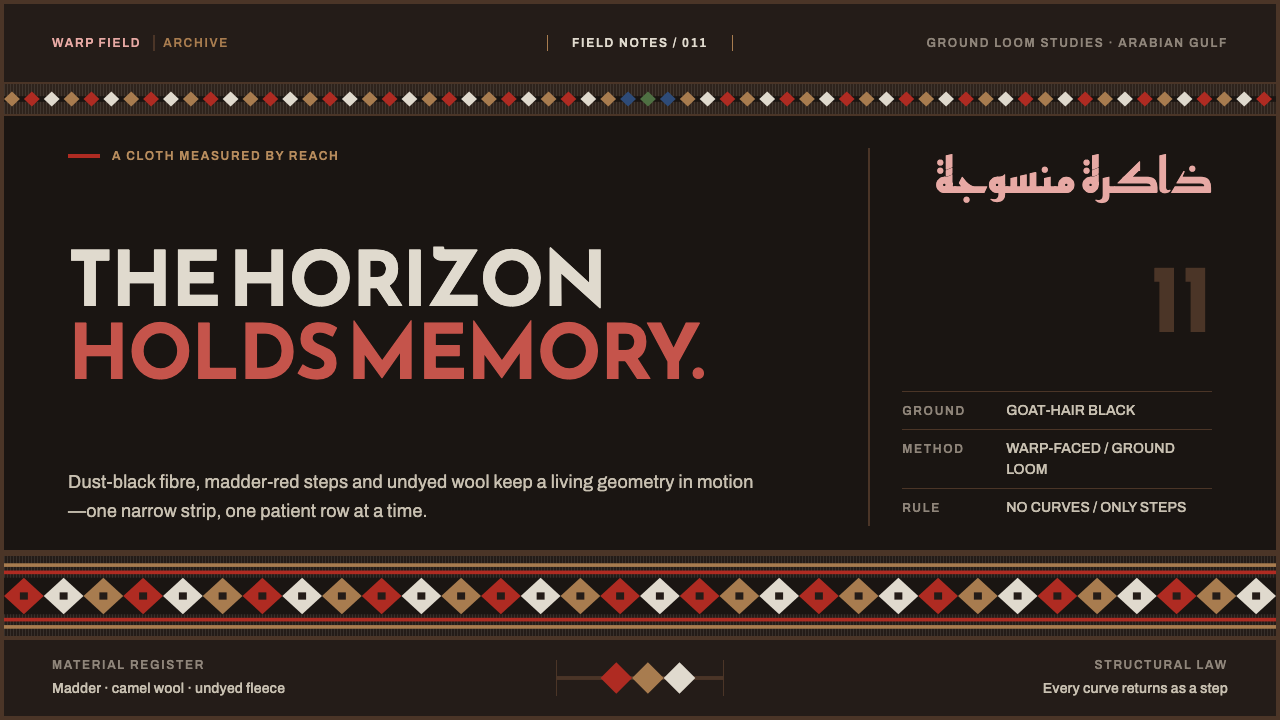 Emirati Sadu WeavingMemory runs in bands. Madder steps cross dusty goat-hair black with no curve…
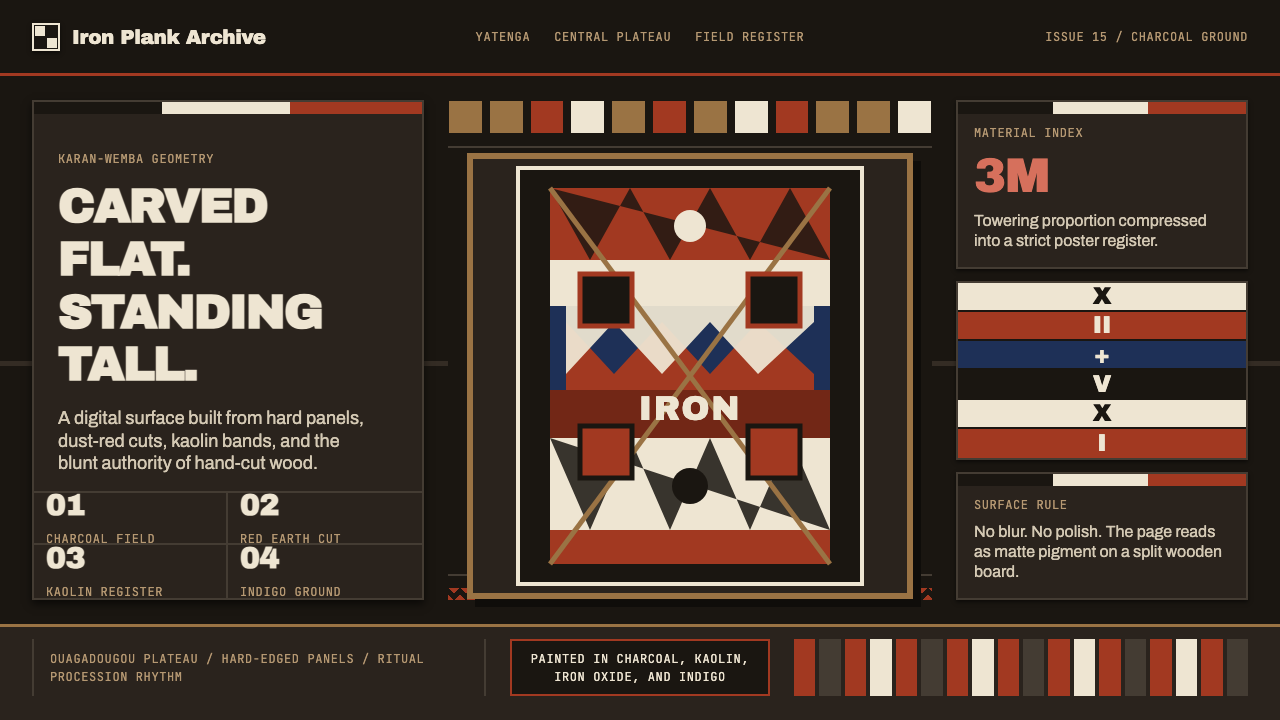 Mossi Burkina Plank MaskCarved, not rendered. Charcoal fields, dust-red cuts, and kaolin bands stack…
 Tatar Leather Mosaic IchigiJewel tones held by thread. Emerald leather blocks clash under raised gold se…
 Andean ChulloOrnament carries a code. Cochineal red stacks strict stitch bands with bead-w…