What is Saltillo Sarape?
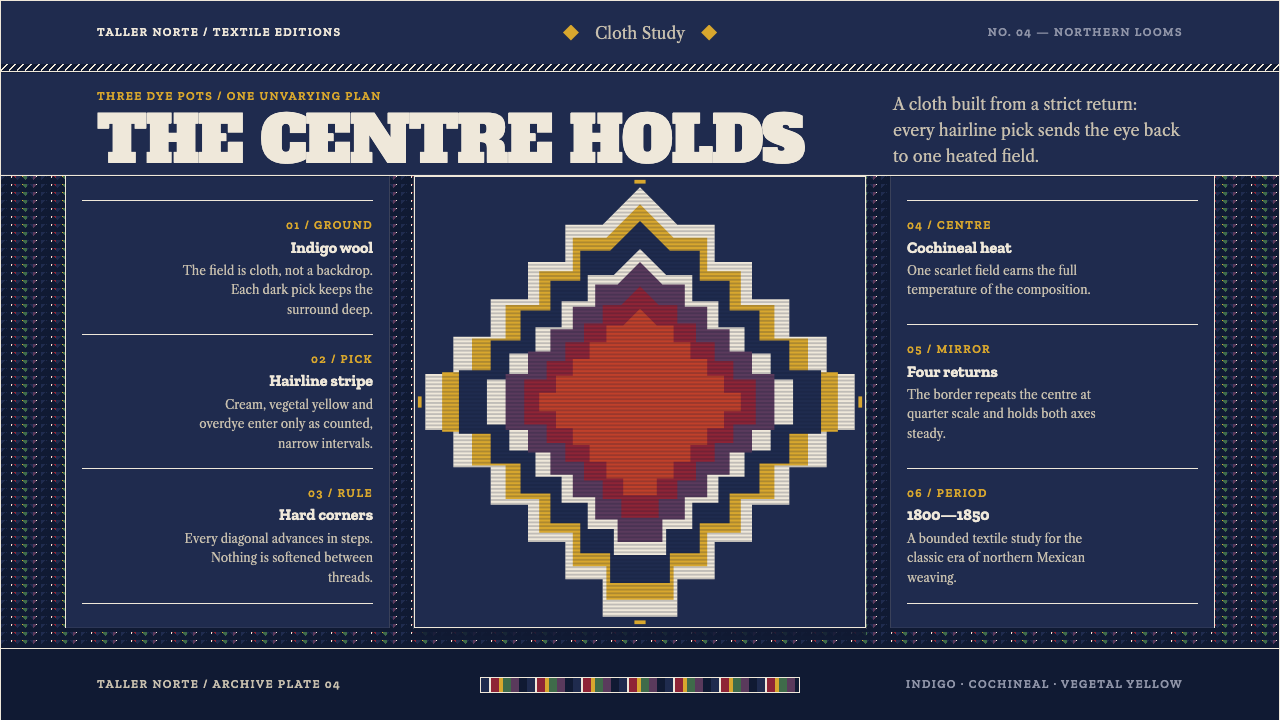
A Saltillo sarape spends all its heat in one place: a single cochineal-scarlet diamond, woven rather than drawn, floating in a field of indigo hairlines.
Saltillo Sarape in brief
The Saltillo sarape is a tapestry-woven wool blanket from Saltillo, in the dry north of Mexico. It follows a plan so consistent that it has become a kind of visual shorthand: a serrated diamond at the centre, a field of hairline zigzag stripes around it, a border that answers the centre, and a slit in the middle through which the head passes when the blanket is worn.
As a design reference it is a lesson in concentration. Three dye sources do almost all the work: cochineal for a deep scarlet, indigo for blue, and a regional plant yellow. Every other colour comes from overdyeing, where one dye is laid over another. The scarlet appears as a large field only once, at the centre, and that scarcity is exactly why it reads as heat. Spread across the whole blanket it would be wallpaper.
Visually the style is governed by the loom rather than by the hand. Edges step instead of curving, because a loom turns a corner at a right angle. Colour changes happen as hard breaks from one row of yarn to the next, never as blends. Curio's Saltillo Sarape system takes this literally: the page itself is indigo wool rather than white paper, and layouts behave like a woven plan, with one centre, one quiet field and one repeating border.

Where does Saltillo Sarape come from?
Saltillo is the capital of the northern Mexican state of Coahuila. The blankets that made its name were woven in the century and a half from about 1750 to 1880, and collectors usually point to the decades between roughly 1800 and 1850 as the classic period. 'Classic' here is a description of form rather than a sales word: it marks the years when the diamond, the stripes and the border settled into the arrangement everyone now recognises.
The tradition is usually described as Tlaxcalan-Spanish. It joins Indigenous weaving skill from central Mexico with the Spanish treadle loom, with wool from sheep the Spanish brought to the Americas, and with colonial demand for woollen cloth. That places the sarape inside the wider field of Mexican colonial textile arts, in which blankets, hangings and cloaks were practical goods first and works of art second, even when they ended up admired as both.
Charro dress supplied the sarape's social setting. In the nineteenth century a rider wore the blanket over the shoulders, and the garment had to be legible at a distance and in motion. It is easy to see why the composition works for that: one large bright centre can be read across a plaza, while the dense field of fine stripes shimmers as the wearer moves. The structure stayed recognisable for generations because it was already doing its job well.
The modern understanding of the form owes a great deal to researchers and writers such as James Jeter, Paula Marie Juelke and Mark Winter, whose work on Mexican textiles is how the Saltillo tradition is documented and discussed today. The diamond and the zigzag stripe have also been widely imitated in later souvenir weaving, which is one reason a clear account of the original structure matters when you borrow from it.
What defines the Saltillo Sarape look?
A Palette of Three Dyes
Cochineal supplies the scarlet, indigo the blue, and a regional plant dye the yellow. Because the colour comes from so few sources, everything sits together with the coherence of a single dye shop: reds run warm, blues run deep as ink. Overdyeing adds a few in-between tones such as violets and greens, but they remain supporting colours. The palette has a clear hierarchy in which scarlet is the event, indigo is the ground and yellow is a rare accent.
The Serrated Centre
The diamond at the heart of the blanket is not a smooth lozenge. Its edges are cut into small steps, like the teeth of a saw, because each step is a place where the weaver changes yarn. These teeth give the shape a vibrating outline and keep it from turning into a flat vector icon. In interface terms it is the single focal object: large, centred and frontal, with everything else on the page arranged to serve it.
The Hairline Stripe Field
Around the centre the blanket is filled with very fine zigzag stripes running the length of the cloth. Each is quiet on its own, but in great number they give the field a faint optical shimmer. The stripes establish rhythm without competing with the diamond, which makes them a useful model for any layout that needs a textured background that stays out of the way.
The Border as Echo
The border takes the diamond idea and repeats it at a smaller scale, so the edge of the blanket restates the centre. The result is a nested composition in which the eye is drawn inward and the frame confirms what it finds there. A layout built on this principle brings its main motif back once, smaller, at the margin, rather than introducing a second idea.
Loom Geometry
A loom cannot weave a true curve. Every diagonal becomes a staircase and every turn becomes a right angle. This constraint is the visual signature of the style: no rounded corners, no feathered edges, no gradient fills. An interface derived from the sarape keeps its corners square and builds its shapes from rectangular units, so that even the diamond is made of blocks.
Wool as the Ground
The dark blanket is the page. Nothing here is paper-white: the background is dyed wool, dense and matte, and light sits on it rather than glowing from within. That makes the style a dark-surface tradition by nature, with warm accents standing out against a cool, deep field, exactly as scarlet does against indigo.

Who shaped Saltillo Sarape?
A researcher whose name, together with Paula Marie Juelke's, is closely tied to the scholarly study of Saltillo sarapes. Work of this kind is what allows the blankets to be read as a system, with centre, field, border and a classic period, instead of as an undifferentiated pile of old textiles.
Co-researcher with Jeter in the study of Saltillo sarapes. The pairing of their names in the literature is a reminder that this tradition is known largely through close looking at surviving blankets: how colour is layered, how stripes are arranged, how the diamond is cut.
A writer on Mexican handwoven textiles whose work sits alongside Jeter and Juelke's in the literature on the sarape. Authors like this matter to designers because they preserve the vocabulary of the craft, including how few dye sources are involved and how colour is built by overdyeing, which keeps a derived design honest about its origin.
The anonymous weavers of Saltillo and the charro riders who wore their work are the real authors of the style. The weavers settled the plan and the dyes; the riders ensured it had to be bold, legible and durable. Most individual makers went unrecorded, so the authorship of the tradition is collective.
How do you use Saltillo Sarape today?
The Saltillo Sarape style is a dark, warm-on-cool system with a single point of focus, which makes it unusually easy to apply once its rule is clear: one centre of heat, and everything else in service of it. Treat scarlet as a scarce resource, spend it once per view, and let the indigo field do the rest of the talking.
For presentation slides, a cover works well when it is built like the blanket. Put a stepped diamond at the centre in scarlet against a deep indigo ground, add a border that echoes the diamond at a smaller scale, and set the title in quiet light type close to the centre. Content slides keep the indigo ground and use a thin stripe band or a modest border to hold the page together. Data slides suit stepped bar charts and block-built diagrams, with a single highlighted series in scarlet and the remaining series in cooler indigo-family tones.
For web interfaces, the style suits dashboards, portfolios and product pages that benefit from a strong focal point. A hero section can place one scarlet diamond or one scarlet call to action in an indigo field, while navigation and secondary elements stay in muted cool tones. A pricing page can feature a single recommended plan as the scarlet centre. Keep corners square, replace soft shadows with flat layering, and give cards the feel of woven panels rather than floating glass.
In editorial and marketing work, the sarape supports travel, craft, heritage and food stories, and campaigns that want warmth with seriousness. Use fine repeating stripe bands as section dividers, a bordered frame for pull quotes, and a single warm photograph or illustration treated as the page's centre. The stripe pattern also works as a subtle full-width texture behind a header, as long as it stays finer than the type set on top of it.
The common mistake is to put scarlet everywhere. Once red appears on buttons, headings, icons, charts and backgrounds at once, the centre loses its power and the page reads as a generic dark theme with warm accents. A second error is softening: rounded cards, blurred shadows and gradient fills contradict the loom logic that defines the style. Finally, avoid turning the diamond into a wallpaper repeat. On the blanket it appears once at the centre and once, smaller, at the border.

Saltillo Sarape — FAQ
What are the defining parts of a Saltillo sarape?
There are four: a serrated diamond at the centre, a field of hairline zigzag stripes around it, a border that echoes the diamond, and a neck slit at the middle so the blanket can be worn. The three dye sources, cochineal, indigo and a regional plant yellow, supply the colour. Together these give the piece an unmistakable plan, and a design derived from it should keep the plan rather than copying only the colours.
Why does the red feel so strong against the blue?
There are two reasons. The first is the dye: cochineal is a red made from a small insect that lives on cactus, and it gives a deep, saturated scarlet that holds its own against a dark field. The second is proportion: the scarlet appears as a large field only once, so it works as a focal point. If red were scattered across the whole surface its effect would be diluted. In design terms, intensity comes from scarcity.
Can this style work on a light background?
It can, but the logic changes. The tradition's identity is a warm centre in a deep cool field, with the indigo wool acting as the page. On a light page the hairline stripes lose their shimmer and the scarlet loses its glow, so a light adaptation should keep a substantial dark indigo area, such as the central panel or the header band, rather than inverting everything to white.
Is a gradient ever appropriate?
Not in the original. Every colour transition on the blanket is a discrete change from one pick of yarn to the next, and the loom cannot weave a smooth curve or a feathered edge. If you need a sense of depth, build it from stepped bands of tone or layered flat panels rather than a blur.
What kinds of products suit the Saltillo Sarape style?
Anything that benefits from heritage, warmth and a single decisive focal point: craft and cultural brands, hospitality, food and beverage, editorial platforms, portfolio sites and event pages. It struggles where neutral, high-density information display is needed, such as data tools with many equally weighted elements, because the style's whole premise is that one thing matters more than the rest.
Related design styles
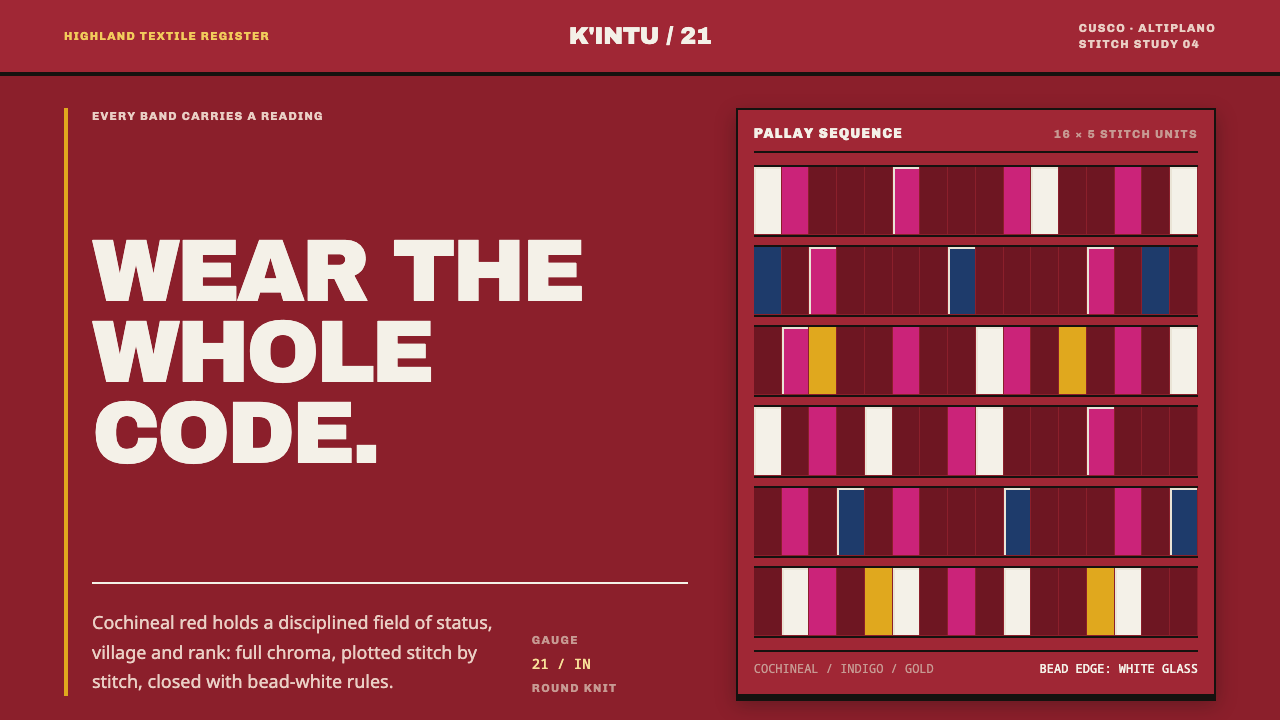 Andean ChulloOrnament carries a code. Cochineal red stacks strict stitch bands with bead-w…
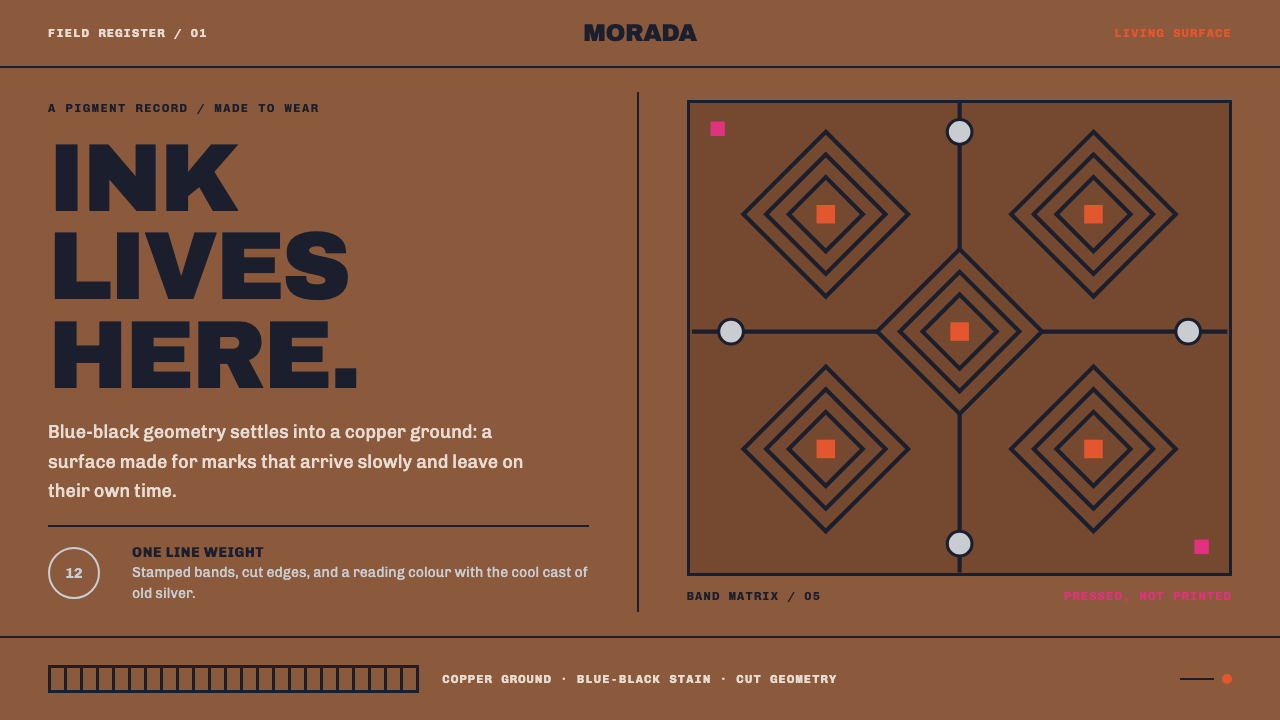 Emberá JaguaA living stain, never a print. Blue-black diamond bands press across copper s…
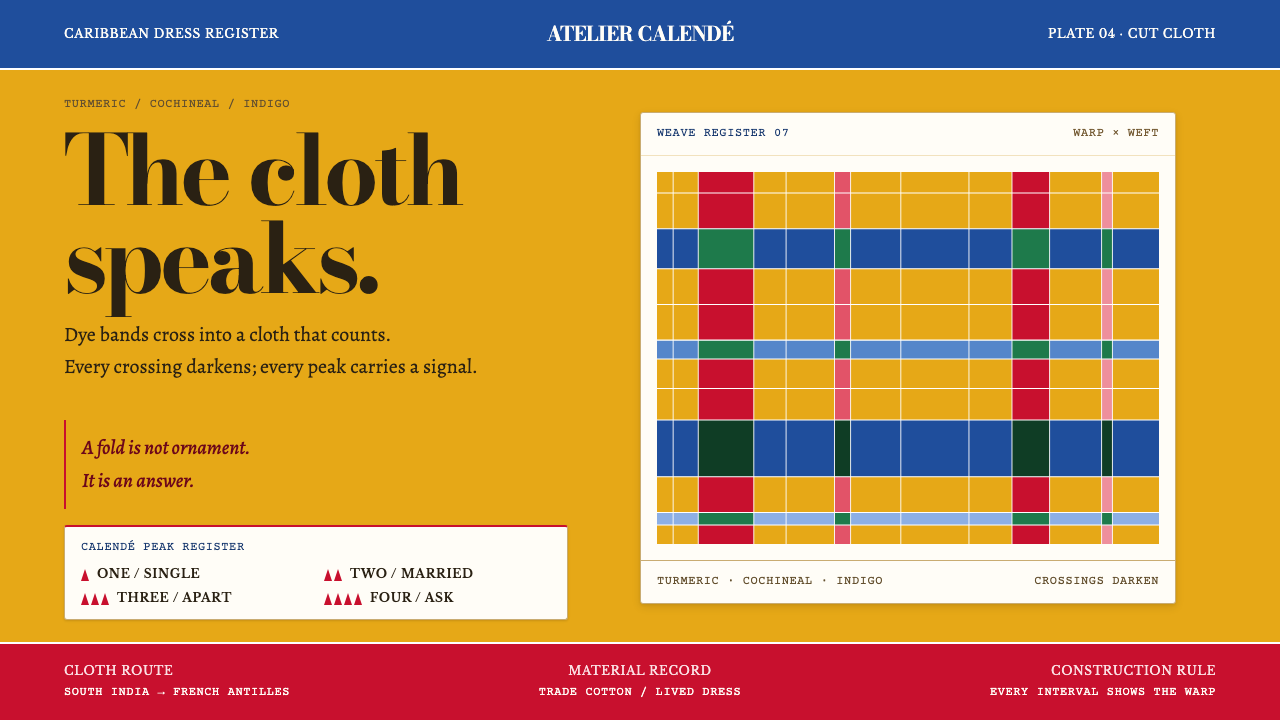 Martinique MadrasA plaid with a voice. Turmeric, cochineal and indigo bands darken at every wo…
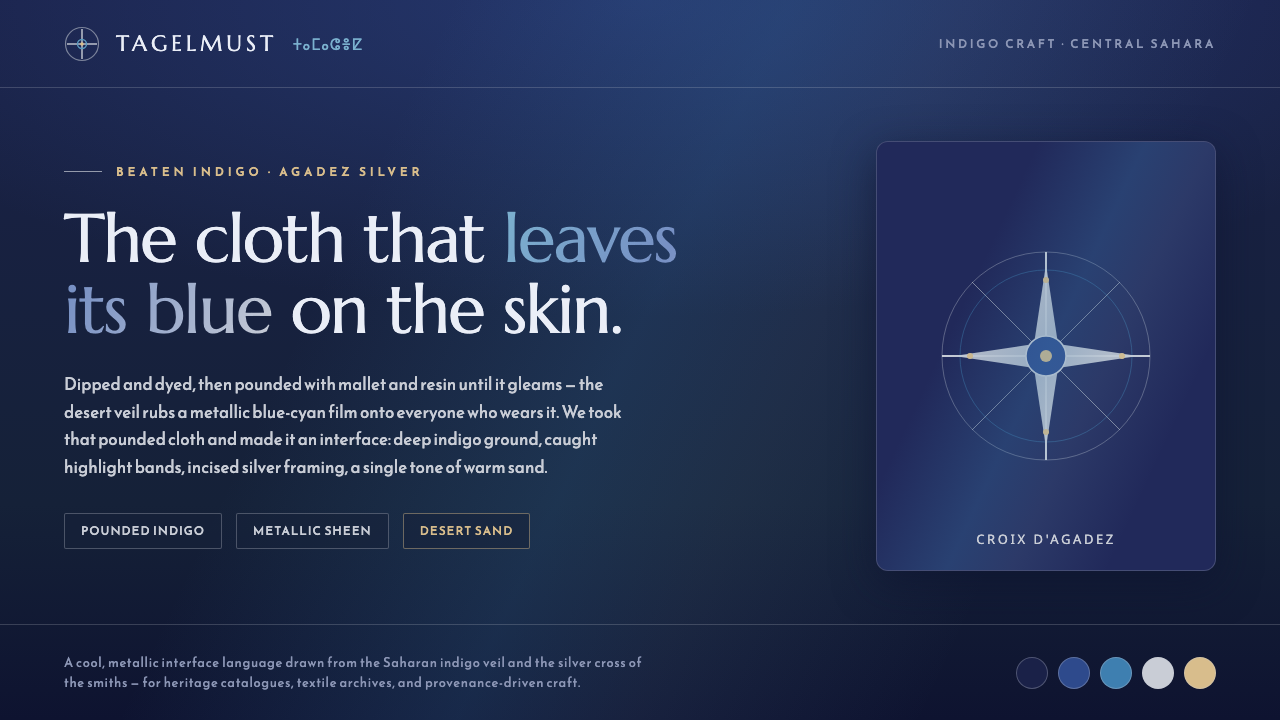 Tuareg Indigo VeilThe cloth that leaves its blue on skin. Pounded-indigo ground, metallic blue-…
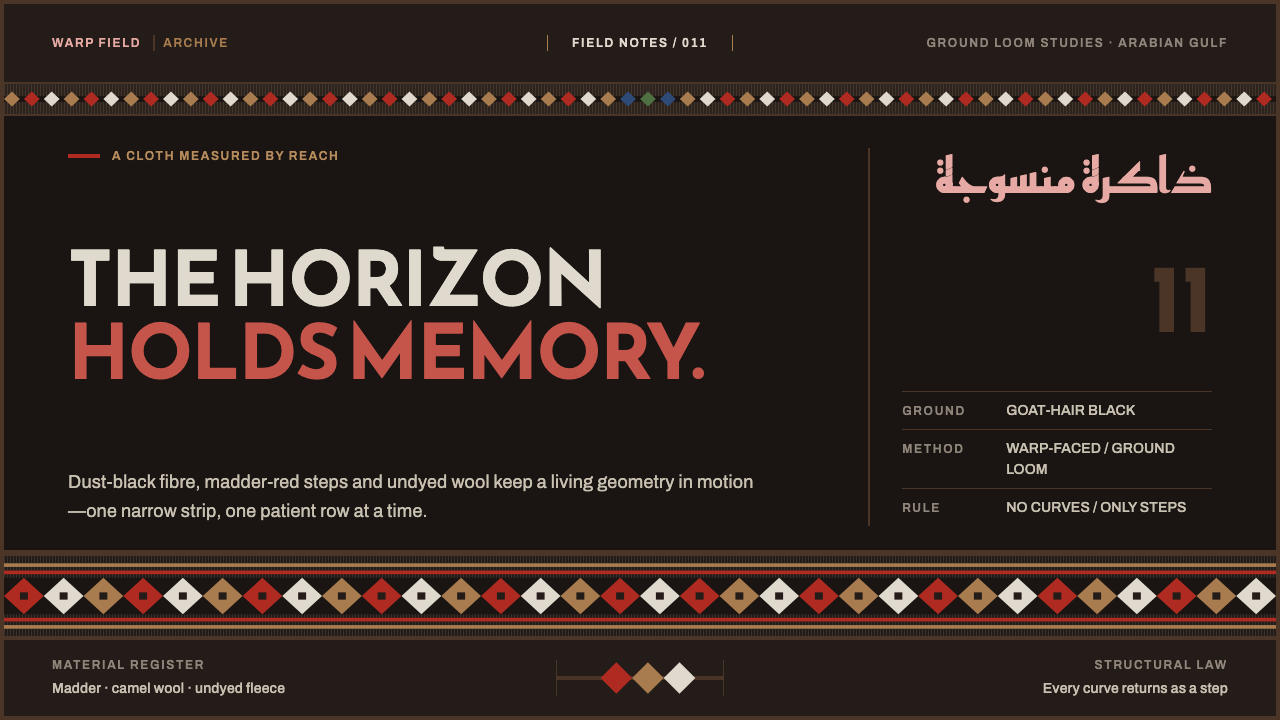 Emirati Sadu WeavingMemory runs in bands. Madder steps cross dusty goat-hair black with no curve…
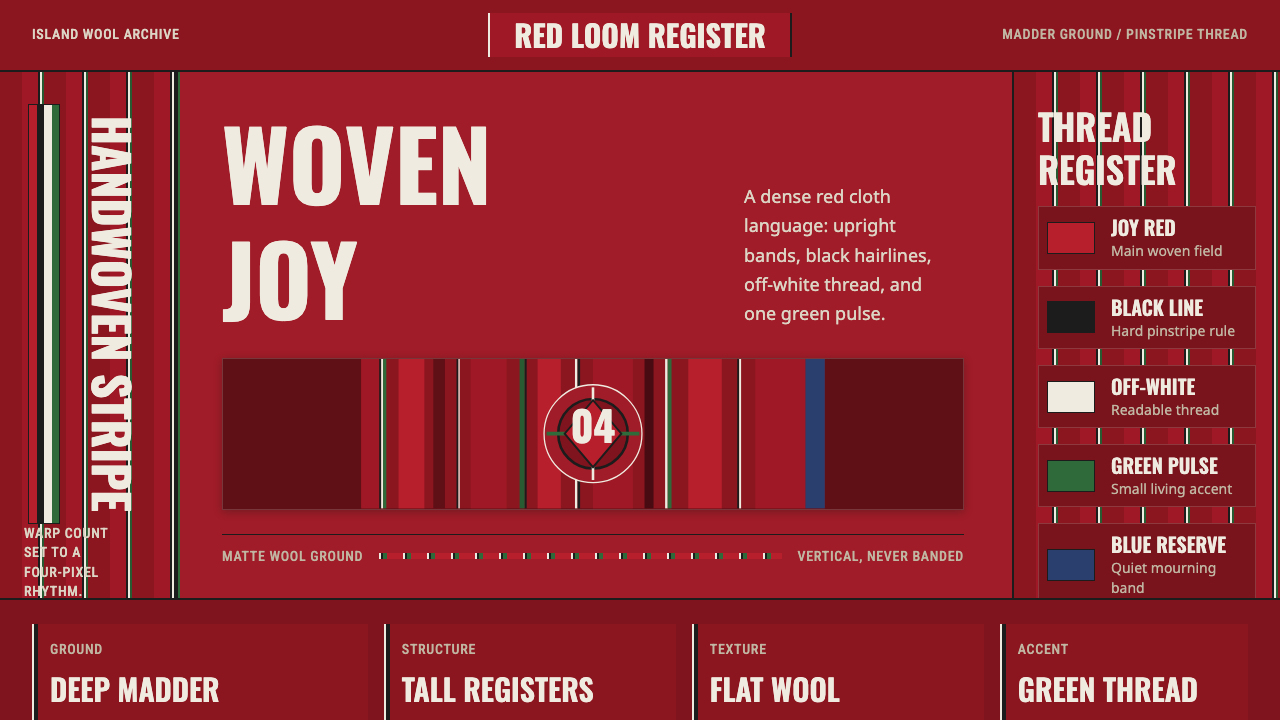 Estonian Kihnu Island SkirtJoy is woven vertical. Madder red ground, Oswald stripes, black and green pin…