What is Tuareg Indigo Veil?
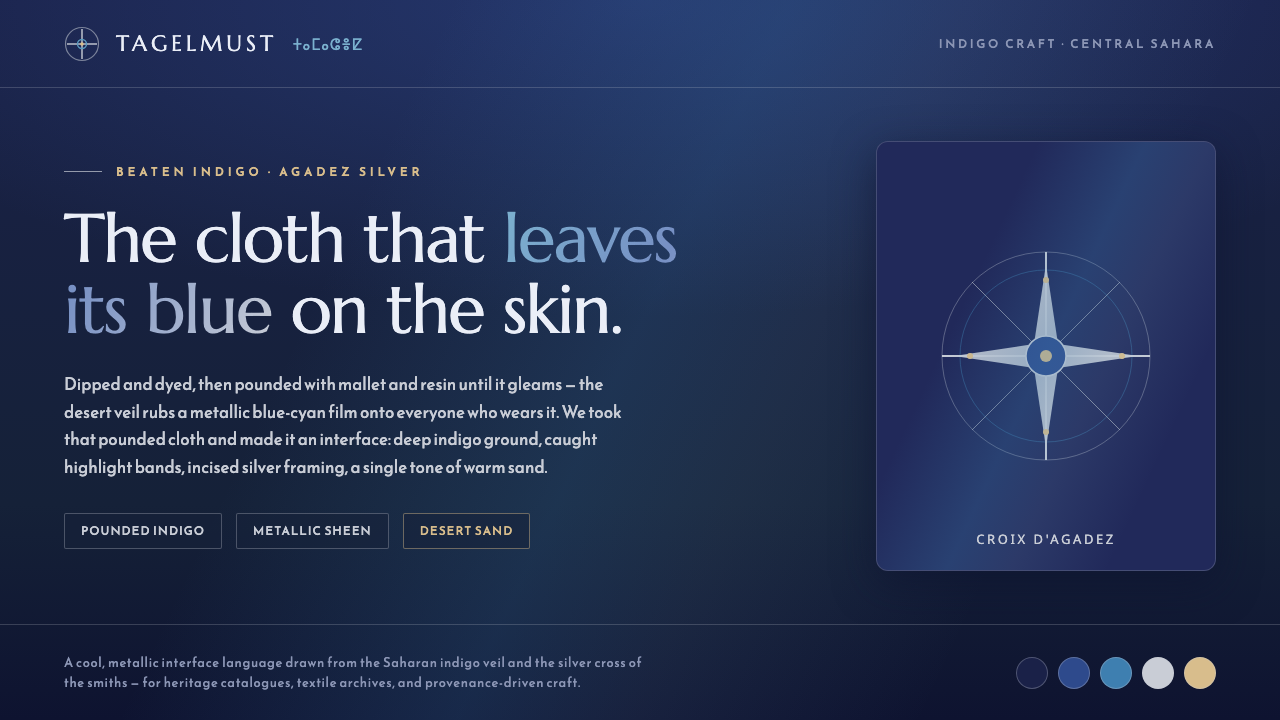
Tuareg Indigo Veil turns the rubbed radiance of pounded indigo cloth into a dark interface language of blue-cyan sheen, silver incision, and desert restraint.
Tuareg Indigo Veil in brief
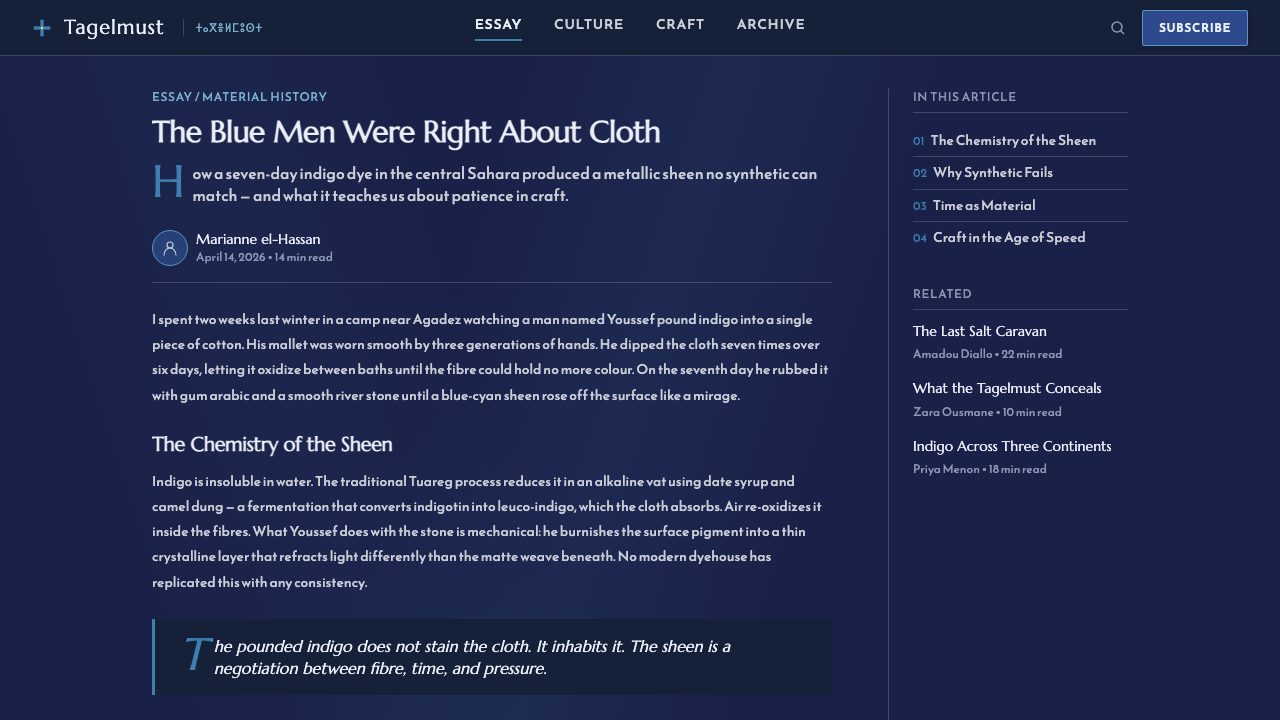
Tuareg Indigo Veil draws from the tagelmust, the indigo head-and-face veil worn by Tuareg, or Kel Tamasheq, men across the central Sahara. Its visual premise is unusually physical: cloth is dyed through repeated indigo dips, then beaten with a wooden mallet and resin until the surface acquires a metallic-looking gleam. The finish does not remain neatly on the fabric. It can rub a blue-cyan cast onto skin, giving rise to the desert image of the blue men.
As a design system, the style begins with a deep, saturated indigo field rather than a neutral dark ground. Lighter rubbed blue-cyan bands rise from that darkness as though they have been revealed by pressure, movement, and wear. Silver-grey linework refers to the Agadez cross and related silverwork, while warm desert sand keeps the composition from becoming cold, digital, or merely futuristic.
The result is not a fabric simulation. It is an interface translation of cloth behavior: large flat indigo planes carry brushed highlight bands, and fine silver marks feel incised into the surface rather than placed decoratively over it. The visual language depends on contrast between mass and trace, shadowed dye and rubbed brilliance, silence and a small number of deliberate ornaments.
Where does Tuareg Indigo Veil come from?
The source tradition is the tagelmust or litham indigo veil tradition of the central Sahara, spanning Mali, Niger, Algeria, and Libya. It is associated here with a long-running nomadic practice, especially during the period from 1900 to 1950. The garment covers the head and face of Tuareg men, making textile, identity, movement through desert conditions, and visible bearing inseparable rather than separate concerns.
Its defining surface comes from process. Indigo is built through repeated dyeing, then worked with a wooden mallet and resin. Beating changes the cloth from a simple colored textile into a denser visual presence: a pounded indigo ground with a sheen that reads as metallic blue-cyan. The phrase blue men points to the striking consequence of this material culture, in which the finish can transfer color onto the wearer’s skin.
A second source is the silverwork of Agadez, particularly the Agadez cross made by silversmiths of the Inadan caste. In an interface adaptation, this does not require literal reproduction of jewelry. Its value lies in the contrast it establishes: bright, narrow silver-grey marks against broad indigo fields. The cross provides a model for linework that is symbolic, crafted, and visibly intentional.
Tuareg Indigo Veil therefore joins two related visual conditions without flattening either one into generic ornament: the cloth’s pounded and rubbed luminosity, and silverwork’s incised precision. The central Sahara supplies more than a mood board. It supplies a material logic in which depth comes from dye, brightness comes from abrasion, and detail carries the concentrated force of metal against cloth.
What defines the Tuareg Indigo Veil look?
Pounded Indigo Ground
The base should feel saturated, deep, and materially worked rather than empty. It is a field of indigo with density, not a generic black backdrop. Large uninterrupted areas make the surface feel like cloth and give every later highlight or silver mark a reason to exist.
Rubbed Blue-Cyan Sheen
Brightness appears as a rubbed or brushed lift from the indigo ground, recalling cloth polished through beating. It should travel in restrained bands or local passages, never dissolve into a broad decorative glow. The sheen suggests pressure and contact: it is evidence of a surface, not ambient light.
Silver Incision
Silver-grey detail is narrow, crisp, and sparingly deployed. Inspired by Agadez-cross silverwork, it works best as borders, separators, directional marks, or compact emblems. These lines should read as cut or engraved into the indigo field, preserving the tension between broad textile mass and precise metal-like detail.
Desert Sand Counterpoint
Warm desert sand is a counterweight, not a second dominant ground. It can hold supporting copy, quiet panels, or moments of pause between indigo sections. Its role is to make the cool metallic sheen feel tactile and terrestrial, preventing the palette from drifting into an abstract night-sky aesthetic.
Flat Fields, Worked Surface
Composition stays flat and graphic, but the flatness is not sterile. Saturated indigo blocks carry selective brushed bands and incised linework, producing a surface that feels handled without becoming pictorial. The style is strongest when texture is implied by a few purposeful interventions rather than layered everywhere.

Who shaped Tuareg Indigo Veil?
Tuareg men are the wearers associated with the tagelmust, the indigo head-and-face veil at the center of this system. Their presence anchors the style in a living practice of dress and material transformation, rather than in an abstract color scheme. The blue-men image comes directly from the rubbed transfer of pounded indigo onto skin.
The Agadez silversmiths of the Inadan caste provide the system’s second formal source through silverwork and the Agadez cross. Their contribution to the visual language is concentrated rather than expansive: bright metal-like marks, clear symbolic form, and fine detail that gains force by appearing against a dark textile ground.
The tagelmust is the material and visual center of the theme. Repeated dyeing, beating with a wooden mallet and resin, and the resulting metallic blue-cyan sheen define the system’s hierarchy: indigo mass first, rubbed luminosity second, then the smallest silver or sand accents.
How do you use Tuareg Indigo Veil today?
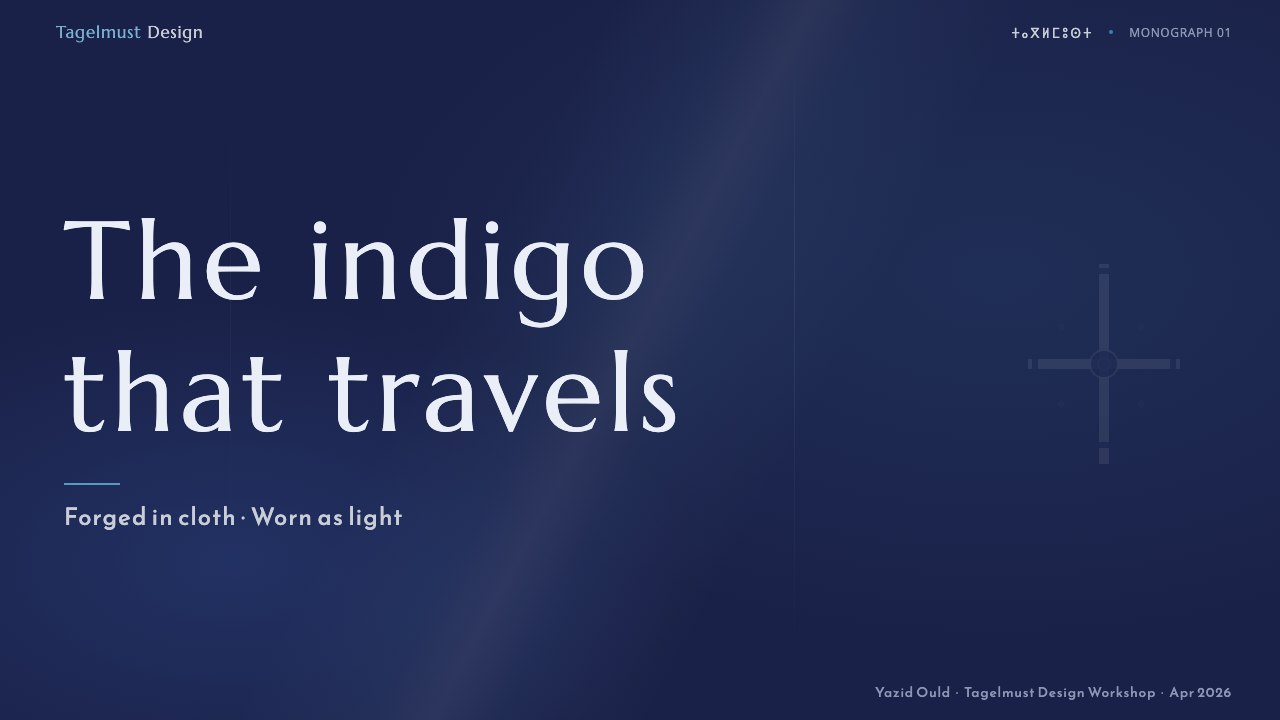
For presentation covers, let one expansive indigo field establish the page, then introduce a restrained blue-cyan brushed passage near the title or as a directional sweep. A compact silver emblem or incised rule can supply focus without turning the cover into costume imagery. Content slides should preserve the same hierarchy: indigo for major framing, sand for reading relief, and silver only where a distinction needs to be made.
Data slides benefit from the theme when charts are treated as carved or inlaid objects rather than colorful decoration. Use indigo as the surrounding mass, distinguish the principal series with rubbed blue-cyan, and reserve silver-grey for rules, labels, or a quiet reference series. The objective is legibility through contrast of material roles, not an attempt to make every category equally vivid.
For web interfaces, the system suits dashboards, analytical views, member areas, and pricing pages that need depth without softness. Deep indigo can establish navigation and primary panels, while sand panels create calmer reading zones. Silver incisions make strong dividers, selected states, and compact controls; blue-cyan sheen should identify priority movement or attention, not become a permanent glow around every interactive element.
For editorial and marketing work, use the style to create an atmosphere of craft, distance, and concentrated value. Long-form pages can alternate dense indigo chapters with sand-colored reading intervals, while campaign modules can use one silver-cross-like mark as a recurring anchor. The common mistake is treating the system as generic desert luxury: adding ornate patterns, excessive metallic effects, or many competing highlights loses the force of the source. The cloth is powerful because its blue, sheen, and mark-making are disciplined.
Tuareg Indigo Veil — FAQ
Is Tuareg Indigo Veil simply a dark luxury style?
No. Its dark ground has a specific material origin in pounded indigo cloth, and its brightness is tied to rubbing, beating, and sheen rather than generic premium gloss. Silver detail comes from Agadez-cross silverwork, while sand introduces the central Sahara as a counterpoint. If these relationships disappear, the result becomes a broad dark-and-metallic look rather than this particular system.
How should the blue-cyan sheen be used?
Treat it as a rubbed reveal from the indigo surface. It is most convincing in bands, edges, or local passages that imply pressure and handling. Used everywhere, it becomes a conventional digital glow and loses the connection to cloth that was dyed repeatedly and beaten until it gleamed.
Should the Agadez cross be copied literally into every layout?
No. The stronger approach is to learn from its role in the system: concentrated silver-grey precision against indigo mass. A compact emblem, an incised divider, or a small directional motif can carry that relationship without turning the cross into a repeated decorative stamp.
Where does this style work best?
It works best where a dark, concentrated interface can support a clear hierarchy: dashboards, analytical products, member spaces, pricing pages, editorial features, and focused campaign pages. It is less suitable when the product needs a light, playful, or highly casual atmosphere, because the pounded-indigo ground and silver incision naturally communicate gravity and deliberation.
Related design styles
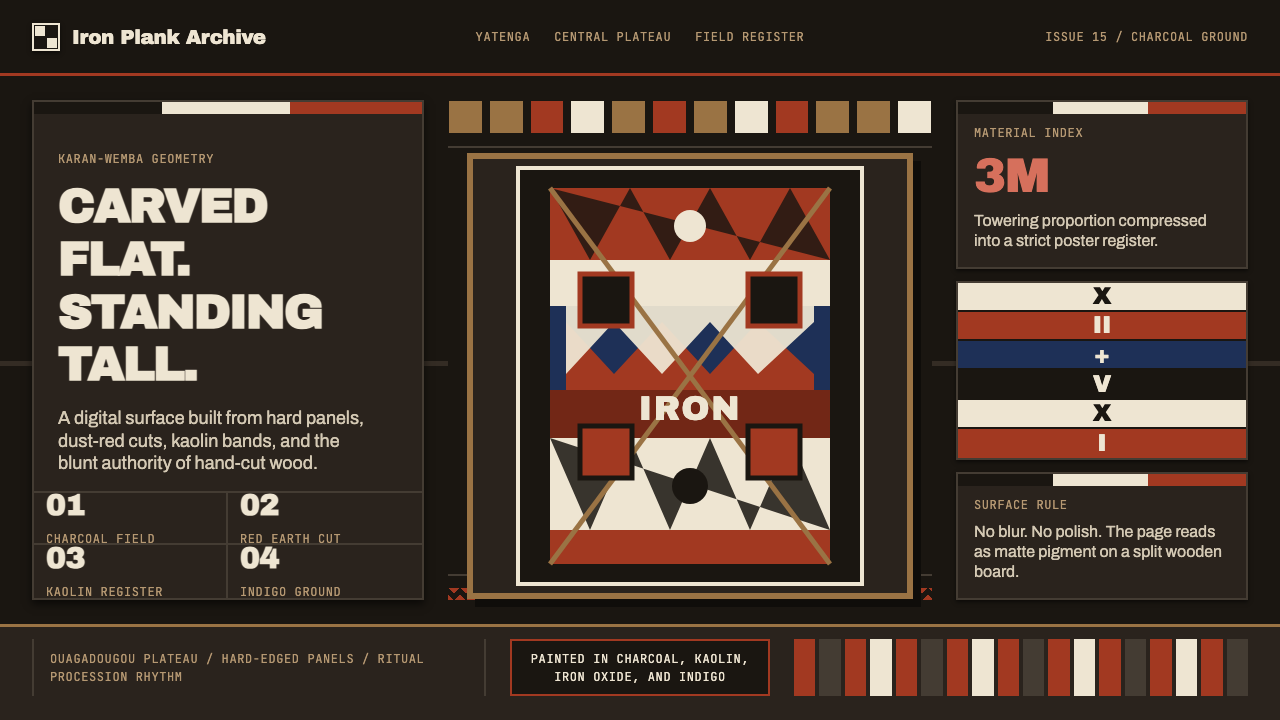 Mossi Burkina Plank MaskCarved, not rendered. Charcoal fields, dust-red cuts, and kaolin bands stack…
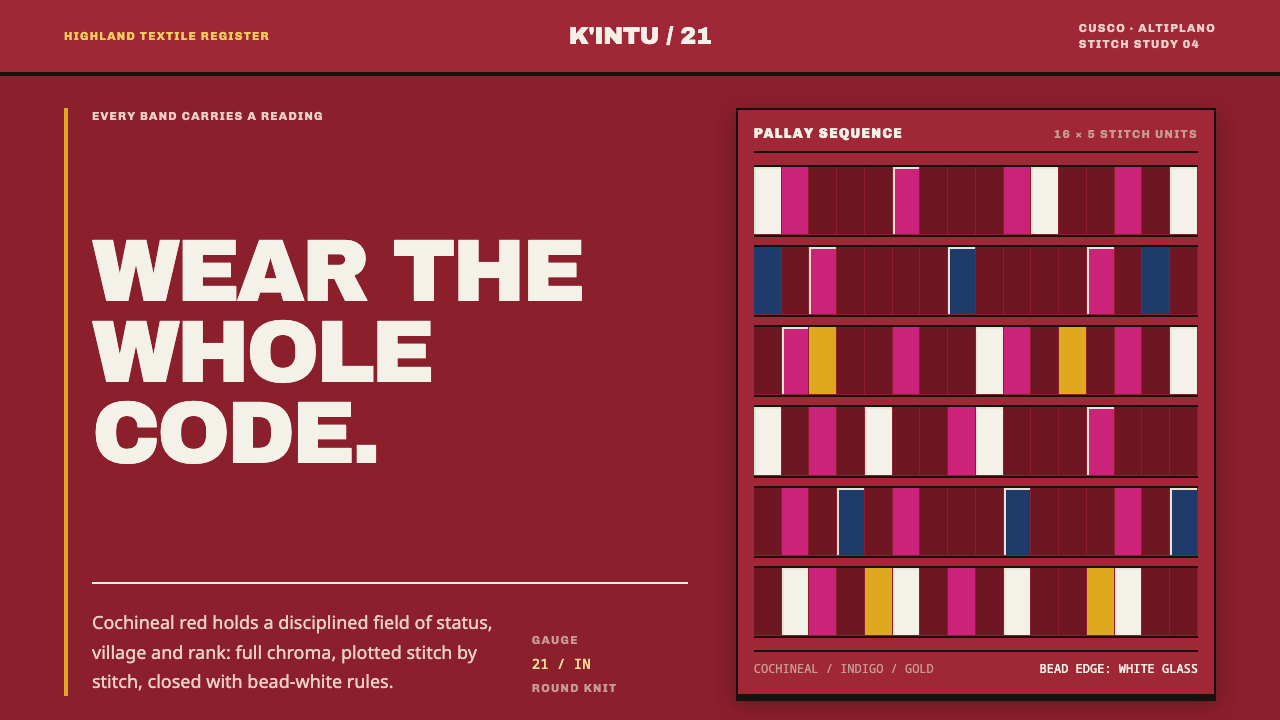 Andean ChulloOrnament carries a code. Cochineal red stacks strict stitch bands with bead-w…
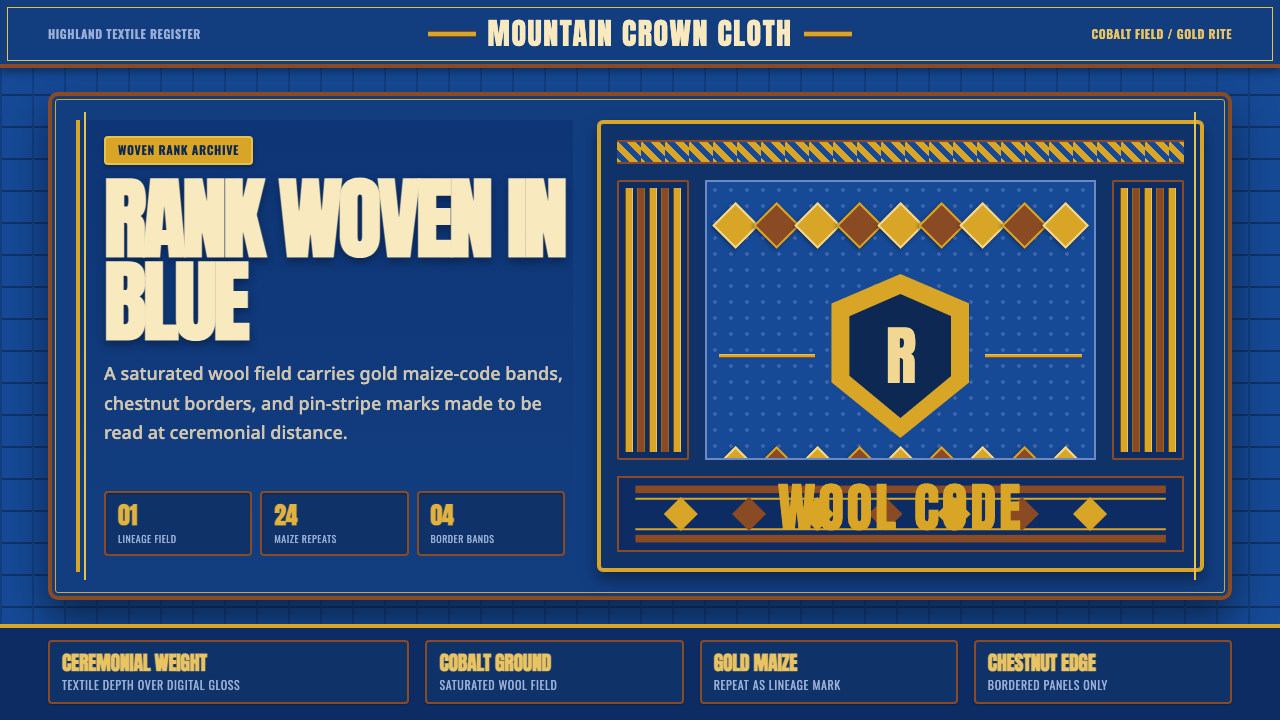 Basotho Seanamarena BlanketRank made visible. Cobalt wool, gold maize diamonds, and chestnut borders rea…
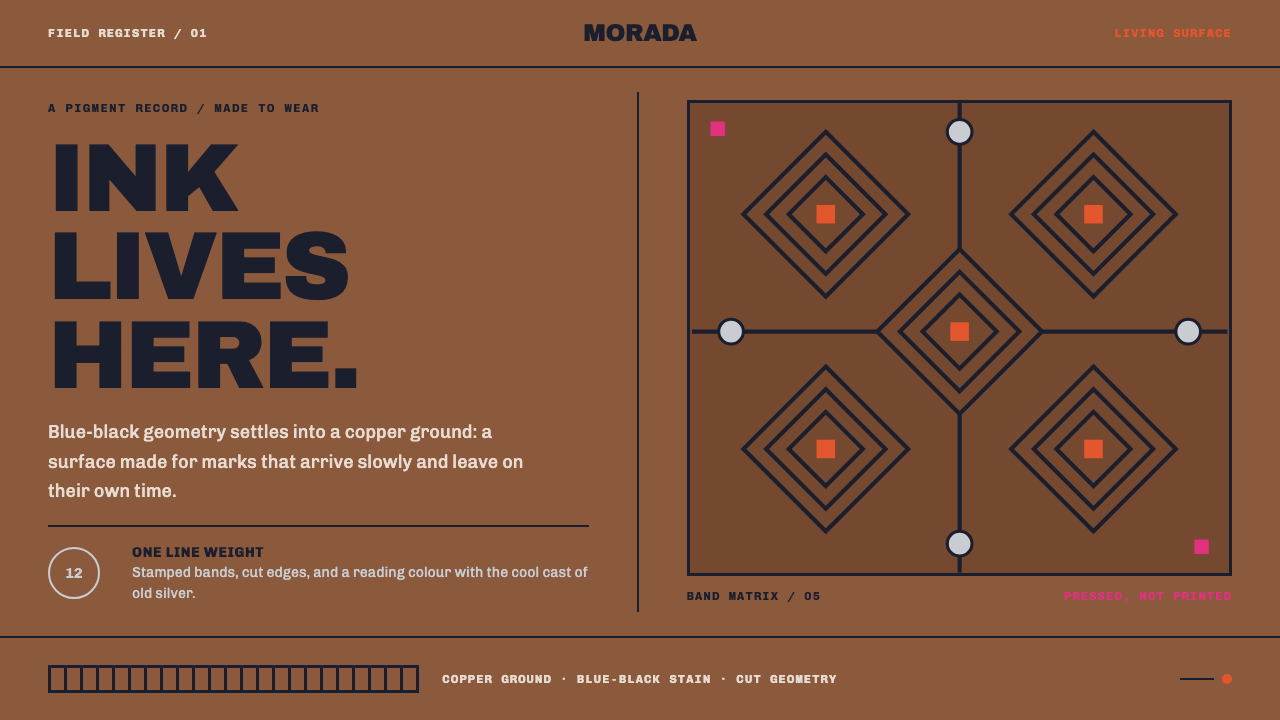 Emberá JaguaA living stain, never a print. Blue-black diamond bands press across copper s…
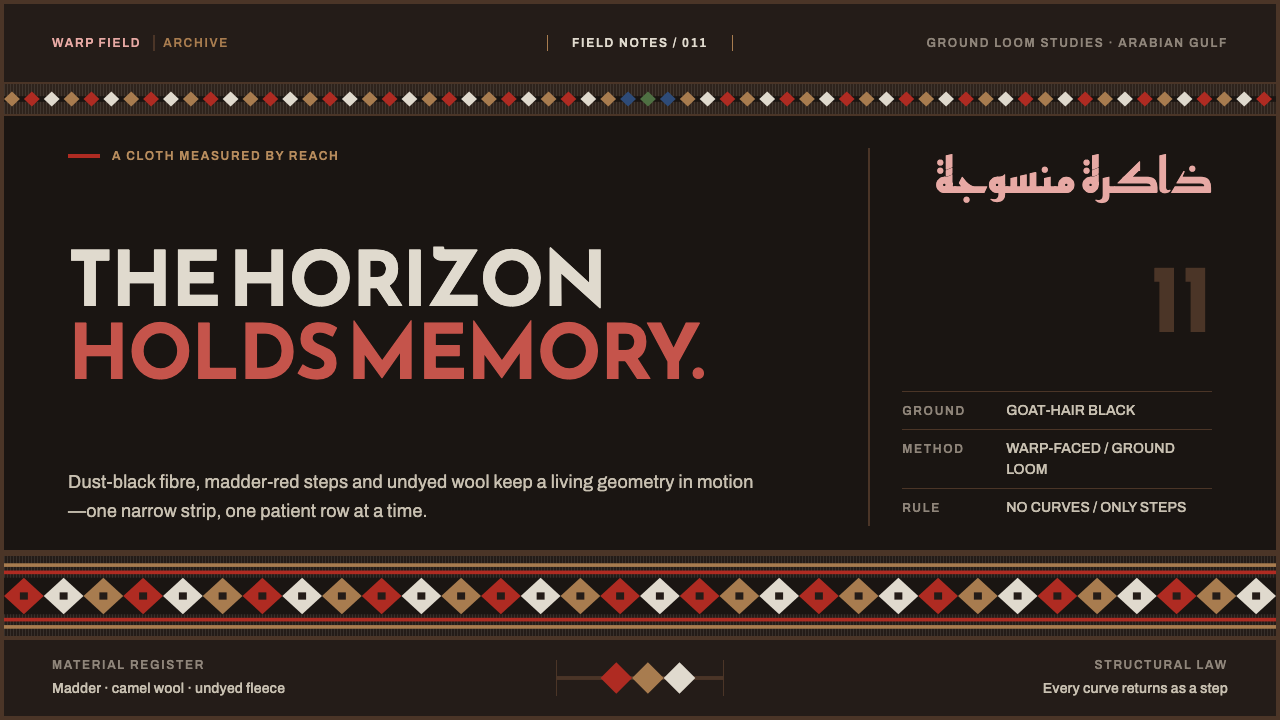 Emirati Sadu WeavingMemory runs in bands. Madder steps cross dusty goat-hair black with no curve…
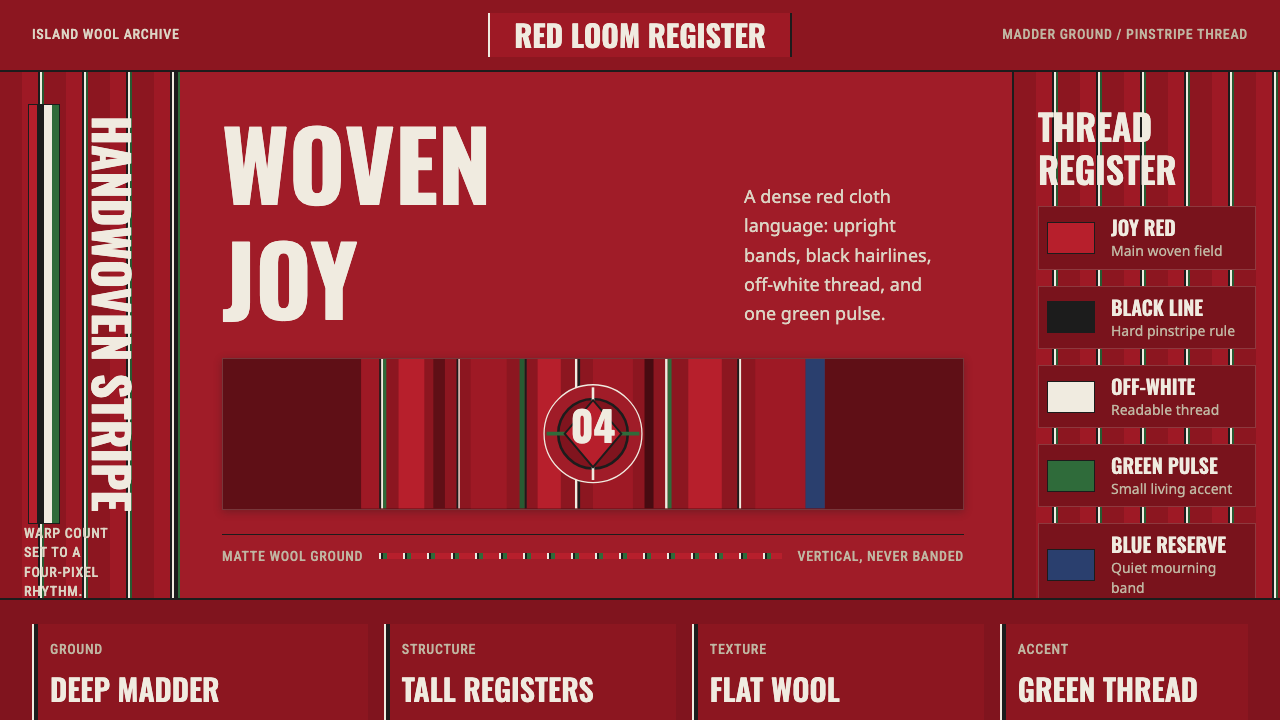 Estonian Kihnu Island SkirtJoy is woven vertical. Madder red ground, Oswald stripes, black and green pin…