What is Martinique Madras?
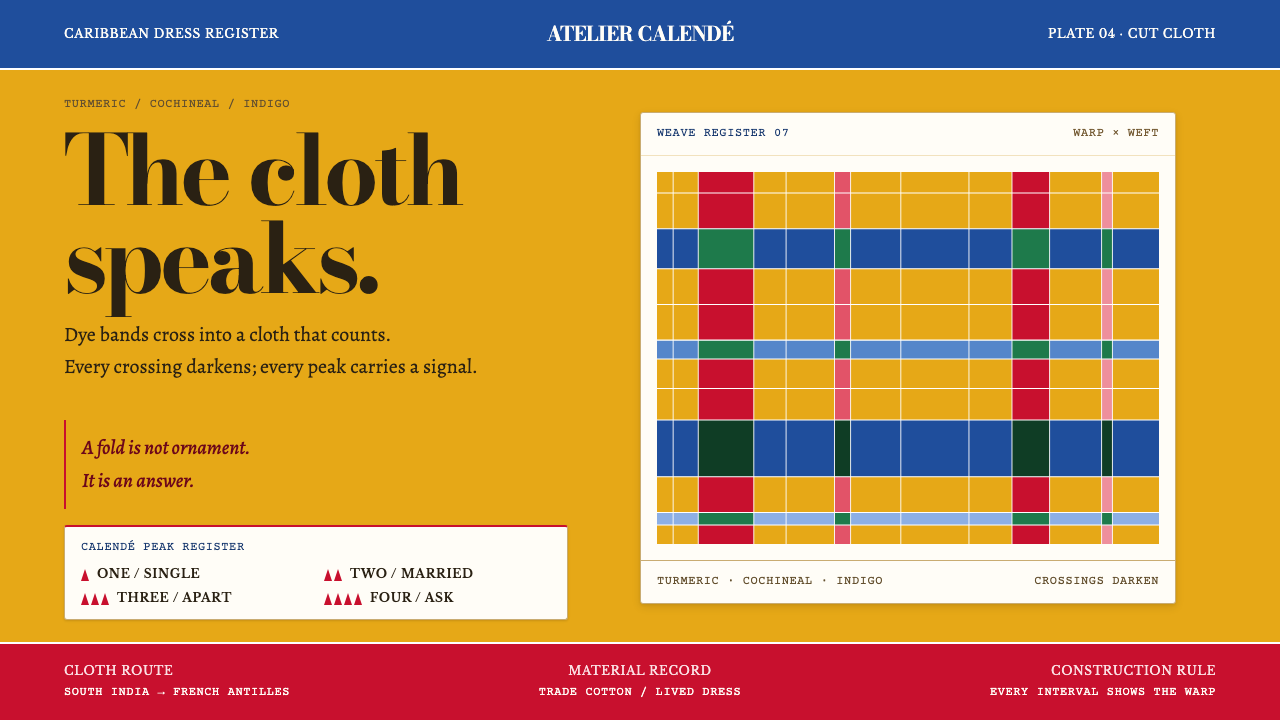
Madras is a woven fact before it is a pattern — dyed bands that cross, darken where they meet, and fold on the head into a code a whole street could read.
Martinique Madras in brief
Martinique Madras is the visual language of a cloth that crossed an ocean and became a way of speaking. It starts from checked cotton woven in Madras, today's Chennai, in South India, dyed with turmeric, cochineal and indigo, and follows that cloth to the French Antilles, where it turned into the everyday dress of Martinique and Guadeloupe: the grande robe créole, the foulard worn at the shoulders, and above all the calendé, a headtie folded into pointed peaks.
The defining idea is that the plaid is structural, not decorative. Bands of unequal width run in both directions and cross at right angles. Hairline white rules mark the intervals between them. Wherever two coloured bands meet, the crossing is darker than either band that made it. That darkening is not a shading effect added afterwards; it is what happens when two layers of dyed thread lie over one another in a weave. Read this way, a madras is a small lesson in how pattern grows out of material.
In tonal terms the cloth sits in a warm, earthy, saturated family: the sunlit yellow of turmeric, the deep red of cochineal and the ink-leaning blue of indigo, interrupted by the clean cut of white. As a design system it favours flat, woven-looking fields over gloss, edges that drift slightly the way handwoven cotton does, and a regularity that is close but never mechanical. It is a style about warmth, identity and being seen on the street, not about polish.

Where does Martinique Madras come from?
The story begins with trade cloth. In the eighteenth and nineteenth centuries, cotton woven in Madras went out along the Indian Ocean cotton trade and into the Caribbean, travelling the colonial routes of the period. The dyes that coloured it came from root and insect rather than from a factory. Turmeric supplies a warm, earthy yellow that is not quite a pure primary. Cochineal supplies a red that leans toward crimson and wine. Indigo supplies a blue that deepens with every dip into the vat. Because those dyes behave differently from one another and from batch to batch, the cloth never looked identical twice, and that variability is part of what the design system keeps.
On arrival in Martinique and Guadeloupe the cloth stopped being merchandise and became dress. Antillean Creole women made it into the grande robe créole, into the foulard, and into the calendé, the headtie folded into peaks. This is the crucial turn in the history: the fabric was imported, but the way of wearing it was invented in the islands. The Smithsonian's National Museum of African American History and Culture holds a Guadeloupe madras headdress in its collection, catalogued as object 2015.153, which is one reason the knotted headtie can be studied as a made thing and not only as a photograph.
The knot is where the cloth becomes language. The count of peaks carried meaning: one for a woman who was single, two for married, three for widowed or divorced, and four for open to whoever asked. A passer-by could read that status across a market or a doorway without a word being spoken. This is public information encoded in fabric, and it explains why the design system treats the plaid as a communicative structure. A code that must be read at a glance only works if the cloth is legible, which means clear bands, clear rules and a few strong colours rather than a murmur of small tones.
The tradition did not end with the trade. The cloth was carried forward into twentieth and twenty-first century festival and heritage wear, where it still appears in the islands as a marker of belonging and occasion. The system distils the textile's logic rather than any single garment: cross-banding, darkened crossings and hairline white are kept, while the costume itself is left to the people who wear it. That restraint matters. The aim is to borrow how the cloth is built, not to dress an interface up as an exotic outfit.
What defines the Martinique Madras look?
Colour from the Dye Vat
The palette belongs to the dye shop, not the screen. Turmeric gives an earthy, sunlit yellow; cochineal gives a red that leans toward crimson rather than orange; indigo gives a blue that deepens toward ink. White enters only as thread, in thin rules and in the cloth's own ground, never as a flood. Because natural dyes shift with every dip, the three hues sit close enough in weight to feel woven together rather than printed side by side.
Unequal Bands
Bands never share a single width. A broad band, a medium band and a narrow band follow one another and repeat over a long enough span that the eye never settles into an even stripe. Broad bands carry colour; narrow bands act as punctuation. The rhythm is closer to a spoken phrase than to a ruler, which is what gives the plaid its sense of a voice.
The Darkened Crossing
Wherever two coloured bands cross, the intersection is darker than both of them. It is the single rule that makes the system recognisable. Translated into interface terms, overlapping fields resolve into a deeper tone of the same family rather than into a clashing third hue or a drop shadow. Depth is shown by layering inside the weave, not by pretending a light source exists.
Hairline White Rules
Fine white rules mark the intervals between the coloured bands. They behave like grout between tiles: they separate, they count, and they let each band keep its identity next to a neighbour of similar weight. They are always thin and always white, and they never turn into borders around boxes. Their job is to measure the cloth, not to frame it.
Handwoven Drift
Handwoven cotton drifts at its edges, and the system lets it. A repeat may run a little long, a band may wander slightly off true, and an end may look softly frayed. Regularity that is perfect to the last hair reads as false, as if a machine had imitated a loom. The right tolerance is human: close enough to feel ordered, loose enough to feel made.
Matte Cotton Surface
Cotton is dry and absorbent, so the surface is matte throughout. There are no glassy highlights, no glossy gradients and no neon glow. Where a sense of volume is needed it comes from the soft rounding of a folded headtie or from layering within the weave, never from synthetic shine. Everything on the page should look as though it could be touched and would feel like cloth.
Pattern as Message
The calendé shows that a pattern can carry information: a count of folded peaks tells a story at a glance. The system borrows the principle. Colour, band width and number are meant to signal something, such as a tier, a state or a category, rather than simply fill space. If a band exists, it should be there for a reason that a viewer could learn to read.

Who shaped Martinique Madras?
The record credits the women of the French Antilles with turning imported cotton into a system of dress and with codifying the tête calendée, the headtie whose peaks announced marital status. They are the authors of the code that gives this style its meaning. The grande robe créole, the foulard and the calendé together form a complete outfit, and the way of wearing them was worked out in Martinique and Guadeloupe rather than carried over from India.
The Smithsonian's National Museum of African American History and Culture holds a madras headdress from Guadeloupe, catalogued as 2015.153. It is the physical anchor for this style: a surviving, studied object that shows the weave, the dye behaviour and the way the cloth folds. Referring to a museum object, rather than to a decorative idea of madras, keeps the system tied to what the cloth actually looks like.
Before the cloth was a costume it was a commodity, moved across the Indian Ocean and into the Caribbean as trade cotton. That commerce explains why a plaid woven in South India dyed with turmeric, cochineal and indigo ended up as the everyday dress of the French Antilles. The trade is the reason the style has two homes at once, one at the loom in Madras and one in the streets of the islands.
The calendé is a convention as much as a garment: one peak for single, two for married, three for widowed or divorced, four for open to whoever asked. It is the clearest evidence in the history that this cloth was always meant to be read. For a design system, the knot code is a model of how colour and count can carry meaning without a single word of text.
How do you use Martinique Madras today?
Martinique Madras works best on subjects that carry warmth, identity and a sense of community. Its principles are structural, so applying it correctly means treating the plaid as a way of building a surface and not as wallpaper: define the bands, let crossings darken, keep a few hairline white rules, and protect plain areas where reading happens.
For presentation slides, a cover can be built around a bounded field of woven bands filling one side of the frame, with the title set on a calm, plain cotton-white panel beside it. Content slides should use the plaid only as a header strip or margin band so that the text keeps its calm ground. On data slides, give each series one of the dye colours and let overlapping areas darken at their crossings, as the cloth does, rather than adding transparency effects. A legend can borrow the narrow band as its divider.
For web interfaces, the style suits cultural, culinary, fashion, travel and hospitality brands, and community platforms where warmth matters more than austerity. Put the plaid in a hero band, a footer strip or a section divider, and keep forms, tables and long copy on plain cotton white. Buttons can be solid dye colours with white lettering; focus states can use a hairline white rule. Pricing tiers or status labels can reuse the knot code idea, with one, two or three bands standing in for levels, as long as each level is explained in words as well.
For editorial and marketing work, madras fits heritage features, festival programmes, cultural-institution material, food and craft stories and Caribbean travel pieces. Treat colour as a headline device: a broad turmeric band can announce a section, a narrow cochineal rule can mark a pull quote. Photographs sit comfortably beside the plaid when they are kept warm and uncluttered, and the cloth works well as a printed ribbon, a card edge or a packaging wrap.
The most common mistake is using the plaid at full strength everywhere. A page covered edge to edge in bands buries its text and wastes the very thing that makes madras speak, which is the contrast between busy and calm. Two further errors are worth avoiding: making the bands perfectly even and machine-tiled, which erases the handwoven character, and sliding into a generic tartan or picnic-blanket look with no darkened crossings. Finally, do not use the headtie as a costume cliché. The system borrows how the cloth is built, not a stereotyped picture of the people who wear it.

Martinique Madras — FAQ
Is Martinique Madras the same as tartan or gingham?
No. Tartan follows set sequences of colours and band widths tied to particular families and places, and gingham is an even two-colour check. Madras is built from bands of unequal width in turmeric, cochineal and indigo, with hairline white rules and a darker crossing wherever two bands meet. The irregularity of the widths and the dye-derived colour are what set it apart. If a design looks evenly checked or reads as a fixed heraldic plaid, it has drifted away from madras.
Why does every crossing look darker than the bands?
Because that is how a woven check works. Where a dyed warp thread and a dyed weft thread lie over each other, the colours add up and the cloth looks deeper at that point. It is a property of the weave, not a decorative choice. In an interface it translates into a rule: overlaps resolve into a darker tone of the same family. Following the rule is what keeps the system honest, and it quietly replaces drop shadows as the way of showing layers.
What do the peaks of the calendé headtie mean?
The number of peaks signals the wearer's situation. One peak means single, two means married, three means widowed or divorced, and four means open to whoever asked. The convention was developed by Antillean Creole women and was legible to anyone passing by. It is the best-known example of this cloth being used as a code. In design terms it supports the idea that colour and count can carry meaning, but the system never relies on the code alone to explain a status.
Can Madras be used on a dark background?
The cloth is a light, matte, cotton-white ground, and that is where the darkening rule reads most clearly. On a dark ground the crossings have nowhere darker to go, and the pattern loses the very feature that identifies it. A dark variation is possible if the ground is deep indigo, turmeric and white carry the bands, and the crossing is shown by a richer, more saturated tone rather than a darker one. Even then, keep the plaid to bounded areas and leave the text on a calm field.
Where does Martinique Madras struggle?
It struggles where the content calls for severity, cold precision or extreme minimalism: regulatory dashboards, legal and financial documents, and anything that depends on a neutral palette. It can also overwhelm dense data tables and long technical reading, because a plaid competes with small text. The style is strongest when the subject is cultural, communal, culinary or festive, and when there is room for plain fields to rest the eye. Matching the warmth of the cloth to the warmth of the subject matters more than any technical detail.
Related design styles
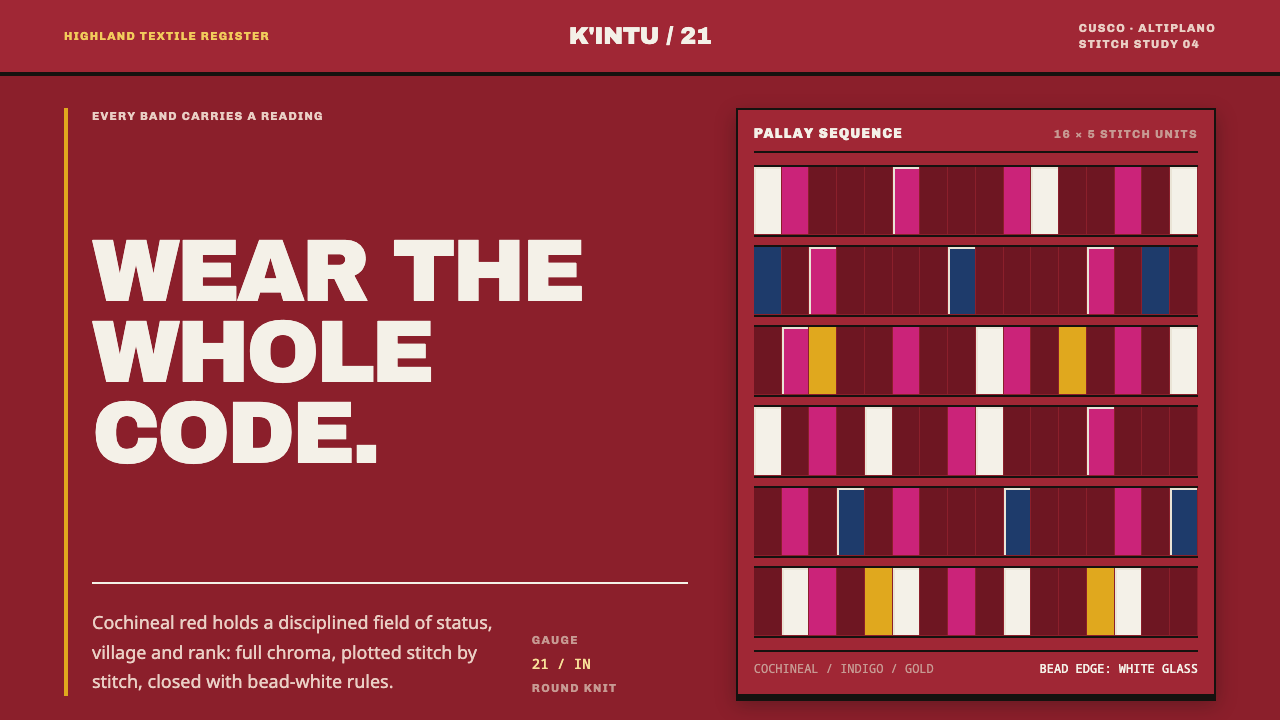 Andean ChulloOrnament carries a code. Cochineal red stacks strict stitch bands with bead-w…
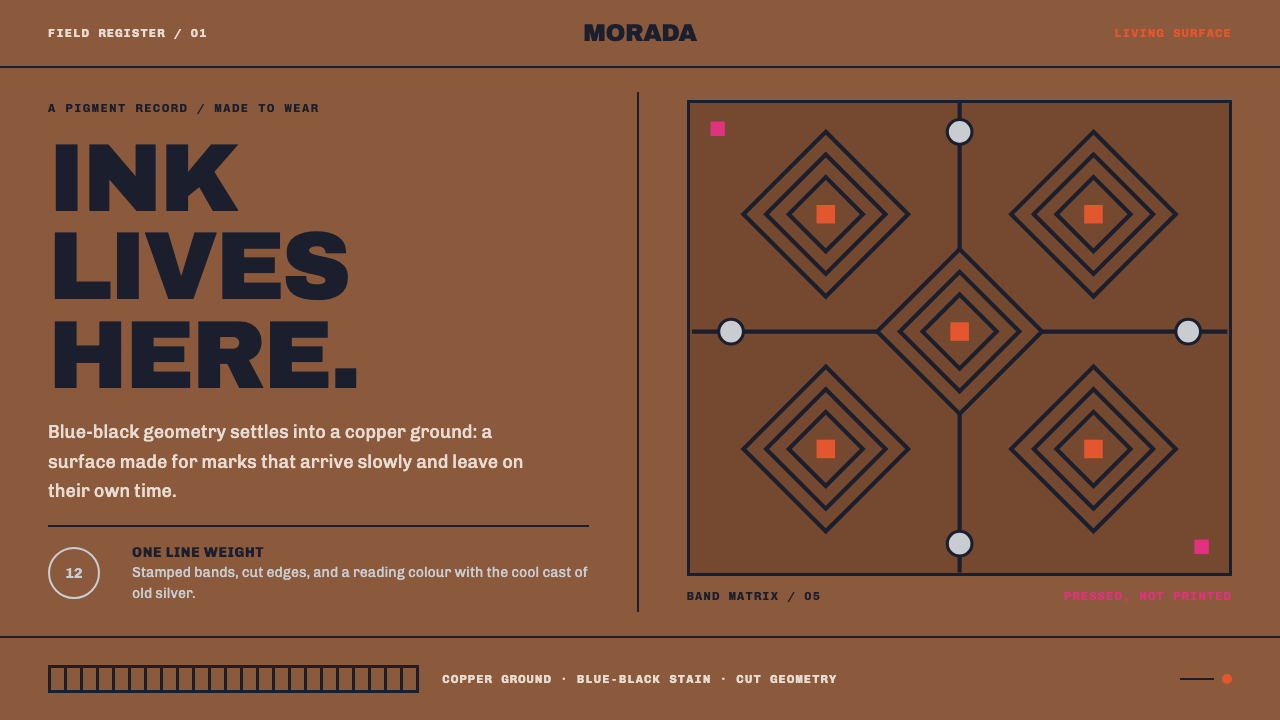 Emberá JaguaA living stain, never a print. Blue-black diamond bands press across copper s…
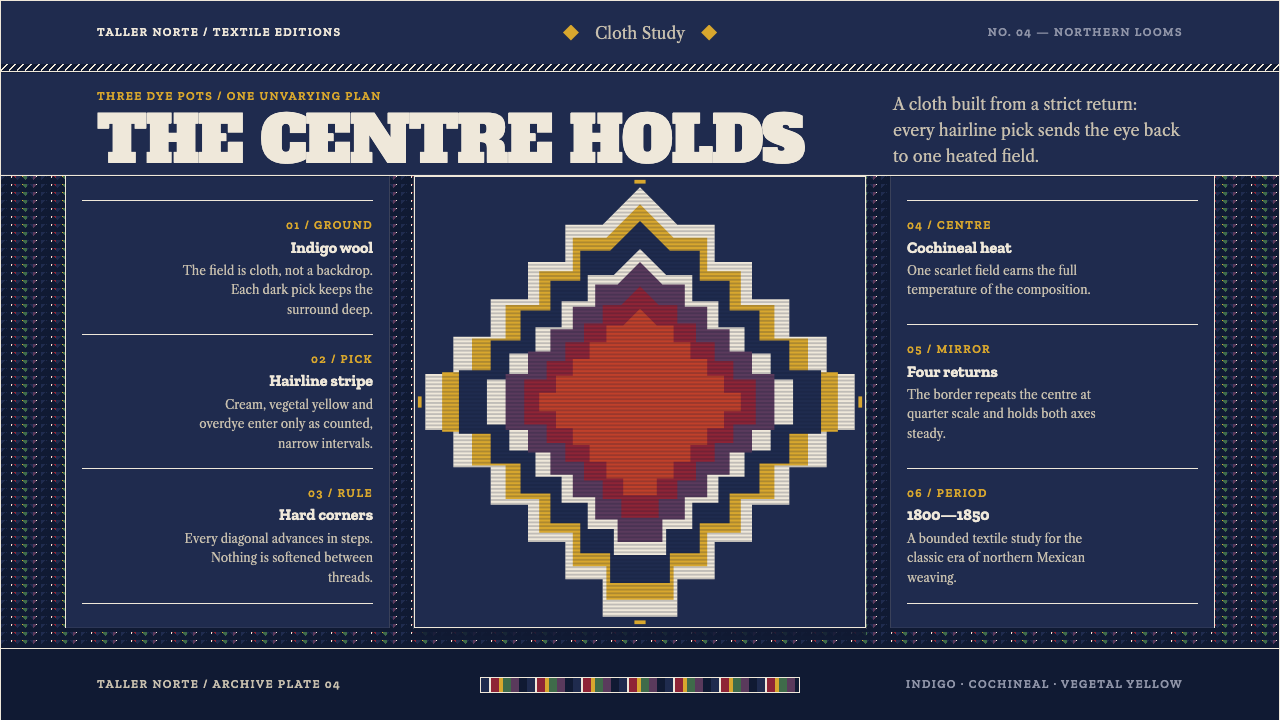 Saltillo SarapeThe centre holds the heat. Indigo hairline stripes frame one cochineal diamon…
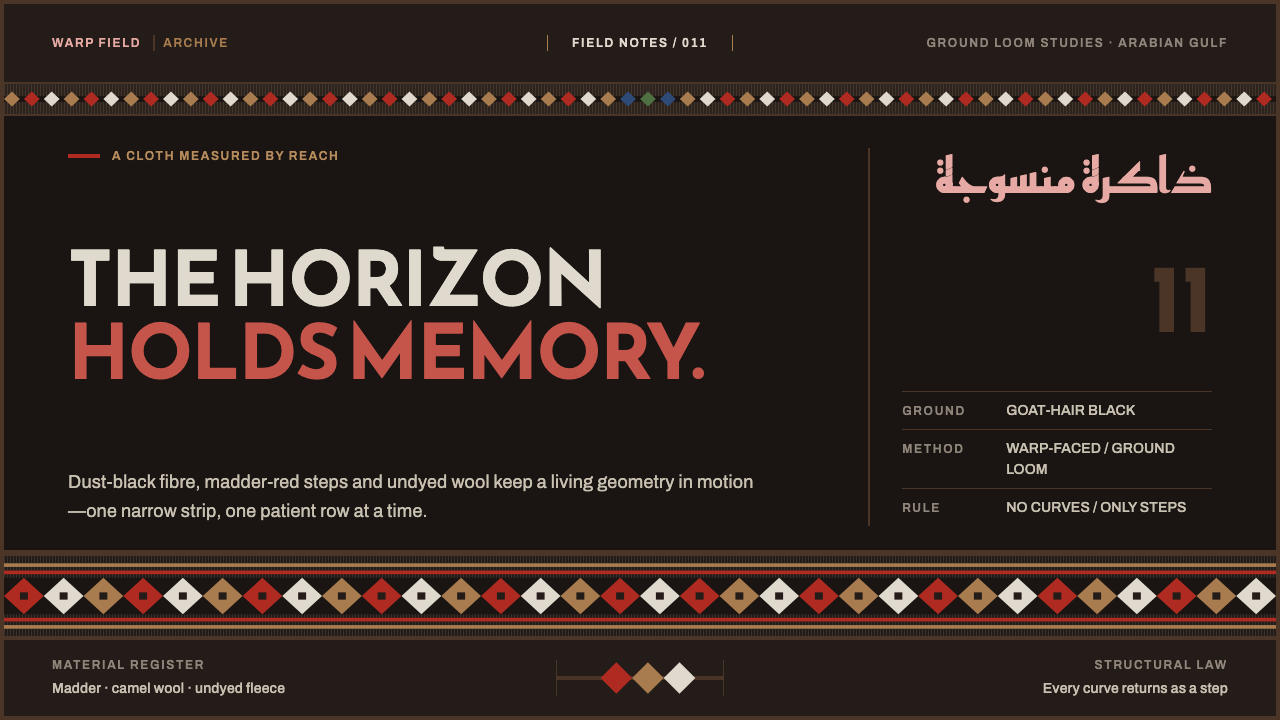 Emirati Sadu WeavingMemory runs in bands. Madder steps cross dusty goat-hair black with no curve…
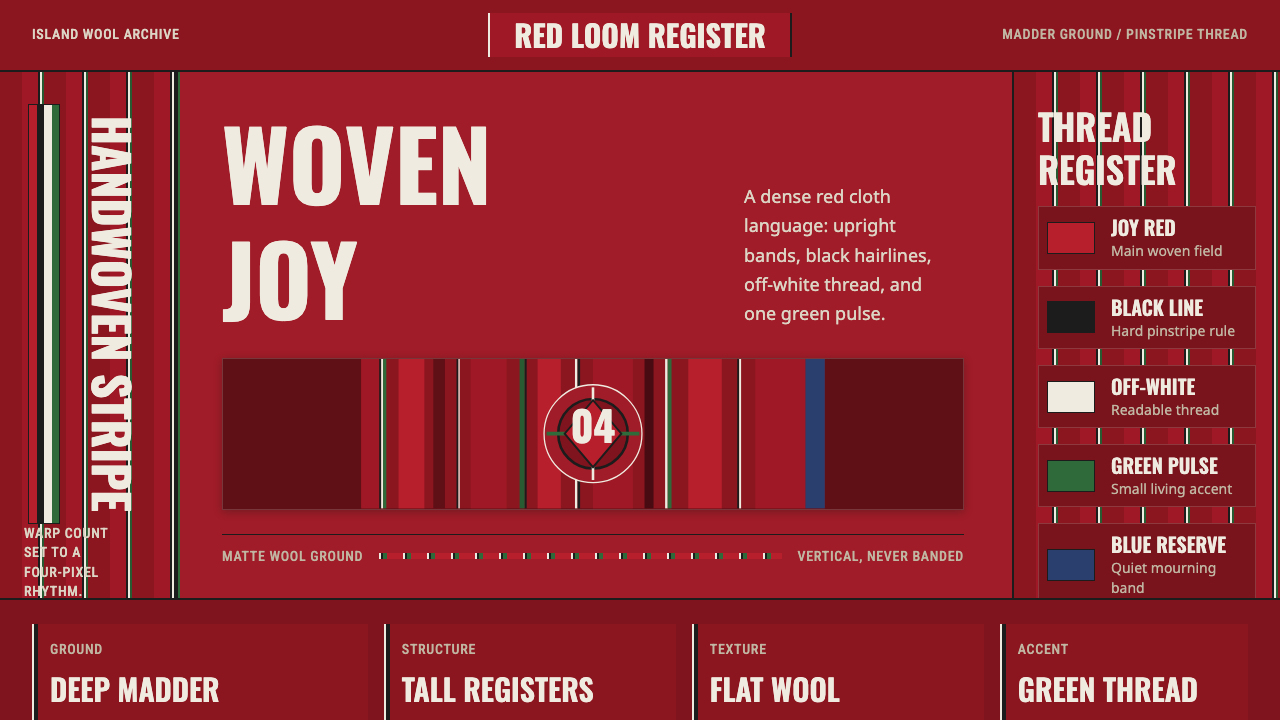 Estonian Kihnu Island SkirtJoy is woven vertical. Madder red ground, Oswald stripes, black and green pin…
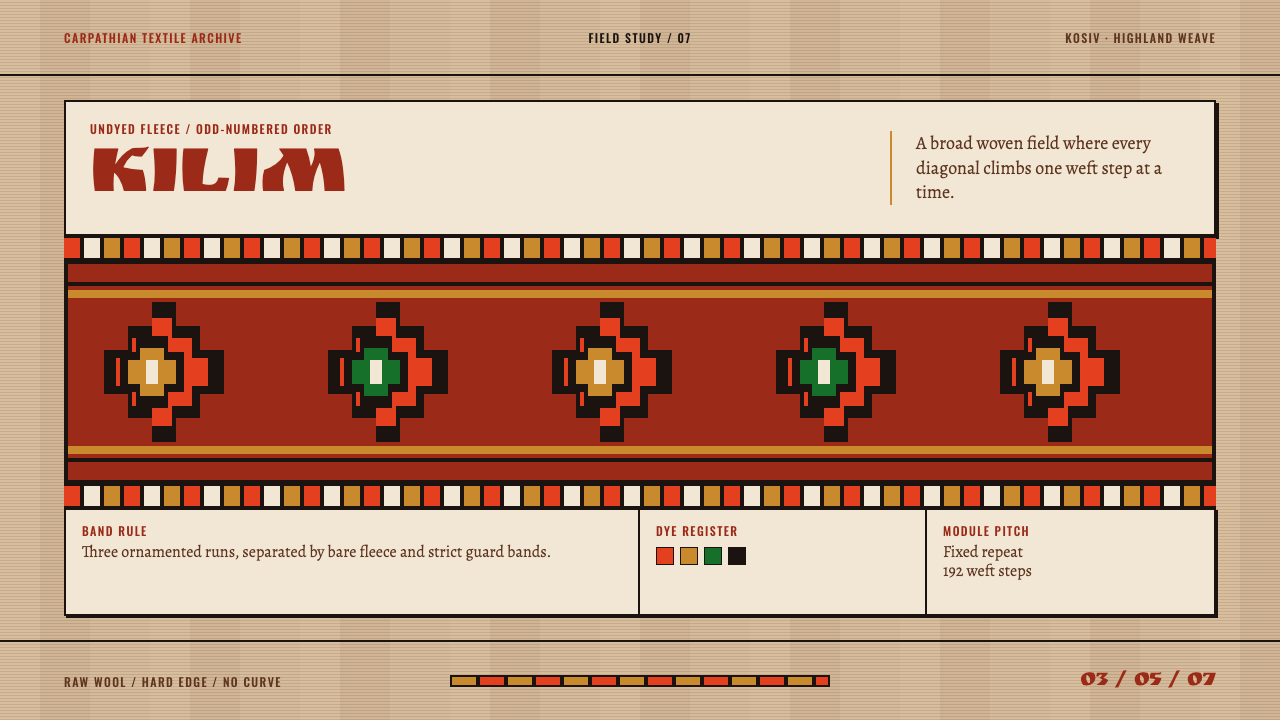 Hutsul KilimGeometry is the craft. Hot red stepped rhombs repeat across raw fleece bands.