What is Marquesan Patutiki?
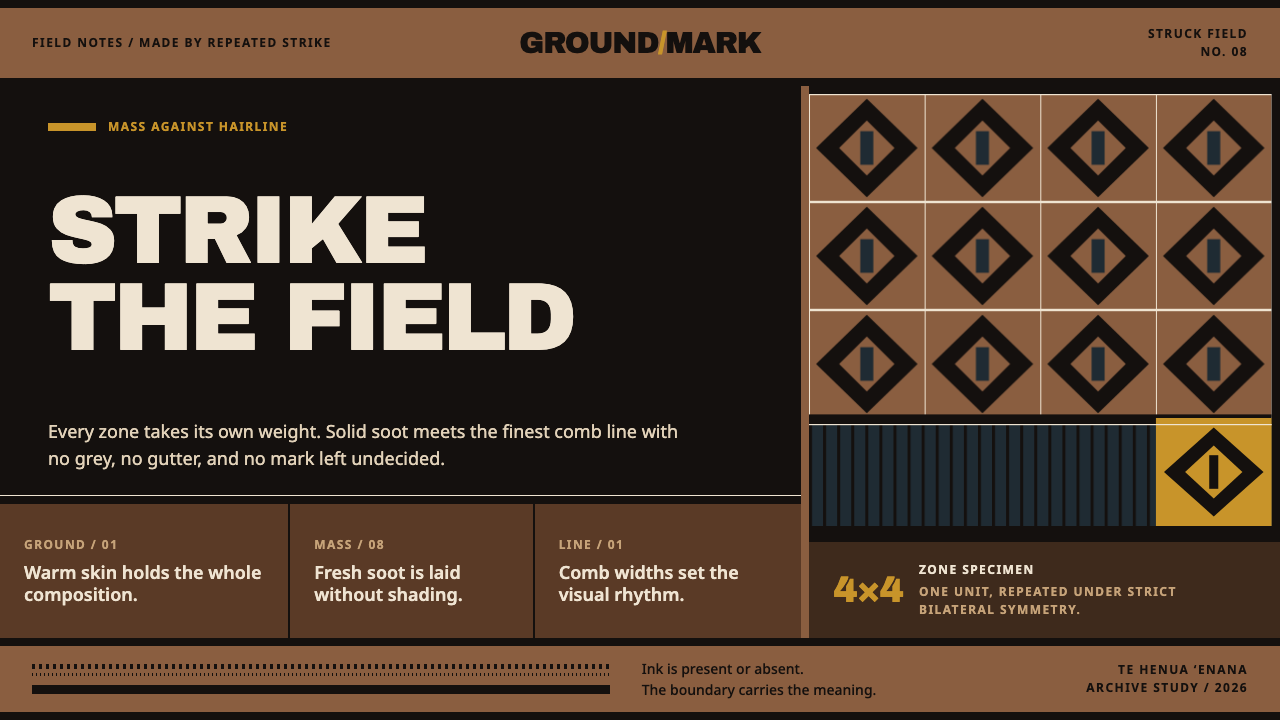
Patutiki means "strike an image", and the phrase is literal — soot from burned candlenut is driven into skin with bone combs, producing a grammar built from only two things: solid black mass and hairline strikes, with nothing soft in between.
Marquesan Patutiki in brief
Marquesan patutiki tattooing is a design language built from a genuinely physical, percussive process rather than a drawn or painted one. Candlenut kernels are burned on stone, the resulting soot is scraped off and dried on banana leaves, then bound with coconut oil into a workable pigment. This pigment is driven into the skin using bone combs cut to different widths, with each width of comb producing a different weight of line — meaning the visual vocabulary of thick versus thin marks comes directly from a change of tool, not from a change in how hard or lightly a line is drawn.
The composition follows the body rather than any abstract rectangular frame. Motifs are organized by anatomical zones — following the structure of muscle and bone — with each zone filled entirely by its own motif and pushed hard against the boundary of its neighboring zone, leaving no buffer or transitional space between them. On men of the highest status, this zone-by-zone filling eventually covers nearly the entire body, producing a field that reads from a distance as nearly solid black.
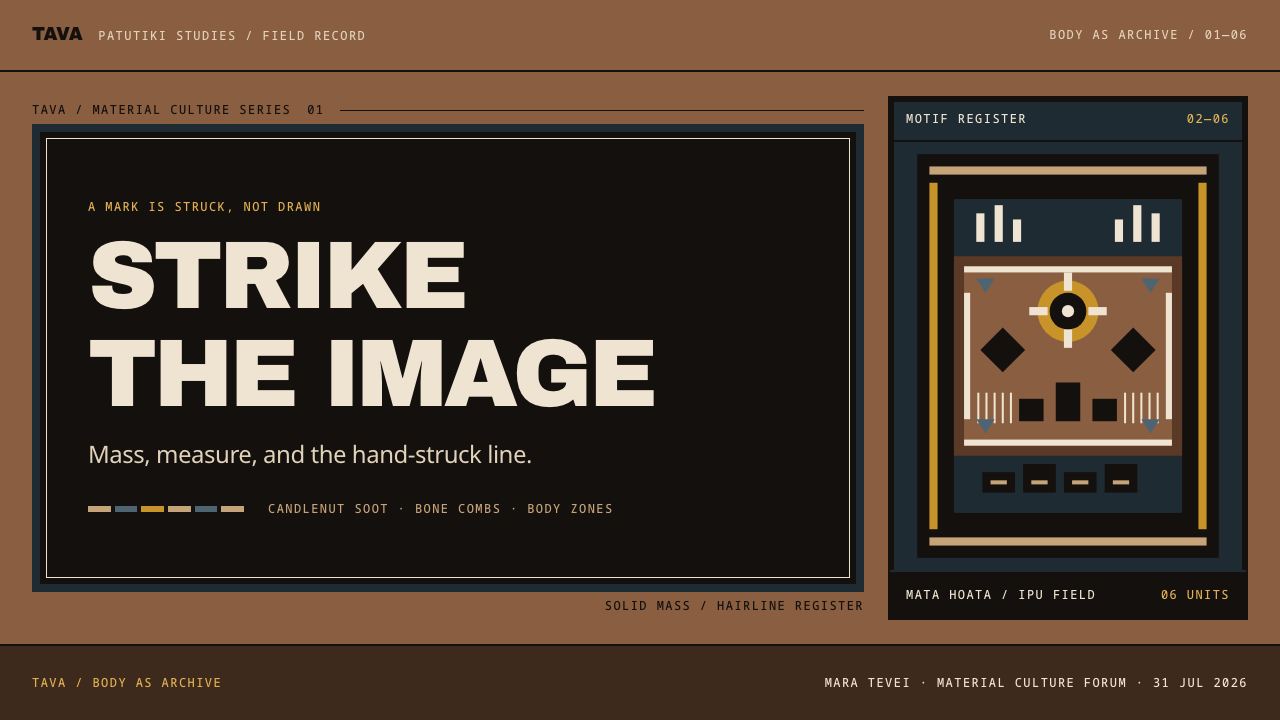
The resulting visual grammar has only two registers: large, unbroken solid black mass, and fine hairline strikes produced by the narrowest combs. There is essentially nothing between these two states — no mid-tone gray, no soft edge, no gradual thickening or thinning of a line. The same motif vocabulary carried in soot on skin was also applied in soot on bark cloth and carved directly into wood on bowls and ceremonial clubs called u'u, meaning the grammar of solid mass against hairline was never exclusive to the body — it was a single visual system used across several materials.
Where does Marquesan Patutiki come from?
Patutiki tattooing was practiced in the Marquesas Islands, known in the local language as Te Henua ʻEnana, from before European contact and continued as a living practice through the nineteenth century. Its motifs and application methods developed over this long pre-contact and early-contact period as an indigenous Polynesian art form deeply integrated with the islands' social structure, since the extent and design of a person's tattooing reflected their status within the community.
European ethnographic documentation of the practice is associated with Karl von den Steinen, whose recording of Marquesan tattoo motifs and their meanings became an important historical reference for understanding the visual system before it was suppressed. This documentation occurred against a backdrop of increasing European contact and colonial presence in the islands during the nineteenth century.
The practice was suppressed under mission rule as European and missionary influence expanded across the Marquesas, interrupting the transmission of patutiki as a living, actively practiced tradition for a significant period. This suppression is a critical part of the history: unlike traditions that evolved continuously, patutiki underwent a real interruption in practice tied directly to colonial and religious pressure.
From the 1980s, the tradition was revived, with practitioners such as Teiki Barsinas playing a role in reestablishing patutiki as an actively practiced art form after the period of suppression. This revival reconnected the tradition to its documented pre-contact and nineteenth-century roots, restoring both the technical methods — soot pigment, bone combs — and the motif vocabulary, including its extension into related Marquesan carving traditions such as haatiki figures.
What defines the Marquesan Patutiki look?
Solid Black Mass
Large anatomical zones are filled entirely and evenly with dark pigment, producing an unbroken solid mass rather than a shaded or gradated area. A design following this principle should use large, completely filled dark regions as a primary compositional element, avoiding any internal texture or gradient within those regions.
Hairline Strikes
The finest lines are produced by the narrowest bone combs, creating a hairline register that sits in direct contrast to the solid mass zones with nothing gradual in between. Compositions should reserve fine-line elements for precise, deliberate marks — outlines, dividers, small details — kept visually distinct from any solid filled area rather than blended with it.
Zone-Based Composition
Motifs are organized according to anatomical zones rather than an abstract grid, with each zone completely filled by its own distinct motif. This suggests dividing a layout into discrete regions defined by underlying structure — content sections, functional areas — and giving each region its own complete, self-contained pattern rather than one motif spanning the whole composition.
Hard Zone Boundaries
Adjacent zones butt directly against one another with no buffer, transition, or softened border between different motifs. A layout drawing on this idea should let distinct sections meet at a hard, direct edge rather than separating them with generous margins or gradient transitions.
Tool-Determined Line Weight
Different line weights come from physically different tools — combs of different widths — rather than from varying pressure or a single flexible instrument. This principle favors a small, fixed set of distinct line weights used consistently, rather than a continuously variable line that thickens and thins freely.
Cross-Material Consistency
The same motif vocabulary and solid-mass-against-hairline grammar appears identically across skin, bark cloth, and carved wood objects such as bowls and u'u clubs. A visual system built on this idea should apply consistently across different media and formats rather than being adapted differently for each surface.
Who shaped Marquesan Patutiki?
Von den Steinen's ethnographic documentation of Marquesan tattoo motifs during the nineteenth century provided a historical record of the patutiki visual system before the practice was suppressed under mission rule. His recorded work became an important reference point for the tradition's eventual revival from the 1980s, giving practitioners documented material to reconnect with.
Barsinas played a role in the revival of patutiki tattooing from the 1980s onward, helping reestablish the practice as an actively performed art form after the interruption caused by suppression under mission rule. This revival work reconnected contemporary practice to the pre-contact and nineteenth-century motif vocabulary and technique.
The extent of a man's tattooing directly reflected his social status within Marquesan society, with high-status men eventually covering nearly their entire body across successive tattooing sessions until the field read as near-black from a distance. Their bodies were, in effect, the primary canvas through which the zone-based composition and its cumulative solid-mass effect were most fully expressed.
How do you use Marquesan Patutiki today?
This style transfers well into any design context where bold, high-contrast simplicity and a sense of earned, accumulated marking are desired. The core discipline is limiting the visual vocabulary to exactly two registers — solid filled mass and fine hairline detail — with no gradient, shading, or soft transition permitted between them.
For presentation slides, a cover built from large solid-black geometric zones abutting directly against a light ground, with fine hairline rules used only for small structural details such as dividers or underlines, translates the grammar cleanly. Content slides should divide information into discrete, fully filled zones — one motif or icon treatment per content block — pushed edge to edge against neighboring zones rather than separated by soft margins.
For web interfaces, this approach suits bold, identity-driven brand sites or portfolio work where visual confidence matters more than dense information density. Section backgrounds can alternate between large solid-dark blocks and light ground, with fine-line iconography reserved specifically for small interactive elements, keeping a strict two-register system throughout rather than introducing intermediate grays.
For editorial and marketing layouts, a zone-based grid — where each content section is treated as its own fully filled compositional unit pushed hard against its neighbors — echoes the anatomical zone logic directly. Pull quotes or section markers can use heavy solid blocks of color or ink alongside fine-line typographic details, maintaining the same two-register contrast throughout a spread.
A common mistake when applying this style is introducing mid-tone grays, soft shadows, or gradient fills to smooth the transition between solid and line elements. The visual power of patutiki comes specifically from the total absence of any middle register — every application should commit fully to either solid mass or hairline, never blending the two into something softer.
Marquesan Patutiki — FAQ
Why does patutiki have only two visual registers — solid mass and hairline?
Line weight in patutiki comes directly from which width of bone comb is used, and combs come in a fixed set of distinct widths rather than a continuously adjustable range. This means the practitioner is physically limited to a small number of discrete line weights, which produces the sharp two-register contrast between large filled zones and fine hairline strikes rather than any gradual middle ground.
Why does the pattern follow the body's anatomy instead of a fixed grid?
Because the canvas is the human body itself, motifs are organized by muscle and bone structure rather than by any abstract rectangular framework. Each anatomical zone is filled with its own motif and pushed hard against neighboring zones, which is why the composition reads as a series of distinct regions rather than a single continuous pattern spread evenly across a flat surface.
What interrupted the practice of patutiki, and when was it revived?
The practice was suppressed under mission rule as European and missionary influence expanded across the Marquesas Islands during the colonial period, interrupting active practice for a significant span of time. From the 1980s, practitioners including Teiki Barsinas helped revive patutiki as an actively practiced tradition, drawing on nineteenth-century documentation such as that recorded by Karl von den Steinen to reconnect with the original motif vocabulary and technique.
Was patutiki only used on skin, or did it appear on other materials too?
The same motif vocabulary extended beyond skin — the same soot pigment used for tattooing was also painted onto bark cloth, and equivalent motifs were carved directly into wood on objects such as bowls and ceremonial clubs called u'u. This shows that the solid-mass-against-hairline grammar functioned as a single visual system applied consistently across multiple materials, not a technique exclusive to the body.
Why does a high-status man's tattooing eventually cover almost his entire body?
The extent of tattooing directly reflected social status within Marquesan society, so high-status men accumulated tattooing across successive zones of the body over time, filling one anatomical region after another. Because each zone is filled with solid mass pushed hard against its neighbors, the cumulative effect of covering enough zones is a body that reads as nearly black from a distance.
Related design styles
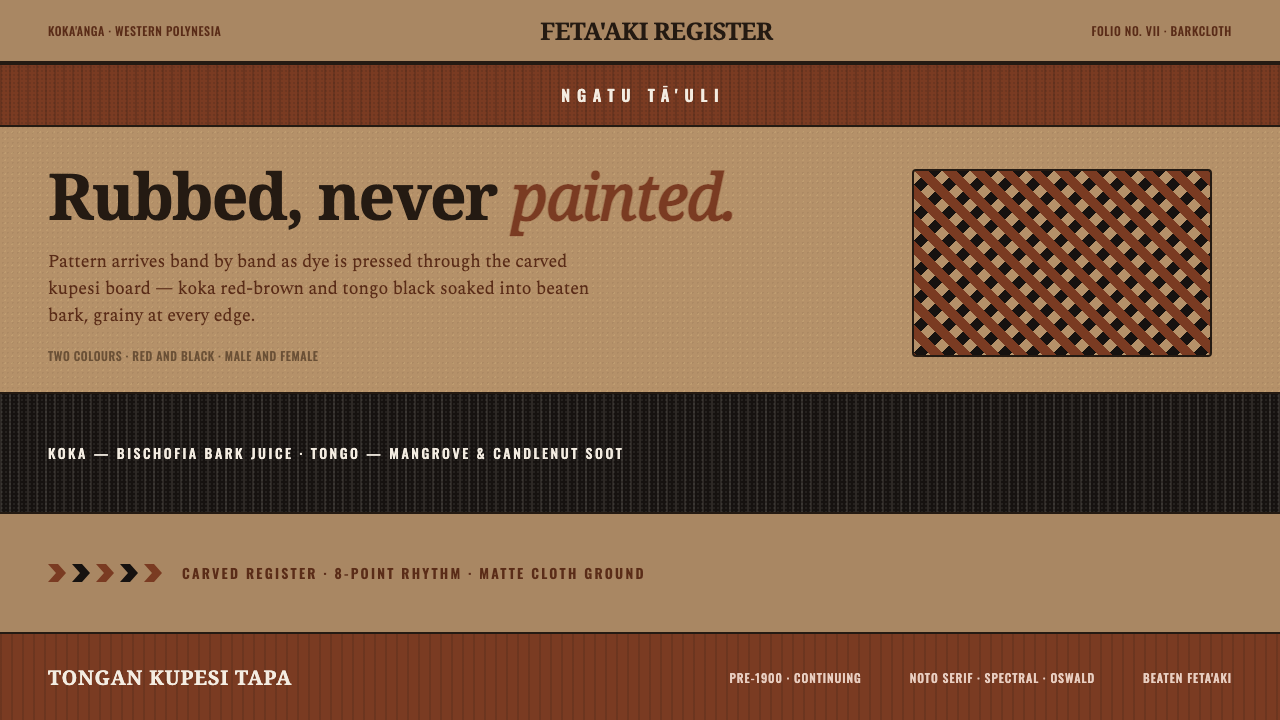 Tongan Kupesi TapaRubbed, never painted. Koka red and tongo black soak into beaten tan bark as…
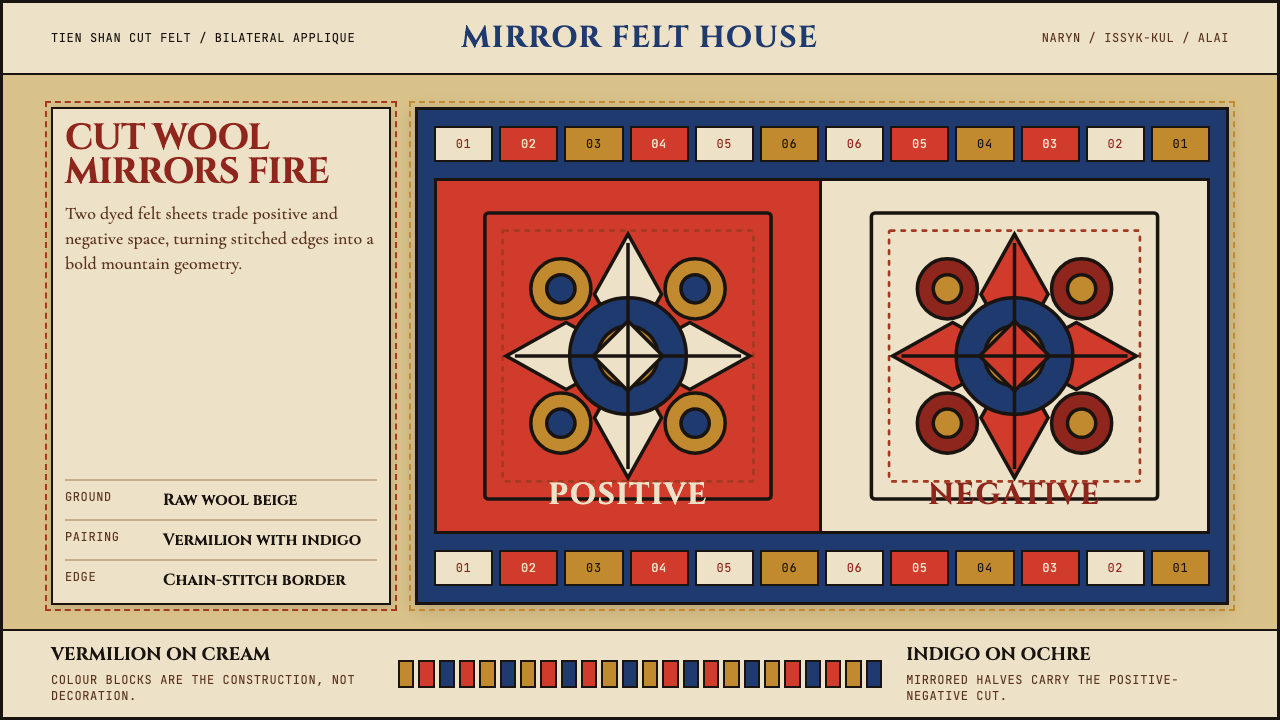 Kyrgyz Shyrdak Felt RugCut felt becomes structure. Vermilion-indigo mirror blocks stitch positive to…
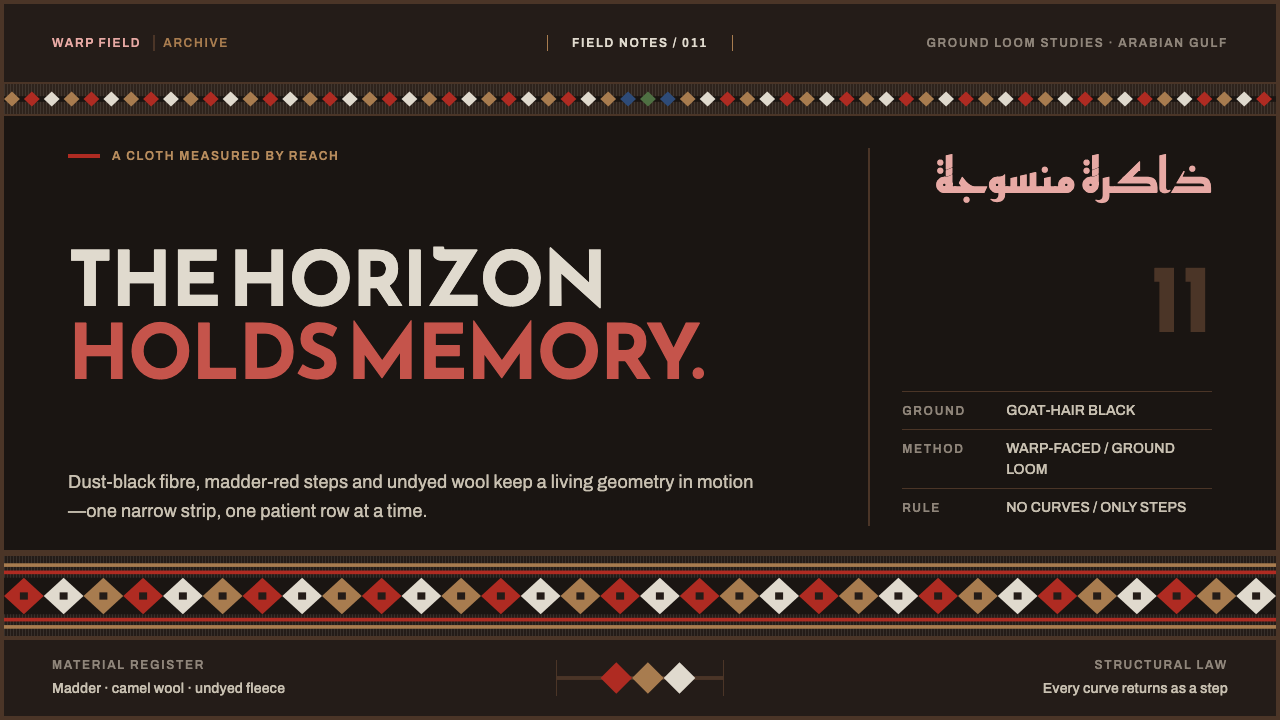 Emirati Sadu WeavingMemory runs in bands. Madder steps cross dusty goat-hair black with no curve…
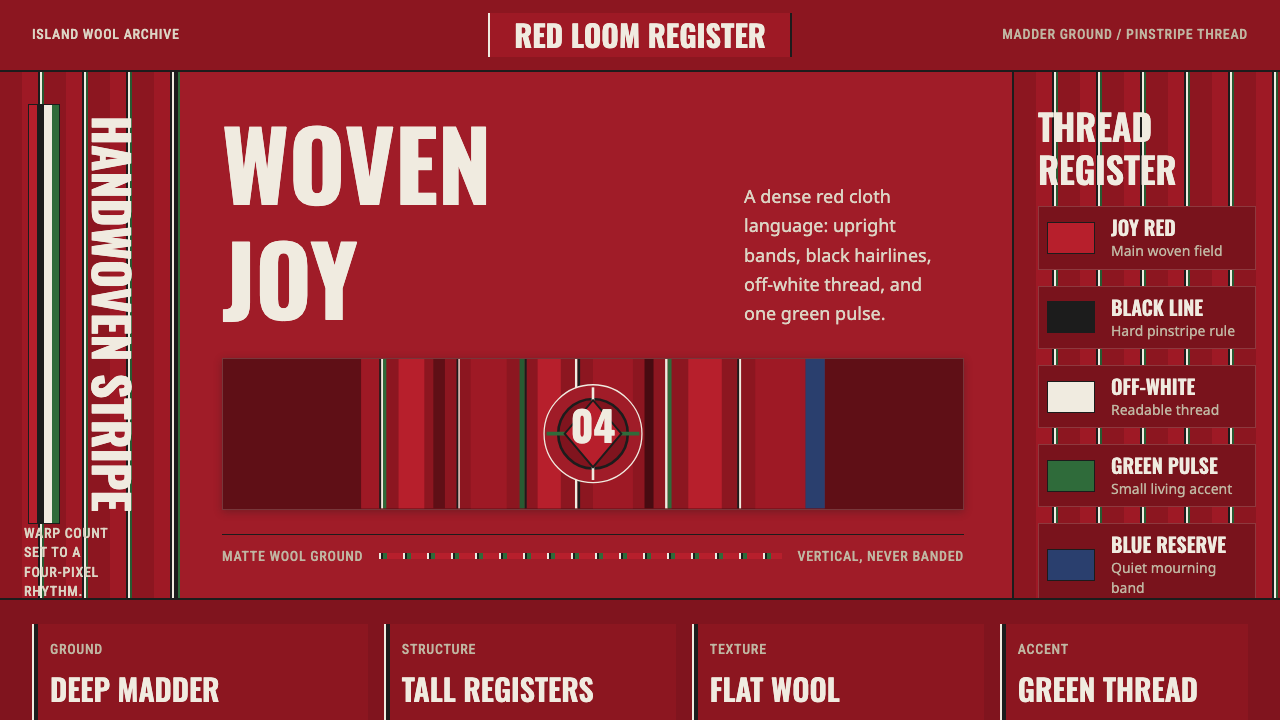 Estonian Kihnu Island SkirtJoy is woven vertical. Madder red ground, Oswald stripes, black and green pin…
 Mossi Burkina Plank MaskCarved, not rendered. Charcoal fields, dust-red cuts, and kaolin bands stack…
 Sindhi Ralli QuiltSings in squares. Vermilion, gold, green, and indigo lock into piped tile rhy…