What is Nüshu 女书?
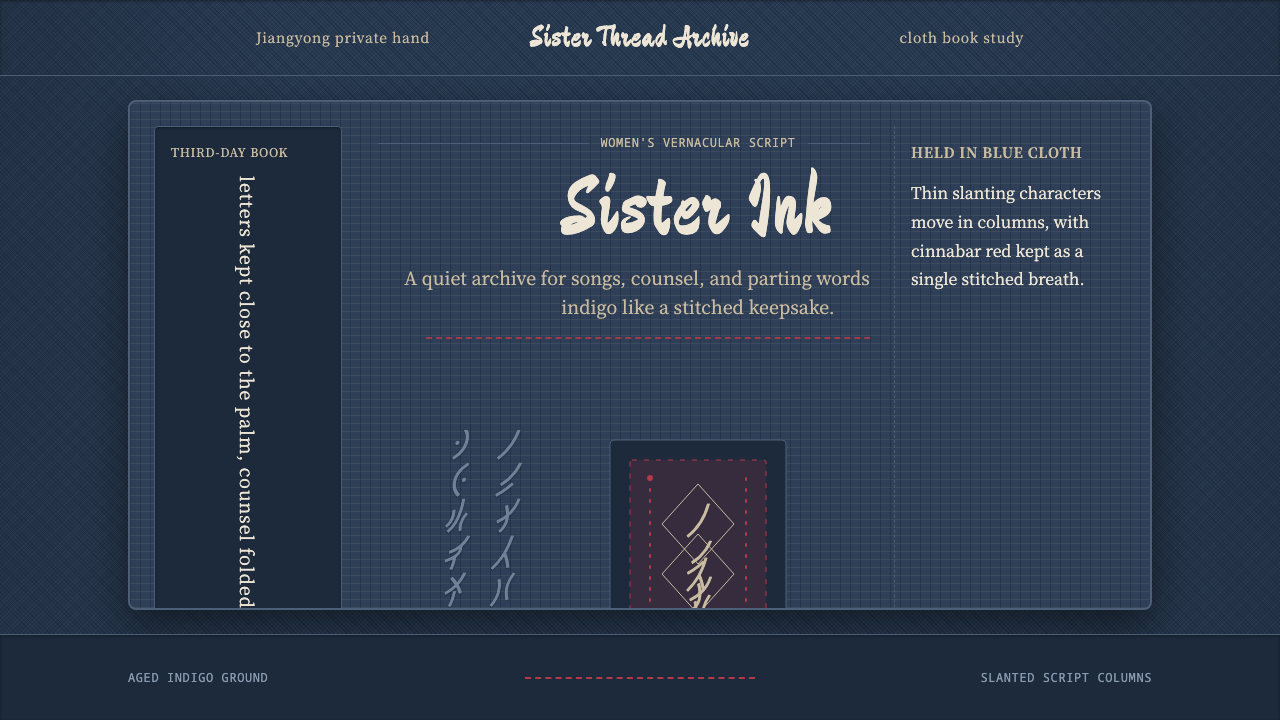
Nüshu is the only writing system in the world made by women, for women — a script as soft and private as the indigo cloth it was stitched onto.
Nüshu 女书 in brief
Nüshu (女书, literally 'women's writing') is a script created and transmitted almost exclusively among women in Jiangyong County, Hunan Province, China. Its characters are thin, slanting, rhomboid in overall shape, and built from a small repertoire of dots, arcs, and diagonal strokes — visually distinct from the square, symmetrical structure of standard Chinese characters, and closer in spirit to a private hand than a public one.
The script lived on intimate, hand-held objects rather than public monuments: paper fans folded and unfolded in the hand, embroidered handkerchiefs, and cloth-bound 'third-day books' (sanzhaoshu) — small volumes stitched from indigo-dyed fabric that women gave to brides three days after their wedding, filled with laments, well-wishes, and autobiographical writing meant to be read only by other women. Red thread and embroidery frequently accompanied the text, but as accent rather than as a competing visual element.
As a design system, Nüshu translates into a quiet, textile-soft register: an aged indigo ground standing in for the cloth it was originally written on, columns of slanting script set vertically and leaning to the right, and red reserved for stitch-like accents rather than bold color blocks. The overall feeling is restrained and warm-toned rather than stark or declarative — closer to the hand and to fabric than to a cold digital interface.
Where does Nüshu 女书 come from?
Nüshu developed in Jiangyong County, a remote area of southern Hunan near the border with Guangdong, at some point before the 19th century — its exact origin date is unknown because the material it was written on (cloth, paper fans, embroidery) rarely survived more than a generation or two, and because the women who used it had every reason to keep it private rather than record its history for outsiders. What survives dates mostly from the 19th and early 20th centuries.
The script arose in a context where women in the region were largely excluded from the formal education that taught boys and men to read and write standard Chinese characters. Rather than learning the male script, women in Jiangyong developed a phonetic system — a syllabary representing the sounds of the local Xiangnan tuhua dialect rather than a logographic system representing whole words or concepts the way standard Chinese characters do. This made Nüshu something closer to an alphabet in function, even though its individual character shapes were often derived from or influenced by standard Chinese forms, tilted and simplified.
Nüshu circulated within networks of laotong — sworn sisterhoods formed between unmarried girls who pledged lifelong loyalty to one another, sometimes as a couple, sometimes within a larger circle — and among women bound by marriage into new households far from their birth families. Because married women in the region often left their natal village and had limited contact with their birth family afterward, Nüshu writings frequently carried an emotional weight of separation, homesickness, and female solidarity across distance, functioning as correspondence, autobiography, and communal memory all at once.
The script was largely unknown to scholars outside Jiangyong until the early 1980s, when Chinese researchers — notably Gong Zhebing — began systematically documenting it, following earlier isolated attention from collectors including Zhou Shuoyi in the 1950s. By that point the number of women fluent in Nüshu had already dwindled sharply, as universal modern schooling in standard Chinese made the older, women-only script increasingly unnecessary. Yang Huanyi, widely regarded as the last person to have learned Nüshu in the traditional way from an older generation of women, died in 2004; since then the script has survived through academic documentation, a dedicated museum and cultural park in Jiangyong, and deliberate teaching programs rather than organic transmission from mother to daughter.
What defines the Nüshu 女书 look?
Slanting Rhomboid Character Form
Unlike the square, upright structure of standard Chinese characters, Nüshu characters lean and taper into an overall diamond or rhomboid silhouette. This tilt is not a stylistic flourish applied to an otherwise square base — it is structural to the script itself, giving every line of text a consistent, gentle forward lean.
Thread-Fine Strokework
Strokes are built almost entirely from dots, shallow arcs, and diagonal lines rather than the heavier horizontal and vertical strokes common in standard Chinese calligraphy. The resulting texture is delicate and even, closer to embroidery stitching than to brush-and-ink weight variation.
Vertical, Right-Leaning Columns
Text is set in vertical columns read top to bottom, with each character leaning consistently to one side, so that a full column reads as a gentle, unified diagonal rhythm rather than a rigid vertical line. This creates a softer, more organic reading flow than perfectly upright columnar text.
Aged Indigo Ground
The base surface reads as dyed cloth rather than bleached paper — a deep, slightly muted blue with the soft irregularity of hand-dyed fabric rather than a flat, uniform digital fill. This ground should feel textile and aged, never bright or synthetic.
Sparing Red Accent
Red appears only in small, thread-like accents — echoing the embroidery and red thread historically paired with Nüshu texts — never as a large color block or bold highlight. Its restraint is the point: red here signals intimacy and care, not urgency or alarm.
Textile Materiality
Surfaces should carry a soft, woven or cloth-like texture rather than the crispness of print or the flatness of glass and screen. Subtle irregularity in the weave or dye reinforces the sense that this is a handmade, handled object rather than a mass-produced one.
Intimate, Hand-Held Scale
Compositions should feel scaled to small, personal objects — a folded fan, a handkerchief, a small bound book — rather than a public banner or monument. Layouts favor compact, enclosed formats over expansive full-bleed statements, keeping the emotional register private rather than declarative.
Who shaped Nüshu 女书?
Widely regarded as the last person to have learned Nüshu in the traditional way, directly from an older generation of women rather than through modern academic instruction, Yang Huanyi died in 2004, marking the end of organic, unbroken transmission of the script and turning subsequent preservation efforts into a matter of deliberate teaching rather than natural inheritance.
One of the last generation of women fluent in Nüshu, Gao Yinxian's writings and recitations were among the earliest and most extensively documented by researchers in the 1980s, providing scholars with source material that shaped much of what is now known about the script's vocabulary, grammar, and traditional uses.
A Nüshu practitioner whose written works and personal testimony contributed to the documentation effort that rescued the script from near-total obscurity, Yi Nianhua's material helped researchers reconstruct the social contexts — sworn sisterhood, marriage laments, third-day books — in which Nüshu was traditionally used.
A Chinese scholar whose systematic research beginning in the early 1980s brought Nüshu to wide academic and public attention for the first time, Gong Zhebing's documentation work is often credited with rescuing the script from the edge of disappearance and establishing the field of Nüshu studies.
Among the earliest outside collectors to take a serious interest in Nüshu, gathering material in the 1950s well before the broader academic rediscovery of the 1980s, Zhou Shuoyi's early collecting preserved texts and testimony that might otherwise have been lost during the intervening decades of social upheaval.
How do you use Nüshu 女书 today?
Nüshu's design register is intimate, textile, and quiet rather than commanding — it works best in contexts that want to feel personal, handmade, and warm, and it resists any context that calls for boldness, urgency, or mass-market scale.
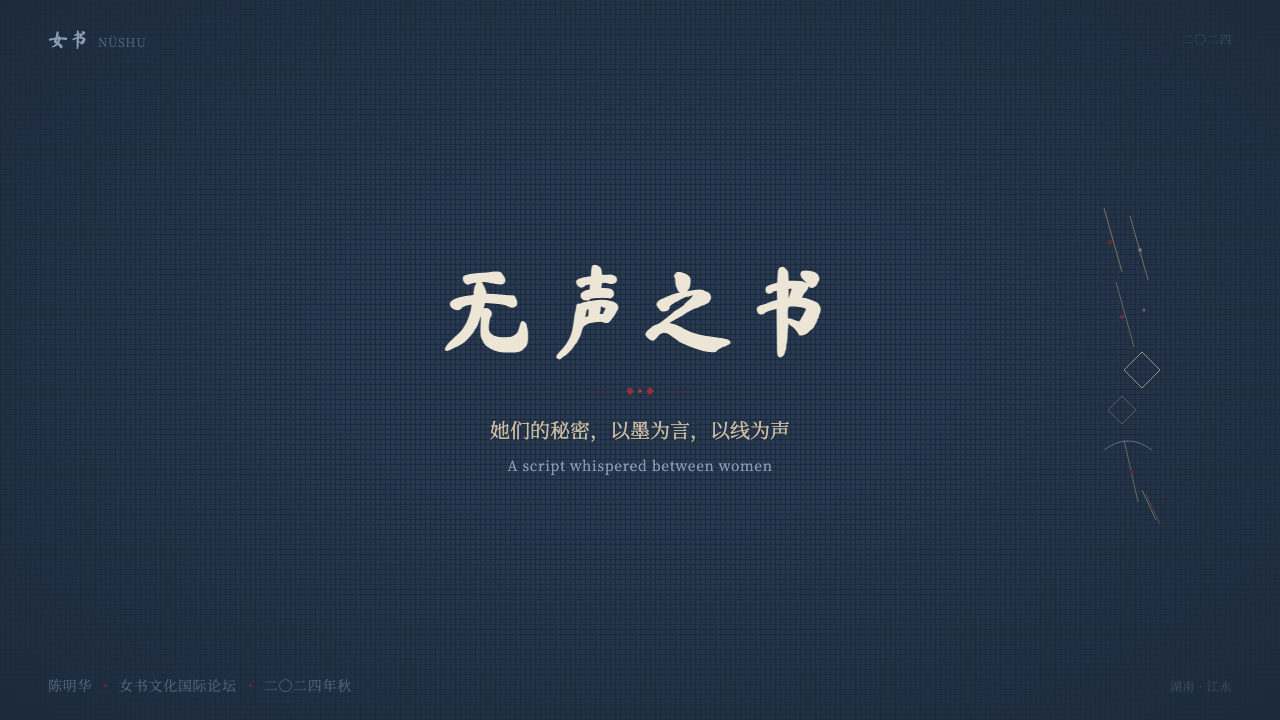
For presentation slides, the style suits cover slides and reflective, narrative moments rather than dense data pages: an indigo cloth-textured background with a small area of vertical script-like ornament in one corner sets a quiet, considered tone. Content slides should keep type legible and horizontal for practical reading, reserving the vertical, script-inspired treatment for accents and section markers rather than the body text itself, since actual Nüshu characters are a closed historical script, not a usable modern typeface.
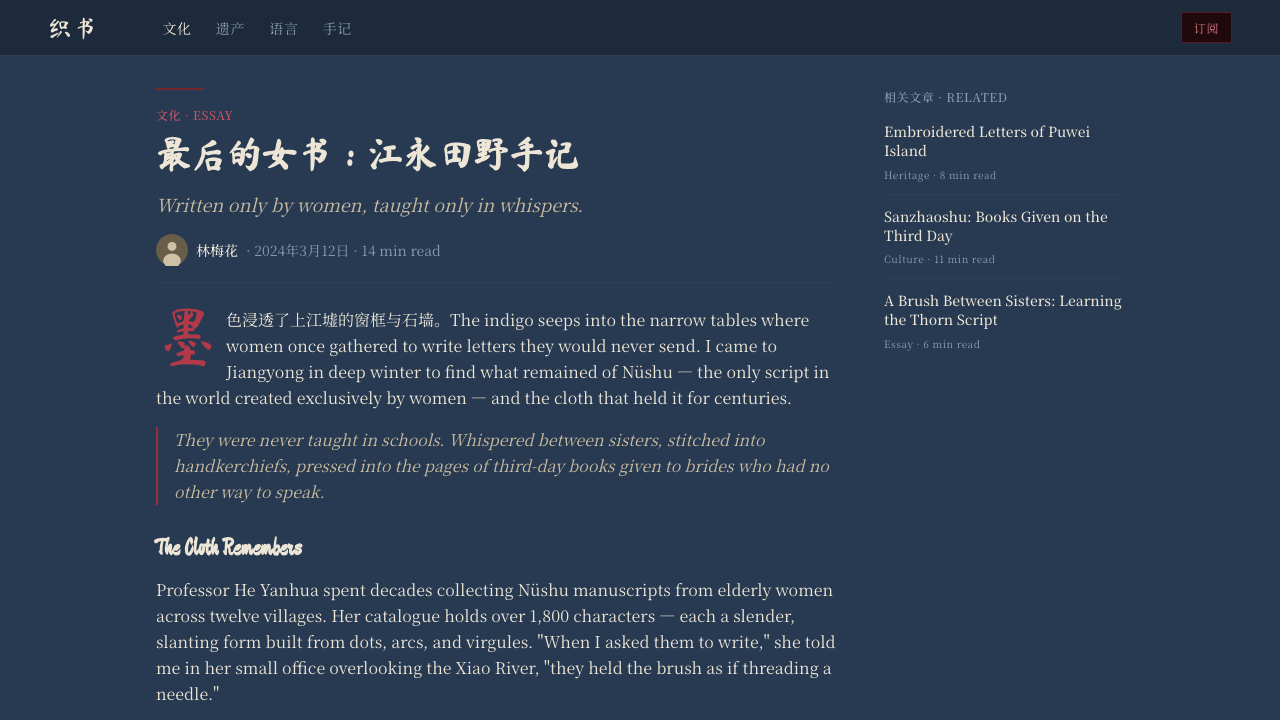
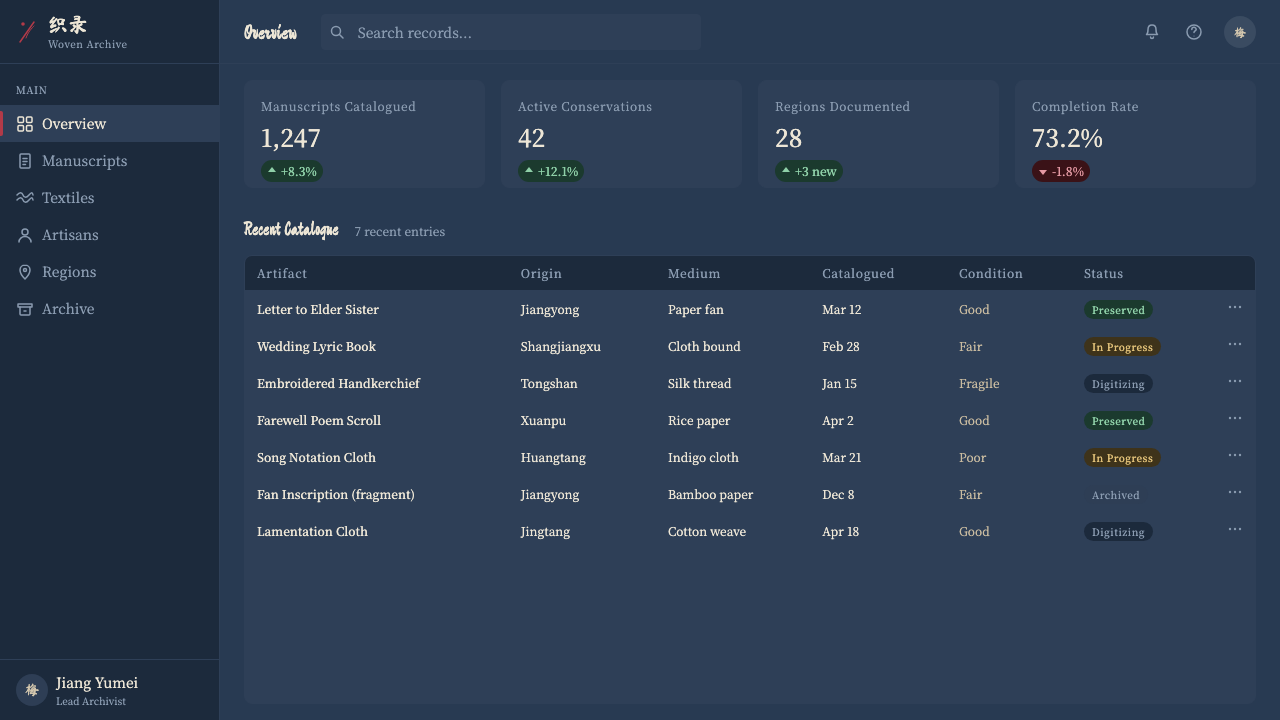
For web interfaces, the aesthetic suits personal storytelling platforms, craft and textile brands, and cultural or heritage sites far better than transactional interfaces like dashboards or checkout flows — a dashboard demands fast scanning and high information density, which runs against this style's soft, low-contrast, slow-reveal sensibility. It works well for a profile page, a letter-writing or journaling feature, or a product page for handmade goods.
For editorial and marketing content, the style rewards a slow, personal tone of voice paired with the visual system — first-person narrative, quiet photography of textiles or handwriting, generous whitespace around small red accents. Marketing pages should avoid loud calls-to-action rendered in bold saturated color; instead, small red accent details paired with confident but quiet typography keep the tone consistent with the script's own restraint.
A common mistake is treating this style as generic 'Asian-inspired' decoration and defaulting to red as a dominant color, the way many East Asian-influenced design systems do — that overwhelms the exact quality that makes Nüshu-inspired design distinct, which is its deliberate restraint and its indigo-and-thread palette rather than red-and-gold boldness. A second mistake is rendering actual Nüshu characters decoratively without understanding that the script is a real, historically significant syllabary belonging to a specific community — it should be referenced through its qualities (slant, thinness, verticality) rather than treated as generic ornamental squiggles.
Nüshu 女书 — FAQ
Is Nüshu a dialect of Chinese, or a separate language?
Neither, exactly. Nüshu is a script — a writing system — used to record the spoken sounds of Xiangnan tuhua, a local dialect of southern Hunan. The language being written was already spoken by both men and women in the region; what was distinct was the writing system itself, developed and used almost exclusively by women as an alternative to standard Chinese characters, which women were largely excluded from learning.
How is Nüshu structurally different from standard Chinese characters?
Standard Chinese characters are logographic, meaning most characters represent a whole word or morpheme rather than a single sound. Nüshu functions more like a syllabary — its characters primarily represent syllable sounds of the local dialect, closer in principle to an alphabet or a system like Japanese kana, even though the individual character shapes were often derived from or influenced by Chinese characters, tilted, thinned, and simplified into the script's distinctive slanting form.
Is Nüshu still actively used today?
Organic transmission — mother teaching daughter, or older sworn sisters teaching younger ones — effectively ended with the death of Yang Huanyi in 2004, the last person known to have learned it in the traditional way. Since then, Nüshu survives through academic study, a dedicated museum and cultural park in Jiangyong, and deliberate teaching programs aimed at cultural preservation rather than everyday practical use, making it closer to a living heritage practice than a functioning daily script.
What is the significance of the red thread paired with Nüshu texts?
Red thread and embroidery were traditionally paired with Nüshu writing on objects like third-day books and handkerchiefs, marking occasions of deep emotional significance — marriage, sworn sisterhood, mourning — in a visual register that stayed intimate rather than showy. In design terms, this history is why the color should appear sparingly, as a fine accent, rather than as a dominant color block; its meaning depends on scarcity.
Why did Nüshu develop specifically among women rather than being shared with men?
Women in Jiangyong were largely excluded from the formal education available to men, which taught standard Chinese characters. Rather than remaining without a writing system, women in the region developed their own, transmitted through sworn-sisterhood networks and family lines and used for purposes specific to women's lives — marriage laments, correspondence with sisters after marriage separated them, autobiographical writing — that standard written Chinese, controlled by and largely serving male literary and administrative culture, did not accommodate.
Related design styles
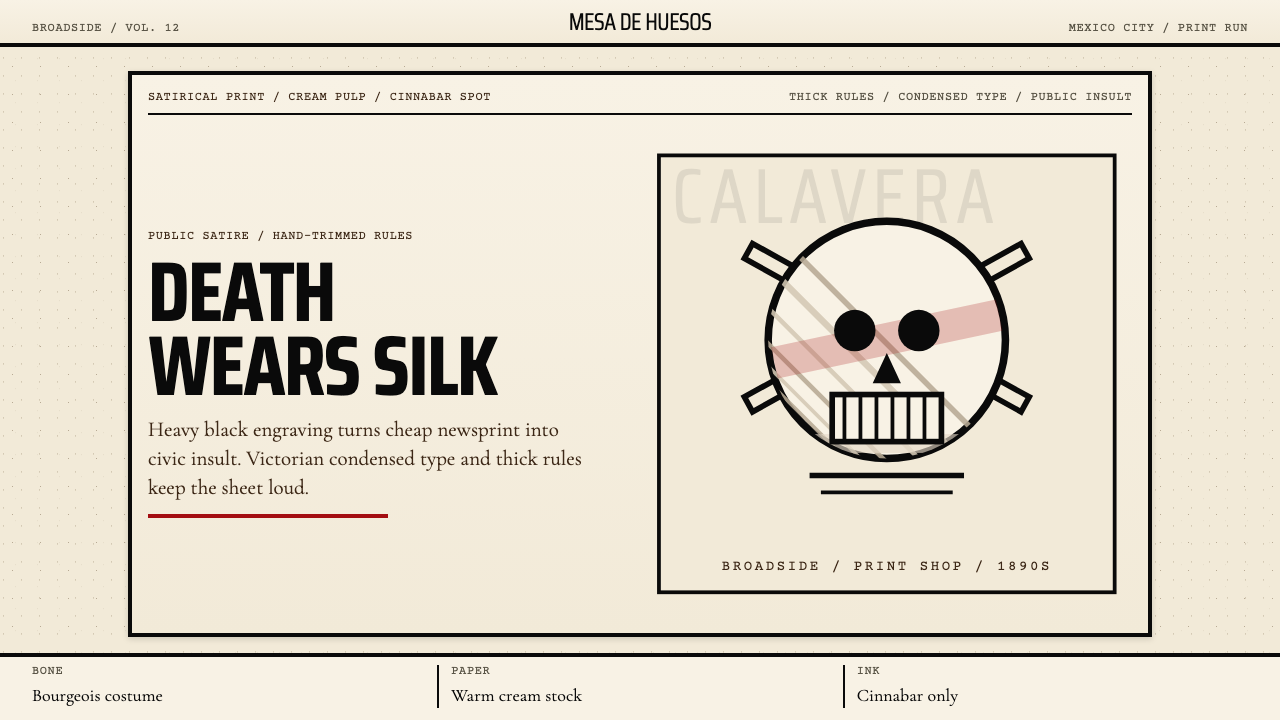 José Guadalupe Posada CalaveraDeath turns civic. Heavy black engravings on cream pulp, with cinnabar red.
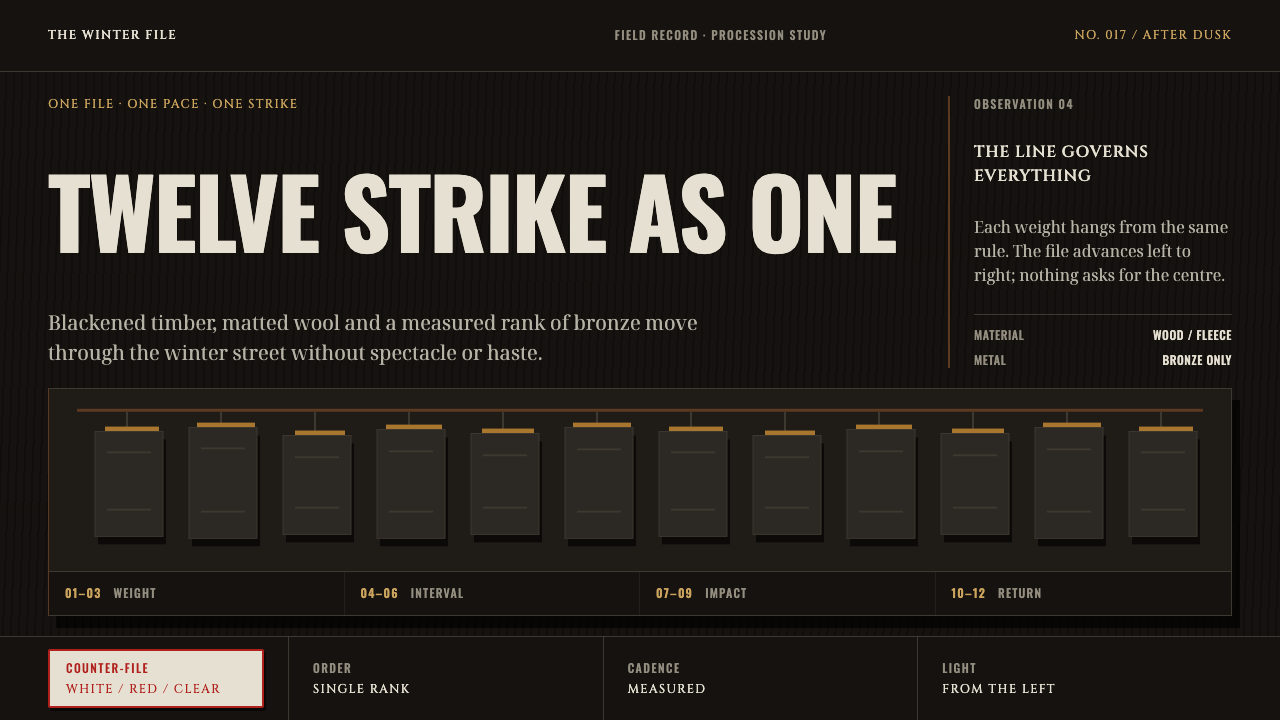 Sardinian MamuthonesRitual moves in one file. Soot-black planes and a rationed bronze rank set th…
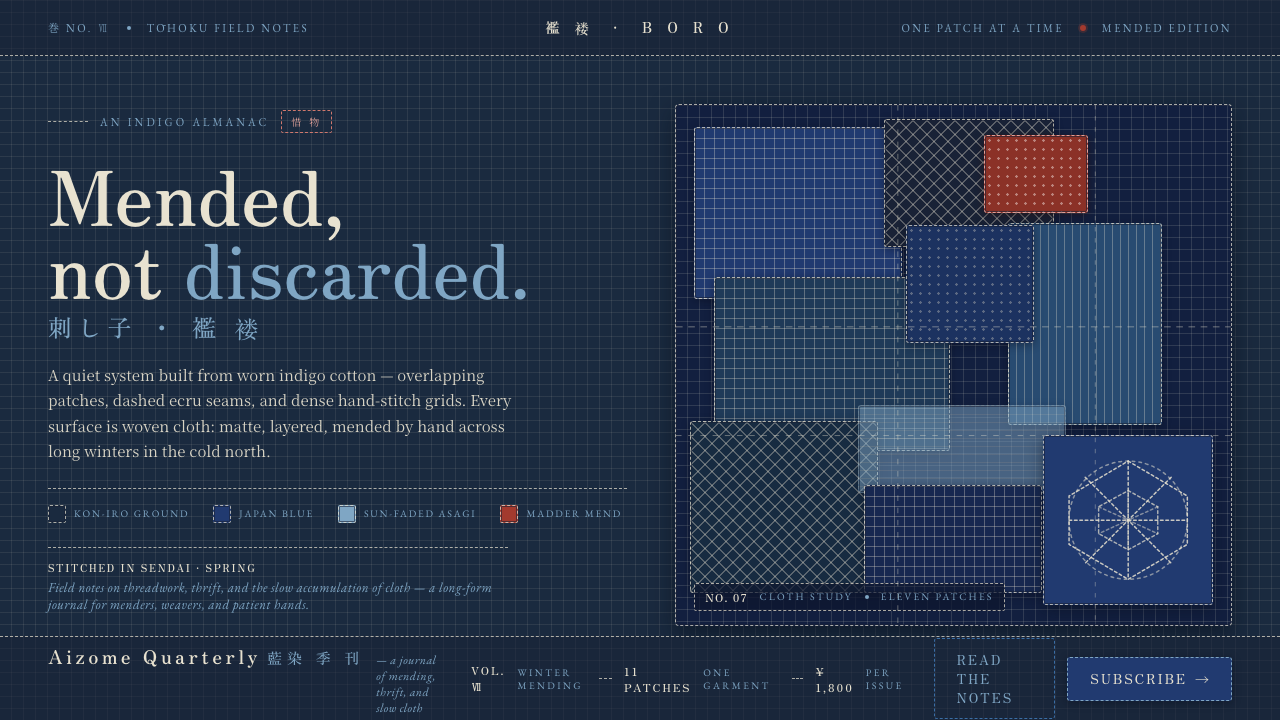 Sashiko BoroMended, not discarded. Deep kon-iro grounds, overlapping patches, dashed ecru…
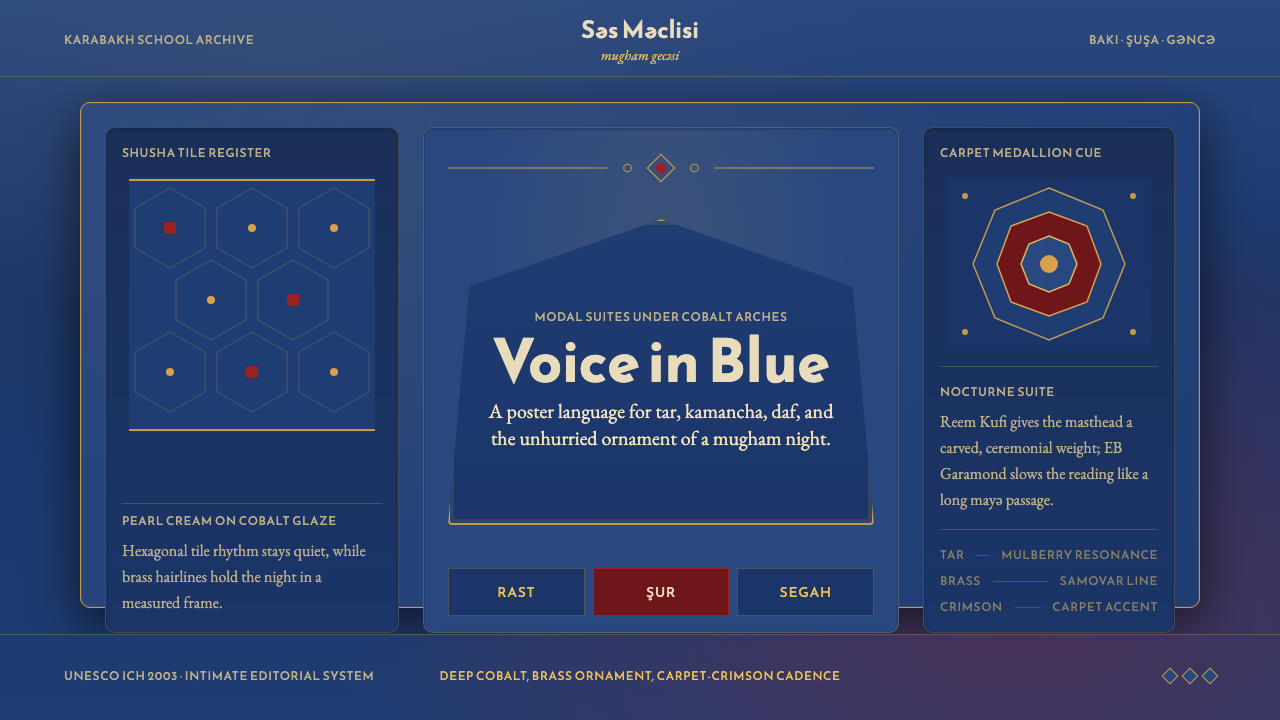 Azerbaijani Mugham Saz BlueMugham night, deeply tiled. Cobalt ground, brass hairlines, arched editorial…
 Bissau-Guinean Pano de PenteIndigo remembers. Narrow bands and kaolin seams turn weave grammar into pixel…
 Bulgarian Shevitsa Folk EmbroideryVillage-bright code. Deep indigo carries shevitsa red crosses and gold-cord b…