What is Moebius (Jean Giraud)?
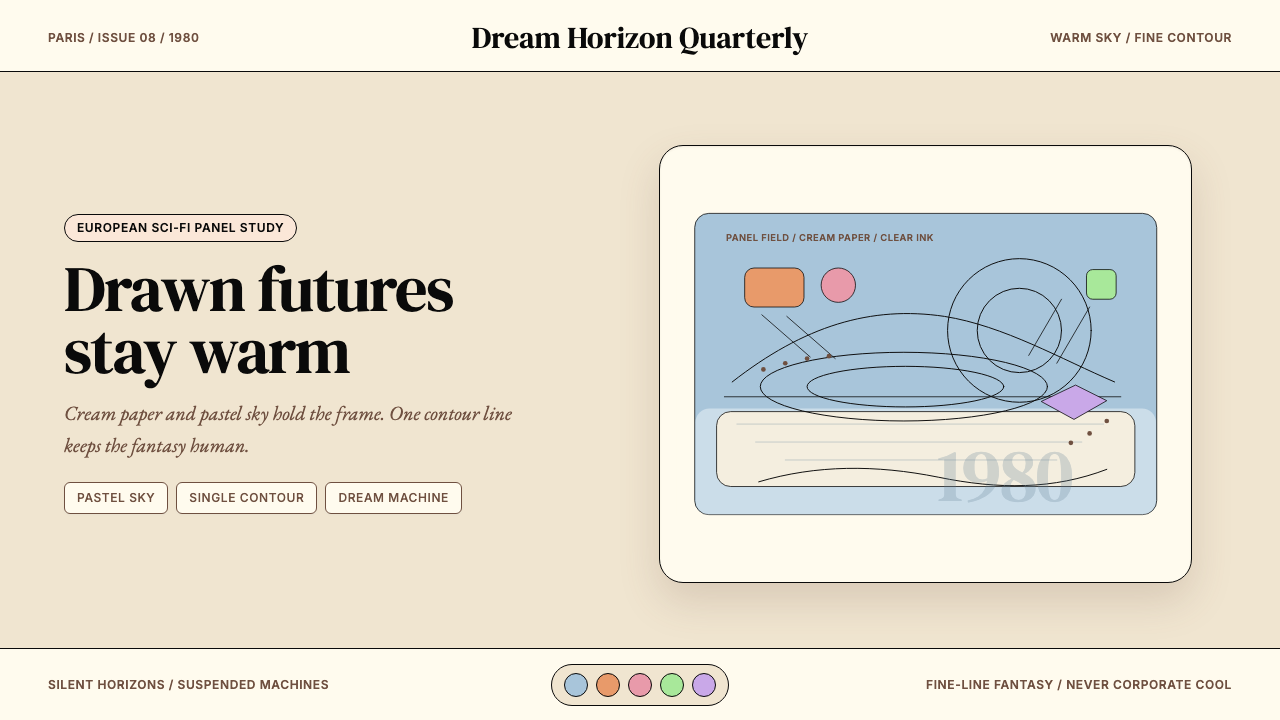
Moebius drew the future as a warm dream — cream horizons, pastel skies, and a single confident ink line that made science fiction feel like a memory.
Moebius (Jean Giraud) in brief
The Moebius aesthetic is the visual language of Jean Giraud (1938–2012), the French comics artist who signed his science-fiction and fantasy work with the pen name Moebius. Where most genre illustration of the 1970s and 1980s reached for darkness, metallic menace, and machine-age aggression, Moebius went the other direction: warm ochre deserts, powder-blue atmospheres, candy-tinted accents in coral, mint, and lilac, all held together by an ink line of extraordinary calm and precision. The result was a science fiction that felt ancient and intimate rather than cold and extraterrestrial.
The hallmarks are immediately legible. Backgrounds open into vast, sparsely detailed spaces — a horizon drawn with a single ruled line, a cliff face described by a handful of confident strokes. Foreground figures and objects receive dense, meticulous fine-line rendering: rivets, fabric folds, mechanical joints, all catalogued with the patience of a medieval manuscript illuminator. Color, when applied, is flat and luminous — saturated enough to read as fantasy, muted enough to feel like memory. Nothing shouts; everything glows.
Translated into a design system, the Moebius sensibility produces surfaces that feel warm, handcrafted, and quietly extraordinary. The underlying structure is always clear — panels, grids, hierarchies — but the atmosphere is that of a Moebius page: open sky, fine line, a story about to begin.

Where does Moebius (Jean Giraud) come from?
Jean Giraud was born in 1938 in Nogent-sur-Marne, near Paris, and came of age reading American Western comics smuggled into postwar France. He began his professional career in the late 1950s drawing the Western serial Blueberry under his own name, a long-running series whose dusty frontier landscapes and morally complex protagonist made it one of the most respected French-language Western comics of the twentieth century. The discipline of drawing horses, desert light, and vast open country trained Giraud's eye for landscape and space in ways that would define everything he later signed as Moebius.
The Moebius pen name emerged in the mid-1960s as a separate creative identity: looser, more experimental, freed from the constraints of the Western genre. The split was deliberate and productive. Giraud used it to explore surrealist narrative, wordless visual poetry, and the kind of open-ended world-building that would become the signature of European bande-dessinée at its most ambitious. In 1974, along with writer-editor Jean-Pierre Dionnet and artist Philippe Druillet, Giraud co-founded Métal Hurlant — a magazine whose name translates roughly as 'screaming metal' — which became the engine of a new European science-fiction aesthetic. The magazine's English-language edition, Heavy Metal, launched in 1977, carried that aesthetic to American readers and directly influenced a generation of science fiction film designers, game artists, and illustrators.
The mature Moebius visual language crystallized across several landmark series. Arzach (1975) — a wordless story following a pterodactyl-like creature across surreal landscapes — distilled the aesthetic to its essence: monumental open space, a lone figure, meticulous fine-line rendering, and color so carefully chosen that the silence between panels becomes almost audible. Le Garage Hermétique (The Airtight Garage, serialized from 1976) added bureaucratic absurdism and dense mechanical invention. L'Incal (The Incal, written by Alejandro Jodorowsky, beginning in 1980) brought operatic scale and was the work that introduced Moebius to the widest international audience.
Beyond the page, Moebius left a decisive mark on the visual imagination of late-twentieth-century science fiction cinema. His concept art contributions to Ridley Scott's Alien (1979), Steven Lisberger's Tron (1982), and Luc Besson's The Fifth Element (1997) demonstrate how fluidly his aesthetic moved between comics and film. Hayao Miyazaki, who visited Giraud in Paris, acknowledged the influence explicitly — the open skies, the flying machines, and the sense of melancholic wonder in Nausicaä of the Valley of the Wind carry clear Moebius inflections. Jean Giraud died in Paris in March 2012, but the vocabulary he built remains one of the most living presences in contemporary speculative design.
What defines the Moebius (Jean Giraud) look?
Palette
The Moebius palette is built on warmth and restraint simultaneously. Base tones are creamy off-whites and warm ochres — the color of aged paper and desert sand — rather than stark white. The sky register is a distinctive powder blue or pale cerulean, never the deep navy of conventional science fiction. Accent colors are saturated but carefully chosen: coral orange, dusty rose, soft mint, and a muted lilac appear as jewel-like concentrations against the warm ground. Nothing is neon; nothing is purely grey. The overall impression is of color that has been exposed to sunlight for decades — vivid in memory, gentle in light.
Line Quality
The defining mark of Moebius draftsmanship is the single-weight ink line of extraordinary confidence. Unlike the crosshatched, expressionistically varied linework of many comics traditions, a Moebius contour is clean, continuous, and almost architectural in its precision. A cliff face, a spaceship hull, a character's coat — all are described by the same calm, unwavering line. The effect is simultaneously handmade and crystalline: you feel the pen moving across the page, yet nothing wavers or corrects. In a design system, this translates to borders, dividers, and icon strokes that are fine and consistent, never reinforced or doubled for emphasis.
Space and Horizon
Moebius compositions are characterized by an abundance of sky and open ground — vast, lightly rendered spaces in which a small figure or vehicle is placed with almost theatrical deliberateness. The horizon line is a consistent structural element, often positioned in the lower third of a panel, giving the sky enormous weight and presence. This spatial generosity is not emptiness; it is atmosphere. In design applications, this sensibility manifests as disciplined use of negative space, generous vertical breathing room between elements, and a preference for layouts where a single strong visual sits in a field of calm rather than competing with dense content.
Flat Color and Luminosity
Color in a Moebius page is applied flat — no gradients within a single shape, no soft atmospheric diffusion — yet the total effect is strangely luminous. The luminosity comes not from technique but from selection: the palette's warm bias makes shadows feel like amber light rather than cool darkness, and accent colors are placed with enough restraint that each one reads as a deliberate decision rather than a fill. In digital design, this principle argues against gradient backgrounds and soft-glow effects in favor of flat-filled panels whose warmth comes entirely from hue temperature and saturation level.
Serif Typography
The typographic mood appropriate to this aesthetic is humanist and literary rather than geometric or technological. Serif letterforms — particularly those with old-style proportions, bracketed serifs, and slightly irregular stroke widths — carry the hand-drawn warmth of the Moebius line into text. Display type should feel like a title inked by hand: generous spacing, unhurried rhythm, scaled large enough to breathe. Body text, set in a readable old-style face, reinforces the impression of a printed page from an alternate universe — technically precise, emotionally warm, and slightly removed from the contemporary.
Fine-Line Detail and Restraint
One of the most instructive tensions in Moebius's work is between hyper-detailed passages and passages of nearly absolute simplicity — a mechanically intricate suit of armor beside a sky described by two lines and a wash of blue. Both are rendered with the same care, but they serve different roles: detail anchors the eye and establishes world-building credibility; simplicity opens the breath and lets the imagination continue the line. Applied to UI or presentation design, this principle suggests that dense content regions should be accompanied by generous open regions, and that complexity in one area is always most effective when offset by stillness in another.
Warm Nostalgia and Futurity
The most paradoxical and most powerful quality of the Moebius aesthetic is its simultaneous sense of the ancient and the not-yet. Desert landscapes and lone wanderers carry mythological resonance; spacecraft and energy weapons belong to imagined tomorrows. The visual device that bridges these registers is consistent: warm palette, open sky, fine line, unhurried scale. The future in Moebius reads not as threatening novelty but as a remembered place the viewer has not yet visited. In design applications, this quality is achieved through color temperature — keeping grounds warm even when imagery is technically futuristic — and through avoiding the cold-chrome, high-contrast conventions of standard sci-fi visual language.

Who shaped Moebius (Jean Giraud)?
Giraud was both the creator of the Moebius aesthetic and its most precise practitioner. Born near Paris in 1938, he developed parallel careers as a Western comics artist (Blueberry) and a science-fiction visionary (Moebius), maintaining the two identities with remarkable discipline for over four decades. His draftsmanship — trained on the demanding requirements of realistic Western illustration — gave the Moebius line its extraordinary control and patience. He died in Paris in 2012, leaving a body of work that remains foundational to European comics, science fiction film design, and the visual imagination of a generation of artists worldwide.
Dionnet was the editor, writer, and co-founder of Métal Hurlant who provided the intellectual and institutional framework within which the Moebius aesthetic could develop and reach an audience. As a writer and editor, he understood that science fiction comics could be literary, philosophical, and visually radical simultaneously — and he shaped the magazine's curatorial identity accordingly. Without Métal Hurlant's platform, the Moebius visual language would have remained a private experiment rather than becoming the international influence it did.
Druillet was the third co-founder of Métal Hurlant and Giraud's artistic counterpart — where Moebius refined and clarified, Druillet amplified and overwhelmed, filling pages with baroque architectural excess and operatic darkness. The contrast between the two artists defined the range of European science-fiction comics at this moment. Druillet's baroque ambition made Moebius's restraint legible as a deliberate choice rather than a limitation, and their coexistence in the same magazine gave readers the full spectrum of what the form could do.
The Chilean-French filmmaker and writer Jodorowsky was Moebius's most important creative collaborator, providing scripts whose cosmological ambition, surrealist logic, and operatic scale pushed Giraud's visual language into new registers. Their collaboration on L'Incal — beginning in 1980 — produced what many critics regard as the high point of European comics narrative. Jodorowsky had earlier attempted to produce a film adaptation of Frank Herbert's Dune, for which he assembled an extraordinary team including Giraud, H.R. Giger, and Chris Foss; though the film was never made, its visual development work circulated widely and influenced the subsequent decade of science fiction cinema.
Miyazaki is not a direct participant in the Moebius tradition but is its most significant inheritor in animation. He visited Giraud in Paris and acknowledged the influence on his work openly. The visual kinship is unmistakable: the open skies of Nausicaä of the Valley of the Wind, the elaborately imagined flying machines of Castle in the Sky, the warm pastoral warmth of My Neighbor Totoro — all share the Moebius sensibility of melancholic wonder, fine-line world-building, and a palette that leans toward warmth even in moments of technological imagination. Miyazaki's work ensured that the Moebius aesthetic reached audiences far beyond comics readers.
How do you use Moebius (Jean Giraud) today?
The Moebius aesthetic is a strong choice for any design context that wants to feel thoughtful, warm, and quietly extraordinary — a world apart from both the cold minimalism of standard tech design and the aggressive maximalism of conventional science fiction. Applying it correctly requires understanding that its power is atmospheric rather than ornamental: the style works because of what it withholds (sharp cool tones, heavy drop shadows, gradient fills) as much as because of what it includes (warm grounds, fine lines, restrained saturated accents).
For presentation slides, the Moebius aesthetic excels on cover pages designed around a single strong visual moment: a wide horizon, a lone object against a cream ground, a passage of fine-line illustration occupying one side of the frame while typographic content occupies the other. Cover typography should be set in a humanist serif face at generous scale, with open tracking that gives the title room to breathe like a headline on a comics page. Content slides work best as lightly structured grids: a warm off-white field, section labels in a smaller weight of the same serif, data displayed as flat-filled shapes using the accent palette rather than default charting blues and grays. Data visualizations treated as geometric objects — bars and segments in coral, mint, and dusty rose — read as deliberate design decisions rather than default software output.
For web interfaces, the Moebius aesthetic is particularly effective in editorial contexts, portfolio sites, and premium product pages where the goal is to establish a distinct sensibility rather than to compete on feature density. Dashboard applications can adopt the style selectively: warm cream backgrounds for the main canvas, fine-bordered card components, and accent color reserved for active states and call-to-action elements. Pricing pages benefit from the theatrical quality the aesthetic carries — a warm gradient-free field, a typographically clear hierarchy of tier names and prices, and minimal accent color used only at the point of conversion. Navigation should be typographic and sparse; icon use should be limited to simple line marks with consistent stroke weight.
For editorial and marketing design — book covers, feature articles, event graphics, brand identity materials — the style rewards commitment. A full-page editorial spread using warm cream paper tone as the background field, a single piece of fine-line illustration, and restrained typographic hierarchy can achieve the quality of a Moebius page: open, precise, quietly arresting. Marketing headers work well with the horizontal horizon composition: a wide warm-ground field, a centered or left-aligned typographic statement in a generous serif, and a single saturated accent color as a narrow stripe or small geometric shape. The key discipline is to resist adding. Every element not present in the Moebius visual tradition — gradient overlays, multi-color type, busy texture, soft-glow ambience — weakens the coherence of the system.
A common mistake when applying this aesthetic is confusing its warmth with permission to add organic, earthy, or rustic elements — rough paper textures, hand-lettered type, brushstroke illustrations. The Moebius aesthetic is warm but it is also precise: the fine ink line is architectural, not gestural; the colors are calibrated, not spontaneous; the compositions are constructed, not found. Warmth here comes from palette temperature and spatial generosity, not from textural complexity or artisanal roughness. A second common error is treating the sci-fi thematic associations as license to add cold metallic surfaces, deep-space blacks, or aggressive neon accents. The style's power comes from its refusal of those conventions — cream where others use grey, powder blue where others use midnight, coral where others use electric cyan.

Moebius (Jean Giraud) — FAQ
Is Moebius style appropriate for corporate or enterprise design?
It can be, but it requires careful positioning. The Moebius aesthetic signals individuality, craft, and a certain literary seriousness — qualities that read well for creative agencies, premium software products, publishing brands, and cultural institutions. For very large enterprises, particularly in financial services or regulated industries, the style's dreamlike warmth and literary register may feel at odds with the authority and reliability those sectors need to project. The test is whether the product's personality can accommodate warmth and quiet eccentricity. If so, Moebius is a powerful differentiator in a landscape dominated by cold minimalism.
How does this style differ from general retro-futurist or vaporwave aesthetics?
The superficial similarities — warm palettes, pastel colors, science-fiction themes — mask fundamental differences in sensibility. Retro-futurism and vaporwave are primarily nostalgic and ironic, working through the language of consumerism, kitsch, and pop culture detritus. Moebius is earnest, classical, and humanist. It has no irony; it is not referencing past styles so much as inhabiting a visual mode that feels timeless precisely because it is grounded in patient draftsmanship rather than cultural trend. Where vaporwave is urban, neon, and digitally synthetic, Moebius is desert, pastel, and hand-drawn. They should not be mixed.
Can I use photography within this design system?
Photography is possible but must be treated carefully. A Moebius-adjacent design system has no native tradition of photography — its visual language is entirely hand-drawn. When photography is necessary, it should be treated tonally: warm-graded rather than neutral, cropped to geometric simplicity, and ideally used as a flat element rather than as a naturalistic window. Duotone treatments using the palette's warm ground and a single accent tone can integrate photography effectively. High-contrast black-and-white photography with a cream paper overlay also works. What to avoid: full-color editorial photography with naturalistic skin tones and ambient lighting, which creates a tonal clash with the system's warm, calibrated palette.
What makes a Moebius-inspired layout feel authentic versus pastiche?
Authenticity in Moebius-inspired design comes from understanding its underlying values rather than copying its surface tokens. The surface tokens — cream backgrounds, powder blue, fine lines, humanist serifs — are reproducible by anyone. What is harder to reproduce is the structural logic behind them: the discipline of restraint (every element justified, nothing added for richness), the spatial generosity (open areas given equal status with content areas), and the warmth of selection (each color chosen for its temperature, not its trendiness). A pastiche applies the palette and the line style while retaining the compositional logic of a different tradition — dense content, cold tones used ironically, type selected for fashionability rather than warmth. Authenticity means subordinating every choice to the same atmospheric goal.
How should dark-mode or dark-background variants be handled in this aesthetic?
A dark variant is possible but sits in tension with the style's core identity, which is built on warmth and openness — qualities that cream and off-white grounds deliver and that dark grounds complicate. If a dark variant is required, the key discipline is to preserve palette warmth rather than defaulting to neutral dark grays or pure black. A dark ground should be a very deep warm brown or desaturated warm tone — close to dark espresso or aged charcoal — rather than a cold slate or pure black. Accent colors can increase in saturation on a dark ground, but the warmest tones — coral and cream — should remain present as highlights rather than disappearing in favor of cooler alternatives. The fine-line aesthetic transfers well to dark grounds; the spatial openness is harder to achieve and requires even more generous negative space.
Related design styles
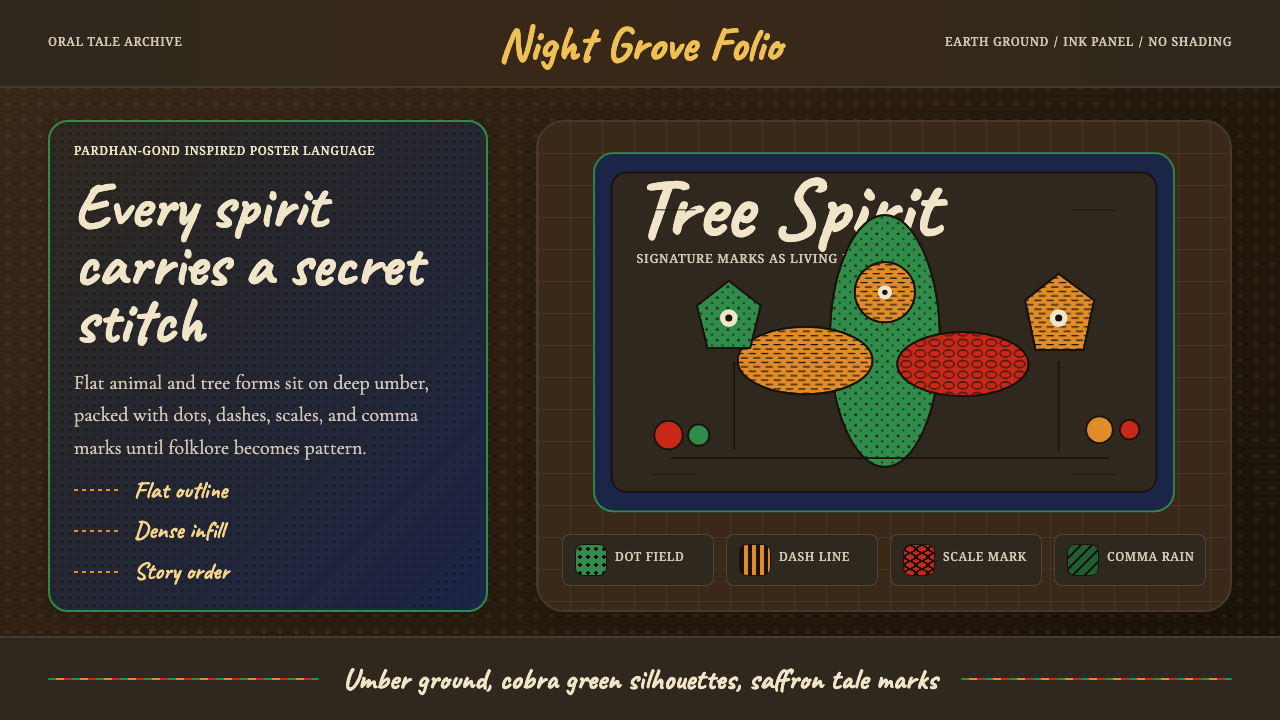 Gond Pardhan (Tree Spirit Painting)Story breathes in pattern. Cobra green forms on umber ground, filled with dot…
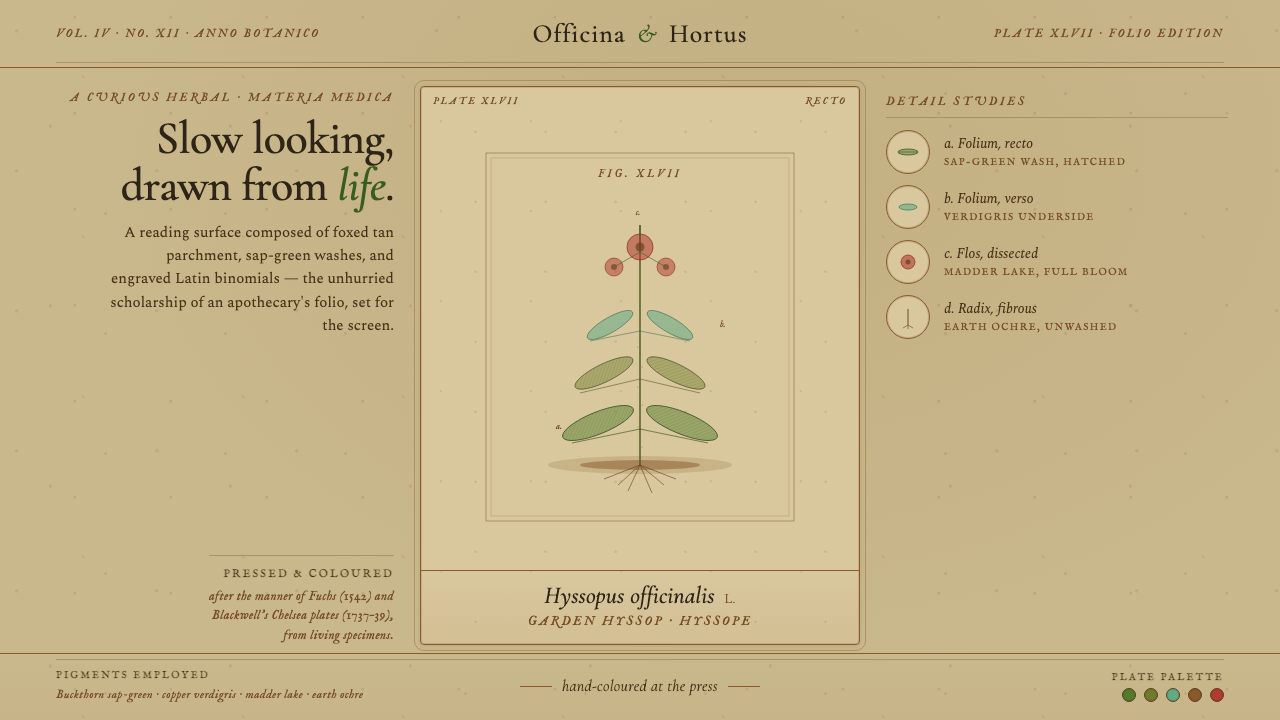 Herbal PharmacopoeiaSlow scholarship of the apothecary folio. Foxed tan parchment, sap-green wash…
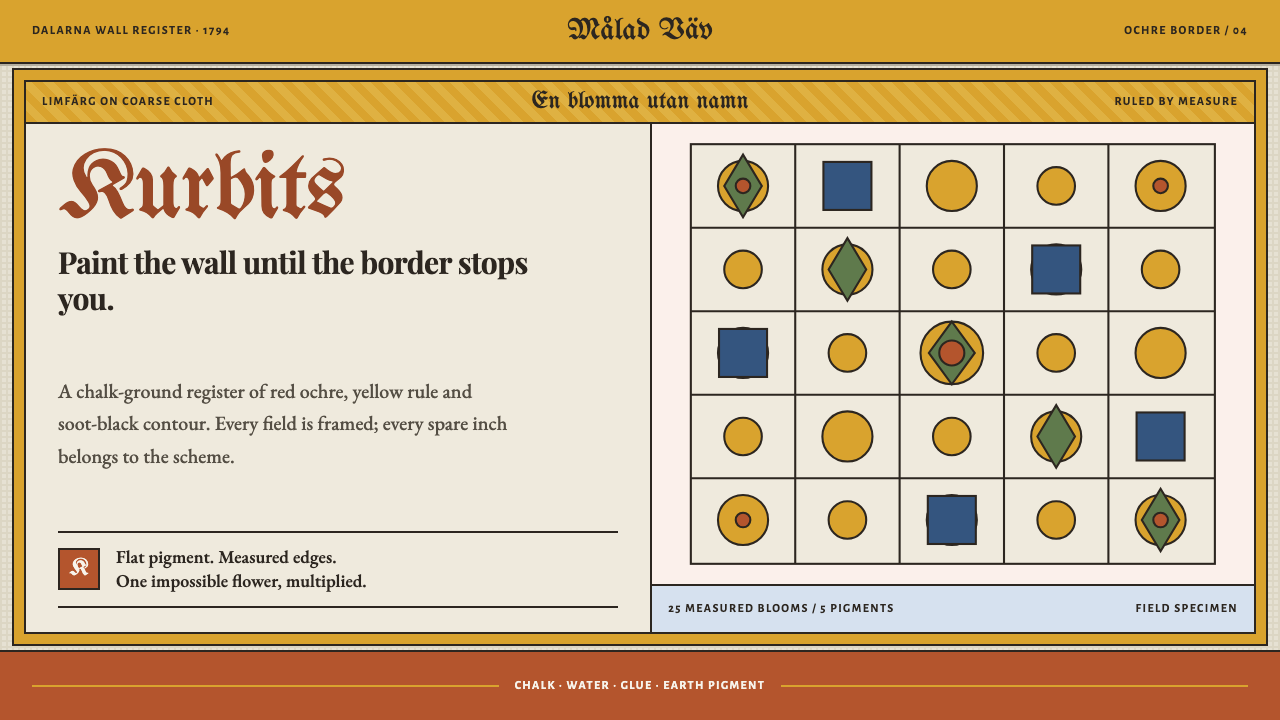 Kurbits Dalarna PaintingNo blank wall survives. Red ochre blooms crowd a chalk ground inside measured…
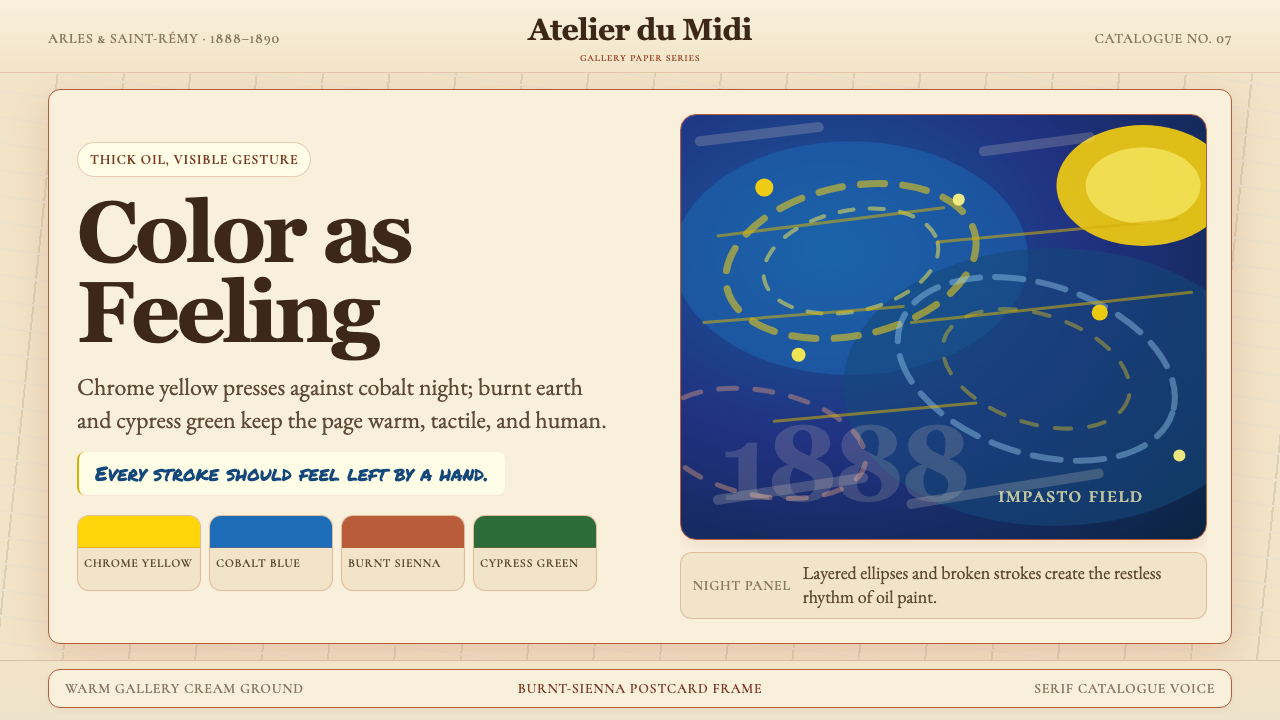 Van Gogh Post-ImpressionistFeeling made visible. Chrome yellow meets cobalt swirls on warm gallery cream.
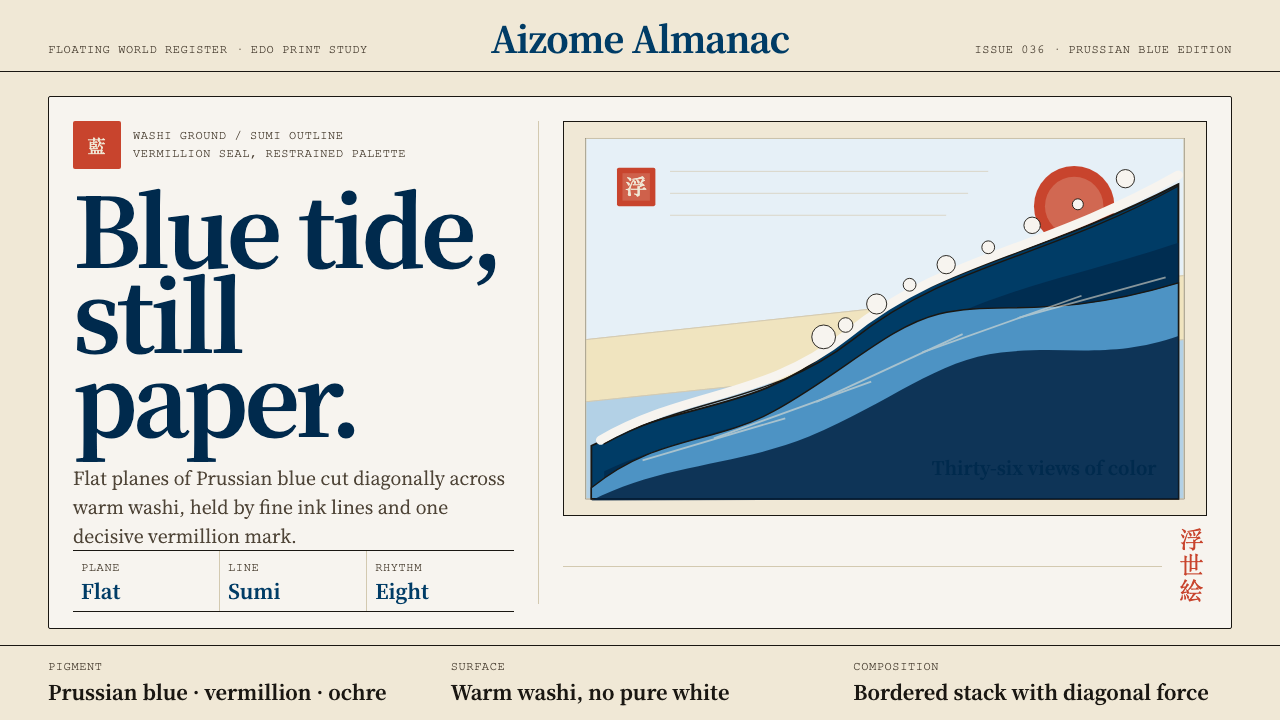 Edo Ukiyo-e (Hokusai)Flat power on paper. Prussian blue diagonals and vermillion seals cut across…
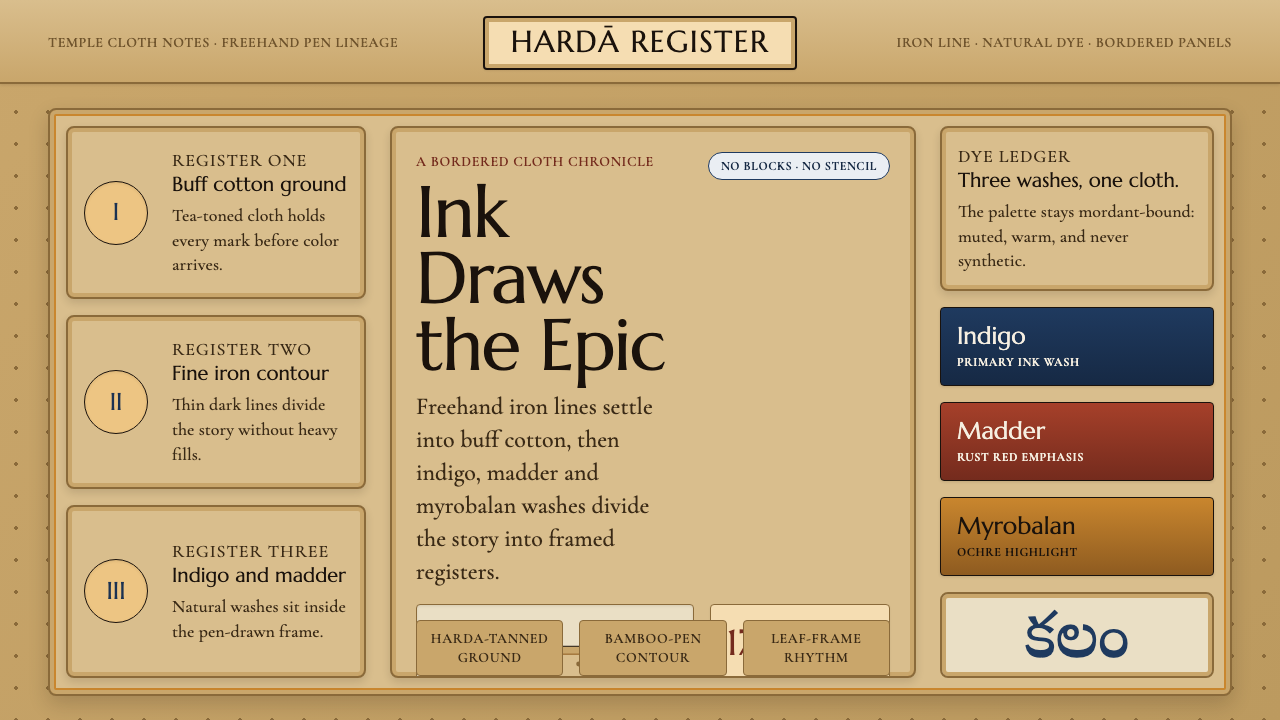 Srikalahasti Kalamkari Pen-WorkHand-drawn cloth storytelling. Buff tan ground, iron lines and indigo-rust pa…