What is Peruvian Arpillera (Story-Cloth)?
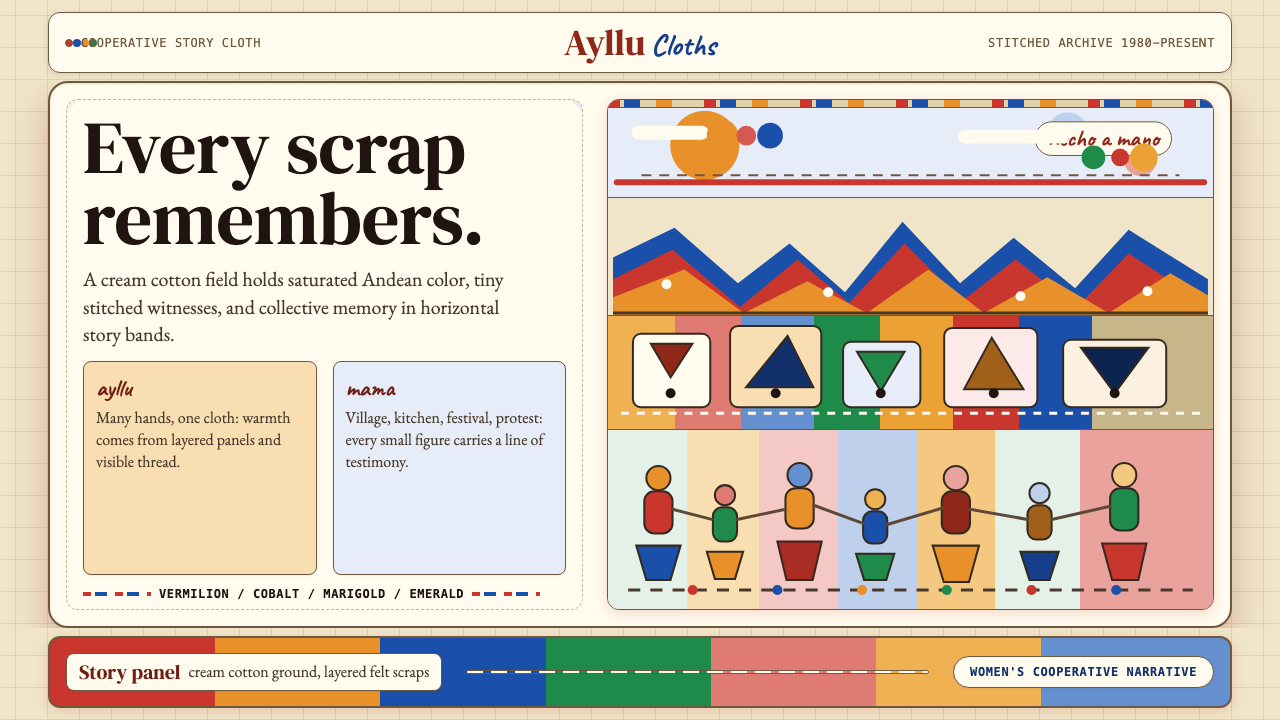
Arpillera stitches collective memory into saturated Andean color — a folk tradition born in political protest that gives designers a warm, narrative-dense visual language unlike anything in the modernist canon.
Peruvian Arpillera (Story-Cloth) in brief
Peruvian Arpillera — pronounced ar-pee-YEH-rah — is a women's story-cloth tradition in which small panels of layered fabric scraps, wool, and felt are hand-stitched into densely populated narrative scenes. Each panel depicts a slice of lived experience: an open-air market, a highland festival, a family meal, a political demonstration. Tiny embroidered figures, often no taller than a thumb, populate horizontal tableaux against silhouetted cordillera ridges and cream-toned undyed cotton grounds. The medium is intentionally humble — nothing is wasted, everything is repurposed — yet the result is visually exuberant and encyclopedically specific.
The defining visual property of Arpillera is its saturated Andean palette. Vermilion and cobalt, marigold orange and emerald green appear together at full intensity, the kind of color combination that a trained colorist might call reckless but that the tradition carries off through the warmth of hand-stitched texture and the organizing logic of the horizontal scene band. Unlike modernist abstraction, which uses color symbolically or structurally, Arpillera uses color the way a festival uses color — to generate joy, to signal communal abundance, to make the scene readable from across a room.
What distinguishes the Arpillera aesthetic from other folk embroidery traditions is its narrative density and its deliberate political dimension. The panels are not decorative in the passive sense; they are acts of documentation and testimony. Every crooked stitch and exposed thread edge is a mark of handwork — of time, care, and collective labor. This legible imperfection is not a flaw to be minimized but the primary carrier of the tradition's warmth and authenticity.

Where does Peruvian Arpillera (Story-Cloth) come from?
The Arpillera form originated not in Peru but in Chile, under the Pinochet military dictatorship that came to power in the coup of September 1973. In the years that followed, thousands of Chileans — predominantly men — were detained, tortured, or killed by the regime. Their female relatives, many of them barred from formal employment or public organizing, began meeting in church-sponsored workshops operated by the Vicaría de la Solidaridad in Santiago. There, starting around 1974, they stitched fabric scraps into small panels depicting the disappearances, the shantytown conditions, and the daily realities the regime's official media refused to show. The Arpilleras were smuggled out of Chile by church workers, diplomats, and solidarity networks, and sold abroad as both crafts and evidence. They were, simultaneously, economic survival and political testimony.
The tradition crossed the Andes and took deepest root in Peru during the 1980s and into the following decades. Lima's rapidly expanding shantytowns — the pueblos jóvenes that ringed the capital as rural migration accelerated — became the primary sites of Peruvian Arpillera production. Women's cooperatives such as Mujeres en Acción organized collective workshops where Arpillera-making was both income generation and social support. The Andean visual vocabulary that Peruvian makers brought to the tradition — the fiesta colors of the sierra, the cordillera silhouettes, the imagery of llamas, markets, and communal cooking fires — transformed the form. What had been, in Chile, primarily a documentary medium became, in Peru, also a vehicle for cultural memory, community identity, and the preservation of Andean oral history.
The Arpillera tradition spread more broadly across Latin America, with significant practice developing in Bolivia, Ecuador, Colombia, and among diaspora communities in Europe and North America. In each country, makers adapted the form to local visual vocabularies and political circumstances, but the core grammar remained constant: fabric scraps on a ground cloth, horizontal scene bands, embroidered figures, and the deliberate choice of a medium that anyone with thread and a needle could practice. This accessibility was not incidental — it was the point. A tradition that required no special materials, no professional training, and no institutional support could survive censorship, displacement, and poverty.
Scholarly and artistic attention to Arpillera grew significantly from the 1980s onward, led in part by the poet and activist Marjorie Agosín, whose advocacy and writing brought Chilean and Peruvian Arpilleras to international museum audiences. Peace studies scholar Roberta Bacic built one of the world's most comprehensive Arpillera collections, documenting the tradition's role across multiple conflict zones. Today, Arpilleras are held in museum and activist collections worldwide, and the form continues to be practiced as living craft — not as historical artifact — by cooperatives and individual makers across the Andean region and its diaspora.
What defines the Peruvian Arpillera (Story-Cloth) look?
Saturated Festival Palette
The Arpillera palette is unmistakably Andean: vermilion, cobalt, marigold, and emerald appear together at full intensity on grounds of undyed cream cotton. These are not color combinations arrived at through systematic theory — they are the colors of highland festivals, market textiles, and dyed wool, transcribed directly into the panels. The effect is warm and assertive rather than refined. Because each panel uses hand-dyed or hand-selected fabric scraps, no two panels share an identical palette, and slight variations in hue and value give the tradition its characteristic living warmth.
Horizontal Tableau Composition
Scenes in Arpillera panels are organized as horizontal bands — a compositional structure that echoes both ancient Andean textile traditions and the sequential logic of narrative illustration. The ground plane is established by the fabric base itself; figures stand on it, and the sky or mountain silhouette occupies the upper register. This band logic allows multiple episodes to coexist within a single panel: a cooking fire on the left, a market transaction in the center, a departure scene on the right, all readable simultaneously. The horizontal scene band is the fundamental unit of Arpillera storytelling.
Embroidered Figure Language
The tiny stitched figures that populate Arpillera scenes are schematic rather than naturalistic — they convey role and action rather than individual portraiture. A figure carrying a bundle signals labor; a circle of figures around a pot signals communal cooking; raised fists or a figure behind bars requires no caption. This economy of figuration descends from folk-art traditions worldwide but is specifically calibrated to convey meaning across language barriers, which was essential when the original Chilean panels were being read by solidarity audiences in Europe who shared neither the language nor the cultural context of the makers.
Texture and Materiality
Unlike design traditions that prize smooth, homogeneous surfaces, Arpillera's visual richness comes directly from the heterogeneity of its materials. Woven cotton scraps sit beside knitted wool remnants beside felt cut-outs beside embroidery floss beside raw fleece. Each material has a different surface, a different way of catching light, a different handle. The three-dimensional relief of raised stitchwork and appliquéd figure elements gives the panels a tactile depth that photography only partially captures. This material richness is not decorative in the modernist sense — it is the medium's content.
Exposed Craft and Deliberate Imperfection
Thread ends are left visible. Stitches vary in length and tension. Appliqué edges are rough rather than turned under and pressed. This is not the imperfection of haste or insufficient skill — many Arpillera makers are highly accomplished needleworkers — but a deliberate aesthetic that keeps the process present in the finished object. The visible hand is a value, not a failure. In an era of digital design where the trace of human labor is systematically erased, this insistence on visible making is a distinct and powerful aesthetic position.
Narrative Density
A single Arpillera panel, which might measure no larger than a small book, can contain a dozen distinct scenes, thirty figures, animals, cooking fires, mountains, and architectural elements — all legible, all purposeful. This density is not horror vacui but controlled storytelling: every element earns its place by contributing to the narrative. The tradition evolved in a context where each panel was doing serious communicative work, and that functional demand shaped an aesthetic of maximum informational density within a compact format.
Collective and Cumulative Authorship
Arpillera is rarely the product of a single maker working in isolation. The tradition developed in cooperative workshops where women divided labor, shared materials, and advised each other on composition and technique. A single panel might involve multiple hands — one maker cuts figures, another embroiders faces, another constructs the landscape. This collaborative authorship is part of why the tradition resists the art-market category of the singular genius and instead aligns itself with collective cultural practice. The visual coherence of any given panel comes not from individual signature but from the shared vocabulary of the tradition itself.

Who shaped Peruvian Arpillera (Story-Cloth)?
The founding practitioners of the Arpillera tradition were women whose names were deliberately withheld for their own protection. Working under the Pinochet dictatorship, often in secret workshops run by the Vicaría de la Solidaridad in Santiago, they developed the core vocabulary of the form — the horizontal scene band, the embroidered figure language, the use of fabric scraps as a medium that required no special materials and could be concealed. Their anonymity is part of the tradition's meaning: this was collective testimony, not individual artistic expression, and the tradition was structured accordingly.
Chilean-American poet, essayist, and activist Marjorie Agosín is among the most important advocates for the Arpillera tradition in the English-speaking world. Her books — including Tapestries of Hope, Threads of Love — documented the Chilean Arpilleristas' work and brought it to literary and academic audiences who might otherwise never have encountered it. She positioned the panels not as folk craft but as human rights documentation, changing how curators, scholars, and the general public understood what the objects were and what work they were doing in the world.
Peace studies practitioner and curator Roberta Bacic assembled one of the most comprehensive international collections of Arpilleras and related conflict textiles, documenting the form's spread across Latin America, Northern Ireland, South Africa, and other post-conflict or ongoing-conflict contexts. Her work demonstrated that the Arpillera's grammar — hand-stitched scenes bearing witness to violence or injustice — was not specific to one culture but had been independently adopted by communities across the world wherever women needed to document what official channels refused to record.
Among the Peruvian makers who developed the distinctly Andean inflection of the Arpillera tradition, Florencia Mallqui represents the generation that brought the form from its Chilean political origins into the visual vocabulary of the highland cooperatives. Working within Lima shantytown organizations in the 1980s and 1990s, makers like Mallqui adapted the tableau format to Andean iconography — llamas, mountain festivals, the imagery of the sierra — while maintaining the tradition's commitment to collective production and testimonial purpose.
How do you use Peruvian Arpillera (Story-Cloth) today?
Arpillera is one of the most emotionally specific design references available to contemporary practitioners — its warmth, handmade quality, and narrative density are not merely visual properties but values that the tradition has earned through its history. Applying it well requires understanding what the style is actually doing: making density feel welcoming rather than cluttered, making color feel celebratory rather than garish, making visible imperfection feel authentic rather than careless. The tradition suits contexts where human warmth, community, cultural richness, and storytelling are primary values.
For presentation slides, Arpillera offers a distinctive alternative to the polished, minimalist aesthetics that dominate most professional decks. A cover slide in this register uses a warm cream or undyed-linen ground tone with saturated accent colors drawn from the Andean palette — one warm, one cool, never more than two at high intensity simultaneously. Imagery should suggest texture: patterns that evoke woven or stitched surfaces, illustrative scenes with visible line-weight variation, or photographic material treated with warm color grading that emphasizes grain and materiality over glossiness. Content slides should maintain generous spacing while allowing the layout to feel layered rather than sparse — overlapping text regions and color bands suggest the panel-within-panel quality of the source tradition. Data visualizations work well when chart elements are rendered with slight irregularity and warm color — bars with subtle texture, pie segments in the Andean palette — conveying human hand rather than algorithmic output.
For web interfaces, Arpillera is well-suited to platforms and products that want to communicate warmth, craftsmanship, cultural authenticity, or community. Artisan marketplace dashboards, cultural organization websites, social impact reporting pages, and cooperative brand identities all benefit from the aesthetic's values. The approach: establish a warm off-white or cream ground, use deep warm neutrals for text and structural elements, and reserve the saturated palette colors for interactive states and primary calls to action. Border treatments should feel hand-drawn or imprecise rather than geometrically perfect — slightly rounded, slightly varied line weights communicate craft. Pricing pages in this register emphasize the human behind the transaction: maker names, origin stories, and material descriptions take priority over feature bullet points.
For editorial and marketing work, the style enables a visual language that is simultaneously festive and serious — appropriate for contexts where celebration and testimony coexist. Cultural publications, social enterprise annual reports, community foundation communications, and fair-trade brand campaigns all operate in this emotional register. An editorial spread in this tradition uses a warm ground, sets body text in a humanist typeface that suggests calligraphic origin without imitating it directly, and uses the saturated Andean colors for pull quotes, section headers, and image frames. Full-bleed imagery should be warm, textured, and human-scale — close photographs of hands, woven surfaces, faces, community gatherings — rather than aerial or architectural. Marketing pages work well with the style's poster-like narrative bands: horizontal full-width sections alternate between light and warm-dark grounds, each containing a scene that advances a story.
A common mistake when applying Arpillera is chasing surface texture without earning the warmth. Scattering fabric-texture overlays and rough-edge masks across an otherwise cold or corporate layout produces visual noise rather than the tradition's characteristic intimacy. The warmth of Arpillera comes from density, narrative specificity, and the sense that every element belongs to the same story — not from decorative texture applied as a filter. A second common error is using the saturated palette without restraint: deploying all four Andean colors at maximum intensity simultaneously produces visual competition rather than celebration. Authentic Arpillera-informed work leads with one or two warm colors at high intensity, uses the others as supporting accents, and relies on the cream ground to give the eye a resting place between saturated passages.

Peruvian Arpillera (Story-Cloth) — FAQ
Is Arpillera a fine art tradition or a craft tradition?
It is both, and the tension between those categories is part of what makes it interesting. The original Chilean Arpilleristas were not positioning themselves as artists — they were documenting human rights abuses and generating income. The cooperative structure, the anonymous authorship, and the functional purpose (to be sold, to circulate, to testify) all align the tradition with craft rather than fine art. But since the 1980s, Arpilleras have been collected by major museums, exhibited in gallery contexts, and discussed in art history alongside other politically engaged fiber art movements. The tradition sits comfortably in neither category, which is precisely why it retains a kind of moral seriousness that has largely been processed out of contemporary fine craft.
How does Arpillera relate to other Andean textile traditions?
Arpillera draws on the Andean textile tradition's characteristic visual properties — saturated color, horizontal register composition, the use of figures in sequential narrative — but it is structurally a distinct form. Traditional Andean weaving (including the backstrap-loom textiles of highland communities, and the pre-Columbian traditions those communities continue) uses integrated woven structures to produce pattern; Arpillera uses appliqué and embroidery on a ground cloth. The fiber arts community in Peru exists on a continuum that includes both traditions, and many makers are fluent in multiple forms, but they are technically and historically separate practices that arrived at similar visual vocabularies through different paths.
Can Arpillera work in dark-background digital contexts?
It can, but the inversion requires care. The canonical Arpillera palette — saturated warm colors on cream ground — depends on the light ground's role as a visual resting place between intense color passages. On a dark background, the saturated colors can become aggressive rather than celebratory, and the characteristic warmth of the tradition risks reading as harsh. A dark version works best when the background is a very deep warm brown or charcoal rather than pure black, when the saturated palette colors are used sparingly as accents rather than as dominant fields, and when the overall density of the composition is reduced so that light-colored elements can breathe. Dark Arpillera is a viable direction for evening event branding, cultural heritage digital experiences, and contexts that want to evoke candlelit or firelit warmth.
What contexts is Arpillera poorly suited to?
Arpillera struggles in contexts that require authority, precision, or institutional neutrality. Financial services platforms, clinical health applications, legal technology products, and enterprise analytics tools all benefit from visual systems that communicate accuracy and systematic control — qualities that the tradition's deliberate imperfection and emotional warmth actively work against. Similarly, contexts requiring sleek aspirational positioning — luxury fashion, premium consumer electronics, high-end real estate — typically demand a visual register that emphasizes refinement and restraint over narrative density and handmade warmth. The tradition is also poorly suited to interfaces where information density creates cognitive load rather than richness: dense data tables, complex workflow management tools, or multi-panel monitoring dashboards where visual warmth would obscure rather than illuminate.
How do you avoid making Arpillera-inspired work look merely folksy?
The risk of folksy pastiche is real and common. The difference between a genuine Arpillera-informed visual language and a superficial folk-art costume lies in two things: narrative specificity and structural commitment. Authentic application treats the composition as a story — every element is present because it contributes to a specific narrative, not because it adds texture or fills space. And it commits to the tradition's structural logic: the horizontal band, the figure scale, the density — rather than cherry-picking decorative elements (zigzag borders, bright color patches) and applying them to an otherwise conventional layout. The tradition's power comes from density and purpose together. Either alone produces pastiche.
Related design styles
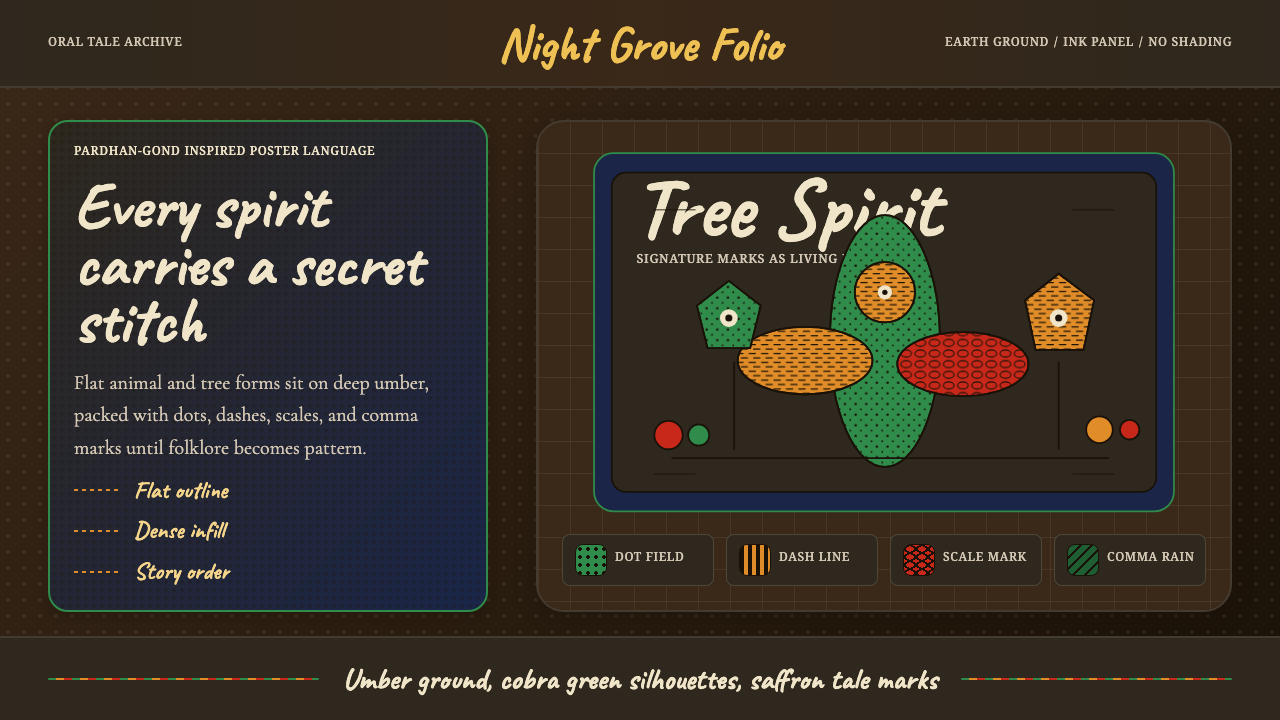 Gond Pardhan (Tree Spirit Painting)Story breathes in pattern. Cobra green forms on umber ground, filled with dot…
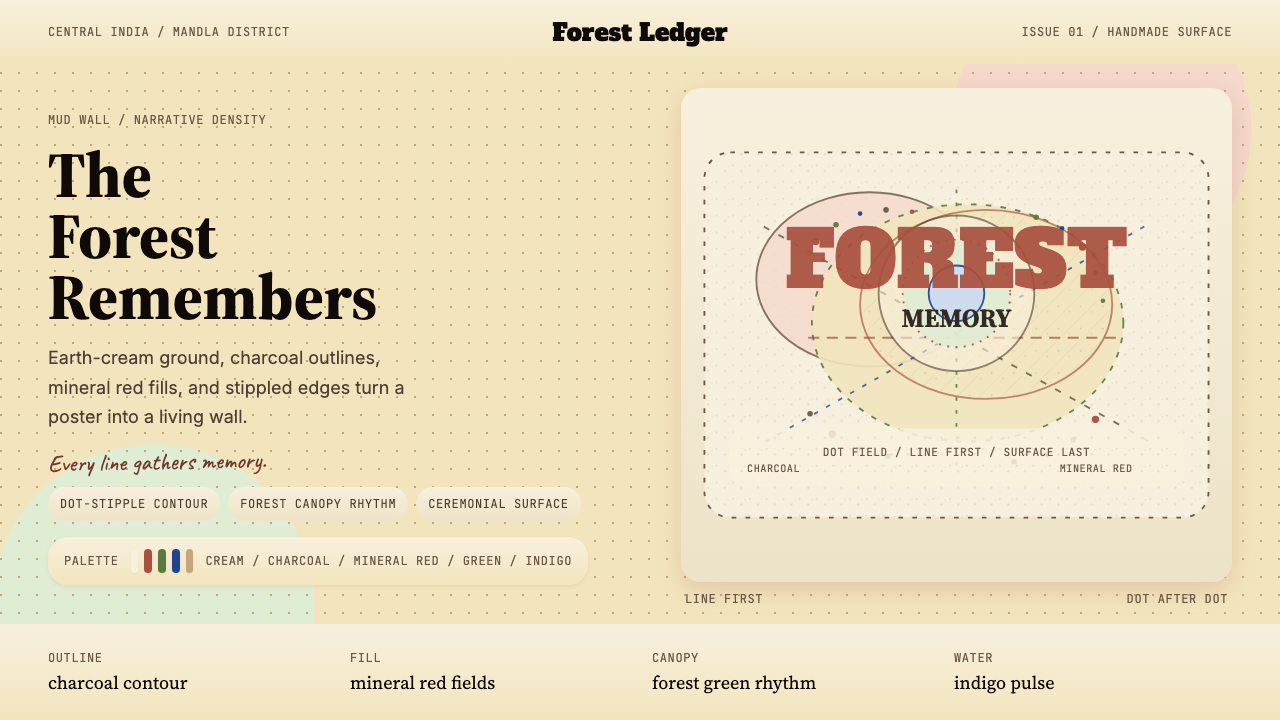 Gond Tribal Art (Madhya Pradesh)The wall becomes a forest. Earth-cream, charcoal, and stippled red make it ce…
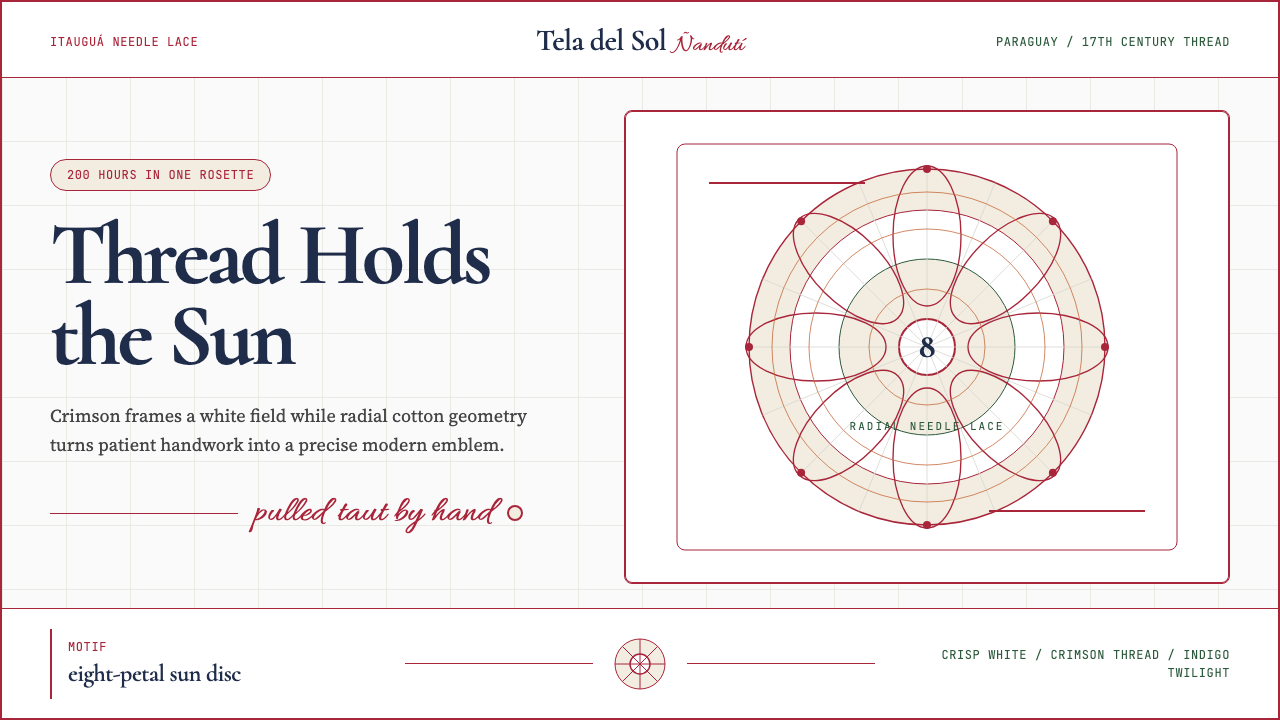 Paraguayan Ñandutí LacePatient craft, modern frame. Crimson lines pin radial lace on crisp white.
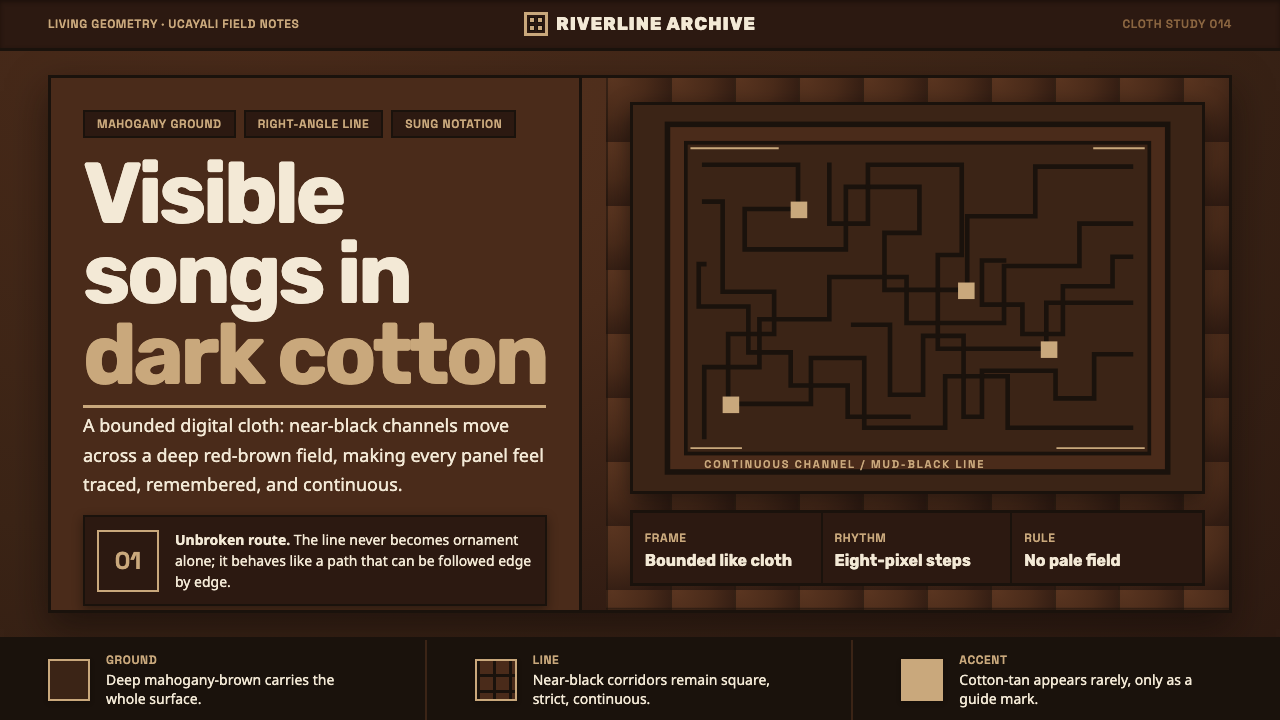 Shipibo Kené PatternSacred geometry sings. Mahogany cotton carries near-black right-angle paths.
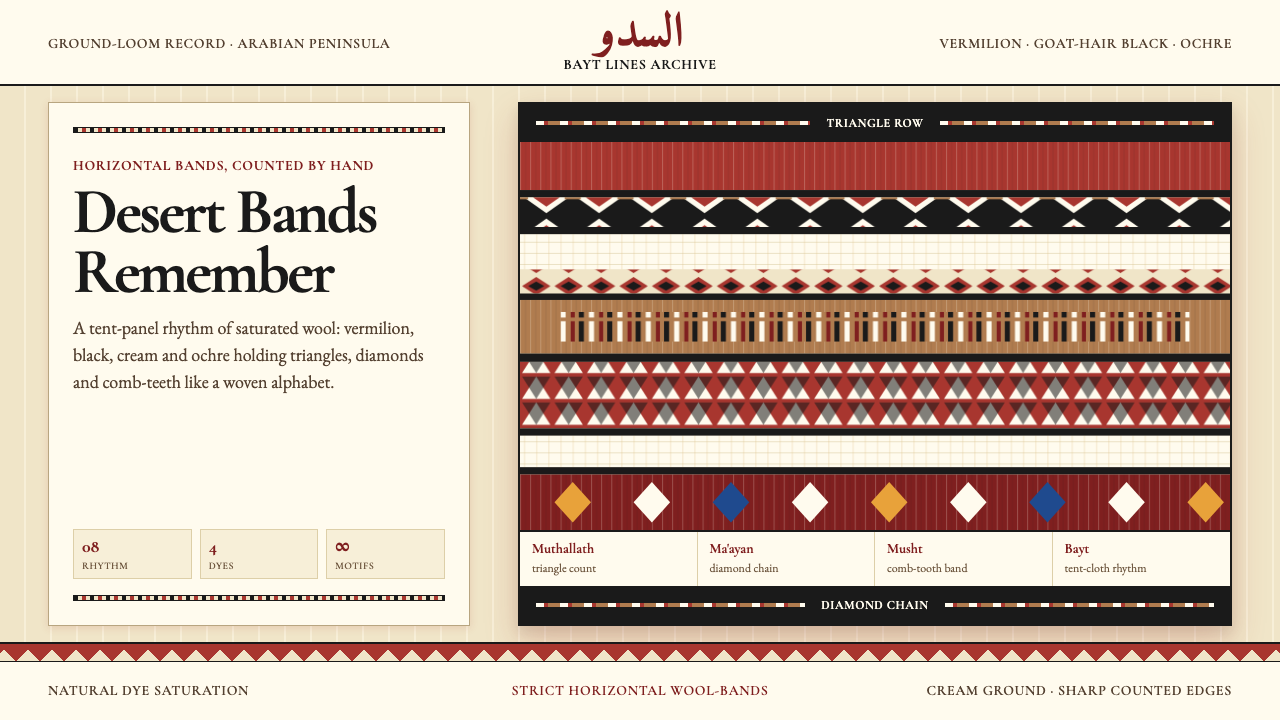 Bedouin Desert Textile (Sadu)Woven memory, not ornament. Vermilion-black bands count triangles and diamond…
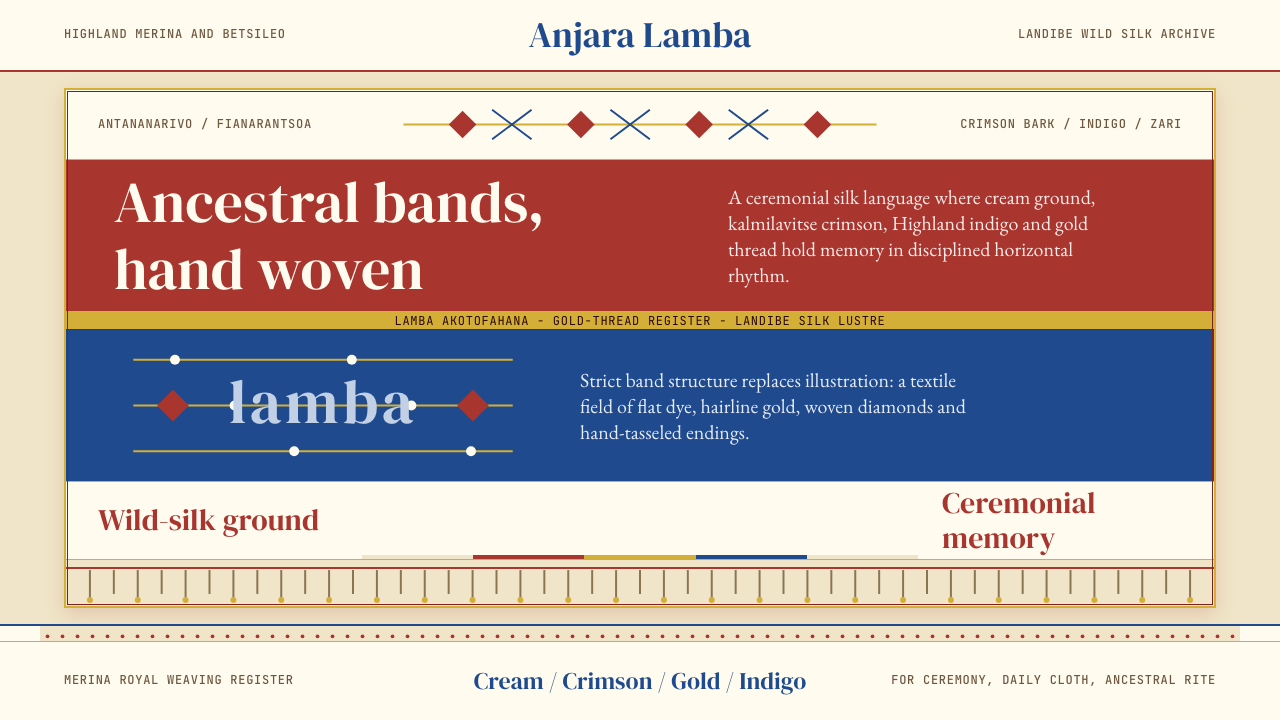 Madagascan Lamba SilkAncestry is woven flat. Crimson, indigo, cream and gold run in strict silk ba…