About Peruvian Arpillera (Story-Cloth)
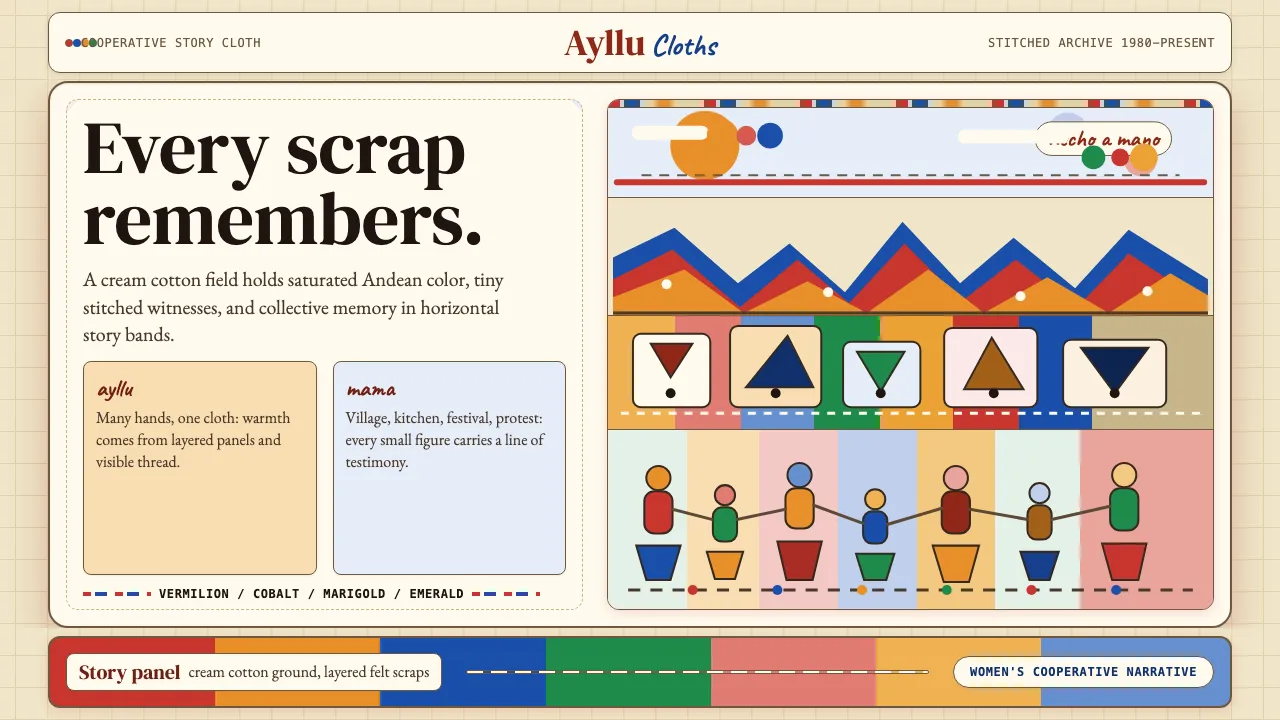
Arpillera is a Latin American women's story-cloth tradition: small fabric-scrap panels stitched with tiny embroidered figures depicting village life, kitchens, festivals, and political protest. Born in 1970s Chile under Pinochet as documentation of the disappeared, the form flowered in Peruvian Lima shantytowns and Andean cooperatives as collective-economy and oral history.
The visual language is saturated Andean fiesta-bright — vermilion, cobalt, marigold, emerald — on cream undyed-cotton ground. Tiny doll-figures populate horizontal tableau scenes against cordillera silhouettes. Warm, narrative-dense, hand-stitched, and politically rooted.
- Origin
- Latin America — Chile (origin), Peru (major flowering), Bolivia, Ecuador, Colombia
- Era
- Chilean origin 1974 onward (Pinochet-era protest); Peruvian flowering 1980s–present via Lima shantytown + Andean women's cooperatives
- Key figures
- Anonymous Chilean Arpilleristas · Florencia Mallqui · Marjorie Agosín · Roberta Bacic
- Movements
- Latin American feminist-craft-as-activism · women's collective-economy cultural-narrative work · post-dictatorship cultural-memory + truth-telling
Peruvian Arpillera (Story-Cloth) design spec
Colors
Typography
The other 11 sections — buttons, cards, spacing, motion, techniques and more — open once you unlock. Download the DESIGN.md or send it to your AI in one click. Unlock once, yours forever.
Sign up nowStyles similar to Peruvian Arpillera (Story-Cloth)
Also inspired by crafts & folk art, with a close feel.
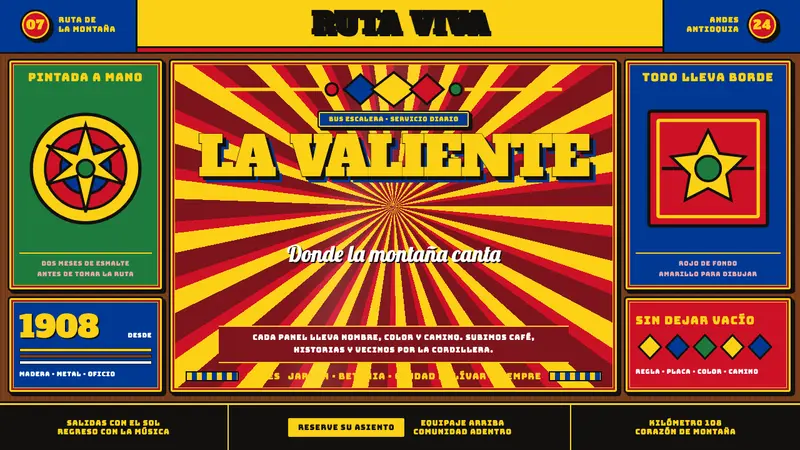 Colombian Chiva BusNothing is left unpainted. Flag-yellow rules, slab lettering and black keylines fill every red panel.
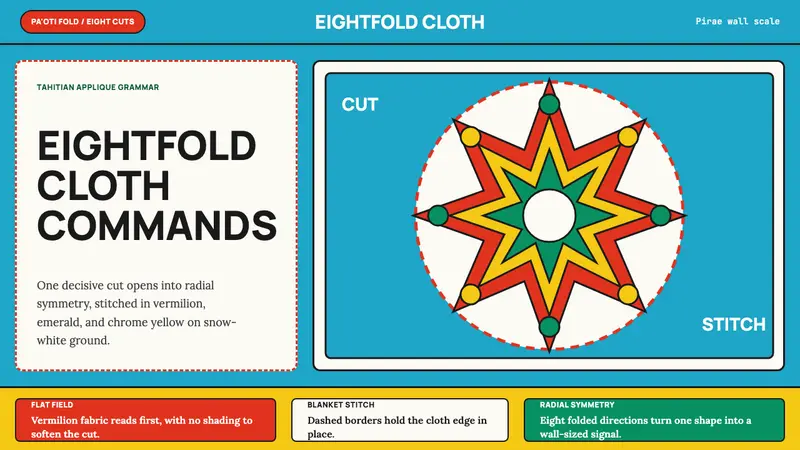 Tahitian Tifaifai (Appliqué Quilt)Flat fields command the room. Vermilion radial applique sits on Pacific cyan and snow white.
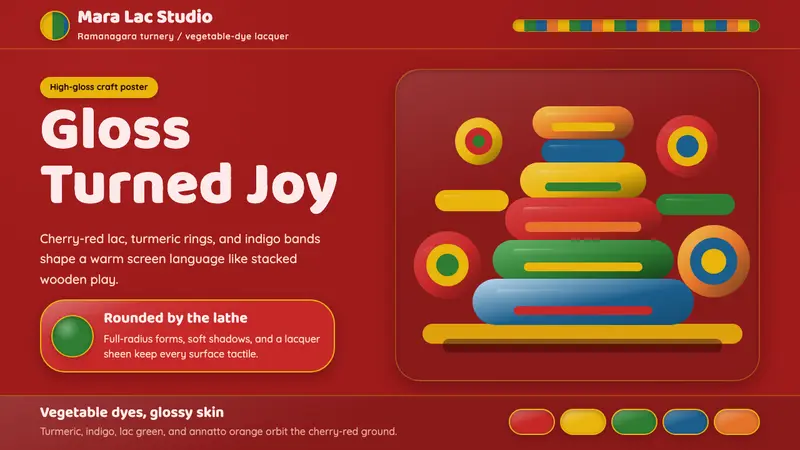 Channapatna Lacquered ToysGloss feels handmade. Lac-red ground and turmeric-indigo bands turn pixels into toys.
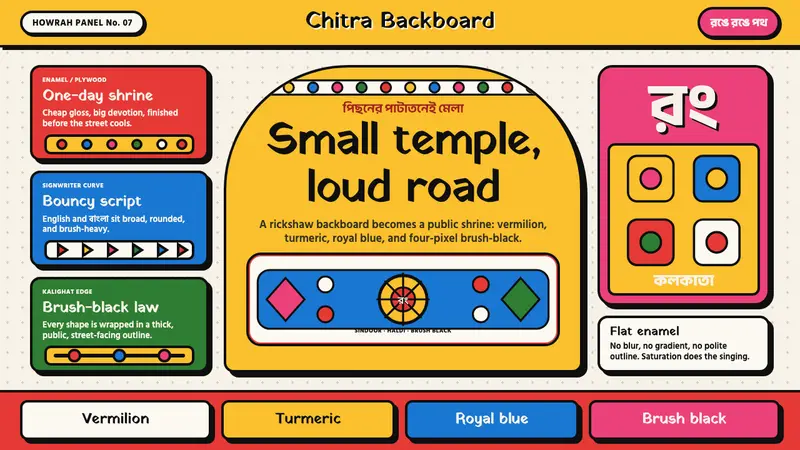 Bengali Rickshaw ArtStreet devotion shouts. Vermilion-haldi panels and brush-black arches turn plywood sacred.