What is Vietnamese Sơn Mài Lacquer?
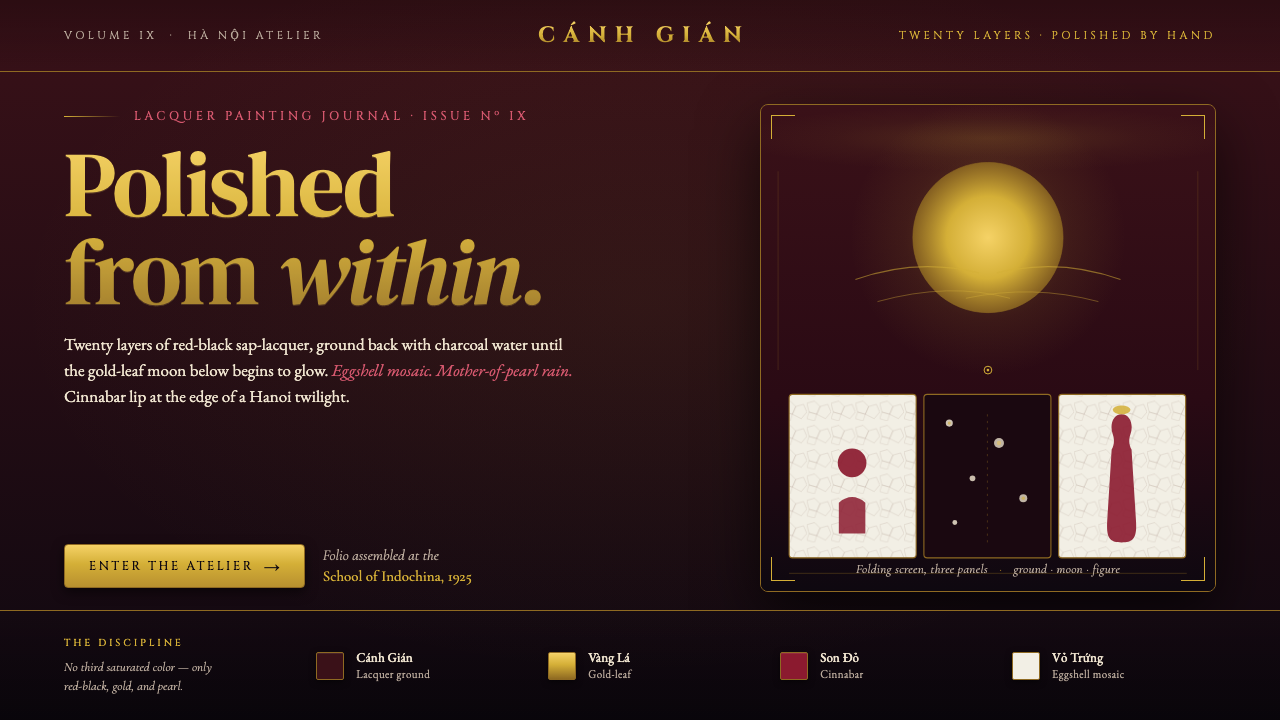
Twenty layers polished to a mirror finish — the Vietnamese lacquer tradition that married millennial craft to modernist composition in 1920s Hanoi.
Vietnamese Sơn Mài Lacquer in brief
Sơn mài — literally 'polish-grind lacquer' — is the Vietnamese fine-art lacquer painting tradition that emerged in Hanoi during the 1920s and 1930s when painters at the École supérieure des Beaux-Arts de l'Indochine fused ancient Asian lacquer craft with the compositional principles of French oil painting. The result was something entirely new: panels built up from ten to thirty layers of raw sap-lacquer, inlaid with crushed eggshell, gold-leaf, silver-leaf, mother-of-pearl, and cinnabar, then painstakingly polished back with charcoal-water until buried luminosity emerged through a glass-smooth surface.
The visual canon of sơn mài is immediately recognizable. Grounds are deep red-black, the precise hue called 'cánh gián' — literally 'cockroach wing' — a tone that seems simultaneously warm and bottomless. Against this ground float gold-leaf moons and clouds, figures assembled from mosaic fragments of eggshell, flickering points of mother-of-pearl that suggest water-light, and thin cinnabar accents that arrest the eye. The surface reads as both opaque and translucent; the polishing process collapses twenty or more strata into a single plane, yet the stratification remains visible as depth.
What distinguishes sơn mài from decorative lacquerware is the deliberate integration of Western pictorial space into the layering process. Painters planned compositions as one might plan an oil painting, but executed them backwards — embedding elements deep in the stack, covering them, embedding more, covering again — so that the final polish is also a form of excavation. The aesthetic consequence is a surface that glows from within, ornate in its materials yet restrained in its palette, simultaneously ancient and modern.

Where does Vietnamese Sơn Mài Lacquer come from?
Lacquer as a craft material has been used in Vietnam for at least two thousand years, initially in temple decoration, ceremonial objects, and furniture produced for imperial and aristocratic patrons. Traditional Vietnamese lacquerware — sơn ta — relied on sap harvested from the Toxicodendron succedaneum tree (cây sơn), mixed with natural pigments and applied in successive coats to wooden armatures. The resulting objects were durable, deeply lustrous, and valued throughout maritime Southeast Asia as luxury goods. This craft tradition was carried on by specialist artisan families and guilds centered in villages around Hanoi, particularly in the Bình Dương area.
The transformation into a fine-art medium began in 1925 when the French colonial administration established the École supérieure des Beaux-Arts de l'Indochine in Hanoi under the directorship of Victor Tardieu, a French painter who had won the Grand Prix de Rome. Tardieu's founding vision — unusual for a colonial institution — was not the imposition of French academic painting but the development of a distinctly Vietnamese modern art. He actively recruited traditional craft masters alongside Western-trained teachers, and the school's workshops became sites of genuine cross-cultural exchange. Students were encouraged to treat lacquer not as a decorative medium but as a painterly one, capable of pictorial depth, tonal nuance, and compositional ambition.
The decisive technical breakthrough came in the late 1920s and early 1930s as students began experimenting with grinding back the lacquer surface after each cycle of inlay. This polishing technique — borrowed from the logic of the lacquer surface itself — revealed that materials buried under multiple coats retained their visual identity and created a stratigraphy of luminosity that no single-layer process could achieve. Nguyễn Gia Trí, widely considered the master who pushed the medium furthest, developed compositions of extraordinary complexity in which eggshell-white figures, gold-leaf architectural details, and mother-of-pearl water-surfaces coexisted within a single panel, each readable at a different apparent depth.
The period from 1930 to 1945 represents sơn mài's classical moment. The school produced a generation of painters — Nguyễn Gia Trí, Phạm Hậu, Nguyễn Sáng, Nguyễn Tư Nghiêm — who treated lacquer as the equal of any fine-art medium and exhibited internationally, bringing Vietnamese lacquer painting to audiences in Paris and elsewhere. After Vietnamese independence in 1945 and through the decades of war that followed, sơn mài continued to develop in both the north and the south, with painters adapting its visual language to patriotic, documentary, and lyrical subject matter. The Vietnamese government formally designated sơn mài as one of Vietnam's national art forms, and it remains actively practiced and taught today in art academies across the country.
What defines the Vietnamese Sơn Mài Lacquer look?
Ground Color
The canonical sơn mài ground is 'cánh gián' — cockroach-wing — a deep red-black that reads differently under different light conditions: warm and almost brown in direct light, nearly black in shadow. It is achieved through multiple coats of lacquer tinted with iron oxide and cinnabar, ground back to reveal uniform depth. This ground is not merely a background; it functions as an active visual element whose warmth anchors every cooler or lighter element placed above it.
Gold and Silver Leaf
Gold and silver leaf are applied in sheets directly to a tacky lacquer coat, then polished flush with the surface in subsequent grinding passes. Gold-leaf areas — moons, clouds, distant mountains, architectural ornament — are luminous but not specular; they glow rather than reflect. Silver-leaf areas, which tend to tarnish to a warm gray within the lacquer stack, create midtone transitions that gold alone cannot produce. The combination gives sơn mài its characteristic sense of internal illumination.
Crushed Eggshell Mosaic
Fragments of hen or duck eggshell, each a few millimeters across, are pressed into the wet lacquer surface in carefully arranged patterns to create figure skins, textured passages of fabric, and areas of warm near-white. The irregular grid of hairline cracks between fragments is as important as the shell pieces themselves — it gives the eggshell areas a texture that reads as living surface from a distance and reveals its intricate construction close up. The opacity of the shell contrasts sharply with the translucent depth of the lacquer ground.
Mother-of-Pearl Inlay
Thin slivers of abalone or river-mussel shell are embedded in the lacquer to suggest water, moonlight on ripples, the shimmer of silk, or atmospheric light phenomena. Unlike gold-leaf, which is warm and constant, mother-of-pearl is iridescent — its apparent color shifts with the angle of view and the color of light. This gives areas of mother-of-pearl an optical liveliness that no painted pigment can achieve. Used sparingly, a few small inlaid points can animate an entire composition with the suggestion of movement.
Palette Restraint
Despite the material richness, sơn mài compositions work within an extremely narrow tonal range: red-black ground, gold, silver-gray, off-white eggshell, iridescent pearl, and sparse cinnabar accents. There are no blues, no greens in the traditional palette — any color present is the color of the material itself, not a pigment applied to simulate something else. This extreme restraint is what makes each element carry weight; in a composition of five tones, the placement and proportion of each tone is a critical decision.
Surface Depth and Polish
The defining quality of a finished sơn mài panel is what Vietnamese painters describe as looking into a well — the surface is perfectly flat and mirror-smooth, yet the eye perceives depth because layers of material at different strata catch the light differently. Achieving this requires alternating cycles of lacquer application, drying, inlay, and grinding with progressively finer abrasives — often charcoal stone ground with water — over many weeks or months. The final polish seals everything into a unified plane while simultaneously revealing the stratigraphy beneath.
Compositional Space
Sơn mài compositions typically structure space through tonal stratification rather than linear perspective. A deep red-black ground establishes a distant atmospheric plane; gold-leaf elements advance toward the viewer as the brightest, warmest tones; eggshell figures occupy a middle ground of warm opacity; mother-of-pearl accents flicker at no fixed depth. The result is a kind of luminous flatness — the composition reads simultaneously as a surface and as a space — that has more in common with East Asian ink painting than with Western pictorial convention.

Who shaped Vietnamese Sơn Mài Lacquer?
Nguyễn Gia Trí (1908–1993) is widely regarded as the supreme master of the sơn mài tradition and the artist most responsible for pushing its compositional and technical possibilities to their limits. Trained at the École des Beaux-Arts de l'Indochine during the 1930s, he developed an approach of extraordinary complexity — his large-format screens featured figures and landscapes built from thousands of individual eggshell fragments, gold-leaf passages of great refinement, and backgrounds of unusual chromatic subtlety. He worked in both the north and south of Vietnam over a career spanning six decades, and his panels are held in major Vietnamese museum collections. His technical notebooks, preserved after his death, document the precise layering sequences that produced his characteristic effects.
Victor Tardieu (1870–1937) was the French painter and administrator who founded the École supérieure des Beaux-Arts de l'Indochine in Hanoi in 1925 and served as its director until his death. His significance to sơn mài lies less in his own practice — he was a conventional oil painter — than in his institutional vision. Against the expectations of the colonial administration, he encouraged students to pursue Vietnamese lacquer as a serious fine-art medium, introduced Western compositional training that students could apply to traditional materials, and created the conditions under which the cross-cultural synthesis of the 1930s became possible. Without Tardieu's pedagogical framework, sơn mài as a fine-art form might never have emerged.
Phạm Hậu (1903–1995) was among the earliest generation of painters to master the sơn mài medium at the École des Beaux-Arts de l'Indochine and is particularly celebrated for his landscapes. Where Nguyễn Gia Trí emphasized figurative complexity, Phạm Hậu explored the atmospheric possibilities of the lacquer ground — using the deep red-black base as an expressive element in its own right, allowing large areas of uninterrupted ground to suggest night, distance, or the weight of still air. His compositions tend toward quieter, more contemplative moods than the elaborate figural screens for which the tradition is best known, and they demonstrate the range of emotional register that the medium is capable of sustaining.
Nguyễn Sáng (1923–1988) represents a postwar generation that brought sơn mài into dialogue with social and political subject matter while retaining its classical technical foundation. He was among the painters who worked through the First Indochina War and the American War, producing lacquer paintings that addressed collective experience, national identity, and historical trauma in a medium previously associated with aesthetic refinement and courtly subjects. His career demonstrates that sơn mài's visual language was flexible enough to absorb radically different content — from the contemplative landscapes of the prewar period to the urgency of mid-twentieth-century Vietnamese political life.
Nguyễn Tư Nghiêm (1922–2016) extended the sơn mài tradition in a direction that drew equally on Vietnamese folk art — particularly the woodblock prints of the Đông Hồ village tradition — and on the formal vocabulary of international modernism. His lacquer paintings incorporated the flat, hieratic figure-drawing of Vietnamese folk visual culture into compositions structured with modernist spatial economy. He worked across media — ink, oil, and lacquer — but his lacquer paintings are among the most widely reproduced in Vietnamese art history, and he was officially honored as a 'People's Artist,' the highest cultural designation in Vietnam.
How do you use Vietnamese Sơn Mài Lacquer today?
Sơn mài is among the most atmospherically distinctive historical styles available to contemporary designers, because its effects — internal luminosity, material depth, extreme tonal restraint — are genuinely unlike those of any Western tradition. Applied correctly, it communicates luxury, cultural specificity, and a sense of layered time that no flat digital surface treatment can replicate. The challenge is translation: the actual medium is a labor-intensive physical craft, and the designer's task is to capture its visual logic — not simulate its texture — in whatever output format is at hand.
For presentation slides, sơn mài works best as a dark, atmospheric style where the background does the emotional work. A cover slide built on this logic uses a very deep warm near-black field — not neutral dark gray — as the dominant ground, with a single luminous accent element: a circle or horizontal band in warm gold tone, or a fragment of near-white that reads as eggshell. Titles sit in a warm off-white that feels extracted from the ground rather than imposed upon it. Content slides should maintain the dark ground but use extreme tonal contrast to establish hierarchy: only the most important heading sits in the warmest, lightest tone; supporting text recedes toward a mid-warm gray. Data visualization in this style uses bars and areas colored in the warm metallic range — gold, amber, pale silver — against the dark ground, with no bright saturated hues.
For web interfaces, sơn mài is well suited to luxury product pages, cultural institution sites, high-end hospitality booking flows, and any digital experience where the product itself merits a sense of ceremony and depth. The approach: set a very dark warm ground as the base, use near-white and warm metallic tones for primary content and interactive elements, and deploy iridescent or shimmer effects only for the most important focal points — hover states, selected items, premium tier indicators. Navigation should be sparse and typographically quiet, letting the dark ground provide the presence. Avoid the temptation to add photographic imagery at high opacity; it competes with the atmospheric quality the palette creates.
For editorial and marketing work, the style supports high-end brand positioning and cultural storytelling. A sơn mài-influenced editorial layout uses a dark, warm-toned background throughout — not white — with body text in a warm near-white that is legible without being stark. Pull quotes and section titles use the warmest, most luminous tone available to the palette. Marketing materials in this style work well with restrained imagery: silhouetted figures, gold-toned photography, or abstract close-up details that recall the material texture of lacquer surfaces without literally depicting them. The style is particularly effective for fashion, jewelry, spirits, and cultural heritage brands whose positioning depends on evoking depth, craft, and longue durée.
A common mistake when applying sơn mài is treating it as a generic 'dark luxury' style — dropping gold text onto a black background and calling it done. Authentic sơn mài logic requires warmth at every level: the dark ground must read warm red-black rather than neutral black, the near-white must lean cream or eggshell rather than pure white, and any metallic accents must be tonally warm rather than cool silver. A second common error is overusing the shimmer or iridescence that mother-of-pearl suggests — in the original medium these effects are sparse and restrained; in digital application, one or two iridescent focal points are sufficient, and saturating the interface with them collapses the depth contrast that makes those points meaningful.

Vietnamese Sơn Mài Lacquer — FAQ
Is sơn mài the same as regular Asian lacquerware?
No — the distinction is significant. Traditional lacquerware across Asia (Japanese urushi, Chinese qiqi, Vietnamese sơn ta) is primarily a craft medium used for functional and decorative objects: bowls, boxes, furniture, architectural elements. Sơn mài is specifically a fine-art painting tradition developed in twentieth-century Vietnam, in which the lacquer is used to create pictorial compositions — landscapes, figures, narratives — conceived as easel paintings or large decorative panels to be hung on walls. The materials overlap, but the intentions, compositions, and visual conventions are fundamentally different. Sơn mài also incorporates the polishing-back technique as a core pictorial device, which is not typical of functional lacquerware production.
Can the sơn mài aesthetic work on light backgrounds, or is it inherently dark?
Sơn mài is inherently dark — the deep red-black 'cánh gián' ground is not incidental but structural to how the style's luminosity works. Elements glow against this ground precisely because of the extreme tonal contrast. A light-ground interpretation is possible but becomes a different proposition: you would retain the warm metallic accents, the eggshell near-white, the sparse decorative vocabulary, and the sense of material richness, but you would lose the most distinctive quality of the tradition — the sense of things emerging from depth. If a light ground is required for readability or context reasons, consider using it only for text-heavy sections while maintaining the dark ground for atmospheric feature areas.
How does sơn mài relate to the broader Vietnamese cultural context?
Sơn mài is inseparable from Vietnamese national cultural identity in a way that few art forms are in their home countries. The Vietnamese government's designation of it as a national art form reflects its role as a medium that both absorbed a colonial encounter (French academic painting principles) and transformed it into something distinctly Vietnamese. Its subject matter — village scenes, festivals, landscapes of the Red River Delta and Mekong basin, historical and mythological narratives — constitutes a visual archive of Vietnamese cultural memory. For this reason, applying the sơn mài aesthetic carries cultural weight; it should be used with awareness of what the style signifies and for whom. In contexts involving Vietnamese cultural institutions, heritage brands, or Southeast Asian audiences, the style reads as culturally specific in ways that demand respect rather than casual appropriation.
Why is the polishing step central rather than just the layering?
Because the polishing is what transforms a stack of materials into a unified visual surface with depth. Without grinding back, the top layer of lacquer would simply obscure everything beneath it, and the piece would read as a monochrome panel with some surface texture. The polishing reveals the inlaid materials — eggshell, gold, mother-of-pearl — by bringing their surfaces flush with the top lacquer coat, creating the visual impression of elements that are simultaneously on the surface and behind it. The depth visible in a finished sơn mài panel is not simulated; it is the actual physical depth between the lacquer strata made visible through transparency and tonal variation. The grinding process also determines final tonality: how much of the ground color is exposed versus how much gold or eggshell dominates is controlled by how far back each area is polished.
Does sơn mài suit contemporary or tech-sector contexts, or is it too historically specific?
It depends on what the product or brand needs to communicate. Sơn mài is poorly suited to contexts that require lightness, speed, rationality, or democratic accessibility — startup dashboards, productivity tools, news platforms, or anything that needs to feel instantly familiar and friction-free. It is well suited to contexts where depth, craft, exclusivity, and cultural resonance are desirable signals: luxury e-commerce, high-end hospitality, cultural institutions, premium spirits or beauty brands, and editorial work aimed at readers who value aesthetic seriousness. In a tech context specifically, it could work for products targeting premium creative professionals — high-end audio, professional photography equipment, artisan-grade software — where the brand benefit is being emphatically not mass-market. The risk is always that cultural distance makes the style feel arbitrary or appropriated rather than meaningful; grounding the application in genuine engagement with the style's origins goes a long way toward making it feel considered rather than decorative.
Related design styles
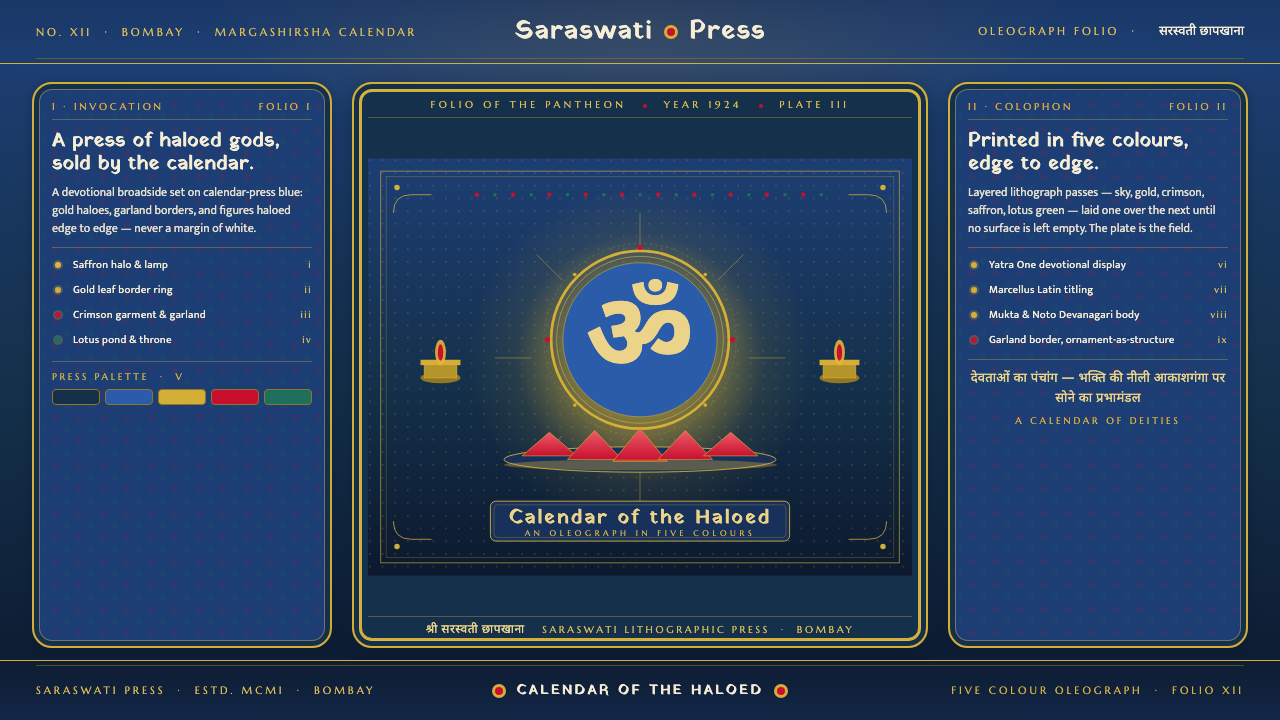 Hindu Pantheon Bazaar PrintDevotional calendar art, edge to edge. Gold halos and garland borders on baza…
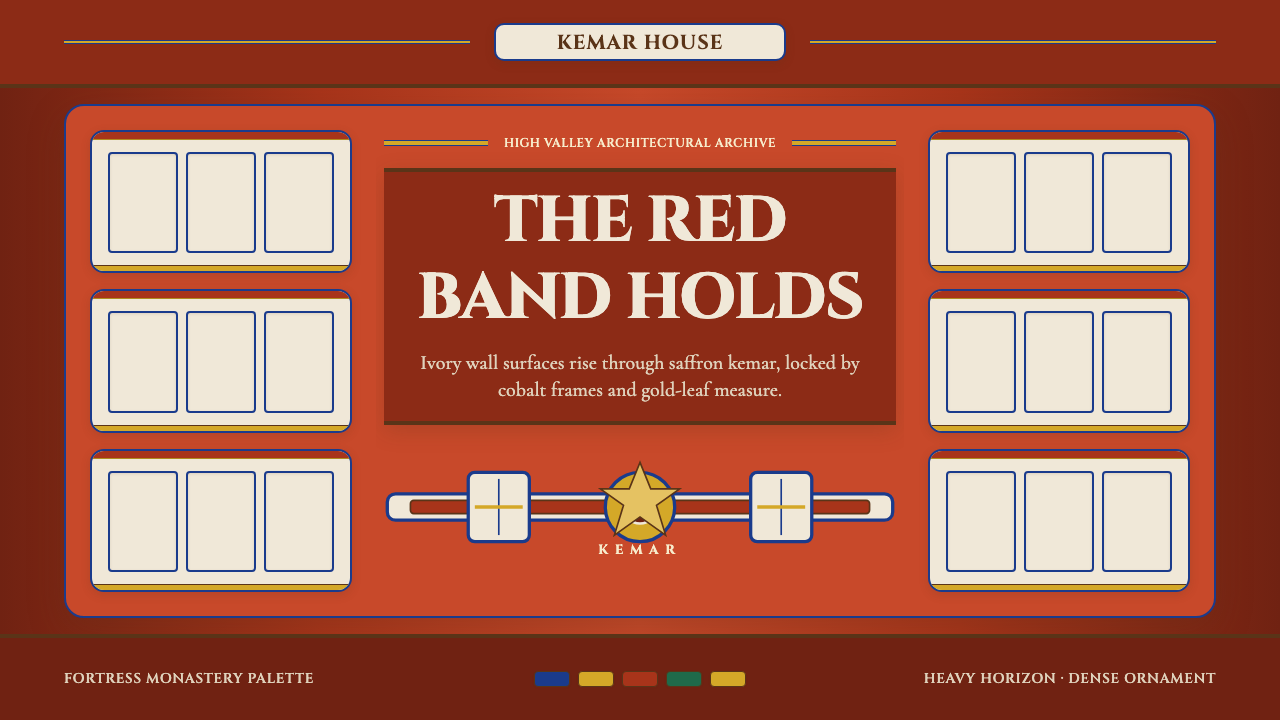 Bhutanese Dzong (Fortress Red)Monumental red holds the page. Cobalt frames and gold bands lock the fortress…
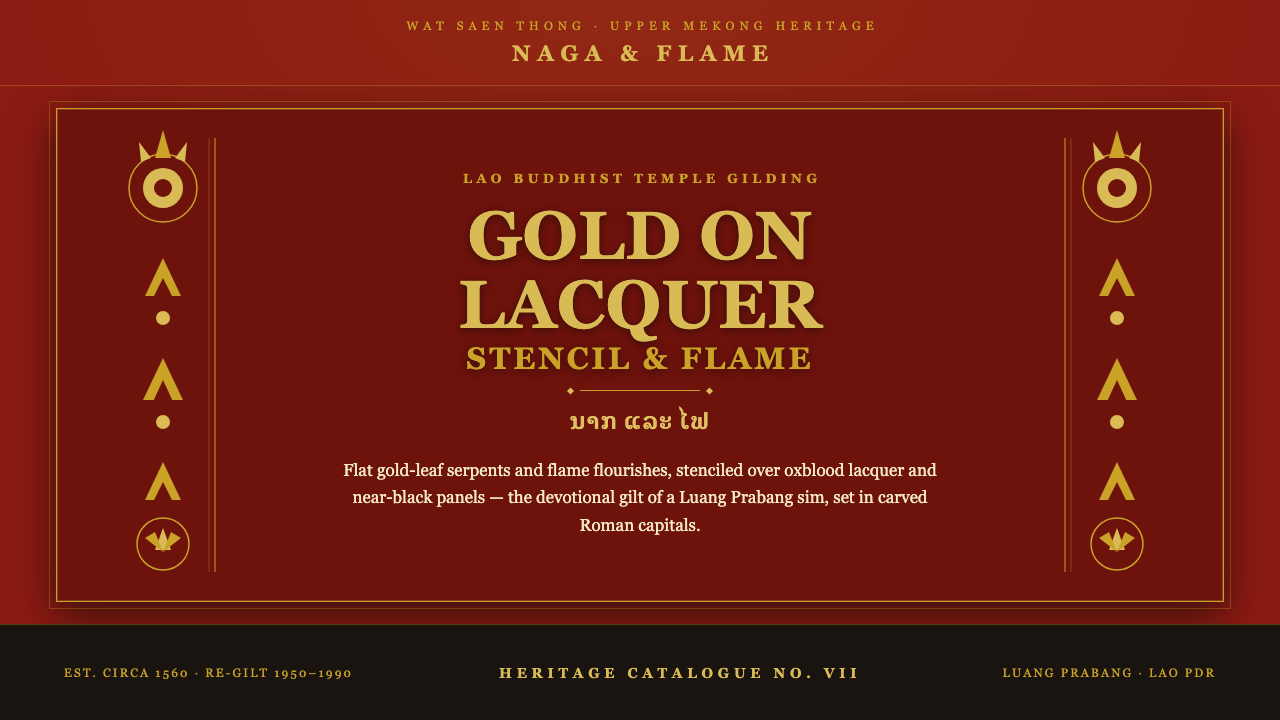 Lao Naga Temple StencilDevotional gilt, not chrome. Flat gold-leaf naga and flame stencils glow on o…
 Mughal Miniature (Akbar era)Opulence refuses emptiness. Saffron paper, ruby panels, cobalt lattice, gold…
 Nepali Paubha (Newari Scroll)Sacred density. Cinnabar ground, gold-leaf frame, lapis rings in strict symme…
 One Thousand and One NightsNight refuses to end. Midnight indigo, lamp-lit gold and star lattice frame e…