What is Russian Palekh Lacquer Miniature?

When Soviet atheism shuttered Russia's churches, the icon painters of Palekh village turned their gilded devotion toward fairy tales — and invented one of the most visually opulent craft traditions of the twentieth century.
Russian Palekh Lacquer Miniature in brief
Russian Palekh lacquer miniature is a painting tradition born in 1924 from the fusion of medieval Russian icon technique and Soviet-era folk storytelling. Practiced by masters trained in the centuries-old methods of tempera painting on gessoed wood, the Palekh style migrated its visual vocabulary from saints and halos onto papier-mâché boxes, brooches, and panels — replacing sacred imagery with scenes from Russian fairy tales, Pushkin's poetry, troika processions, and mythological firebirds.
What distinguishes Palekh from other Russian lacquer schools is its absolute commitment to deep lacquer black as the compositional ground. This near-absolute darkness is not emptiness — it is the stage from which gold-leaf ornament, jewel-bright figures, and luminous highlights emerge with extraordinary vibrancy. The technique demands that every color be layered repeatedly in translucent egg-tempera washes, building up depth and luminosity that no single opaque application could achieve. The result is a surface that seems to glow from within.
The characteristic compositional device of the style is the oval cartouche frame — a gilt border that encloses the narrative scene like a locket or a stage proscenium. Within these frames, figures are rendered with elongated proportions borrowed directly from Byzantine icon conventions: long necks, tapering fingers, expressive tilted heads. The landscape setting, whether a forest of swirling birch trees or a stylized Slavic village, is rendered in similarly convention-bound forms, creating an unmistakable visual grammar that is simultaneously ancient and entirely distinctive.
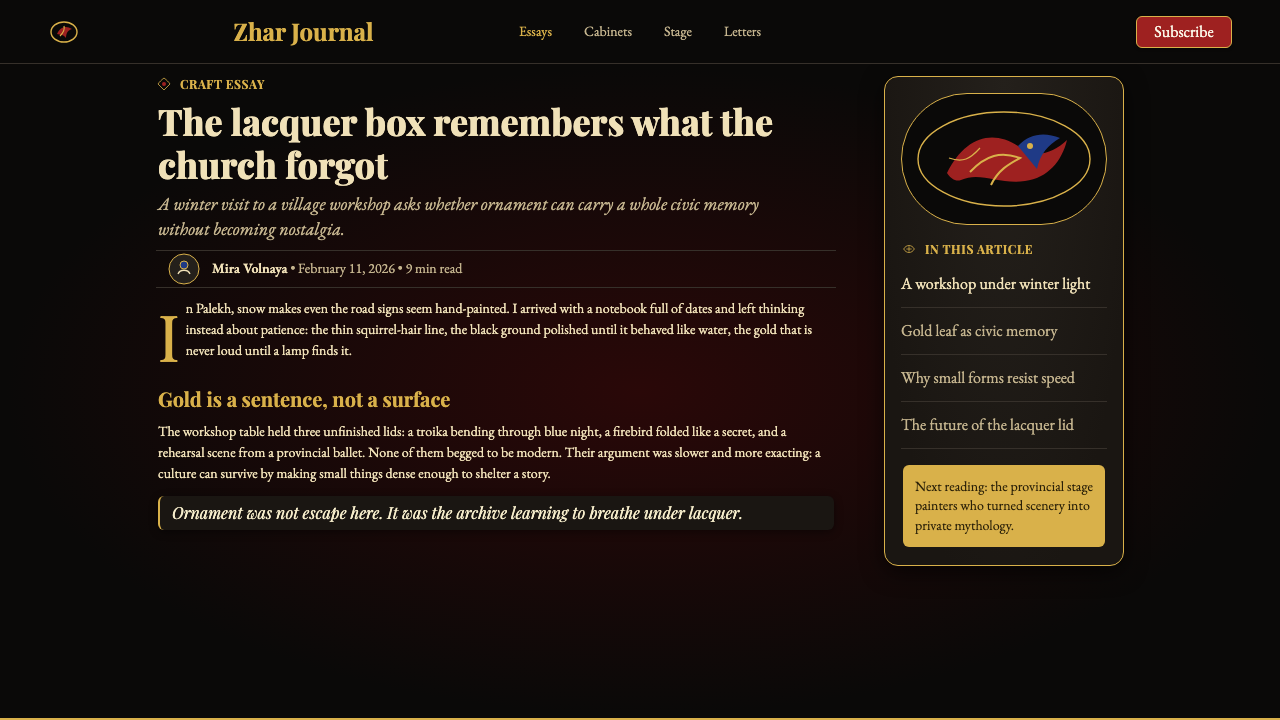
Where does Russian Palekh Lacquer Miniature come from?
Palekh village, located in the Ivanovo Oblast northeast of Moscow, was a center of icon painting for at least three centuries before the Soviet revolution. During the seventeenth and eighteenth centuries, Palekh masters supplied painted icons to churches across Russia, developing a distinctive local variation of the Byzantine-derived Russian icon tradition that favored exceptionally fine brushwork, rich jewel-tone pigments, and intricate gold-leaf patterning. By the nineteenth century, Palekh's reputation was such that its painters received commissions from imperial patrons and restored icons in the Kremlin Armory and major cathedrals.
The Bolshevik revolution of 1917 and the subsequent anti-religious campaigns brought this centuries-old livelihood to an abrupt halt. Churches were closed or repurposed; the market for icons collapsed. The painters of Palekh faced a choice between abandoning their craft entirely or finding a secular form that Soviet cultural institutions might support. In 1924, Ivan Golikov — who had received classical icon training in the village — founded the Palekh Artel of Ancient Painting (Артель древней живописи) together with fellow masters including Aleksandr Kotukhin, Ivan Vakurov, and Pavel Bazhenov. Their solution was ingenious: they transferred the full technical apparatus of icon painting — egg tempera on a prepared black ground, gold-leaf application, the elongated Byzantine figure canon — onto lacquered papier-mâché objects, replacing saints with characters from Russian folklore and literature.
The choice of subject matter was diplomatically shrewd as well as artistically fertile. Russian fairy tales, Pushkin's narrative poems, folk legends, and scenes of peasant and village life were all sanctioned themes under Soviet cultural policy, which promoted a romanticized vision of Russian folk heritage. The Palekh Artel received official recognition from the Soviet state and was eventually incorporated into the broader system of state-sponsored craft enterprises. This institutional support allowed the tradition to flourish through the 1930s, 1940s, and into the postwar period, with the Palekh State Art School training successive generations of painters in the full technical and compositional vocabulary of the style.
The peak decades of Palekh production ran roughly from the mid-1930s through the 1980s. During this period, Palekh boxes became prized collectibles and diplomatic gifts, distributed internationally as emblems of Soviet cultural achievement. The style evolved gradually over these decades — individual masters brought their own compositional innovations while maintaining the fundamental visual conventions — but the core aesthetic remained remarkably consistent: deep black grounds, gold ornamentation, oval cartouche frames, jewel-bright tempera figures, and the unmistakable elongation of the Byzantine figure tradition. After the collapse of the Soviet Union, the Palekh school continued as a living tradition, supported by collectors worldwide and by the Palekh village's designation as a historic center of folk art.
What defines the Russian Palekh Lacquer Miniature look?
Ground Color
The absolute foundation of the Palekh aesthetic is its deep lacquer black ground — a darkness so dense and even that it functions less as a background color and more as an absence of light that makes every element placed upon it appear to radiate. This is not a neutral dark; it is the compositional basis on which all other visual decisions depend. The black is typically achieved through multiple applications of lacquer on papier-mâché, each layer sanded and polished until the surface achieves a near-mirror finish.
Palette and Pigment
Against the black ground, Palekh masters deploy a jewel-tone palette centered on crimson red, lapis lazuli blue, and deep emerald green — applied in egg-tempera, which allows for exceptional translucency and layered depth. These hues are used at near-maximum saturation but never appear harsh, because the black ground and the surrounding gold act as mediators, absorbing visual tension between adjacent saturated areas. White is used for the finest highlights — the gleam on a horse's flank, the edge of a wing — and appears as pure luminosity rather than as a flat tone.
Gold Leaf and Ornament
Gold leaf is perhaps the most immediately recognizable element of the Palekh visual system. Applied both as structural framing — the oval cartouche borders, the scene's outer decorative band — and as surface detail within figures and landscapes, gold operates at multiple scales simultaneously. Fine gold lines trace the folds of garments, the branches of stylized trees, and the geometric patterns of architectural elements. Broad areas of gold form the cartouche frame itself and the ground on which inscriptions or titles appear. The gold in Palekh is never yellow paint; it is genuine leaf applied with patient precision and burnished to catch light directionally.
Figure Style and Proportion
Palekh figures inherit the elongated proportions of Byzantine icons directly. Heads are small relative to the body; necks are long and graceful; fingers taper to fine points; poses are simultaneously expressive and formally composed. Faces, rendered in the lightest tones of the composition, carry specific conventional expressions — serenity, heroic resolve, or gentle sorrow — rather than individualized portraiture. Movement is depicted through flowing drapery and the diagonal lean of figures, not through foreshortening or perspective tricks. Figures float weightlessly against the dark ground, organized by compositional rhythm rather than spatial logic.
Landscape and Setting
Palekh backgrounds are not naturalistic landscapes but highly stylized visual shorthand for natural environments. Birch trees appear as sinuous curving strokes with gold-leaf bark highlights; distant hills are rendered as rhythmic undulating forms without any attempt at atmospheric perspective. Water becomes a field of parallel wavy lines; sky is suggested by a band of tone rather than depicted. This approach to setting treats the landscape as a pattern system — formally integrated with the human figures — rather than as a spatial environment they inhabit.
Cartouche and Framing
The oval cartouche is the signature compositional unit of the Palekh tradition. Derived from the framing conventions of medieval illuminated manuscripts and icon borders, the cartouche creates a contained pictorial world — a narrative stage set apart from the outer surface of the object. The frame itself is typically built up from multiple registers of gold ornament: an inner edge of fine line, a band of stylized foliate or geometric ornament, and an outer border that terminates the composition. In more complex pieces, multiple cartouches may be arranged across the object's surface, each containing a separate scene from a continuous narrative.
Finish and Surface Quality
The final lacquer overcoating applied to a Palekh miniature produces a surface that is simultaneously protective and optically transformative. Multiple coats of clear lacquer, each polished between applications, create a depth-effect in which the painted image appears to recede behind a glassy surface — not unlike looking at a scene through a perfectly still pool of water. This finish is central to the aesthetic: it unifies the matte egg-tempera pigments and the reflective gold leaf under a single visual register, and it gives even small objects a weight and completeness that makes them feel like finished artworks rather than decorated containers.

Who shaped Russian Palekh Lacquer Miniature?
Ivan Golikov was the founding figure of the Palekh Artel and the master most responsible for establishing the style's visual conventions. Trained as an icon painter in Palekh before the revolution, he brought to the secular subject matter of the Artel's early years a full command of Byzantine compositional grammar and tempera technique. His paintings of troika scenes, firebirds, and episodes from Russian epic poetry are characterized by exceptional dynamism — figures in motion, horses at full gallop — rendered within the controlled formal conventions of the icon tradition. Golikov's ability to infuse inherited technique with narrative vitality defined the aesthetic ambition of the Palekh school from its inception.
Aleksandr Kotukhin was among the co-founders of the 1924 Artel and became known for his particularly refined handling of landscape elements and architectural settings within the Palekh compositional tradition. Where Golikov emphasized dynamic narrative action, Kotukhin developed a more meditative, lyrical quality — his scenes tend toward atmospheric stillness, with landscape elements rendered in fine interlocking patterns that carry the eye across the picture surface in a way that is as much decorative as narrative. His work helped establish the breadth of compositional approaches available within the Palekh idiom.
Ivan Vakurov brought to the founding group a particularly strong command of the gold-work traditions inherited from icon painting, and his contributions helped establish the Palekh Artel's reputation for technical excellence in gold-leaf application. Vakurov's figures tend to be more architecturally arranged than those of some contemporaries — compositions organized around stable geometric groupings that recall the compositional hierarchies of larger icon programs. His influence on subsequent generations of Palekh painters was significant in terms of technical discipline and compositional structure.
Pavel Bazhenov was a founding member of the 1924 Artel who became particularly associated with scenes drawn from Russian literary sources — Pushkin's tales and narrative poems furnished many of his subjects. His contribution to the early Palekh tradition was in demonstrating the range of literary subjects that the style's visual conventions could accommodate, helping to secure the school's legitimacy within Soviet cultural policy as a vehicle for honoring Russia's literary heritage. Bazhenov's figures show a characteristic attentiveness to costume detail, with embroidered garments and decorative textile patterns rendered in meticulous fine brushwork.
The Palekh State Art School, established in the late 1920s to train successive generations of miniature painters, is less a single figure than a collective force that has sustained the tradition across nearly a century of political and economic change. The school preserved the full technical curriculum — preparation of papier-mâché supports, application of gesso grounds, egg-tempera mixing and layering, gold-leaf gilding, and final lacquering — transmitting it intact from masters trained before the revolution to students who have never known anything but the secular Soviet and post-Soviet context. Its graduates continue to practice in Palekh village today.
How do you use Russian Palekh Lacquer Miniature today?
Palekh lacquer miniature is among the most visually intense historical styles available for contemporary design applications — which is precisely what makes it both rewarding and demanding to apply. Used correctly, it produces work of extraordinary richness and depth. Applied carelessly, it collapses into generic dark-and-gold ornamentation that misses the tradition's essential qualities. The first principle of applying this style is to commit to its logic: deep black grounds are not optional atmospheric elements, they are the foundation from which everything else derives its luminosity.
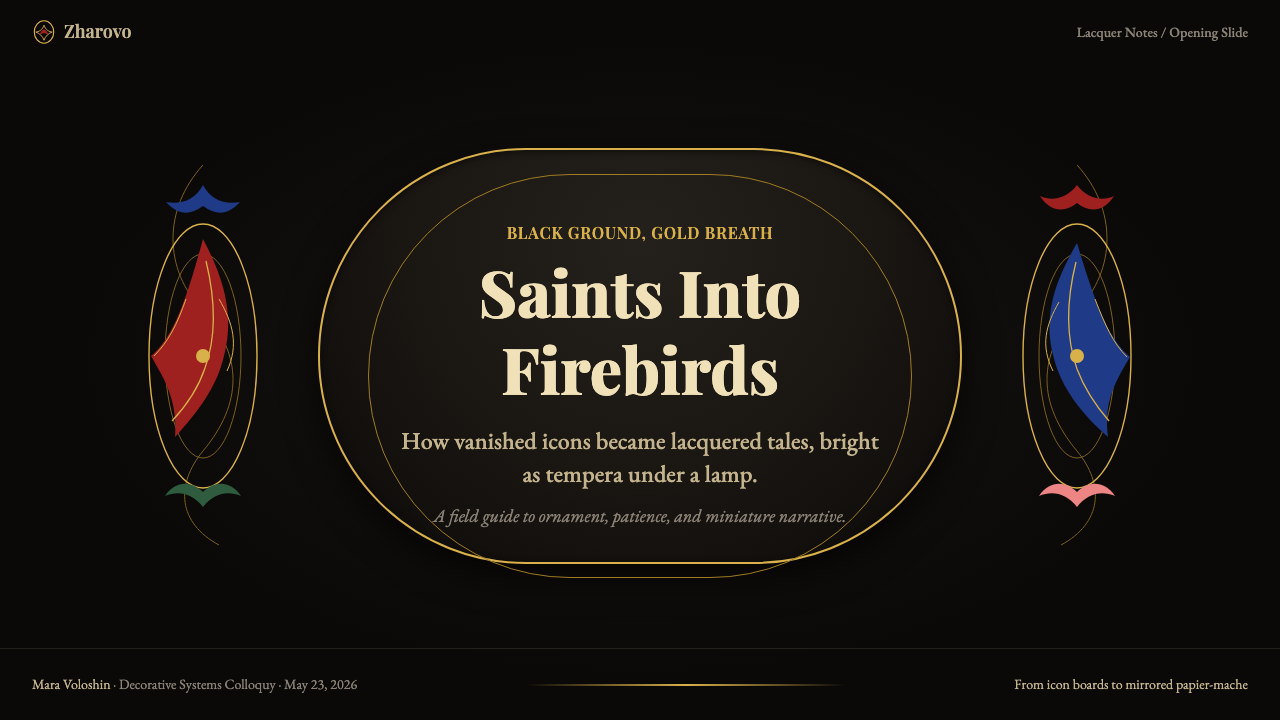
For presentation slides, Palekh is exceptionally well-suited to cover pages and section dividers where visual impact is the primary goal. A cover slide built on this tradition uses a near-black or fully black ground, a large compositional area for the key visual element — a stylized illustration, a single bold typographic treatment, or an ornamental cartouche form — and restrains supplementary text to the periphery where it can sit in legible contrast without competing with the central composition. Content slides should maintain the dark ground but pull back on ornamental density: a single thin gold border framing the slide area, body text in cream or pale tone against the black, and data visualizations whose color coding borrows from the jewel-tone palette — deep crimson for primary series, lapis for secondary, emerald for tertiary.
For web interfaces, Palekh finds its most natural application in contexts where luxury, depth, and ceremonial weight are desired values: premium product launch pages, cultural institution websites, editorial platforms covering art and history, or brand landing pages for heritage goods. A Palekh-derived dashboard would use the dark ground throughout, with information panels appearing as framed cartouche-like units rather than flat cards. Typographic hierarchy should rely on the contrast between gold-toned headings and cream body text, rather than on size differences alone. Interactive states — hover, active — are best expressed through a shift in the gold tone rather than through additive effects like glows or hard shadows.
For editorial and marketing materials, the style supports imagery-heavy formats where visual narrative is central. A Palekh-derived editorial spread might pair a large illustrative area — a full-bleed dark ground with a central ornamental motif — against narrow columns of cream text. Marketing campaigns can deploy the oval cartouche frame as a recurring compositional signature, creating a series of visual containers that are immediately recognizable across media. The style translates well to print at high resolution, where the richness of the jewel tones and the precision of the gold-line work benefit from the full range of offset or fine-art printing.
The most common mistake when working with this style is treating the gold and jewel tones as purely decorative, without committing to the black ground that gives them their function. Palekh palettes placed against white or light gray backgrounds lose their depth and luminosity — the jewel tones, which are calibrated to the darkness beneath them, read as merely saturated rather than glowing. A second common error is over-densifying the composition. Authentic Palekh miniatures are densely detailed, but the density is organized by a clear compositional hierarchy — figures in primary narrative positions, landscape as secondary setting, gold ornament as structural framing. Importing all this detail without the underlying hierarchy produces visual noise rather than richness.
Russian Palekh Lacquer Miniature — FAQ
What makes Palekh different from other Russian lacquer traditions like Mstera or Kholuy?
All three traditions emerged from icon-painting villages in the same region and converted to secular lacquer work in the same 1920s period, but they developed distinct visual identities. Palekh is the most formally strict: it commits absolutely to the black ground and the Byzantine elongated figure canon, and its compositions tend toward the most ornamental density. Mstera is characterized by lighter grounds — often blue or green — and a more open, lyrical landscape style with softer figure proportions. Kholuy developed in a more illustrative direction, with figures that are somewhat more naturalistic and landscapes that allow for greater spatial depth. Palekh is generally considered the most prestigious of the three, partly because of its rigorous adherence to the original icon-painting technical tradition.
Can the Palekh aesthetic work in digital contexts, given that it originated as a physical craft?
Yes, but the translation requires deliberate choices. The physical tradition's most important qualities — the depth of the black ground, the luminosity of the jewel tones against it, the precision of the gold-line ornament — can all be achieved in digital work if the designer commits to their underlying logic rather than simply importing visual motifs. A digital surface can render the near-mirror black ground effectively; it can produce jewel tones that hold their saturation; vector tools can achieve gold-line precision. What digital work cannot replicate is the physical depth of the lacquer overcoating — the sense that the image recedes behind a glassy surface. This depth can be approximated through layering and translucency, but it remains a fundamental difference between the source tradition and its digital applications.
How should typography be handled in a Palekh-influenced design?
Typography is not a strong native component of the Palekh visual system — the tradition is primarily pictorial, with text appearing as peripheral labeling or titling rather than as an integrated compositional element. In contemporary applications, type choices should support the style's register rather than competing with it. Serif letterforms with some calligraphic quality — particularly those with visible contrast between thick and thin strokes — harmonize with the tradition's brushwork sensibility better than geometric sans-serifs. Type color should draw from the palette: gold tones for headings, cream or pale tones for body text against dark grounds. The most important typographic principle for this style is restraint in quantity: Palekh compositions are dense, and adding dense typography on top of rich visual material produces congestion rather than richness.
Is Palekh appropriate for contemporary brand identities, or is it too historicist?
The style is highly appropriate for brands whose identity genuinely aligns with its register of values: heritage, craftsmanship, ceremonial luxury, cultural depth, narrative richness. It works well for cultural institutions, luxury goods with artisan positioning, publishers of art books and literary fiction, hospitality brands in heritage contexts, and any brand that wishes to communicate that it takes both visual and cultural seriousness as core values. It is less appropriate for brands seeking to project approachability, technological forward-thinking, or everyday accessibility — the style's intensity and formality make it read as exceptional rather than everyday. The risk is not that it reads as old-fashioned, but that it reads as overspecified: using it signals a very particular set of values, and those signals will be received clearly by audiences with cultural literacy and less clearly by general audiences.
What is the relationship between Palekh and the broader tradition of Russian icon painting?
Palekh miniature is a direct secular descendant of the Russian icon tradition. The connection is not merely stylistic — it is technical, biographical, and institutional. The founders of the Palekh Artel were trained icon painters whose technique, material vocabulary, and compositional grammar came entirely from the icon workshop tradition. The elongated Byzantine proportions, the egg-tempera medium layered over a prepared dark ground, the gold-leaf gilding, the hierarchical arrangement of figures, the stylized landscape conventions — all of these derive directly from medieval icon practice without any significant break or transformation. What changed was the subject matter and the object type. The saints became firebirds; the devotional panel became a lacquered box. The visual system that carries these new subjects is the icon system, adapted but not fundamentally altered.
Related design styles
 One Thousand and One NightsNight refuses to end. Midnight indigo, lamp-lit gold and star lattice frame e…
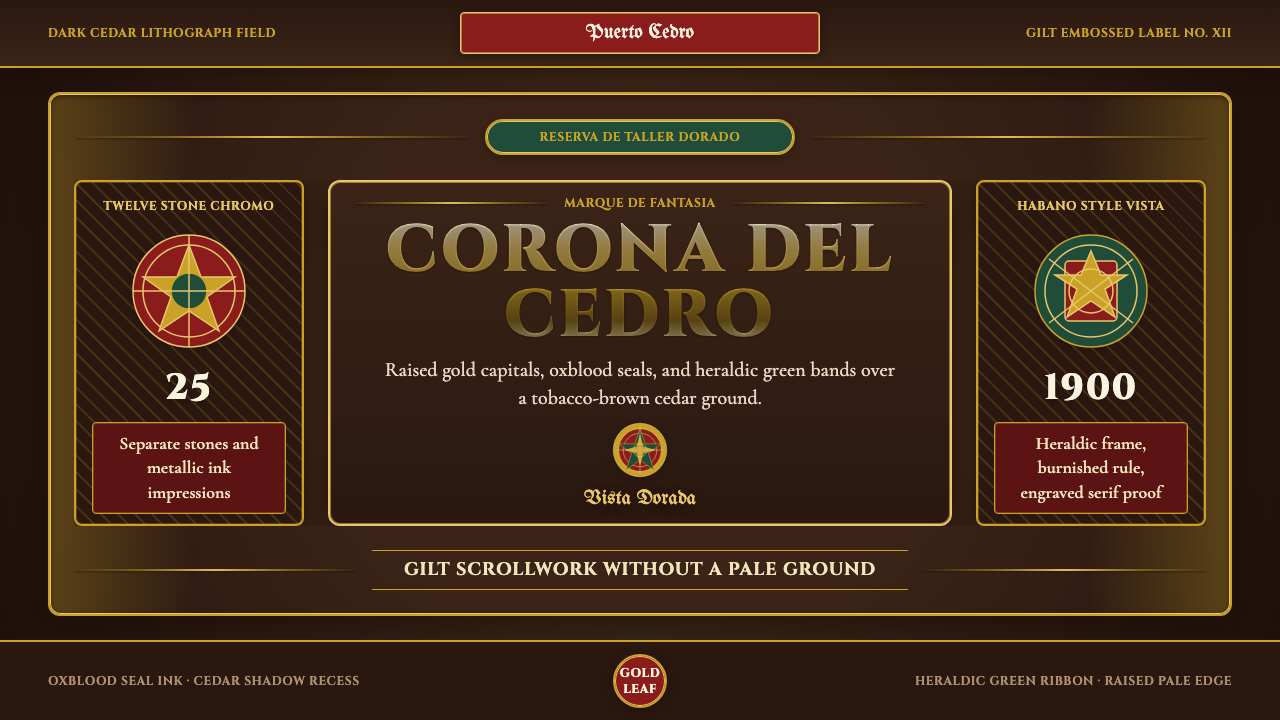 Cigar Box LabelGilt maximalism glows. Gold Cinzel capitals lock into a tobacco-brown framed…
 Hindu Pantheon Bazaar PrintDevotional calendar art, edge to edge. Gold halos and garland borders on baza…
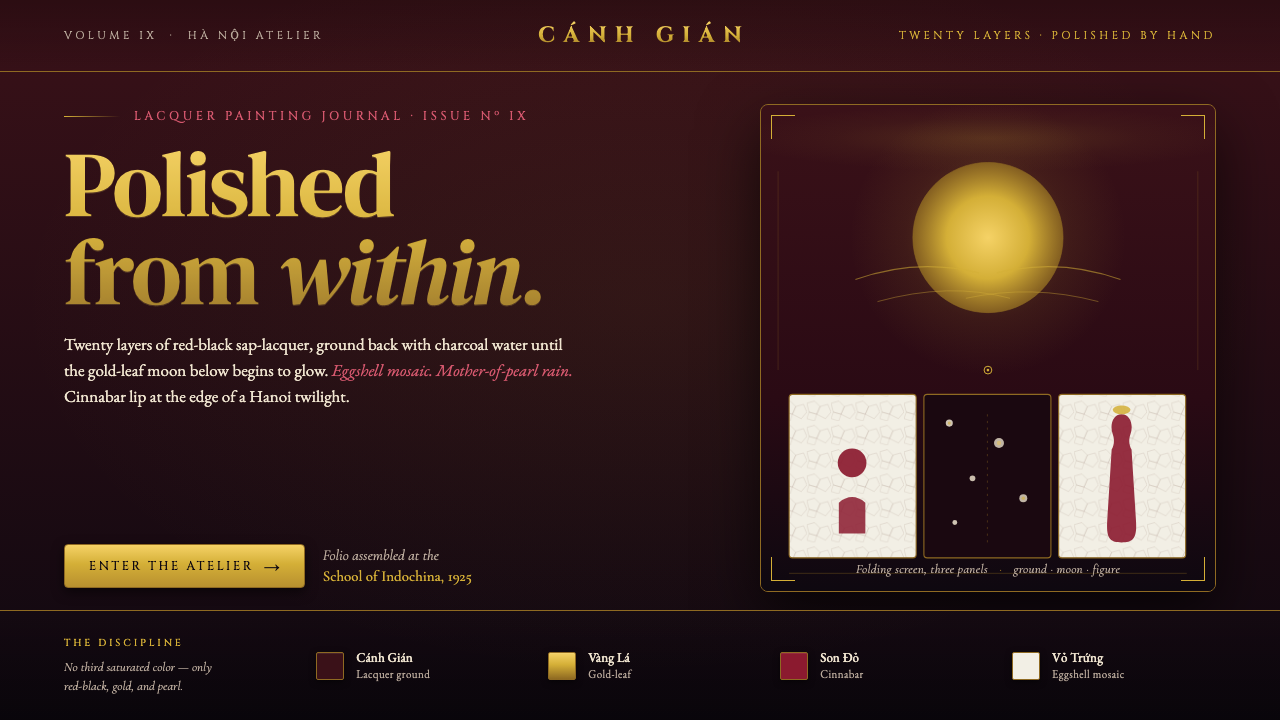 Vietnamese Sơn Mài LacquerTwenty layers polished to glass. Cockroach-wing red-black ground, gold-leaf m…
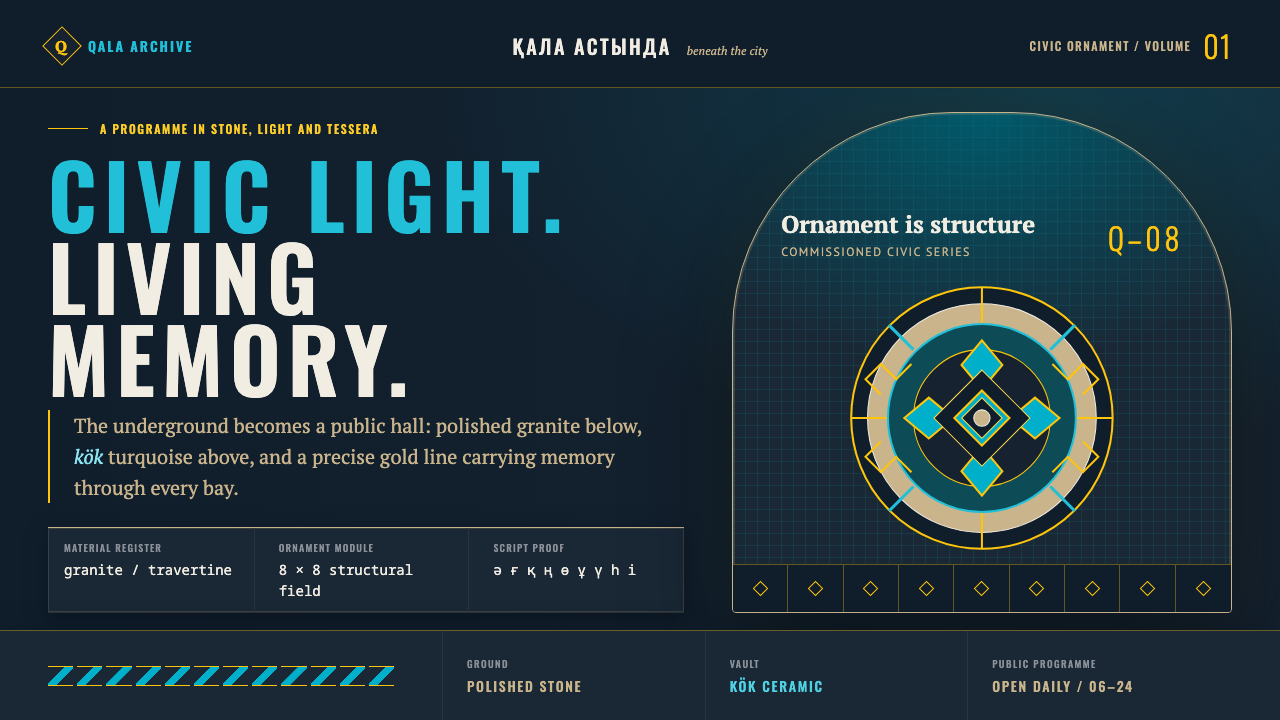 Almaty Metro MosaicCivic grandeur speaks Turkic. Kök vaults and gold geometry rise above polishe…
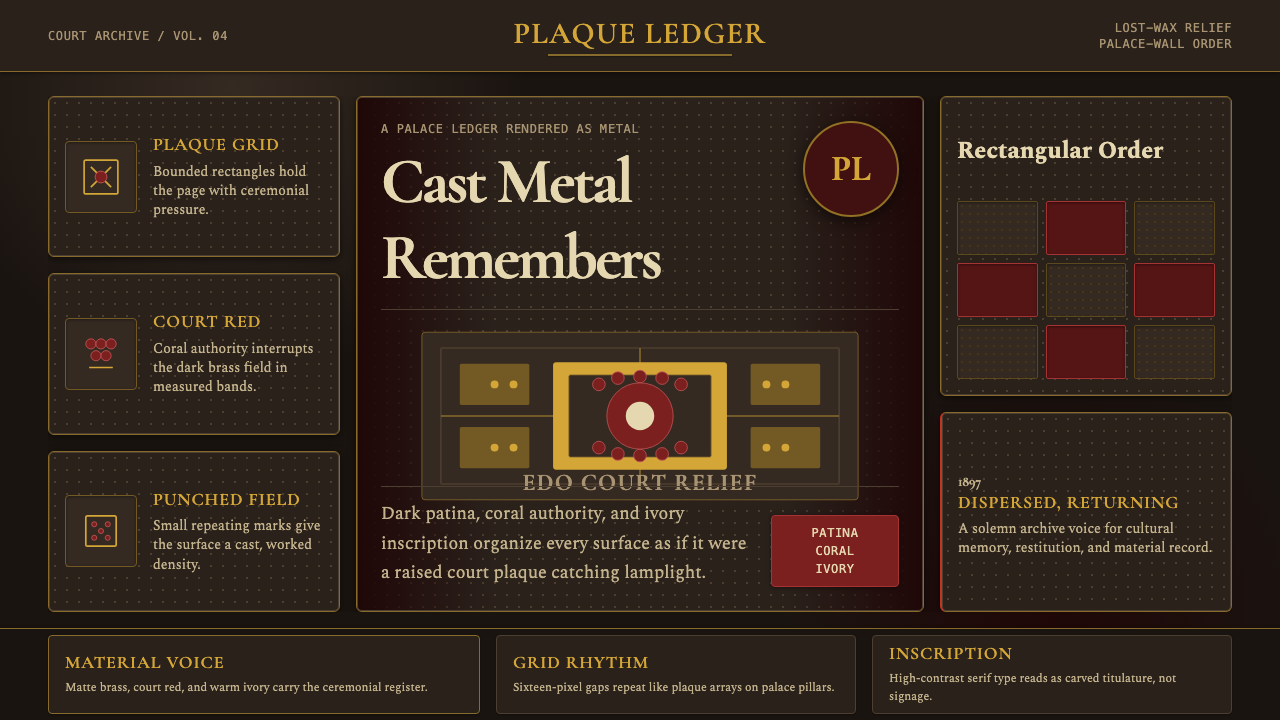 Benin Bronze Oba CourtCourt gravity in cast metal. Patinated brass grid, coral red panels, ivory se…