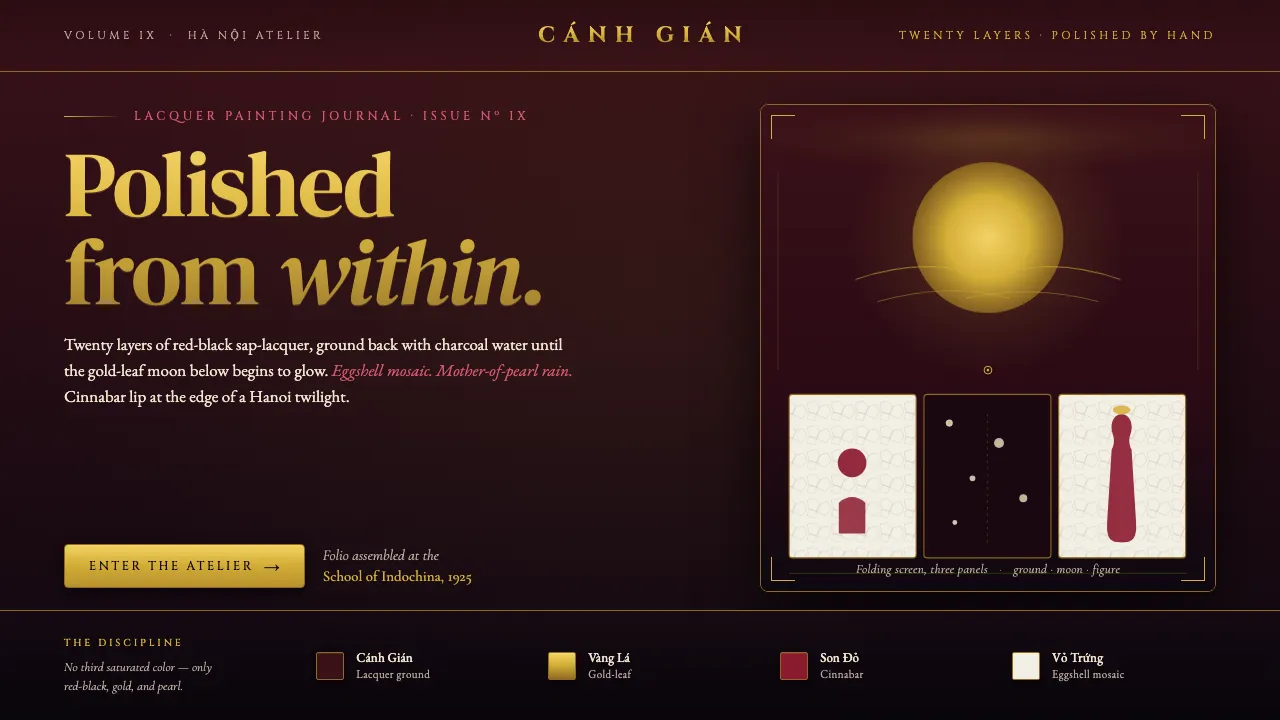
About Vietnamese Sơn Mài Lacquer
Sơn mài — "polish-grind lacquer" — is the Vietnamese fine-art lacquer painting tradition that fused ancient Asian lacquer craft with French oil-painting principles in 1920s Hanoi. Painters built up ten to thirty layers of sap-lacquer ground on wooden panels, inlaid crushed eggshell, gold-leaf, silver-leaf, mother-of-pearl, and cinnabar, then polished the surface back with charcoal-water to reveal stratified luminosity beneath glass-smooth depth.
The visual canon says: deep red-black "cánh gián" ground, gold-leaf moon and clouds, eggshell-mosaic figures, mother-of-pearl water-glints, cinnabar accents. The result glows from within — twenty layers polished smooth as a mirror, ornate ancestral craft framed by modernist composition.
- Origin
- Vietnam — Hanoi (École des Beaux-Arts de l'Indochine + post-1945 Fine Arts Association studios), Saigon/Ho Chi Minh City
- Era
- Ancient temple-lacquer roots (1c CE+); 20c easel-painting transformation 1925–1945 at École supérieure des Beaux-Arts de l'Indochine, Hanoi; postwar continuation as Vietnamese national art form
- Key figures
- Nguyễn Gia Trí · Nguyễn Sáng · Nguyễn Tư Nghiêm · Victor Tardieu · Phạm Hậu
- Movements
- Indochinese modern-art synthesis · Asian lacquer-painting tradition · Vietnamese national-modernism
Vietnamese Sơn Mài Lacquer design spec
Colors
Typography
The other 11 sections — buttons, cards, spacing, motion, techniques and more — open once you unlock. Download the DESIGN.md or send it to your AI in one click. Unlock once, yours forever.
Sign up nowStyles similar to Vietnamese Sơn Mài Lacquer
Also inspired by art & artists, with a close feel.
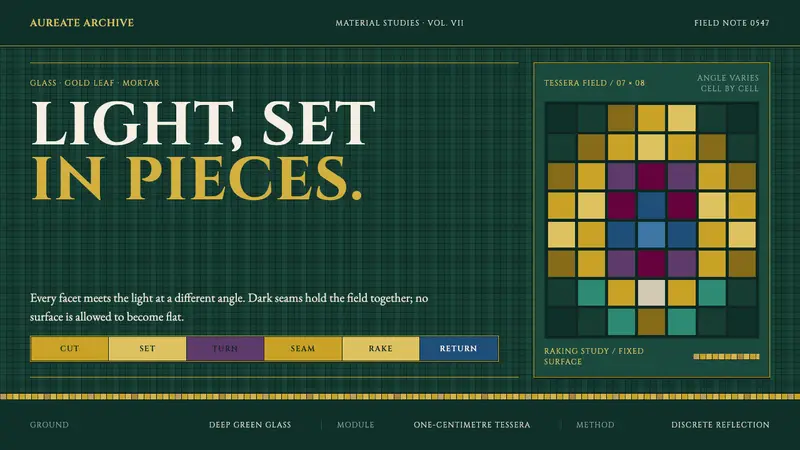 Ravenna Gold MosaicLight lives between pieces. Gold cells, green glass and dark seams make the surface shimmer.
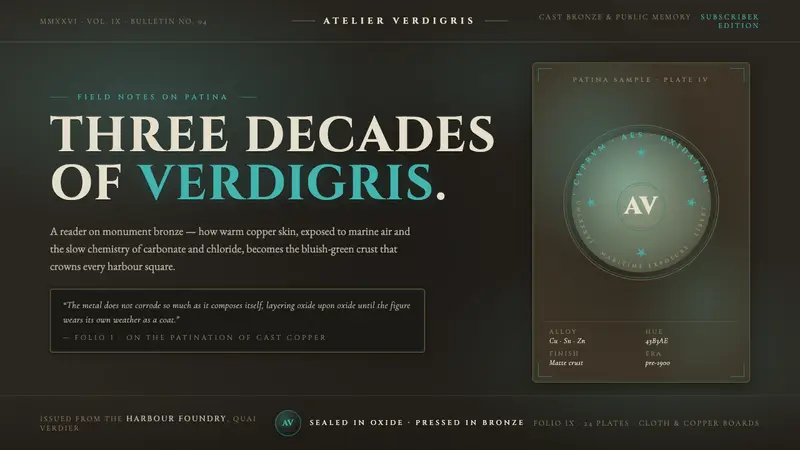 Bronze Patina StatueThree decades of weather, worn as a coat. Verdigris crust on dark bronze, engraved Roman capitals.
 Byzantine Mosaic / IconSacred weight, tiled in light. Gold tesserae ground, Cinzel capitals, arch-framed symmetry.
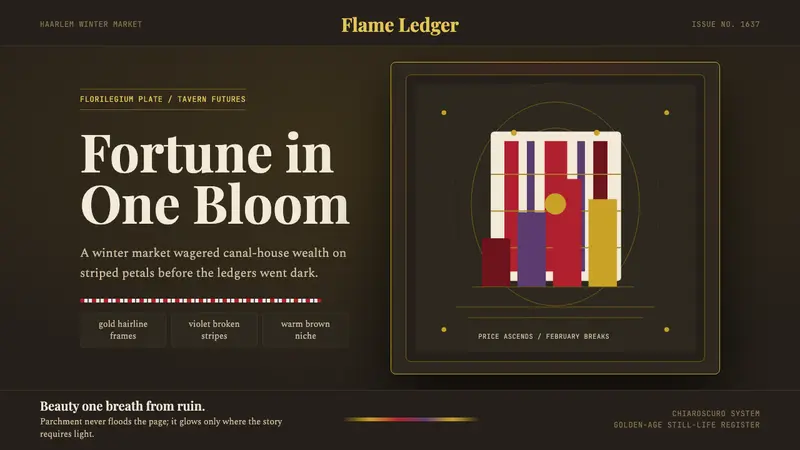 Dutch Tulip ManiaSpeculation burns in shadow. Flame red petals, violet stripes, gold frames on warm brown.