What is Lebanese Art Deco (Beirut)?
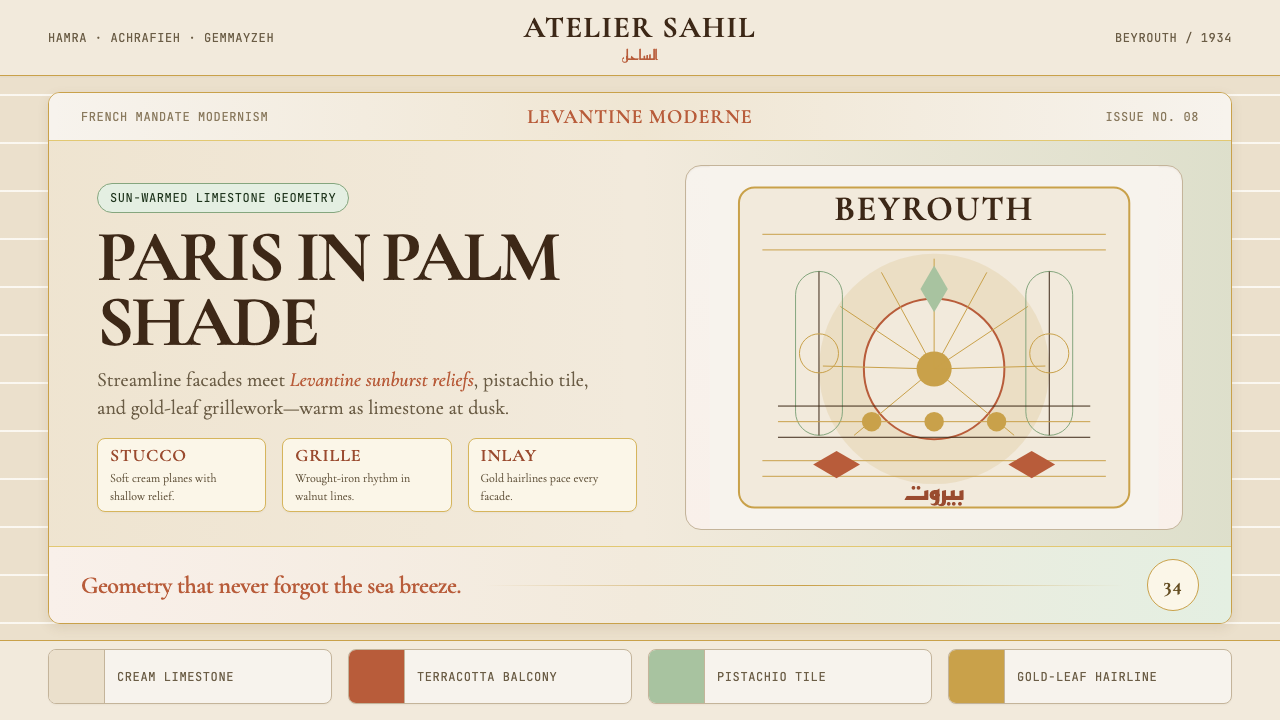
Beirut's Art Deco is Paris filtered through palm shade — French Mandate modernism fused with Levantine sunburst reliefs and gold-leaf ornament to produce an interwar elegance unique to the Eastern Mediterranean.
Lebanese Art Deco (Beirut) in brief
Lebanese Art Deco is a regional variant of the interwar modernist movement that flourished in Beirut between roughly 1920 and 1948, with its richest concentration in the years 1925 to 1935. Unlike its European counterparts, which emerged from the industrial ambitions of Paris and New York, Beirut's Art Deco was shaped by the particular conditions of French Mandate rule: architects trained at the École des Beaux-Arts brought streamline moderne sensibilities to a city whose limestone hillsides, Mediterranean light, and Levantine craft traditions demanded something warmer, more tactile, and more locally rooted.
The defining quality of Lebanese Art Deco is its layering. Cream limestone facades carry geometric friezes borrowed from both Western modernism and Arabesque pattern-making. Wrought-iron grilles echo the geometry of Islamic latticework while also quoting the sunburst motifs that swept Paris in the 1920s. Pale stucco surfaces are warmed by terracotta ornament and pistachio-green accents — color choices drawn from the regional landscape rather than the industrial palette of European modernism. The result is a cosmopolitan style that feels simultaneously cosmopolitan and rooted.
As a design system, Lebanese Art Deco is characterized by its horizontal banding rhythm, its use of gold-leaf hairlines to articulate surface, its blend of serifed display lettering with geometric ornamental frames, and an overall warmth of palette that distinguishes it sharply from the cooler, more ascetic European Art Deco of the same era. It is a style about ornamentation used with architectural intelligence — not the excess of late Victorian decoration, but not the total refusal of Bauhaus either. Ornament here is structural and cultural, serving both the eye and the building's relationship to its city.

Where does Lebanese Art Deco (Beirut) come from?
The conditions for Beirut's Art Deco moment were laid in 1920, when the League of Nations granted France the Mandate for Syria and Lebanon. The French administration embarked on an ambitious urban modernization program in Beirut, commissioning new boulevards, public institutions, and residential blocks that would project the image of a progressive colonial power while satisfying the housing demands of a rapidly growing city. French architects — many of them educated at or influenced by the École des Beaux-Arts — arrived with drawing conventions rooted in classical Beaux-Arts planning but increasingly drawn to the Art Deco vocabulary that had just triumphed at the landmark 1925 Paris Exposition Internationale des Arts Décoratifs et Industriels Modernes.
The local building material of choice, Beirut limestone (locally called 'roumi stone' for its creamy Roman-pale color), profoundly shaped what the style could be. Unlike the terracotta bricks or reinforced concrete of European Art Deco, limestone was cool to the touch, warmed to amber in the late afternoon sun, and responsive to the chisels of local stonemasons who brought generations of Levantine craft knowledge to bear. Architects such as Antoun Tabet, Bahige Makdissi, and Farid Trad, as well as the prolific Aractingi brothers, navigated between their French training and the expectations of a Beiruti merchant class eager for modern, cosmopolitan residences that nonetheless resonated with local material and ornamental traditions.
The Levantine visual heritage — lattice screens, geometric muqarnas, calligraphic friezes, and the arabesque as structural ornament — proved unexpectedly compatible with the Art Deco vocabulary. Both traditions were based on geometric repetition and the treatment of surface as something to be articulated rather than left plain. Beirut architects merged them: sunburst reliefs appeared above doorways as both a Deco motif and an echo of the rayed patterns in Ottoman tilework; geometric iron grilles served as both modernist abstraction and continuation of the mashrabiyya screen tradition. Gold-leaf detail, used sparingly on capitals and door surrounds, connected the buildings to the city's long mercantile history of precious material display.
The peak years of Lebanese Art Deco production, roughly 1925 to 1935, coincided with Beirut's emergence as a regional commercial and cultural hub. The neighborhoods of Hamra, Achrafieh, Gemmayzeh, and Mar Mikhael developed dense concentrations of the style — apartment buildings with elaborate facade programs, cinema facades with geometric neon framing, banks and commercial premises whose entrance compositions quoted directly from the Paris Exposition's most celebrated pavilions. The approach effectively fused French Mandate civic aspiration with the Levantine city's own appetite for beauty displayed through skilled material craft. After Lebanese independence in 1943 and into the late 1940s, new architectural currents began to displace Art Deco, but the built legacy remained formative for how Beirut understood its own urbanism.
What defines the Lebanese Art Deco (Beirut) look?
Palette: Terracotta, Pistachio, and Cream
The Lebanese Art Deco palette is warm where European Art Deco tends toward cool or neutral. Cream limestone is the ground tone — not stark white but the color of sun-warmed stone. Against this, terracotta offers a brick-earth warmth for accent surfaces and relief ornament. Pistachio green, a color deeply embedded in the Eastern Mediterranean material landscape, appears as a counterpoint — cooler, slightly muted, always in natural-toned rather than saturated form. Gold, derived from actual gold-leaf application on architectural surfaces, reads as a hairline accent: used to trace edges, frame openings, and articulate cornices rather than fill large areas. The palette overall conveys warmth, antiquity, and mercantile confidence without the bombast of gilded excess.
Levantine Geometric Ornament
The most distinctive characteristic of Lebanese Art Deco is its fusion of Western geometric modernism with Levantine ornamental traditions. Sunburst reliefs — radiating fan motifs standard to the global Art Deco vocabulary — are inflected with the tighter, more intricate repetition of Arabesque geometry. Friezes along cornices and balcony parapets deploy interlocking geometric patterns that read simultaneously as Deco abstraction and as descendants of the muqarnas or the hammered metalwork of the traditional Levantine bazaar. This dual genealogy is never resolved into one or the other; the tension between Western formal logic and Eastern ornamental density is the style's most generative quality.
Horizontal Banding and Facade Rhythm
Lebanese Art Deco buildings are organized by strong horizontal stringcourses — bands of stone or plaster that wrap the facade at each floor level, creating a visual rhythm of light and shadow as the sun moves across the surface. In two-dimensional work, this translates to a compositional logic of horizontal registers: information and ornament are distributed in clearly defined horizontal zones rather than clustered at the center or scattered across the field. The horizontal emphasis also evokes the layered quality of Beirut's hillside urban fabric, where terraces of buildings step up from the sea. Layouts built on this principle have an architectural legibility — the eye moves along bands, reading from register to register with a sense of measured, deliberate pace.
Wrought-Iron Geometry as Compositional Structure
Wrought-iron balcony grilles, window guards, and door screens are among the most visually striking features of Beirut's Art Deco streetscape, and they carry their own design logic directly into the graphic vocabulary of the style. The grilles are always geometric — fan radiations, diamond grids, stepped zigzag borders, or interlocking circles — and they function as light-filtering screens that layer transparency and opacity in ways that shift with the angle of view. In design work, this logic appears as geometric line structures that frame and contain rather than decorate: borders that organize content the way an iron grille organizes a window opening. The line weight in these elements tends toward the medium-fine — present and authoritative but never so heavy that they dominate the content they frame.
Display Type with Architectural Weight
The typographic sensibility of Lebanese Art Deco is built around display letterforms that carry the same quality as carved stone: weight, proportion, and a sense of deliberate permanence. Serifed or bracketed display type — with the particular warmth of classical roman construction — is the natural companion to limestone facades and gold-leaf detail. In contrast, secondary and body text may carry a lighter, more neutral quality that allows the headline to anchor the composition the way an inscription panel anchors a building's entrance. The key principle is contrast between the architectural weight of display type and the supporting role of running text, mirroring the way Beirut's buildings balance bold cornice ornament with quieter plaster wall surfaces.
Gold Hairlines as Articulation
In Beirut's Art Deco buildings, gold-leaf was applied at the threshold between architectural masses: tracing the rim of a capital, outlining the border of a balcony surround, marking the transition between a plain plaster surface and a carved relief panel. This use of gold as a liminal element — present at edges and transitions rather than filling surfaces — translates directly into the graphic design vocabulary as fine gold rules and hairline borders. These elements serve not as decoration but as articulation: they tell the eye where one zone ends and another begins. Used with restraint, a fine gold line carries enormous hierarchical authority; used in excess, it loses its liminal quality and becomes mere gilding.
Warmth Through Texture and Material Memory
One of the distinguishing qualities of Lebanese Art Deco — relative to other regional Art Deco variants — is its warmth, which derives not from saturated color but from the memory of natural materials. Cream limestone, terracotta plaster, hammered iron, worn timber shutters, and the particular dappled light of the Eastern Mediterranean all feed into an aesthetic register that is modern but not clinical, geometric but not cold. In design applications, this warmth is achieved through palette tone rather than saturation (muted, natural tones rather than vivid artificial ones), through texture used as background surface character rather than as decorative fill, and through compositional breathing room that prevents density from tipping into oppressiveness.

Who shaped Lebanese Art Deco (Beirut)?
One of the most significant Lebanese architects working during the French Mandate period, Tabet designed numerous residential and civic buildings that exemplify the fusion of Beaux-Arts French training with Levantine material sensibility. His facades display the characteristic layering of horizontal stringcourses, limestone relief ornament, and wrought-iron grille screens that define the style at its most accomplished. Tabet navigated the tension between the cosmopolitan ambitions of his Beiruti clients and the constraints and opportunities of local craft and material, producing buildings that remain among the most studied examples of Lebanese Mandate-era architecture.
Makdissi was among the Lebanese architects who brought the Art Deco vocabulary from French architectural education back to Beirut, translating it through a deep knowledge of local building practice. His work demonstrates an acute sensitivity to the way limestone behaves under the Eastern Mediterranean sun — how relief carving reads differently in the raking afternoon light than in the flat midday glare — and he calibrated the depth and density of ornamental programs accordingly. His buildings in Achrafieh and adjacent neighborhoods represent a refined balance between French compositional rigor and the more sensory, material-rich tradition of Levantine building.
Trad was a key figure in Beirut's interwar architectural scene, designing buildings whose ornamental programs drew with particular sophistication on the dual vocabulary of Levantine geometric craft and European Art Deco. His cinemas and commercial buildings were notable for the boldness of their entrance compositions — wide geometric friezes above doorways, geometric mosaic tile floors in vestibules, iron screens whose pattern complexity rivals the most ambitious European examples of the form. Trad's work helped establish Beirut's claim as a sophisticated regional capital capable of producing Art Deco architecture equal to anything produced in Alexandria, Cairo, or Tel Aviv during the same era.
The Aractingi brothers were among the most prolific builders of the Mandate era, responsible for a significant portion of the apartment stock that gave Achrafieh, Gemmayzeh, and Mar Mikhael their distinctive Art Deco character. Their work tends toward the residential middle register — not the landmark civic buildings of the major individual architects, but the texture-giving background fabric of the city — and it was this work that established Lebanese Art Deco as an urban vernacular rather than an elite commission. Their facades, with their consistent horizontal banding, gold-hairline moldings, and wrought-iron balcony screens, created the repetitive yet varied visual rhythm that defines the character of Beirut's surviving Mandate-era streetscapes.
While not a single individual, the École des Beaux-Arts in Paris functions as a shaping institutional force whose influence on Lebanese Art Deco is impossible to overstate. The architects who built Mandate Beirut were educated in its compositional conventions: the hierarchical organization of facades into base, body, and crown; the use of classical orders inflected toward the modern; the treatment of the cornice line as the building's most ornamented gesture. When these architects brought that training to Beirut, they found that its principles could accommodate the Art Deco vocabulary more naturally than strict Beaux-Arts classicism, and that local craft traditions could supply ornamental richness in ways that inflected the global style into something recognizably Levantine.
How do you use Lebanese Art Deco (Beirut) today?
Lebanese Art Deco is one of the more transferable historical styles for contemporary design work because it combines the structural clarity of geometric modernism with an ornamental warmth that counteracts the coldness that often afflicts heavily geometric design systems. Applying it correctly requires understanding what makes it distinct from both generic Art Deco and from Bauhaus or Swiss modernism: it is the warmth of the palette, the intelligent use of ornament as articulation rather than decoration, and the horizontal banding logic that gives compositions an architectural sense of weight and permanence.
For presentation slides, Lebanese Art Deco excels at cover compositions that feel both authoritative and welcoming. A cover slide benefits from a cream or warm stone-toned background rather than pure white, with a headline set in display type of architectural weight anchored by a gold hairline rule beneath it. Geometric ornamental elements — a simplified frieze strip, a wrought-iron-inspired border frame — can contain the composition without overwhelming it. Content slides should adopt the horizontal register logic: headings sit in their own clearly demarcated zone, body content in another, and supporting data or callouts in a third. Data slides work well when charts and graphs are treated as geometric objects, with terracotta and pistachio used to differentiate data series rather than generic blue and orange.
For web interfaces and dashboards, the style maps cleanly onto components that benefit from a sense of established authority: pricing pages where tier differentiation needs to feel premium without being aggressive, analytics dashboards where the data density is high enough that the visual framework must be clear without being sterile, and editorial platforms where reading experience is paramount. Use the horizontal banding logic to organize page sections: a warm cream or stone-toned background for primary content areas, a slightly deeper terracotta-warm tone for secondary panels or sidebars, and gold hairline rules to separate content zones. Navigation should carry typographic weight; icon systems, when needed, should draw from geometric rather than organic forms.
For editorial and marketing design — print or digital — Lebanese Art Deco supports a register that is sophisticated without being austere, historical without being nostalgic, and cosmopolitan without being anonymous. A magazine feature layout in this style uses wide horizontal header bands, body text in a legible serifed face, pull quotes framed in fine gold-line borders, and section breaks marked by short geometric ornamental rules. Marketing materials benefit from the poster-like quality of the style: a full-width image or color block at the top, a clear horizontal hierarchy of headline and sub-headline, and a call-to-action element framed by the gold-hairline logic. The warmth of the palette makes it particularly effective for luxury goods, hospitality, cultural institutions, and any context where heritage and quality are the primary brand signals.
The most common mistake when applying Lebanese Art Deco is treating the ornamental elements as decoration to be added on top of a conventional layout, rather than as the structural logic that organizes the layout from the start. Geometric friezes and gold hairlines only work when they define zones and transitions; placed arbitrarily, they read as clutter. A second common error is pushing the palette toward more saturated versions of terracotta and pistachio — the authentic register is muted and sun-warmed, not vivid and synthetic. Finally, applying the style to purely minimalist contexts where ornament genuinely has no organizational role will produce an uncomfortable tension: Lebanese Art Deco needs sufficient content density to justify its ornamental vocabulary, much as a Beirut apartment building needs multiple stories to justify its cornice program.

Lebanese Art Deco (Beirut) — FAQ
How is Lebanese Art Deco different from Egyptian or North African Art Deco?
All three are regional inflections of the global interwar Art Deco movement, and they share the French colonial educational channel that produced their architects. The differences lie in local materials, ornamental vocabularies, and climatic adaptation. Egyptian Art Deco, particularly the Cairo and Alexandria variants, frequently incorporates Pharaonic motifs — the lotus, the papyrus column, the winged scarab — in ways that have no parallel in Lebanese work. North African Art Deco, shaped by the different material traditions of Morocco and Tunisia, tends toward different tile and stucco patterns. Lebanese Art Deco is distinguished by the particular warmth of Beirut limestone, the stronger presence of Levantine arabesque geometry in its friezes, and the mercantile Mediterranean character of its cities, which produced a commercial sophistication that shaped even residential architecture.
Can Lebanese Art Deco work in digital-first or product design contexts, or is it too historically tied to print and architecture?
The style is more transferable to digital contexts than it might initially appear, but it requires conscious translation rather than direct transposition. The horizontal banding logic maps well onto screen-based layout systems where content is organized into clear sections and scrolling creates a sense of moving through registers. The geometric ornamental elements translate into border components, divider rules, and framing systems that give interfaces a sense of considered structure. The warm palette performs well in dark mode as a relief from the starkness of fully desaturated dark-mode conventions. The areas where translation is most difficult are fine detail and texture — the hairline gold rule that reads beautifully in high-resolution print may need to be rendered more boldly on lower-resolution screens, and relief textures must be very lightly suggested or they will feel heavy.
Is the style appropriate for brands that have no connection to Lebanon or the Middle East?
Lebanese Art Deco is historically specific but not ethnically exclusive — it is a regional synthesis of French, Levantine, and Mediterranean influences that produced an aesthetic coherent enough to function as a stand-alone design language. The question of appropriateness is ultimately about what values the style communicates and whether those align with the brand. Lebanese Art Deco communicates warmth, cosmopolitan sophistication, historical depth, handcraft quality, and the particular elegance of a city that stood at the crossroads of cultures. Any brand whose values align with those qualities can use the style authentically, regardless of geographic origin. The risk is thoughtless exoticization — reducing the style to a collection of vaguely 'Middle Eastern' ornaments without understanding the architectural intelligence behind them.
How do I avoid the composition feeling heavy or over-ornamented?
The key is understanding that Beirut's Art Deco buildings are not uniformly ornamented — they distribute ornament strategically at threshold moments (entrances, cornices, floor transitions) while leaving large areas of plain limestone or stucco to breathe. In design work, this translates to the principle of ornamental economy: use geometric friezes and gold hairlines to mark transitions and hierarchies, not to fill every available surface. The proportion of plain to ornamented surface in authentic work is much higher than casual observers realize. A composition that uses one frieze band, two gold hairline rules, and two geometric frame elements will read as richly Lebanese Art Deco; doubling all of those elements will read as overwhelming. Restraint is not the enemy of richness here — it is the condition of it.
What distinguishes authentic Lebanese Art Deco from a generic 'vintage Middle Eastern' aesthetic?
Authentic Lebanese Art Deco is architecturally grounded and historically specific. It is defined by the horizontal banding rhythm of Beirut's limestone facades, not by generic arabesques applied without structural logic. It uses geometric ornament derived from both Levantine and Deco traditions in ways that serve the organization of the composition — ornament appears at transitions and thresholds, not scattered as surface texture. The palette is specific: cream limestone, terracotta, muted pistachio green, gold as hairline. Most importantly, the style has an underlying compositional logic derived from Beaux-Arts training — hierarchical zones, clear relationships between structural and ornamental elements, a sense of the whole composition as an integrated architectural gesture. A generic 'vintage Middle Eastern' approach typically lacks this structural discipline, using ornamental motifs as surface pattern without the underlying compositional logic that makes the authentic style coherent.
Related design styles
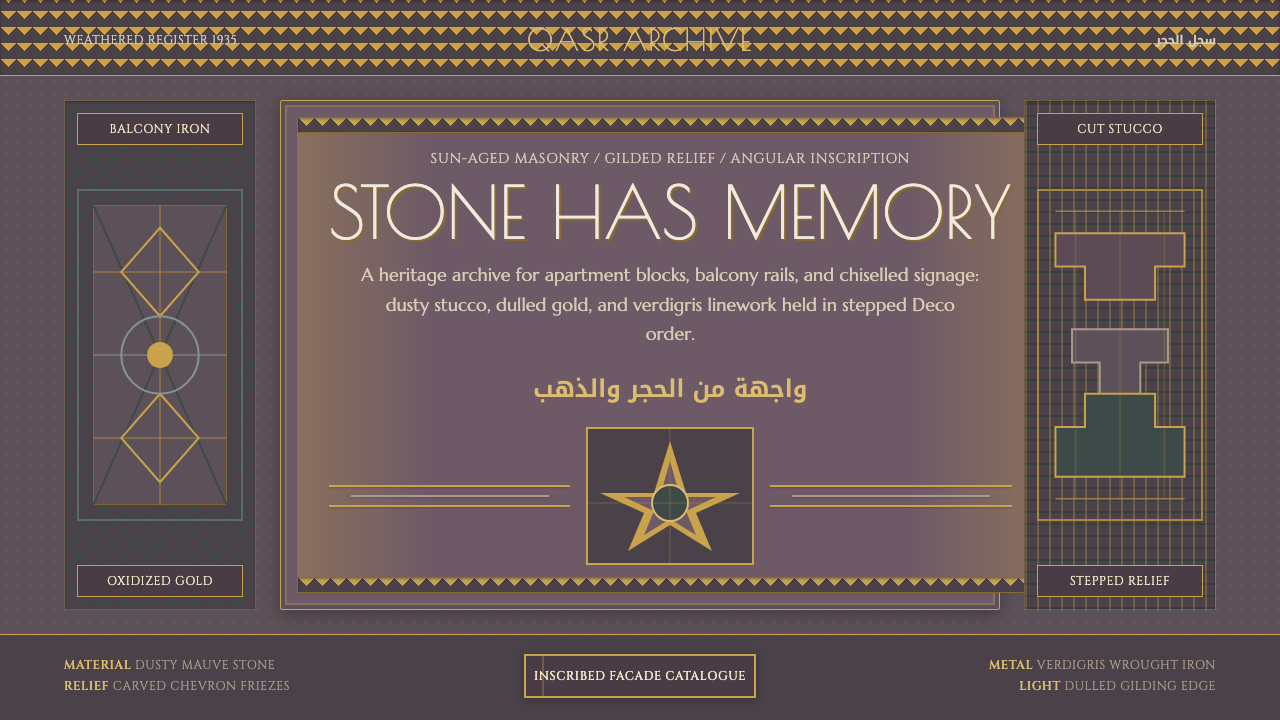 Cairo Downtown Art DecoStone-real glamour. Mauve stucco, dulled gold rules, and verdigris Deco geome…
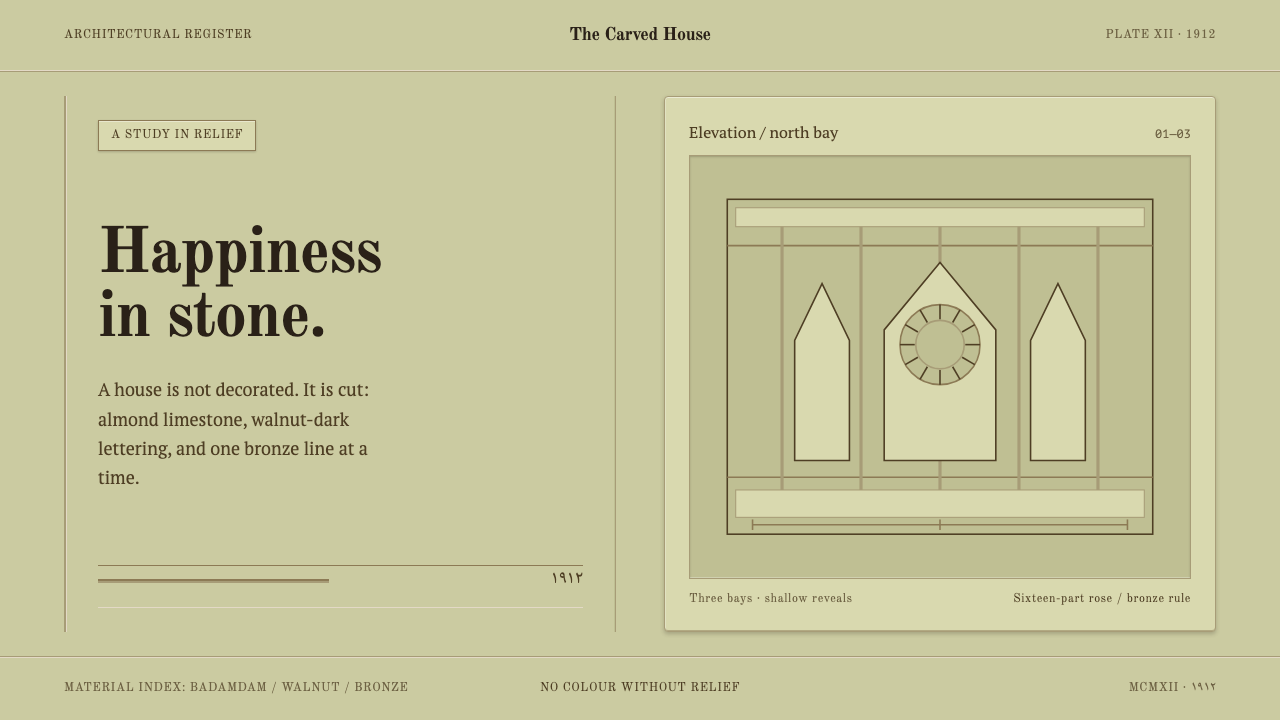 Baku Oil Boom MansionsWealth made tactile. Almond limestone, Old Standard TT, and recessed bays car…
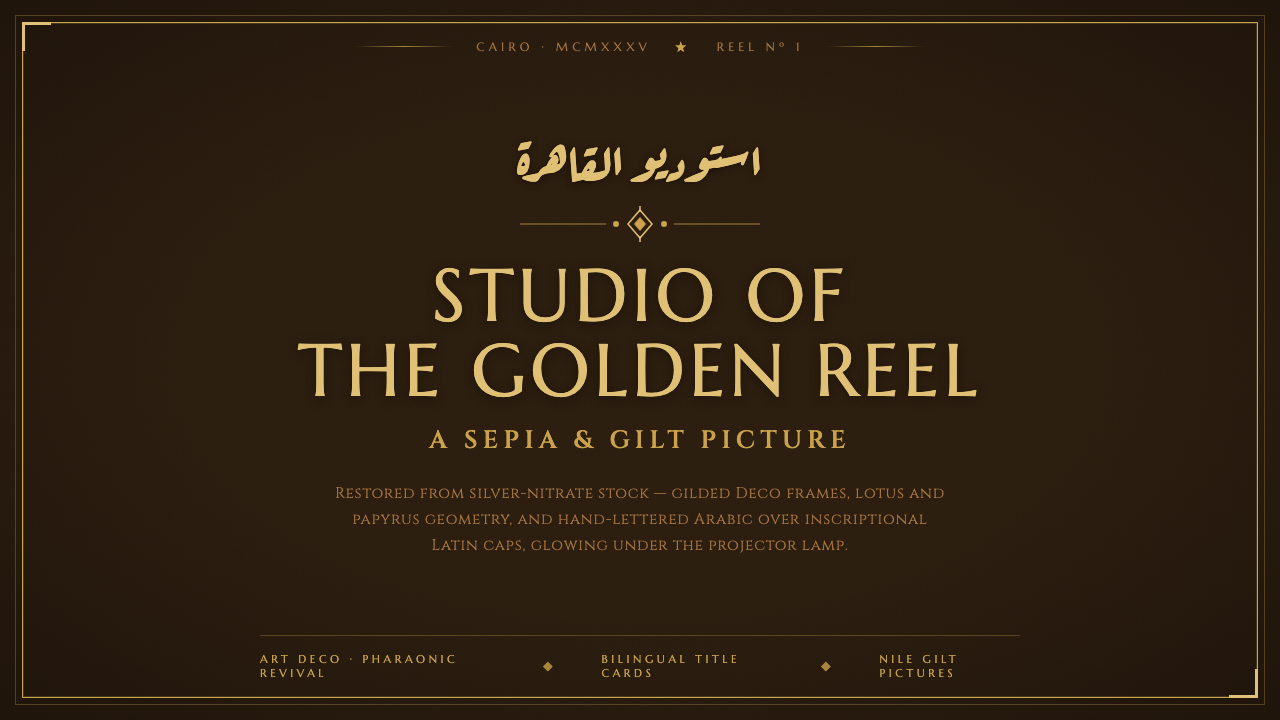 Studio Misr CairoEgyptian cinema's golden age, gilded. Silver-nitrate brown, Deco gold frames,…
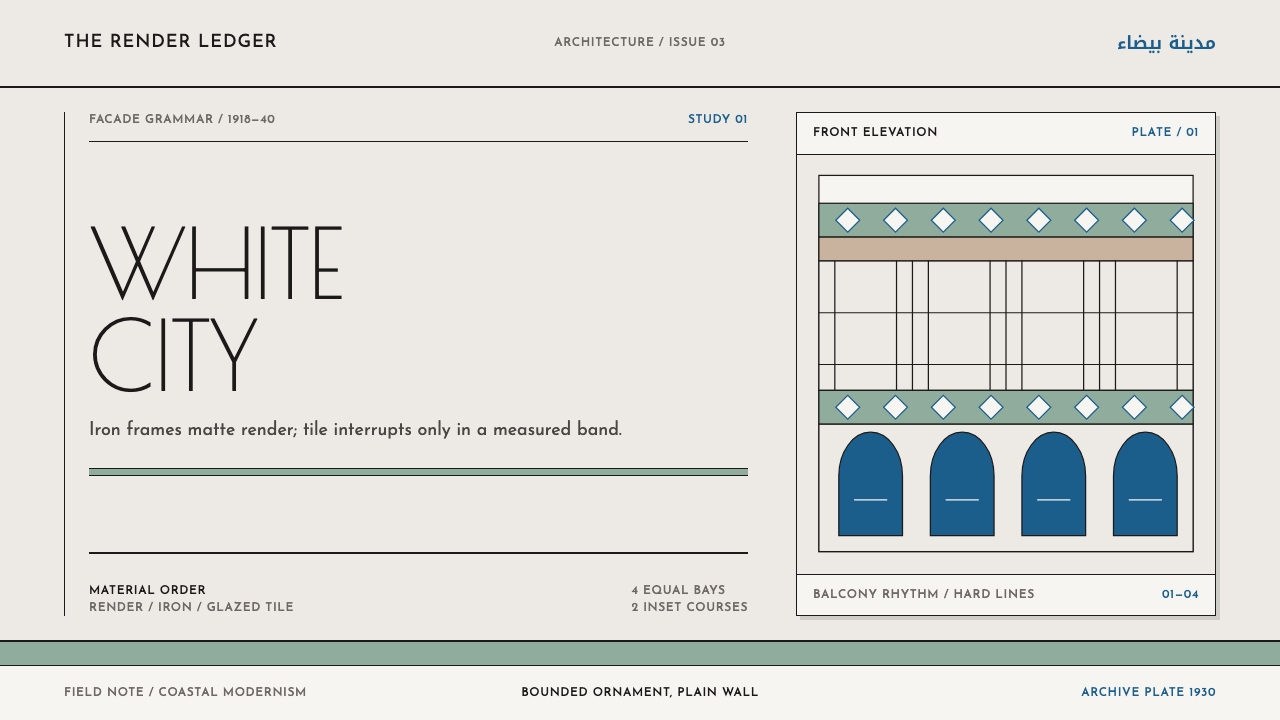 Casablanca Néo-MauresqueOrnament knows its boundary. Matte render, black iron, and celadon tile land…
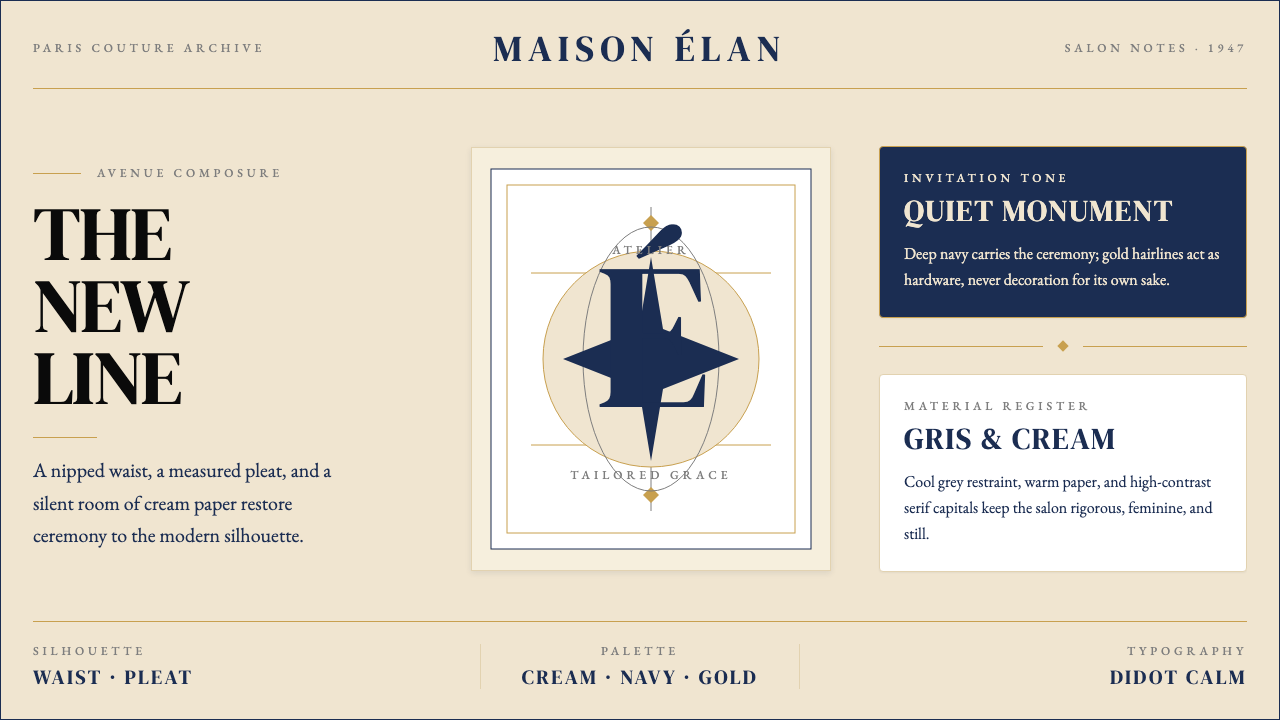 Dior New Look (1947)Couture speaks softly. Cream ground, navy Didot capitals, and gold hairlines…
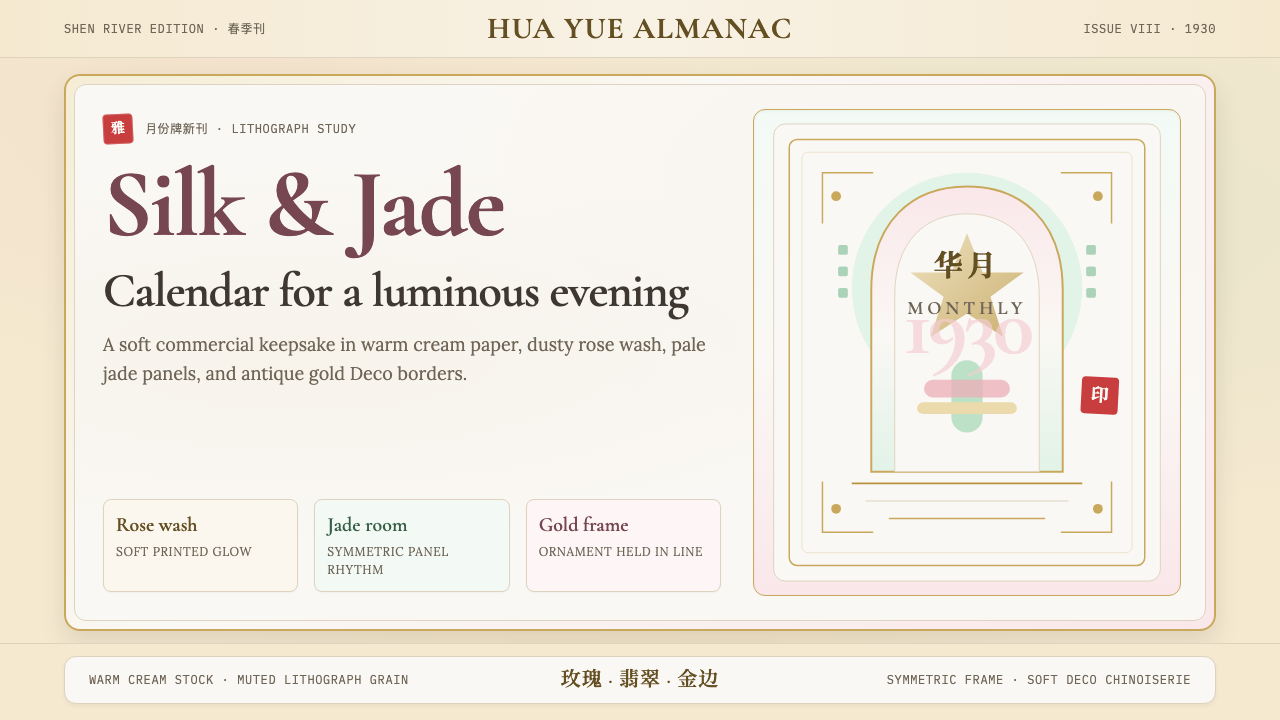 Shanghai Calendar 1930Old Shanghai glows softly. Cream paper, dusty rose, jade panels, and gold Dec…