What is Shanghai Calendar 1930?
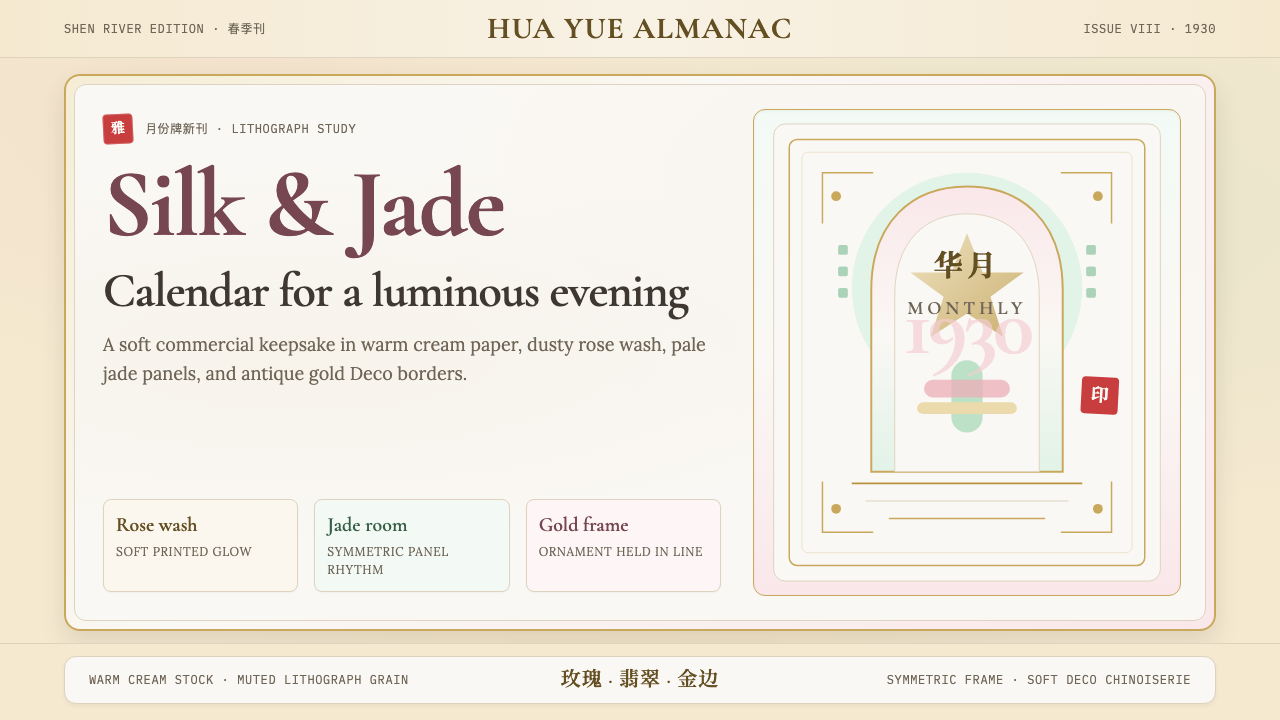
Shanghai calendar posters fused Chinese figure painting with Art Deco geometry into the most glamorous advertising aesthetic the East ever produced.
Shanghai Calendar 1930 in brief
Shanghai calendar posters — yuèfènpái (月份牌) — were the defining commercial art form of Republican-era China. Produced in the city's International Settlement from roughly the mid-1910s through the late 1930s, they appeared as free giveaways from cigarette companies, pharmaceutical houses, and department stores, and ended up covering the walls of homes and shops from Shanghai to Singapore. The images depicted fashionable women — qípáo-clad, bobbed-haired, relaxed in modern interiors — surrounded by intricate ornamental frames borrowed from both Chinese decorative tradition and Western Art Deco.
The visual language is immediately distinctive: warm cream or ivory grounds that evoke aged lithograph paper, figure compositions rendered with a soft-focus, almost luminous quality derived from the gōngbǐ fine-line painting tradition, and borders constructed from jade-toned panels, gilded geometric friezes, and chinoiserie motifs — lotus scrolls, cloud collars, bamboo lattice — interwoven with the clean symmetrical framing of Deco architecture. Color palettes favor dusty rose, powder blue, sage green, warm gold, and ivory, kept deliberately muted and powder-washed rather than saturated.
The aesthetic carries a quality that has no single Western equivalent: it is simultaneously commercial and refined, modern and nostalgic, cosmopolitan and Chinese. This hybrid character was not accidental — it was the deliberate product of artists who understood both the Western chromolithographic posters arriving from Europe and the classical Chinese painting vocabulary they had studied for years. The result is a design language of unusual richness, warmth, and cultural specificity.

Where does Shanghai Calendar 1930 come from?
The calendar poster's origins lie in the intersection of two commercial forces: foreign tobacco companies seeking to penetrate the Chinese market in the early twentieth century, and a generation of Shanghai artists trained in both the gōngbǐ painting tradition and the new imported medium of chromolithography. The British-American Tobacco Company is widely credited with commissioning some of the earliest examples, distributing them alongside cigarette packages as collectible almanac sheets that combined a painted image with calendar grids. By the 1910s, the format had been adopted by Chinese-owned businesses and had evolved into a standalone art form.
The golden age — roughly 1925 to 1937 — coincided with the height of Republican Shanghai's cosmopolitan ambition. The city of this era was simultaneously a treaty port under partial foreign administration, a center of Chinese nationalist politics, a hub of Japanese commercial influence, and the publishing capital of the Chinese-speaking world. Its residents consumed Japanese magazines, Hollywood films, and Parisian fashion alongside Chinese opera, classical poetry, and traditional festivals. The calendar poster absorbed this plurality: Western Art Deco geometry and symmetry, the chromolithographic color palette of European commercial printing, and the soft figuration and ornamental vocabulary of Song and Ming dynasty Chinese painting.
The artists who defined the style worked largely in specialized commercial studios. Zheng Mantuo (鄭曼陀, 1888–1961) is credited as the first major innovator, developing a blended technique that combined watercolor wash with gōngbǐ line work to produce the soft-focus, porcelain-skinned female figures that became the genre's signature. Hang Zhiying (杭穉英, 1900–1947) ran the most commercially influential studio of the era — Zhiying Studio — training a generation of artists and producing work that set the standard for figural elegance, ornamental frame design, and the integration of Western Deco motifs with Chinese decorative traditions. His compositions display a particular mastery of the dense, jewel-like border systems that frame the central figure.
The abrupt end of the golden age came with Japan's full-scale invasion of China in July 1937 and the fall of Shanghai in November of that year. The conditions that had sustained the form — commercial prosperity, cosmopolitan openness, the patronage of foreign and Chinese businesses alike — dissolved under wartime occupation. After 1949, the People's Republic redirected commercial printing toward socialist realist imagery, and the yuèfènpái aesthetic was effectively suppressed for decades. It was only from the 1980s and 1990s onward that scholars, collectors, and designers began to recover and revalue the form, and the style entered global visual culture as a marker of a specific, irretrievably lost world.
What defines the Shanghai Calendar 1930 look?
Color Palette
The palette is soft and powder-washed rather than saturated. Ivory and warm cream serve as the dominant ground, evoking the aged quality of lithograph paper. Accent colors — dusty rose, powder blue, sage green, warm gold, and muted coral — are kept at low intensity, creating a sense of delicacy and refinement rather than commercial loudness. Darker values appear sparingly in border elements and shadows, never overwhelming the overall luminosity. The effect is of light filtered through translucent silk: everything glows softly from within.
Figural Softness
The central figures — almost always fashionable women of the Republican era — are rendered with a characteristic soft-focus luminosity. This technique, pioneered by Zheng Mantuo, blended the wet-into-wet wash of watercolor with the precision line work of classical gōngbǐ painting to produce skin tones of an almost porcelain translucency. Edges are never hard; contours dissolve slightly into the ground. The figures occupy a middle space between illustration and portraiture, idealized but never abstract.
Ornamental Borders
The border systems are among the most structurally complex elements of the aesthetic. They typically consist of two or three nested frames, each carrying different decorative vocabulary: an outermost band of geometric Deco fretwork in gold or jade tones; a middle register of chinoiserie motifs — lotus blossoms, cloud collar patterns, bat-and-coin symbols of prosperity, bamboo lattice; and an innermost frame that creates a clean pictorial ground for the figure. The layering is dense but never chaotic, ordered by the same symmetrical logic that governs classical Chinese architectural ornamentation.
Art Deco Integration
Western Art Deco forms are present throughout but always subordinated to the overall Chinese sensibility. Geometric friezes with the stepped profiles and fan-shaped radiants characteristic of Deco architecture appear in header and footer bands. Stylized floral motifs take on the flat, symmetrical quality of Deco ornament. The overall compositional logic — a strong central axis, mirrored flanking elements, hierarchical zoning from top to bottom — is Deco in its structural approach while Chinese in its surface vocabulary. Neither tradition dominates; the two are genuinely synthesized.
Typography and Text
Text elements are treated with elegant restraint. Brand names and product titles typically appear in refined serif letterforms — either European-style display serifs or classically proportioned Chinese brush characters — placed within dedicated cartouches or banner panels rather than floating freely over the image. Chinese characters, when used as decorative elements, are rendered in the regular script (kǎishū) or seal script (zhuànshū) tradition, contributing to the sense of historical depth and cultural rootedness. Never condensed, never bold-slab, always measured and composed.
Compositional Symmetry
Unlike Bauhaus or Swiss-style asymmetric grid compositions, the calendar poster tradition is fundamentally symmetric. The central figure occupies a vertical axis, flanked by matching decorative panels. The upper and lower portions of the composition mirror each other in density and ornamental weight. This symmetry carries cultural meaning — in Chinese aesthetic tradition, balanced composition (均衡, jūnhéng) connotes stability, harmony, and auspiciousness. The symmetry is not rigid but slightly relaxed, breathing rather than mechanical, suited to printed paper rather than stone.
Luxury Surface Quality
Every element of the calendar poster aesthetic connotes quality and luxury without ostentation. Gold accents are used sparingly but consistently, giving borders and text elements a warm metallic highlight. Surface textures — where they appear — suggest woven silk, carved lacquer, or hand-laid paper rather than digital cleanliness. The overall impression is of something made with patience and skill, closer to a collectible print than a mass advertisement, even though the medium was inherently commercial and widely distributed.

Who shaped Shanghai Calendar 1930?
Zheng Mantuo is credited as the founding innovator of the modern yuèfènpái style. Working in the 1910s and 1920s, he developed the technique that became the form's signature: building up the central figure using the wet-wash layering of Western watercolor while maintaining the fine-line precision of Chinese gōngbǐ painting for contours and detail. This blended method produced the soft, luminous skin tones and dissolving edges that distinguished Shanghai calendar art from both straight Western commercial illustration and traditional Chinese figure painting. His compositions introduced the framing conventions — the cartouche for text, the ornamental border separating image from calendar grid — that subsequent artists would elaborate and refine.
Hang Zhiying's Zhiying Studio was the most commercially successful and artistically influential calendar poster enterprise of the golden age. Hang trained under earlier masters and then established his own studio in Shanghai around 1921, eventually employing dozens of artists at its peak. His contribution was not only in his own figure painting — which combined elegance of posture and costume with acute sensitivity to Western fashion illustration — but in systematizing the production of the border and ornamental elements that gave the format its characteristic richness. He developed standardized border templates drawing on both Art Deco geometry and Chinese decorative motifs, which could be combined and reconfigured for different clients. His early death in 1947 at the age of forty-seven cut short a career that had defined the aesthetic standard for an entire generation.
Jin Meisheng was among the most prolific calendar poster artists of the Republican era and one of the few significant practitioners to survive the political changes of 1949 and continue working into the People's Republic period. His work is noted for a particular brightness and warmth of palette and for figure compositions that project a sense of idealized domestic happiness — women in gardens, with children, arranged in serene and prosperous settings. He demonstrated how the calendar poster aesthetic could adapt across different ideological contexts, and his later work in the socialist period, though serving different propaganda purposes, retained formal qualities traceable to the yuèfènpái tradition he had helped define.
Xie Zhiguang brought a particular fluency with Western-style figure drawing into the calendar poster tradition, his figures displaying an understanding of volumetric modeling and Western academic proportion alongside the expected Chinese softness of technique. He was among the artists most attuned to the cosmopolitan fashions of the International Settlement era, and his compositions frequently feature women in Western dress as naturally as in traditional qípáo, reflecting the genuinely bicultural world his audience inhabited. His work represents the calendar poster at its most internationally literate — visually accessible to both Chinese and foreign viewers while remaining distinctly rooted in its Shanghai context.
How do you use Shanghai Calendar 1930 today?
The Shanghai calendar poster aesthetic transfers most naturally to contexts that benefit from warmth, cultural richness, and a sense of refined historical depth. Unlike purely geometric or typographic styles, it requires a light touch: the goal is to evoke the luminosity and ornamental elegance of the original form, not to reproduce it literally. The key design decisions are palette and border treatment — get those right, and the rest of the system follows.
For presentation slides, this aesthetic works beautifully on cover pages and section dividers. A cover benefits from a centered, symmetrical composition: a large central image panel — illustrated, photographic, or simply a bold typographic arrangement — surrounded by a layered ornamental border in ivory, dusty rose, and gold tones. Body content slides should be treated more sparingly: a warm cream ground, refined serif headings, generous margins, and decorative elements limited to corner accents or a thin gold rule. Data slides can take inspiration from the framing conventions — present charts and tables within light bordered panels that recall the cartouche tradition, giving each data element its own contained, dignified space.
For web interfaces, the style is well-suited to landing pages, product pages, and editorial layouts where warmth and a sense of craft matter more than stark functionality. A pricing or feature comparison page rendered in this aesthetic uses a cream background, bordered card components that recall the poster's nested frame structure, refined serif or calligraphic heading treatments, and accent colors in dusty rose or jade green for interactive states and callouts. Navigation should be measured and typographic rather than icon-dense; hover states should feel like a gentle illumination rather than an abrupt color switch. Dashboard applications can incorporate the style through warm-toned card borders, gold-accented data labels, and background textures that suggest aged paper without becoming distracting.
For editorial and marketing content, the aesthetic supports immersive storytelling layouts. Magazine-style article pages benefit from a wide ornamental drop cap to open sections, generous white space that functions like the quiet air around a central figure, and pull quotes framed in a light bordered panel. Marketing campaign pages can use the full visual vocabulary: a full-width hero section with a centered figure composition, layered border elements framing key messages, and a warm, muted palette that creates a sense of considered luxury. Brand identity work for fashion, beauty, food, or hospitality products that want to signal heritage, cultural depth, or artisanal craft will find this style more resonant than cleaner contemporary alternatives.
A common mistake when applying this aesthetic is conflating it with general chinoiserie kitsch — adding generic dragon or cherry blossom motifs and calling the result Shanghai-inspired. Authentic application requires attention to the specific ornamental vocabulary of the Republican period: the stepped Art Deco fretwork, the cloud collar and lotus scroll patterns, the particular proportion and softness of the figure rendering. A second common error is over-saturating the palette. The calendar poster palette is always dusty and powder-washed; the moment you push colors to full saturation, the delicate, aged quality that defines the style evaporates. When in doubt, desaturate further and warm the overall tone with ivory or cream.

Shanghai Calendar 1930 — FAQ
How is this style different from general vintage Chinese poster art?
The Shanghai calendar poster (yuèfènpái) is a specific historical form from a specific era and city, with a precise visual vocabulary. It is distinct from, for example, the bold flat-color propaganda posters of the People's Republic, the woodblock print tradition of folk art, or the ink-wash landscape tradition of literati painting. The defining characteristics are the soft-focus figural rendering technique, the nested ornamental border system combining Art Deco geometry with Chinese decorative motifs, and the muted powder-washed palette on cream grounds. General vintage Chinese aesthetic references may share individual elements, but the combination and the specific softness of the figural tradition are what define the yuèfènpái style.
Can this aesthetic work for dark or night-mode interfaces?
It can, but requires careful adaptation. The historical palette is fundamentally light-ground — cream and ivory are canonical. A dark inversion should not simply flip cream to black; rather, it should seek deep, warm-toned dark grounds: deep indigo, very dark olive, or near-black brown that retains warmth. Gold and dusty rose accents translate well to dark grounds, as they retain their luminous quality against depth. Dusty blue and sage green may need to be lightened slightly to maintain visibility. The ornamental border elements benefit from being rendered in a warm metallic or softly glowing tone rather than stark white lines, which would break the period sensibility entirely.
Is this style appropriate for technology products?
It depends entirely on what the technology product wants to communicate. If the product is positioned around heritage, craft, cultural identity, or a deliberate departure from the cold rationalism of typical tech aesthetic, then the Shanghai calendar style can be highly effective — think platforms serving the luxury market, cultural institutions, editorial products, or consumer apps that want to differentiate through warmth and historical depth. If the product's core proposition is speed, precision, or analytical rigor, the style's softness and ornamental richness may send conflicting signals. Technology products that apply this style most successfully tend to be those where the human-facing layer — the identity, marketing, editorial — can use the full aesthetic, while underlying functional interfaces take only the palette and typographic conventions.
How should photography be used within this aesthetic?
Photography works best when it is treated to share the style's softness and warmth rather than presented in sharp, high-contrast modern form. Images should be processed with warm toning, slight desaturation, and soft highlight treatment that echoes the powder-washed quality of the palette. Cropping and framing are important: photographs placed within ornamental bordered panels — particularly those that echo the nested frame structure of the original posters — integrate naturally. Full-bleed sharp photography tends to clash with the aesthetic unless it has been carefully matched in tone and subject matter. Portraits work especially well when lit softly from the front, avoiding the dramatic side-lighting of more contemporary editorial styles.
What distinguishes authentic use of this style from superficial chinoiserie?
The distinction lies in specificity, restraint, and understanding of source material. Superficial chinoiserie reaches for generic Chinese markers — dragons, pagodas, cherry blossoms, red and gold combinations — without understanding the actual visual logic of the source tradition. Authentic application of the Shanghai calendar aesthetic requires attention to the specific ornamental vocabulary of the Republican era (Art Deco geometry combined with cloud collar, lotus, and bat-coin motifs), the particular soft-focus figural quality, the powder-washed rather than saturated palette, and the symmetrical compositional logic. It also requires restraint: the originals achieve their effect through the accumulation of refined details at a measured pace, not through visual loudness. If the result feels overwhelming, it has drifted toward kitsch; if it feels quiet and luminous, it is closer to the source.
Related design styles
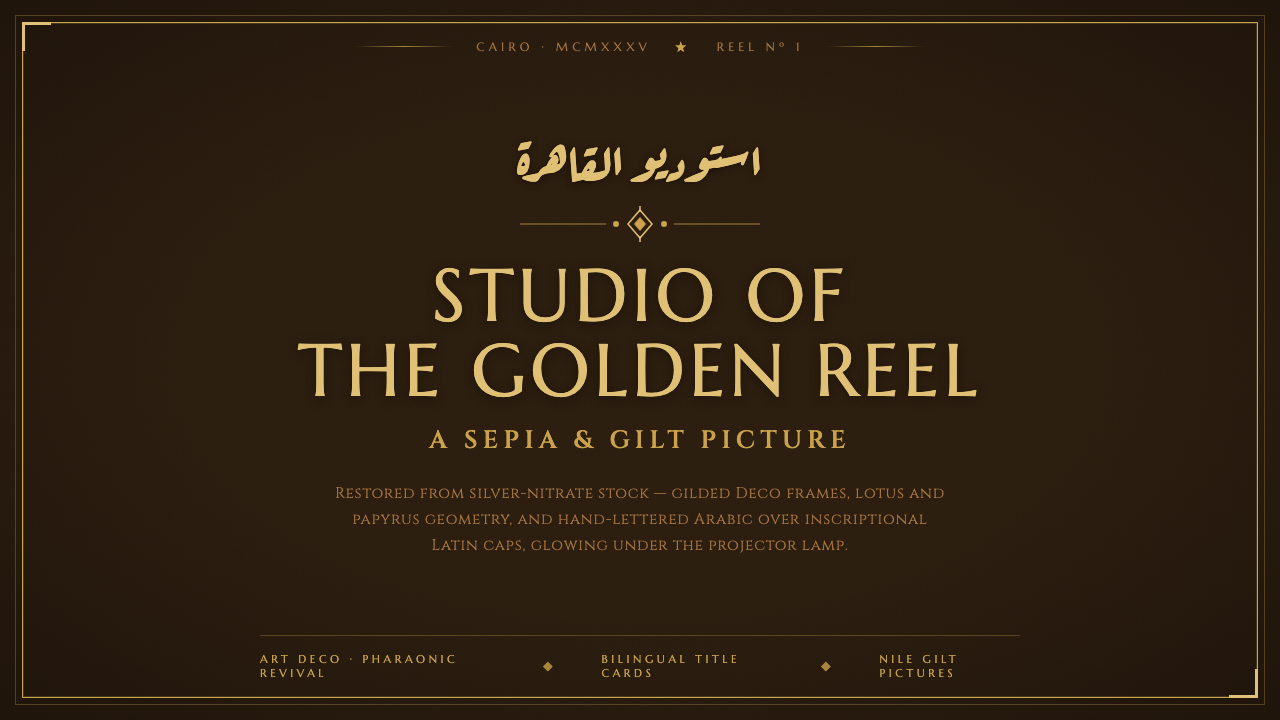 Studio Misr CairoEgyptian cinema's golden age, gilded. Silver-nitrate brown, Deco gold frames,…
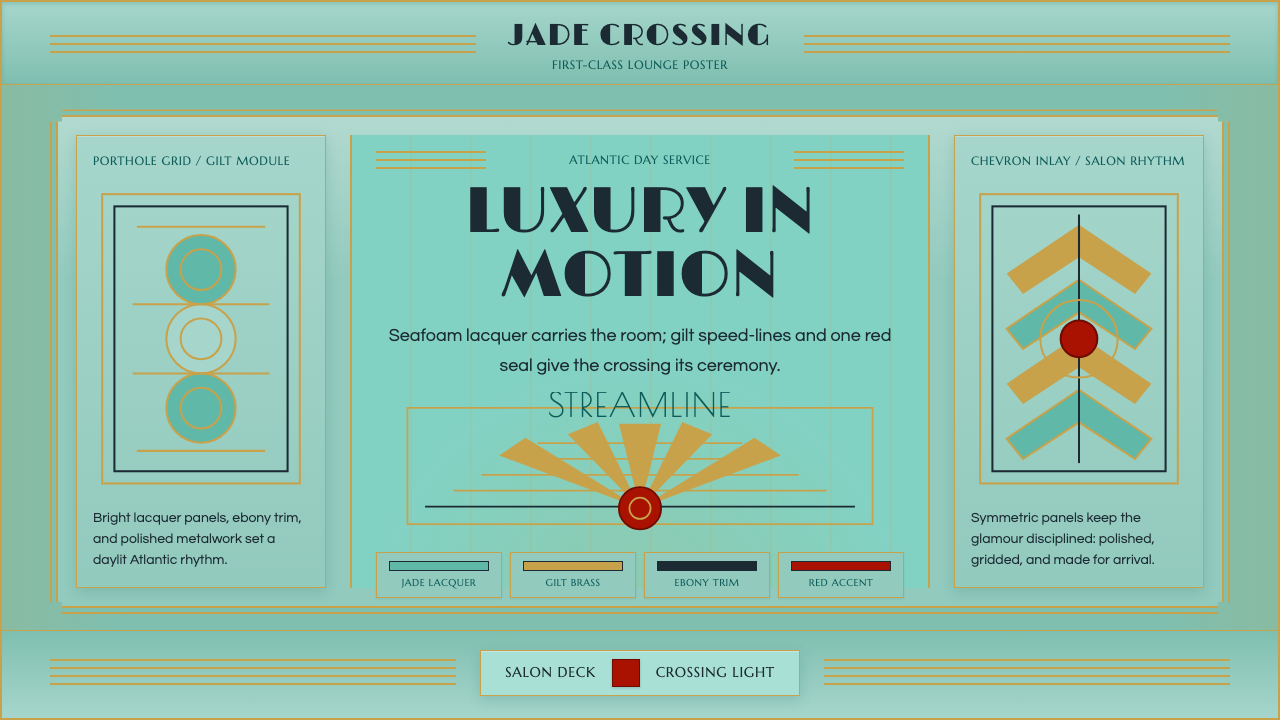 Ocean Liner SeafoamLuxury in motion. Seafoam lacquer, gilt speed-lines, and Deco symmetry frame…
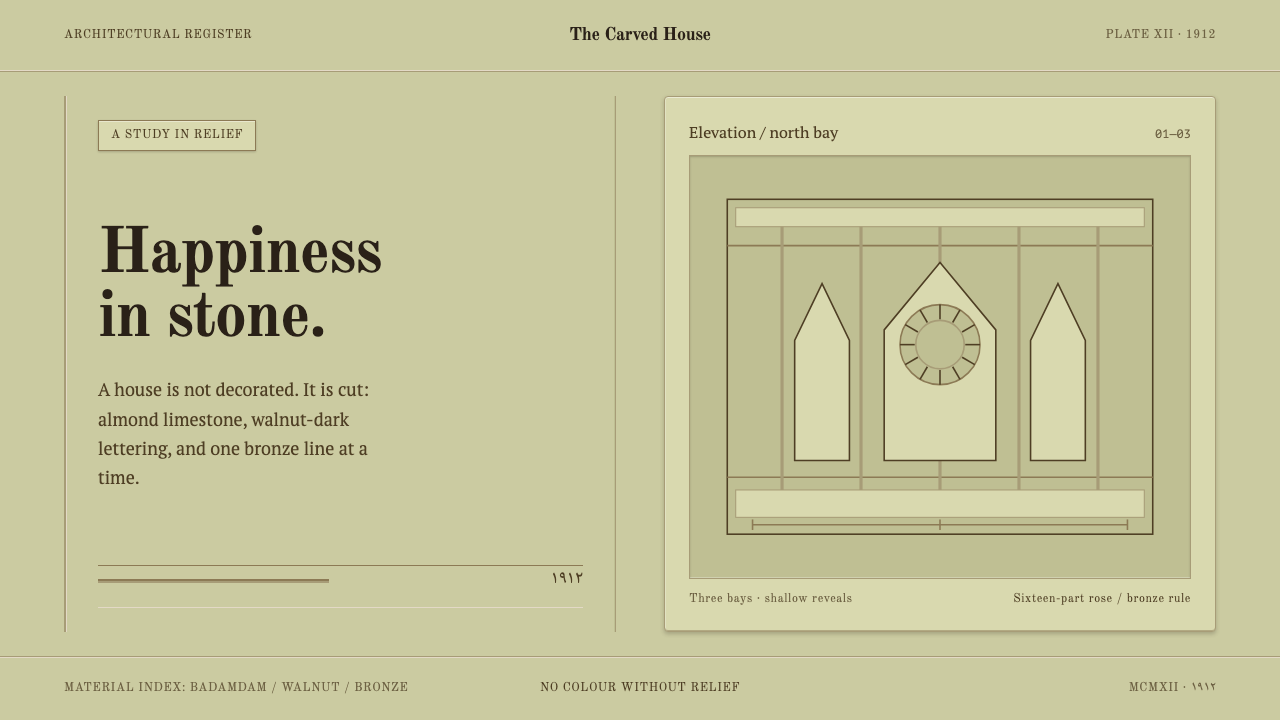 Baku Oil Boom MansionsWealth made tactile. Almond limestone, Old Standard TT, and recessed bays car…
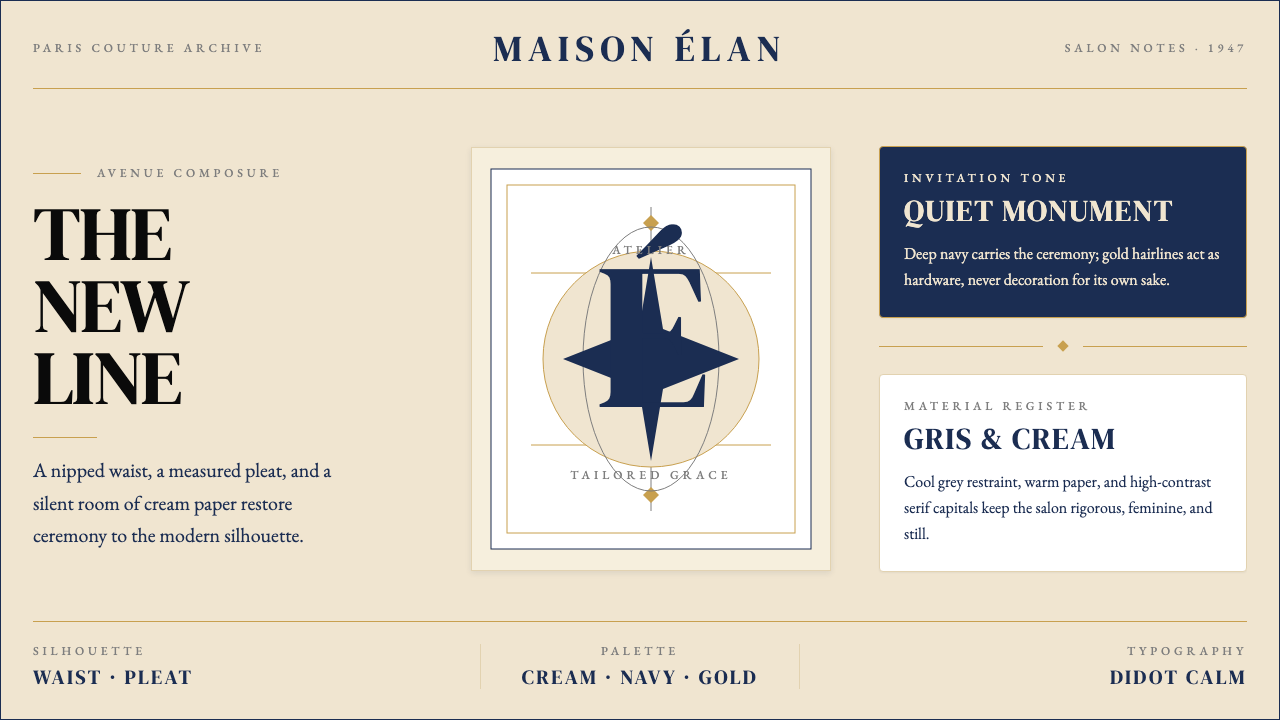 Dior New Look (1947)Couture speaks softly. Cream ground, navy Didot capitals, and gold hairlines…
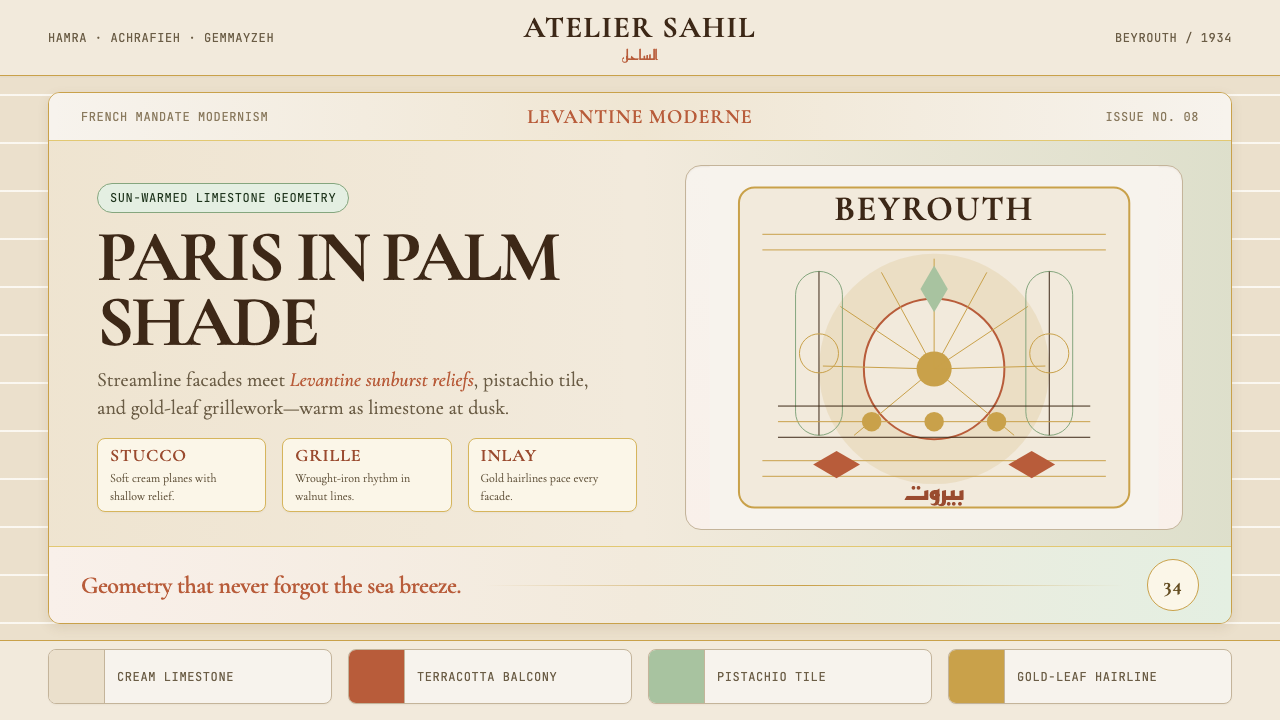 Lebanese Art Deco (Beirut)Cosmopolitan warmth. Cormorant friezes, gold hairlines, terracotta-pistachio…
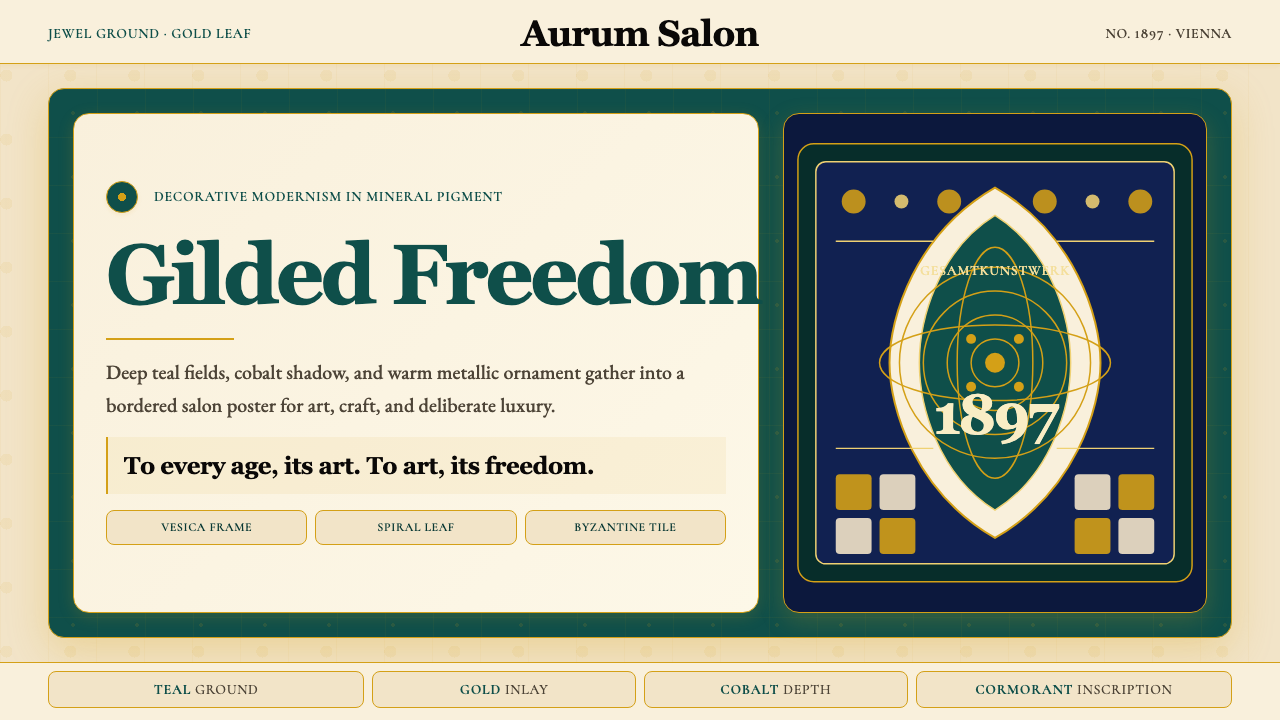 Wiener Secession (Klimt)Opulence made modern. Teal grounds, gold inlay, vesica frames and Cormorant d…