What is Surrealism (Dalí / Magritte)?
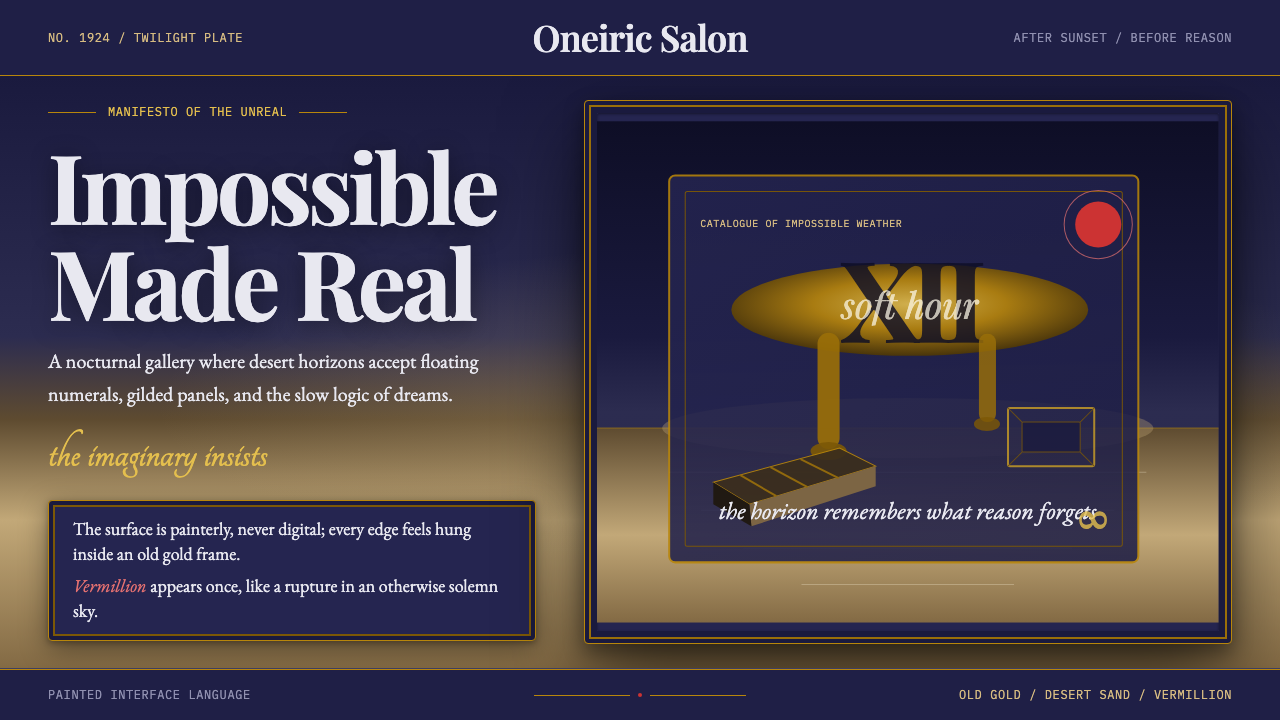
Surrealism makes the impossible feel inevitable — dream skies, melting time, and uncanny juxtapositions rendered with the precision of a classical oil painting.
Surrealism (Dalí / Magritte) in brief
Surrealism is the visual language of the unconscious made tangible. It places familiar objects in impossible relationships — a locomotive emerging from a fireplace, a clock draped over a branch like wet cloth, a bowler-hatted man whose face is obscured by a floating apple — and renders each element with the meticulous detail of academic painting. The result is an image that feels simultaneously rational and irrational, familiar and deeply foreign.
As a design aesthetic, Surrealism draws on the movement's most enduring visual signatures: twilight skies in deep indigo and violet, desert horizons in warm ochre and sand, the richness of old gold ornament, and serif typography that recalls the printed pages of early-twentieth-century Paris. Surfaces have a painterly quality — never clinical or digital — and compositions favor theatrical staging over functional minimalism. The atmosphere is uncanny, elegiac, and slightly unsettling.
What distinguishes the Surrealist aesthetic from mere strangeness is its internal consistency. Each impossible element is rendered with conviction. The dreamlike quality comes not from vagueness or blur but from the juxtaposition of hyper-real objects in contexts where they have no logical right to appear. Applied to design, this means every visual choice must be deliberate: the twilight gradient that reads as infinite sky, the gold frame that signals gravitas, the serif headline that whispers of another era.

Where does Surrealism (Dalí / Magritte) come from?
Surrealism was formally launched in Paris on October 15, 1924, when the poet and critic André Breton published the first Manifesto of Surrealism. Breton defined the movement as 'pure psychic automatism' — a method for expressing the true functioning of thought, free from the control of reason and any aesthetic or moral preoccupation. The manifesto drew heavily on Sigmund Freud's theories of the unconscious, dream interpretation, and free association, translating psychoanalytic method into an artistic program. Surrealism emerged from the wreckage of Dadaism, inheriting its anti-rationalist spirit but redirecting it from pure negation toward a positive exploration of the subconscious mind.
Salvador Dalí, born in Figueres, Catalonia, in 1904, joined the Paris Surrealist circle in 1929 and rapidly became its most recognizable figure. His contribution was the 'paranoiac-critical method' — a self-induced hallucinatory state that allowed him to generate irrational imagery while retaining enough rational control to execute it with photographic precision. Works such as The Persistence of Memory (1931), with its celebrated melting watches on a sun-baked Catalan landscape, exemplify this fusion: the imagery is dreamlike, but the execution — the cast shadows, the reflected surfaces, the precise rendering of the cliffs of Cap de Creus — is that of a trained academic painter. Dalí's visual world is characterized by infinite dream-skies, desert and coastal horizons, architectural impossibilities, and an obsessive attention to surface texture.
René Magritte, working in Brussels from the late 1920s onward, developed a parallel but distinct Surrealist sensibility. Where Dalí's images are florid, theatrical, and psychologically charged, Magritte's are quiet, deadpan, and philosophical. He favored the juxtaposition of ordinary objects rendered in flat, matte tones — a pipe accompanied by the caption 'This is not a pipe,' a man in a bowler hat replaced by a dove, an interior whose window opens onto a painted canvas of the same view. Magritte's work interrogates the relationship between representation and reality, image and word, interior and exterior. His palette leans toward overcast blues, grey-greens, and the warm ochres of domestic interiors, and his compositions have the stillness of an unanswered question.
The movement reached its cultural peak during the 1930s and into the Second World War, when many of its figures — Dalí, Max Ernst, Yves Tanguy, and others — emigrated to the United States. New York became a secondary Surrealist capital, and the movement's visual vocabulary entered advertising, fashion photography, and window display. Salvador Dalí collaborated with Coco Chanel, designed a dream sequence for Alfred Hitchcock's Spellbound (1945), and worked with Walt Disney on the animated short Destino (conceived 1945). This commercial absorption did not dilute the aesthetic — it amplified it. The Surrealist image became one of the most widely reproduced visual languages of the twentieth century, and its influence on contemporary digital design, editorial illustration, and luxury branding remains direct and traceable.
What defines the Surrealism (Dalí / Magritte) look?
Color — Twilight and Desert
The palette is organized around two dominant registers: a cool twilight range spanning deep indigo through violet and dusky blue, and a warm desert range of sand ochre, burnt sienna, and bleached bone. Against these grounds, old gold and deep crimson serve as accent tones — the gold of antique frames, the red of a rose or a pair of lips. The effect is neither cheerful nor neutral but emphatically atmospheric, evoking the hour between sunset and night when familiar forms begin to lose their certainty.
Painterly Texture
Surfaces in Surrealist design never read as digital. They carry the visual memory of oil paint — subtle tonal modulation, the suggestion of canvas grain, the warm imperfection of a varnished ground. This texture does not mean literal noise filters or photo effects; it means achieving a depth and warmth that distinguishes the image from flat vector output. The background feels like sky or earth, not a color fill. Shadows have weight; highlights glow rather than flash.
Dreamlike Juxtaposition
The defining compositional logic of Surrealism is the encounter of unrelated or incompatible objects in a shared space, rendered with enough conviction that the combination feels inevitable rather than arbitrary. A teacup in a landscape, a door opening onto cloud, a word where an object should be — these juxtapositions generate meaning through friction. Applied to design, this principle manifests as unexpected scale relationships, objects placed outside their functional contexts, or visual metaphors that require a moment of pause to resolve.
Serif Typography
Type in Surrealist design is always serif — not modern geometric serifs but old-style and transitional faces with bracketed serifs, moderate stroke contrast, and a sense of literary provenance. Headline type is set with grandeur and weight, often at large scale against the deep background. Body text, where it appears, favors a narrow, bookish measure. The underlying message is that Surrealism is a literary and philosophical movement, not a commercial or digital one; the typography should carry that cultural memory.
Classical Framing and Ornament
Gold frames, architectural moldings, and formally composed borders appear in Surrealist imagery as ironic or earnest signals of cultural weight. Dalí mounted his visions in the visual language of museum art; Magritte placed his philosophical provocations inside easel paintings. In applied design, this translates to bordered containers, formal compositional symmetry for specific elements, and the use of ornamental detail — a rule, a cartouche, a vignette — as deliberate quotation from the tradition of academic painting and fine-press printing.
Infinite and Uncanny Space
Surrealist space recedes to impossible distances. The horizon is always further than it should be; the sky is deeper, the desert wider, the architecture more maze-like than any real place. This spatial expansiveness is achieved through careful tonal recession — elements near the viewer are warmer and more detailed, while the background dissolves into cool blue haze. The psychological effect is vertigo — a sense of standing at the edge of something enormous — which in design translates to a feeling of scale and consequence beyond the ordinary.
Hyper-real Detail
The impossible in Surrealist imagery is always rendered with absolute specificity. Dalí's melting clocks have visible numerals, accurate cast shadows, and the correct texture of oxidized metal. Magritte's pipe is painted with the care of a still-life study. This obsessive attention to detail is what distinguishes Surrealism from fantasy: fantasy accepts ambiguity; Surrealism insists on precision. In design, this means every element — a shadow, a reflection, a typographic detail — should be resolved, never approximate.

Who shaped Surrealism (Dalí / Magritte)?
Born in Figueres, Catalonia, in 1904, Dalí trained at the Royal Academy of Fine Arts in Madrid before joining the Paris Surrealists in 1929. His paranoiac-critical method — a disciplined simulation of paranoid delusion used to generate images — produced the movement's most iconic works: The Persistence of Memory (1931), The Elephants (1948), and Dream Caused by the Flight of a Bee Around a Pomegranate a Second Before Awakening (1944). Dalí was also the movement's most prolific commercial figure, working with advertisers, fashion houses, filmmakers, and theater directors, and designing everything from jewelry to furniture to a telephone shaped like a lobster. His visual vocabulary — infinite dream-skies, desert landscapes, melting or morphing objects, architectural impossibilities, and meticulous academic technique — remains the most widely recognized shorthand for Surrealism in popular culture.
Magritte was born in Lessines, Belgium, in 1898 and spent most of his career in Brussels, working in deliberate contrast to the flamboyant theatrical mode of Dalí. His paintings are quiet, deadpan, and philosophically rigorous: The Treachery of Images (1929), The Son of Man (1964), and Personal Values (1952) all interrogate how images represent — or fail to represent — the things they depict. Magritte painted in a flat, even technique that deliberately evacuated the expressive brushwork typical of fine art, giving his impossible scenes the matter-of-fact quality of a commercial illustration. His contribution to applied design has been enormous: the bowler hat, the apple, the cloud, the pipe — these recurring motifs have become a visual shorthand for intellectual wit and uncanny juxtaposition deployed across luxury advertising, book covers, and editorial design.
Breton was the movement's theorist, organizer, and self-appointed pope. His 1924 Manifesto of Surrealism defined the movement's intellectual program and declared its allegiance to Freudian psychoanalysis, automatic writing, and the liberation of the unconscious from rational control. A second manifesto followed in 1929. Breton was both tireless advocate and notoriously difficult collaborator — he excommunicated Dalí, Ernst, and others from the movement at various points. As a prose writer, his own work — particularly Nadja (1928) — demonstrates that Surrealist aesthetics could be applied as effectively in language as in paint, a principle that influenced a century of experimental fiction and advertising copy.
Ernst was the movement's most formally experimental figure, developing techniques — frottage, grattage, and decalcomania — that introduced chance and automatic processes into image-making. Frottage (rubbing pencil over paper laid on a textured surface) and grattage (scraping paint to reveal underlying layers) generated organic, unexpected textures that became characteristic of the movement's more abstract wing. Ernst's forest paintings and his novel in collage, Une Semaine de Bonté (1934), demonstrate how Surrealist imagery could be built from found imagery and material accident rather than purely from the imagination — a method that directly anticipates photomontage, collage-based editorial design, and contemporary algorithmic image generation.
Oppenheim's Object (1936) — a teacup, saucer, and spoon covered in fur — is one of the most concise demonstrations of Surrealist object-making: an everyday item rendered useless and uncanny by the substitution of a single material property. Oppenheim was among the first prominent women in the Surrealist movement, and her work demonstrates that the movement's logic of juxtaposition could be applied to three-dimensional design objects with exactly the same conceptual force as painting. Her influence on product design, fashion, and accessory design — the deliberate collision of materials with incompatible cultural associations — runs from the 1930s directly to the present.
How do you use Surrealism (Dalí / Magritte) today?
Surrealism is among the most distinctive and high-commitment design aesthetics available for contemporary work. It is not a veneer to be applied lightly — the style carries strong cultural associations with dream, the unconscious, luxury, and intellectual gravity, and any application that undermines those associations will read as pastiche. The first question to ask is whether the content and audience warrant this level of atmospheric density. Surrealism works best for products and platforms positioning themselves as transformative, luxurious, or intellectually serious: high-end editorial, luxury brand campaigns, cultural institutions, or technology products that want to signal that they are doing something genuinely new.
For presentation slides, the Surrealist aesthetic excels at cover pages and section dividers but demands restraint on content slides. A cover benefits from the full visual vocabulary: a deep twilight sky as background, a gold-framed central image or headline, serif type set at commanding scale, and a single warm accent anchoring the composition. Content slides should be treated as calm successors to that cover — a cleaner field with the same serif typography, tonal backgrounds rather than flat fills, and data or bullet points given space to breathe. Data visualizations on Surrealist slides work best when they feel like scientific diagrams from another era: fine lines, labeled axes, a spare but considered palette drawn from the same warm-and-cool register as the rest of the deck.
For web interfaces and dashboards, the style suits contexts where the user is expected to linger and explore rather than process information rapidly. A Surrealist dashboard might use a deep indigo or violet ground for the primary background, with card components framed in subtle gold or warm ochre borders rather than the sharp hard shadows of Bauhaus-derived work. Navigation should be typographic and formal, with serif labels and generous spacing. Pricing pages in this aesthetic work well for premium or luxury tiers — the visual weight of the style communicates that the product is not a commodity. The key discipline is restraint: one or two Surrealist visual elements per screen are evocative; five are overwhelming.
For editorial and marketing work, the Surrealist aesthetic has a long and proven history. Magazine covers, book jackets, advertising campaigns, and cultural event posters have drawn on this vocabulary continuously since the 1930s. In contemporary editorial application, the style works best when the central image does the conceptual work — an unexpected object, a striking juxtaposition, a figure in an impossible setting — while typography and layout remain relatively controlled. Marketing pages in this style should commit to the atmospheric quality: large-format imagery, unhurried pacing, copy that reads as thoughtful rather than urgent, and a consistent color identity built from the twilight and desert palette.
A common mistake when applying the Surrealist aesthetic is confusing strangeness with quality. Arbitrary bizarre imagery — random objects superimposed on photographs, unexpected font choices for no conceptual reason, mismatched textures piled together — produces chaos rather than the productive unease that Surrealism aims for. The discipline that distinguishes authentic Surrealist-influenced design from visual noise is the same discipline that characterizes the paintings of Dalí and Magritte: every impossible element must be rendered with conviction and internal consistency. The impossible should feel inevitable, not accidental.

Surrealism (Dalí / Magritte) — FAQ
Is Surrealist design too niche for mainstream commercial use?
Not inherently, but it requires a product context that can carry the aesthetic weight. Surrealism has been used successfully in mainstream commercial work since the 1930s — it is the vocabulary of countless luxury perfume campaigns, high-fashion editorials, and technology brand launches. The constraint is that the style signals seriousness, transformation, and a certain refusal of the ordinary. Products that are genuinely premium, genuinely new, or genuinely concerned with the imagination align naturally with the aesthetic. Products that are primarily utilitarian, value-focused, or reassuringly familiar will find the style alienating rather than differentiating.
How do Dalí and Magritte differ as design references, and when should I favor one over the other?
Dalí's visual mode is warm, theatrical, and psychologically charged — his imagery tends toward the baroque, with rich desert and coastal landscapes, organic morphing forms, and an overall feeling of overwhelming, hallucinatory detail. Magritte's mode is cool, spare, and philosophically quiet — his images are flatter, more controlled, and generate their uncanny quality from conceptual juxtaposition rather than painterly richness. For emotional, immersive, or luxury-brand contexts, Dalí's register is appropriate. For intellectual, editorial, or conceptually driven work — a think-tank, a publication, a technology platform exploring a new category — Magritte's stripped, questioning sensibility will serve better.
Can Surrealism work in a light-background layout, or does it require dark backgrounds?
Surrealism is not restricted to dark backgrounds, but dark or twilight grounds are its natural register. The movement's most characteristic images take place in the hour between dusk and night, in infinite desert space, or in dimly lit interiors — all of which favor the low-key end of the tonal range. A light-background Surrealist layout is possible, particularly drawing on Magritte's palette of overcast blues and domestic ochres, but it requires careful management: without the depth of a dark ground, the uncanny quality can flatten into mere quirk. The gold and warm accent tones should be used more sparingly on a light ground, and the typographic and compositional discipline becomes more important as the atmospheric depth decreases.
How should photography be handled in a Surrealist design system?
Photography in a Surrealist context works best when it participates in the movement's logic of juxtaposition and impossibility rather than functioning as straightforward documentary or lifestyle imagery. This means treating photography as raw material: compositing unexpected elements into a single scene, shifting the scale of objects relative to their surroundings, applying tonal treatments that echo the twilight palette, or cropping and framing in ways that remove the image from its original context. Straightforward portrait or product photography will feel incongruous unless it is treated — at minimum, desaturated and toned to sit within the palette. The historical Surrealists were themselves deeply interested in photography as a medium for making the real feel unreal; applying that same intention to sourced or commissioned photography is the most authentic approach.
What are the most common mistakes that make Surrealist design fall flat?
Three failures recur most often. The first is arbitrary strangeness — placing unusual objects together without the internal logic that makes the impossible feel inevitable. True Surrealist imagery has a reason, even if that reason is subconscious; randomly bizarre combinations simply read as incoherent. The second is imprecise execution — soft, vague, or digitally obvious surfaces undermine the hyper-real precision that the style requires; the impossible must be rendered with the conviction of documentary photography. The third is tonal inconsistency — mixing the Surrealist atmosphere with cheerful or contemporary visual idioms (flat illustration, bright UI color conventions, casual sans-serif type) breaks the spell immediately. The aesthetic is all-or-nothing: commit to the twilight palette, the classical typography, and the painterly surface, or choose a different style.
Related design styles
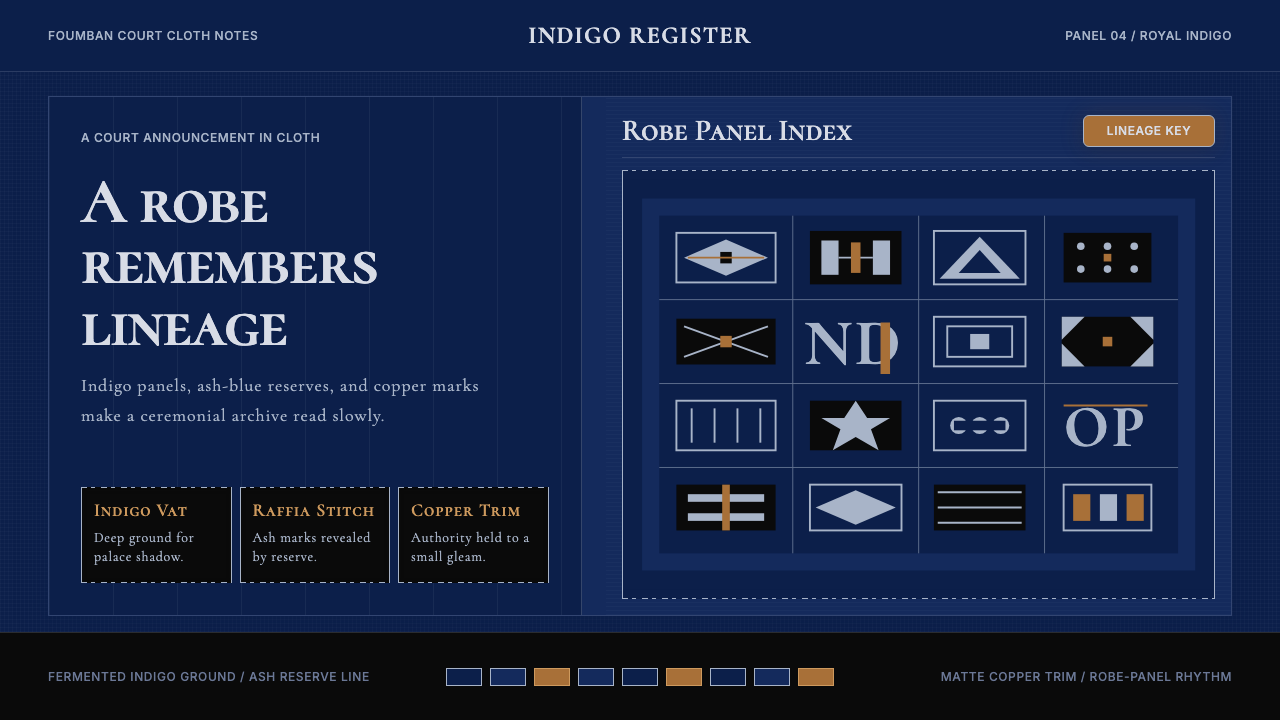 Cameroonian Ndop Royal IndigoReads like court cloth. Indigo panels, ash stitch grids, and matte copper kee…
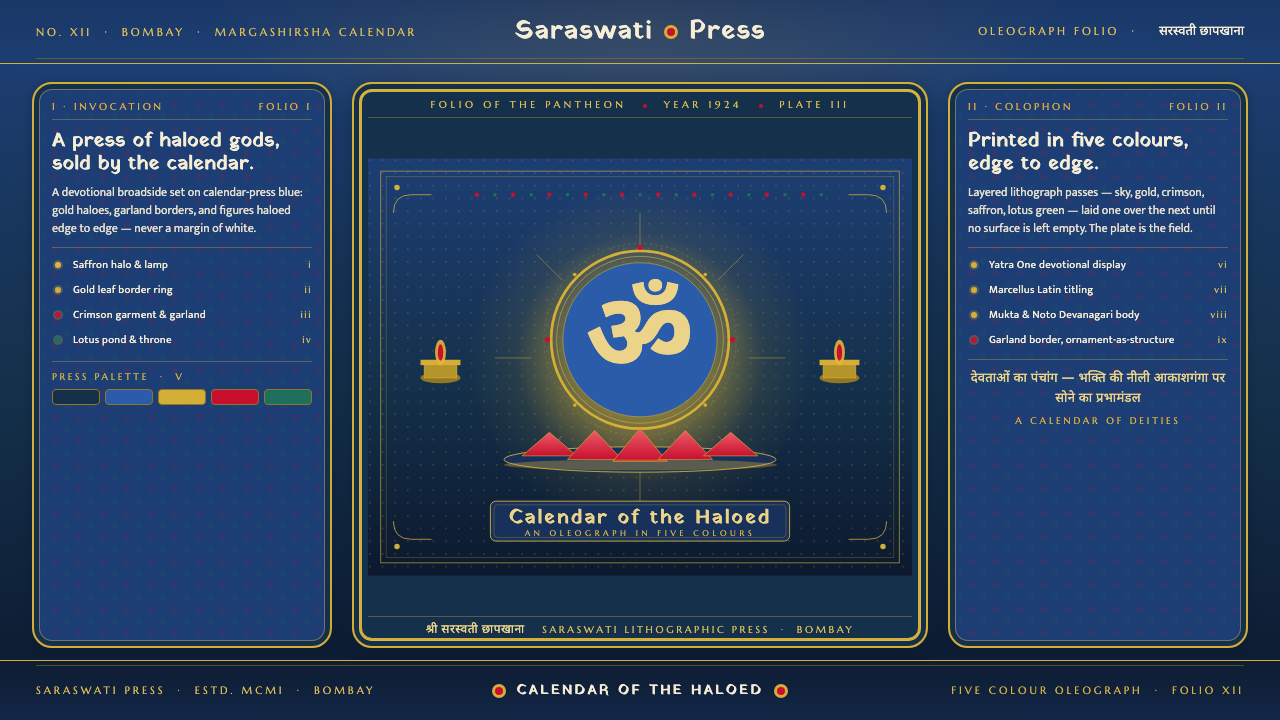 Hindu Pantheon Bazaar PrintDevotional calendar art, edge to edge. Gold halos and garland borders on baza…
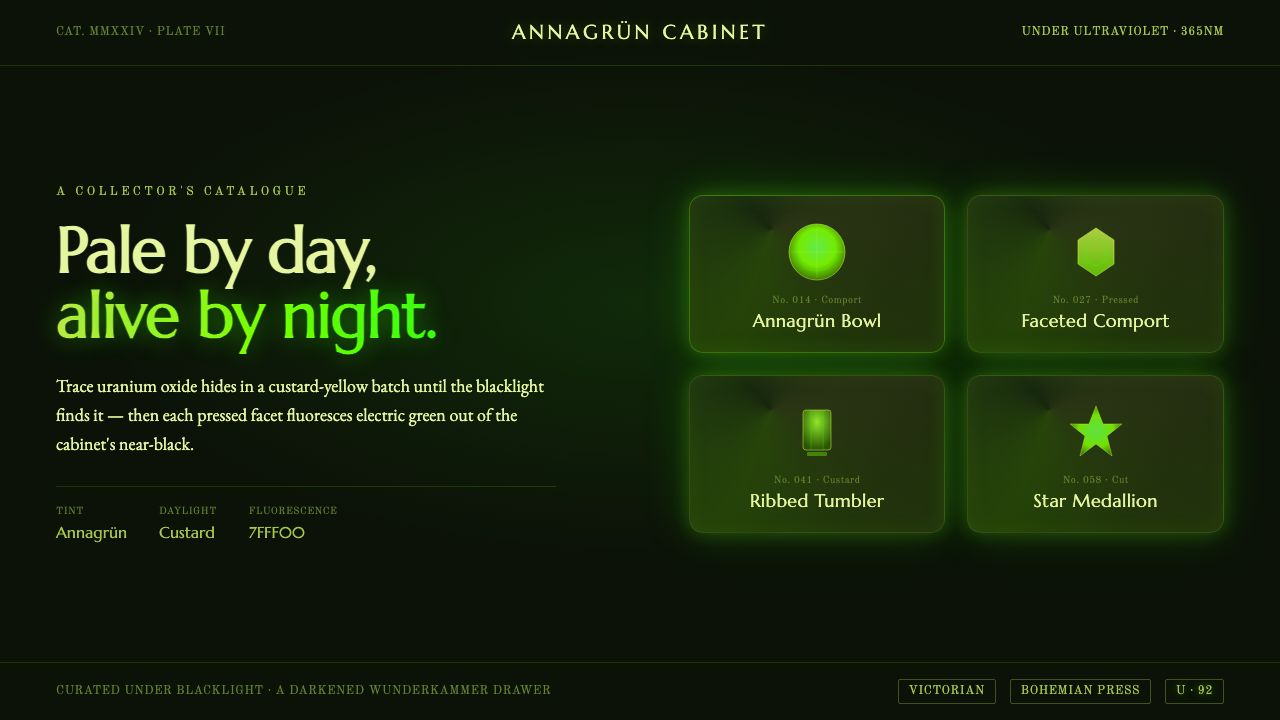 Uranium Vaseline GlassPale by day, electric green by night. Uranium glass fluorescing out of cabine…
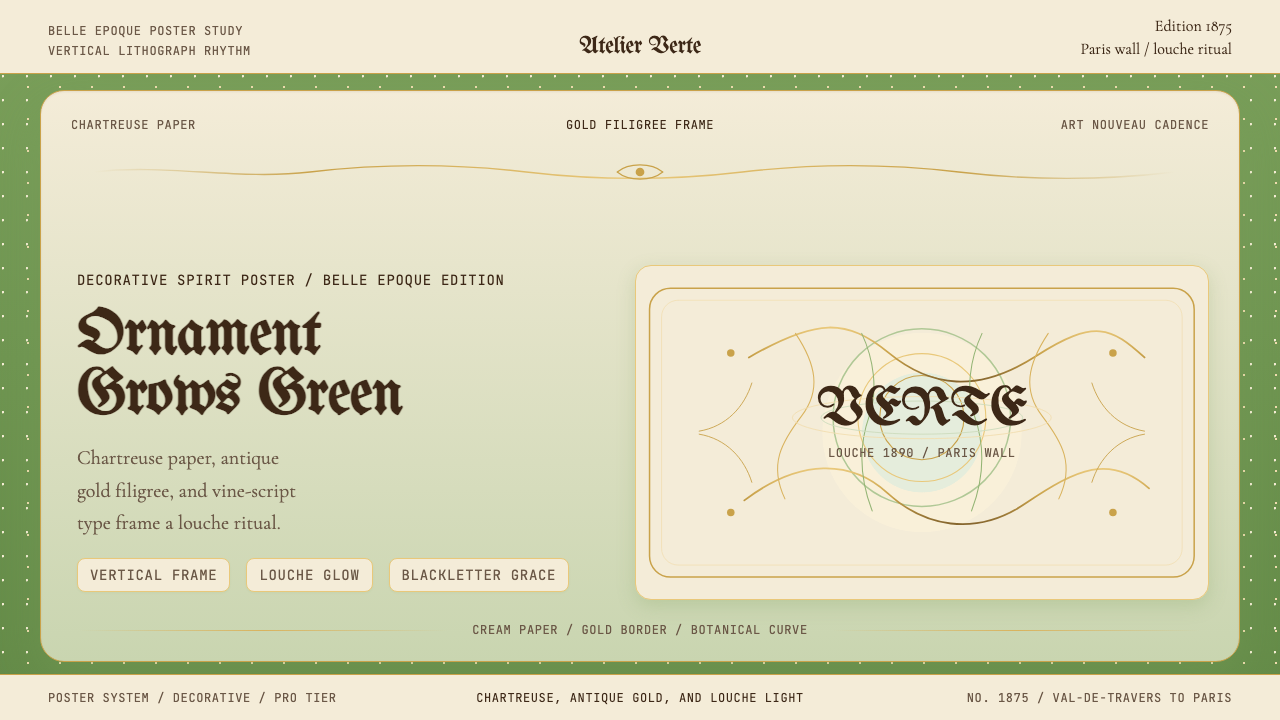 Absinthe Art Nouveau Green (1875)Ornate and verdant. Chartreuse field, gold filigree, vine-script type, and lo…
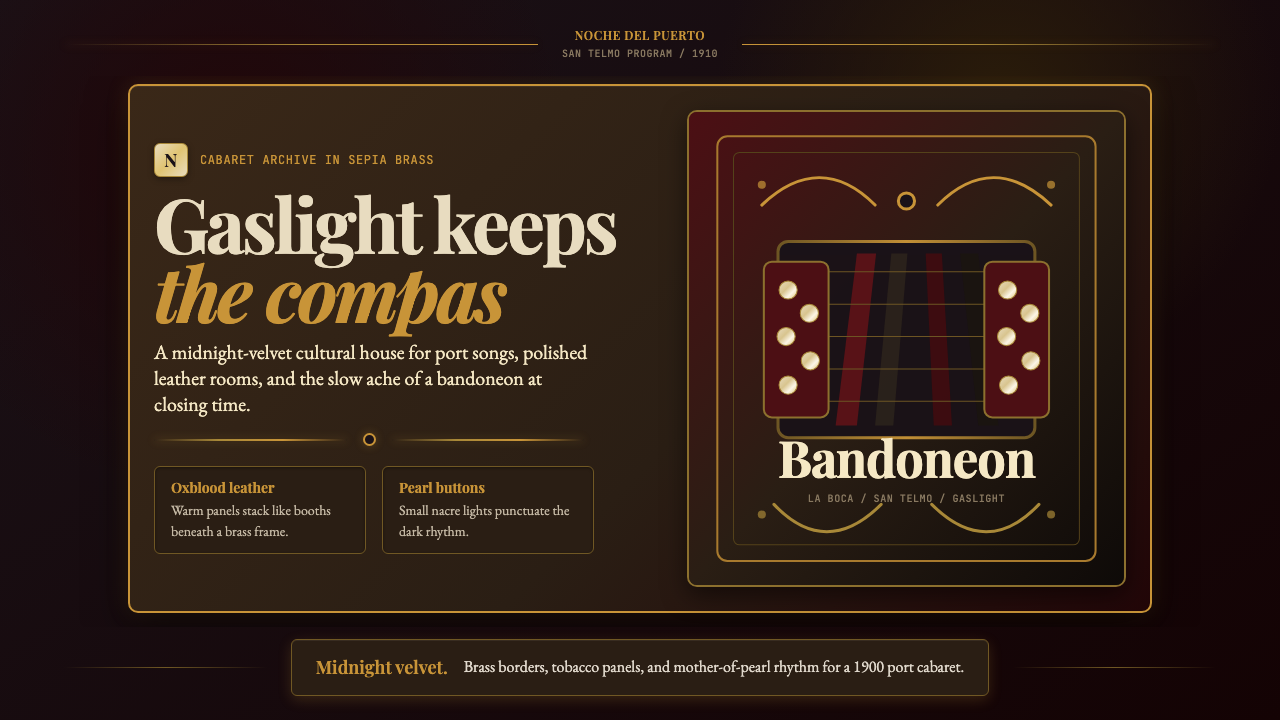 Argentine Bandoneón 1900 (Tango)Gaslit tango luxury. Midnight velvet, brass fileteado, and pearl-button geome…
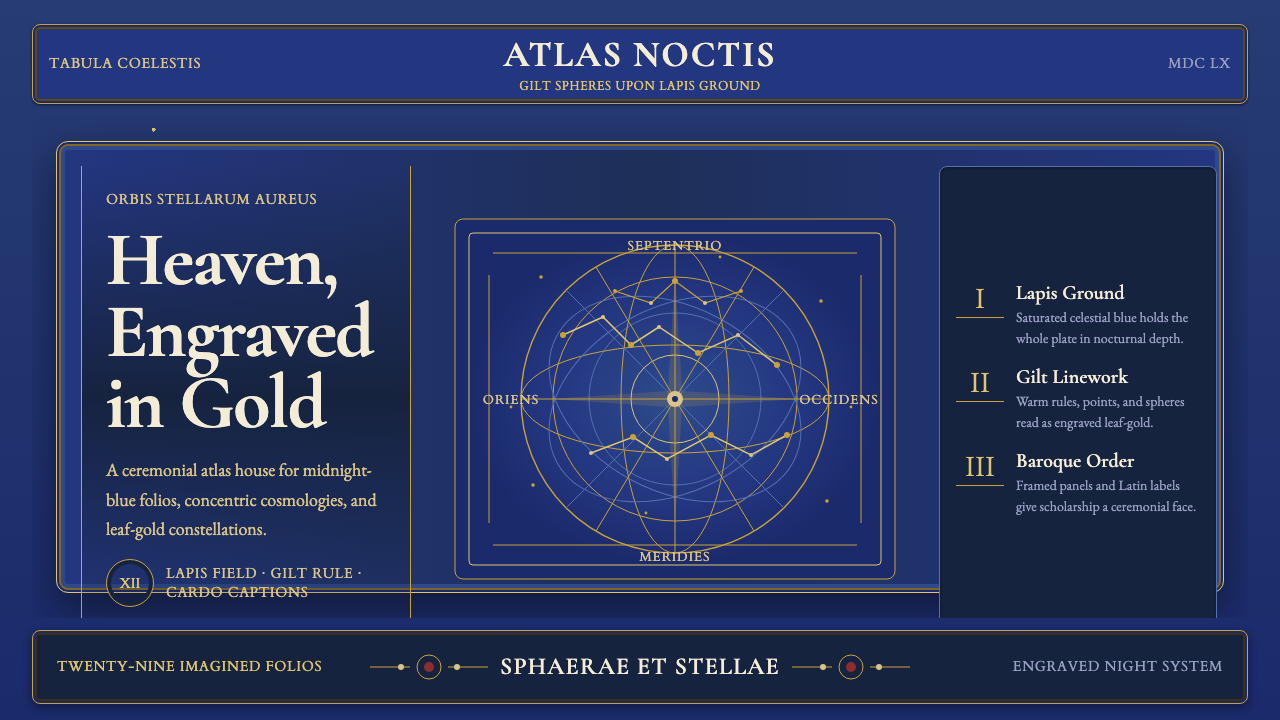 Cellarius Celestial AtlasCelestial luxury on lapis. Gilt serif type, star fields, and concentric chart…