What is Disney Classic (1937)?
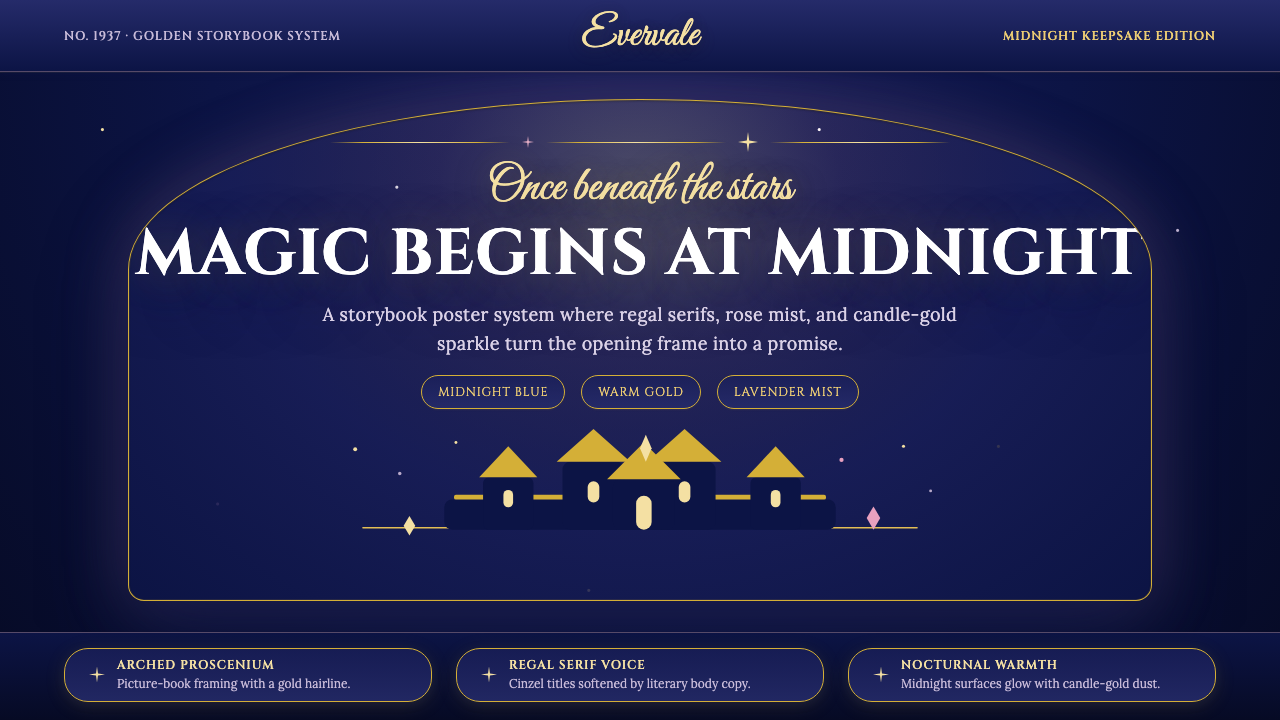
Disney Classic conjures fairy-tale wonder through a nocturnal palette of midnight blue, warm gold stardust, and regal hand-lettered script that has whispered "once upon a time" since Snow White debuted in 1937.
Disney Classic (1937) in brief
Disney Classic is the fairy-tale visual language that defined twentieth-century American animation — a system built on a midnight-blue sky, castle silhouettes, hand-lettered script arching across the frame, and a warm galaxy of golden stardust. It says "once upon a time" before a single word is read. Born with Snow White and the Seven Dwarfs in 1937, the aesthetic was consolidated through the Golden Age of Animation (1937–1942) and received its most celebrated renewal during the Disney Renaissance of the late 1980s and 1990s, which produced The Little Mermaid, Beauty and the Beast, Aladdin, and The Lion King.
The system is nocturnal but never cold. Its darkness is softened by candlelight and starlight — deep blue gives way to violet at the horizon, and every surface can carry a highlight or a sparkle. Regal serif letterforms pair with flowing scripts to produce a typographic voice that is simultaneously authoritative and enchanting. Arched shapes echo castle gateways; ornate flourishes are not waste but warmth. Where Bauhaus strips every surface to necessity, Disney Classic layers every surface with ornament that earns its place by deepening the emotional mood.
The style is fundamentally a storytelling system. Its visual cues are calibrated to signal transition — from the ordinary world to the magical — and its color contrasts, from deep shadows to radiant gold, create a sense of cinematic depth and theatrical lighting. It is well-suited to brands and experiences that want to lead with wonder, heritage, and sincere romance rather than rational argument.

Where does Disney Classic (1937) come from?
The Disney Classic visual language was forged at Walt Disney Studios in Burbank, California, during the production of Snow White and the Seven Dwarfs — the world's first feature-length cel-animated film, released on December 21, 1937. Walt Disney had spent years convincing skeptics — industry colleagues called the project "Disney's Folly" — that animation could sustain a full narrative arc with emotional depth. To succeed, his artists had to develop not just new storytelling techniques but an entirely new pictorial vocabulary: one that could make audiences forget they were watching drawings and lose themselves in a world that felt simultaneously fantastic and emotionally true.
The visual decisions made during Snow White's production established the core grammar. Night scenes were painted in layered indigos and blue-blacks, with golden window light cutting through the darkness to signal warmth and safety. The Evil Queen's castle was all hard angles and shadow; the dwarfs' cottage was warm amber and rounded edges. The opening title sequence introduced the hand-lettered, arching script — inspired by the illuminated manuscripts of European fairy-tale illustration tradition — that would become the studio's most recognizable typographic signature. Artists drew on the visual vocabulary of Arthur Rackham and Edmund Dulac, Victorian fairy-tale illustrators whose work blended decorative ornament with atmospheric darkness.
The Golden Age that followed (roughly 1937 to 1942, encompassing Pinocchio, Fantasia, Dumbo, and Bambi) deepened and codified the style. Mary Blair, who joined Disney in 1940 and would become one of the most influential visual artists in the studio's history, brought a more modern sense of color contrast and simplified shape to the studio's palette — her influence is visible in Cinderella (1950) and, most expansively, in the concept art for the "It's a Small World" attraction at Disneyland. Eyvind Earle, the background artist on Sleeping Beauty (1959), introduced a gothic-tapestry quality to the style, with elongated vertical forms, stylized foliage, and an intensity of blue-green contrast that gave the film a look unlike anything the studio had produced before.
The Disney Renaissance of 1989–1999 returned the studio to theatrical animated features after a difficult middle period and brought the classic visual vocabulary back to wide cultural attention. Films produced during this era — beginning with The Little Mermaid (1989) and peaking commercially and critically with The Lion King (1994) and The Hunchback of Notre Dame (1996) — updated the midnight-blue-and-gold palette for a new generation while preserving its core emotional logic: darkness as drama, gold as aspiration, ornate detail as enchantment. The studio's theatrical title cards, promotional materials, and theme park identity systems all drew from this refined vocabulary, establishing the Disney Classic look as a coherent and widely recognized visual brand system that has remained in continuous use and evolution since.
What defines the Disney Classic (1937) look?
Color Palette
The palette is anchored by a deep, nocturnal blue — the color of a clear sky just past dusk — which serves as both background canvas and emotional foundation. Against this darkness, warm gold appears as the primary accent: in stardust, in architectural gilding, in the radiant glow of magic. A soft lavender or lilac occupies a middle register, neither fully cool nor fully warm, providing tonal relief between sky and gold. These three hues — midnight blue, warm gold, and soft violet — form a triad that reads as simultaneously royal and enchanted. White and near-white appear as highlights and sparkle effects; very dark shadow tones deepen the sense of theatrical depth.
Typography
The typographic voice operates on a deliberate duality. Display text reaches for the hand-lettered: flowing, arching, with letterforms that feel individually drawn rather than mechanically set — evoking the title cards of classic fairy-tale books and illuminated manuscripts. Where the hand-lettered script carries wonder and magic, a companion regal serif provides gravitas and readability in secondary roles. The two voices are never in competition; they are the equivalent of a narrator's solemn opening sentence and the enchanted world it introduces. Gold letterforms on dark grounds, or cream letterforms with an inner glow, are characteristic treatments. Type is never crowded — generous spacing allows each word to breathe and carry weight.
Ornament and Flourish
Where Bauhaus treats every ornament as a moral failure, Disney Classic treats ornament as emotional vocabulary. Flourishes, star motifs, filigree borders, and arched frames are not decoration applied to content — they are the content's emotional wrapper, signaling that what lies within is precious and magical. Stars appear not merely as pictograms but as dynamic elements: they trail light, they scatter, they cluster around focal points to create a sense of wonder radiating outward. Architectural ornament — the pointed turret, the arched gateway, the sweeping staircase silhouette — functions as a stage set that places the viewer inside a story rather than in front of content.
Light and Depth
Disney Classic is above all a system of light drama. Objects glow from within; backgrounds recede through atmospheric haze; foreground elements are richly saturated while distance fades toward cooler, lighter tones. This atmospheric perspective — borrowed from nineteenth-century landscape painting and refined through the Disney multiplane camera technique — gives every composition a cinematic sense of scale and depth. Highlights are soft and luminous rather than hard and specular; shadows carry color (a deep blue or purple shadow reads as more enchanted than a neutral gray one). The overall effect is of being inside a lit scene rather than looking at a flat surface.
Shape Language
The dominant shapes are curved, arched, and pointed in equal measure — the soft arc of a castle turret, the gentle vault of a gateway, the sharp tip of a spire. Circles appear as magical halos or sparkle bursts; elongated ovals define faces and props in the classic character design tradition. Straight lines are used only when rigidity needs to be felt — the iron bars of a dungeon, the steps of a formal staircase — and they are almost always contrasted with organic curves nearby. This tension between angular drama and soft romance reflects the visual grammar of the fairy tale itself: danger expressed in sharp forms, safety and wonder in rounded ones.
Narrative Staging
Every composition in the Disney Classic style is implicitly a stage set — it has a foreground, a middle ground, and a background, and the viewer is given a specific position from which to witness the scene. Text is placed where a narrator would stand: above, centered, or in an arched band across the upper field, as if projected onto the sky. Focal points are marked by light and by convergent leading lines — a castle at the end of a bridge, a figure at the top of a staircase, a title beneath a burst of stars. The result is content that feels curated and presented rather than simply laid out.
Gold as Signal
Gold in the Disney Classic system functions less as a color and more as a semantic marker: wherever gold appears, something is magical, important, or aspirational. It marks the castle towers against the night sky, the spinning wheel's highlight, the fish scales of Ariel's tail, the enchanted rose's glow. In two-dimensional design applications, this logic translates directly: gold trim, gold text, gold stars, and gold dividers signal elevation and enchantment. Its warmth is specifically opposed to the blue-cool of the background — this contrast is the style's central emotional engine, repeatedly staging the relationship between the mysterious dark and the warm, radiant possibility within it.

Who shaped Disney Classic (1937)?
Walt Disney (1901–1966) was not a visual artist in the conventional sense — he could not draw at the level of his animators — but he was the creative and commercial force that brought the aesthetic into being. His insistence on emotional realism in animation, his willingness to invest profits from Mickey Mouse shorts into the production of Snow White, and his early development of the multiplane camera (which allowed animated scenes to convey depth and atmospheric perspective for the first time) established the foundational conditions for the Disney Classic visual language. His personal taste favored European fairy-tale illustration, Victorian theatrical staging, and the operatic storytelling of early cinema — all of which shaped the style's ornate, theatrical quality.
Mary Blair (1911–1978) is perhaps the most creatively radical artist to have worked within the Disney Classic idiom. Her concept art introduced bold, high-contrast color juxtapositions — unexpected pairings of warm and cool, or of saturated hue against near-neutral ground — that pushed the studio's palette beyond its naturalistic comfort zone. Her influence is most visible in Cinderella (1950) and in the attraction design for "It's a Small World" (1964), where her signature style of simplified, pattern-rich, theatrically colored imagery achieved its purest expression. Blair proved that the Disney visual system could accommodate strong individual artistic vision without losing its essential warmth and accessibility.
Eyvind Earle (1916–2000) served as the primary background artist and color stylist on Sleeping Beauty (1959), for which he developed a visual approach unlike anything the studio had previously produced: elongated Gothic forms, stylized natural patterns drawn from medieval tapestry and Persian miniature painting, and an intense, jewel-toned color palette in which blue-greens, deep teals, and saturated violets dominated. His work on the film represents the Disney Classic palette at its most painterly and ornate, and it remains one of the most distinctive visual achievements in the history of animation. Earle's approach influenced subsequent generations of animation background artists and concept designers.
Walt Disney's informal name for his core group of animators — among them Frank Thomas, Ollie Johnston, Marc Davis, and Milt Kahl — the Nine Old Men were responsible for refining and sustaining the Disney Classic visual language across the studio's most productive decades. They developed the principles of character animation (squash and stretch, anticipation, follow-through) that gave Disney characters their distinctive warmth and believability, and their work on the classic fairy-tale features established the emotional register — sympathetic, earnest, capable of genuine pathos — that distinguishes the Disney style from every imitation. Their collaborative approach produced a consistency of visual quality that no single artist could have sustained alone.
Howard Ashman (1950–1991) was not a visual artist but a lyricist and theatrical producer whose creative partnership with composer Alan Menken during the Disney Renaissance (The Little Mermaid, Beauty and the Beast, Aladdin) shaped the visual direction of those films as profoundly as any painter. Ashman brought a Broadway musical sensibility to Disney storytelling, insisting that each film's visual environment should serve the emotional arc of the songs — that the palette of an underwater kingdom, a provincial French town, or a magical palace should be calibrated to the emotional temperature of the music. His influence made the Renaissance films the most visually and emotionally integrated expressions of the Disney Classic aesthetic.
How do you use Disney Classic (1937) today?
Disney Classic is one of the most emotionally specific styles available to a designer, which means its power is directly proportional to the alignment between the style's values and the product's values. Applied correctly, it transports the viewer into a frame of mind where wonder, trust, and sincere feeling are natural — where the brand feels like a narrator that is on the viewer's side and has something genuinely magical to share. Applied incorrectly or to an incompatible product, it reads as nostalgic kitsch or, worse, as a brand cynically borrowing emotional equity it has not earned. Before applying the style, ask: does this product genuinely offer an experience that deserves to be called enchanting? If the answer is yes, the style becomes a powerful amplifier. If the answer is uncertain, a subtler reference may serve better.
For presentation slides, the Disney Classic system works most effectively when the visual hierarchy is treated as cinematic staging. Cover slides should be composed like a title card: a deep, night-sky field, with the presentation title in hand-lettered or regal serif treatment centered in the upper or middle register, and a flourish of stars or a delicate architectural silhouette anchoring the bottom. The goal is to make the viewer feel they are about to be told a story, not shown a deck. Content slides require more restraint: the dark background can be lightened to a very deep navy or even a rich dark neutral, with body text in cream or soft white. Section dividers work well as arched gold banners or ruled lines with star terminals. Avoid crowding — in this style, generous negative space reads as enchantment rather than emptiness.
For web interfaces and dashboards, Disney Classic is less universally applicable than a system like Bauhaus or Stripe, but it is extremely effective in the right contexts: entertainment platforms, cultural institutions (museums, opera companies, performing arts centers), premium hospitality and travel brands, and children's educational products aimed at parents as much as children. In these contexts, a dark-field UI with gold accent states, generous typography in a regal serif for headers and a clean humanist typeface for body, and subtle star or sparkle micro-interactions creates an experience that feels premium and emotionally resonant. Pricing and conversion pages within such a system should preserve the warmth of the palette while introducing enough contrast and clarity that the decision hierarchy is unambiguous — gold call-to-action elements against a deep background work particularly well.
For editorial and marketing work, the style excels at storytelling-forward formats: brand origin stories, campaign launches for entertainment or cultural events, annual reports for foundations or arts organizations, and high-end product launches where heritage and craft are key messages. A full-bleed midnight-blue cover with a single gold-lit architectural element and a centered title in flowing script sets an unmistakable tone. Interior spreads can alternate between dark and lighter grounds — a very deep navy body-copy page paired with a cream pull-quote page — to create visual rhythm without abandoning the palette. Gold drop caps, star-motif section breaks, and subtle luminous borders are all characteristic details that, used with discipline, reinforce the style without tipping into pastiche.
The most common mistake when applying Disney Classic is confusing ornament with excess. The style requires decoration, but every decorative element must serve the emotional narrative — stars cluster where attention should peak, flourishes mark openings and closings, gold appears where something is being elevated in importance. Indiscriminate application of all available motifs simultaneously — stars everywhere, gold borders on every panel, script text for all levels of hierarchy — produces a result that reads as theme-park merchandise rather than the considered visual storytelling that defines the style at its best. A second common mistake is ignoring the darkness: the style depends on its deep nocturnal ground for its emotional power, and attempts to apply it on white or light backgrounds strip the magic from the gold, leaving only the ornament.

Disney Classic (1937) — FAQ
When is Disney Classic appropriate versus too niche?
Disney Classic is appropriate when the product's core promise is experiential, aspirational, or emotionally resonant in a warm, celebratory way — think entertainment platforms, cultural events, premium hospitality, heritage brands, and creative services that want to signal craft and magic. It is too niche when the product's value is primarily rational, utilitarian, or data-driven: a B2B SaaS dashboard, a medical information platform, or a financial analytics tool would all suffer from the style's ornate, theatrical quality. The test is simple: would a real fairy tale be a useful metaphor for how this product makes the user feel? If yes, the style is a candidate.
Can Disney Classic work on a light or white background?
Technically yes, practically with significant loss. The style's emotional power is generated by the contrast between the deep nocturnal ground and the warm golden light within it — this contrast is the style's central metaphor, the visual equivalent of a lit window in the dark. On a white or light background, gold accent colors lose their luminosity and read as yellow rather than radiant; star motifs appear flat rather than glowing; and the overall mood shifts from enchanted to merely decorative. If a light-background variant is needed (for a printed piece or a web section that must be accessible), the recommended approach is to introduce a rich cream or warm ivory ground rather than true white, and to use deep navy as a secondary ground for key panels, preserving the essential contrast in at least the most important zones of the layout.
How do I avoid the style looking like generic theme-park decoration?
The difference between authentic application and pastiche is editorial discipline. Generic theme-park decoration uses every motif simultaneously at maximum intensity: all stars, all gold, all script, all flourishes, at all times. Authentic Disney Classic design uses restraint to create hierarchy — a single prominent star cluster on a key focal point, gold reserved for elements that are genuinely being elevated, script only for titles and moments of special weight. The nocturnal blue must genuinely dominate; ornament should appear to emerge from the background rather than being applied on top of it. Study the studio's actual theatrical title cards and poster art from the Renaissance era rather than merchandise: they are models of how much space to leave, where to concentrate ornament, and how few elements are actually needed to achieve the full effect.
How does Disney Classic relate to other ornate historical styles, like Art Nouveau or Art Deco?
All three are ornate and historically rooted, but they differ fundamentally in source and intent. Art Nouveau (roughly 1890–1910) draws its ornament from biological forms — tendrils, petals, the sinuous curves of natural growth — and is associated with craftsmanship, material richness, and the aestheticization of everyday objects. Art Deco (roughly 1920–1940) is geometric and streamlined: its ornament is industrially derived, its palette metallic and cool, its mood sophisticated and urban. Disney Classic draws from neither of these directly; its roots are in the European fairy-tale illustration tradition (Rackham, Dulac, the Brothers Grimm visual culture) and in the theatrical staging conventions of Victorian and Edwardian popular entertainment. Its ornament is narrative rather than structural or industrial: it exists to tell a story about enchantment, not to demonstrate craft or signal modernity.
Is Disney Classic always associated with children's content, or can it work for adult audiences?
The style's strongest historical expressions — the Renaissance films, the theatrical poster art, the theme park environmental design — were aimed at family audiences in which adults were as central as children. The style works for adult audiences when it is applied with sophistication rather than nostalgia: a high-end event invitation, a luxury travel brand, a cultural institution's gala materials, or an entertainment platform's premium tier all represent adult contexts where the style's warmth, drama, and sense of occasion are assets rather than liabilities. The key distinction is between applying the style to make something feel childlike (a mistake) and applying it to make something feel genuinely enchanted (the intended effect). The former uses all the style's most obvious motifs; the latter uses them with the restraint and intentionality that distinguish design from decoration.
Related design styles
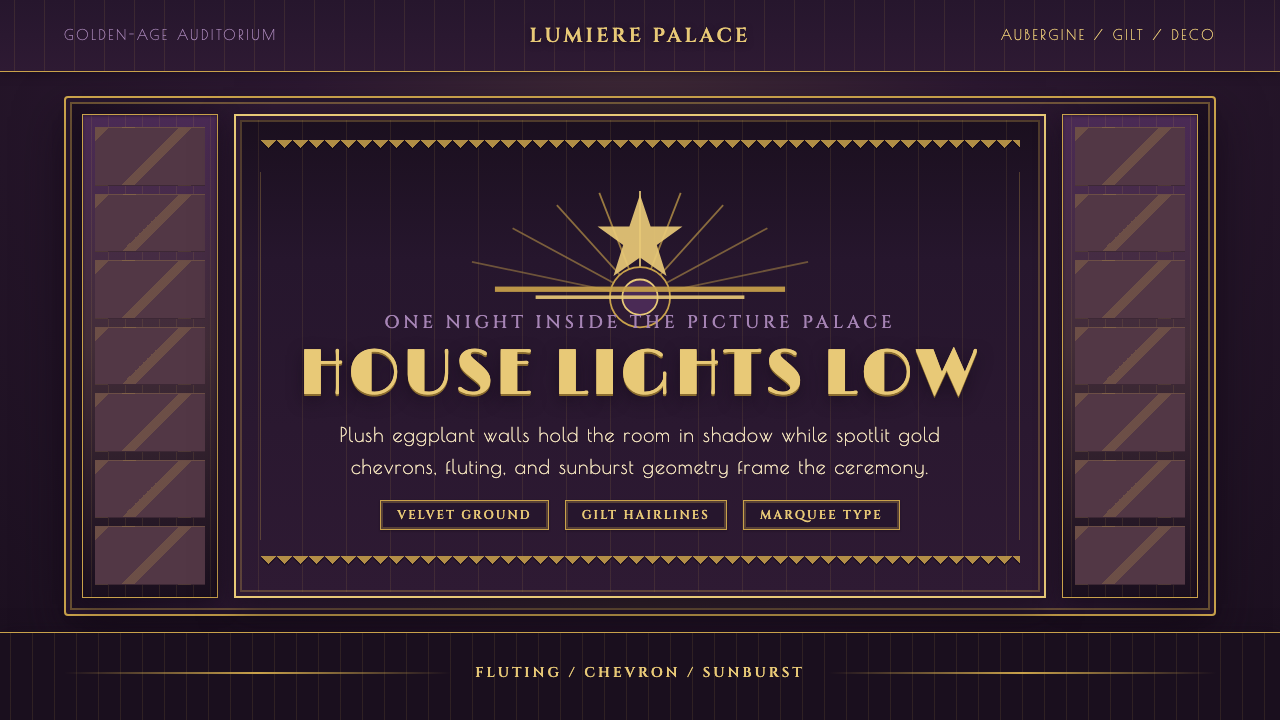 Velvet Cinema DecoDark theater opulence. Aubergine velvet and gilt Deco geometry stage every su…
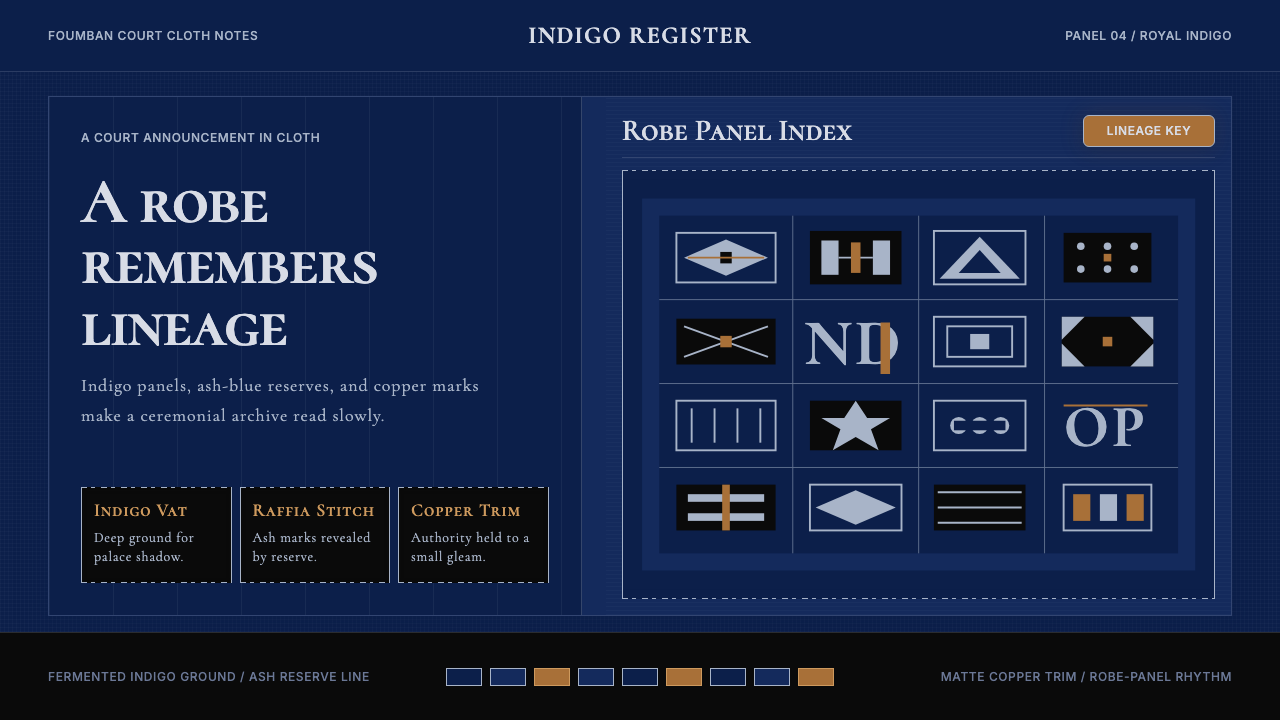 Cameroonian Ndop Royal IndigoReads like court cloth. Indigo panels, ash stitch grids, and matte copper kee…
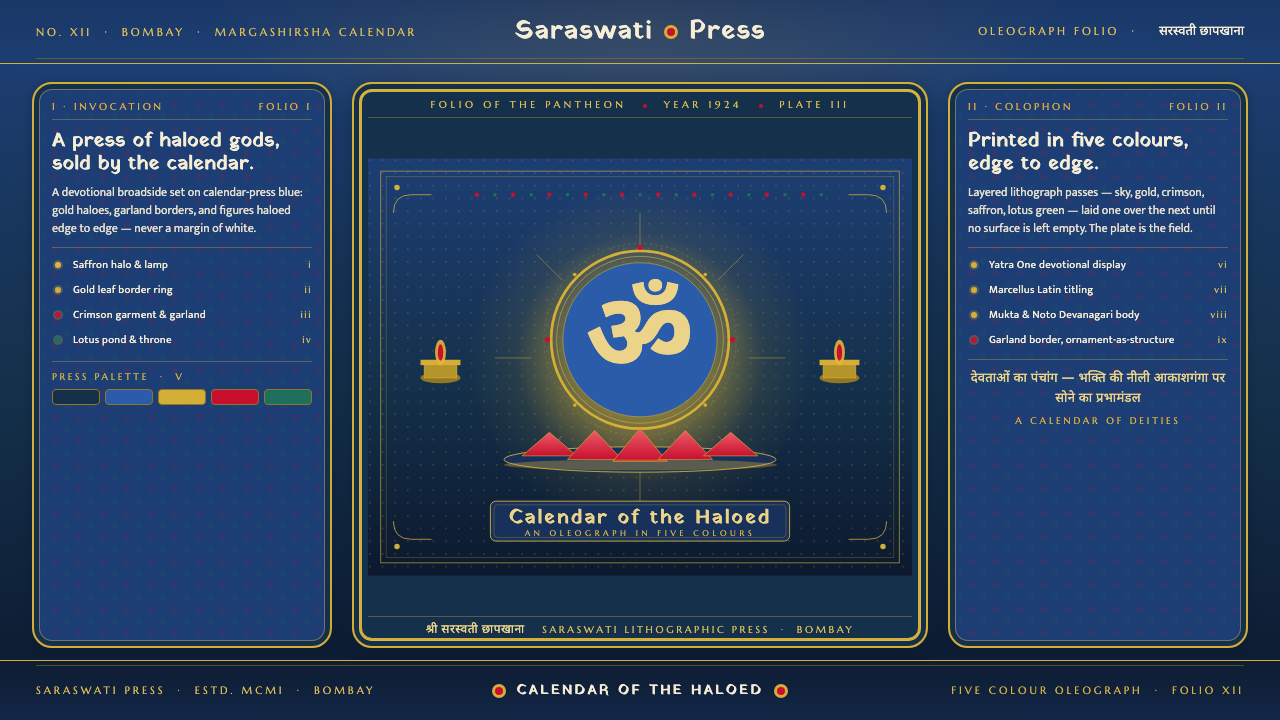 Hindu Pantheon Bazaar PrintDevotional calendar art, edge to edge. Gold halos and garland borders on baza…
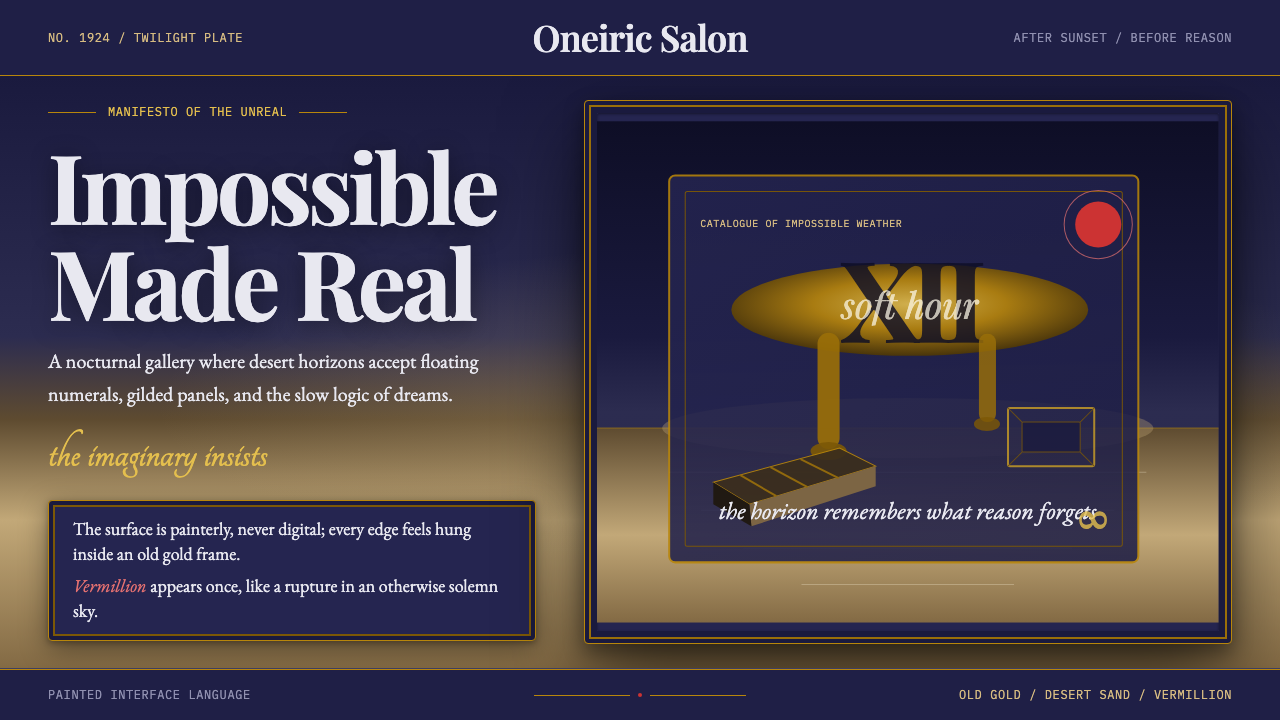 Surrealism (Dalí / Magritte)Impossible feels real. Twilight blue, old gold frames, and serif type stage d…
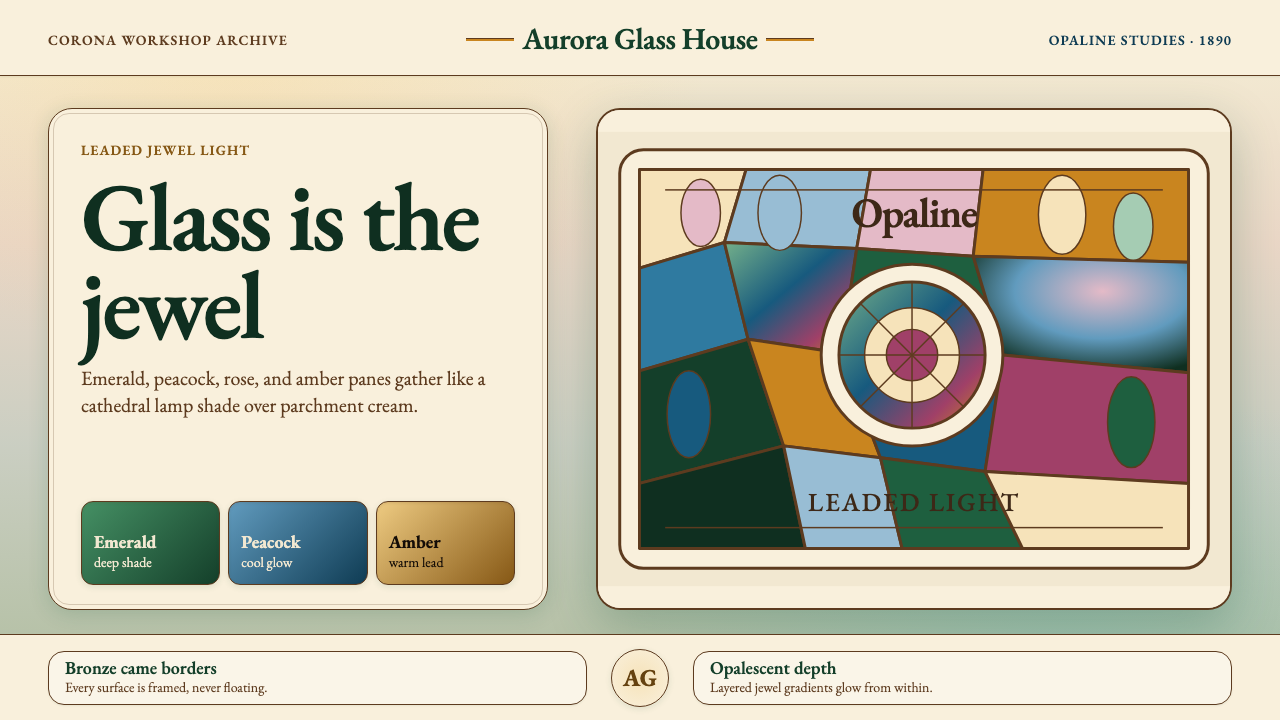 Tiffany Stained GlassJewel light, framed in bronze. Emerald and peacock panes glow on parchment cr…
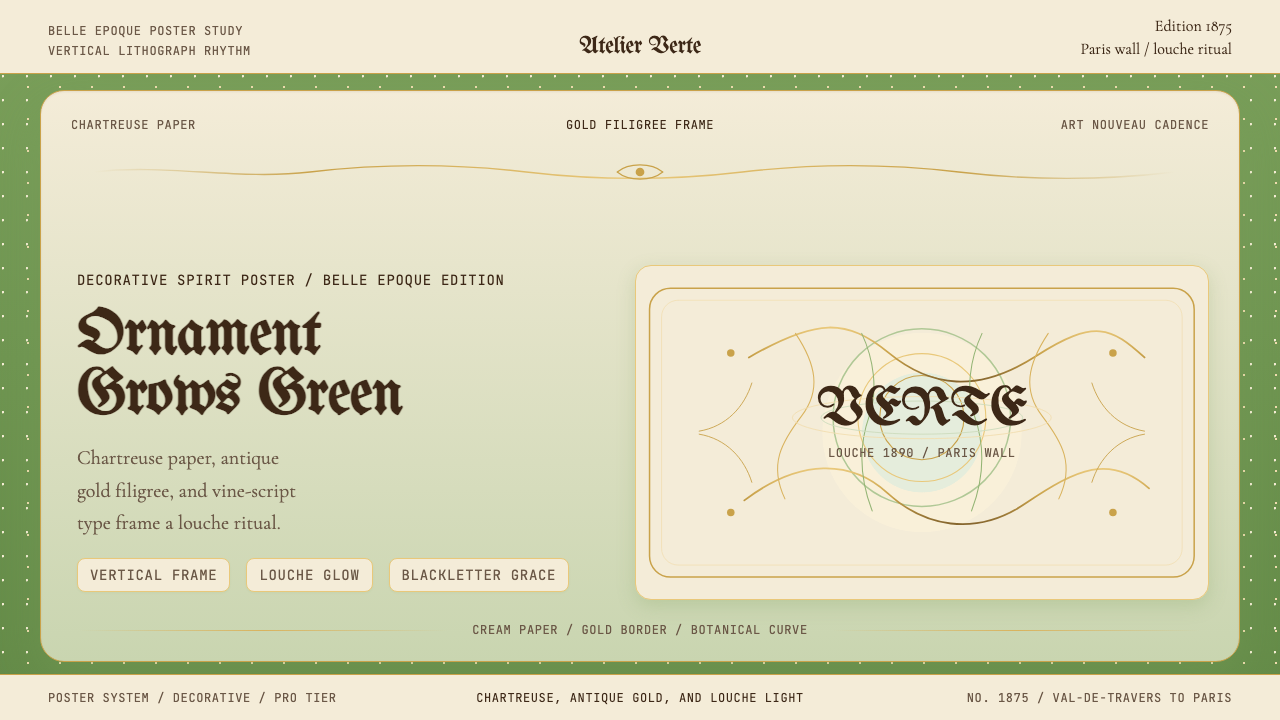 Absinthe Art Nouveau Green (1875)Ornate and verdant. Chartreuse field, gold filigree, vine-script type, and lo…