What is Zoroastrian Fire Temple?
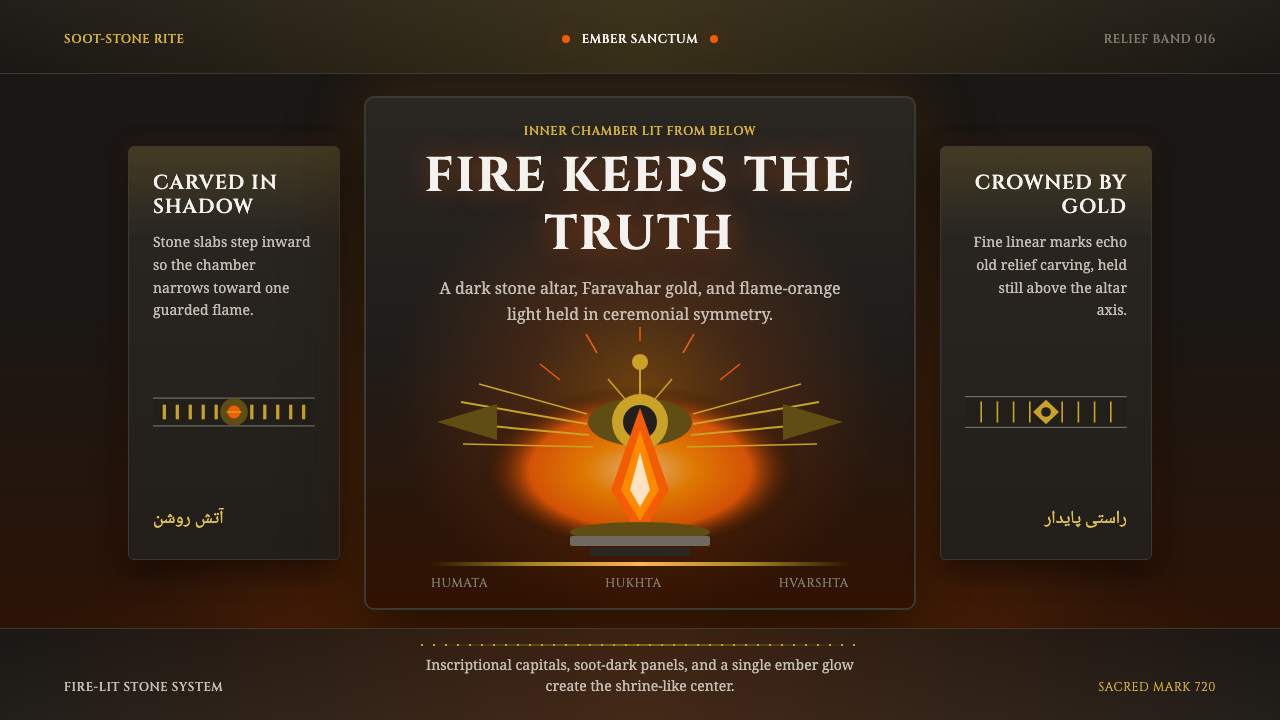
In a Zoroastrian fire temple, everything recedes into stone darkness so that a single flame — kept burning for centuries — can be the only thing that speaks.
Zoroastrian Fire Temple in brief
Zoroastrian Fire Temple is a design system built around the visual experience of an eternal flame kept alive in stone darkness — the sacred fires maintained inside the inner sanctums of Zoroastrian fire temples for centuries, sometimes for well over a thousand years without interruption. Warm flame-orange burns against soot-dark sanctum walls, while the winged Faravahar, the ancient emblem of Zoroastrian Persia, presides above the altar in carved, symmetrical relief.
The style's central discipline is one of radical subordination: almost everything in the composition exists to make the flame the only source of light and attention. Inscriptional serif capitals carry the gravity of stone carving rather than the lightness of print; ornament is reduced to precise, repeated geometric bands rather than free decoration; and color outside the flame itself stays deliberately muted, dark, and stone-like, so nothing competes with the one element that is meant to glow.
This produces a visual language of reverence and restraint rather than spectacle. Unlike design systems built around abundance or ornament, Zoroastrian Fire Temple achieves its effect through subtraction — the less that surrounds the flame, the more powerfully it reads, exactly as a sacred fire kept in a darkened inner chamber commands more attention than one lit in open daylight.

Where does Zoroastrian Fire Temple come from?
Zoroastrianism is among the oldest continuously practiced religions in the world, tracing its origin to the teachings of the prophet Zarathustra, whose exact dates are debated among scholars but who is generally placed somewhere in the second millennium BCE in the eastern Iranian world. Central to Zoroastrian theology is the veneration of fire as a physical symbol of Ahura Mazda's truth and light, purity maintained through ritual care rather than fire as an object of worship in itself — a distinction Zoroastrian scholars have long emphasized against the common Western misconception that adherents 'worship fire.'
The Achaemenid Persian Empire, founded by Cyrus the Great in the sixth century BCE and reaching its height under Darius I and Xerxes I, was the first great political power closely associated with Zoroastrian religious practice, though the precise relationship between the imperial court and formal Zoroastrian doctrine remains a subject of ongoing historical debate. Achaemenid relief art — the carved stone friezes and processional reliefs found at sites like Persepolis — established a visual vocabulary of formal, symmetrical, carved figures arranged in disciplined registers that would echo through later Persian and Zoroastrian visual culture for centuries.
The Faravahar, the winged disc-and-figure emblem now closely associated with Zoroastrianism and with Iranian national identity more broadly, appears throughout Achaemenid monumental carving, most famously at Persepolis, though its precise original religious meaning is debated among scholars — some read it as a symbol of royal glory (khvarenah) rather than a specifically Zoroastrian religious icon in its earliest usage. Over subsequent centuries it became firmly established as a symbol of the faith and of Persian identity, typically rendered in carved stone relief with strict left-right symmetry.
The specific architectural tradition of the Atash Behram — the highest grade of Zoroastrian sacred fire, requiring an elaborate consecration ritual combining fires from multiple sources — survives today most prominently at temples in Yazd, Iran, a city whose desert isolation helped it remain a center of Zoroastrian practice even as the religion's numbers dwindled following the Arab conquest of Persia in the seventh century CE. Many Zoroastrians emigrated from Persia to Gujarat in western India beginning around the tenth century CE, becoming the community known as the Parsis, who established their own fire temples, called agiaries, particularly concentrated in and around Mumbai, where some of the oldest continuously burning sacred fires outside Iran are maintained today.
What defines the Zoroastrian Fire Temple look?
Soot-Dark Sanctum Walls
The ground is a dark, stone-like tone with a subtle sooted quality, as if the walls themselves have absorbed centuries of smoke from the sacred fire they surround. This ground should feel material and weighty rather than flat or purely digital, evoking the interior of a genuine stone sanctum.
Flame Orange as Focal Light
Warm flame-orange is reserved almost exclusively for the fire itself or elements directly associated with it — an altar glow, a highlighted symbol. This color should never spread broadly across a composition; its entire meaning depends on appearing scarce and central, the single source of light in an otherwise dark space.
Faravahar Symmetry
Any emblematic or symbolic element in the composition should follow strict left-right symmetry, echoing the carved winged Faravahar figure and the broader tradition of Achaemenid relief symmetry. Asymmetric, casual arrangements undercut the sense of formal, ceremonial gravity the style depends on.
Inscriptional Serif Capitals
Typography draws on the gravity of carved stone inscription rather than the lightness of print — serif capital letterforms with a monumental, chiseled quality, evoking text carved permanently into rock rather than printed on a page that could be discarded.
Carved Relief Bands
Ornament, where it appears, takes the form of precise, repeated geometric bands echoing Achaemenid processional relief friezes rather than free-form decoration. These bands should feel disciplined and rhythmic, like rows of carved figures marching in formation, not decorative flourishes added for visual interest.
Radial Glow
Where the flame or its light is rendered, it should radiate outward in a soft, diminishing glow against the dark sanctum ground, echoing the way firelight actually behaves in a darkened inner chamber — bright at its source, fading quickly into surrounding shadow rather than illuminating the whole space evenly.
Everything Else Recedes
Beyond the flame, its symmetrical emblem, and the inscriptional type, every other element in the composition — background texture, secondary detail, supporting content — should stay muted and dark, deliberately receding into shadow. This subordination is the style's governing principle: nothing may compete with the flame for visual primacy.

Who shaped Zoroastrian Fire Temple?
The prophet whose teachings form the foundation of Zoroastrianism, traditionally credited with articulating the faith's core theology, including the veneration of fire as a symbol of divine truth and light. His precise historical dates remain debated among scholars, but his teachings shaped a religious and visual tradition that has persisted for millennia.
The first great Persian imperial dynasty, founded by Cyrus the Great and reaching its height under Darius I and Xerxes I, closely associated in later tradition with Zoroastrian practice. Its monumental relief art at sites like Persepolis established the disciplined, symmetrical visual vocabulary — including the winged Faravahar emblem — that continues to define Zoroastrian visual culture.
The high priests of the Parsi Zoroastrian community in India, responsible for maintaining the ritual purity and continuous care of sacred fires in agiaries across Gujarat and Mumbai. Their centuries of unbroken ritual practice have preserved fire temple traditions that might otherwise have been lost following the decline of Zoroastrian numbers in Iran.
How do you use Zoroastrian Fire Temple today?
On presentation slide covers, the style creates an immediate sense of gravity and focus: a dark, stone-toned field, a single warm-glowing focal element positioned centrally, and inscriptional serif type used sparingly for the title. Content slides should keep the dark ground dominant, using flame-orange only for the single most important highlighted figure or callout on any given slide, with everything else — body text, secondary charts — rendered in muted, recessive tones.
For web interfaces, this style suits products that want to project heritage, trust, and quiet authority rather than energy or excitement — premium or luxury brands, cultural and heritage institutions, meditation or wellness products seeking a contemplative register. Dashboards should use the radial-glow treatment sparingly, reserved for a single primary metric or status indicator, since the entire visual logic depends on scarcity of light.
In pricing pages, the symmetrical Faravahar-style emblem treatment can be adapted to frame a single recommended tier with formal, ceremonial weight, while flame-orange marks only the most important price point or call-to-action button, letting the surrounding tiers recede into the darker, quieter palette.
For editorial and marketing content about heritage, permanence, tradition, or quiet luxury, full-bleed hero sections work well built from the dark sanctum ground with a single centered glowing focal point and formal, symmetrical framing, echoing the experience of standing before an altar in a darkened inner chamber.
The most common mistake is treating flame-orange as a general accent color and using it liberally throughout a layout — on multiple headlines, buttons, or decorative elements simultaneously — which destroys the sense of a single sacred, hard-won point of light. A second frequent error is over-decorating the composition with excessive ornament; the style's power comes specifically from restraint and subtraction, and adding decorative flourishes beyond the disciplined relief-band vocabulary undermines its ceremonial gravity.

Zoroastrian Fire Temple — FAQ
Do Zoroastrians actually worship fire?
No, and this is a common misconception. Fire in Zoroastrian practice is venerated as a physical symbol of Ahura Mazda's truth, light, and purity — a focal point for prayer and ritual, maintained with great ceremonial care — rather than being an object of worship in itself. Zoroastrian scholars and practitioners have long emphasized this distinction against the popular but inaccurate characterization of the faith as 'fire worship.'
How dark should the sanctum ground actually be — could it work as a mid-tone gray instead of near-black?
The near-black quality is essential to the style's core logic: the darker the surrounding ground, the more powerfully a scarce point of warm light reads by contrast, echoing how a sacred fire in a genuinely darkened inner chamber commands more visual and emotional weight than one in an evenly lit room. A mid-tone gray ground flattens this contrast and weakens the sense of a flame that has to earn its light against real darkness.
Is the Faravahar emblem exclusively a Zoroastrian religious symbol?
Its earliest meaning in Achaemenid carving is debated among scholars, with some interpreting it as a symbol of royal glory rather than a strictly religious icon. Over the following centuries, however, it became firmly associated with Zoroastrianism specifically and with Iranian cultural identity more broadly, and it is this later, widely recognized association that the design style draws from.
Can this style be applied to non-religious, secular products?
Yes — the transferable value is the underlying visual logic of scarcity and reverence, not the specific religious content. Any product wanting to communicate permanence, quiet authority, or a single point of focused importance against a receding, dark field can borrow this structural principle, provided the specifically sacred symbolism (the Faravahar, altar imagery) is either omitted or handled with appropriate cultural sensitivity.
What is the difference between the Atash Behram fires in Yazd and the Parsi agiaries in Mumbai?
Atash Behram is the highest of the three grades of Zoroastrian sacred fire, requiring an elaborate consecration ritual combining fires gathered from multiple sources, and is found in a small number of temples, notably in Yazd, Iran. Agiary is the general term used within the Parsi community in India for a fire temple, which may house fire of a lower consecration grade. Both traditions share the same underlying visual and ritual language of a flame maintained in a protected inner sanctum, which is what this design style draws from broadly rather than depicting one specific temple.
Related design styles
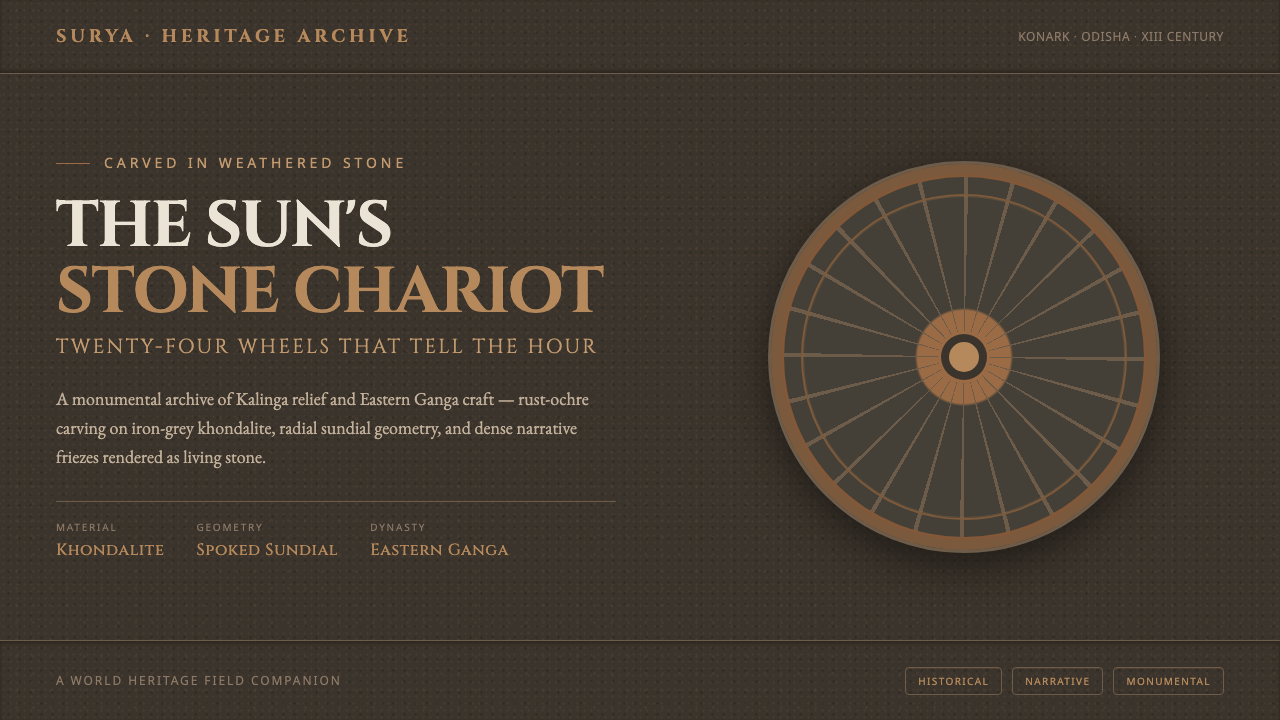 Konark Sun Temple WheelHeavy as carved stone. Rust-ochre sundial wheels and Cinzel inscription on ir…
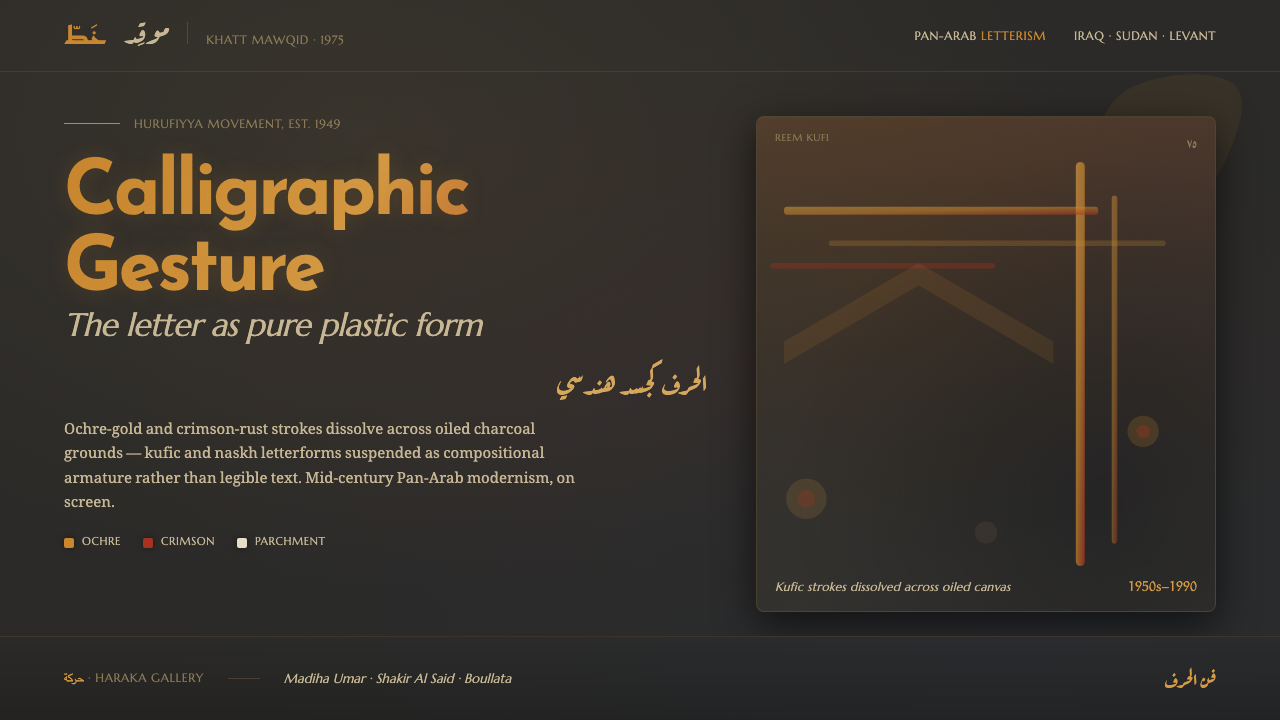 Hurufiyya Letter ArtArabic letters as pure gesture. Ochre and crimson strokes dissolve across oil…
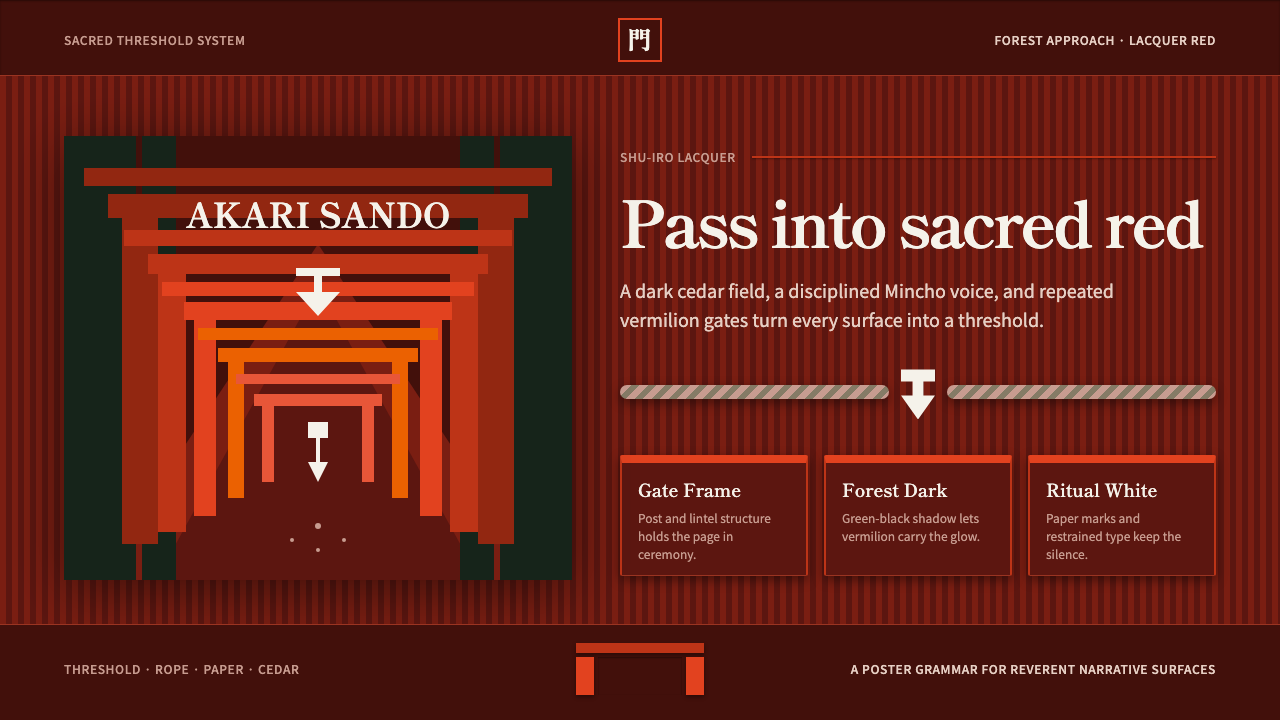 Shinto ToriiSacred red holds the dark. Vermilion gates, Mincho type, and shide white fram…
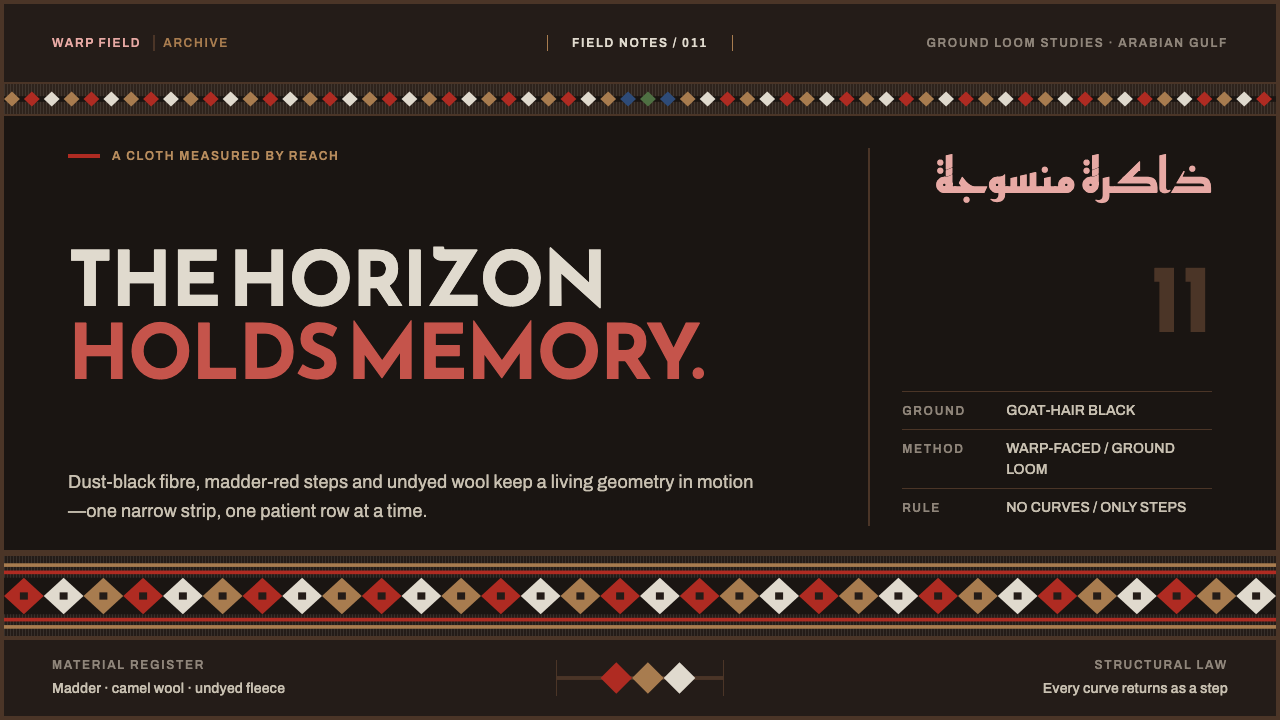 Emirati Sadu WeavingMemory runs in bands. Madder steps cross dusty goat-hair black with no curve…
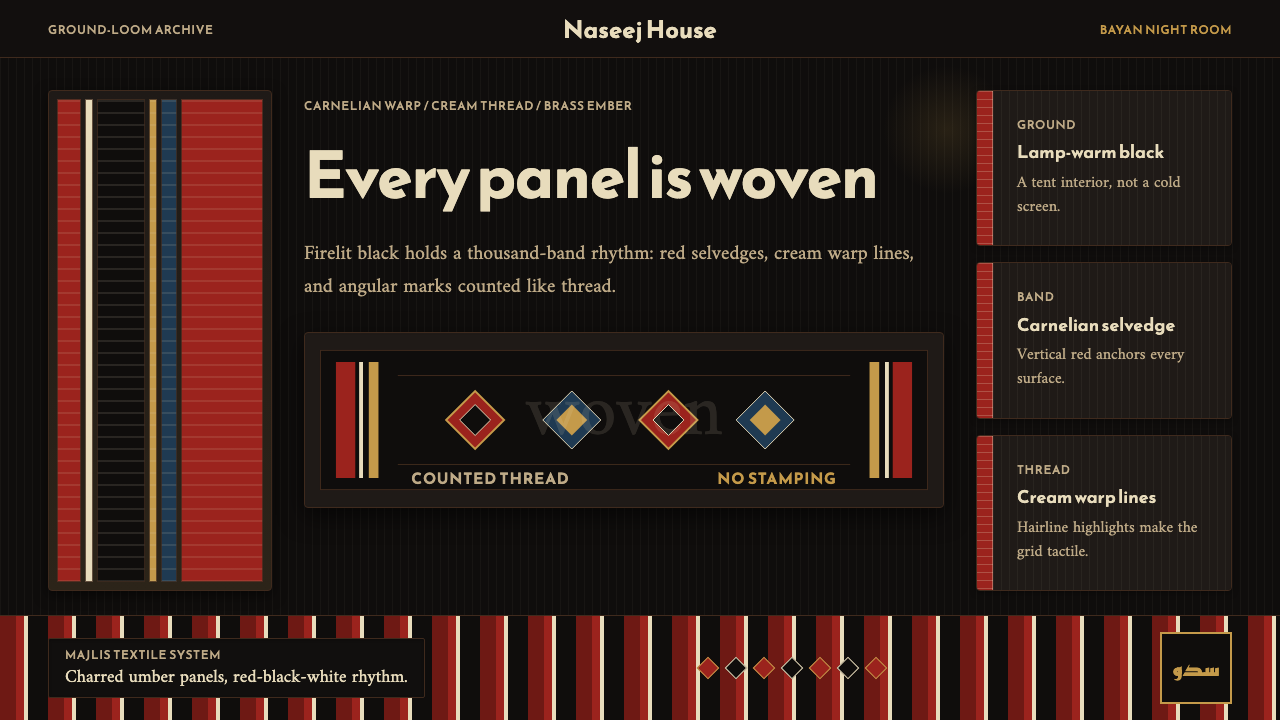 Kuwaiti Sadu Bedouin WeaveFirelit craft, not dark mode. Carnelian bands and cream warp lines make each…
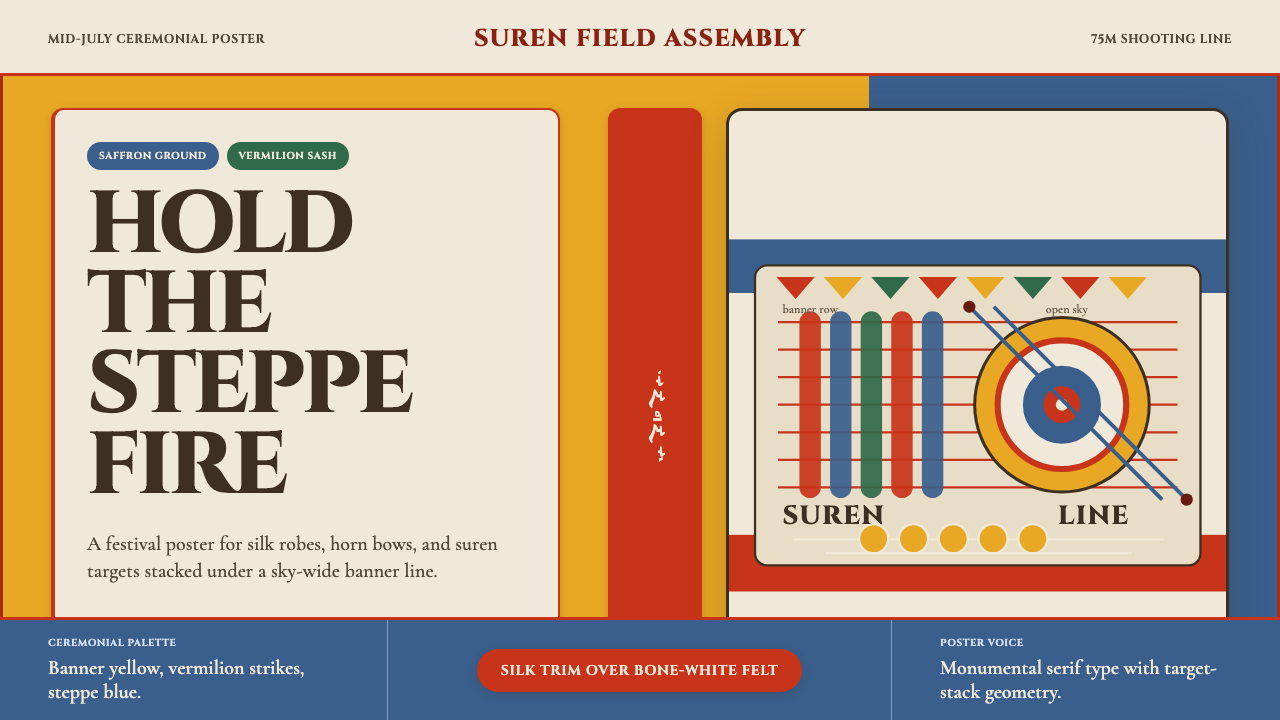 Mongolian Naadam ArcheryFestival heat at full draw. Saffron ground, vermilion trim, suren circles.