What is Yoruba Aso Oke?
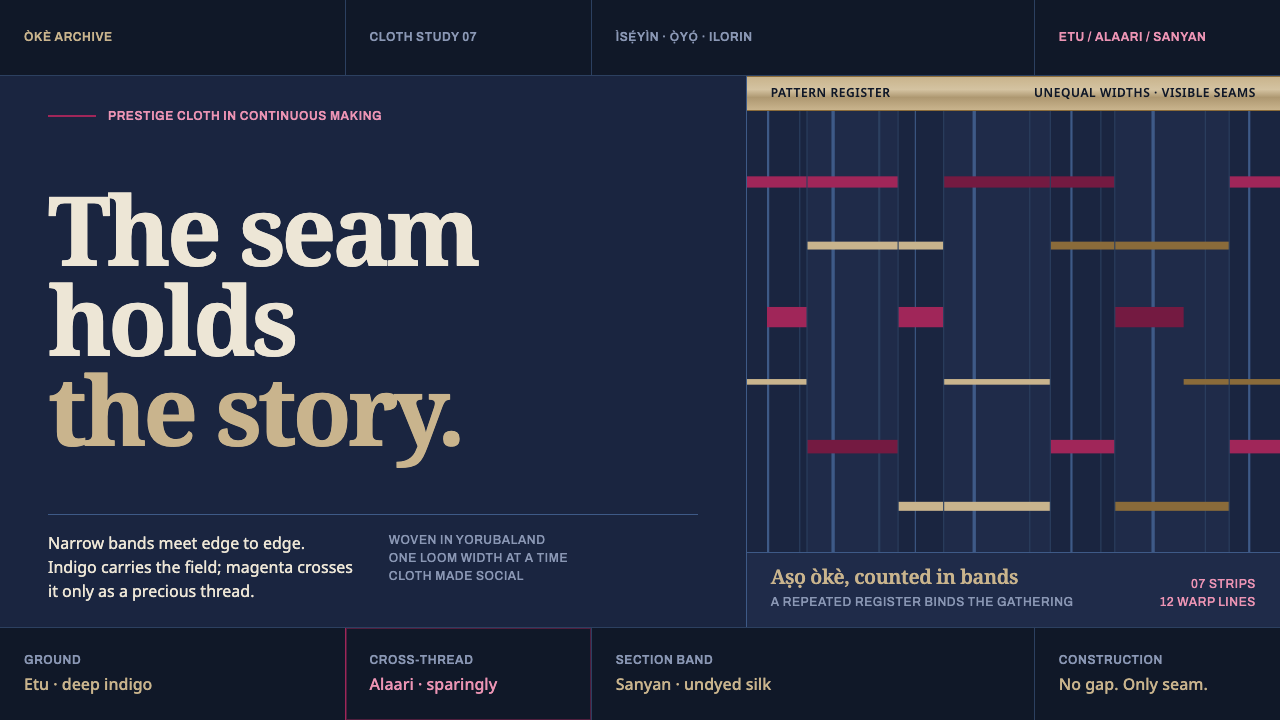
Yoruba Aso Oke builds a layout the way a weaver builds a cloth — narrow strips of unequal width joined edge to edge, the seam left visible, with near-black indigo as the ground and magenta allowed in only as stripe and brocade.
Yoruba Aso Oke in brief
Yoruba Aso Oke is a design language drawn from the hand-woven ceremonial cloth of the Yoruba people of south-west Nigeria. The cloth is woven in long, narrow strips on a horizontal loom, and the strips are then sewn side by side into a robe, a wrapper or a headtie. The name aso oke is usually glossed as 'top cloth', the cloth worn when an occasion demands the best.
The design system takes its logic directly from that construction. Every layout is a set of unequal narrow columns butted together, with the seam between them kept in view rather than hidden. There are no gaps between panels, no floating cards, no drop shadows and no round pill buttons; separation is a seam, and rhythm comes from stripes. The page is built the way the cloth is built, which makes the structure honest and easy to read.
The look is dark, dense and quietly rich. A near-black indigo ground is broken by hairline pale-blue lines, sanyan beige carries the section bands, and magenta alaari appears sparingly as stripe or woven brocade. The overall effect is of a textile you could unroll: vertical, rhythmic, and ceremonial without being loud.

Where does Yoruba Aso Oke come from?
Aso oke belongs to Yorubaland in south-west Nigeria, and its best-known weaving centres include Iseyin, Oyo and Ilorin, with Okene also named among them. The tradition predates 1900 and has been in continuous production through to today. The weaving is done by men on narrow horizontal treadle looms, and the width of the strip is part of the identity of the cloth: roughly four inches across for a robe, and up to eighteen inches for the wider cloth used in a woman's wrapper. The finished garment is made by sewing strip to strip along the selvedge, so the seams are a built-in part of the cloth's pattern rather than a flaw.
Three kinds of thread define the prestige hierarchy of aso oke, often described as the etu, alaari and sanyan triad. Etu is the indigo cloth, dipped repeatedly until it reads almost black and relieved only by warp stripes a single thread wide in pale blue. Alaari is a magenta silk, imported and dyed, used sparingly as stripe or as weft-float brocade, where extra threads float across the surface to form a raised motif. Sanyan is undyed wild silk with a beige-brown tone that varies naturally from thread to thread. The design system adopts each of these as a role: indigo as ground, magenta as rare ornament, beige as band.
Aso oke is also a social technology. In the practice known as aso ebi, a family holding a wedding or a funeral chooses one cloth and everyone in the family party dresses in it, so a large gathering becomes legible as a group at a glance. The cloth is therefore more than fashion; it is the visual language of belonging. In design terms this is a powerful idea: many separate people are made to read as one unit by sharing the same pattern, yet each person's wrapper or robe remains an individual piece.
Narrow-strip weaving is a wider West African tradition, and the aso oke of Yorubaland is one of its most recognised forms. A writer on African textiles such as Duncan Clarke belongs among the reference points for how the craft is described, but the real authors of the style are the weavers of Iseyin and Ilorin, whose strip-by-strip method is the template for the layout logic here. The craft survives today in both ceremonial and everyday use, and that continuity is part of why the aesthetic still feels alive rather than historical.
What defines the Yoruba Aso Oke look?
Near-Black Indigo Ground
The dominant surface is etu indigo, dipped so many times that it reads as almost black while keeping a blue undertone. It gives the whole page a deep, dense, textile-like darkness. Because the ground is so dark, other colours are not decorations on top but threads shown against it, and everything lighter reads with unusual clarity.
Unequal Narrow Columns
Layouts are assembled from vertical columns of different widths, each corresponding to a woven strip. The widths are not equalised: a wide strip next to a narrow one is the point, because that is how a real cloth is composed. This produces a vertical, rhythmic page in which the column pattern itself is the main ornament.
The Visible Seam
Where one strip meets the next, the seam is left in view and used as a design element. There are no gutters, margins or gaps between panels. This is the system's central rule: separation is a seam, not a space. The result feels continuous and constructed at once, like a garment whose stitching is part of its beauty.
Magenta Only as Stripe and Brocade
Magenta alaari is the single rich accent, and it is rationed. It appears as thin stripes and as small brocade blocks that look woven into the surface, never as a flood or a large solid fill. The restraint is what gives it value: a little magenta on near-black reads as a precious thread rather than a decorative colour.
Sanyan Beige Section Bands
Section headers and dividing bands use a beige-brown reminiscent of undyed wild silk. Its tone is warm and slightly uneven in spirit, which softens the density of the indigo while marking the page into clear sections. The band works like a different kind of thread in the same cloth, signalling a change of chapter without introducing a new palette.
Hairline Warp Stripes
Within the dark ground, very fine pale-blue lines run lengthwise, one thread wide in the original and a hairline in the interface. They provide rhythm and subtle texture, making the indigo breathe without lightening it. Rules, table lines and dividers follow this model: thin, vertical-leaning and quiet.
No Shadows, No Pills
A woven cloth has no drop shadows and no rounded pill shapes, so the interface has none either. Buttons are squared, flat and defined by colour or a seam; depth is suggested only by overlapping bands or contrast. This flatness makes the system feel architectural and tactile, and it avoids the generic softness of default web components.

Who shaped Yoruba Aso Oke?
The male weavers of Iseyin work on narrow horizontal treadle looms and are among the best-known makers of aso oke. Their method of weaving strip by strip is the structural model for the system's column layouts, and their handling of etu, alaari and sanyan supplies its roles for colour.
Ilorin is another major centre of aso oke weaving, and its weavers carry the same strip-weaving logic into a distinct local practice. Their presence in the record is a reminder that the style is a regional tradition shared across several towns, not the property of a single workshop.
A scholar of African textiles whose writing is among the references through which the narrow-strip tradition is explained to wider audiences. He stands in this article for the documentary layer of the style: the descriptive vocabulary through which a craft becomes a design source.
The families who choose one cloth for a wedding or a funeral are the social authors of aso oke's modern meaning. Their practice turns many individuals into one visible group, which the design system echoes whenever several unequal columns are read as a single cloth.
How do you use Yoruba Aso Oke today?
Yoruba Aso Oke is a distinctive structural style, and it is most effective when the strip logic is applied to the whole layout, not only to the colours. The key decision is to build with columns and seams rather than with cards and gaps. If a design uses these ideas honestly, it will feel more like a woven object than like a generic dark theme.
For presentation slides, divide each slide into three to five vertical strips of unequal width, butted together without gutters. A title slide might use one wide indigo strip for the title, a narrow beige strip for the subtitle or date and a thin magenta stripe as the only accent. Content slides can place text in the widest column and supporting items in the narrower ones. Data slides suit vertical stripe charts and bar charts that echo warp stripes, with magenta reserved for the one value that matters.
For web interfaces, the style suits fashion and textile commerce, cultural platforms, community and event sites, and dashboards that want a sophisticated dark mode. Use a multi-column layout whose panels touch, with a visible seam line between them; avoid margins and floating cards. Navigation and section headers can sit in beige bands. Calls to action should be flat and rectangular, using magenta only for the single primary action, and hover states should shift a stripe or border rather than add a glow.
For editorial and marketing work, the style supports fashion lookbooks, wedding and ceremony invitations, cultural features and brand stories about craft. Use column breaks as a storytelling device, with each strip carrying one image, quote or paragraph. Photography of people in coordinated dress pairs naturally with the aso ebi idea, and repeated patterned strips can serve as borders and section dividers in print.
The most common mistake is to add gaps and rounded cards between panels, which destroys the seam logic and turns the page into a generic dark UI. Another is to use equal-width columns throughout, which loses the rhythm of unequal strips. Magenta used as a large fill removes its precious quality, and drop shadows or pill buttons contradict the loom. Finally, remember that aso oke is a living tradition with social meaning; treat it as a structural inspiration and credit the source where it is natural.

Yoruba Aso Oke — FAQ
What does aso oke mean?
Aso oke is the Yoruba name for hand-woven ceremonial cloth from south-west Nigeria, usually glossed as 'top cloth'. It is woven in narrow strips on horizontal looms and sewn together into garments worn for weddings, funerals, naming ceremonies and other important occasions. The style uses its structure — narrow strips joined with visible seams — as the basis for layout.
What are etu, alaari and sanyan?
They are the three prestige materials of aso oke. Etu is the deep indigo cloth that reads almost black; alaari is imported magenta silk used for stripes and brocade; sanyan is undyed wild silk with a beige-brown tone. In the design system they become ground, rare accent and section band respectively.
Why is there no spacing between panels?
Because a woven garment is made of strips sewn edge to edge, with no gaps. The seam does the job that whitespace does in other systems. Removing the gutter and keeping a visible seam line gives the page its textile quality, and it also makes the column rhythm the main source of structure and ornament.
How can the style work with dense data?
Quite well, if the data is organised into columns. Tables, ranked lists and stripe-style charts all fit the strip logic, and the near-black ground gives high contrast to pale text. Use beige bands for section headers and a single magenta mark for the key value, and keep the rest of the palette quiet so the data can carry the page.
What does aso ebi have to do with the design?
Aso ebi is the custom of a family or group choosing one cloth and wearing it together at an event. It shows how a shared pattern can turn many people into one visible unit. In the design system, the same idea appears whenever several unequal strips are read as a single cloth: separate parts, one coherent whole.
Related design styles
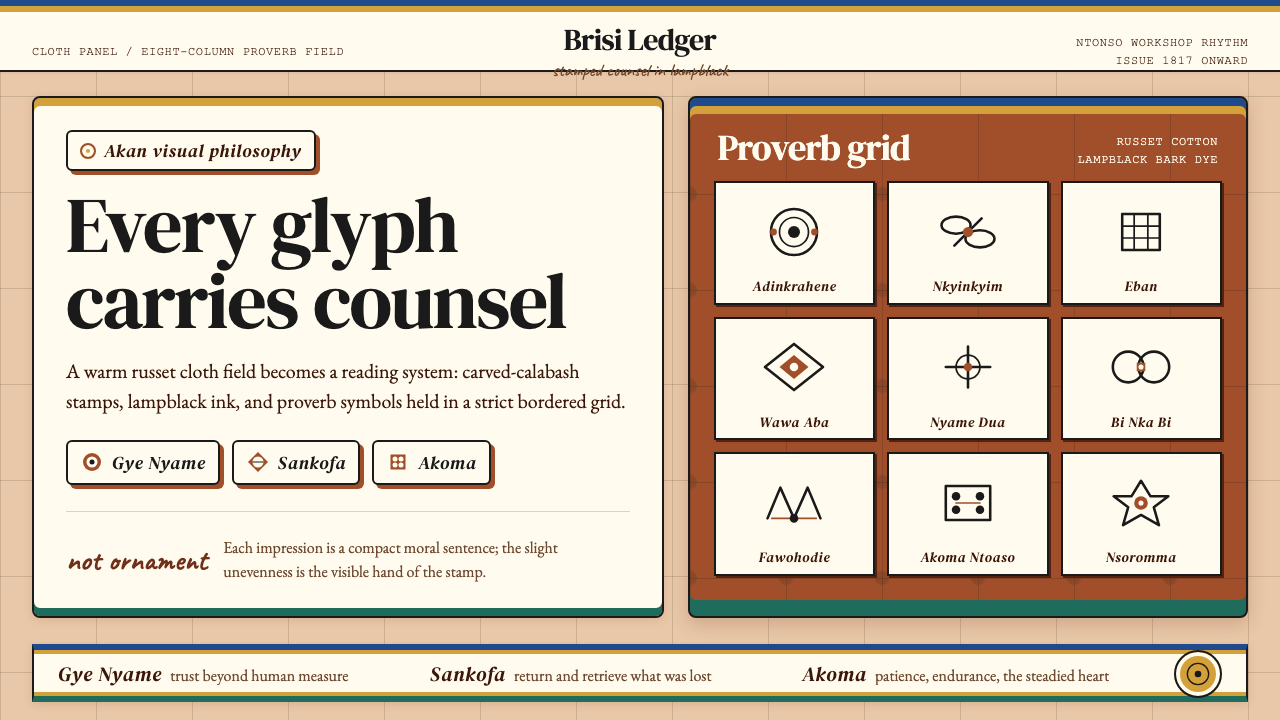 Akan Adinkra (Ghana)Proverbs become cloth. Russet grids, lampblack serif marks, and gold-edge ban…
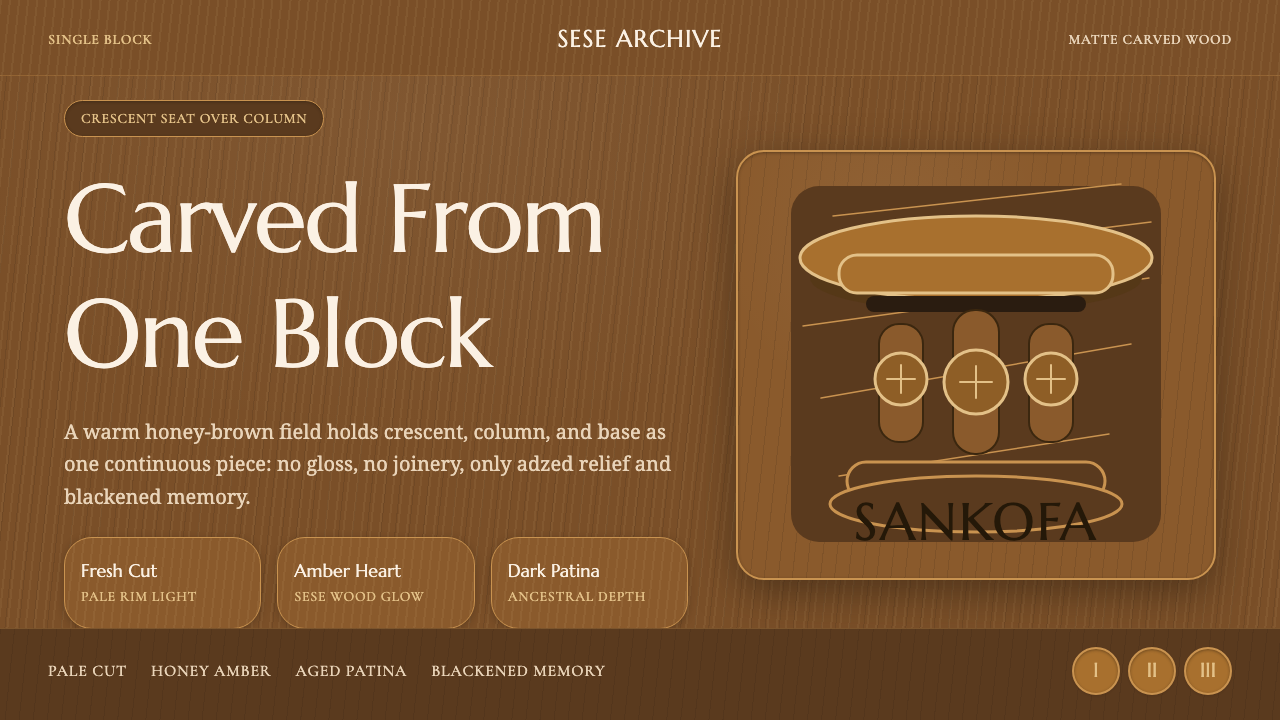 Akan Carved StoolMatte wood carries memory. Honey amber, Marcellus type, and crescent-column r…
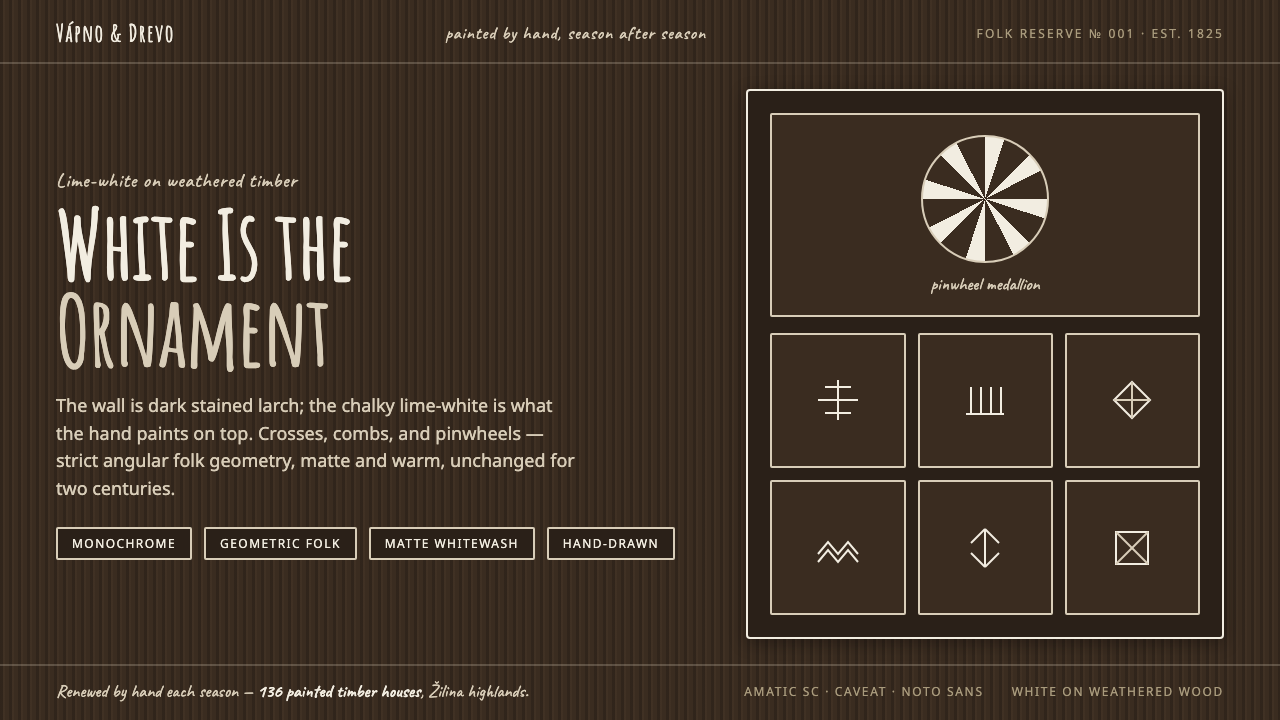 Čičmany Painted House OrnamentWhite is the ornament, not the page. Lime-white folk geometry on dark weather…
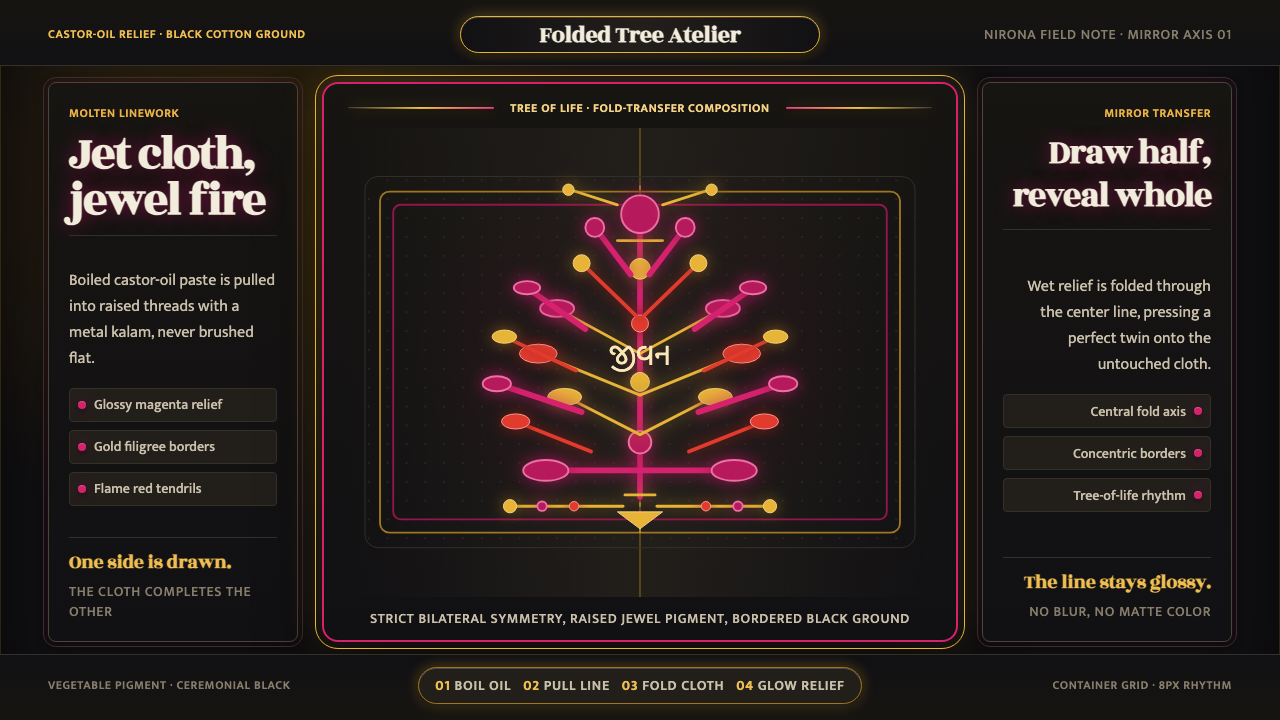 Kutch Rogan Castor-Oil PaintingGlossy symmetry holds the dark. Magenta castor-oil lines mirror across black…
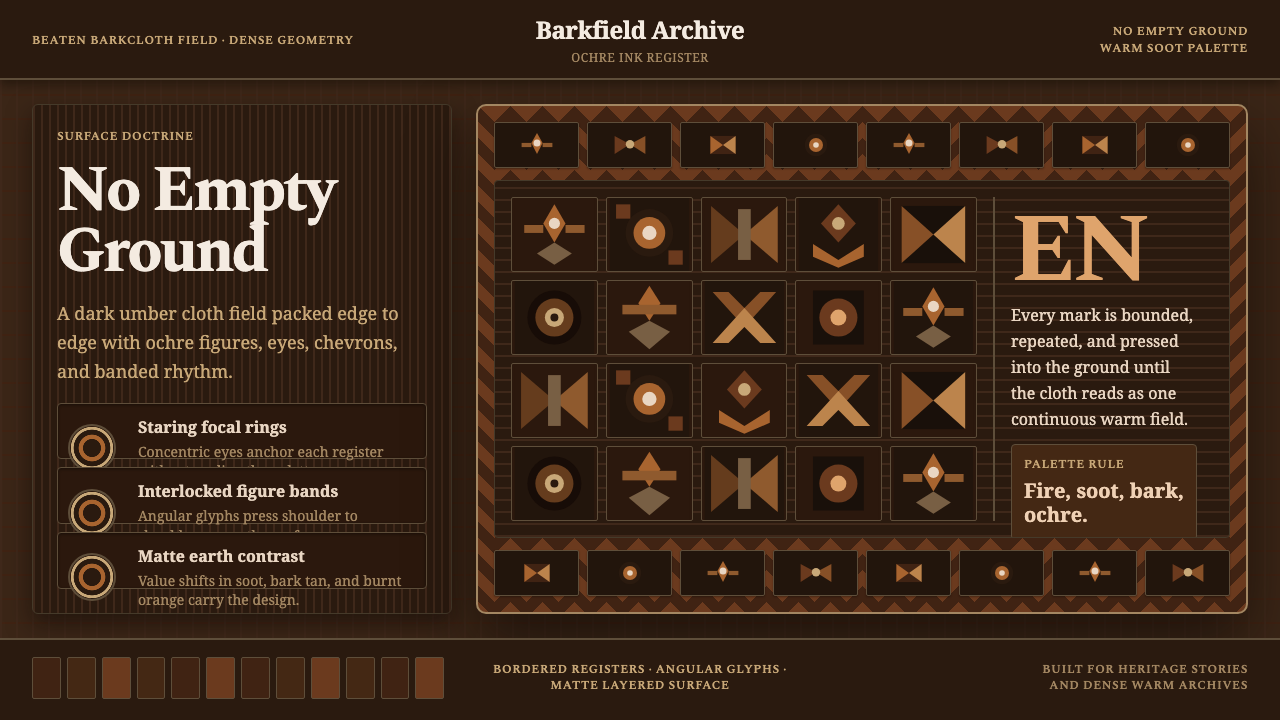 Marquesan Enata Tapa MotifNo empty ground. Ochre enata geometry packs a dark umber barkcloth field.
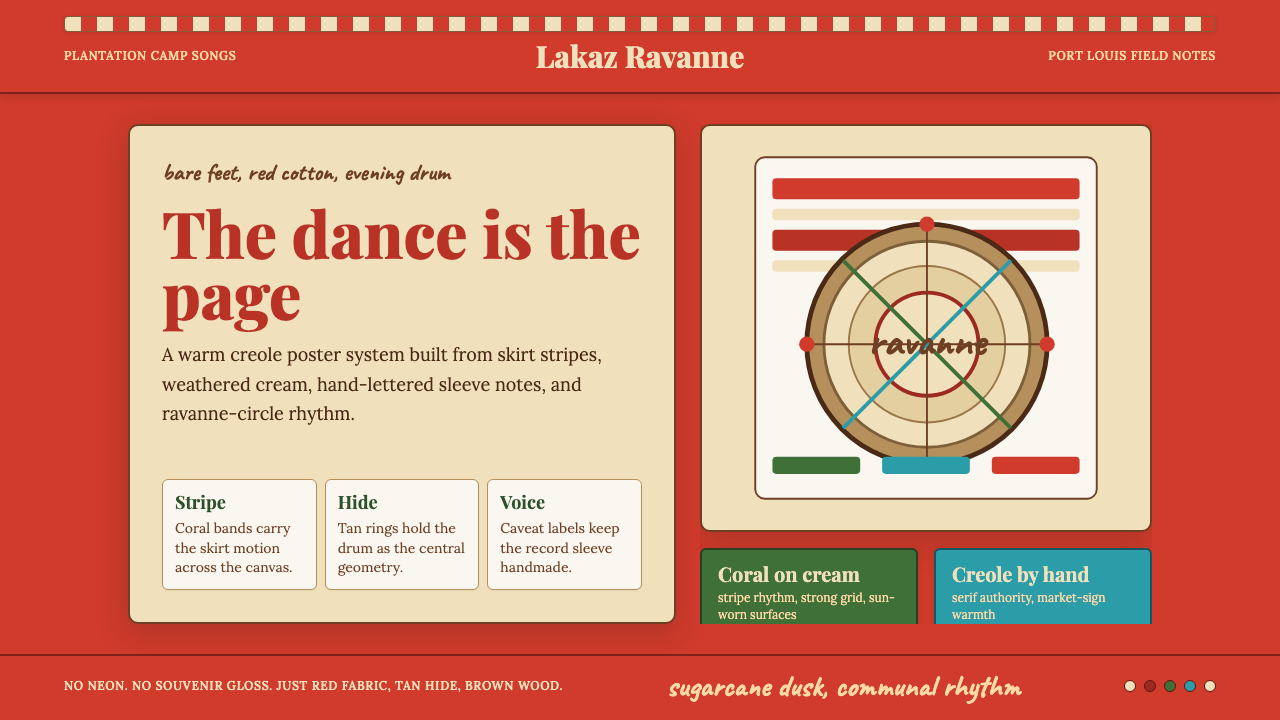 Mauritian Sega Creole (1810)Rhythm made visible. Coral stripes, cream sleeve type, and ravanne circles ca…