What is Akan Carved Stool?
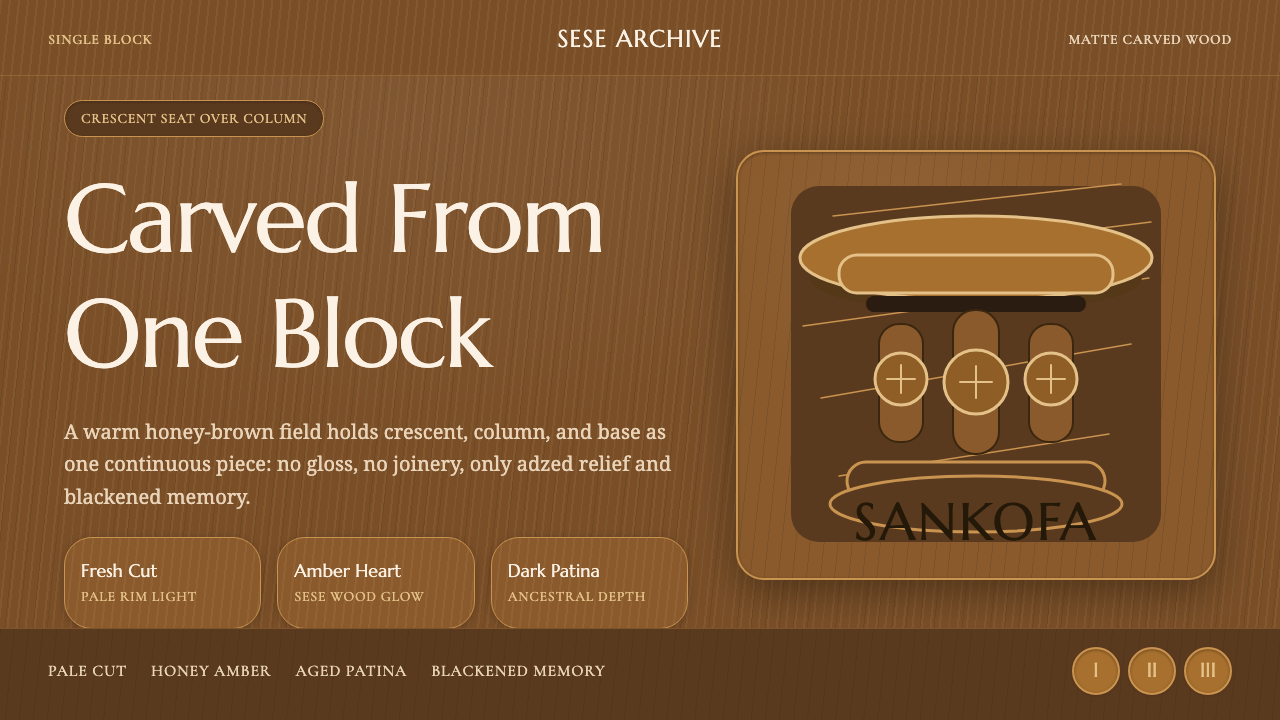
The Akan carved stool is not furniture — it is a single block of wood shaped into a throne, a soul-seat, and eventually an ancestor.
Akan Carved Stool in brief
The Akan Carved Stool style draws on the sika dwa tradition of Ghana's Akan peoples: low wooden stools cut and shaped from a single log, each one a solid mass rather than an assembly of joined parts. The signature silhouette is a wide crescent seat balanced above a sculpted supporting column, the whole form left in warm, unstained wood — honey-gold when freshly cut, deepening to amber-brown with handling and oil, and in some cases smoked to near-black. Nothing about the surface is glossy or lacquered; the finish is matte, and the tool marks of the adze remain visible as faceted planes rather than being sanded into invisibility.
This is a style built around mass and proportion rather than pattern. A stool's authority is legible in its weight: a wide, low seat sitting close to the ground reads as stability and permanence, not delicacy. Adinkra symbols — the pictographic marks associated with Akan visual culture — appear as sparing accents at the base or seat edge, not as an all-over surface pattern. Each mark carries a specific proverb or idea, so they are used the way a seal or watermark is used: rarely, and always meaningfully.
The tonal range of the wood itself is the palette. Rather than a fixed set of colors, the system spans a life-cycle of tone: pale gold in fresh timber, warm amber-brown as oil and handling darken the grain over years, and near-black where a stool has been ritually blackened. All three stages read as versions of the same material rather than as separate color choices — the aesthetic is about the wood aging, not about swapping hues.
Where does Akan Carved Stool come from?
Among the Akan peoples of present-day Ghana and neighboring Côte d'Ivoire, the stool (dwa) is bound up with personhood itself, long before it is bound up with furniture. In Akan tradition, an infant is formally given a personal stool during naming rites, and from that point the stool is treated as an extension of its owner's spirit, or sunsum. The English idiom of a chief being 'enstooled' into office — rather than crowned — comes directly from this: political and spiritual authority in Akan society is literally seated.
The most celebrated stool in Akan history is the Golden Stool, or Sika Dwa Kofi, at the center of Asante national identity. According to Asante oral tradition, the priest Okomfo Anokye summoned the stool down from the sky around the year 1700, and it descended to rest on the lap of Osei Tutu I, the founding Asantehene, at the moment the scattered Akan clans were unified into the Asante Confederacy. The Golden Stool was never treated as a seat to be sat upon; it was, and remains, understood as the vessel of the entire Asante nation's soul — an object of sovereignty rather than of use.
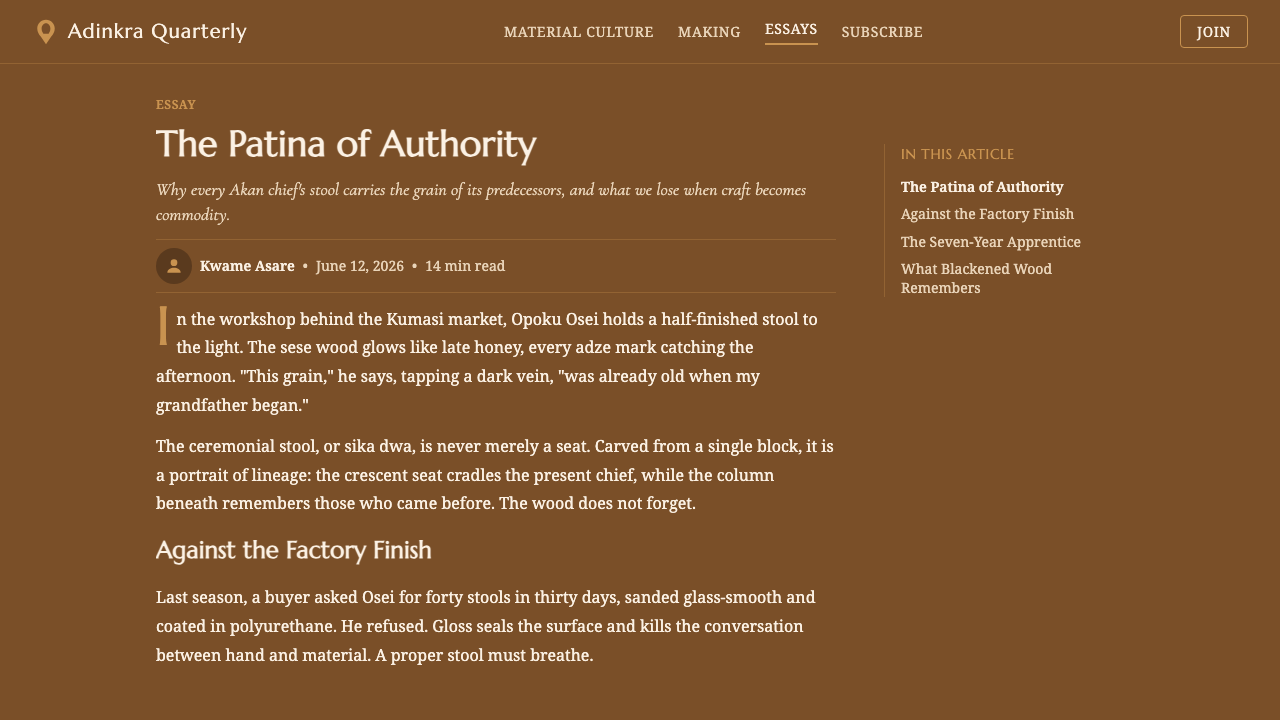
When an important stool-holder dies, their personal stool is not discarded but ritually blackened — smoked and treated in a process known as nkonnwa tuntum — and installed in a stool house alongside the blackened stools of earlier ancestors, where descendants make periodic offerings. This practice is the direct source of the style's tonal range: a stool's darkening from honey to near-black is not decay, it is the material record of a life and its passage into ancestorhood.
The Golden Stool's status as a symbol of sovereignty was tested directly by British colonial power. In 1900, Governor Frederick Hodgson demanded the stool be produced so that he could sit on it as a sign of imperial submission — a demand so culturally offensive that it triggered the War of the Golden Stool. Yaa Asantewaa, the Queen Mother of Ejisu, led the Asante resistance in the stool's defense. The Golden Stool itself was hidden and never surrendered, and the episode has stood ever since as one of the clearest examples in African history of an object of craft doubling as an object of national resistance.
What defines the Akan Carved Stool look?
Color
There is no fixed hue palette; the color system is the wood's own tonal range. Fresh-cut surfaces read as pale honey-gold, oiled and handled surfaces settle into a warm amber-brown, and ritually blackened surfaces move toward a deep near-black that still carries warmth rather than reading as cold or neutral gray. Any single application should commit to a position within this range rather than mixing unrelated cool tones in.
Surface and Grain
The finish is matte throughout — no gloss, no lacquer, no reflective sheen. Because each stool is adzed from a single block by hand, the surface carries faceted planes and visible tool marks rather than the perfectly smooth curve of a lathe-turned or machine-sanded object. This faceting catches light unevenly across the form, which is part of what gives the style its handmade, sculptural weight.
Silhouette
The defining shape is a wide crescent seat balanced above a sculpted, often waisted or figured supporting column, the whole resting on a broader base. The proportions favor width and lowness over height — a stool sits close to the ground and spreads wide, which is what reads visually as stability, permanence, and seated authority rather than height or grandeur.
Symbolic Accents
Adinkra-derived marks appear sparingly, typically at the base of the column or the edge of the seat, never as an all-over surface pattern. Each symbol carries a specific proverb or concept, so their role is closer to a seal or a signature than to decoration — a small, deliberate mark rather than a repeated motif filling space.
Patina and Age
Age is treated as a legitimate part of the visual system rather than something to be disguised. A newly finished surface, a years-old oiled surface, and a ritually blackened surface are all valid expressions of the same material, and a design can draw from any point along that continuum depending on how much weight or history it wants to signal.
Composition and Restraint
Compositions tend to be sparse and low-set, echoing the physical proportions of the stool itself. A single crescent-and-column silhouette, generously surrounded by warm negative space, communicates more authority in this system than a crowded or symmetrical arrangement — the restraint is itself part of what signals status.

Who shaped Akan Carved Stool?
Osei Tutu I was the founding Asantehene (king) of the Asante Confederacy, formed around 1701 when he unified the previously scattered Akan clans of the region. Asante oral tradition holds that the Golden Stool descended from the sky to rest on his lap at the moment of unification, making his reign the origin point of the stool's status as a national rather than merely personal object.
Okomfo Anokye was the priest credited in Asante tradition with summoning the Golden Stool from the sky and with advising Osei Tutu I during the founding of the confederacy. He is remembered as much for statecraft as for spiritual authority, and the legend surrounding the stool's descent remains the founding narrative that gives Akan royal stools their sacred, rather than purely decorative, status.
Yaa Asantewaa was the Queen Mother of Ejisu who, in 1900, led the Asante uprising against British colonial demands to seize and sit upon the Golden Stool. Though the war ultimately ended in exile for its leaders, the Golden Stool itself was never surrendered, and Yaa Asantewaa's resistance cemented the stool's meaning as an emblem of sovereignty that could not be separated from the people it represented.
Behind any individual stool stands a lineage of Asante carvers who trained through apprenticeship to work a single log into a finished stool using only an adze, without joinery or mechanical tools. Their craft knowledge — reading the grain of sese wood, balancing a crescent seat over a narrow column without the piece splitting — is the technical foundation the entire visual style depends on, even though most individual carvers' names were never recorded.
How do you use Akan Carved Stool today?
On presentation slides, the Akan Carved Stool aesthetic works best as a cover treatment: a warm amber-wood background field with the crescent-and-column silhouette rendered large and slightly off-center, paired with a restrained serif title set in dark warm brown rather than pure black. Content slides should keep the wood-tone background but reduce the motif to a small recurring mark — a divider line or corner accent — so it doesn't compete with text. Data slides benefit from rendering bars or segments as blocks of varying wood tone, from pale to near-black, so that the data hierarchy reads through material darkness rather than through a rainbow of unrelated hues.
For web interfaces, the style suits dashboards and pricing pages that want to read as substantial and trustworthy rather than playful. Card backgrounds can sit in a warm off-white or pale amber rather than clinical white, panel edges can carry a faint faceted texture rather than a flat drop shadow, and pricing tiers can be differentiated by depth of wood tone — a paler tier for an entry plan, a darker or near-black tone for the top tier — instead of switching between unrelated accent colors.
In editorial and marketing contexts, the style is a strong fit for heritage, craft, furniture, and slow-design brands that want to signal permanence rather than novelty. Long-form articles can use the crescent motif as a recurring section divider, and marketing hero sections read powerfully with a large-scale, softly rendered silhouette of the stool form used as background texture behind a headline, rather than as a literal product photo.
A frequent mistake is collapsing this style into generic 'African print' visual shorthand — bold geometric pattern-fill borrowed from an entirely different textile tradition. The Akan Carved Stool identity is about mass, wood, and silhouette, not about printed pattern, and pattern-filling a layout with Adinkra-style marks misreads their actual role as sparing, meaningful accents rather than an all-over decorative motif.
The second common mistake is over-polishing the surface treatment — adding gloss, gradient sheen, or bright highlight effects to make the wood 'pop.' That instinct fights the material honesty at the center of the style. The visual weight of the Akan Carved Stool look comes from restraint: generous warm negative space, a matte finish, and a composition that stays low and wide rather than tall and busy.
Akan Carved Stool — FAQ
Is it appropriate to use Akan stool aesthetics for a brand that has no connection to Ghana or Akan culture?
Treat it as a material and formal language — warm wood tone, faceted matte surface, crescent-and-column silhouette — rather than as a literal reproduction of sacred objects. Avoid recreating the Golden Stool itself or specific chiefly stool forms tied to particular offices, and use Adinkra-style marks the way the tradition uses them: sparingly and meaningfully, not as generic decorative filler. Where a project's connection to Akan culture is central rather than incidental, crediting the source tradition in copy or documentation is good practice.
Why do Akan chiefs get 'enstooled' rather than crowned?
Because in Akan political culture, the stool itself is the object of office rather than a crown or throne in the European sense. Since infancy, an Akan person's personal stool is treated as bound to their spirit, and a chief's stool is understood as the seat of their authority — so taking office literally means being formally seated on a stool, and losing office is described as being 'destooled.' The vocabulary reflects the underlying belief system rather than being a mere translation convenience.
Why do some stools in this style look nearly black while others are honey-colored — isn't that inconsistent?
It isn't inconsistency, it's the intended range. In the source tradition, the darkening of a stool from pale wood to deep near-black tracks its life: fresh timber, years of oiled use, and eventually ritual blackening after an owner's death. A design system built on this style should treat the full tonal range as available material rather than picking one tone and calling the rest incorrect — the darkening itself carries the meaning.
Does this style work for a dark-mode digital product?
It can, and the ritually blackened end of the wood-tone range gives it a natural bridge into dark mode — but the near-black should stay warm rather than shifting to a cool neutral gray or blue-black, or the material logic breaks down. A dark-mode application should keep accents in the amber-to-honey range for contrast and interactive states, rather than introducing unrelated cool colors.
How is this different from generic 'tribal' or 'safari' design clichés often seen in Western branding?
Generic 'tribal' or 'safari' visual shorthand typically borrows unrelated patterns and colors from many different cultures and eras and blends them into a single vague mood. The Akan Carved Stool style is traceable to one specific tradition, one material, and a documented history — the sika dwa carving practice, the Golden Stool legend, the Yaa Asantewaa war — with a coherent internal logic, wood tone as life-cycle, silhouette as authority, symbols as sparing accents, rather than an assembled mood board. Specificity is what separates a genuine design system from a cliché.
Related design styles
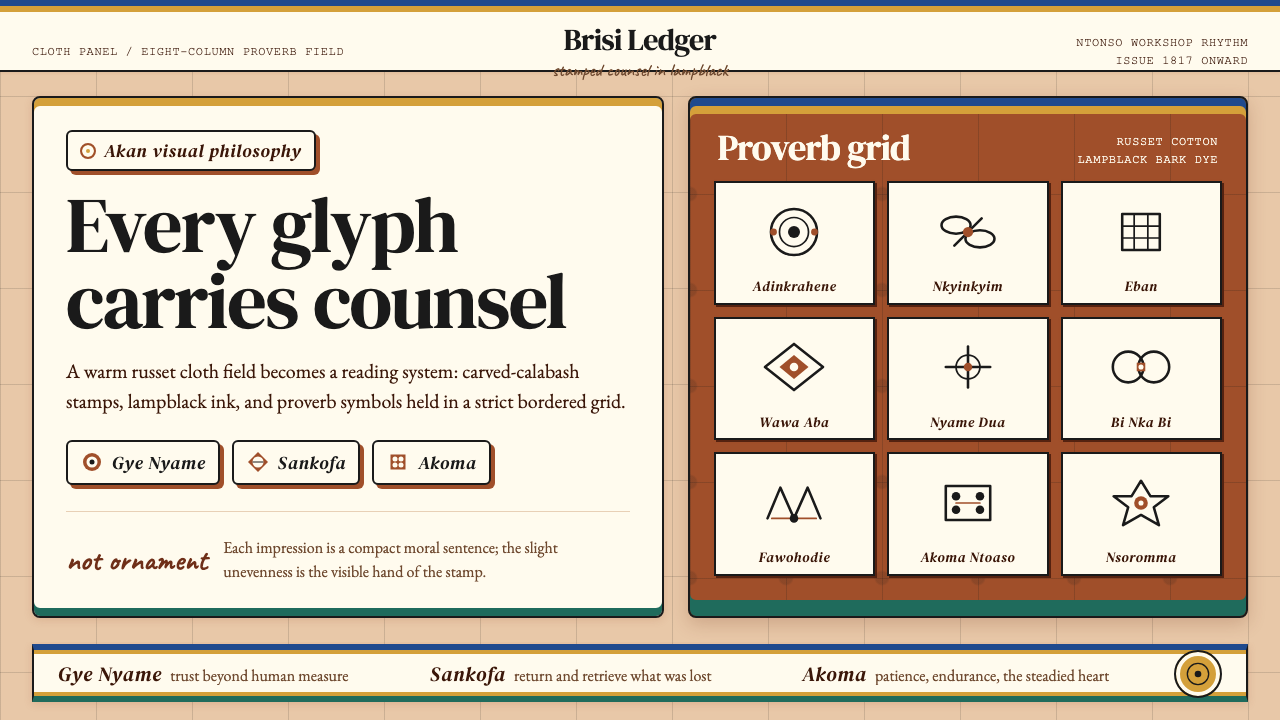 Akan Adinkra (Ghana)Proverbs become cloth. Russet grids, lampblack serif marks, and gold-edge ban…
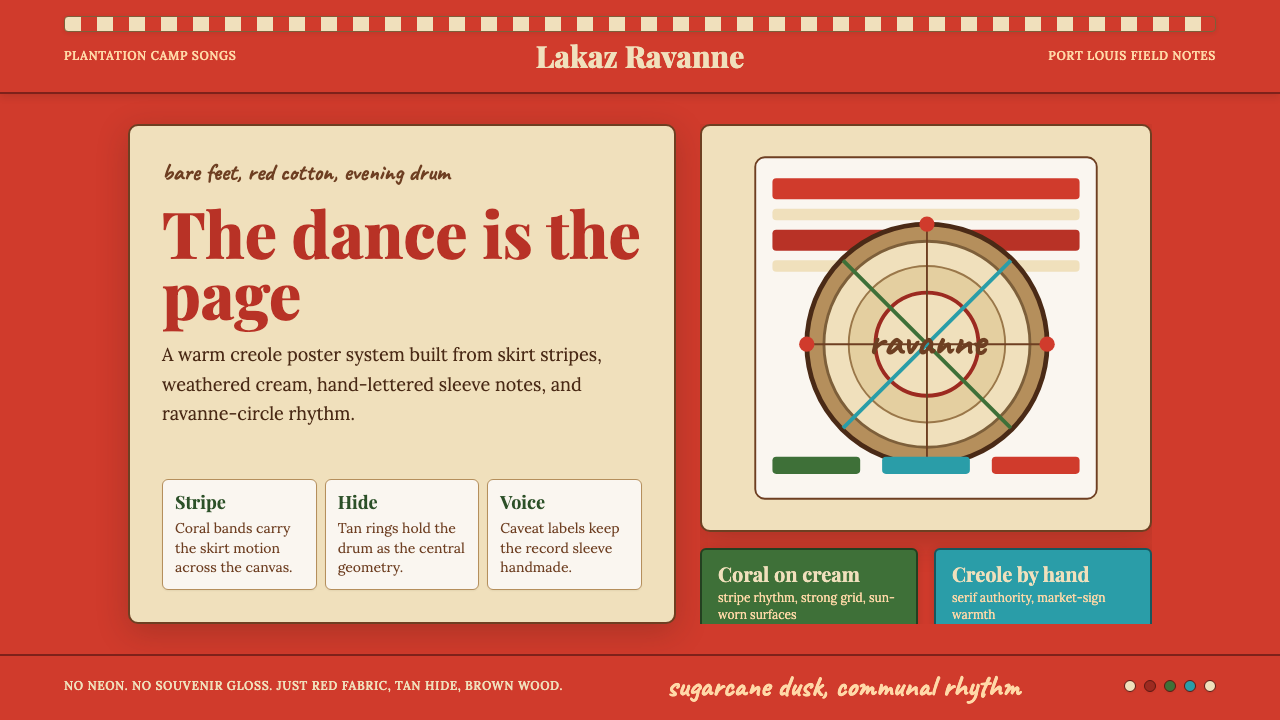 Mauritian Sega Creole (1810)Rhythm made visible. Coral stripes, cream sleeve type, and ravanne circles ca…
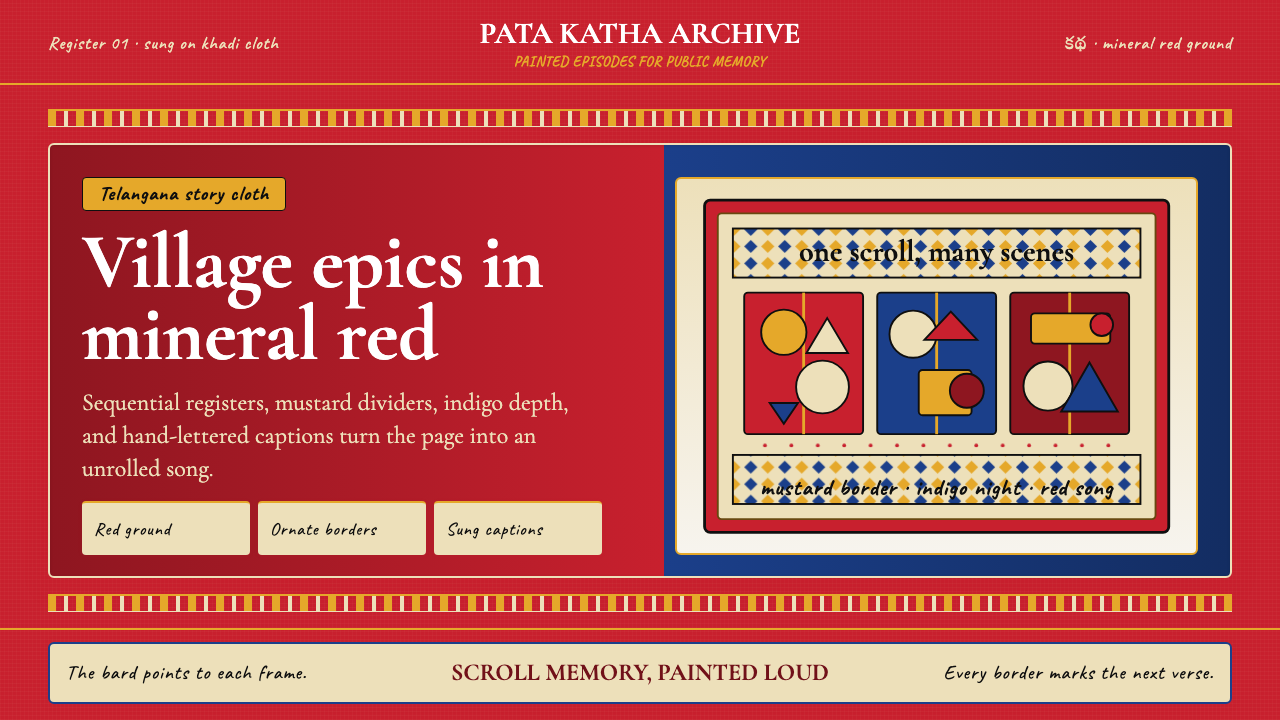 Andhra Cheriyal Scroll PaintingSaturated oral memory. Mineral red registers, mustard diamonds, and serif son…
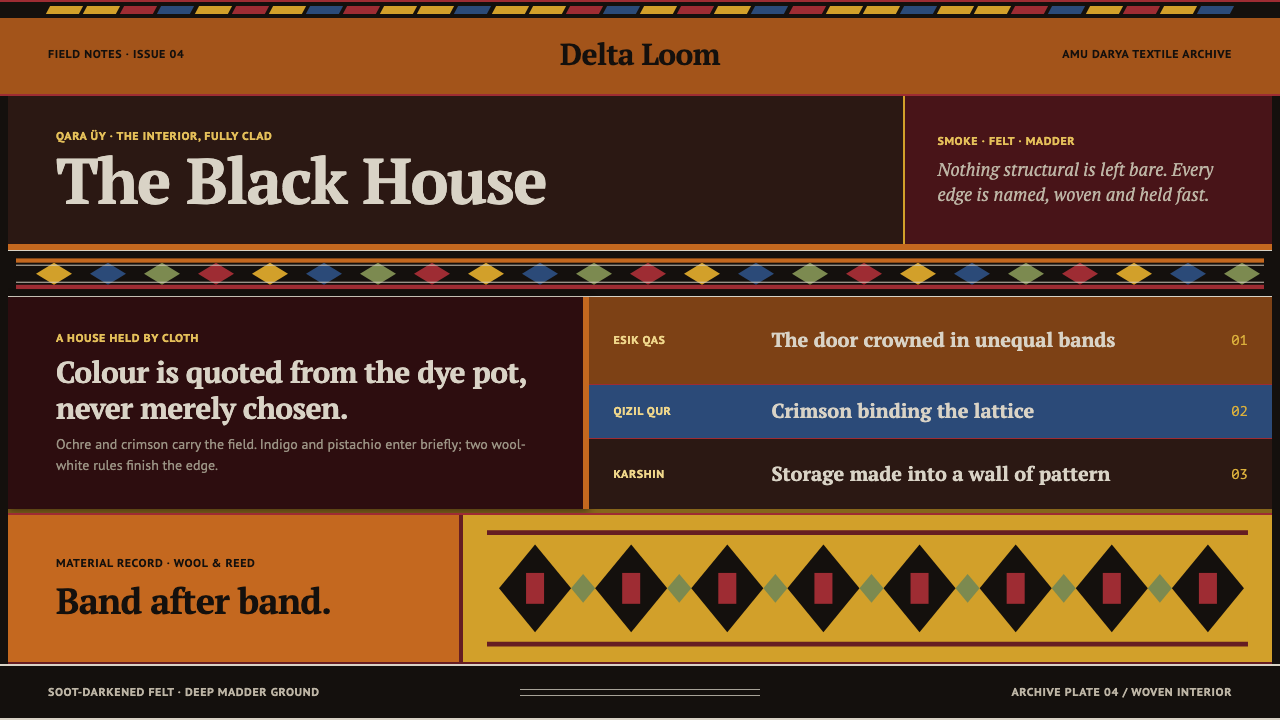 Karakalpak Yurt InteriorNo surface is left bare. Ochre, crimson and indigo bands wrap a smoke-darkene…
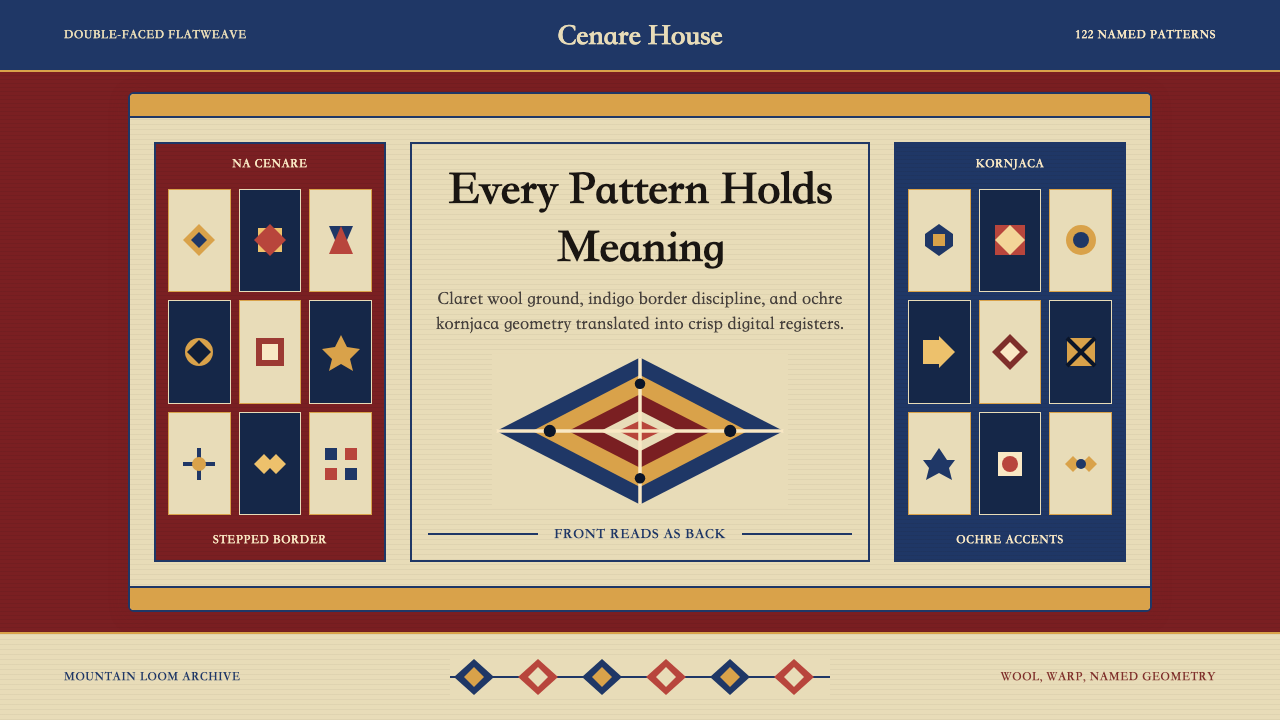 Serbian Pirot KilimWoven memory, sharply framed. Claret ground, indigo borders, ochre stepped di…
 Ukrainian Rushnyk Ceremonial TowelCeremony stitched in red. Linen panels, soot-black crosses, and wheat-gold st…