What is Bishnupur Terracotta Temples?
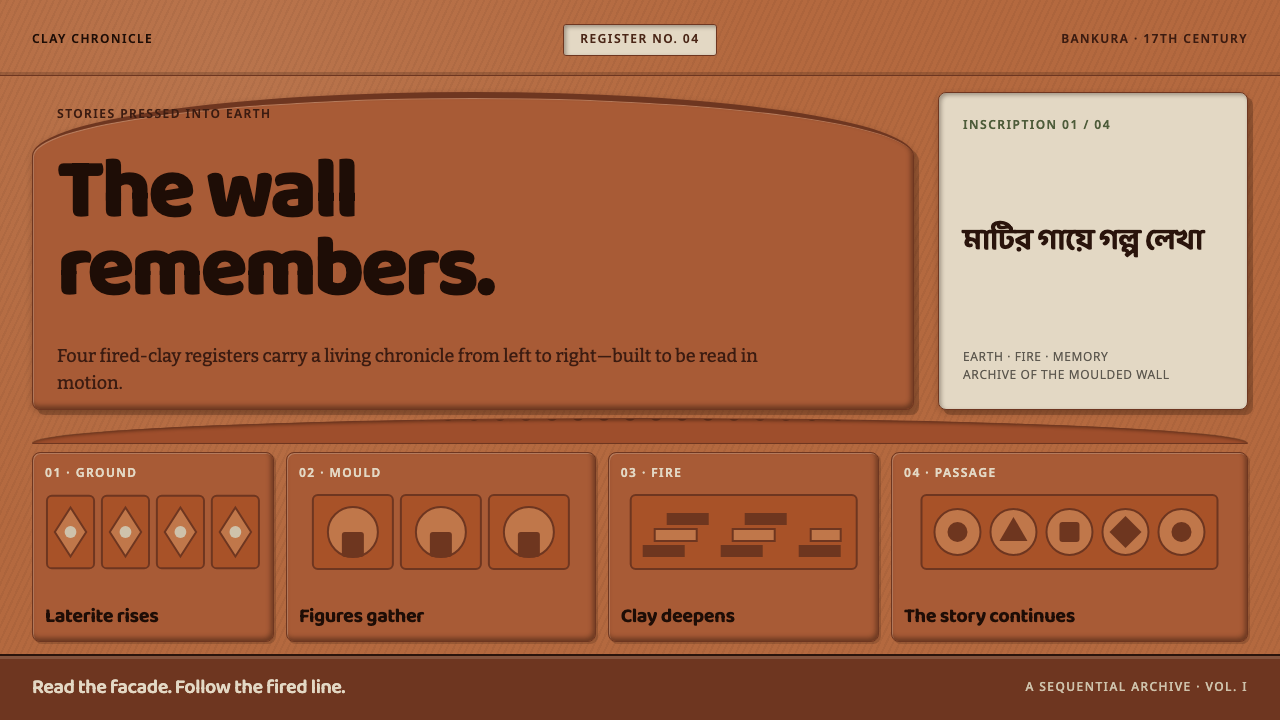
Bishnupur's temples turned a landscape with no good stone into a library of fired clay — a wall you read from left to right, one relief panel at a time.
Bishnupur Terracotta Temples in brief
Bishnupur terracotta is the architectural and decorative language of the brick-and-laterite temples raised by the Malla kings at Bishnupur, in the Bankura district of West Bengal, during the seventeenth and eighteenth centuries. Its defining trait is a wall that is also a picture. Laterite block and brick are faced with moulded, fired-clay panels, and those panels are stacked in horizontal registers that climb the facade beneath a gently curved, hut-like roofline.
What the panels carry is narrative, not pattern. Battles from the Ramayana, the playful episodes of Krishna's life, hunting parties, boats on rivers, processions and household scenes unfold side by side along the wall, so that a visitor walking around the temple reads it the way one unrolls a scroll. Ornament here is never wallpaper. It is a story with a beginning at one edge and an ending at the other, and the reading direction is part of the design.
Visually, the style is warm, earthy and tactile. The ground is the colour of baked clay and rusted laterite. Figures stand out in shallow relief, defined by the shadows they cast rather than by outlines. Dividers bend like the eave of a thatched hut instead of running ruler-straight. A pale lime-plaster tone is held in reserve for inscription bands and captions. Curio's interpretation keeps all of this intact: the wall is the page, not a brick-coloured accent laid over a white one.
Where does Bishnupur Terracotta Temples come from?
The story begins with a shortage. Bankura lies on the western fringe of Bengal, where the delta's soft alluvium gives way to uplands of laterite — a rust-red, pitted rock that can be cut into blocks while freshly quarried and hardens in the open air, but is far too coarse for fine carving. The Malla kings of the seventeenth century had no building stone worth carving. What they did have was river clay in abundance and generations of potters and brickmakers who knew how to handle it. Their masons raised walls in laterite block and brick, then dressed every reachable face in moulded, fired clay. Necessity became a style.
The religious climate gave that style its subject matter. The temples of Bishnupur belong to the Bengal Vaishnava bhakti revival, the wave of devotion centred on Krishna and Radha that reshaped religious life across the region. These temples were not congregational halls; they were houses for a deity, and worship included walking around the shrine. The outer wall therefore became the place where the community met the sacred story. Panels at eye level and below were close enough to read, and the registers above them were meant to be glimpsed from the courtyard. Royal patronage turned devotion into building, and building into a picture book in clay.
Several fixed points anchor the chronology. The Rasmancha, a pyramidal masonry structure ringed by arcaded galleries, dates to around 1600 and is associated with Bir Hambir. The Shyam Rai temple followed in 1643 and the Jor Bangla in 1655, both under Raghunath Singha Dev. The Jor Bangla shows the curved-roof idea in its purest form: two hut-shaped roofs joined together, with a small tower rising from their meeting point. The single-towered ek-ratna type, literally 'one jewel', sits alongside it in the repertoire. Both types translate the chala, the curved thatched roof of the Bengali village hut, into permanent brick. A later Malla ruler, Durjana Singha Dev, is remembered for continuing this patronage in the late seventeenth century.
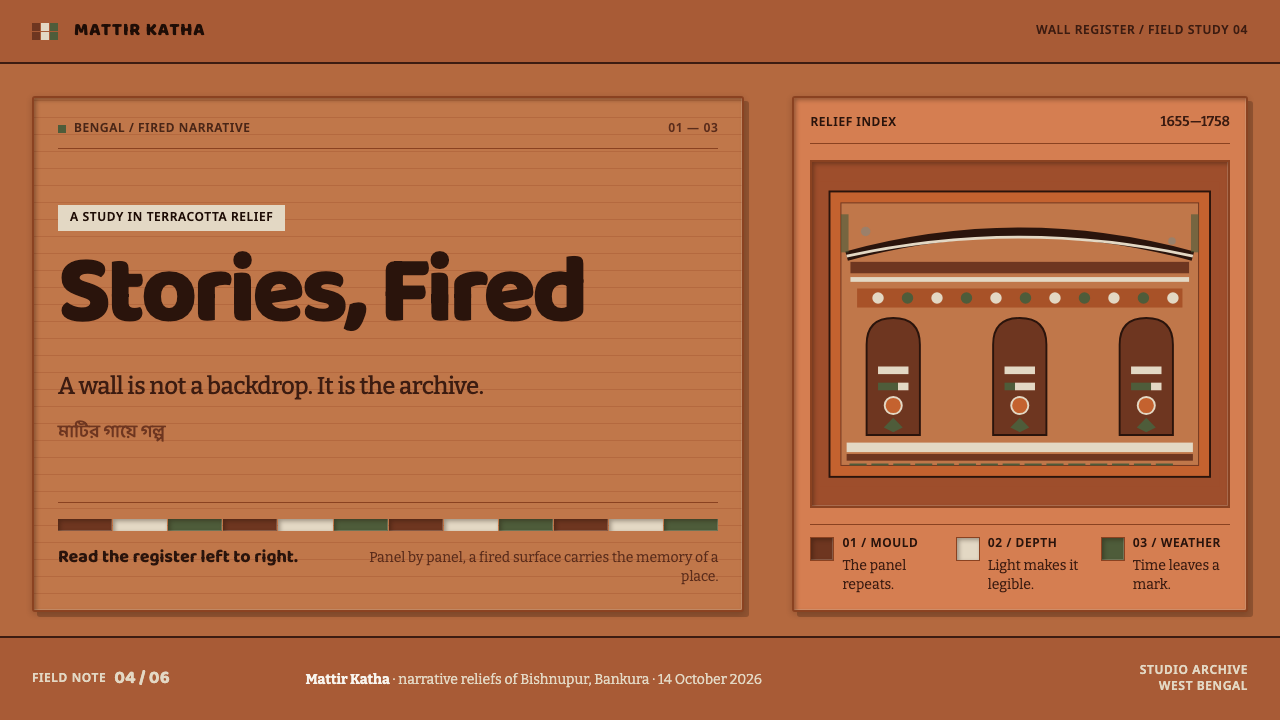
The craft behind the panels explains their look. Each relief began as clay pressed or modelled, shaped by mould, dried and fired, then fixed into the wall as a standardised unit. That is why the wall reads as a grid of equal tablets, each with its own small scene, and why motifs recur with slight variation. The method rewards repetition without demanding sameness: boats, horsemen and dancing figures return again and again, but never as exact copies. This blend of modular rhythm and handmade irregularity is the quality Curio's system tries to preserve.
What defines the Bishnupur Terracotta Temples look?
Color
The palette is taken from what the walls are made of: the deep rust of laterite, the orange-red of baked clay, the browns of weathered brick and the dusty shadow tones in between. There are no clean primaries and no cool accents. Warmth is the whole mood, and variation comes from the way fired clay never reaches exactly the same tone twice. A single pale plaster tone is kept apart, used only where the wall carries writing.
Relief and Raking Light
Every content block behaves like a pressed panel. Light arrives from the upper left, grazing the surface so that raised edges catch brightness on one side and cast a soft, directional shadow on the other. Depth is shallow and consistent: figures are never freestanding sculpture, only low relief. Edges are recognised by their shadow, not by a drawn outline, which gives surfaces a handmade, pressed-into-clay quality.
Registers
Content is organised in horizontal bands stacked up the wall, each band holding a row of panels that belong together. A register is both a unit of meaning and a unit of layout: it begins at one edge, runs across, and ends at the other. This produces a strong horizontal rhythm and makes pages feel built, course by course, the way a brick wall is built.
The Curved Eave
Where another style would use a flat rule, Bishnupur uses a curve borrowed from the thatched village hut, the chala. Dividers, section edges and cornice-like bands bow gently downward at the ends. The curve is subtle but constant, and it is what separates this system from generic brick-textured design: the whole composition is quietly shaped by one remembered roofline.
Narrative Ornament
Decoration is always a sequence to be read, never a field of repeated pattern. Figures face a direction of travel, scenes follow one another, and the eye is led from left to right. Symmetry is avoided on purpose: a mirrored wall would have no beginning and no end, and the style depends on having both. Even the smallest ornamental unit is treated as a moment in a story.
Modular Variation
Because the panels come from moulds, the wall is a grid of near-equal units, yet no two neighbours are identical. Good Bishnupur layouts echo this: equal-sized cards or tiles that repeat with small differences in content, spacing or tone. Mechanical perfection is treated as a defect. A little irregularity at the joints is exactly what tells the eye that this surface was assembled by hand.
Plaster Inscription Bands
Writing lives on a different material from the story. Titles, captions and labels sit on pale plaster-toned bands set into the clay wall, with lettering that feels pressed or incised rather than printed. Type is sturdy and warm, with generous spacing, and never competes with the relief. This separation of image-material and text-material keeps long documents legible without breaking the wall's unity.
Who shaped Bishnupur Terracotta Temples?
Bir Hambir is the Malla ruler associated with the Rasmancha of around 1600, the earliest anchor in Bishnupur's temple-building story. His reign is remembered as the point at which the court turned decisively toward Vaishnava devotion, giving later kings both a religious mission and an architectural programme to continue. For design purposes he stands for the founding gesture: committing a whole city to clay as its principal medium.
Raghunath Singha Dev presided over the mid-seventeenth-century heart of the tradition. The Shyam Rai temple of 1643 and the Jor Bangla of 1655 both belong to his time. These are the buildings that fix the visual vocabulary: terracotta registers running across the facade, the curved hut-roof translated into brick, and narrative panels crowded with epic scenes. Much of what people picture when they say 'Bishnupur' was set in place during his years.
Durjana Singha Dev is remembered as a later Malla patron who continued the building programme in the late seventeenth century, extending the family's devotion into new temples of the single-towered kind. His place in the story is one of continuity: proof that the clay-wall idea was not a single reign's experiment but a living convention carried across generations, refined without ever abandoning its basic logic of story, register and eave.
How do you use Bishnupur Terracotta Temples today?
Bishnupur terracotta works best when your content is a sequence: a timeline, a case study, a process, a journey, a catalogue of episodes. The style has an opinion about reading order, so it rewards material that already has one. Applying it well means borrowing the wall's logic, which is registers, relief and a curved eave, rather than just filling the background with a brick-red colour.
For presentation slides, a cover can treat the whole slide as a wall: a deep terracotta field, a gently curved band across the lower third, and the title set on a pale plaster-toned inscription strip. Content slides work as one or two registers, each holding a row of equal panels that carry short, parallel points. Data slides suit this system well, because charts can be rendered as raised panels with bars in clay tones, grouped in a row so the comparison reads from left to right.
For web interfaces, think of cards as pressed panels. Pricing tiers, feature groups and dashboard widgets sit in a row, lit from the upper left, with soft directional shadows instead of hard outlines. Section dividers curve slightly rather than ruling flat. Navigation and labels can live on plaster-toned bands, while primary buttons keep the clay palette and show their depth through pressed or raised states. Keep the surface warm and avoid cool grey chrome that would break the material.
For editorial and marketing work, the style is excellent at long-form storytelling. A feature article can be laid out as successive registers, each introducing an episode, with captions and pull quotes set on plaster bands. A landing page can lead with a single large relief-like panel and then unfold into a horizontal run of smaller ones. Images, when used, are cropped into the same panel proportions so photographs and illustrations feel like tiles from the same wall.
The most common mistake is to treat the palette as the style. A flat orange-brown background with ordinary cards is not Bishnupur; without relief, raking light and curved dividers, it is just a warm theme. The second mistake is symmetry. Centered, mirrored layouts and repeated wallpaper patterns erase the left-to-right reading that gives the style its meaning. Finally, avoid shadows that come from every direction. One consistent light source is what makes the clay feel real.
Bishnupur Terracotta Temples — FAQ
Why is Bishnupur's architecture made of clay instead of stone?
Because the local geology offered no good building stone for carving. The region's laterite can be cut into blocks, but it is too coarse for fine detail. River clay, on the other hand, was abundant and the craft of working and firing it was well established. The Malla builders therefore raised walls in laterite and brick and then covered them with moulded, fired-clay panels. What began as a workaround became the signature of the style, and the clay surface allowed a level of narrative detail that coarse laterite could never carry.
What does 'chala' mean and why do the dividers curve?
Chala refers to the curved, sloping roof of a traditional Bengali thatched hut, whose eaves bow downward at the corners. Bishnupur's builders translated that roofline into brick, and it appears in the temple types known as ek-ratna and jor-bangla. In the Curio system, curved dividers are a quiet quotation of that eave. They replace flat horizontal rules and give the layout a soft, hand-shaped feeling that is recognisably Bengali rather than generically warm or rustic.
Is this a decorative style or a storytelling style?
It is primarily a storytelling style. The panels depict episodes from the Ramayana, scenes from Krishna's life, hunts and boats, and they are arranged so that the sequence matters. Ornament in this tradition is never a symmetrical field of repeated motifs; it is a story read from left to right. That is why the Curio system favours directional layouts, registers and captions over centered, mirrored compositions. If your content has no sequence at all, a different style may suit it better.
Can the Bishnupur style work on a dark background?
The reference is a sunlit wall, so the system is built on a warm, light-to-mid ground, and raking light from the upper left is what gives it depth. A dark inversion is possible, but it needs care: relief reads through highlights and shadows, and a very dark ground tends to flatten the clay tones into mud. If you go dark, keep the warm brown family, preserve the single light direction and let the plaster-toned bands carry the contrast for text.
How is terracotta relief different from stone carving as a design influence?
Stone carving is subtractive: the artist cuts away material, and surfaces tend to feel crisp, deep and monumental. Terracotta relief is built by pressing and modelling, so edges are softer, depth is shallower and repetition from moulds is part of the character. In design terms, that means rounded edges, restrained depth, modular tiles that repeat with variation and a warm, earthy tonal range. If you want hard-edged grandeur, look elsewhere; if you want something tactile and handmade, this is the right reference.
Related design styles
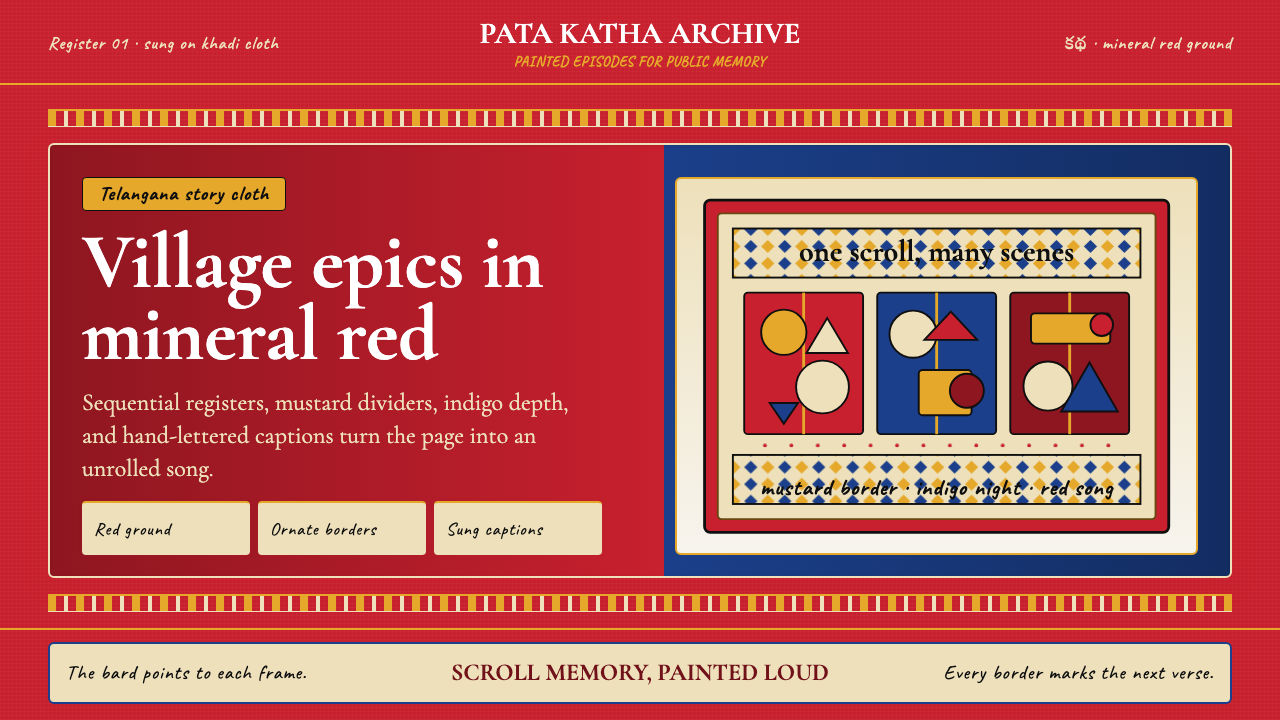 Andhra Cheriyal Scroll PaintingSaturated oral memory. Mineral red registers, mustard diamonds, and serif son…
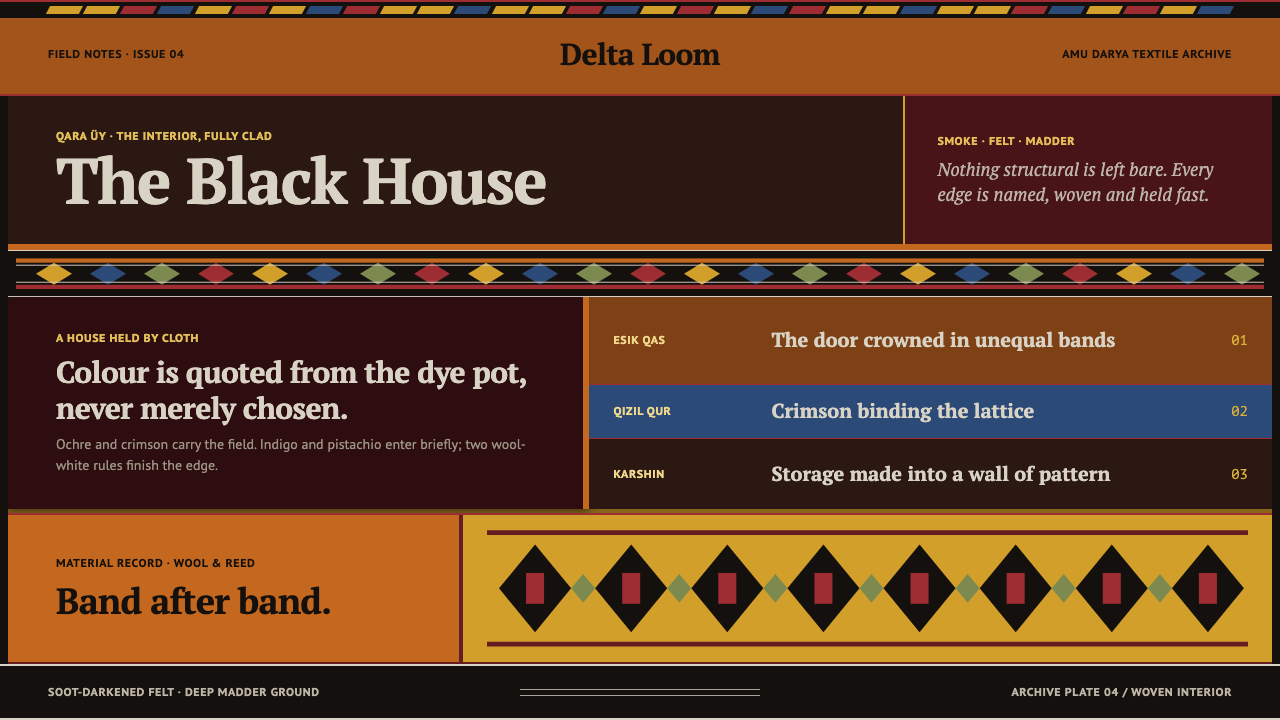 Karakalpak Yurt InteriorNo surface is left bare. Ochre, crimson and indigo bands wrap a smoke-darkene…
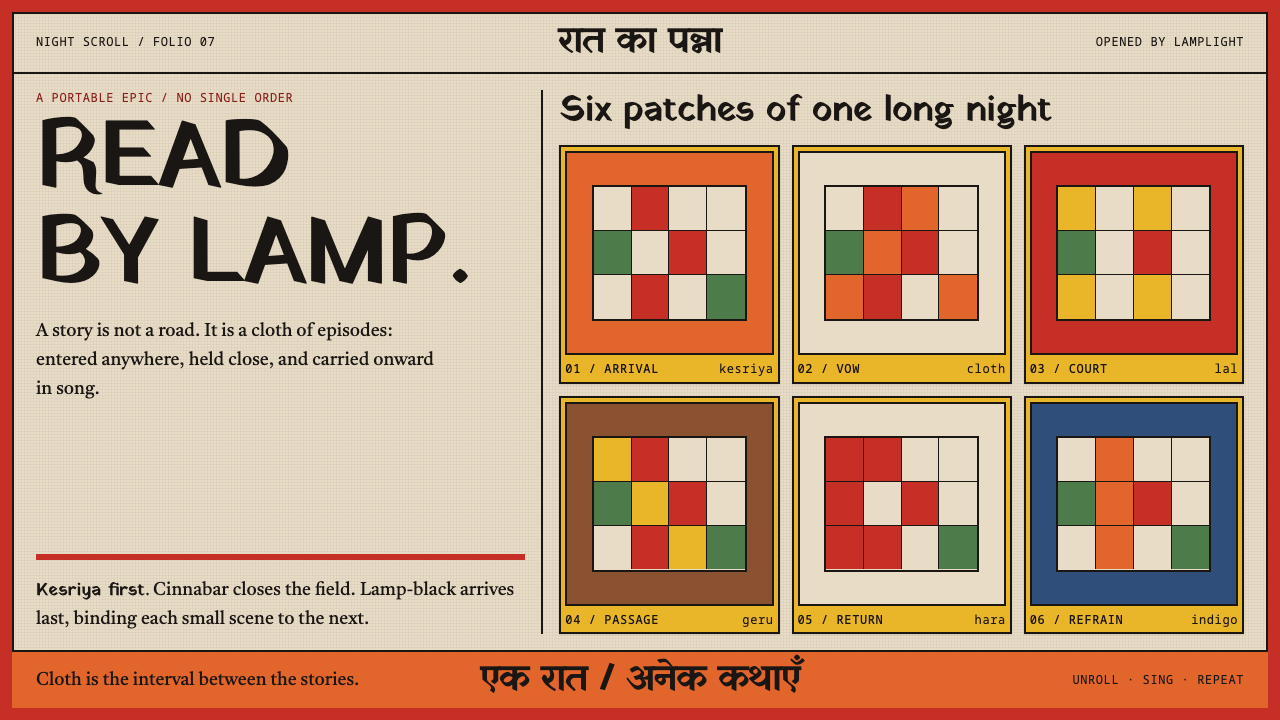 Phad Scroll PaintingAn epic refuses a single order. Kesriya cells and cinnabar rules open by lamp…
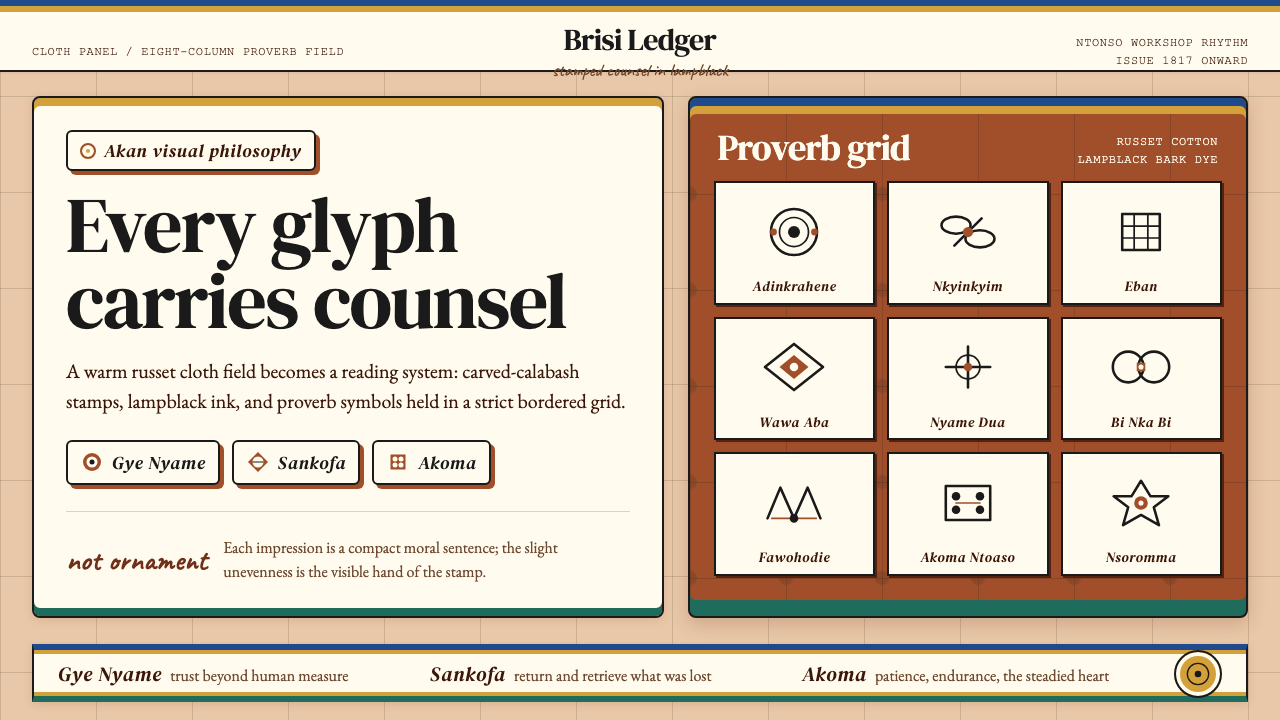 Akan Adinkra (Ghana)Proverbs become cloth. Russet grids, lampblack serif marks, and gold-edge ban…
 Akan Carved StoolMatte wood carries memory. Honey amber, Marcellus type, and crescent-column r…
 Kutch Rogan Castor-Oil PaintingGlossy symmetry holds the dark. Magenta castor-oil lines mirror across black…