What is Kutch Rogan Castor-Oil Painting?
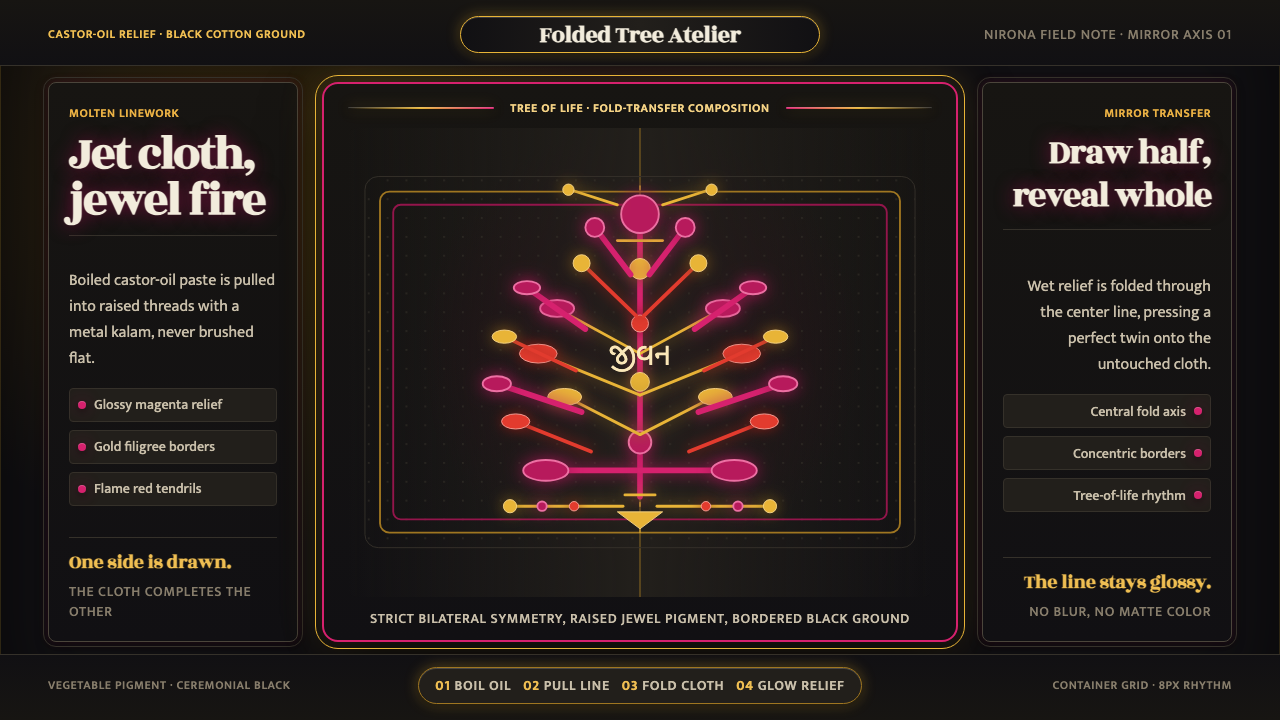
Beneath the black, Rogan painting turns boiled castor oil into glossy relief: magenta and jewel-toned lines fold into a perfect mirror around the Tree of Life.
Kutch Rogan Castor-Oil Painting in brief
Rogan painting is a nearly four-century-old Kutchi folk textile craft preserved by the Khatri family of Nirona village in Kutch, Gujarat, India. Its visual identity comes from a rare combination of materials and method: castor oil is boiled into a thick glossy gel, mixed with vegetable pigments, and drawn directly onto dark cotton cloth. The result is neither flat print nor ordinary brushwork. It is a raised, shining line suspended against black.
The painter works on only one half of the fabric with a metal stylus called a kalam. Once the painted cloth is folded, the wet castor-oil relief presses onto the untouched half and transfers an almost exact mirror image. Bilateral symmetry is therefore not an ornamental decision added at the end; it is built into the physical act of making. Every central stem, curling branch, and jewel-toned contour is shaped by this fold.
Rogan is immediately recognizable because its darkness is active rather than empty. Jet-black cotton provides the ground, while glossy magenta and other jewel-toned lines appear to float above it. The Tree of Life serves as the central visual motif, turning symmetry into an image of growth: the design expands outward from a central axis while remaining disciplined by reflection. The surface feels luminous without using any atmospheric illusion; its light comes from the material itself.

Where does Kutch Rogan Castor-Oil Painting come from?
The craft is associated with a lineage carried from Iran and with the Sassanid-Persian Tree of Life tradition. In Kutch, that lineage became a distinctive textile practice centered on castor oil, vegetable pigments, dark cotton, and the folded transfer. Its continuity is inseparable from the Khatri family of Nirona, which has kept the practice alive across generations rather than allowing it to survive only as a historical reference.
Nirona village is not merely a location attached to the style after the fact. It is the place in which the craft’s living identity is concentrated. The relationship between village, family, cloth, and method gives Rogan its particular character: the work is not a generic decorative pattern but a local practice whose signature depends on a specific material vocabulary and a specific act of making.
The process begins with castor oil, boiled for two days until it becomes a thick, shiny gel. Vegetable pigments are mixed into this substance, producing the colored medium that will become the raised line. The painter then uses the metal kalam to draw directly on the cloth. Because no brush touches the surface, the line retains the pressure and direction of the stylus, giving the finished image a tactile relief rather than a merely colored mark.
The final image is completed through folding. The painter composes only one side, then brings the two halves together so that the castor-oil lines press across the fold. This makes the mirror image a consequence of the craft’s physical sequence. The Tree of Life fits this structure particularly well: its central trunk establishes the axis, while branches and ornamental growth can radiate outward in balanced reflection. Rogan’s history therefore survives not only in its motifs but in its repeatable choreography of preparation, drawing, folding, and transfer.
What defines the Kutch Rogan Castor-Oil Painting look?
Dark Ground
Jet-black cotton is not a neutral backdrop but the active field that makes the relief visible. Its darkness absorbs visual noise and gives every colored line a sharp, luminous presence. The ground should feel continuous and quiet, allowing the glossy marks to carry the entire hierarchy of the composition.
Castor-Oil Relief
The line is glossy because it is made from castor oil boiled into a thick gel, not from a conventional flat pigment wash. Its raised quality gives the image a physical edge and makes light part of the reading experience. The material should look deliberate, concentrated, and slightly tactile rather than thin, dry, or matte.
Jewel-Toned Color
Magenta leads the visual memory of Rogan, joined by jewel-toned pigment lines that glow against black. Color is concentrated inside the relief rather than spread across the whole surface. The palette gains force from restraint: saturated marks should remain distinct, with the dark ground separating them instead of blending them into a continuous field.
Bilateral Symmetry
Symmetry is the governing structure of the craft. It comes from folding the cloth and transferring the wet design, so the two sides should feel related at every scale. The strongest compositions establish a clear central axis, then let branches, curls, and ornamental details echo across it without losing the sensation of organic growth.
Tree of Life
The Tree of Life provides the central image around which the craft’s symmetry becomes legible. Its trunk gives the composition a vertical anchor, while its branches turn reflection into expansion. The motif is not merely an illustration placed on cloth; it is a diagram of balance, continuity, and growth expressed through the same axis that governs the transfer.
Stylus-Made Line
The kalam makes the line direct and intentional. Since no brush touches the cloth, the mark is defined by the movement of a metal stylus and the consistency of the castor-oil medium. Digital adaptations should preserve that sense of a line being drawn, pressed, and deposited, rather than replacing it with soft airbrushing or smooth atmospheric effects.

Who shaped Kutch Rogan Castor-Oil Painting?
Abdul Gafur Khatri is a named figure associated with the living Rogan tradition of Nirona. His importance is best understood through the craft he represents: a technique in which castor oil, vegetable pigment, metal-stylus drawing, and folded transfer remain inseparable. He stands for the continuity of a local practice whose visual language depends on both family transmission and physical making.
The Khatri family of Nirona has kept Rogan painting alive across generations. The family is not simply a historical name attached to an old style; it is the custodial structure through which the method, material knowledge, and disciplined symmetry continue to exist as a craft. The family’s role explains why Rogan remains a living textile practice rather than a reconstructed aesthetic.
The Rogan painter is an anonymous but clearly defined craft role: the maker who prepares the castor-oil medium, works with the kalam on one side of the cloth, and completes the design by folding and pressing it. This figure is central to understanding the style because the visual result cannot be separated from the sequence of actions that produces it.
How do you use Kutch Rogan Castor-Oil Painting today?
Rogan is most transferable when its construction is respected rather than imitated superficially. Begin with a near-black field, establish a strong central axis, and use glossy jewel-toned lines as the primary carriers of attention. Symmetry should organize the composition, while the Tree of Life can provide a central image of branching continuity. Avoid treating the style as a generic dark floral pattern; its identity depends on the relationship between material shine, folded reflection, and raised line.
For presentation slides, the cover should feel like a single dark textile surface interrupted by one luminous, symmetrical motif. The title can sit close to the central axis or align with the branching structure, but it should not compete with the Tree of Life. Content slides should use the same disciplined field: a quiet black ground, restrained jewel-toned rules or line drawings, and clear mirrored relationships. Data slides can turn charts into branching or radial structures, provided the information remains legible and the decorative symmetry does not overpower the evidence.
For web interfaces, Rogan suits dashboards and pricing pages that need a strong dark identity with carefully controlled emphasis. Use the black field as the stable surface, reserve magenta or another jewel tone for active states and important distinctions, and let raised-looking borders or line motifs echo the castor-oil relief. Cards should feel arranged around an axis rather than scattered. Navigation and controls should remain calm and precise so that the glossy accents signal hierarchy instead of becoming constant visual noise.
For editorial and marketing work, the style supports a dramatic relationship between darkness and illumination. A feature article can place a symmetrical Tree of Life or branching line illustration beside a narrow column of text, allowing the image to act as a visual spine. Campaign pages can use the fold as a conceptual device: paired sections mirror one another while carrying different messages. Product or craft storytelling should keep the material process visible, emphasizing the castor oil, the metal stylus, the black cotton, and the transfer rather than presenting the pattern as an unexplained surface.
The common mistake is to copy only the black background and bright magenta accents. That produces a dark decorative theme, not Rogan. Other failures include using loose asymmetry, replacing the raised line with soft glow, introducing too many unrelated colors, or scattering botanical motifs without a central axis. The essential discipline is material and structural: one side is drawn, the image is mirrored, the line has weight and shine, and growth radiates from a controlled center.

Kutch Rogan Castor-Oil Painting — FAQ
Is Rogan painting made with a brush?
No. The painter uses a metal stylus called a kalam, and no brush touches the cloth. The castor-oil medium is drawn directly onto the dark cotton, which helps explain why the finished lines feel raised, deliberate, and tactile rather than like a thin painted wash.
Why is Rogan painting so symmetrical?
The symmetry is created by the making process. The painter works on one half of the fabric, folds it, and presses the wet castor-oil lines onto the other half. The second side is therefore a transferred mirror image, making bilateral balance a structural consequence rather than an optional decorative preference.
What gives the lines their glossy relief?
Castor oil is boiled for two days until it becomes a thick, shiny gel, then mixed with vegetable pigments. When this medium is drawn onto the cotton, it remains as a raised line with a reflective surface. The visual glow comes from the material and its relief, not from a painted light effect.
Is the Tree of Life only a decoration?
Within the supplied Rogan tradition, the Tree of Life is the central motif around which the composition is organized. Its trunk establishes the axis and its branches make the mirrored structure readable. It therefore functions as both image and framework: a representation of growth whose form reinforces the physical logic of folded transfer.
Related design styles
 Torajan Tongkonan (Boat-Roof House)Ancestral dusk, carved in color. Soot black frames ochre, lime white, and tur…
 Andhra Cheriyal Scroll PaintingSaturated oral memory. Mineral red registers, mustard diamonds, and serif son…
 Bishnupur Terracotta TemplesThe wall tells the story. Fired-clay relief panels unfold in warm horizontal…
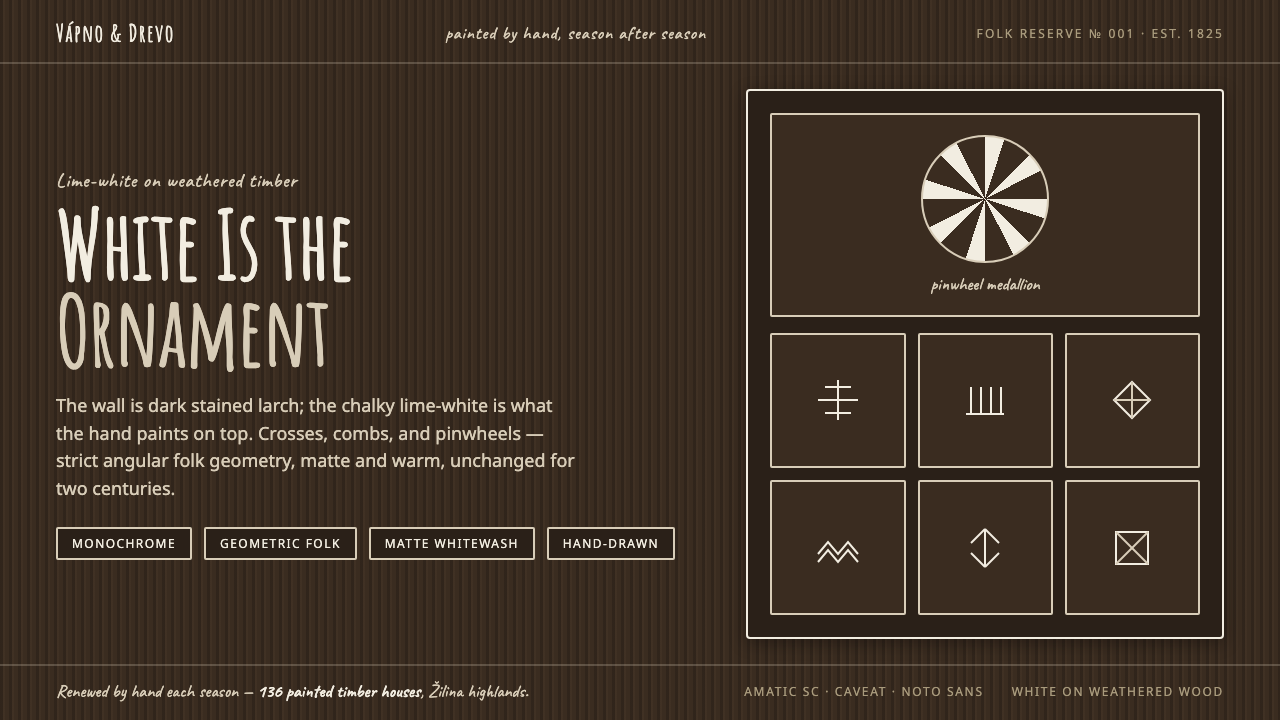 Čičmany Painted House OrnamentWhite is the ornament, not the page. Lime-white folk geometry on dark weather…
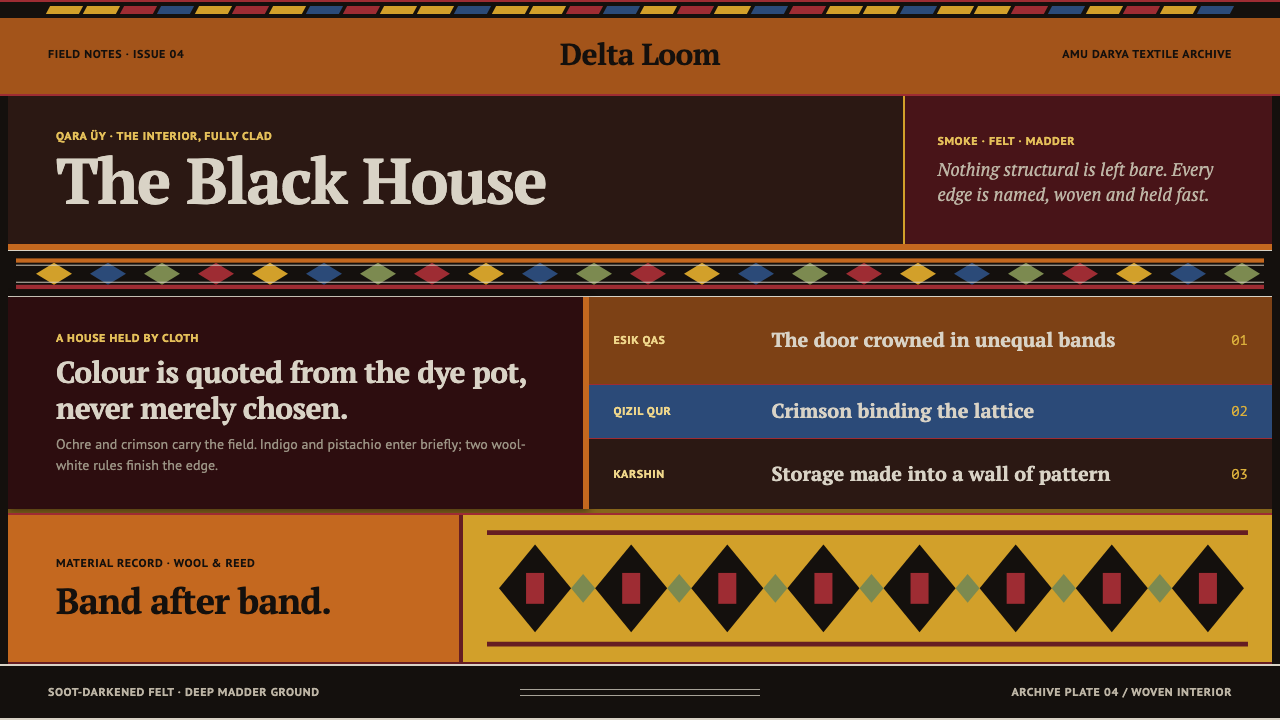 Karakalpak Yurt InteriorNo surface is left bare. Ochre, crimson and indigo bands wrap a smoke-darkene…
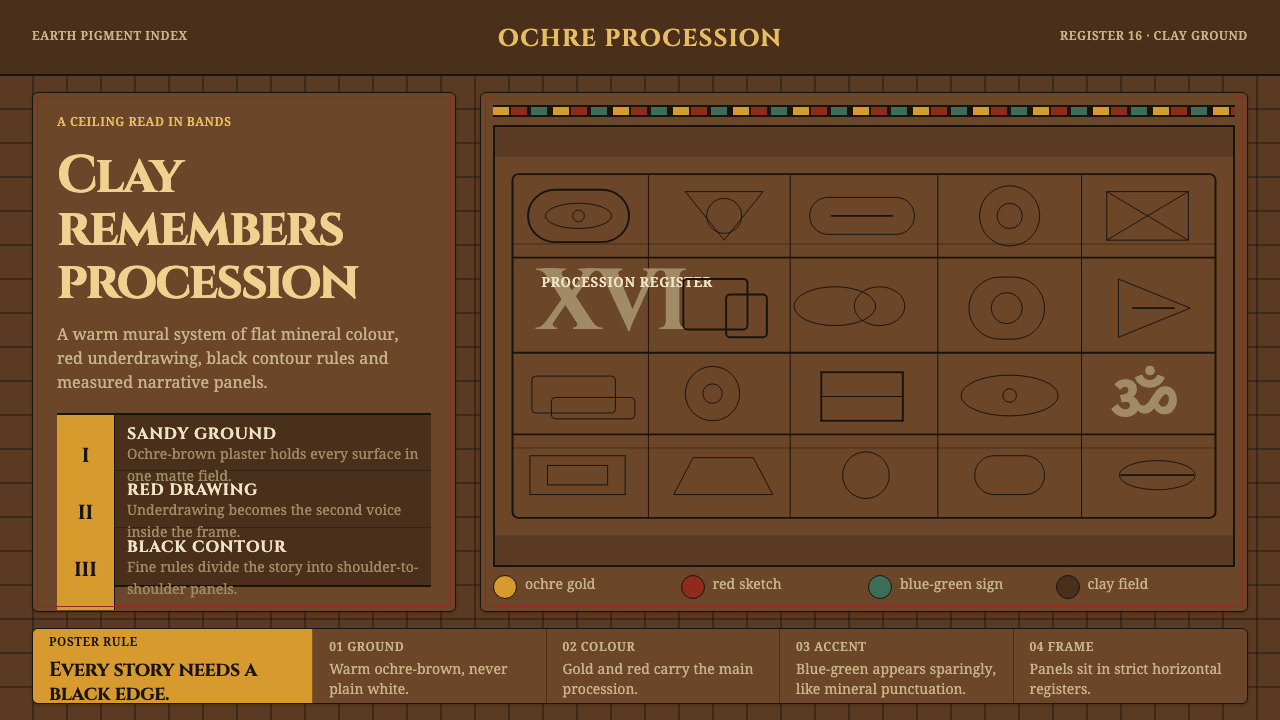 Lepakshi Vijayanagara CeilingEarth remembers in registers. Ochre gold, red underdrawing and black rules ma…