What is Čičmany Painted House Ornament?
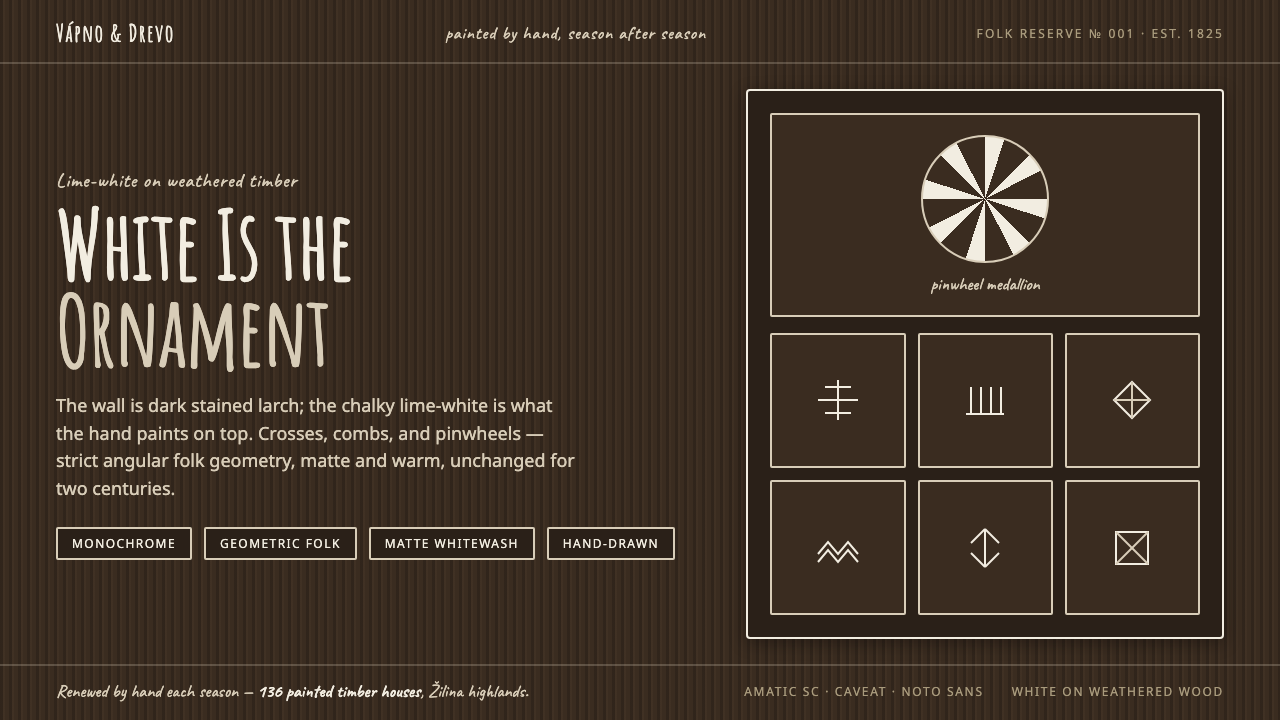
Čičmany turns the wall into the artwork: chalky white folk geometry emerges from dark weathered Slovak timber, carrying protection, memory, and handwork into the screen.
Čičmany Painted House Ornament in brief
Čičmany Painted House Ornament is the visual language of a Slovak mountain village where dark weathered timber cottages are covered with hand-painted, lime-white geometric ornament. Crosses, combs, hearts, and pinwheels are arranged as angular patterns across the wood, creating a surface that feels both architectural and intimate. The patterns have remained substantially unchanged since about 1825, giving the style a strong sense of continuity rather than historical reconstruction.
The central principle is an inversion of the usual decorative instinct. White is not the page, the wall, or the neutral field; white is the ornament. The ground is dark stained and weathered timber, while the warm chalky white sits on top as a protective and expressive layer. This relationship gives every mark unusual authority. A line does not float in empty space. It is painted onto a surface that already carries age, grain, and material presence.
On screen, the style depends on strict geometry softened by evidence of the hand. Angular line, matte brushwork, dark grounds, and hand-drawn type recreate the spirit of a whitewashed cottage without turning it into a generic rustic theme. The result should feel ordered but not mechanical, ceremonial but not precious, and visibly made rather than digitally polished.
Where does Čičmany Painted House Ornament come from?
Čičmany is a mountain village in the Žilina region of Slovakia, part of the folk-architecture tradition of Eastern Europe. Its cottages are built from dark timber that weathers into a deep, muted ground. The ornament belongs directly to this architecture: it is not a detachable graphic layer applied for tourism or display, but a recurring treatment of the houses themselves.
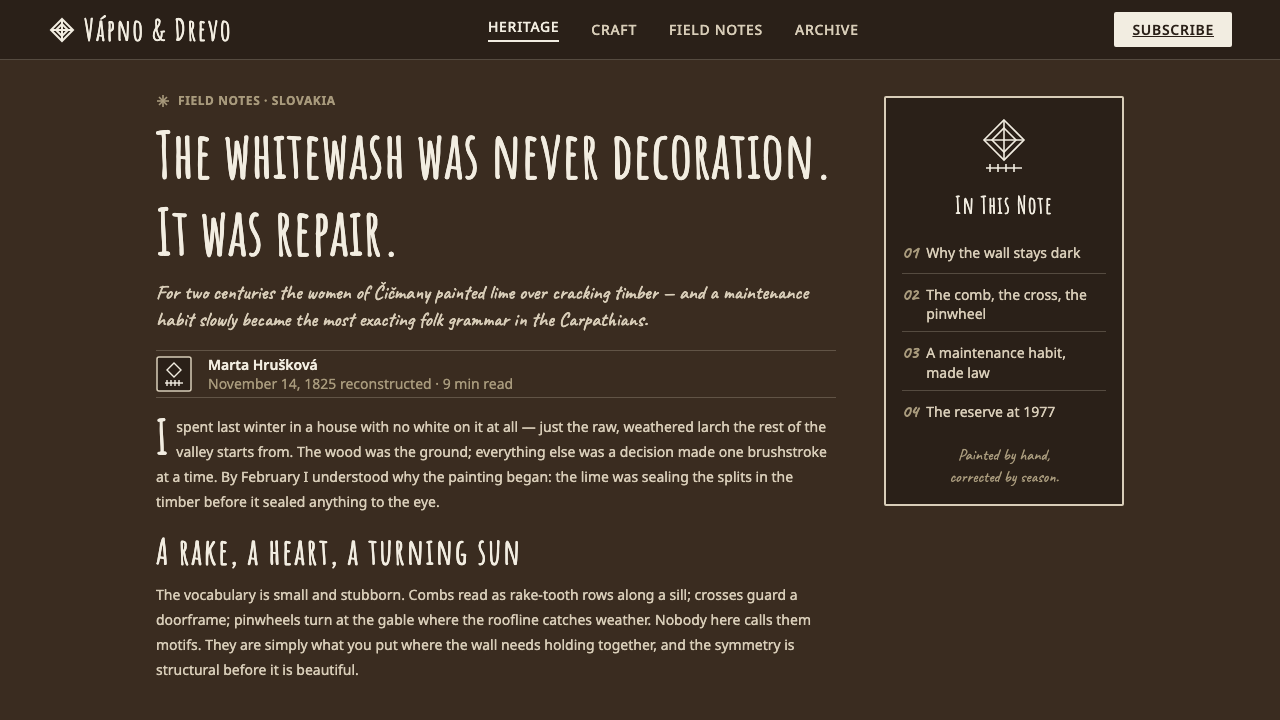
The whitewash began as a practical response to the vulnerability of cracked larch wood. Lime was applied to protect the timber, and the protective treatment gradually became more elaborate. Angular lines and repeated geometric forms developed into a living folk grammar. Practical maintenance and visual identity therefore became inseparable: the same white surface that helped preserve the wood also made the houses recognizable as part of a shared village tradition.
The patterns were renewed by the village women, who continued the protective work by hand each season. Their role is essential to understanding the style. The ornament is not merely a fixed archive of motifs; it is a practice of returning to the wall, renewing the white layer, and preserving a visual language through repeated manual action. The crosses, combs, hearts, and pinwheels belong to this continuity of making.
The architectural tradition was formally protected when Čičmany became the world's first folk-architecture reserve in 1977. That designation confirmed the importance of the village as a preserved environment rather than a collection of isolated decorative details. For contemporary design, the lesson is equally important: the style comes from the relationship between ground, material, maintenance, and ornament. Reproducing a few white symbols without that relationship produces a costume, not a system.
What defines the Čičmany Painted House Ornament look?
Dark Timber Ground
The ground is the first and most important decision. Use a dark, weathered timber-like field rather than a clean white canvas. It should feel stained, aged, and materially present, allowing the ornament to read as something painted onto a surface. The darkness is not a dramatic backdrop added for contrast; it is the architectural foundation of the visual language.
Chalky Lime White
White functions as ornament, not as empty space. The preferred white is warm, chalky, and matte, closer to limewash than to a sharp digital white. It should feel deposited by a brush and absorbed by timber. The contrast with the dark ground is direct but not glossy, giving the palette a quiet physicality.
Folk Geometry
The visual vocabulary is built from crosses, combs, hearts, and pinwheels. These forms should remain legible as simple geometric constructions, with angular lines and repeated arrangements doing most of the organizational work. Their strength comes from recurrence and variation within a shared grammar, not from elaborate illustration or ornamental complexity.
Hand-Renewed Line
The ornament must retain the feeling of manual renewal. Lines can be disciplined and geometric while still carrying the slight irregularity of a brush moving across wood. This is not careless roughness. It is the visible trace of a seasonal practice in which village women renewed the protective lime patterns by hand.
Matte Materiality
Čičmany ornament is tactile without being decorative for decoration's sake. Dark timber and lime-white paint should feel dry, absorbent, and subdued rather than polished or luminous. In digital applications, matte surfaces and restrained contrast help the work retain its connection to weathered wood and protective whitewash.
Drawn Type
Typography should feel drawn into the same world as the house ornament. Hand-drawn letterforms can echo the angular grammar without becoming a literal imitation of every motif. Type needs to remain readable, but its character should be made rather than mechanically neutral. The best result lets lettering and ornament share a surface logic.
Who shaped Čičmany Painted House Ornament?
The village women who renewed the protective lime patterns by hand each season are the human keepers of the system. Their work connects preservation to authorship: maintaining the timber also meant maintaining a recognizable visual grammar. They represent the repeated, communal labor that keeps the ornament alive rather than turning it into a frozen historical sample.
The dark timber cottage is both architecture and canvas. Its weathered surface gives the white ornament a grounded field, while the larch wood explains why limewash was needed in the first place. The cottage embodies the style's inseparable relationship between material condition, practical protection, and visual identity.
The crosses, combs, hearts, and pinwheels form a living folk grammar rather than a random collection of motifs. Their continuity since about 1825 gives the system cultural depth, but their meaning in design comes from how they repeat, align, and belong to the dark ground. The grammar is strongest when it organizes the surface instead of merely decorating it.
How do you use Čičmany Painted House Ornament today?
Čičmany Painted House Ornament transfers best when its governing relationship is preserved: dark ground first, white ornament second, geometry held firmly, and handwork allowed to remain visible. The goal is not to cover a layout with folk symbols. It is to make the whole composition feel as though it has been painted onto a weathered architectural surface and renewed through use.
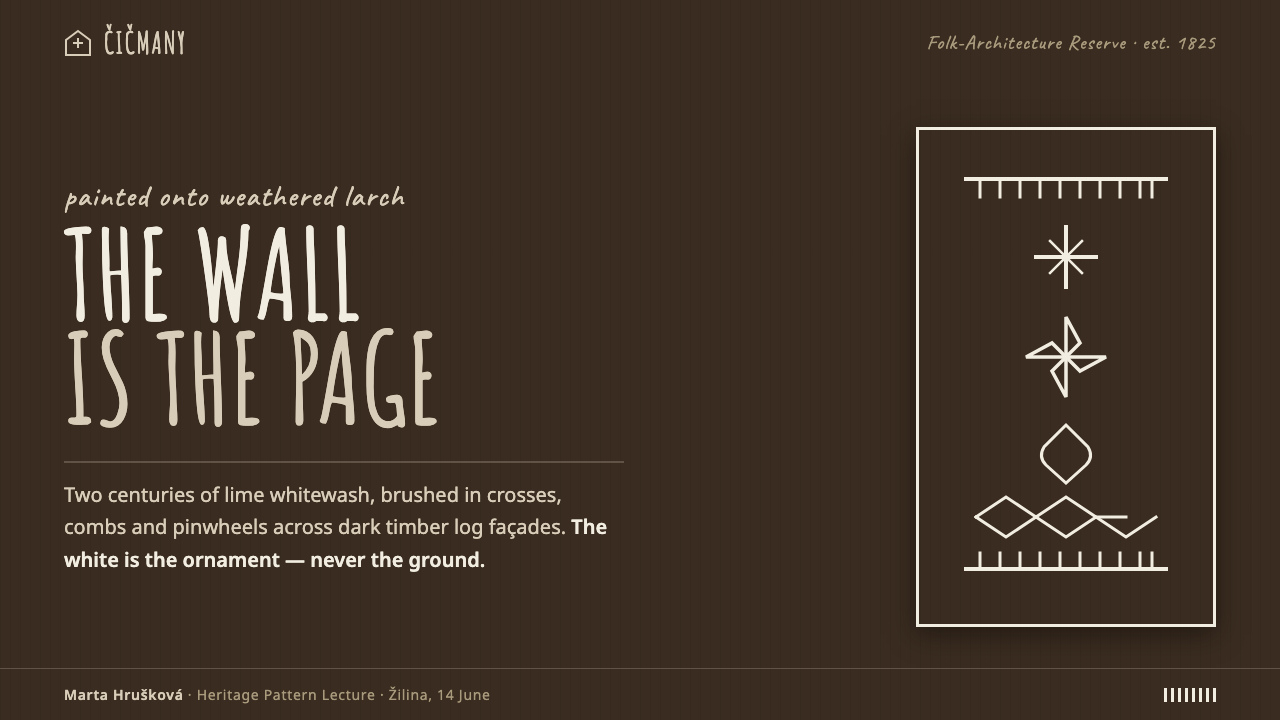
For presentation slides, use the dark timber-like ground as the persistent field across the deck. Cover slides can place a bold white cross, heart, comb, or pinwheel arrangement near the edge, with hand-drawn title lettering treated as another painted element. Content slides should keep their structure calm and legible, using white ornament to mark sections or frame key statements. Data slides can turn repeated geometric marks into a visual counting system, provided the pattern remains subordinate to the information.
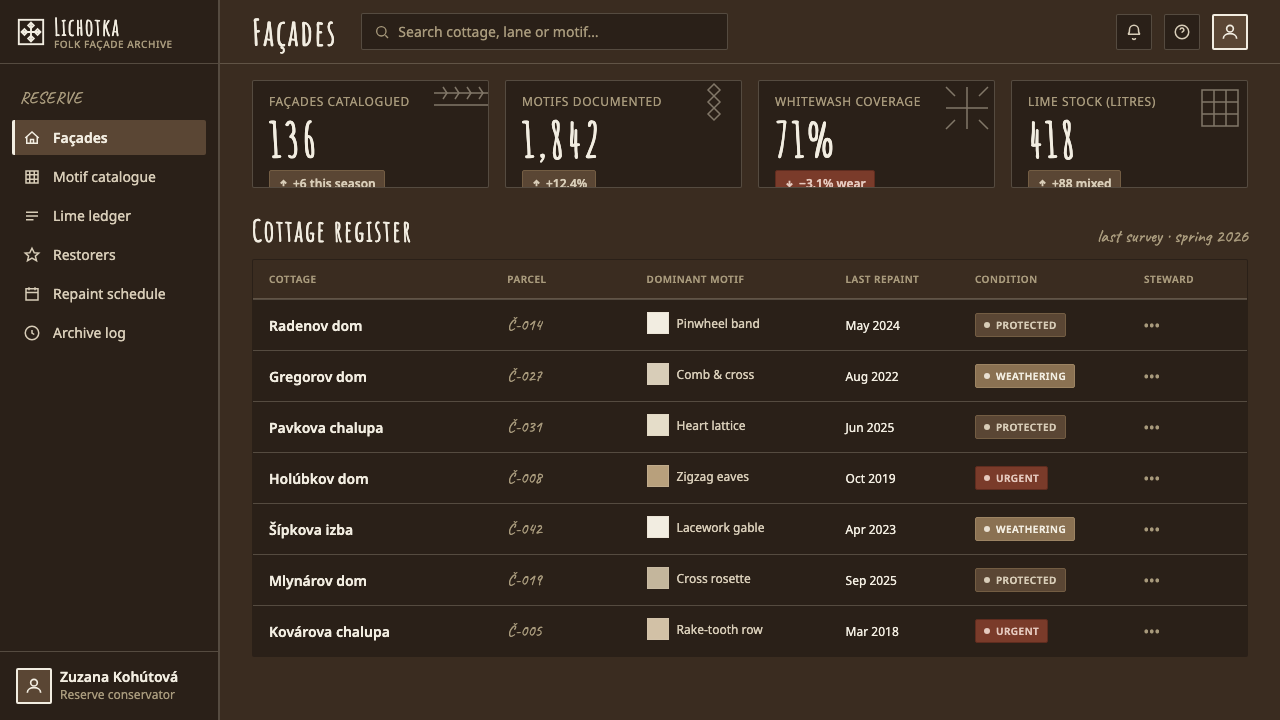
For web interfaces, the style suits dashboards and pricing pages that can support a strong dark foundation and a tactile, hand-made identity. Panels should read as areas painted or set onto the same dark surface, while white is reserved for primary text, essential outlines, and meaningful geometric indicators. Pricing tiers can be distinguished through changes in ornament density or motif arrangement rather than a parade of unrelated colors. The system works when the interface feels coherent as a village wall, not when each card becomes a separate decorative object.
For editorial and marketing work, the style creates a memorable contrast between grounded material darkness and luminous white marks. Article pages can use angular ornaments as section signals, while broad dark fields give photographs, statements, or product details a strong sense of place. Campaigns can treat a single repeated motif as a recognizable signature, letting the hand-drawn quality carry warmth without abandoning structure. The result should feel local, protective, and made by people.
The common mistake is reversing the hierarchy: placing white everywhere as the background and sprinkling dark symbols on top. That produces a generic folk pattern and loses the defining idea that white is the ornament. Another mistake is making the geometry perfectly sterile. Čičmany depends on disciplined forms that still reveal brushwork, weathering, and renewal. If the result looks like a polished icon set or a rustic sticker sheet, the material relationship has been lost.
Čičmany Painted House Ornament — FAQ
Should Čičmany ornament use a white background?
No. Its defining relationship is the opposite: the ground is dark weathered timber, and the chalky white is painted ornament. A white background may be useful for a restrained variation, but it should not be presented as the canonical logic of the style. The dark field is what makes the white marks feel material, protective, and architectural.
Are the crosses, combs, hearts, and pinwheels symbolic icons?
The approved material identifies them as recurring geometric ornaments, not as a fixed symbolic icon dictionary. Their strongest design role is grammatical: they repeat, align, and organize the painted surface. Use them as part of a coherent pattern language rather than assigning unsupported meanings to each individual form.
Why is hand-drawn irregularity important?
Because the ornament comes from seasonal manual renewal by the village women. Slight variation shows that the pattern is a living practice applied to timber, not a mechanically reproduced graphic. The geometry should remain clear and disciplined, but it must not erase the evidence of the brush and the material beneath it.
Can this style work for a light interface?
It can be adapted, but a light interface must preserve the original hierarchy somehow. If the entire experience becomes pale and neutral, the defining contrast disappears. A successful adaptation keeps a dark architectural field for important regions and uses warm white as the active mark, text, outline, or ornament rather than treating it as a passive background.
What makes this different from a generic rustic style?
Čičmany is not defined by roughness, vintage effects, or decorative folk imagery alone. Its identity comes from a specific material relationship: cracked larch wood protected by limewash, dark timber carrying white geometric ornament, and a seasonal hand-renewal practice preserved through the village. Remove that relationship and the result may look rustic, but it is no longer Čičmany.
Related design styles
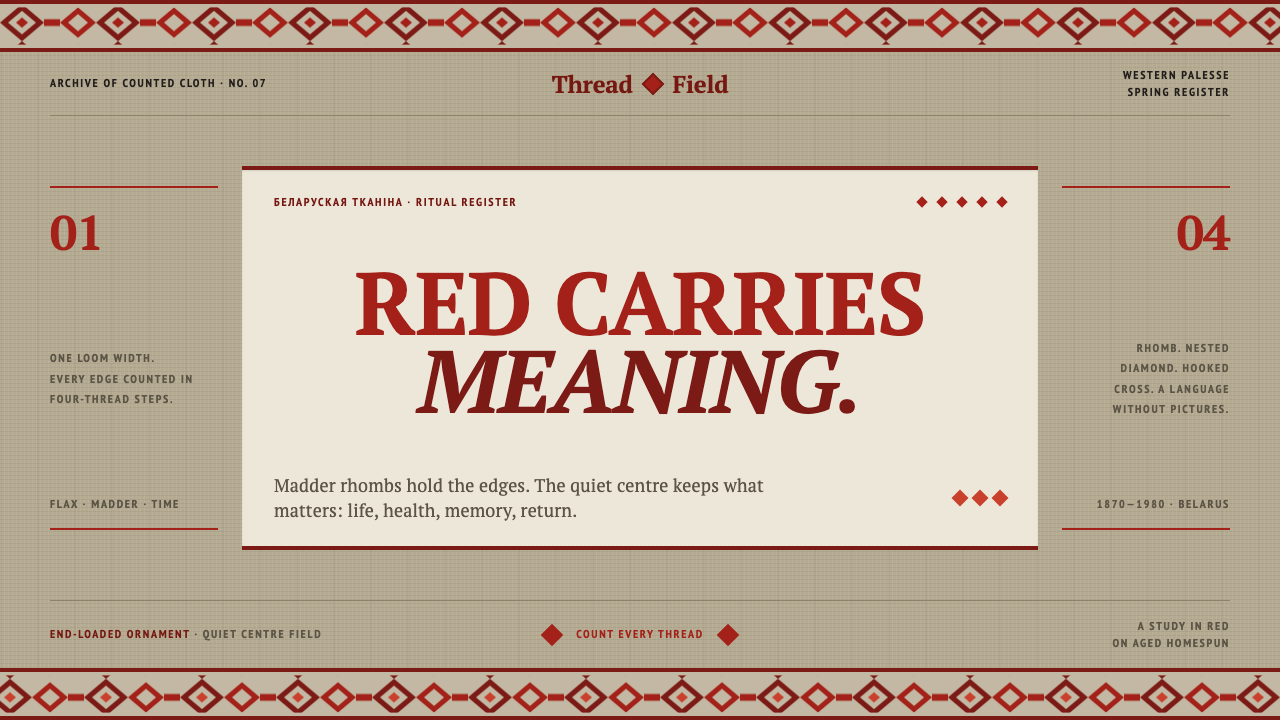 Belarusian RushnykRed carries meaning. Madder rhombs crowd aged flax edges while the woven cent…
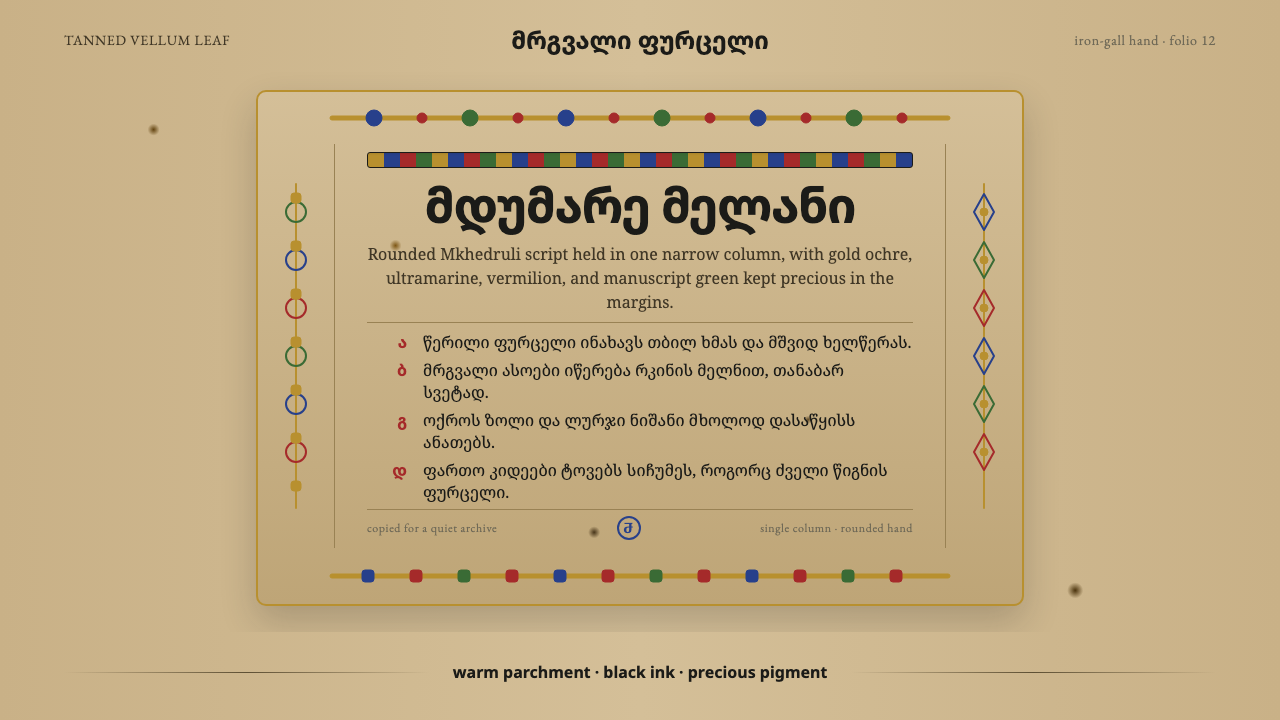 Georgian MkhedruliA manuscript breathes slowly. Tanned vellum, round Mkhedruli ink, ochre and u…
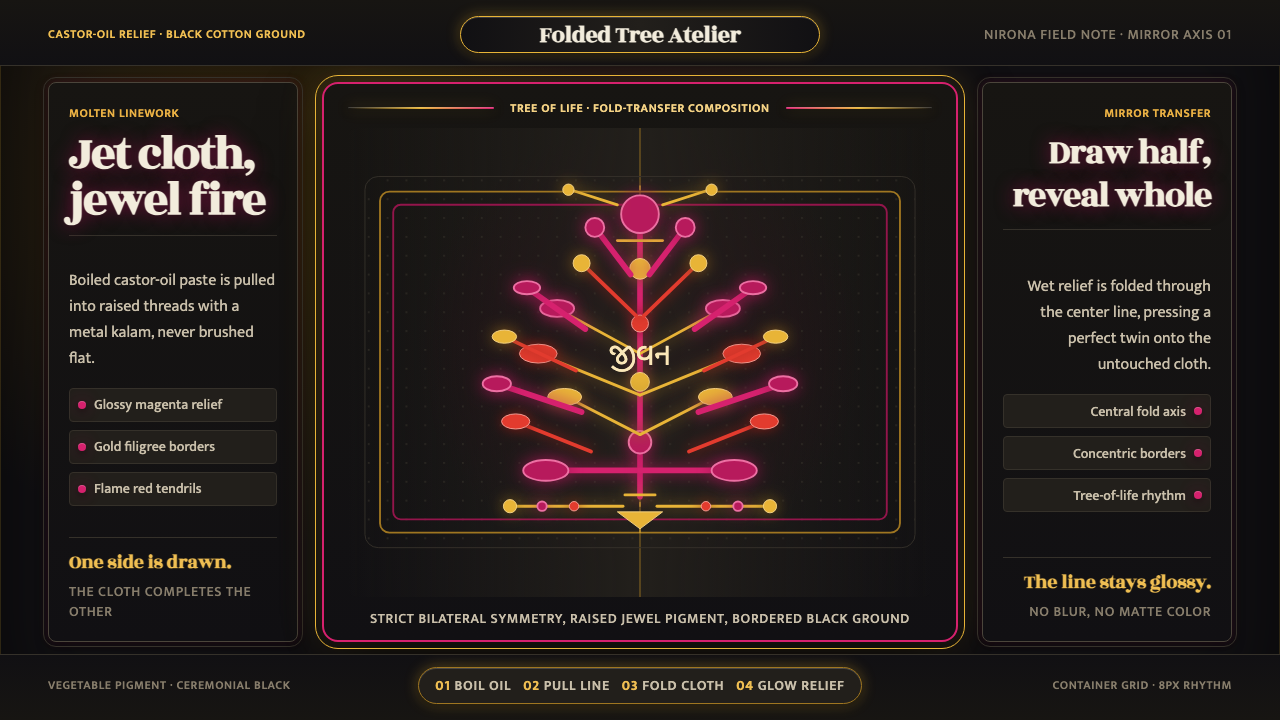 Kutch Rogan Castor-Oil PaintingGlossy symmetry holds the dark. Magenta castor-oil lines mirror across black…
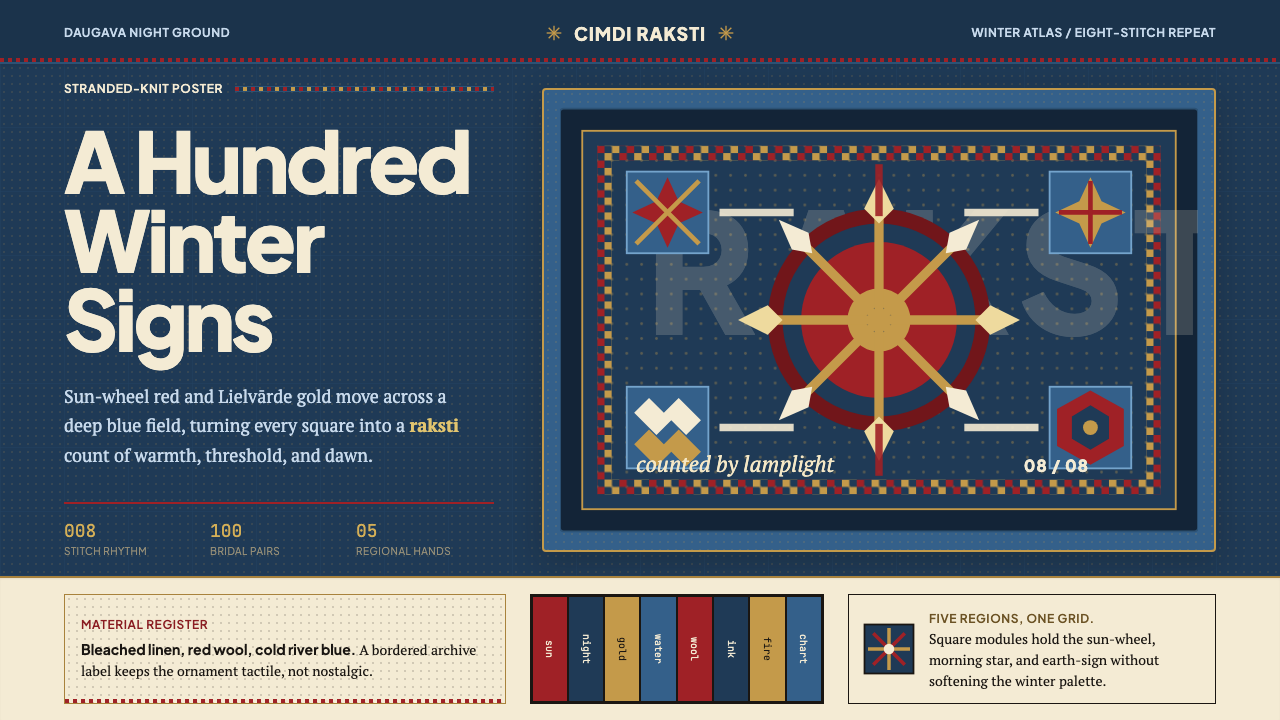 Latvian Knitted MittensWinter craft glows. Sun-wheel red and Lielvarde gold lock into an 8-stitch bl…
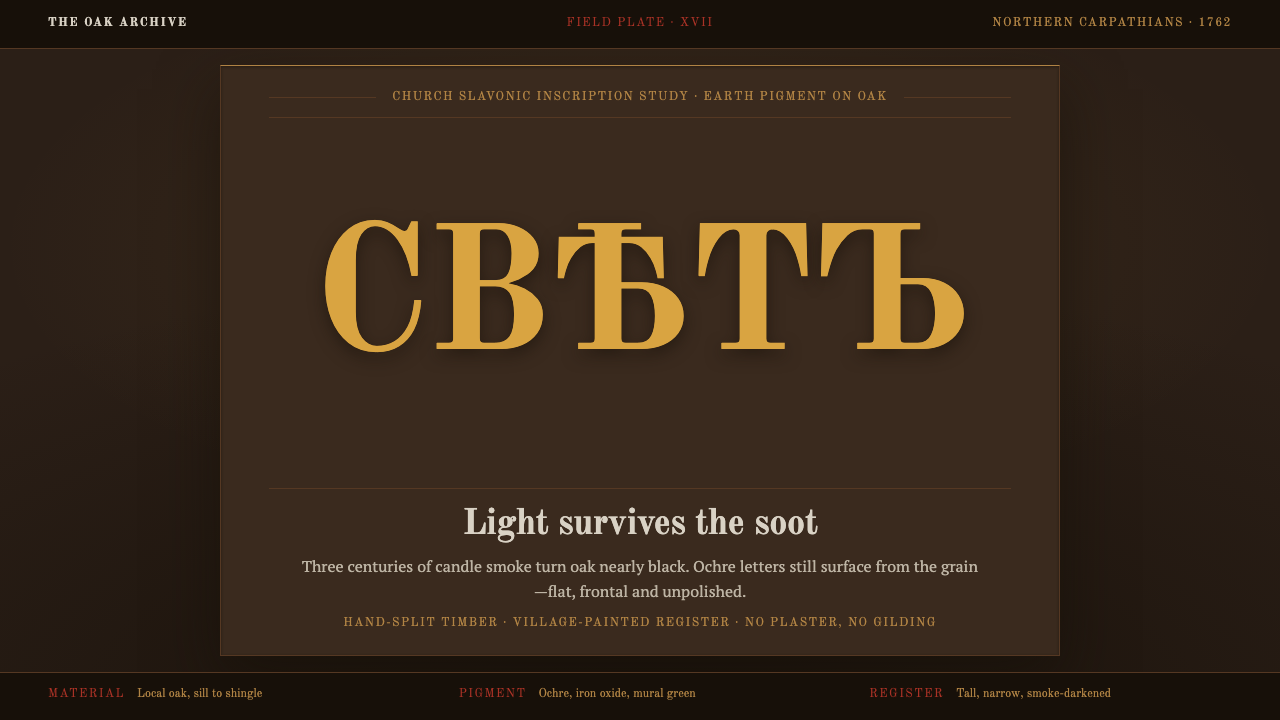 Maramureș Wooden ChurchLight survives the soot. Ochre type and earth-red geometry rise through smoke…
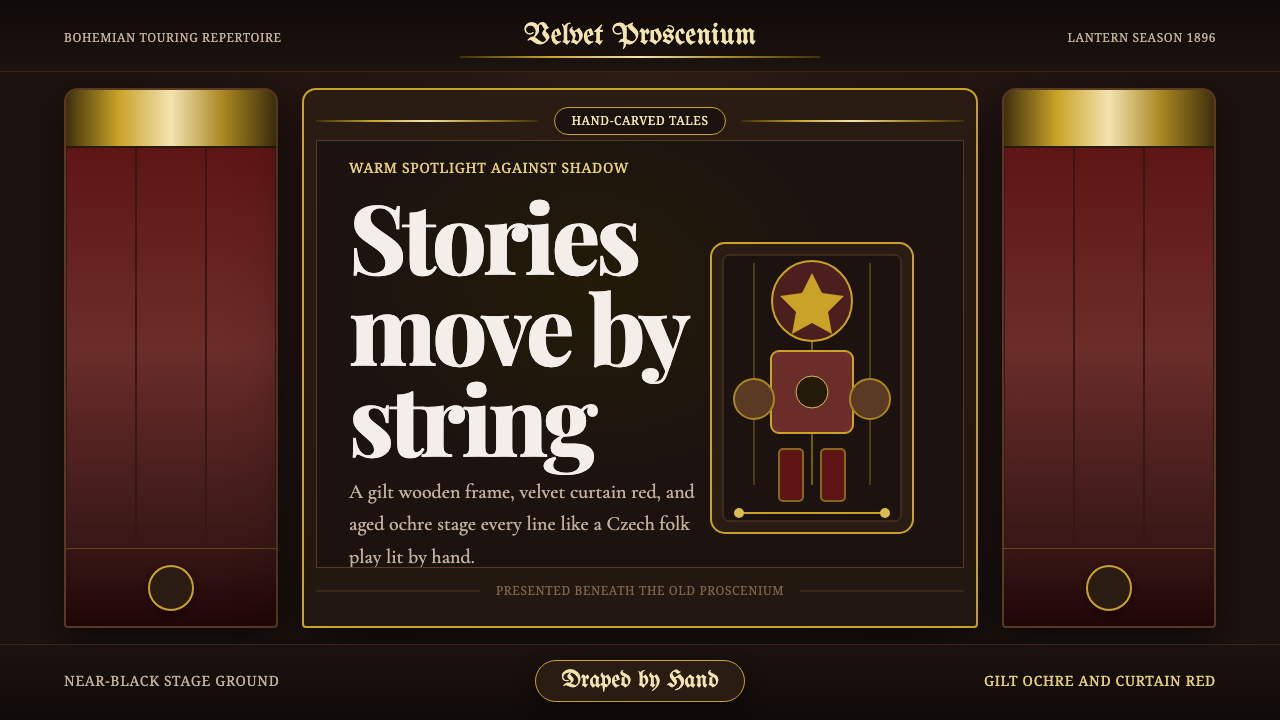 Marionette TheaterStorytelling feels hand-lit. Curtain red, gilt borders, and carved serif type…