What is Marquesan Enata Tapa Motif?
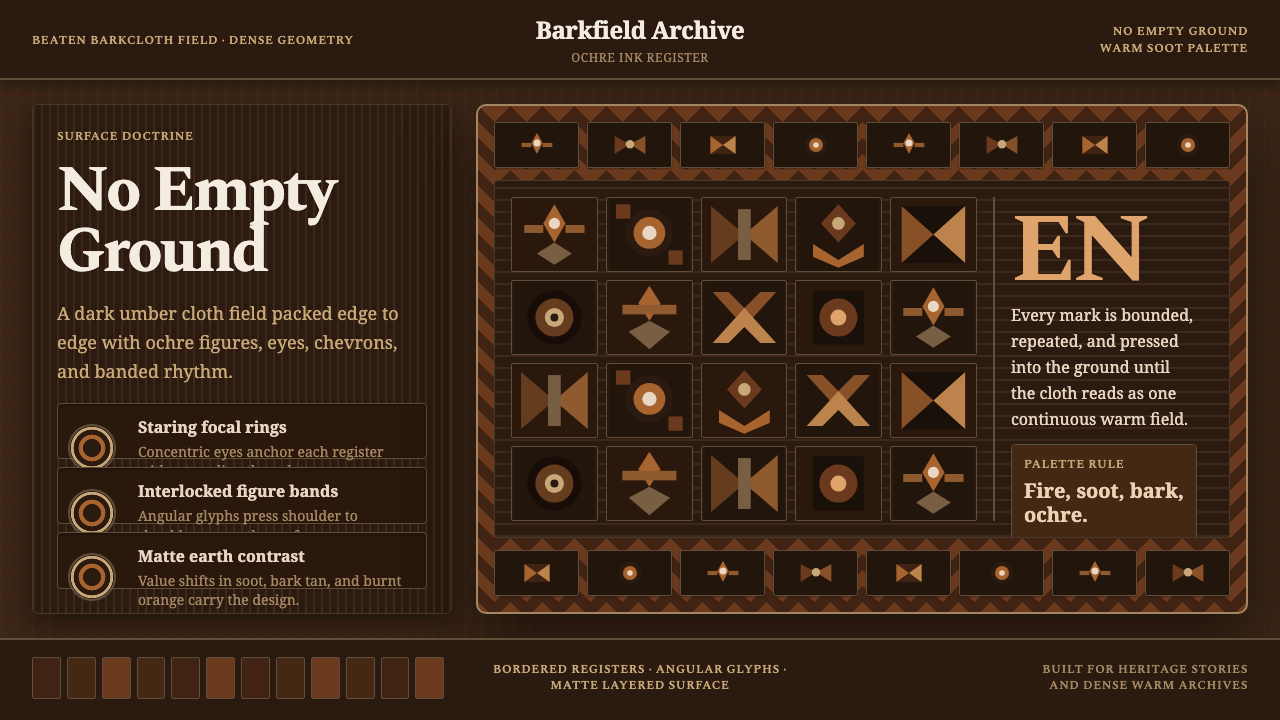
Marquesan Enata Tapa turns a dark barkcloth ground into a continuous field of ochre human geometry, where density, warmth, and direct material expression leave no room for emptiness.
Marquesan Enata Tapa Motif in brief
Marquesan Enata Tapa Motif is a visual language rooted in traditional tapa production on Fatu Hiva in the Marquesas Islands of French Polynesia. Sheets of beaten mulberry bark become a dark, fibrous ground for repeated enata — human figures — and staring tiki eyes, drawn in ochre and soot. The defining impression is not a single emblem but a surface filled from edge to edge, with chevrons, bands, and figures interlocking so that the cloth reads as one continuous field.
The motif system treats repetition as structure rather than decoration. Human figures become modular signs, arranged in sequences that create rhythm without introducing an empty interval. Tiki eyes add a direct, watchful presence, while bands and chevrons organize the surrounding density. The result is warm, tactile, and emphatically planar: the pattern does not float above the ground but appears worked into the barkcloth itself.
Its palette comes from the island’s available materials — burnt earth ochres, plant soot, and tree saps — producing a range of browns, blacks, oranges, reds, and yellows. In digital interpretation, the ground remains deep umber rather than pale, while continuous ochre-brown geometry carries the visual energy. The system is therefore defined as much by material and coverage as by iconography: dark fiber beneath, warm marks above, and almost no visual silence between them.

Where does Marquesan Enata Tapa Motif come from?
The origin of the motif lies in traditional Marquesan tapa production, recorded here as a practice established before 1900. On Fatu Hiva, mulberry bark was beaten into sheets, creating the physical substrate for painted pattern. The cloth was not treated as a neutral white page. Its dark, fibrous surface remained part of the visual identity, giving every ochre or soot mark an immediate sense of contact with material.
The production process explains the motif’s unusually dense appearance. Enata figures, tiki eyes, chevrons, and bands were placed across the cloth as connected components rather than isolated illustrations. Edge-to-edge interlocking allowed the pattern to continue across the surface, so the eye encounters a field of recurrence instead of a central image surrounded by open ground. Density is therefore not an incidental visual effect; it is a consequence of how the surface is organized.
The palette also follows the resources of the Marquesan environment described in the source material. Burnt earth ochres supply the dominant warmth, plant soot provides the deepest dark marks, and tree saps help complete a family of browns, blacks, oranges, reds, and yellows. Because these colors are materially derived, they belong to the same visual world as the barkcloth ground. The contrast is present, but it remains earthy rather than luminous or synthetic.
The cultural vocabulary of the style is carried by the enata and tiki forms. The enata is a repeating human figure; the tiki eye is a staring sign with immediate visual force. Together they establish a system in which the human and the watchful are repeated across a surface that feels inhabited. In contemporary digital use, the responsibility is to preserve that relationship: geometry should feel continuous and material, the dark ground should remain active, and the motif should not be reduced to a few decorative icons placed on an otherwise empty interface.
What defines the Marquesan Enata Tapa Motif look?
Dark Barkcloth Ground
The ground is deep umber, fibrous in character, and visually active. It should feel like barkcloth rather than a generic dark background: warm, slightly irregular, and capable of holding ochre marks without becoming black void. The surface establishes the style’s emotional temperature before any figure appears.
Ochre Material Palette
Ochre leads the palette, supported by soot-dark marks and related earthy browns, oranges, reds, and yellows. The colors should appear gathered from earth, plants, and sap rather than selected for electronic brightness. Warm variation is welcome, but the palette remains materially coherent and never becomes a collection of unrelated accents.
Repeating Enata
The enata figure is a modular human sign whose power comes from recurrence. Repetition turns individual figures into a collective rhythm, allowing the motif to read as a field rather than a sequence of separate illustrations. Figures can face, echo, or interlock with neighboring forms, but they should retain a clear human presence.
Tiki Eyes
Staring tiki eyes interrupt pure pattern with an unmistakable sense of presence. They are not soft mascots or incidental ornaments; their direct gaze gives the surface a watchful intensity. Used sparingly within a dense field, they become moments of recognition that keep repetition from becoming anonymous.
Edge-to-Edge Interlock
Chevrons, bands, and figures are arranged to continue across the surface. The pattern should not depend on a single centered emblem or a wide margin around it. Its characteristic movement comes from components meeting at the edges, creating continuity, compression, and a sense that the field could keep extending beyond the visible frame.
Direct Mark-Making
The visual language favors marks that appear applied directly to the ground. Edges may feel hand-worked and material, but they should remain legible and intentional. The style gains strength from the visible relationship between pigment and substrate, not from simulated polish, glossy depth, or decorative effects detached from the cloth.

Who shaped Marquesan Enata Tapa Motif?
The Marquesan tapa beaters are the makers of the ground itself. By repeatedly beating mulberry bark into sheets, they establish the dark, fibrous surface that makes every later mark materially specific. Their role is not merely preparatory: the density, warmth, and tactile authority of the finished motif depend on the barkcloth substrate they create.
Marquesan motif painters cover the barkcloth with enata figures, tiki eyes, chevrons, and bands in ochre and soot. Their practice turns separate signs into an interlocking field. The key achievement is compositional continuity: each mark participates in the larger surface, so the cloth feels inhabited rather than merely decorated.
Enata and tiki iconography functions as the collective visual vocabulary of the style. The repeating human figure supplies rhythm and social presence, while the staring eye supplies recognition and watchfulness. Together they keep the system grounded in the human and the inhabited, even when the pattern is treated abstractly.
How do you use Marquesan Enata Tapa Motif today?
For presentation slides, use the motif as a continuous framing system rather than a small decorative badge. A cover can place the title inside a dark bark-brown field with an ochre band or enata sequence crossing the composition. Content slides benefit from a quieter density: let the pattern occupy an edge, header zone, or background field while keeping the main text clearly separated. Data slides can use repeated figures, bands, or chevrons as structural markers, provided the data itself remains legible and the motif does not become visual noise.
For web interfaces, the style suits dashboards, pricing pages, and analytical tools that need a strong sense of identity. A dark barkcloth ground can carry the page shell, while warm ochre geometry marks navigation, active states, or tier distinctions. Panels should feel integrated into the field rather than floating as sterile cards. Tiki eyes can identify important status areas, but their gaze should remain purposeful; every symbol needs a clear role in the information hierarchy.
For editorial and marketing work, the motif supports covers, section openers, packaging-like announcements, and campaigns that want to feel rooted, tactile, and culturally specific. Use a dense pattern as a full-bleed atmosphere, then create readable zones through contrast and controlled interruption rather than pale empty space. Headlines can sit against a calmer portion of the barkcloth field, while bands and enata sequences guide the reader through sections or call attention to a statement.
In identity systems, continuity is more important than isolated ornament. A recurring band can connect a website, presentation, and social graphic; an enata sequence can become a recognizable border language; a tiki eye can function as a deliberate point of attention. The system works best when the same material logic appears everywhere: dark ground, warm pigment, repeated human geometry, and marks that seem applied directly rather than rendered as polished digital decoration.
The common mistake is to use the motif as a few brown icons on a mostly empty dark interface. That preserves the color family but loses the defining principle: the surface should feel occupied and continuous. Another mistake is to make the pattern too clean, glossy, or futuristic. Enata Tapa depends on density, earthy warmth, and the visible relationship between mark and barkcloth; remove those qualities and only a generic tribal-inspired ornament remains.

Marquesan Enata Tapa Motif — FAQ
Is Marquesan Enata Tapa a pattern or a broader design system?
It is best understood as a broader design system expressed through pattern. The repeated enata figures and tiki eyes are important, but so are the dark barkcloth ground, the earthy material palette, the edge-to-edge interlock, and the refusal of empty ground. Using one icon without preserving those relationships produces a fragment, not the full visual language.
Why is the ground dark instead of pale?
The dark ground comes from the barkcloth substrate described in the source material. It preserves the sense that the motif is made on a fibrous material rather than placed on a neutral page. A pale ground would change the balance, weaken the relationship between pigment and substrate, and make the system feel more like ordinary decorative patterning.
Can the motif work in a clean modern interface?
Yes, but modernity should come from organization and restraint, not from erasing the motif’s material character. The pattern can frame a dashboard, distinguish pricing tiers, or give an editorial page a strong identity. The interface should still preserve the dark field, warm marks, repeated geometry, and deliberate density that make the style recognizable.
How much repetition is appropriate?
Repetition should be strong enough that the surface feels continuous, but varied enough that the eye can recognize figures, bands, and eyes as distinct signs. The goal is neither a sparse scattering of symbols nor an unreadable wall of identical marks. Use changes in grouping, direction, and material emphasis to create rhythm while keeping the overall field dense.
Related design styles
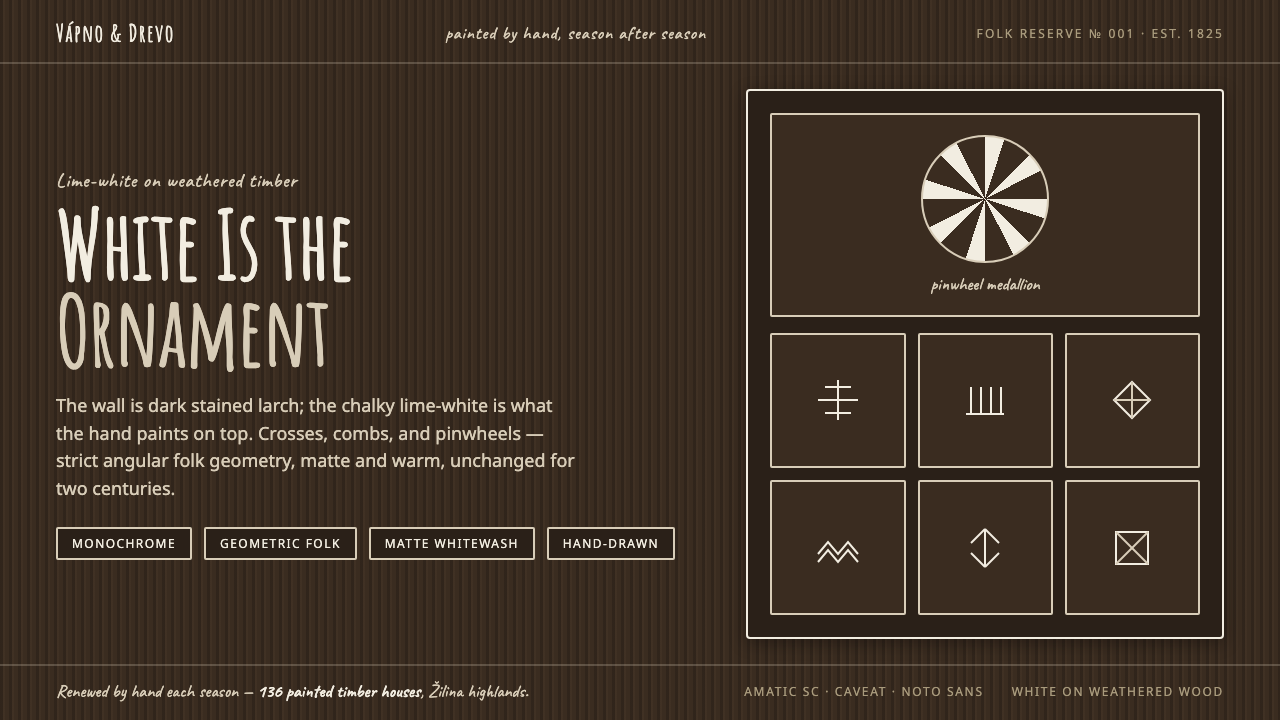 Čičmany Painted House OrnamentWhite is the ornament, not the page. Lime-white folk geometry on dark weather…
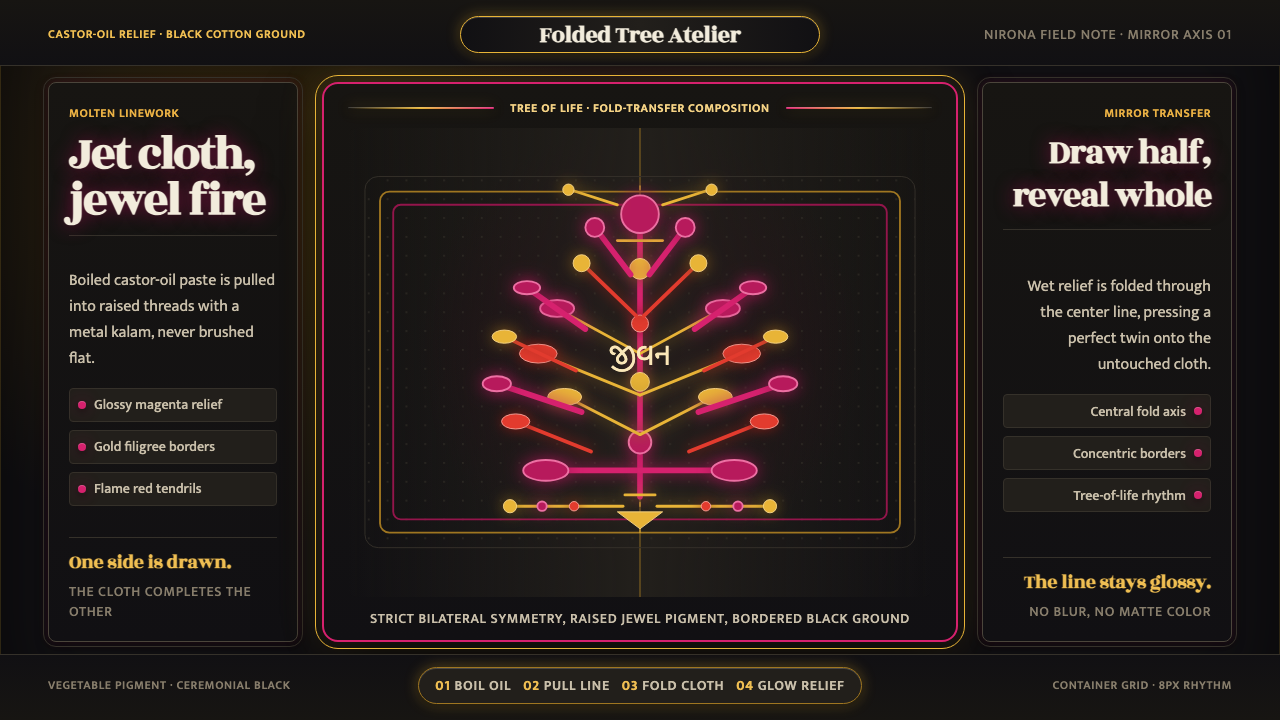 Kutch Rogan Castor-Oil PaintingGlossy symmetry holds the dark. Magenta castor-oil lines mirror across black…
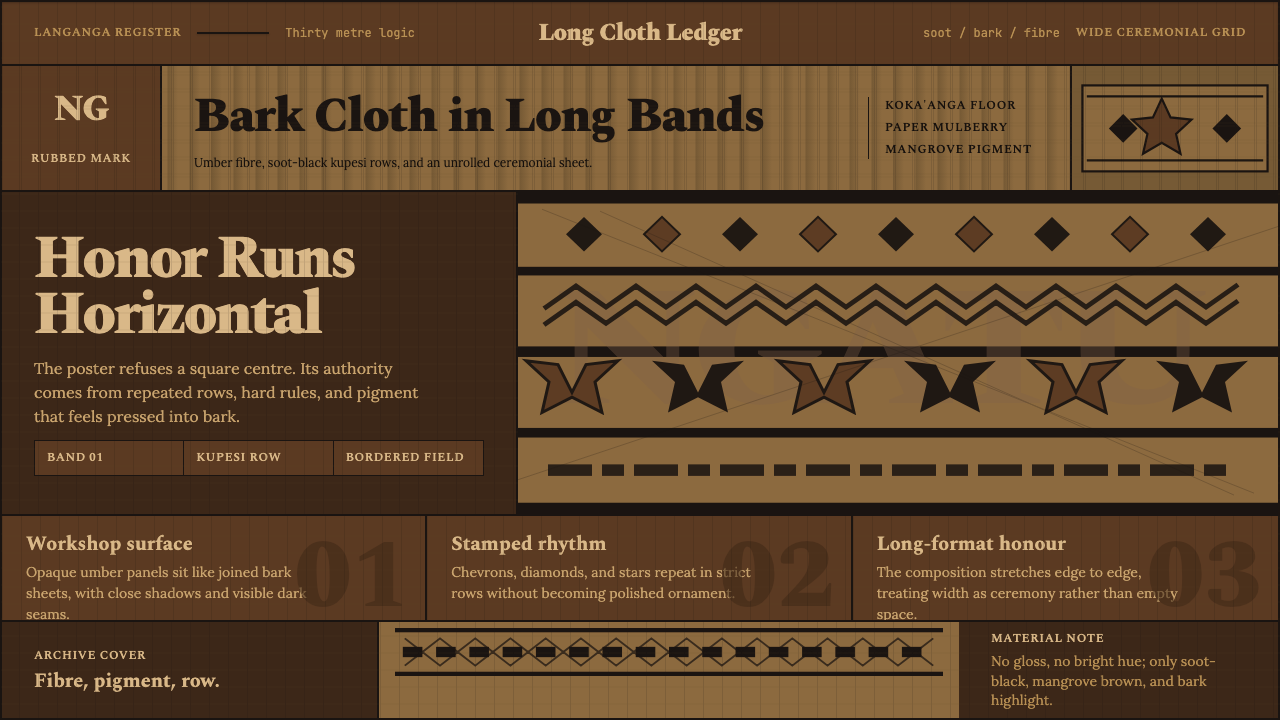 Tongan Ngatu (Tapa)Ceremony runs wide. Soot-black rows stamp umber bark with strict kupesi geome…
 Torajan Tongkonan (Boat-Roof House)Ancestral dusk, carved in color. Soot black frames ochre, lime white, and tur…
 Welsh Tapestry Blanket CarthenWarmth has two faces. Cochineal and cobalt invert across ink-black woven band…
 Akan Adinkra (Ghana)Proverbs become cloth. Russet grids, lampblack serif marks, and gold-edge ban…