What is Welsh Tapestry Blanket Carthen?
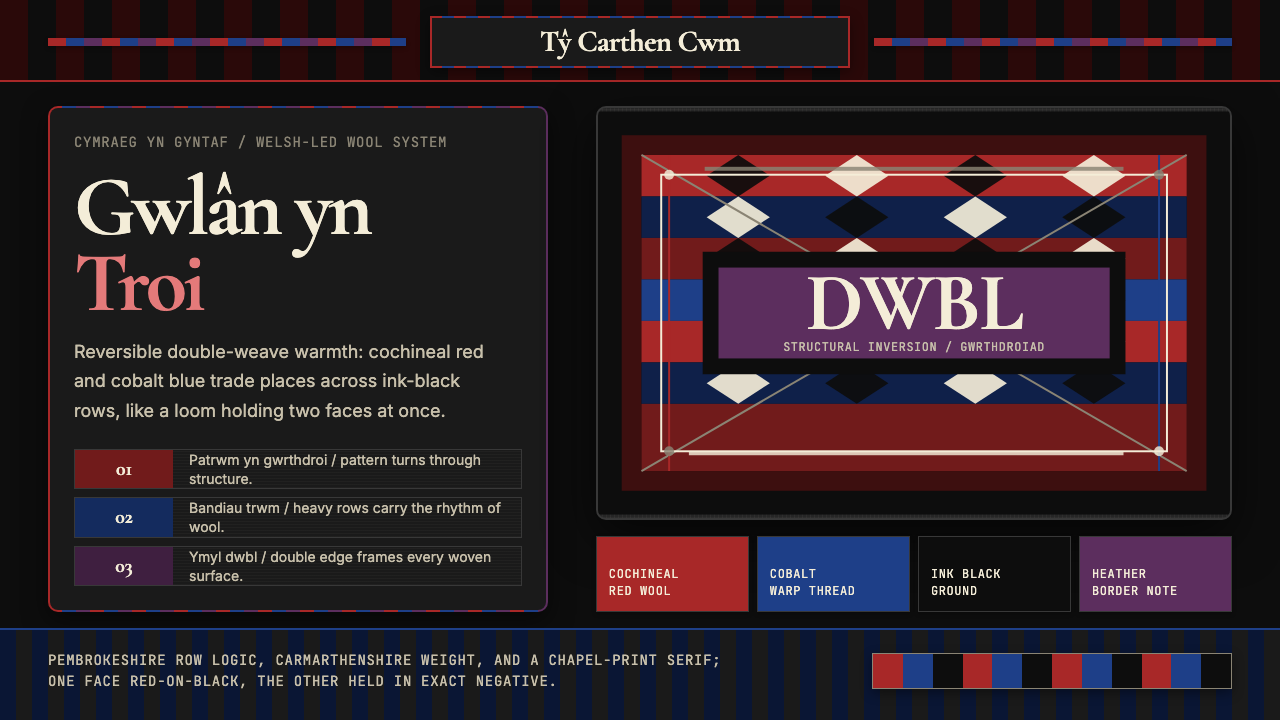
The Welsh carthen reverses the world — what is red on one face becomes black on the other, and this structural inversion, born on an eighteenth-century double-weave loom, is the whole idea.
Welsh Tapestry Blanket Carthen in brief
Welsh tapestry blanket design — known in Welsh as the carthen — is a textile tradition rooted in the rural farmhouses and later the mill towns of southwest and northwest Wales. Its most striking formal feature is reversibility: each blanket is woven on a double-weave loom so that the pattern on the face appears in exact negative on the reverse. Where one side shows a bold geometric band in wool-dyed crimson against deep black, the other shows that same band in black against crimson. This is not a decorative trick applied after the fact; it is the mechanical consequence of how the fabric is constructed.
The visual language that emerges from this weaving logic is bold, banded, and structured around tonal inversion. Compositions are built from horizontal and diagonal registers — repeating stripe sequences interrupted by panels of geometric interlocking, often borrowing motifs from medieval Welsh floor tiles, Celtic knotwork, and the broader tradition of European folk weaving. The color palette is wool-saturated and earthen: the dominant pairing is deep crimson or cochineal red against ink black, with accents in undyed cream, cobalt, and warm ochre appearing in different regional and mill traditions.
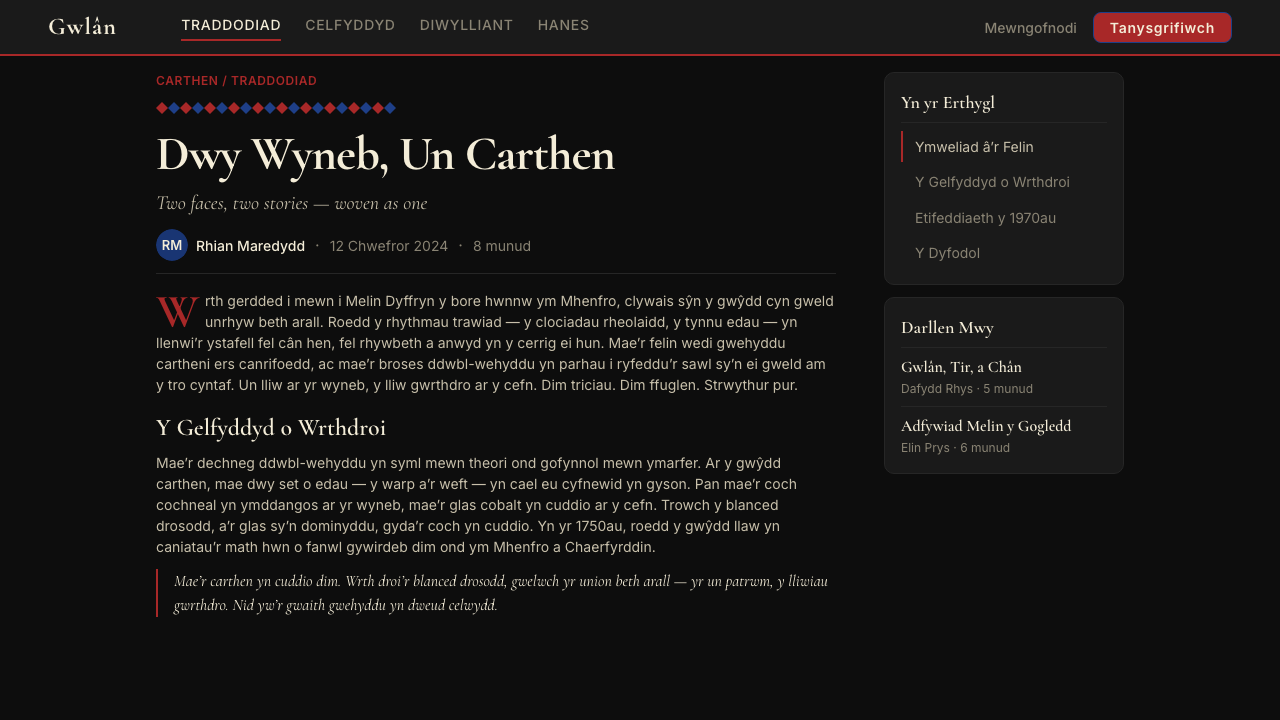
Translated into interface and screen contexts, this design system carries the same structural logic. Compositions are organized around bands and inversions rather than floating elements. Color operates in pairs — a dominant saturated tone and its structural negative — and the grain of woven textile gives even digital surfaces a perceptible tactile character. It is a style for contexts that want warmth without sweetness, and boldness without aggression.
Where does Welsh Tapestry Blanket Carthen come from?
The carthen tradition dates to at least the eighteenth century, when farmhouses across Pembrokeshire and Carmarthenshire kept small treadle looms for domestic production. These early blankets were made from locally raised wool — the long-staple fleece of Welsh mountain sheep — spun and dyed in the farmyard, then woven in the winter months when agricultural labor slowed. The characteristic double-weave structure allowed weavers to produce a heavy, reversible fabric with no exposed back-of-work, practical for sleeping, traveling, and wrapping goods. The geometric banding patterns were not decorative whimsy but efficient use of the loom's threading sequence: changing the shed created the band, and the double structure created the inversion automatically.
The industrial revolution transformed the tradition without erasing it. Beginning in the 1820s and reaching a peak in the 1850s, water-powered woollen mills spread through the river valleys of Cardiganshire, Merionethshire, and Montgomeryshire. These mills adopted the carthen format but scaled it to steam-powered Jacquard-loom production, introducing a wider range of geometric motifs and expanding the color palette to include synthetic dyes — aniline crimson, prussian blue, and chrome yellow — that were more vivid and colorfast than the older plant-based dyes. The Mill period produced the visual richness most strongly associated with Welsh tapestry today: the deep-saturated banding, the elaborate interlocked panel work, and the reversible double-layer construction at commercial scale.
The early twentieth century saw a sharp decline as machine-made alternatives undercut handweaving on price. Many mills closed between the 1920s and the 1950s. The 1970s brought a revival driven partly by the broader craft renaissance of that decade, partly by growing interest in Welsh cultural identity following the establishment of the Welsh Language Society in 1962 and the broader devolution movement. Weavers and scholars like J. Geraint Jenkins, whose research at the Welsh Folk Museum documented the mill tradition in detail, gave the carthen a documented historical foundation that supported its revival as a culturally rooted rather than merely nostalgic practice.
The contemporary period — from roughly 2000 onwards — has seen the carthen move into a dual position: as a living craft produced by a small number of active Welsh mills and studio weavers, and as a recognized cultural symbol used across Welsh heritage, tourism, and design contexts. Weavers including Eifion Griffiths, Amanda Griffiths, and Bonni Davies have been central to this continuity, working within the traditional double-weave structure while developing contemporary colorways and applications. Wool Week Wales, an annual celebration of Welsh wool and weaving held across the country, has been important in connecting the tradition with new audiences and contexts.
What defines the Welsh Tapestry Blanket Carthen look?
Structural Inversion
The defining characteristic of Welsh tapestry is that the pattern exists in two simultaneous negatives: the face and the reverse carry the exact same motif in inverted tones. In interface terms this becomes a compositional principle — every dominant color block implies and anticipates its inversion, and the system is designed to function in both modes. Dark-dominant and light-dominant variants are not afterthoughts; they are co-primary.
Banded Composition
Welsh tapestry compositions are organized into horizontal bands of varying widths — narrow accent stripes flanking broader field zones, interrupted by denser geometric panel blocks. This rhythm creates a strong vertical stacking logic that translates naturally into layout structures: header bands, content zones, and footer bands read as a designed system rather than arbitrary division. The bands have weight and sequence; they are not decorative trim but structural scaffolding.
Wool-Saturated Color
The palette draws from the specific quality of wool-dyed color: deeply saturated but never harsh, with a warmth and slight textural variation that distinguishes it from flat synthetic color. The characteristic pairings are ink black against crimson red, or cream against cobalt, with the dominant tone occupying most of the composition and the secondary tone appearing in geometric accents. Colors do not compete; they occupy their structural territory cleanly.
Geometric Motif Language
The panel work within Welsh tapestry draws from a specific vocabulary of interlocking geometric forms — chevrons, stepped diamonds, bilateral interlace, and grid-crossing diagonal fills — derived from medieval Welsh floor tiles and Celtic decorative traditions filtered through the loom's threading constraints. These are not free-hand shapes; they are forms that the loom generates naturally from its threading sequence. In design application, they appear as patterned fills, dividers, and textural backgrounds rather than illustrative elements.
Tactile Grain
Even in its digital translation, Welsh tapestry design retains an implicit reference to the physical grain of woven cloth — the slight irregularity of hand-spun fiber, the visible weft and warp structure that gives the surface depth without gloss. This tactile quality separates it from purely graphic stripe patterns: there is always a suggestion of material weight and craft process. On screen, this grain is suggested through subtle surface texture, slight tonal variation within color fields, and the avoidance of perfectly smooth gradients.
Reversibility as System Logic
Unlike traditions that produce a 'right side' and a 'wrong side,' the carthen has no hierarchy between faces. This equality is a design principle: the system does not privilege one mode over the other, and both light-on-dark and dark-on-light compositions receive equal structural attention. In practice, this means designing both states fully from the start rather than treating one as a derived variant, and ensuring that neither state reads as a concession.
Regional and Mill Variation
Because the tradition was produced across multiple counties and dozens of distinct mills, Welsh tapestry does not have a single canonical form. Pembrokeshire production tends toward narrower banding and simpler panel work; the Teifi Valley mills favored broader field areas and more complex interlace. Cardigan Bay coastal workshops used cooler blues and greys alongside the dominant red-black. This range means the style can be interpreted with considerable latitude — the structural principles are consistent, but the specific proportions, motif complexity, and accent palette have legitimate historical precedent across a wide spectrum.
Who shaped Welsh Tapestry Blanket Carthen?
Jenkins was the curator of material culture at the Welsh Folk Museum at St Fagans for much of the latter twentieth century, and his research systematically documented the surviving Welsh woollen mill tradition at a time when many mills were closing. His scholarly work gave the carthen and related Welsh textile traditions a rigorous historical foundation, transforming them from folk curiosities into documented cultural heritage. Without his documentation effort, much of the technical and regional knowledge of the mill weaving tradition would have been lost.
Griffiths represents the contemporary practitioner generation that has sustained the double-weave carthen tradition into the present. Working within the structural constraints of the historical double-weave loom format, he has developed colorways and pattern compositions that connect the tradition's formal logic to contemporary aesthetic sensibilities. His work demonstrates that the carthen is not a museum object but an active design language capable of addressing present contexts.
Working alongside Eifion Griffiths, Amanda Griffiths has been involved in both the production and the promotion of contemporary Welsh tapestry work, contributing to efforts to build audiences and commercial viability for the tradition in the present century. Her work reflects the reality that sustaining a living craft tradition requires not only technical mastery but also engagement with the cultural and commercial contexts that allow it to continue.
Davies is among the contemporary weavers who have engaged with the carthen tradition while connecting it to wider conversations about Welsh cultural identity, craft sustainability, and the role of textile heritage in regional economies. Her practice reflects the contemporary understanding of traditional crafts as living cultural resources rather than fixed historical forms, and her work has contributed to the growing visibility of Welsh textile arts in national and international contexts.
How do you use Welsh Tapestry Blanket Carthen today?
Welsh tapestry blanket design carries a very specific set of values into any context it enters: warmth, material weight, structural boldness, and cultural rootedness. Understanding which of those qualities a given project needs — and which would be unwelcome — is the first task before any application begins. The style works against lightness and airy minimalism; it carries presence and gravity by design.
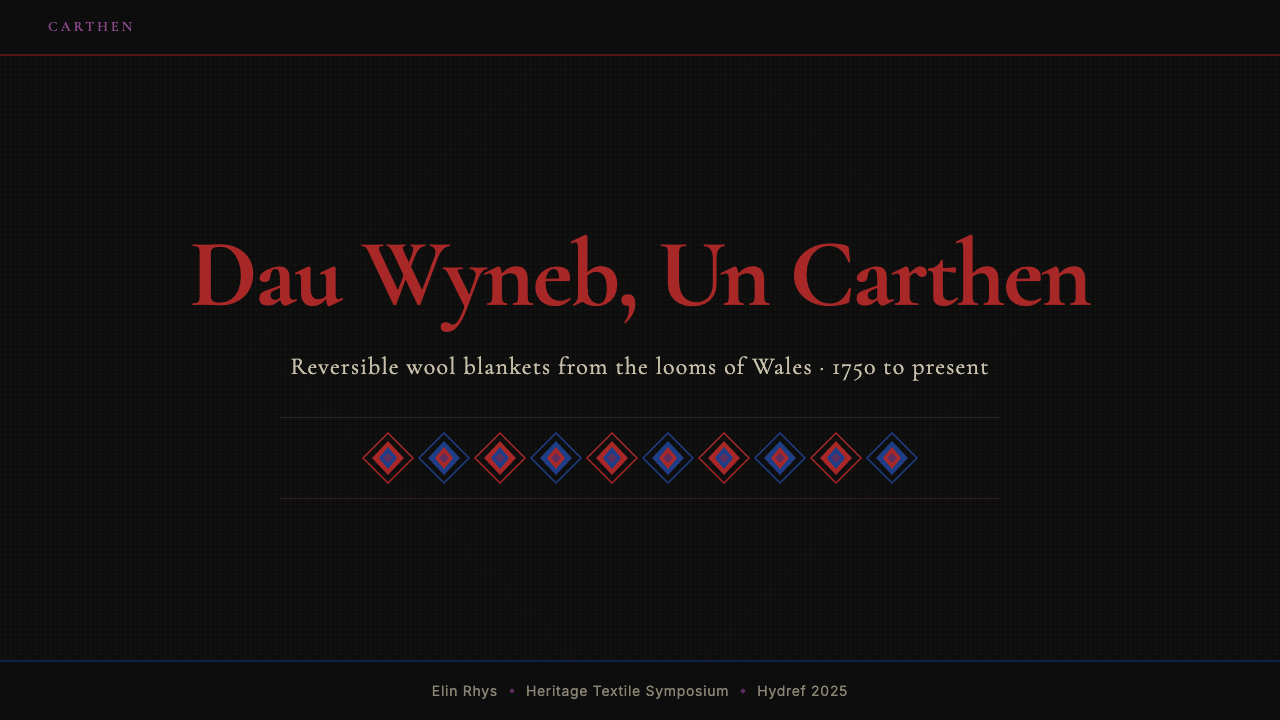
For presentation slides, the carthen tradition offers a particularly strong cover page approach. A single bold band in deep crimson or ink black crossing the slide horizontally, with title type in the inverted tone, immediately establishes the style's structural logic. Interior content slides benefit from banded dividers between sections — not decorative rules, but color-weighted bands that carry the same compositional logic as the textile registers. Data visualization takes well to the palette: charts and tables organized around the dominant red-black pairing carry visual authority without the clinical feel of purely neutral palettes. Avoid crowding multiple color accents simultaneously; the carthen palette is designed for strong pairings, not polychrome complexity.
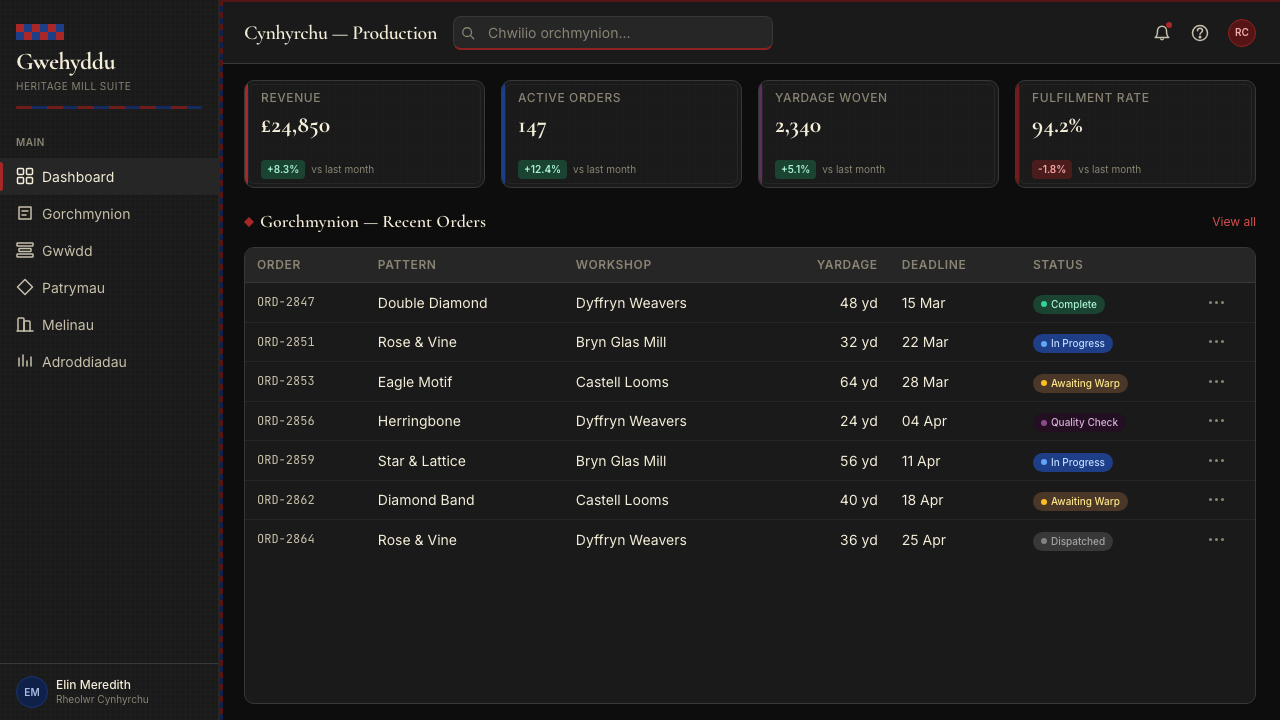
For web interfaces, the style suits contexts that want to project craft quality, cultural identity, or warm authority — heritage brands, artisanal producers, cultural institutions, and regional identity projects. Structurally, it supports strong top-of-page banded headers, horizontal dividers with geometric fill, and card components with textured backgrounds. Navigation and body text work best in high-contrast pairings that respect the style's inversion logic: if the hero is dark-dominant, the content area can shift to light-dominant, with the structural band marking the transition. Dashboards and data-heavy interfaces are less natural territory, though the geometric register language can work well as a structural element in sidebars and category headers.
For editorial and marketing work, the carthen approach lends itself to full-width feature treatments where a band occupies the entire header and the content below reads against a complementary tone. Magazine layouts benefit from the banded approach: the style naturally generates a strong top-of-article visual identity without requiring photography. The geometric motif vocabulary can appear as section ornaments, pull-quote frames, or divider elements — used sparingly, they reinforce the textile reference without becoming pattern wallpaper. Marketing materials for products with craft, heritage, or regional identity positioning are the most natural home for this style.
A common mistake when applying Welsh tapestry visually is over-saturating the palette — using the red and black at full maximum intensity without considering the warmth and slight texture that characterize the actual textile. The carthen palette is rich, not screaming; the reds have depth and warmth, the blacks are ink-deep rather than digital-zero. A second mistake is importing only the color without the structural banding logic: isolated crimson elements on a white ground do not read as Welsh tapestry — they read as a generic red accent. The band and the inversion are the content of the style; color alone is not enough.
Welsh Tapestry Blanket Carthen — FAQ
How is Welsh tapestry different from other British textile traditions?
Welsh tapestry occupies a distinct position even within the rich landscape of British textile traditions. Unlike Scottish tartan — which encodes clan and family identity through color-and-stripe grids — the carthen does not carry personal or genealogical symbolism; its patterns are structural and geometric rather than coded. Unlike English needlework or embroidery traditions, the carthen creates its imagery through the weave structure itself rather than thread applied on top of a ground fabric. And unlike the flat woven kilim traditions of other cultures, the double-weave structure makes it uniquely reversible. It is also specifically industrial in one phase of its history, giving it a range from farmhouse to factory that few other British textile traditions span.
Can Welsh tapestry work in a light-background, high-airiness design?
The carthen tradition is inherently a style of weight and presence; applying it to very light, airy, or minimalist design contexts will work against its structural logic. That said, a light-dominant variant — cream or undyed wool white as the dominant tone with crimson or cobalt accents — is historically authentic; many carthen pieces used cream as one of their two dominant tones. The key is that the banding logic must be preserved: even a light-dominant carthen-derived design should have clear bands with structural weight, not a scattering of color accents on a white field. Light can be the ground, but the pattern must still carry presence.
What makes the double-weave technique visually distinctive from printed textile patterns?
A printed textile pattern is applied onto a fabric surface: the pattern and the fabric are two separate things. A double-weave structure means the pattern and the fabric are the same thing — the pattern exists because of how the threads are interlaced, not because of what was applied afterwards. This produces a surface quality that has depth without gloss, where color has a slight variation and texture rather than the flat uniformity of print. It also means that the pattern has a structural logic: the motifs that can be achieved are constrained by what the loom can produce from its threading sequence. This constraint is visible in the work — carthen patterns have a rhythmic coherence that purely decorative prints rarely achieve.
Is this style appropriate for digital products targeting global audiences, or does the cultural specificity work against it?
Cultural specificity cuts both ways. For products or brands that have no relationship to Welsh, British, or Celtic culture, the carthen references will be read as generic bold geometric stripe design — which is still a strong and valid visual approach, just not one carrying cultural resonance. For products that are genuinely rooted in Welsh or Celtic heritage, or that want to signal craft quality, regional pride, or handmade warmth, the cultural reference is an asset rather than a liability. The question to ask is whether the cultural dimension is a bonus or a distraction for the specific audience. One reliable universal application: the color logic and inversion principle are structurally strong enough to work as a design system even with the cultural references stripped out.
How does the style handle photography and illustration?
The carthen tradition is entirely textile-based; there is no photographic or illustrative dimension in the historical source material. In design applications, photography can be integrated by treating it as one of the banded zones — cropped to a strong horizontal register, placed at full bleed within a band, and often treated with a color wash in the dominant palette tone to maintain color cohesion. Naturalistic full-color photography in small proportions sits awkwardly against the saturated boldness of the carthen palette; better to commit either to tinted or duotone treatment, or to full cropped bleed. Illustration works best when it follows the geometric constraint: flat, structured, and pattern-consistent rather than organic or hand-drawn.
Related design styles
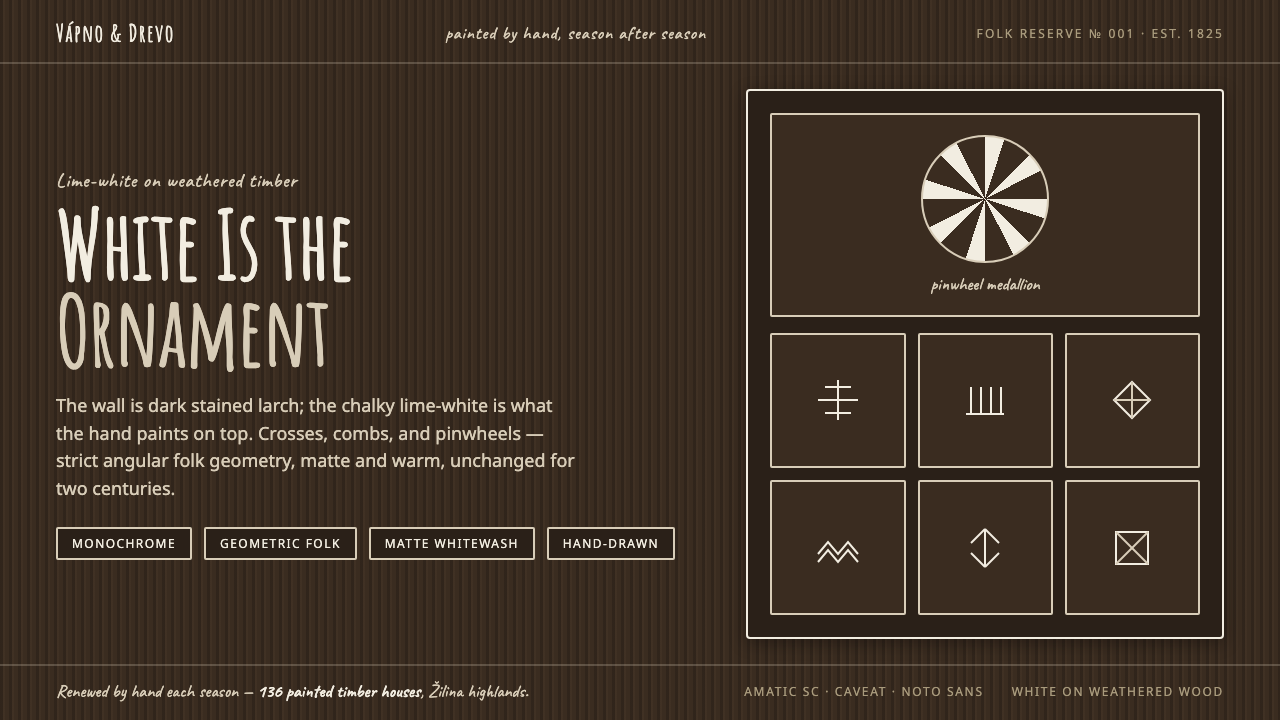 Čičmany Painted House OrnamentWhite is the ornament, not the page. Lime-white folk geometry on dark weather…
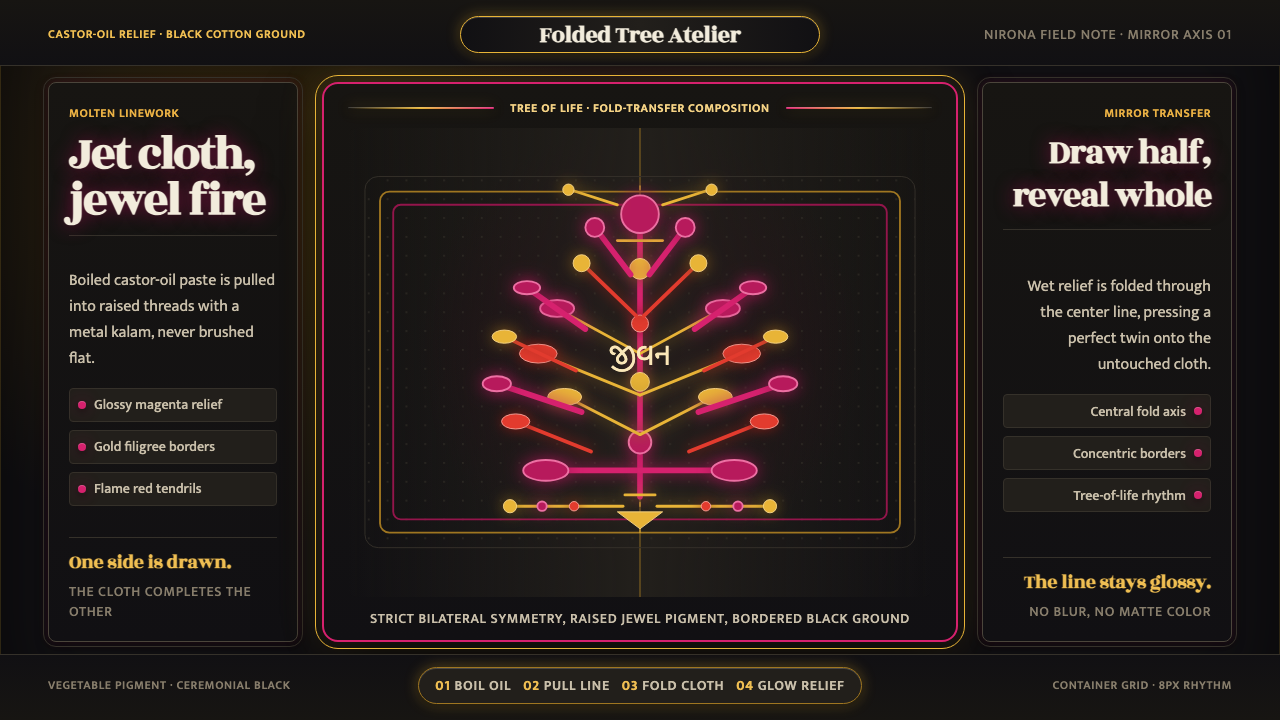 Kutch Rogan Castor-Oil PaintingGlossy symmetry holds the dark. Magenta castor-oil lines mirror across black…
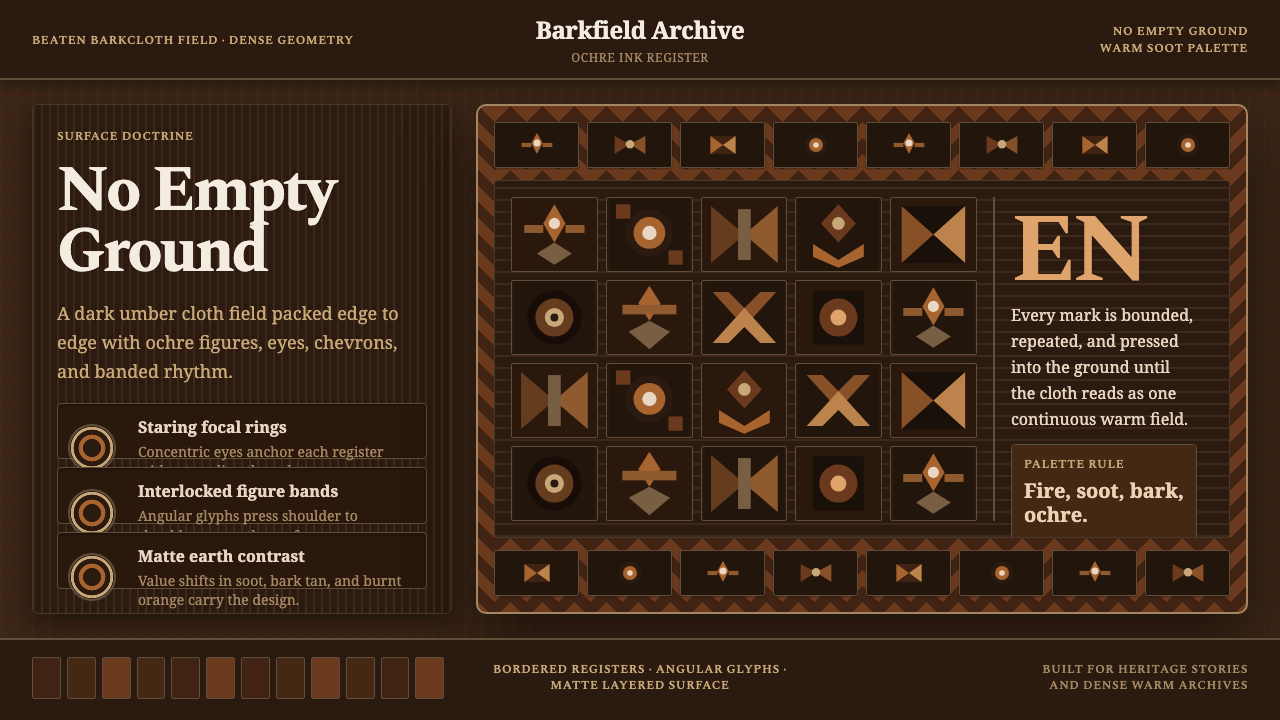 Marquesan Enata Tapa MotifNo empty ground. Ochre enata geometry packs a dark umber barkcloth field.
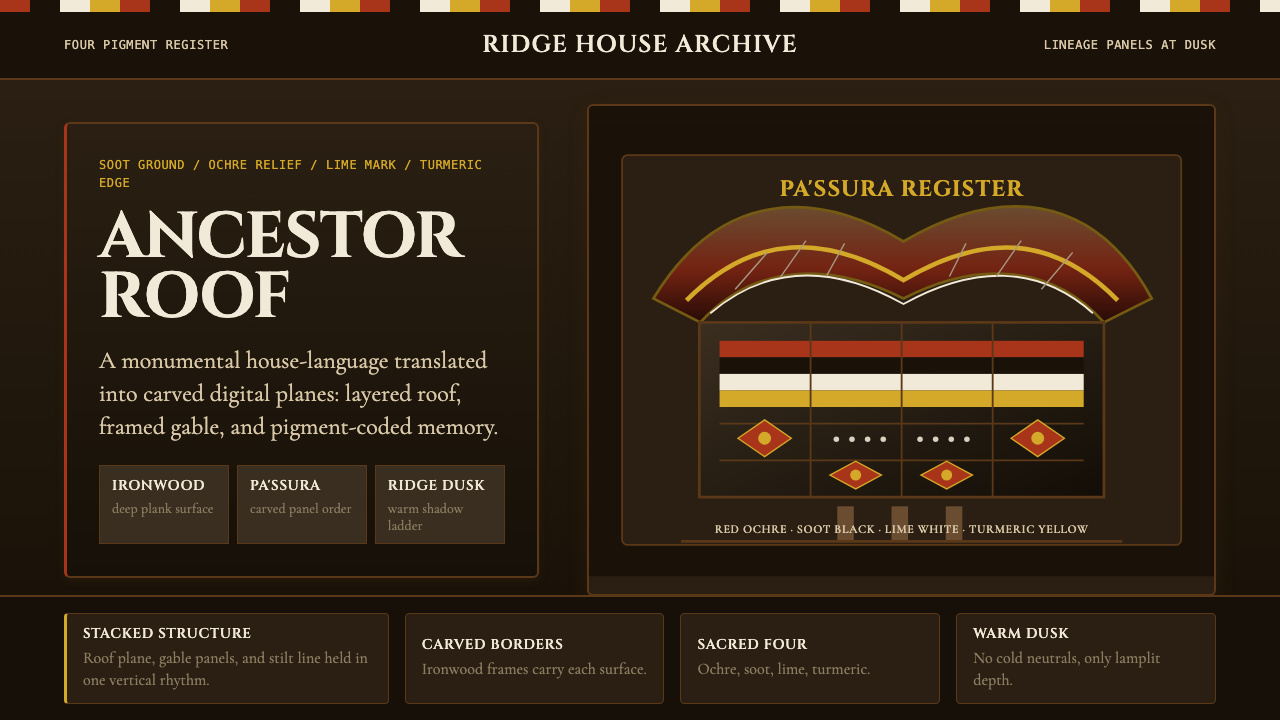 Torajan Tongkonan (Boat-Roof House)Ancestral dusk, carved in color. Soot black frames ochre, lime white, and tur…
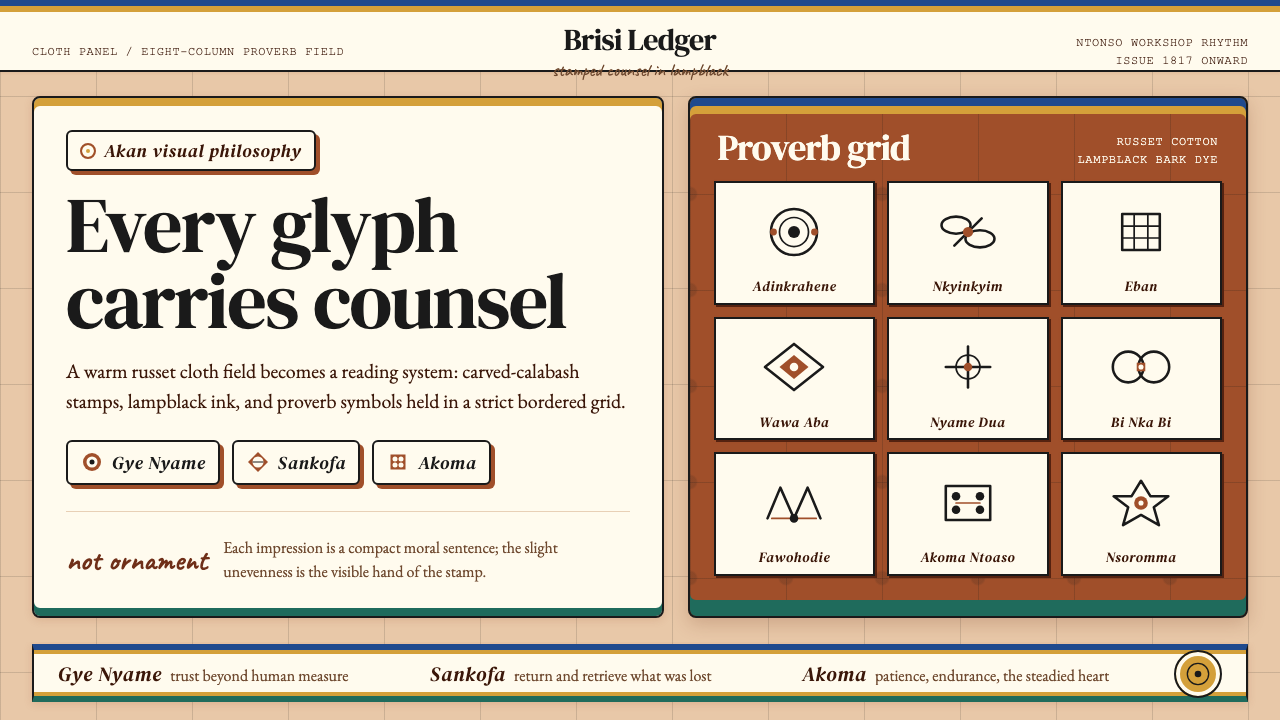 Akan Adinkra (Ghana)Proverbs become cloth. Russet grids, lampblack serif marks, and gold-edge ban…
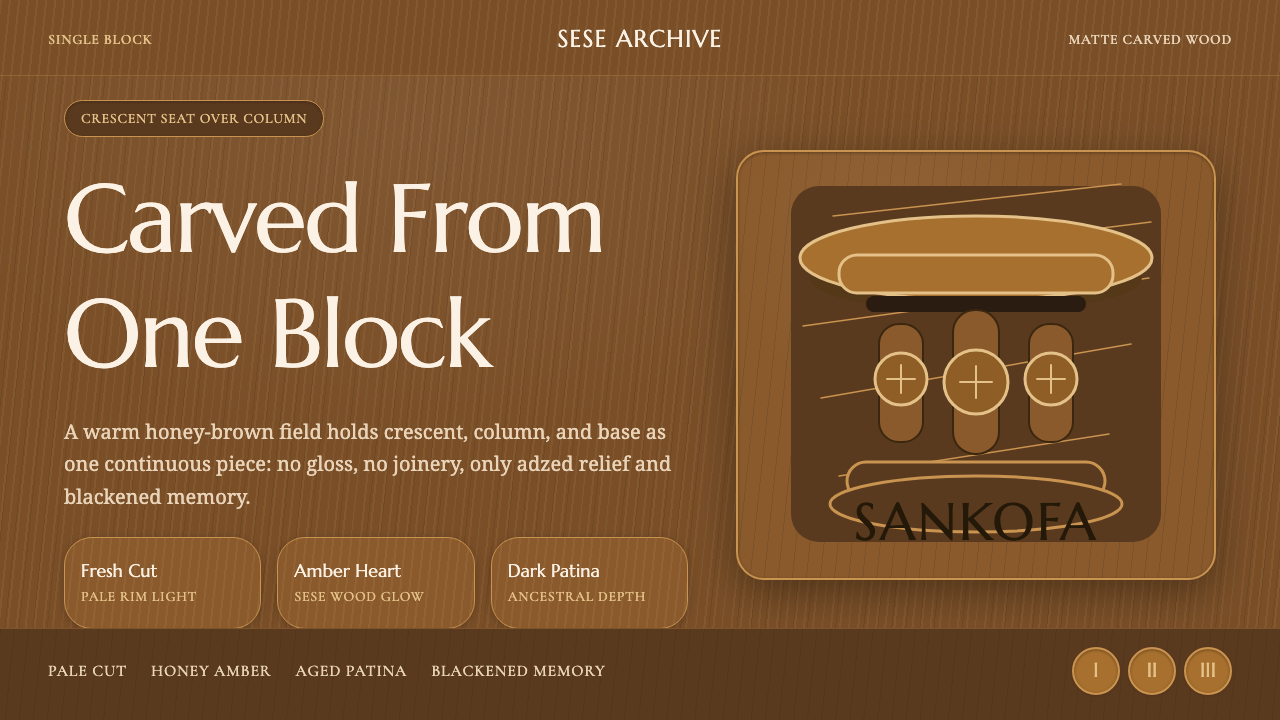 Akan Carved StoolMatte wood carries memory. Honey amber, Marcellus type, and crescent-column r…