What is Yayoi Kusama Polka Dot?
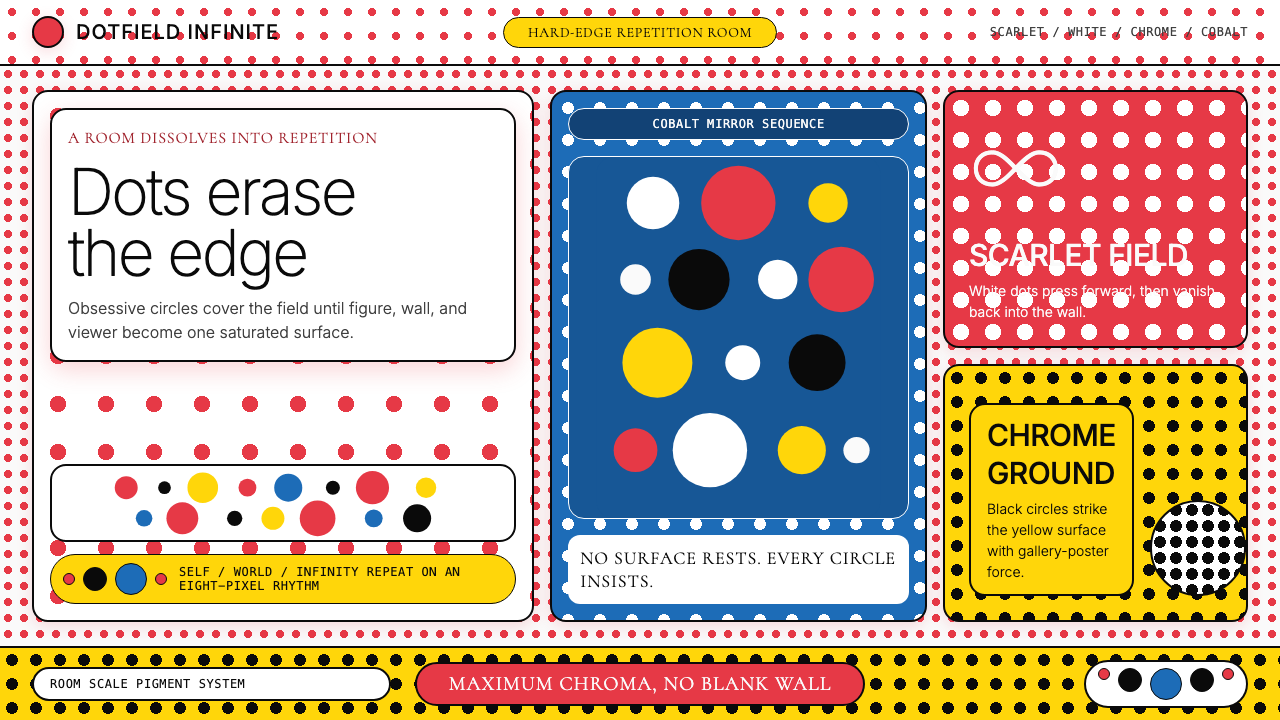
Yayoi Kusama turned obsessive repetition into a visual universe — where every dot multiplies into infinity and the boundary between self and space dissolves.
Yayoi Kusama Polka Dot in brief
Yayoi Kusama's polka-dot aesthetic is one of the most recognizable visual systems in contemporary art and design. At its core, it is built from a deceptively simple unit — the perfectly round, hard-edged dot — multiplied across every available surface with an intensity that shifts from decoration to immersion. Scarlet dots bloom across white grounds; black dots march across fields of chrome yellow; mirrors reflect dots reflecting mirrors, stretching the pattern outward without terminus. The visual effect is saturated, relentless, and strangely meditative.
What separates Kusama's dot language from ordinary pattern design is its psychological charge. Kusama has described the dots as arising from hallucinations she experienced since childhood — visions of flowers speaking to her, of nets and spots consuming the world around her. Rather than suppressing these visions, she painted them compulsively, covering canvases, objects, rooms, and eventually entire buildings. The dots are simultaneously a symptom, a therapy, and a cosmology. In Kusama's own words, a single polka dot is 'one earth, one sun, one moon — and one of us.' They represent the dissolution of individual identity into a larger, infinite field.
As a design system, this aesthetic operates on the logic of horror vacui — the fear of empty space. Every surface wants covering. Dots crowd together at multiple scales simultaneously, large spheres floating among dense fields of smaller ones. Color relationships are high-chroma and chromatic rather than neutral: the classic pairings are saturated warm tones against saturated neutral grounds, creating optical vibration rather than calm contrast. The overall quality is joyful and slightly vertiginous — an aesthetic that is immediately approachable but impossible to fully absorb.

Where does Yayoi Kusama Polka Dot come from?
Yayoi Kusama was born in 1929 in Matsumoto, a city in the Nagano Prefecture of Japan. Her childhood was difficult — her family was prosperous but emotionally cold, and she grew up experiencing vivid hallucinations that she later described as the ground from which her art grew. She began painting obsessively as a child, and by her mid-twenties had already been drawing and exhibiting in Japan for several years, studying Nihonga (traditional Japanese painting) at the Kyoto City School of Arts and Crafts. But Japan in the postwar years felt confining to her ambitions, and she was encouraged by correspondence with the American painter Georgia O'Keeffe, to whom she wrote asking for advice about working in the United States.
In 1957, Kusama moved to New York City, arriving in the midst of the Abstract Expressionist moment but immediately developing a direction entirely her own. Her 'Infinity Net' paintings — vast canvases covered edge to edge with obsessively repeated small arcs and loops — were exhibited at the Brata Gallery in 1959 and attracted serious critical attention. These works predated and in some ways anticipated the Minimalist and process-oriented art that would dominate the 1960s. She became a fixture in downtown Manhattan's art scene, befriending and occasionally collaborating with artists including Donald Judd and Eva Hesse, two figures whose own interest in serial repetition and the accumulative properties of form resonated with Kusama's compulsive methodology.
The polka-dot motif as a fully developed system emerged through the 1960s, when Kusama began her 'Happenings' — public performances in which she painted dots on the naked bodies of participants in Central Park and at anti-Vietnam War demonstrations. The dot left the canvas and became environmental, social, and bodily. Simultaneously, she developed her first Infinity Mirror Rooms: enclosed chambers lined with mirrors and filled with lights or hanging objects, where the viewer stands inside the reflected repetition and the sense of individual selfhood blurs into the surrounding pattern. The first of these rooms, 'Phalli's Field' (1965), used stuffed fabric protrusions covered in polka dots and reflected into apparent infinity in floor-to-ceiling mirrors.
Kusama returned to Japan in 1973, checked herself into a psychiatric institution in Tokyo where she has lived voluntarily ever since, and continued producing work prolifically from a studio across the street. Her international reputation, which had faded during the 1970s and 1980s, was powerfully renewed beginning with a retrospective organized by the Center for International Contemporary Arts in New York in 1989. Her dot-covered pumpkin sculptures — large, gourd-shaped forms in yellow-and-black or red-and-black — became iconic objects in the 1990s and 2000s. The 2017 touring exhibition of her Infinity Mirror Rooms, presented by institutions including the Hirshhorn Museum in Washington D.C., drew record-breaking attendance and made her installations among the most photographed art objects on social media worldwide. Gallery representation by David Zwirner beginning in 2013 further cemented her position at the center of the contemporary art market.
What defines the Yayoi Kusama Polka Dot look?
The Dot as Primary Unit
The perfectly round, hard-edged dot is the irreducible atom of this visual system. Unlike decorative polka dots in fashion or textile design, Kusama's dots carry an almost aggressive insistence — they are not gentle accents but total coverage. They appear at multiple scales simultaneously within a single composition: very large circles float alongside medium and minute ones, creating a sense of visual depth without any use of perspective or gradient. The dot's geometry is strict; it never becomes oval, irregular, or soft-edged.
Maximum Chroma, Flat Application
Color in this system is pushed to its highest achievable saturation and applied as flat, unmodulated fields — no shading, no tonal variation within a single dot, no blending at edges. The signature pairings are high-intensity warm tones against grounds of contrasting high-intensity color: scarlet on white, dense black on chrome yellow, vivid red-orange on black. The visual result is optical vibration — colors that appear to pulse or advance against each other. No neutral or muted tone is used to 'rest' the eye; the composition deliberately refuses relief.
Horror Vacui — Total Surface Coverage
Kusama's aesthetic operates from a deep antipathy toward empty space. In her installations, dots cover floors, ceilings, walls, furniture, the objects placed in rooms, and the bodies of people inside them — no surface is exempt from the pattern. In two-dimensional design, this translates to a compositional logic that treats open background as provisional rather than intentional: the ground is simply waiting to be filled. When used in design contexts, this principle should be applied with deliberate intent — either commit to dense coverage that approaches the original energy, or acknowledge that a minimal polka-dot application is a quotation rather than a translation.
Mirror and Infinite Reflection
The Infinity Mirror Room is as central to Kusama's visual identity as the dot itself. Mirrors multiply a finite set of dots into an apparently boundless field, collapsing the distinction between the actual and the reflected. In design applications, this principle manifests as deliberate use of repetition that implies continuation beyond the frame — patterns that bleed off the edge, layouts whose rhythm suggests they extend indefinitely. The visual sensation being chased is not completeness but endlessness: the feeling that the design occupies a space far larger than the artifact that contains it.
Joyful Intensity — Warm Over Severe
Despite the obsessive energy and the psychological roots of the dot motif, the overall emotional register of this aesthetic is warmth and celebration rather than austerity. Kusama's color choices tend toward the festive — reds, yellows, hot pinks, vivid oranges — and the dot's circular geometry reads as playful and organic rather than mechanical and cold. This makes the system unusual among high-saturation aesthetics: it is intense without being aggressive, maximalist without being overwhelming. Successful applications preserve this joyful charge rather than letting the density become oppressive.
Scale Contrast Within a Single Pattern
One of the less-copied but most effective devices in Kusama's visual language is the simultaneous use of dots at dramatically different scales within a single field. Rather than a uniform repeated unit, the pattern layers large, medium, and small dots — creating internal hierarchy and a sense of spatial depth that a uniform grid cannot produce. This scalar variation is what gives the pattern its three-dimensional quality even in flat reproduction. In design work, using only one size of dot produces something closer to a stock repeat pattern; introducing at least two sizes begins to approach the layered complexity of the original.
The Body and the Object as Canvas
Kusama's dot language does not respect the conventional boundaries of a picture frame. From her 1960s Happenings onward, she applied dots to bodies, furniture, boats, cars, and pumpkins with the same logic she applied to canvas — the dot makes everything equal, everything part of the same infinite field. In contemporary design applications, this principle translates to brand ecosystems where the dot pattern migrates coherently across product packaging, environmental graphics, merchandise, and digital surfaces. The style performs best when the application is total rather than selective.

Who shaped Yayoi Kusama Polka Dot?
Born in Matsumoto, Japan in 1929, Kusama studied traditional Japanese painting before moving to New York in 1957, where her Infinity Net paintings and participatory Happenings established her as a major avant-garde voice. Her voluntary residence in a Tokyo psychiatric institution since 1973 has not slowed her output; she produces paintings, sculptures, and immersive installations at a pace that astonishes younger artists. Her Infinity Mirror Rooms — first developed in 1965 — became globally iconic after the 2017 touring exhibition, and her dot-covered pumpkin sculptures are among the most recognizable objects in contemporary art. She was awarded Japan's Order of Culture in 2016 and remains one of the highest-selling living artists at auction.
The American Minimalist sculptor Donald Judd was a significant figure in Kusama's New York years during the 1960s. Where Judd pursued serial repetition through industrial fabrication and strict geometric modules, Kusama pursued it through obsessive handwork and accumulative organic form. The parallel is instructive: both artists were interested in what happens when a unit is repeated past the point of individual significance — when the series becomes the subject rather than the object. Judd's critical support and their shared milieu in downtown Manhattan helped position Kusama within serious art-world discourse at a time when her work was also drawing popular attention.
The German-American artist Eva Hesse, a close peer of Kusama's in the New York avant-garde scene of the 1960s, shared an interest in obsessive repetition and the psychological dimensions of accumulative form-making. Hesse worked in latex, fiberglass, and rope, building soft sculptures from repeated units in a methodology that resonated with Kusama's dot accumulations. Both artists insisted on the connection between compulsive process and the resulting form — that the repetition was not merely formal but autobiographical. Hesse's early death in 1970 cut short a practice that had been in direct conversation with Kusama's for nearly a decade.
The gallerist David Zwirner began representing Kusama in 2013, a partnership that dramatically accelerated both her market presence and institutional visibility in the final years of her career. Zwirner's global gallery infrastructure — with spaces in New York, London, Hong Kong, and Paris — made it possible to mount large-scale Kusama exhibitions across multiple cities simultaneously, and the gallery's programming helped sustain the intense media attention that followed the 2017 Infinity Room phenomenon. The Zwirner relationship represents the institutional side of Kusama's late-career canonization: the transformation of a lifelong outsider into one of the most commercially and critically central figures in contemporary art.
Though not a direct collaborator, Georgia O'Keeffe played an unexpectedly formative role in Kusama's trajectory. The young Kusama wrote to O'Keeffe from Japan in the early 1950s — an audacious act for an unknown artist — and O'Keeffe responded with practical encouragement, advising her on how to build a life as a working artist in the United States. O'Keeffe's example — of an artist who had constructed a singular, immediately recognizable visual language outside the major art-world centers — was a meaningful precedent for what Kusama would go on to build. The correspondence represents one of the stranger and more touching moments of connection between two of the twentieth century's most distinctive artistic personalities.
How do you use Yayoi Kusama Polka Dot today?
Kusama's dot aesthetic is one of the most immediately impactful design styles available to contemporary practitioners, but it is also one of the easiest to misapply. Its power comes not from the dot itself but from the density, the chromatic intensity, and the deliberate rejection of calm — all three must be present for the application to succeed. A few small polka dots scattered on a slide or a webpage borrows the symbol without borrowing the system, and the result reads as decorative rather than intentional. The commitment the style demands is total: either the dots fill the space, or you are making a different design choice.
For presentation slides, this aesthetic works most powerfully on cover pages and section breaks — moments where visual impact matters more than information density. A cover built in this system should feature a field of dots at multiple scales filling most or all of the available surface, with the title set in high-contrast type that punches through the pattern. Section-break slides can use a single large dot as a full-bleed background element — a bold circle in the primary color of the section — with a minimal text treatment floating above it. Content slides require more restraint: a dot border or a dot-field accent in one corner can signal the system without overwhelming the data. Data slides are an opportunity — bar charts, donut charts, and bubble diagrams can be treated as designed dot compositions, with each data element rendered as a circle and the scale of the dot encoding the value.
For web interfaces, the style suits contexts where brand energy and emotional immediacy are the primary communication goals: landing pages for consumer products, event sites, limited-edition launches, and cultural institution pages. Dashboard or enterprise UI contexts are more difficult — the visual intensity makes sustained data-reading harder, so the dots should be confined to hero sections, empty states, and loading screens rather than being applied to functional chart and table areas. Pricing pages can use the dot system effectively in the tier-differentiation columns, with each tier anchored by a dot field in its signature color. Navigation and footer areas should stay typographically clean to give the eye a resting point.
For editorial and marketing work, the style performs brilliantly in print and large-format contexts — posters, packaging, event graphics, and magazine covers — where its flat, high-chroma intensity photographs and scales well. A marketing campaign built on this system should commit to a primary dot color and a secondary ground color and use them consistently across all touchpoints: social cards, out-of-home placements, digital banners, and direct mail. The pattern should bleed off the edge wherever possible to reinforce the horror-vacui logic that the dots extend beyond the artifact. Photography, when used alongside the dot system, works best when cropped tightly and composited into the dot field rather than placed in a clean rectangle; the dots should invade the image rather than frame it.
The most common mistake when working with this style is treating it as a polka-dot pattern rather than a total environment. Designers often use the dots as a decorative accent — a spotted border, a spotted header bar — while keeping the rest of the layout in a conventional visual language. This produces incoherence: the dots announce a system that the rest of the design immediately abandons. A related mistake is normalizing the color — desaturating the palette or shifting to pastel tones to make the design 'safer' or more 'on-brand.' The style depends on chromatic intensity; muted dots produce something that looks like children's product design rather than Kusama. If the full color intensity is not appropriate for the use case, a different design system is the better choice.

Yayoi Kusama Polka Dot — FAQ
Can Kusama's dot aesthetic work in a dark or black background layout?
Yes, and it has strong precedent in Kusama's own work — her black-ground dot paintings and her black-on-chrome-yellow pumpkins demonstrate that the style functions powerfully on dark grounds. On a black background, warm high-chroma dots advance dramatically, producing a glowing, bioluminescent quality very different from the scarlet-on-white energy of the light-ground version. The key discipline is the same as in the light-ground version: commit to one or two dot colors rather than using the full available palette, and ensure that the dot density remains high enough to preserve the horror-vacui logic. Isolated dots on a large black field produce decoration, not the immersive quality the style depends on.
How is this different from ordinary polka-dot pattern design?
Conventional polka-dot patterns — in textiles, stationery, and surface design — typically use a single dot size repeated on a uniform grid with a balanced, calm rhythm. The dots are a texture: pleasant, regular, subordinate to whatever content they frame. Kusama's system is structurally different in three ways. First, it uses multiple dot scales simultaneously, creating internal depth and hierarchy. Second, the color relationships are pushed to maximum chroma contrast rather than calibrated for harmony. Third, and most importantly, the density is applied as total coverage rather than as a repeating unit in service of negative space. The result is not a pattern you look at — it is an environment you exist inside.
Is this style appropriate for professional or corporate contexts?
It depends on what the organization wants to communicate. Kusama's dot aesthetic is fundamentally an aesthetic of joy, intensity, and emotional openness — values that align naturally with consumer brands, cultural institutions, entertainment companies, fashion labels, and any organization positioning itself as bold, creative, or unconventional. It is less suited to contexts where authority, stability, and analytical rigor are the primary desired impressions — financial services, legal practices, healthcare systems, or B2B enterprise software, where the visual intensity can undermine trust signals. For organizations that sit between these poles — a technology company that wants to feel human, a financial product aimed at younger consumers, a healthcare brand emphasizing wellness over clinical severity — selective, high-quality application of the style in campaign contexts rather than core UI can work effectively.
How should photography be treated within this design system?
Photography sits in tension with the Kusama dot aesthetic, because realistic photographic imagery imports the visual logic of the natural world — perspective, tonal gradation, ambient light — into a system that deliberately refuses all of those things. The most effective approaches treat photography as a surface to be invaded rather than a window to be opened: tight crops, silhouettes against dot fields, or aggressive duotone treatments that reduce the photograph to two tones matching the dot palette. Kusama's own practice provides the model — in her Happenings, she painted dots directly onto human bodies, making the person part of the dot environment rather than a subject placed in front of it. The worst outcome is placing a naturalistic photograph in a clean white frame inside a dot-field background, which creates a visual rupture rather than integration.
What makes something look authentically Kusama-inspired versus just 'spotted'?
Three qualities separate an authentic application from a superficial one. The first is density — the dots must accumulate to the point where they change the fundamental nature of the space rather than decorate a corner of it. The second is chromatic commitment — the colors must be at or near maximum saturation; a desaturated or pastel interpretation loses the visual energy that defines the system. The third is scale variation — using at least two or three different dot sizes within the same composition creates the layered, spatially complex quality that distinguishes Kusama's pattern from a simple repeat. Beyond these formal qualities, there is an intentional quality to authentic applications: the designer has thought about what the dots mean in the specific context, not merely what they look like. Kusama's dots are always about accumulation toward infinity — applications that use them to evoke boundlessness, abundance, or transformation are working with the system; applications that use them simply as decoration are working against it.
Related design styles
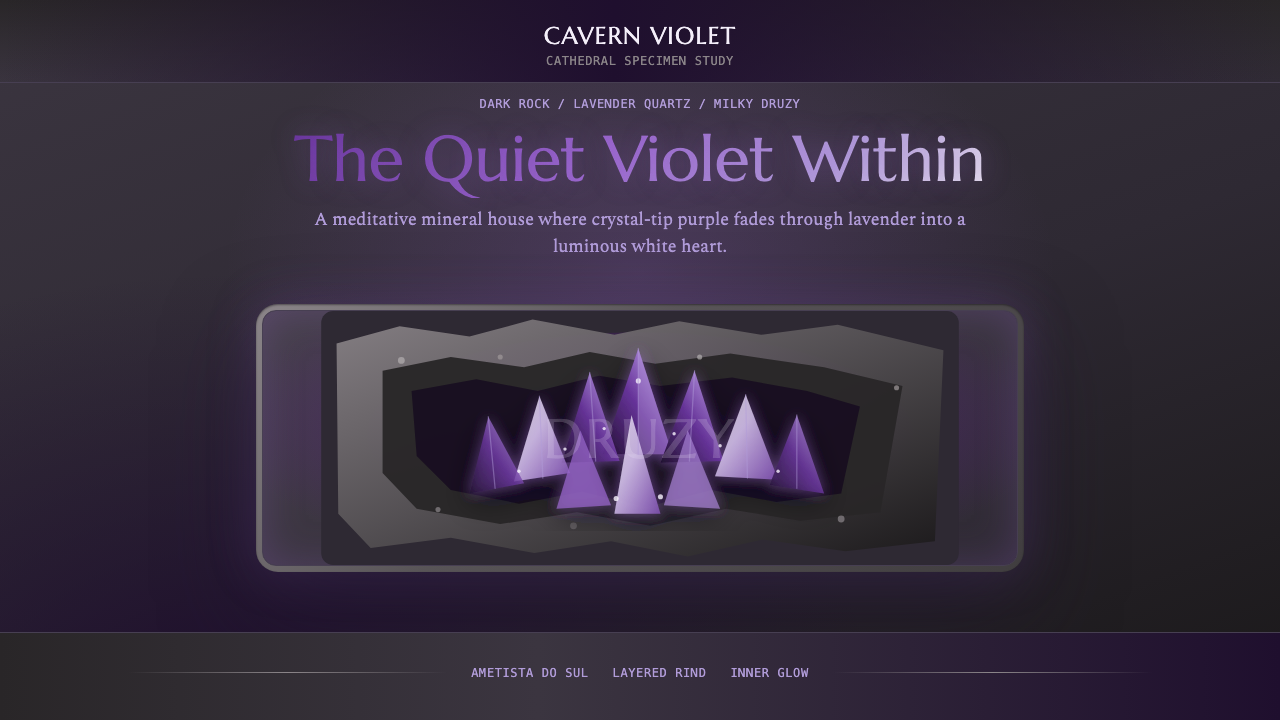 Amethyst GeodeMeditative gem luxury. Amethyst gradients glow in dark stone, framed by rough…
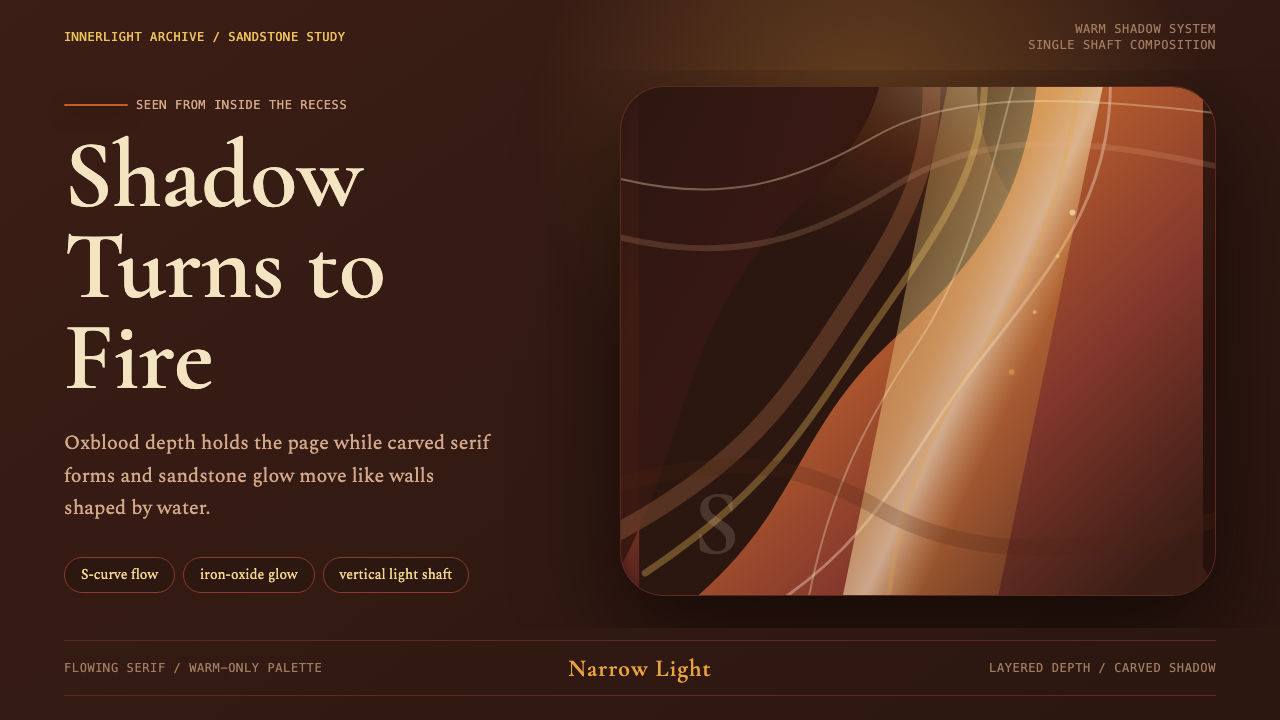 Antelope Slot CanyonGlows from shadow. Oxblood ground, sandstone S-curves, and one warm gold shaf…
 Mongolian Nomadic SteppeSteppe memory in jewel tones. Blood-red felt, saffron, indigo, and bordered u…
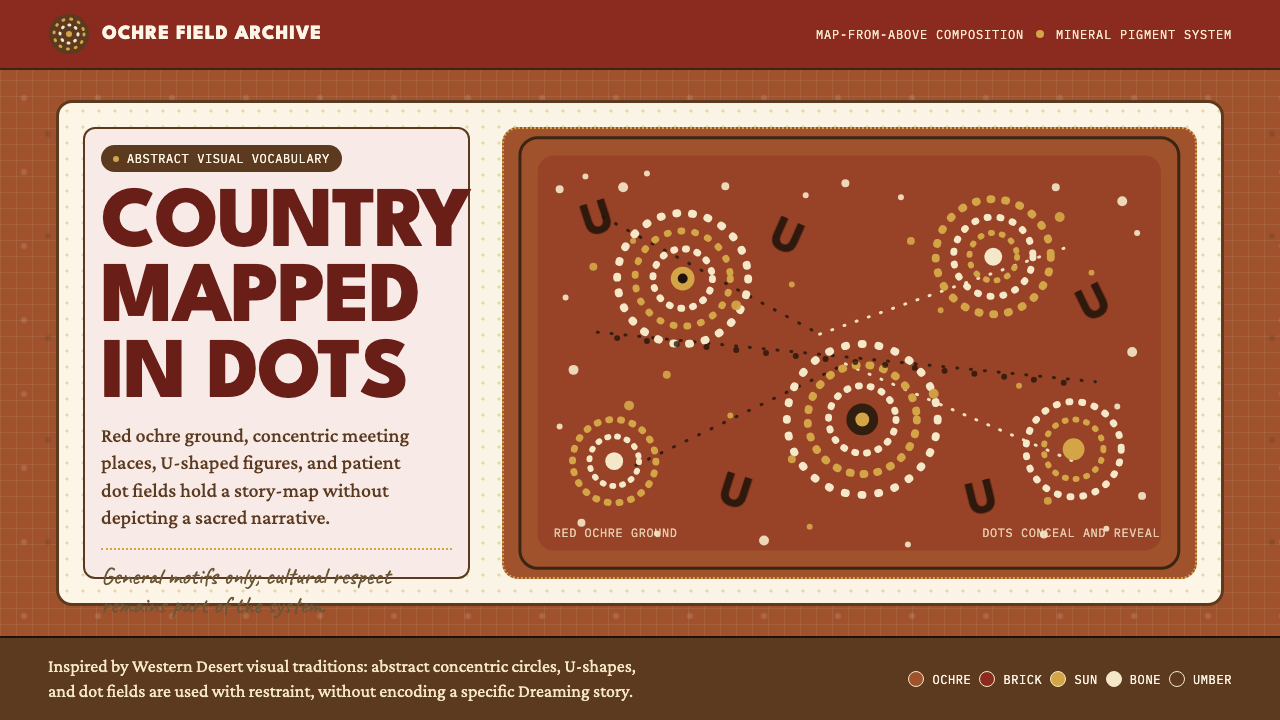 Aboriginal Dot PaintingAncient story-map energy. Red ochre, bone dots, concentric circles, and U-mar…
 Brazilian Tropicália (1968)Art must be loud. Jungle green, banana yellow Anton type, and hard-shadow col…
 Greek Antiquity (Attic Vase)Myth becomes architecture. Terracotta, black slip, and Greek-key borders fram…