What is Xhosa Umbhaco?
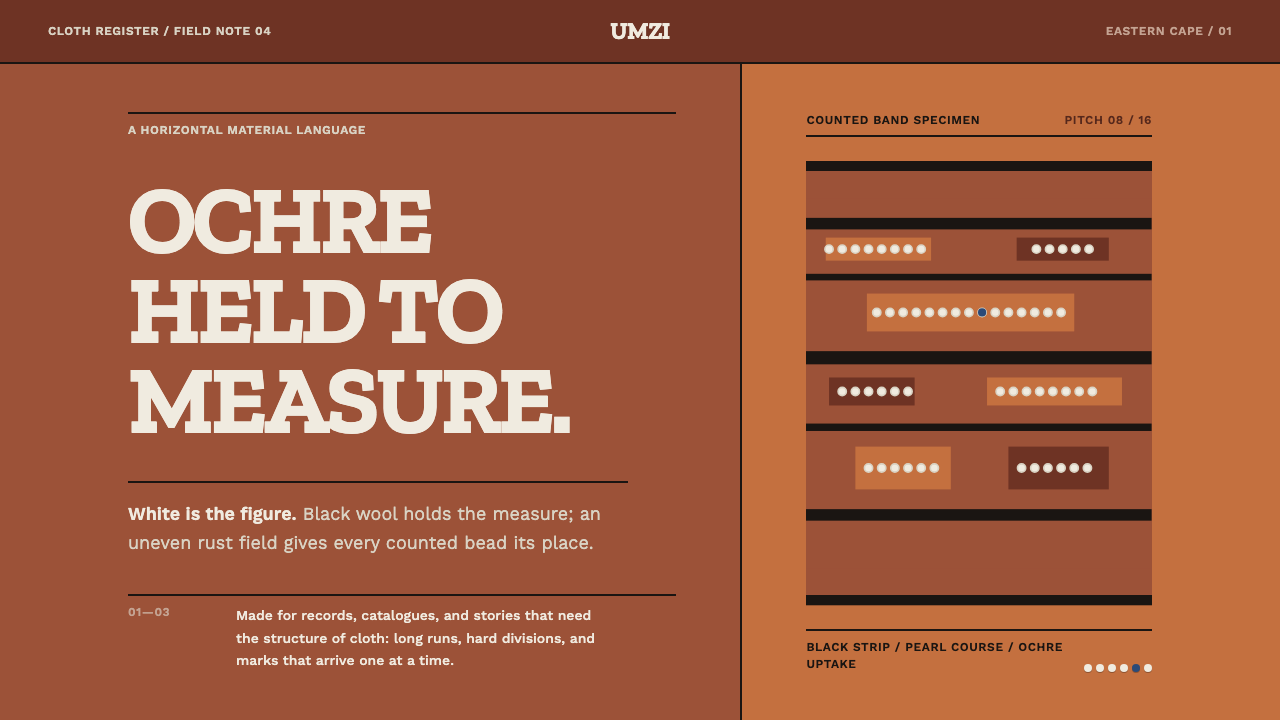
Xhosa Umbhaco takes the structure of an ochre-rubbed blanket literally: a rust-brown field, narrow black bands, and counted rows of white beads that the eye reads across the page.
Xhosa Umbhaco in brief
Xhosa Umbhaco is a design system built from umbhaco, the ochre-dyed wrapping cloth of the Xhosa-speaking people of South Africa's Eastern Cape. Its visual language is a deep rust-brown field, narrow black bands that cross it from edge to edge, and rows of small white beads and pearl-toned buttons sewn into the spaces between.
The system works as a reading system. Ochre is the page; white is the figure; black bands divide; and nothing curves except a bead. Layouts unfold horizontally, the way the cloth wraps the body, so the eye travels along bands rather than down a single column. Colour is never decorative. Each colour has a job, and the jobs do not overlap.
The overall impression is warm, grounded and rhythmic. The ground is uneven by nature, because ochre rubbed into cloth by hand never lies perfectly flat, and the white elements carry all the clarity, used only where something needs to be read. It is a style of counting and placement, not of ornament.
Where does Xhosa Umbhaco come from?
Umbhaco begins as a white cotton blanket. Rubbed again and again with red ochre, it turns a deep rust-brown, the colour held unevenly by the weave. The depth of the tone varied with clan and with the local clay, so no two cloths matched. Colonial-era writers, noticing this dress along the Eastern Cape frontier, called the Xhosa the 'red blanket people' — an outsider's label, but one that records how visible the ochre cloth was to those who met it.
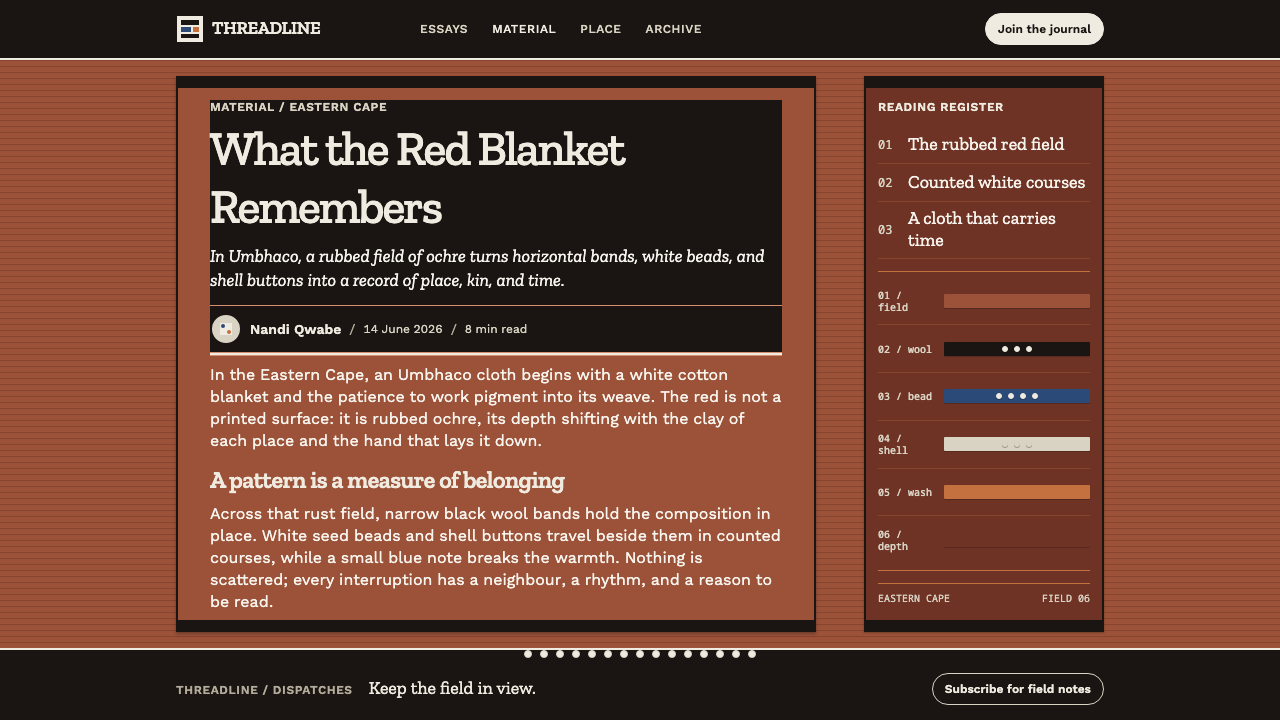
The version of the cloth this system draws on belongs to roughly the first half of the twentieth century, though ochre-cloth dress itself is much older. Narrow strips of black wool were stitched across the blanket from edge to edge. Between them, in bands of varying width, were sewn courses of white glass seed beads and rows of mother-of-pearl buttons. The result turned a plain wrap into a ruled and counted surface: horizontal bands, each with its own count and rhythm, like lines of writing laid across the body.
The source places the dress in the Xhosa districts along the Kei and Mbashe rivers in the Eastern Cape, and ties it to three overlapping traditions: Southern African ochre-cloth dress, a Xhosa glass-bead idiom in which colour, count and placement can carry information about the wearer, and the regalia of the abakwetha, the young men in initiation. White has a ceremonial register as well as a decorative one: during initiation the body is covered in a white clay called ingceke. Against ochre, white clay, white beads and pearl buttons all work the same way, as the figure that the ground exists to set off.
The source also names Lovedale Mission Press, John Bennie and Tiyo Soga among its key figures. They belong to the printed, alphabetic side of the same landscape — a mission press, a missionary linked to early written isiXhosa, and a Xhosa minister and translator — and their presence marks a contrast the system builds on. The cloth is read by counting and position; the printed page is read by letters. Umbhaco takes the cloth's grammar and applies it to screens.
What defines the Xhosa Umbhaco look?
The Ochre Field
Ochre is the page, not an accent: a deep rust-brown that fills the whole surface. It is deliberately uneven in feeling, a colour that looks hand-rubbed and clay-held rather than printed flat. Because the ground does all the unifying work, other colours are kept few and each is given a single job.
White as Figure
White is the only light colour, and it appears exactly where something must be read: a heading, a value, a key label, a row of beads. It is a pearl or bone white, never a dazzling one. Using white sparingly keeps its power; the moment it spreads across large areas, the ochre stops being a ground and becomes just a tint.
Black Banding
Narrow black bands divide the surface edge to edge. They are the system's rules, section breaks and structural lines, and they take the place of boxes, cards and shadows. A black band does one thing — it separates — and it never wraps around something to frame it.
Horizontal Reading
Layouts unfold sideways, the way the cloth wraps the body. Content is organised into bands read from left to right, each band a unit with its own internal rhythm, and the page is a stack of such bands rather than one flowing column. Where an interface forces vertical scrolling, the bands are what repeat down the page.
Counted Rows
Beads are counted, and the system counts too. Repeating elements — dots, buttons, ticks — appear in rows of a deliberate, visible number with even spacing, so the rhythm can be felt and checked. Random scatter is the opposite of the idiom; the pleasure lies in regular intervals and the occasional, meaningful change in count.
Nothing Curves but a Bead
Rounded forms are reserved for beads and buttons, the only circular things on the cloth. Panels, buttons, inputs and containers are rectangular and square-cornered, so that every circle on the page reads as a bead, as something counted. It is the rule that keeps the circle meaningful.
Hand-Rubbed Unevenness
The ground's tone is allowed to vary slightly, as ochre does when worked in by hand and caught unevenly by the weave. This is not a texture filter or a faux-cloth effect; it is a restraint on perfect flatness. Where texture is used at all, it should come from tone and density, never from a drawn weave pattern.
Who shaped Xhosa Umbhaco?
Lovedale was a mission institution in the Eastern Cape, and its press produced books, school texts and periodicals, including material in isiXhosa. It stands in the source material for the written, printed record of the region. The system keeps it as a counterweight: the cloth communicates through counted position and colour, the press through alphabets, and a faithful design lets the first logic govern while the second supplies the readable text.
Bennie was a Scottish missionary in the Eastern Cape whose work is tied to the earliest written forms of isiXhosa. His presence in the source material marks the moment a spoken language was fixed on the page for the first time, in a script worked out largely within mission circles. It is a reminder to treat the printed record of Xhosa life as a perspective, not as a neutral window.
Soga was a Xhosa minister, writer and translator, widely remembered as the first black South African ordained in the Scottish mission tradition and as the translator of Bunyan's Pilgrim's Progress into isiXhosa. In the source he stands for the Xhosa voice within the printed record: someone fluent in both the cloth world and the book world, writing in his own language.
How do you use Xhosa Umbhaco today?
Xhosa Umbhaco suits subjects that can use a strong, horizontal, rhythm-based structure: craft, textiles, heritage, education, cultural programming and any product whose content naturally arrives in rows and counts. It asks for confidence with a restricted palette and returns a system that reads quickly because it is so regular.
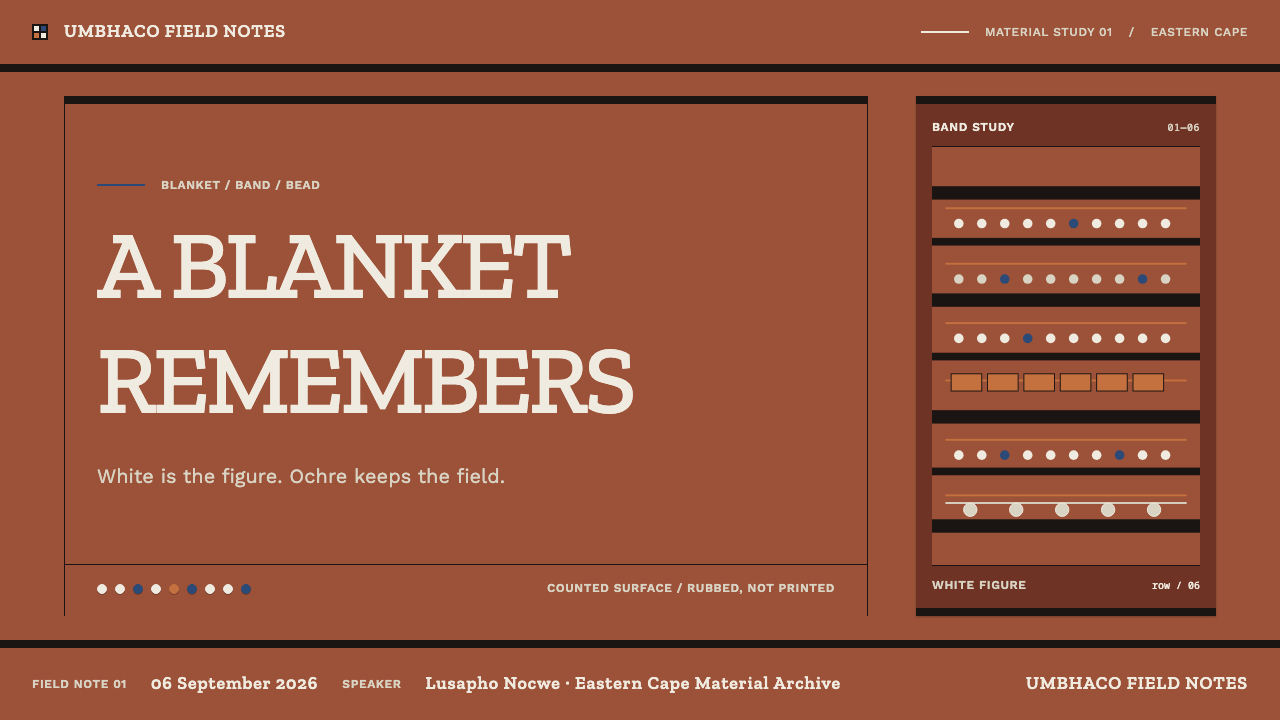
For slides, a cover works as a full ochre field crossed by one or two black bands, with a single row of white beads or buttons beneath carrying the title or a short line. Content slides are built as stacked bands: one idea per band, white used only for the words that must be read, black bands doing all the dividing. Data slides suit anything that counts — tallies, timelines, ranked lists, progress through stages — because rows of marks are the system's native chart. Bar charts become bands, and dot rows become literal bead counts.
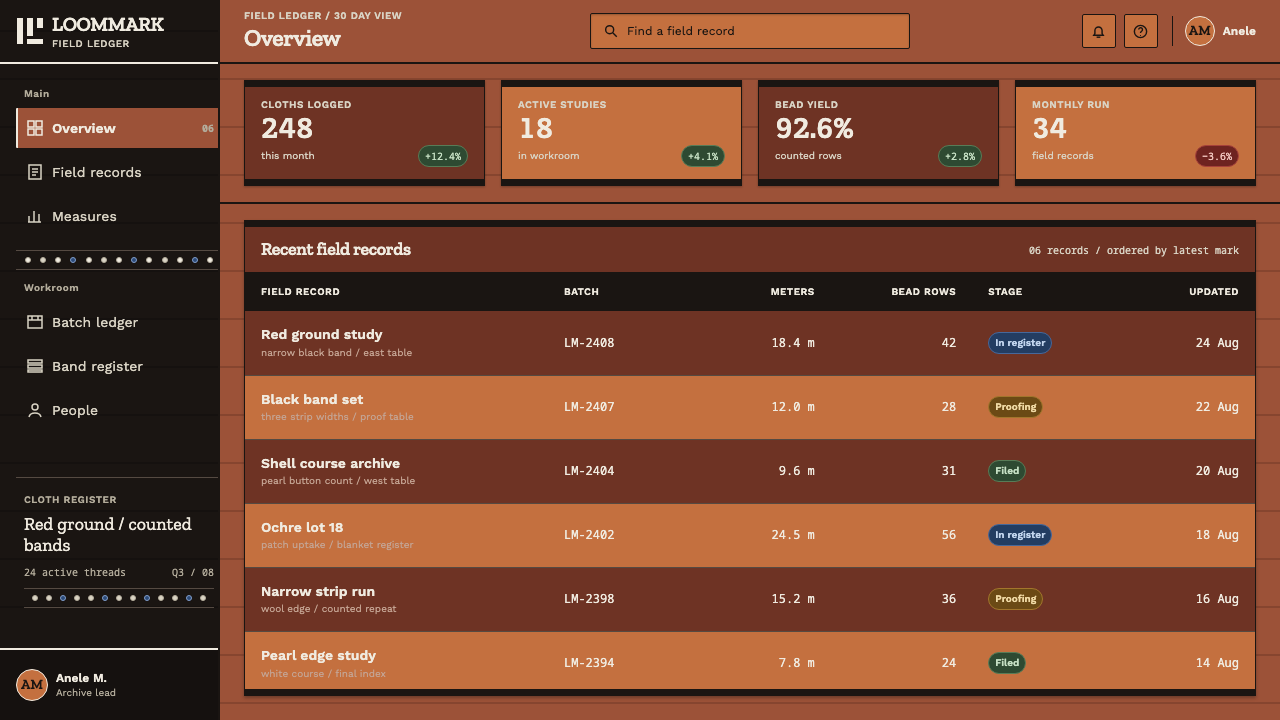
In interfaces, the system favours horizontal structure: banded sections, table-like rows, carousels that scroll sideways, and dashboards organised into strips rather than cards. Navigation reads as a band across the top; pricing becomes a row of columns separated by black bands, with the recommended plan marked by white against the ochre. Buttons and inputs keep square corners so that circles stay reserved for counted items such as step indicators, ratings and badges.
For editorial and marketing work, the style gives a distinct, warm and structured voice. Articles can be laid out as sequences of horizontal bands, with section breaks as black bands and pull-quotes set as white-on-ochre strips. Campaign pages for crafts, music, food or education can use the cloth structure as an identity device — a repeating band motif across print and screen — as long as the context respects where it comes from.
The most common mistake is treating the bead rows as confetti or the ochre as a trendy earth-tone background. Beads are counted, not sprinkled; ochre is a ground, not a tint. A second mistake is introducing curves — rounded cards, pill buttons, circular avatars everywhere — which dilutes the rule that makes a circle mean 'bead'. A third is overusing white until the page loses its ochre ground. Finally, because the dress is a living tradition, avoid using it to decorate subjects with no connection to it without saying where it comes from.
Xhosa Umbhaco — FAQ
What does umbhaco mean?
In the source material it names the wrapping cloth worn by Xhosa people in the Eastern Cape: a cotton blanket coloured with ochre and, in the beaded and button-banded form this system uses, carrying black wool strips, glass seed beads and mother-of-pearl buttons. The system uses the word for the structure of that cloth rather than for any single garment.
Why is ochre the background instead of an accent?
Because on the cloth it is the ground. The blanket is rubbed with ochre until the whole surface changes colour, and everything else is added to it. Making ochre a minor accent over white would reverse the figure-ground relation that the system exists to preserve: ochre as page, white as figure.
Why is nothing round except beads and buttons?
Because they are the only circles on the cloth, and the system wants a circle to mean something. If panels, buttons and avatars were all rounded, the viewer could no longer tell a counted bead from a decorative shape. Restricting curves keeps the layout rectilinear, and it means a circle on the page always signals a countable unit.
Does the dark ochre ground work for text-heavy pages?
Yes, with discipline. Following the figure-ground rule, text that must be read is set in white or pearl against the ochre, and body copy is best kept in short bands rather than long paragraphs. Black bands are for dividing, not for carrying words. A rust-brown ground is forgiving of light text, but contrast should still be checked on real screens.
Is it appropriate to use a cultural dress tradition as a design style?
It can be, if done with care. The system is a structural reading of the cloth, not a copy of any particular garment or of meanings encoded in specific beadwork, and it avoids imitating particular bead messages. Name the source, use it for subjects where that heritage is relevant or honoured, and avoid treating it as generic exotic decoration. When in doubt, credit the tradition and give it context.
Related design styles
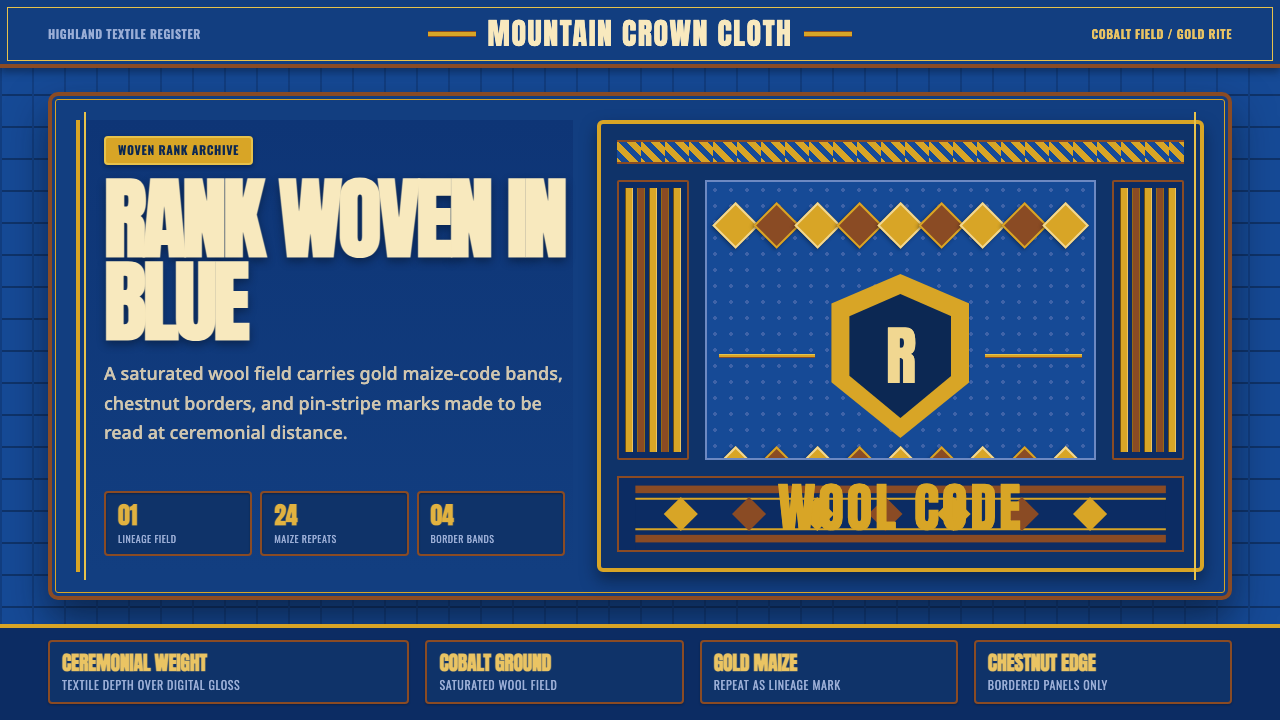 Basotho Seanamarena BlanketRank made visible. Cobalt wool, gold maize diamonds, and chestnut borders rea…
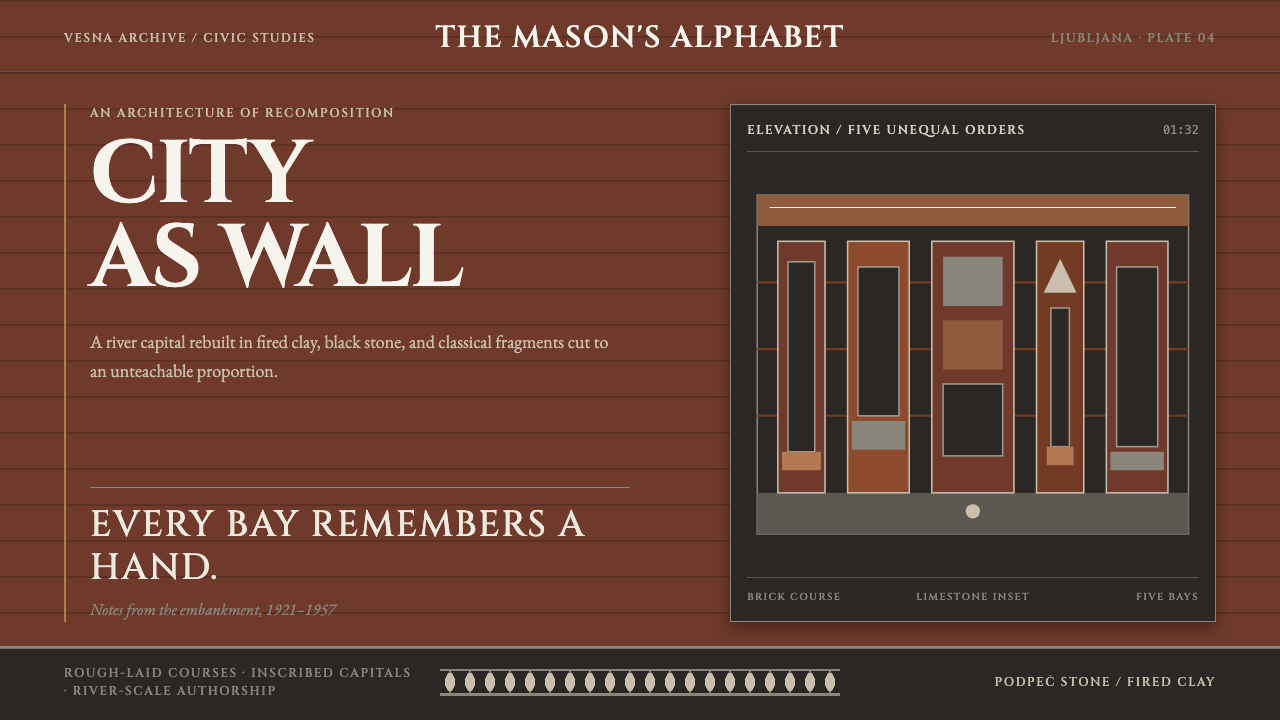 Plečnik's LjubljanaA city made monumental by hand. Fired-clay courses and carved Roman capitals…
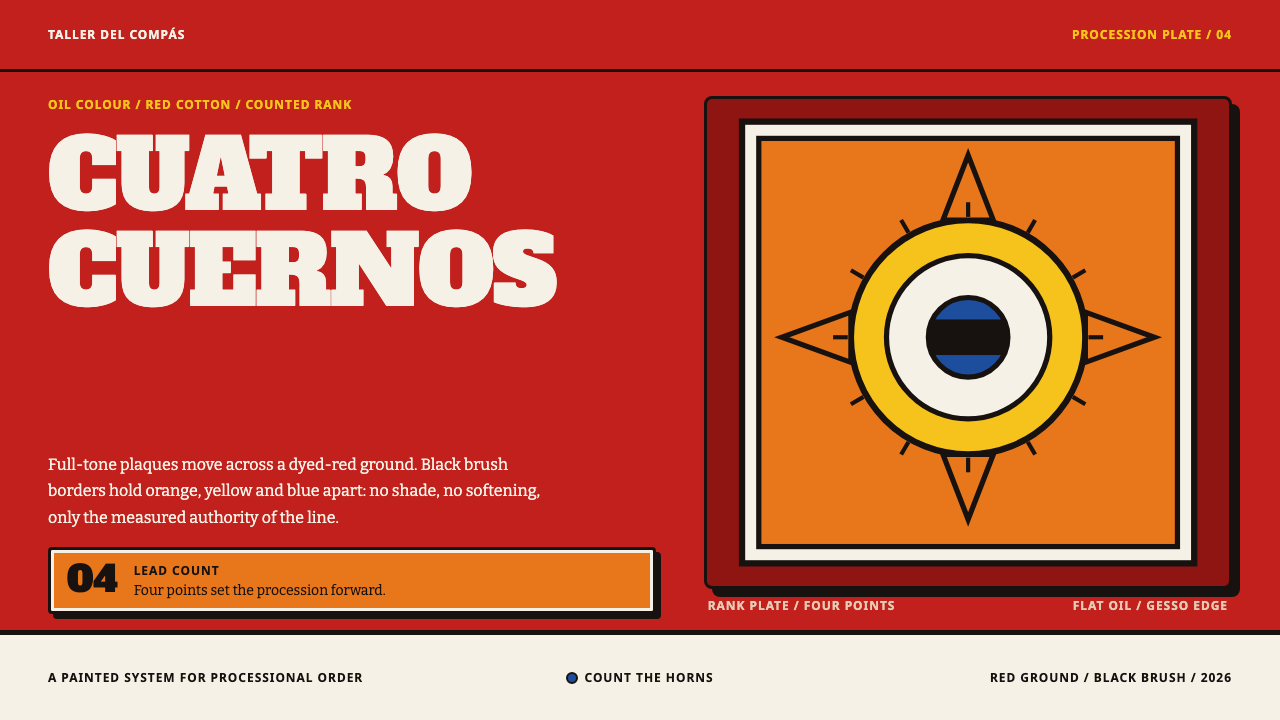 Diablos de YareRank is painted, not implied. Red cotton carries flat orange, yellow and blue…
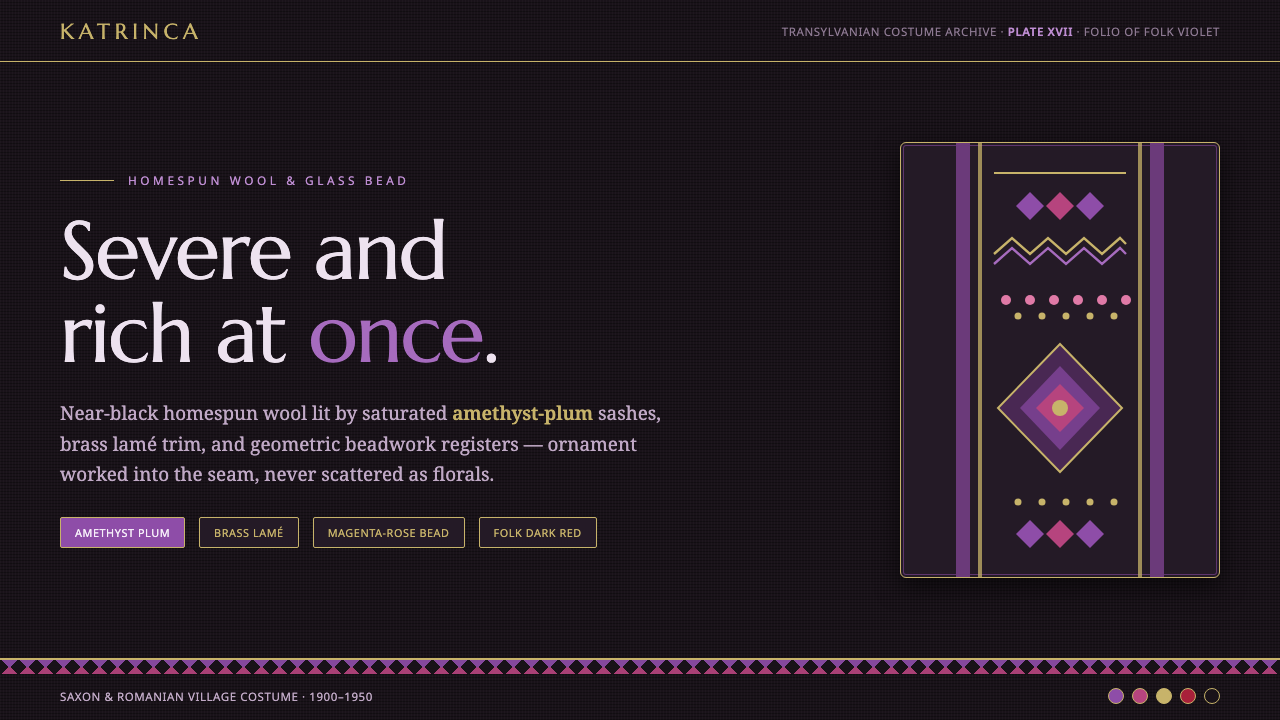 Romanian Folk VioletSevere and rich at once. Near-black homespun wool lit by amethyst-plum and br…
 Andean ChulloOrnament carries a code. Cochineal red stacks strict stitch bands with bead-w…
 Estonian Kihnu Island SkirtJoy is woven vertical. Madder red ground, Oswald stripes, black and green pin…