What is Łowicz Striped Costume?
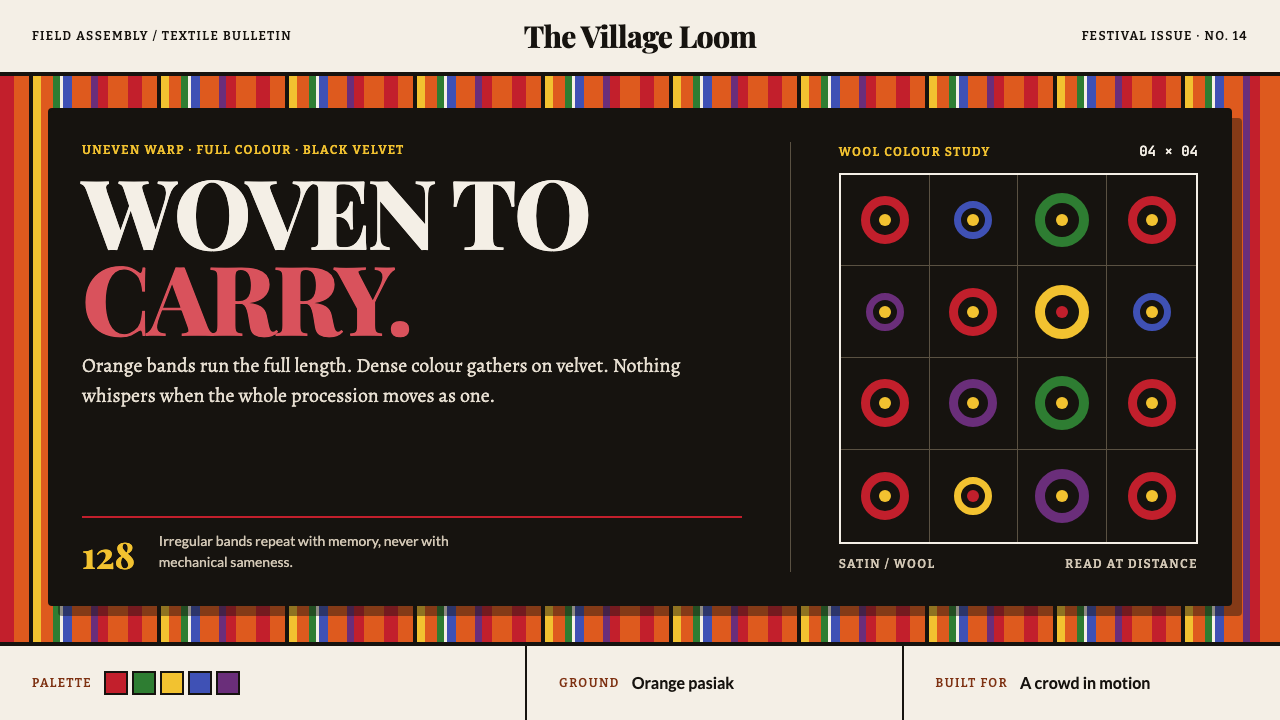
Łowicz dress is a loud woven ground of unequal stripes with black velvet panels of packed flowers laid over it — cloth built to be recognised across an entire procession.
Łowicz Striped Costume in brief
The Łowicz striped costume is the regional folk dress of the town of Łowicz and the villages around it, on the Mazovian plain in central Poland, west of Warsaw. As a visual style it is built from two halves that never blend: a woven field of vertical stripes in warm, saturated colour, and dark panels of black silk velvet crowded with embroidered flowers. Polish ethnographers group this kind of regional outfit under the name strój ludowy, and Łowicz is one of the easiest examples to recognise at a glance.
The ground is called pasiak, a woolen cloth whose stripes are woven in rather than printed on. They run vertically down the full height of a skirt and are deliberately unequal in width, so the eye meets a rhythm rather than a pattern. Before 1914 the dominant ground was red; afterwards it turned orange, and once aniline dye reached the villages, green, blue and violet appeared between the warm stripes and cooled them down.
Laid over that field are the velvet panels: black silk, worked edge to edge with satin-stitch roses and forget-me-nots in wool thread. The flowers are not scattered. They sit in tight bouquets, and the black ground shows only as a narrow gutter between them. Nothing in the system is delicate. Its contrast is set for a festival procession, so that a figure is legible from across a street, and any effect that asks the viewer to step closer — faint tints, hairline detail, distressed finishes — is foreign to it.

Where does Łowicz Striped Costume come from?
Łowicz lies west of Warsaw on the Mazovian plain, and the dress associated with it was being worn from the early nineteenth century onward. Like other Polish regional costumes, it worked as a visible statement of where a person belonged: place could be read off the cloth before anyone spoke. That is the idea inside the Polish term strój ludowy, and it explains why the Łowicz look is so consistent. It was a shared local convention, not the invention of an individual designer.
The striped ground came off the handloom. Weavers in the Łowicz villages made pasiak by working from the old patterns of their own households rather than from drawn plans, which is why every length has rhythm and none is uniform. The documented history of the colour is unusually clear: red grounds before 1914, and orange-ground pasiak documented from around 1914 through the 1930s. That orange is the one this style takes as its centre. The cooler stripes of green, blue and violet followed once aniline dye reached the villages.
The second half of the costume is embroidery. Black silk velvet is the surface, wool thread is the medium, and roses and forget-me-nots are the subject, worked in satin stitch and packed so densely that the velvet reads less as a plain field than as a frame for flowers. Together with the woven stripes this gives Łowicz dress its signature structure: a loud, rhythmic ground below, and dark bouquet-bearing panels on top.
That the costume can be described with confidence today owes a good deal to the institutions that collect and record regional dress. The State Ethnographic Museum in Warsaw is named among the keepers of this heritage, and the orange-ground cloth of roughly 1914 to the 1930s is the period for which the record is clearest. Curio's style takes that window as its subject: a living folk costume at the moment its palette was most confident, not a revival and not a stylised souvenir.
What defines the Łowicz Striped Costume look?
Woven Stripes
The ground is a grid made by the loom: vertical stripes of unequal width running the full height of the field. Unequal is the rule. Even bands would read as upholstery, whereas here wide and narrow stripes alternate in a rhythm that feels hand-set, so the surface hums without ever repeating predictably. Stripes are structure, not wallpaper, and they are always vertical.
Warm Colour, Cooled
Orange leads. The red that dominated earlier cloth has shifted into a saturated orange, and green, blue and violet are placed between the warm stripes as cooler notes. These cool colours are accents inside the field and never overturn its heat. The result is a palette that is bright, high in energy and unambiguous in daylight, with no muddy in-between tones.
Black Velvet Panels
Dark panels of silk velvet are laid onto the striped field. Black is the great stabiliser: it gives the eye somewhere to rest, creates the strongest contrast in the system, and acts as the stage on which the flowers perform. In an interface these are the zones for focus content — a headline, a key figure, a call to action — set apart from the busy ground.
Packed Floral Clusters
Roses and forget-me-nots appear in dense bouquets worked edge to edge, not as scattered sprigs. Because the embroidery is wool thread in satin stitch, each flower is a filled, tightly worked shape with a soft, raised presence. The flowers live on the dark ground only; the stripes stay free of them. Density is the point, and empty space inside a panel is rare.
Legible From Across the Street
Everything is tuned to be read at a distance. Contrast between stripe and velvet is high, shapes are large and simple, and detail is placed where it helps recognition rather than reward close inspection. Hairlines, whispered greys and low-contrast tints have no role here. If an effect needs the viewer to lean in to find it, it belongs to a different style.
No Softening
There is no distressing, no antique patina, no gentle blur. The cloth is meant to look new, woven and ready for a festival. Light never fades the colours into pastels. Depth, where it exists, comes from one layer lying on another — velvet over stripes — rather than from simulated shadow or glow. The style is confident precisely because it does not hedge.

Who shaped Łowicz Striped Costume?
The largely anonymous makers behind the striped cloth. They wove pasiak by hand, following the patterns of their own households, and their habit of unequal, rhythmic stripes is what gives the style its identity. Their record of colour — red before 1914, orange after, with cooler stripes added once aniline dye arrived — is, in effect, the palette history this style follows.
Wool floral embroidery is the second craft that defines the dress. The roses and forget-me-nots that cover the black velvet were worked in satin stitch and packed edge to edge. This tradition accounts for the style's dense, bouquet-like handling of ornament and for its rule that flowers appear on dark ground only.
An institution rather than a person: one of the custodians of Polish regional dress, whose collecting and documentation help fix what Łowicz costume looked like in particular periods. It is named here as part of the lineage, a reminder that the style rests on documented, worn garments rather than on imagination.
The wider tradition in which Łowicz sits. Each region has its own look, and the Łowicz version is defined by woven stripes and black velvet. Remembering that this is one regional costume, not a generic 'Polish folk' pattern, matters when the style is applied to a design: it carries a specific place with it.
How do you use Łowicz Striped Costume today?
The Łowicz style is at its best when a project needs to be seen first and read second: events, festivals, cultural programmes, regional brands, and anything that benefits from instant recognition. Its structure — a bright striped field carrying dark panels — gives a designer a clear answer to the question of where the eye should go.
On a cover slide, let the striped field fill the background in orange-led vertical bands of unequal width, and set one black panel across it to hold the title in large, high-contrast type, with a single cluster of flowers in the panel's corner if an image is needed. Content slides work best when each slide has one dark panel as the stage for its main message; keep the stripes to a narrow margin or edge so that body text never sits on them. Data slides can echo the loom: vertical bars of unequal width in the warm range, with one cooler green, blue or violet bar to mark the value that matters, and the chart placed on a dark panel for contrast.
For web interfaces, treat the page as a woven field and cards as velvet panels. A hero can carry the full stripes behind a dark panel containing the headline and call to action; below it, content blocks become dark panels separated by bands of stripe. Pricing pages suit the style well because tiers read as clearly separated panels, with a cool stripe marking the recommended plan. Dense dashboards are a harder fit, since the style prefers large shapes over small ones; keep it to landing and summary views and use calm neutrals for data-heavy tables. Buttons should be big, solid and unmistakable, because thin outlines and ghost buttons vanish at the viewing distance this style assumes.
In editorial and marketing work, the style supports posters, event programmes, festival microsites, craft and food brands, and tourism material. Layouts should stay bold: large type on dark panels, stripe fields as section dividers, and a floral cluster as a single recurring emblem. Photography should be saturated and daylit, cropped to sit inside panels like embroidered inserts. Use the flowers sparingly and always on dark ground; a bouquet laid directly on the stripes loses the contrast the whole system depends on.
The most common mistake is softening. Designers reach for pastel versions of the stripes, add a paper-grain overlay or distress the type, hoping to make the result feel more authentic. The effect is the opposite, since Łowicz cloth was made to be bright and new. A second mistake is making the stripes even, which turns a woven rhythm into a generic pattern. A third is running body copy across the stripes, where it competes with the ground. Keep text on dark panels, keep the stripes uneven, and let the flowers stay on the black.

Łowicz Striped Costume — FAQ
What is pasiak?
Pasiak is the striped woolen cloth woven on handlooms in the Łowicz region and used for skirts. The stripes are part of the weave, not printed, and they run vertically with unequal widths. In Curio's style it supplies the striped ground and its rhythm, while black velvet panels with embroidered flowers sit on top of it.
Why is the ground orange rather than red?
The documented record shows red grounds before 1914 and orange-ground pasiak from around 1914 through the 1930s. This style follows the orange period, which is why it feels sunny and energetic rather than deep and ceremonial. We describe what the cloth shows; the cool green, blue and violet stripes arrived later with aniline dye and are used here as accents inside the warm field.
Is this a light or a dark style?
Overall it is a bright, warm style, because the striped field is the dominant surface. But the black velvet panels give it strong dark areas, so it is best thought of as a bright field with dark stages rather than a dark mode. Text and key content should sit on the dark panels, which are the high-contrast zones.
Can the style work for data-heavy or serious products?
With care. The style favours large shapes, strong contrast and few details, which suits landing pages, summaries and event or cultural platforms. For dense tables and long reading, keep the stripes to the edges, put content on calm dark or neutral panels, and let the loud ground frame the interface rather than fill it. It is a poor fit for products whose tone depends on restraint, such as legal or clinical tools.
Is this the same as a generic Polish folk look?
No. Polish regional dress differs from place to place, and this style documents Łowicz and the Mazovia region specifically: woven vertical stripes, a warm orange ground in the documented period, and black velvet with dense wool embroidery. Treating it as a catch-all 'folk' pattern loses the particulars that make it recognisable, so use it with its place named.
Related design styles
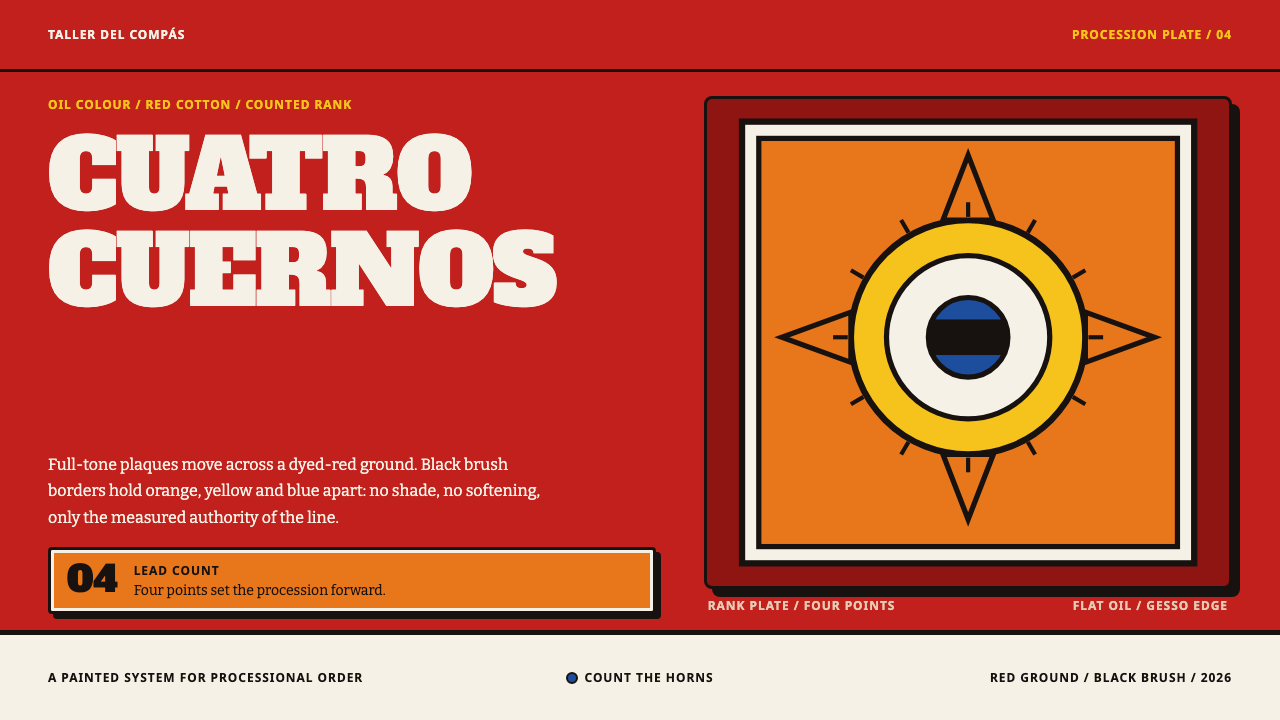 Diablos de YareRank is painted, not implied. Red cotton carries flat orange, yellow and blue…
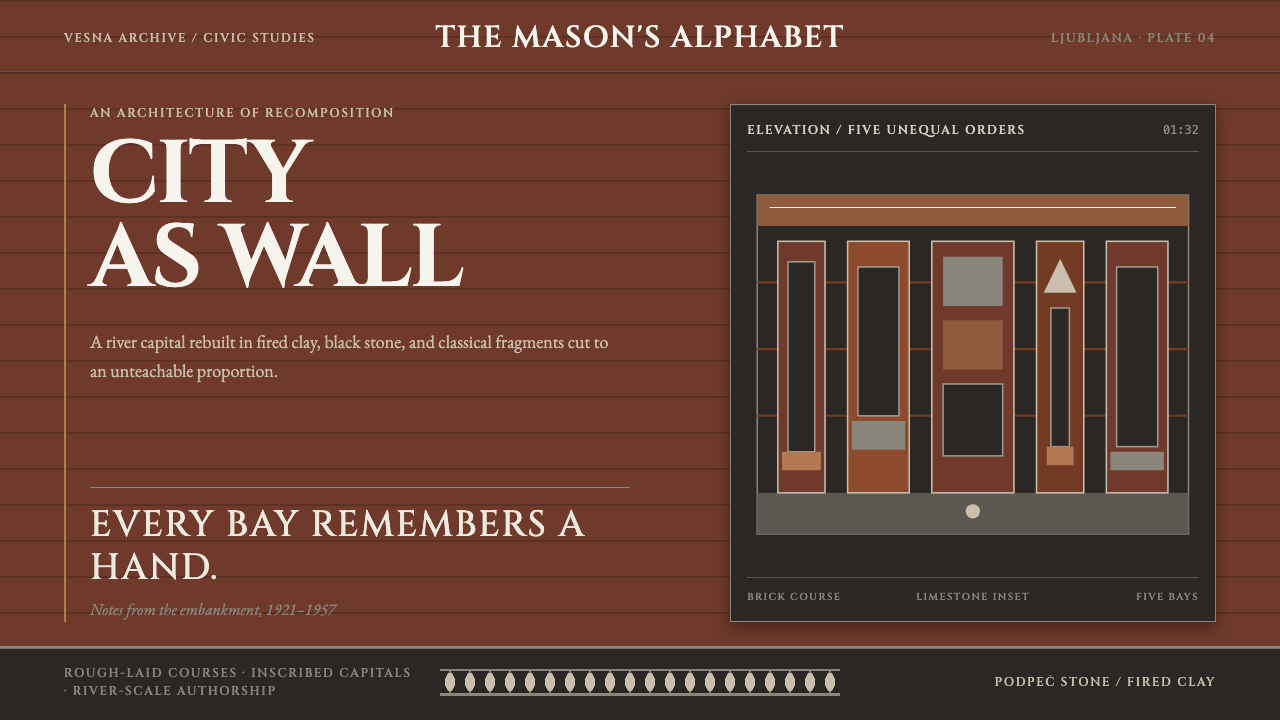 Plečnik's LjubljanaA city made monumental by hand. Fired-clay courses and carved Roman capitals…
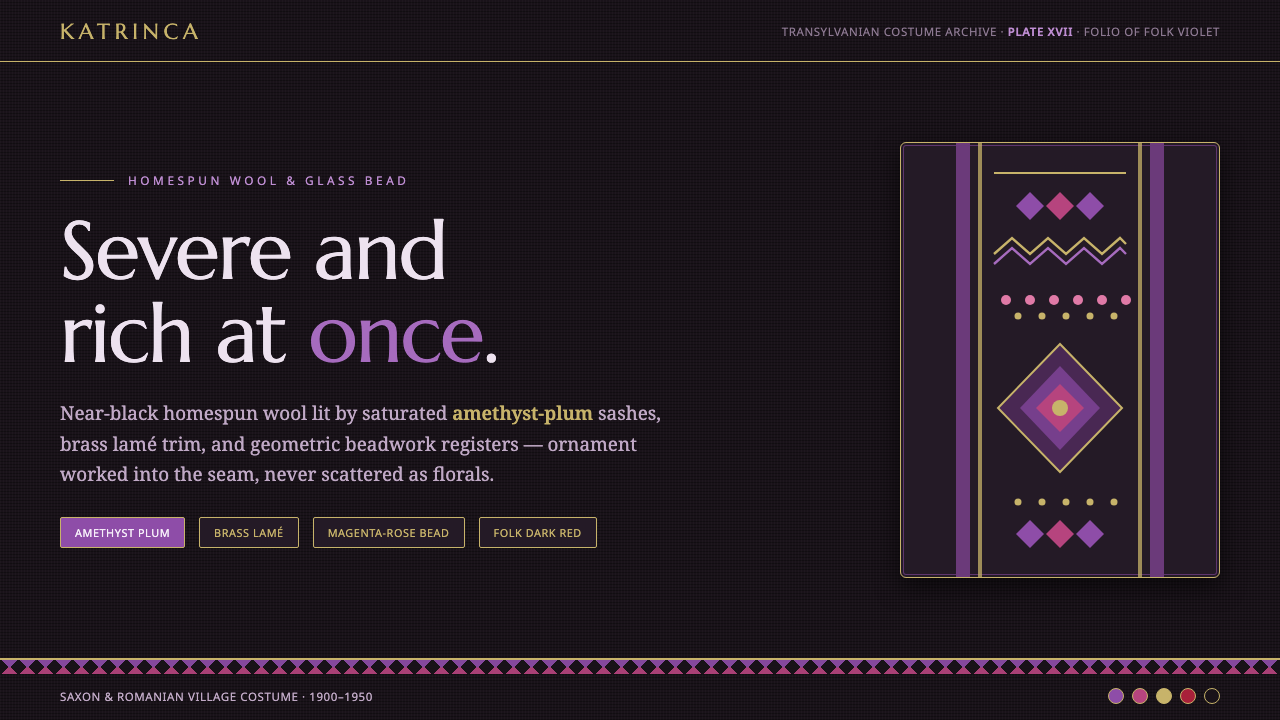 Romanian Folk VioletSevere and rich at once. Near-black homespun wool lit by amethyst-plum and br…
 Xhosa UmbhacoCloth becomes a reading system. Ochre fields, black bands, and counted pearl-…
 Basotho Seanamarena BlanketRank made visible. Cobalt wool, gold maize diamonds, and chestnut borders rea…
 Estonian Kihnu Island SkirtJoy is woven vertical. Madder red ground, Oswald stripes, black and green pin…