What is Vogue Didone?
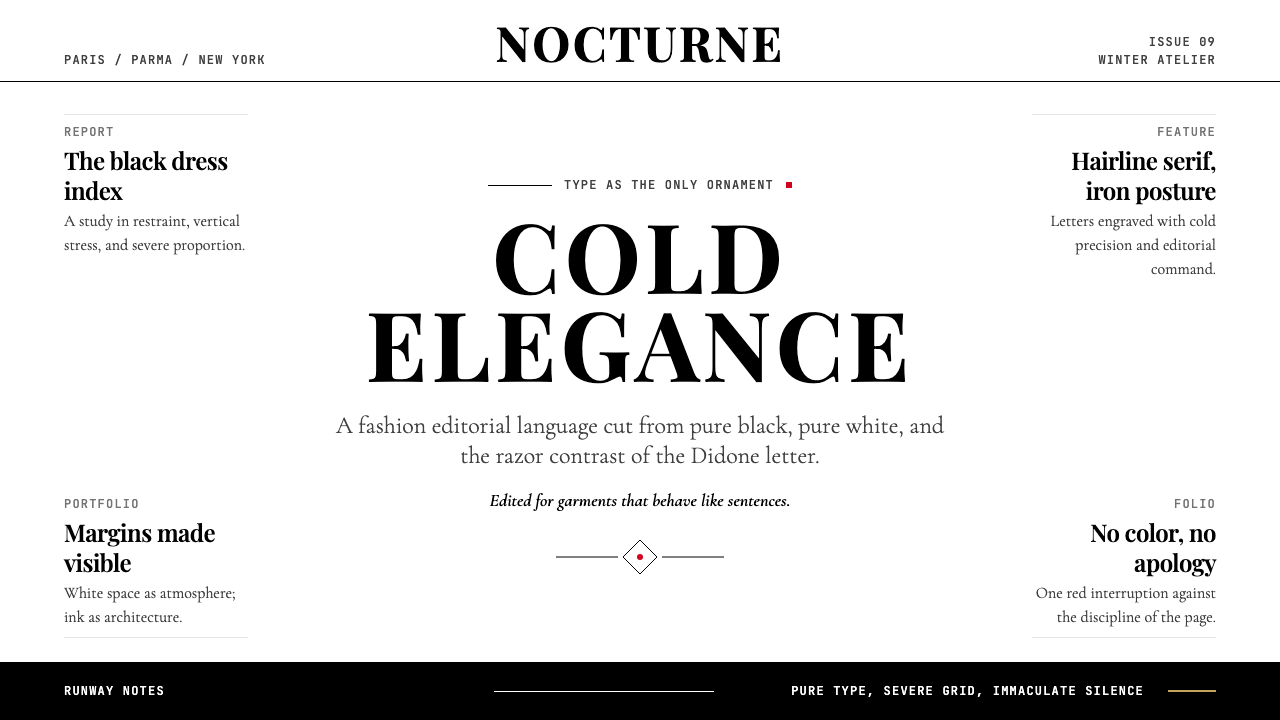
Vogue Didone turns the extreme thick-thin contrast of eighteenth-century type into the coldest, most authoritative silence in luxury editorial.
Vogue Didone in brief
Vogue Didone is a typographic design system built entirely around the visual logic of the Didone typeface family — the group of high-contrast serifs that emerged in France and Italy in the 1780s and that fashion publishing has claimed as its own visual signature for more than a century. Its palette is reduced to near-absolute terms: pure black on pure white, with a single accent color — typically a sharp, cool red — used sparingly as a punctuation mark rather than a decorative field. Whitespace is not padding; it is the primary compositional material.
The system's defining quality is cold precision. Unlike historically warm or handcrafted editorial styles, Vogue Didone withholds all softness: no gentle gradients, no warm paper tones, no illustrative flourishes. Every element is either fully present or fully absent. A headline set in a Didone face at large scale occupies the layout with the weight of a formal declaration; the body text that follows retreats to near-invisibility by comparison. This tension between typographic scale extremes is the system's central aesthetic act.
Understood correctly, Vogue Didone is not a layout style with a Didone font dropped in — it is a philosophy about where authority comes from. In this system, authority is typographic. The letterform itself — its hairline serifs, its vertical stress axis, its dramatic modulation from thick stroke to almost-nothing — is the sole decoration. Everything else steps back to let the type speak at full volume.

Where does Vogue Didone come from?
The Didone typeface genre takes its name from a portmanteau of Didot and Bodoni — the two families whose near-simultaneous development in the 1780s defined the category. In Paris, Firmin Didot refined the transitional serifs inherited from his family's earlier work into something far more extreme: strokes modulated with mechanical precision, serifs reduced to unbracketed horizontal hairlines, and a stress axis turned almost perfectly vertical. At almost exactly the same time, working in Parma under the patronage of the Duke of Parma, Giambattista Bodoni arrived at a remarkably parallel solution through different means — a letterform of operatic contrast, designed with the perfection of a mathematical instrument but carrying the emotional weight of Italian Baroque architecture. Both men were working in the same cultural moment: the Neoclassical turn away from Rococo warmth toward rational, geometric order.
The industrial era that followed made Didone type ubiquitous. The extreme contrast that made these faces unsuitable for certain printing conditions also made them spectacular for display use — on playbills, fashion almanacs, and the new illustrated press of the nineteenth century. By the time the modern fashion magazine emerged in the late nineteenth and early twentieth centuries, Didone was already the typographic register of luxury: its sharp geometry implied precision, its high contrast implied drama, and its vertical stress implied the erect posture of aristocratic bearing.
The specific link between Didone and the fashion magazine as a form was forged at Vogue. In 1908, Pat O'Hara designed the logotype that would define the publication's visual identity for generations — a high-contrast serif wordmark whose thick-thin drama became instantly synonymous with fashion authority. The deeper transformation came in the 1930s under M.F. Agha, Condé Nast's art director, who moved the magazine's internal typography decisively toward a Didone-led system in which the contrast of the letterform did the work that color or decoration might have done elsewhere. The editorial whitespace Agha introduced — generous margins, wide leading, restrained use of illustration — gave the Didone type room to radiate its particular atmosphere of cold luxury.
This typographic tradition extended through the twentieth century across the major fashion capitals. Paris, Milan, London, and New York each developed their own inflection of the high-contrast serif editorial, but the underlying system remained consistent: black type, white ground, minimal color, and maximum typographic contrast. By the time digital design tools made it possible to apply these principles to screen-based interfaces, the Didone editorial register had accumulated over a century of cultural association with luxury, precision, and editorial authority — an association that transferred intact into digital product design.
What defines the Vogue Didone look?
Typographic Contrast
The system's visual engine is the extreme thick-thin modulation of Didone letterforms. The thickest strokes of a capital letter can be many times the weight of its thinnest hairlines, creating a drama unmatched in any other serif tradition. This contrast is not a stylistic choice within the system — it is the system. Scale amplifies the effect: setting a Didone face at large display sizes makes the contrast nearly sculptural, each letter a study in tension between mass and void.
Black-and-White Discipline
The foundational palette is absolute: pure black type on pure white ground. This is not a preference for light colors but a structural commitment — the chromatic neutrality of the ground is what allows the typographic contrast to operate at full intensity. Introducing warm off-whites or cool grays softens the effect considerably; this system demands the hardest possible ground against which its type can assert itself.
Editorial Whitespace
Generous margins and deliberate negative space are not the absence of design — they are its primary material. The whitespace that surrounds a Didone headline is as compositionally active as the headline itself; it creates the silence that makes the type feel declarative rather than communicative. Crowding the space destroys the system's atmosphere completely. When in doubt, the correct move is always more white.
Vertical Stress and Upright Axis
Didone letterforms carry their weight along a nearly perfect vertical axis, unlike the diagonal stress of earlier Old Style and Transitional types. This vertical orientation imparts a quality of formal uprightness — posture, in a physical sense — that distinguishes the style from more relaxed editorial approaches. The letters stand at attention. Combined with unbracketed hairline serifs, this axis reinforces the system's cold, geometric authority.
Single Accent Color
Where color enters the system at all, it arrives as a single, precisely placed accent — most often a sharp, cool red whose function is punctuation rather than decoration. It might mark a folio, underline a key phrase, or signal an action state in a digital interface. Its power comes entirely from scarcity: the moment a second accent color joins it, both colors lose their authority. The red survives only while it remains alone.
Type as Sole Decoration
In authentic Vogue Didone work, there is no illustrative ornament, no decorative border, no geometric motif used for visual richness. The letterform itself — in its drama, its contrast, its scale — is the visual event. Any additional decorative element competes with what the type is already doing and weakens the system. Thin rules used as structural dividers are permissible; anything more elaborate is a concession.
Scale Hierarchy Over Color Hierarchy
Information hierarchy in this system is established almost entirely through scale and weight — the difference between a large, heavy headline and small, light body text can span a vast range, and it is this range that organizes the reader's attention. Color is not used to mark hierarchy; it is reserved for the single-accent function described above. This means that the typographic scale must be considered and deliberate, not arrived at by default.

Who shaped Vogue Didone?
Firmin Didot was the French punchcutter and publisher who, working in Paris in the 1780s and 1790s, pushed the modulation of the Latin serif to its rational extreme. His letterforms — with their almost mechanical thick-thin contrast and their horizontal, unbracketed hairline serifs — represented the culmination of the Neoclassical typographic project: a letterform that looked as though it had been derived by geometric principle rather than carved from living tradition. The typefaces that bear his family's name became the standard of French luxury printing and remain the reference point for the entire Didone category.
Working in Parma under the patronage of the Duke of Parma from 1768 onward, Giambattista Bodoni arrived at a parallel solution to Didot's through a distinctly Italian sensibility — more operatic in its contrast, more luxurious in its spacing, and perhaps more emotionally present despite its formal severity. His Manuale Tipografico, published posthumously in 1818, is among the most beautiful books of type specimens ever produced. Bodoni's name became synonymous with a particular ideal of typographic grandeur that fashion publishing would inherit wholesale.
Pat O'Hara designed the Vogue logotype in 1908, establishing the high-contrast Didone wordmark that would anchor one of the most recognizable visual identities in magazine history. The decision to set the publication's name in a Didone face — rather than the more common display types of the period — was a declaration about the magazine's position: precision, authority, and the cold beauty of the perfectly formed letter as the visual signature of fashion itself.
Mehmed Fehmy Agha served as art director for Condé Nast publications — including Vogue — from 1929 to 1943, and it was under his direction that the high-contrast Didone editorial system reached its mature form. Agha introduced generous whitespace, disciplined typographic hierarchy, and the restrained use of photography that became the template for luxury editorial design throughout the mid-twentieth century. His work demonstrated that the Didone typeface family, given adequate space and typographic discipline, was sufficient to carry an entire visual identity without the support of decorative elements.
How do you use Vogue Didone today?
Vogue Didone translates directly and powerfully into presentation design, but it requires a discipline that most slide software defaults actively resist. The cover slide should be treated as a fashion editorial spread: the title set large in a high-contrast serif, positioned with deliberate asymmetry against a pure white or pure black ground, with no background imagery, no badge or logo cluttering the lower corners, and no decorative frame. The title is the image. Interior content slides must honor the same whitespace logic — one idea per slide, type sized to fill the available space confidently, and any supporting copy set small and subordinate enough that it does not compete with the headline.
Data slides present a particular opportunity within this system. Charts and graphs rendered in monochrome — all bars in black, all lines in black, with a single data series highlighted in the system's red accent — acquire an analytical authority that color-coded charts rarely achieve. The key is treating the chart as a typographic element rather than an infographic: label axes directly in the same typeface as the body copy, remove gridlines that do not carry information, and let the shape of the data speak in high contrast against the white field.
For web interfaces, Vogue Didone is best deployed in contexts where the product's positioning depends on communicating exclusivity, authority, or refined taste: luxury e-commerce, high-end service landing pages, premium editorial platforms, and pricing pages for products at the upper end of their market. In these contexts, the correct approach is to resist the temptation to soften the system for screen — the coldness is the message. Keep the background white, the type black, and the interactive accent color to one. Card components should have crisp borders rather than soft shadows; hover states should shift the accent color, not introduce new visual complexity.
In editorial and marketing applications, the system's poster-like directness becomes a significant advantage. A marketing email built on Vogue Didone principles — large Didone headline, minimal body copy set in a contrasting small scale, and a single link or button in the accent color — will read with far more force than one built around imagery and decorative elements. The same logic applies to social media assets: the system's high contrast reproduces well at small sizes and across varied screen conditions, making it more durable than softer, texture-dependent approaches.
The most common failure mode when applying Vogue Didone is confusing restraint with emptiness. Designers who have not internalized the system's logic often add elements — a secondary typeface for warmth, a background texture for richness, a second accent color for variety — at precisely the moments when the correct choice is to hold the line and trust the whitespace. Each addition slightly dilutes the cold authority that the system depends on, and the cumulative effect is a layout that looks like an imitation of luxury rather than the thing itself. The discipline is to treat every element not yet present as already removed for good reason.

Vogue Didone — FAQ
Is Vogue Didone suitable for dark-background interfaces?
The historic Didone editorial tradition is definitively light-ground: pure black on pure white was the canonical form, and the system's energy derives from this reversal of the natural reading condition. A dark inversion is possible — white Didone type on a black ground carries genuine drama — but it changes the emotional register from cold authority to something closer to theatrical menace. The accent color must be reconsidered for the dark ground: a warm red that works crisply on white can feel aggressive or unstable on black, and a cooler red or no accent at all may serve better. The dark variant is a legitimate creative choice, not a compromise, but it should be approached as a different application of the principles rather than a simple inversion.
How is Vogue Didone different from a generic luxury style?
Generic luxury design tends to rely on warm metallics, softened edges, ambient texture, and a palette drawn from natural precious materials — champagne, gold, cream, pale stone. Vogue Didone refuses all of this. It achieves luxury through severity rather than richness: the more it removes, the more authoritative it becomes. The test is whether a layout could appear in a mid-tier fashion publication with a few adjustments — if yes, it is not Vogue Didone but a softer variant. True Vogue Didone work has an almost uncomfortable coldness that only a few contexts can carry.
Can Vogue Didone include photography or imagery?
Photography is compatible with the system, but only when treated with the same typographic discipline as everything else. Fashion editorial photography in the Didone tradition is high-contrast, often cropped to near-abstraction, and presented against a pure ground rather than integrated into a textured layout. The photograph should function as a shaped form within the composition — its placement and proportion governed by the same whitespace logic as the type. Lifestyle photography, textured product shots, and backgrounds with natural visual noise are all foreign to the system's logic and weaken it significantly.
What kinds of products or brands should avoid this style?
Vogue Didone is poorly suited to any context where warmth, approachability, or human connection is a core brand value. Children's products, food and beverage brands, wellness and health applications, community platforms, and consumer products competing primarily on friendliness or affordability will all be misrepresented by this system's cold authority. The style communicates distance — intentionally — and that distance is appropriate only when the product's value proposition is enhanced rather than undermined by formality and precision. Using it outside these conditions does not merely fail aesthetically; it actively signals the wrong relationship between the brand and its audience.
How do you apply Vogue Didone without it looking dated or overly editorial?
The risk of a dated appearance arises when designers faithfully reproduce the surface markers of 1920s–1940s fashion editorial — period-specific decorative rules, particular column structures, a pastiche relationship with the original material — rather than applying the underlying principles. Vogue Didone updated for contemporary digital contexts uses the same typographic logic — extreme contrast, disciplined whitespace, cold palette, single accent — but at the proportions and interaction patterns native to screens. The scale of type changes; the principle does not. A pricing table that applies this system correctly will not look like a magazine page — it will look like itself, organized by the same values.
Related design styles
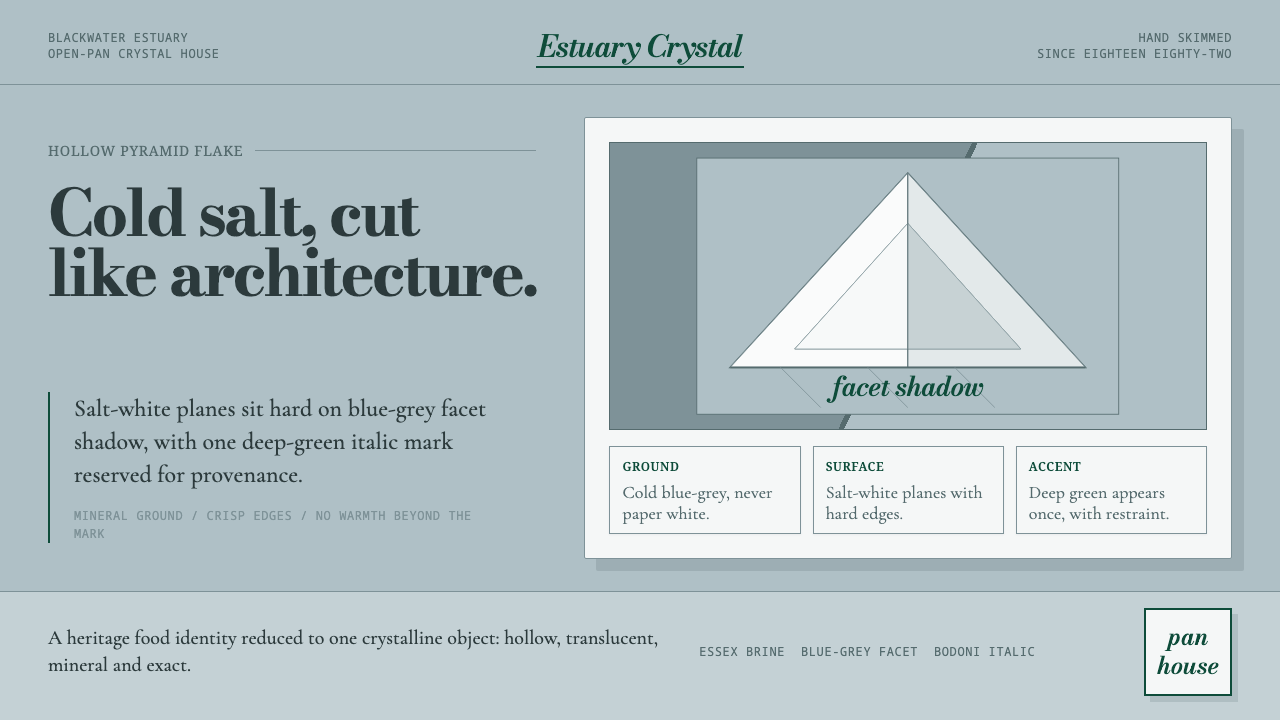 Maldon Sea Salt PyramidCold mineral luxury. Salt-white facets on blue-grey ground, struck once with…
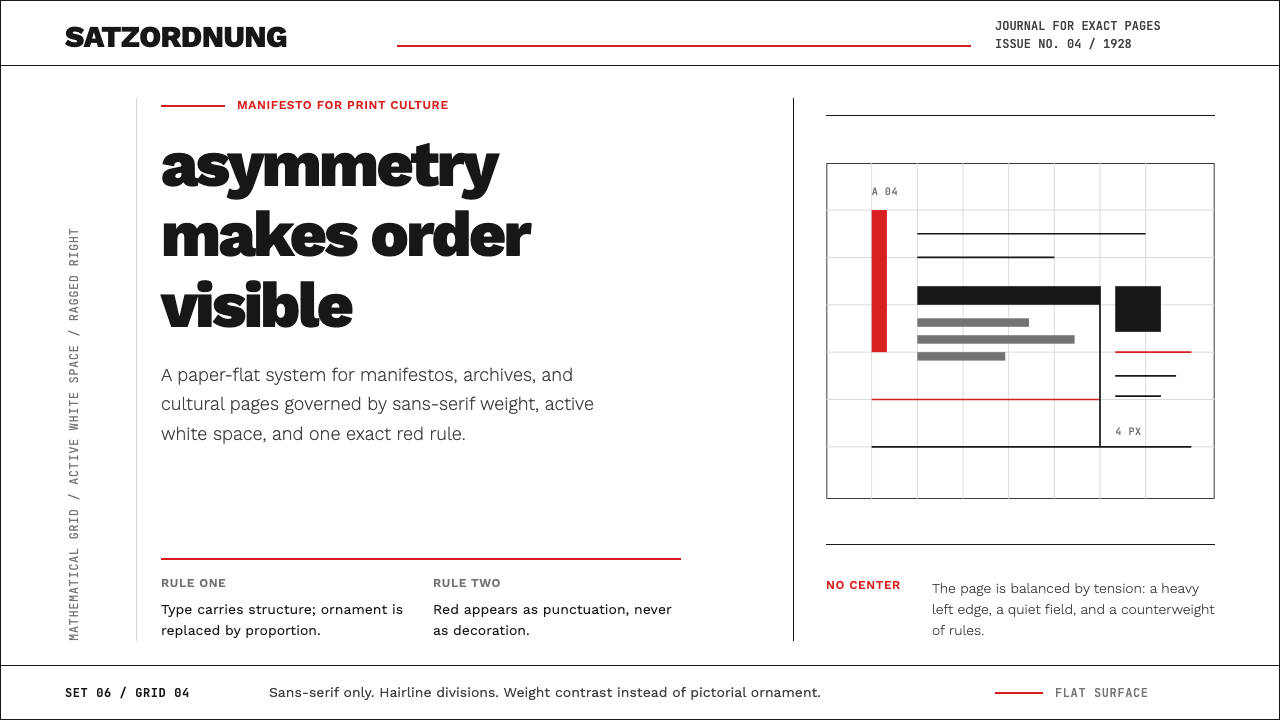 New Typography (Tschichold 1928)Tschichold's 1928 doctrine in CSS. Asymmetric grid, hairline rules, red-and-b…
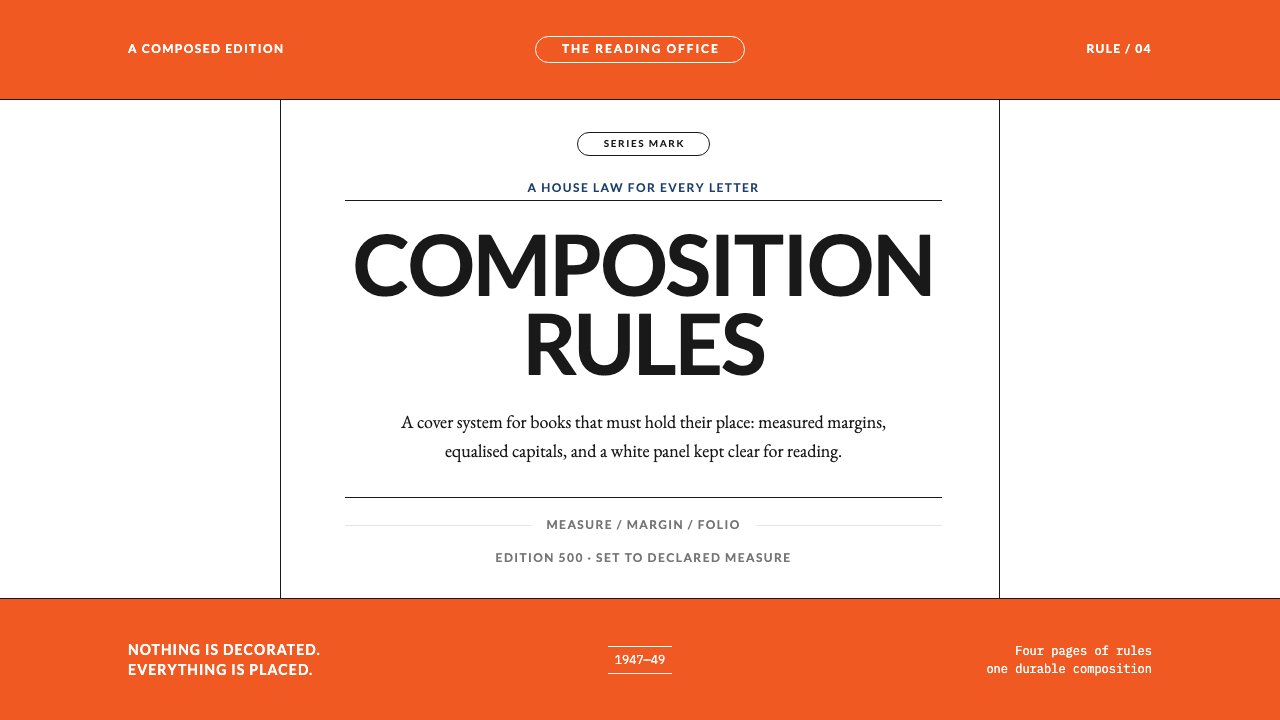 Tschichold Penguin RulesOrder becomes visible. Orange bands frame a white panel of equalised Lato cap…
 Casablanca Néo-MauresqueOrnament knows its boundary. Matte render, black iron, and celadon tile land…
 Gill Sans (BBC, 1928)Quiet authority, clearly set. Warm cream, black humanist sans, and hairline o…
 Nordic Classicism AsplundStone, not cream. Engraved Trajan capitals on cool chalk stucco, fluted colum…