What is New Typography (Tschichold 1928)?
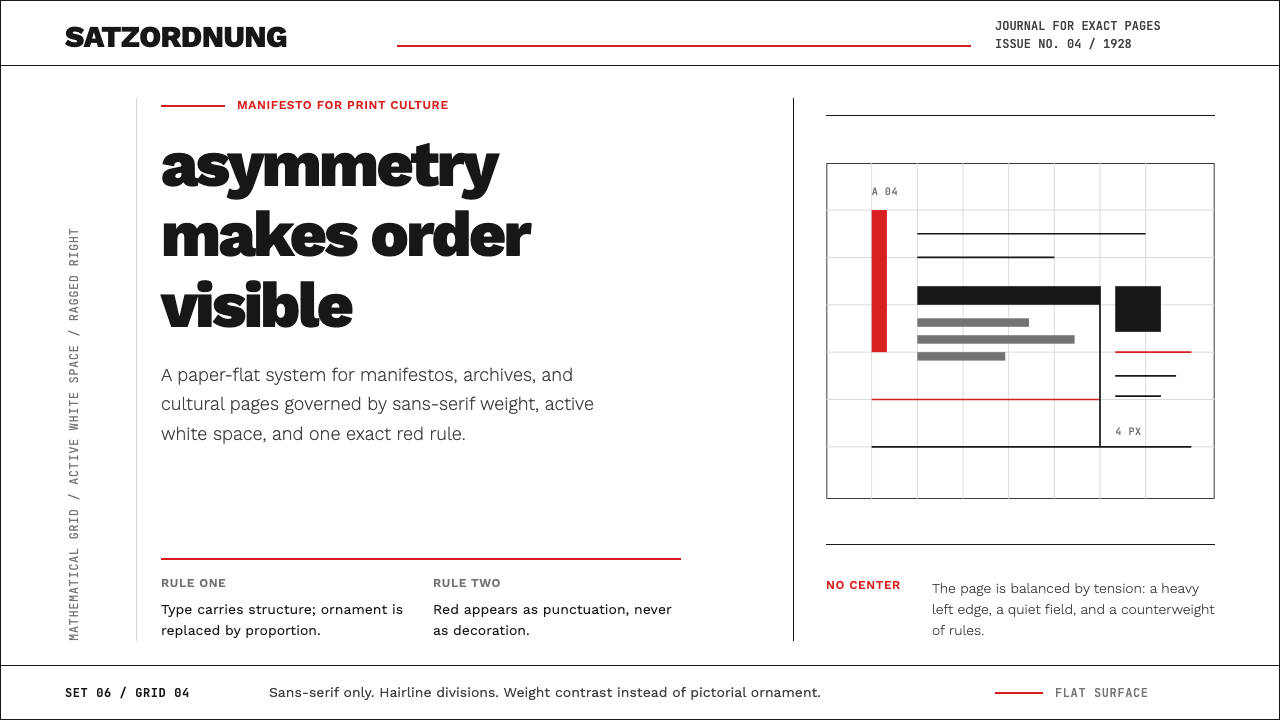
Jan Tschichold's 1928 manifesto declared war on centered symmetry and gave modern design its most rigorous set of rules: asymmetric grids, sans-serif type, and red-and-black rule lines as the only ornament permitted.
New Typography (Tschichold 1928) in brief
New Typography is the design doctrine Jan Tschichold codified in his 1928 book 'Die neue Typographie,' published in Berlin. At its core, the system rejects the centuries-old convention of centered, symmetrical page composition and replaces it with asymmetric grid layouts governed by mathematical logic. Every element — type, rule lines, white space — is assigned a position that serves communication rather than classical decorum.
The visual vocabulary is deliberately sparse. Sans-serif letterforms carry all typographic weight; serifs are treated as historical residue with no functional value. Red and black are the only colors admitted, and red appears almost exclusively as a hairline rule or a single accent element, not as a field of color. The paper or screen ground — always light, typically pure white — is an active compositional element, not a neutral backdrop.
What distinguishes New Typography from mere minimalism is its ideological precision. Tschichold was not advocating restraint for aesthetic reasons alone; he was articulating a theory of reading. Asymmetric composition creates a natural directional flow. Hierarchies built through contrasts of type scale rather than decorative flourishes allow the eye to move through information without being led astray. The style is an argument about how visual order should be produced.

Where does New Typography (Tschichold 1928) come from?
Jan Tschichold was born in Leipzig in 1902, the son of a sign painter. His early exposure to lettering and commercial print gave him an unusually practical understanding of type as a production craft rather than an academic exercise. In 1923, at the age of twenty-one, he attended the Bauhaus exhibition in Weimar and encountered the work of László Moholy-Nagy, El Lissitzky, and the Russian Constructivists for the first time. The encounter was transformative. Within a year he had published 'elementare typographie,' a special issue of the printers' journal Typographische Mitteilungen, laying out the principles that would become the foundation of New Typography.
The Russian Constructivist influence was decisive. Artists such as El Lissitzky, Alexander Rodchenko, and Varvara Stepanova had pioneered the use of diagonal tension, rule lines as structural elements, and the deliberate contrast of black type against white space for political posters and book design in the Soviet Union during the early 1920s. Tschichold absorbed their formal innovations and stripped them of explicit political content, transforming a revolutionary visual language into a systematic doctrine applicable to any commercial or institutional print context — advertisements, catalogs, business stationery, timetables.
When Tschichold published 'Die neue Typographie' in 1928, he was twenty-six years old and working as a teacher at the Munich Master Printers' School. The book was addressed not to art directors or gallery audiences but to practicing printers and compositors — people who set type daily. It was a manual as much as a manifesto, offering diagrams, case studies, and specimen pages that showed exactly how asymmetric grid layouts could be constructed using the metal type and rule lines that printers already had in their composing rooms. This pragmatic orientation gave the work an influence that purely theoretical manifestos rarely achieve.
The Nazis' rise to power in Germany brought the movement to an abrupt halt domestically. In 1933, Tschichold was briefly arrested by the Gestapo in Munich on charges of creating 'un-German' and Bolshevist typography. He emigrated to Basel, Switzerland, where a separate tradition of rigorous typographic rationalism was already developing. From Basel, New Typography's principles diffused into what would become Swiss International Style in the 1950s and 1960s — a global design language still visible in corporate identity systems, wayfinding, and digital interfaces today. Tschichold himself later repudiated the strict dogmatism of his 1928 position, arguing that it had become a new form of orthodoxy, but the doctrine he established outlived his own revision of it.
What defines the New Typography (Tschichold 1928) look?
Asymmetric Grid
The foundational principle of New Typography is the deliberate rejection of centered, bilateral symmetry in favor of layouts organized by a rigorous but non-mirrored grid. Elements are placed according to reading direction and visual weight rather than geometric reflection. A heavy typographic block on one side of a page may be balanced by a single hairline rule or an expanse of white space on the other — tension replaces mirror-image balance. This asymmetry is not arbitrary; it follows the natural left-to-right scanning movement of the eye and creates an implicit sense of direction that symmetric layouts cannot produce.
Sans-Serif as Default
Tschichold mandated sans-serif type as the only form suitable for modern communication. His argument was functional: serifs developed as artifacts of hand-carved stone inscriptions and calligraphic tradition, and carry no communicative benefit in print. Sans-serif letterforms, by contrast, reduce the character to its essential readable structure. In practice, New Typography uses sharp contrasts of weight and scale — a very large, bold heading against a compact, lighter body — to establish hierarchy without relying on decorative variation between typeface families.
Red and Black as the Only Palette
New Typography admits exactly two colors: black and a single saturated red, used against a white or light ground. Black handles all typographic matter and structural rules. Red appears as a hairline rule separating sections, a short accent line beneath a heading, or a single word or numeral pulled out for emphasis — never as a background field or decorative fill. This extreme restraint gives red an intensity it could not achieve in a broader palette; each red element carries disproportionate visual weight precisely because it is the only color present.
Hairline Rule Lines as Structure
Rule lines — thin horizontal or vertical printed lines — are used as active compositional elements rather than passive decorators. In New Typography a hairline rule is not a border around content; it is a structural joint between compositional zones, a guide for the eye across white space, or a device that gives a page its dominant reading axis. Rules may appear in red or black. Their thinness is essential — they carry weight through contrast with surrounding white space, not through their own mass.
White Space as Active Silence
Generous, controlled white space is not emptiness in New Typography — it is one of the primary compositional instruments. Tschichold argued that a page's unprinted areas should be as carefully considered as its printed ones. Wide margins, large gaps between sections, and deliberate open zones around individual type elements allow each element to carry maximum legibility and visual authority. The tendency to fill every corner of a layout with content is exactly what New Typography disciplines out of design practice.
Functional Hierarchy over Decoration
Information hierarchy in New Typography is produced entirely through typographic contrast — differences in scale, weight, and spatial relationship — never through decorative devices such as ornamental borders, illustrative vignettes, or color fields. A headline is recognizable as a headline because it is substantially larger and heavier than the text beneath it, not because it sits inside a decorative cartouche. This approach produces hierarchies that are immediately readable even when elements are radically simplified.
Zero Ornament
Any visual element that cannot be justified by a communicative or structural function should not exist. New Typography extends this principle even to typographic ornament — flourishes, swash characters, decorative initials, and printer's flowers are all excluded. What remains is not coldness but clarity: when every element earns its place, the reader's attention is never divided between the message and its decoration. This is perhaps the principle most frequently violated in contemporary interpretations of the style, which often add gestural marks or textural elements in the name of visual interest.

Who shaped New Typography (Tschichold 1928)?
Tschichold authored 'Die neue Typographie' in 1928 and 'elementare typographie' in 1925, establishing the codified rules of asymmetric layout, sans-serif primacy, and functional hierarchy that defined the movement. Born in Leipzig to a sign-painting father, he came to typography through practice before theory. After fleeing Nazi Germany in 1933 he settled in Basel, where his influence helped seed what would become Swiss International Style. In a celebrated late-career reversal, he redesigned Penguin Books' entire paperback range in the late 1940s using classical proportional principles — the same principles he had attacked in 1928 — arguing that dogmatic modernism was itself a tyranny. The tension between his two positions remains generative for typographic thought today.
The Russian artist and designer El Lissitzky (born Lazar Markovich Lissitzky, 1890) was among the most direct influences on Tschichold's visual system. His 'Proun' compositions — abstract paintings and prints that used diagonal tension, compressed perspective, and geometric forms in dynamic asymmetric arrangement — gave Tschichold a formal vocabulary to work from. Lissitzky also designed the landmark book 'Pro dva kvadrata' (About Two Squares, 1922) and collaborated on the typographic design of Mayakovsky's poetry, demonstrating that avant-garde visual logic could be applied to mass-produced printed matter. His work formed a bridge between revolutionary Soviet art and the rationalist German typography Tschichold would systematize.
Moholy-Nagy's role in shaping the visual environment that produced Tschichold was substantial. As a Bauhaus master from 1923, he edited the influential 'Bauhausbücher' series with Gropius, wrote 'Malerei Fotografie Film' (1925), and championed the idea that typography and photography should be integrated into a unified visual communication system rather than treated as separate disciplines. His slogan 'typography is communication made visible' captured an idea central to Tschichold's project. Moholy-Nagy also introduced the constructivist red-and-black contrast into Bauhaus print work, providing one of the most direct visual antecedents for the New Typography palette.
Paul Renner designed Futura in 1927 — a typeface whose geometric sans-serif letterforms were so closely aligned with New Typography's principles that it became one of the movement's most used type tools in practice, even though Tschichold did not formally endorse a single typeface. Renner was a contemporary and sometime collaborator of Tschichold in Munich, and both were arrested by the Nazis in 1933: Renner for a pamphlet critical of National Socialism, Tschichold for his typography. Futura's reduction of letterforms to their geometric essentials — the circular 'o,' the perfectly straight stems — made it the most visible typographic embodiment of New Typography's rejection of historical ornament.
As the director of the Bauhaus printing and advertising workshop from 1925, Herbert Bayer produced some of the most direct precedents for Tschichold's applied system. Bayer's design for Bauhaus exhibition catalogues, stationery, and the Dessau campus signage system demonstrated that asymmetric composition, rule lines, and limited color could be extended into a coherent identity system — not just applied to individual posters. His 'Universal' typeface experiment, which attempted to eliminate capital letters and reduce letterforms to purely geometric constructions, was the most radical typographic proposal of the era and influenced Tschichold's theoretical position even where Tschichold's practical advice differed.
How do you use New Typography (Tschichold 1928) today?
New Typography transfers well to contemporary design work because its principles operate at the level of structure rather than surface. Applying it correctly means internalizing what the visual system is actually doing: using asymmetric tension to create reading direction, using type scale to produce hierarchy without decoration, and treating white space as a compositional element with as much deliberateness as any printed element. The most common failure mode is to borrow the visual surface — a red rule line here, a bold sans-serif headline there — without adopting the underlying discipline that makes those elements work.
For presentation slides, New Typography is among the most powerful style systems available for both cover and content pages. A cover slide benefits from the bold asymmetric logic: the title in heavy sans-serif type anchors to the left margin while a single red horizontal rule runs beneath it, and the remaining space is held open rather than filled. Content slides should be treated as grids: one dominant type size for the heading, one for body text, and no decorative separators — only deliberate white space between zones. Data slides are particularly strong in this style because charts and tables already have an inherent geometric quality; treating bar charts as flat geometric objects and aligning them to the same grid as surrounding type creates a unified diagram-like page.
For web interfaces and dashboards, New Typography's principles map cleanly onto component-based design systems. Define a strict column grid — an odd number of columns often enforces the asymmetric logic more naturally than an even number — and keep the background at or close to pure white. Body text and structural elements should be black; reserve any red-family accent for interactive states, warnings, or primary calls to action, and use it sparingly enough that it retains its intensity. Card components should have hard, visible borders rather than soft shadows; input fields should be clearly bounded. Navigation and wayfinding should be handled typographically, with scale and weight doing the organizational work rather than icons or color coding.
For editorial layouts, marketing pages, and printed materials, the style supports exceptionally strong information hierarchy at any reading speed. An article layout in this system gives body text a narrow, well-set measure with generous leading, uses a wide outer margin for pull quotes or metadata, and marks section breaks with a bold horizontal rule in black or red rather than any ornament. Marketing pages benefit from the style's poster-like structural confidence: full-width feature blocks that alternate typographic treatments — light type on dark ground, dark type on light ground — create rhythm and momentum without decorative filler. The red accent, used on a single call-to-action element per section, achieves a click-directing intensity that softer palettes rarely match.
A persistent mistake when working in this style is treating the red-and-black restriction as too severe and quietly introducing additional colors — muted neutrals, secondary blues, warm grays — to soften the severity. This choice almost always dissolves the system's logic. The intensity that makes New Typography immediately legible and visually authoritative comes precisely from the restriction: two colors in strong contrast against a white ground, with hierarchy produced entirely by typographic means. A second common error is centering headlines or section titles, which reintroduces the classical symmetry the style is specifically defined against. Every time centering appears, it signals a failure of confidence in the asymmetric grid rather than a harmless stylistic choice.

New Typography (Tschichold 1928) — FAQ
How is New Typography different from Swiss International Style?
New Typography (1928) is the ideological parent; Swiss International Style (1950s–1960s) is its methodical descendant. Tschichold's system was polemical, asymmetric, and built around just two colors. Swiss Style — as developed by designers such as Josef Müller-Brockmann, Emil Ruder, and Armin Hofmann — systematized those principles into a more rigorous mathematical grid framework, introduced photography as a primary design element, opened the palette to include a broader range of colors, and removed the explicitly political edge. Swiss Style is calmer, more corporate, and more widely applicable across large identity systems. New Typography is more confrontational and more visually urgent. Think of Swiss Style as New Typography with its polemical heat brought down to a productive institutional temperature.
Can this style work with color photography or illustration?
With significant care, yes — but the photography must be subordinated to the typographic structure rather than allowed to dominate. In historically authentic New Typography, photography appears cropped to a rectangle or silhouetted against white, treated as a flat geometric element rather than a representational window. In contemporary adaptation, a single black-and-white or heavily desaturated photograph can work within a New Typography layout if it is strictly cropped, flush with a grid column edge, and given no special treatment — no vignette, no shadow, no caption in a decorative box. Color photography is more problematic because it introduces hues that compete with the red accent; if used, it should be converted to near-monochrome or treated as a background texture that recedes behind typographic elements.
What makes the red accent work — and what makes it fail?
The red accent works when it is rare, structural, and directional. A single red rule beneath the main heading, one red numeral in a data table, a short red bar separating the header from the body — in each case the red is answering a specific compositional question rather than decorating. It fails when it becomes generous: a red background block behind a callout, red used for more than one distinct element per spread, or red applied to text that runs more than a word or two. The moment red stops being a structural joint and becomes a color field, it loses the intensity that makes it function. The underlying principle is that the accent should appear rare enough that the viewer's eye is always drawn to it — red should arrive as information, not as atmosphere.
Tschichold later rejected his own rules. Does that undermine the style?
It complicates it productively. In the late 1940s and 1950s, Tschichold publicly argued that the rigidity of New Typography's rules had become a new kind of dogma, as totalitarian in its way as the classical symmetry it had displaced. He returned to classical proportional typography for his Penguin Books redesign and wrote essays criticizing the movement he had founded. This reversal is sometimes used to dismiss the style, but it is more accurately understood as a refinement of the underlying principle: that typography should serve communication rather than ideology. The 1928 system was built for a specific historical moment — the mechanized print industry, the need to rationalize an overcrowded decorative tradition — and it is entirely coherent to apply its formal logic to contemporary work without treating it as an eternal law. The useful inheritance is the discipline, not the dogma.
Where does this style struggle in digital products?
New Typography struggles most in contexts that require warmth, approachability, or cultural softness. Consumer-facing e-commerce, wellness applications, social platforms oriented around personal expression, and any product where the primary emotional register is comfort or playfulness will resist the style's severity. The style also becomes genuinely difficult to apply to very dense interactive interfaces — complex forms, multi-panel dashboards, or data-heavy tables — because the two-color palette and strict typographic hierarchy can create ambiguity when dozens of interactive states need to be visually distinguished. In those contexts, the discipline needs to be relaxed selectively: introducing a secondary accent or a wider range of typographic weights, while preserving the asymmetric grid logic and the avoidance of decorative ornament. The core rule of thumb is that the style fits products where authority, precision, and intellectual seriousness are the values the brand needs to project.
Related design styles
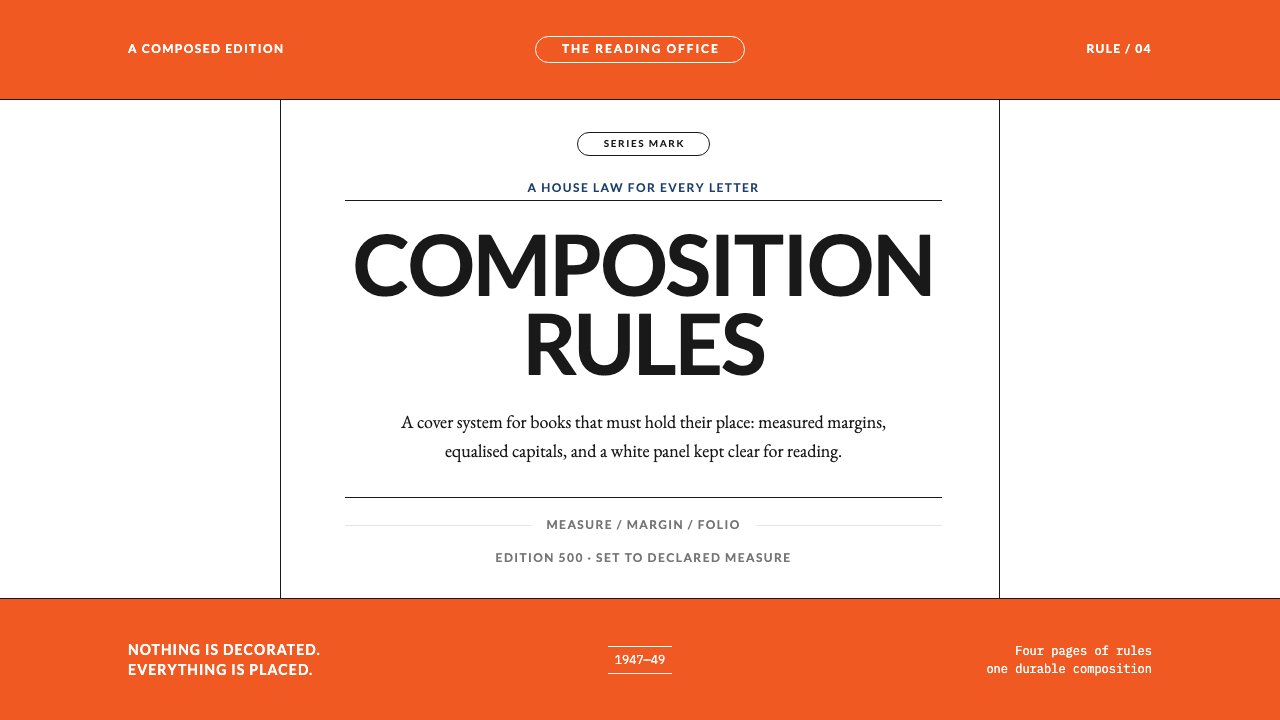 Tschichold Penguin RulesOrder becomes visible. Orange bands frame a white panel of equalised Lato cap…
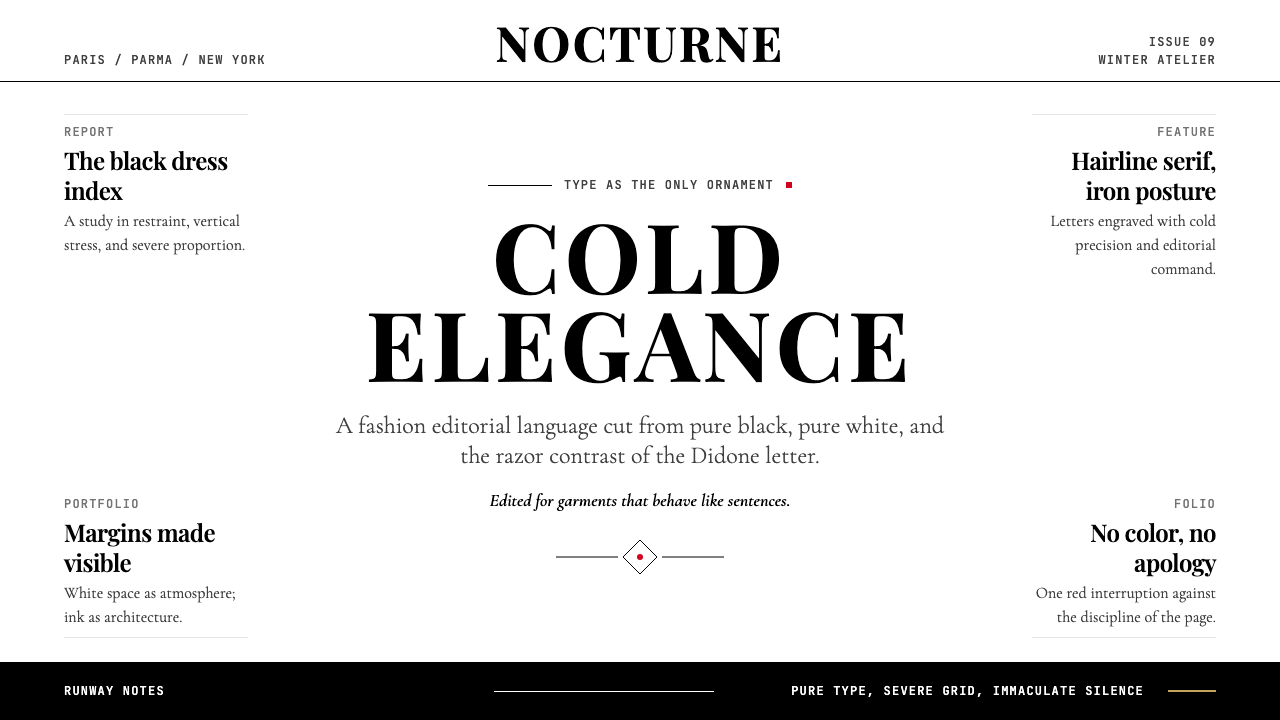 Vogue DidoneCold authority. Black-on-white Didone, red accent, and vast editorial whitesp…
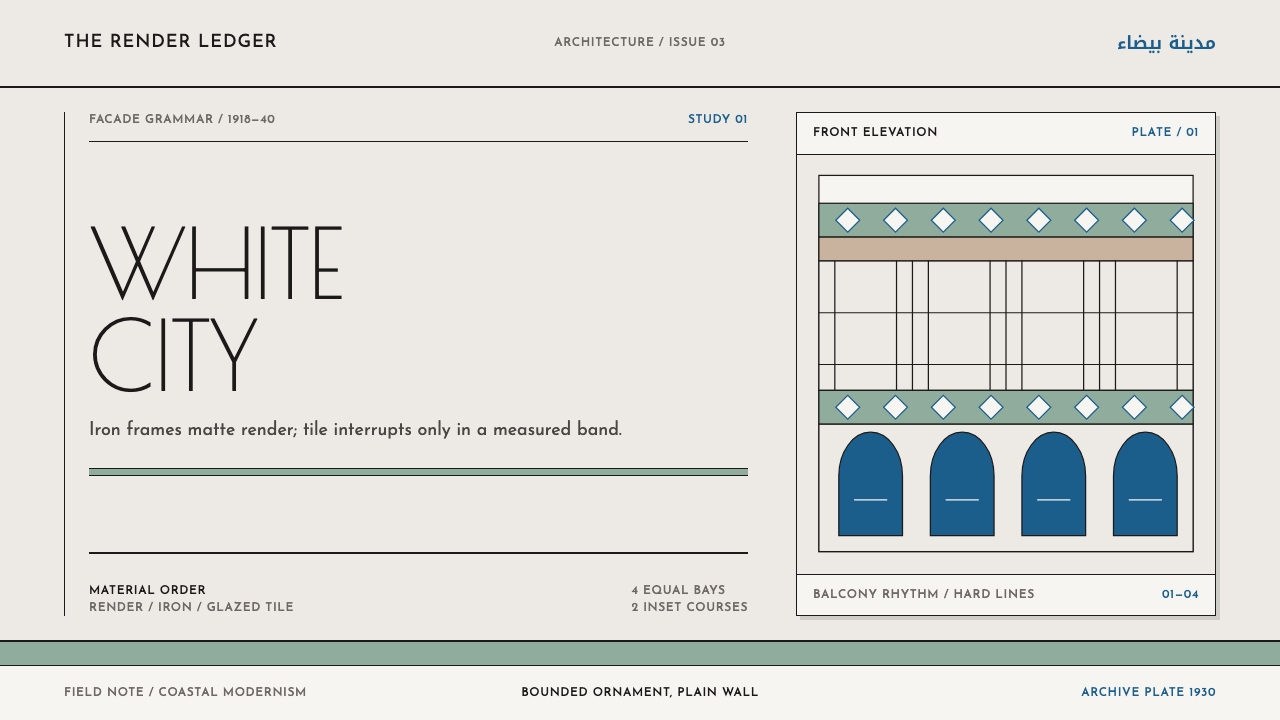 Casablanca Néo-MauresqueOrnament knows its boundary. Matte render, black iron, and celadon tile land…
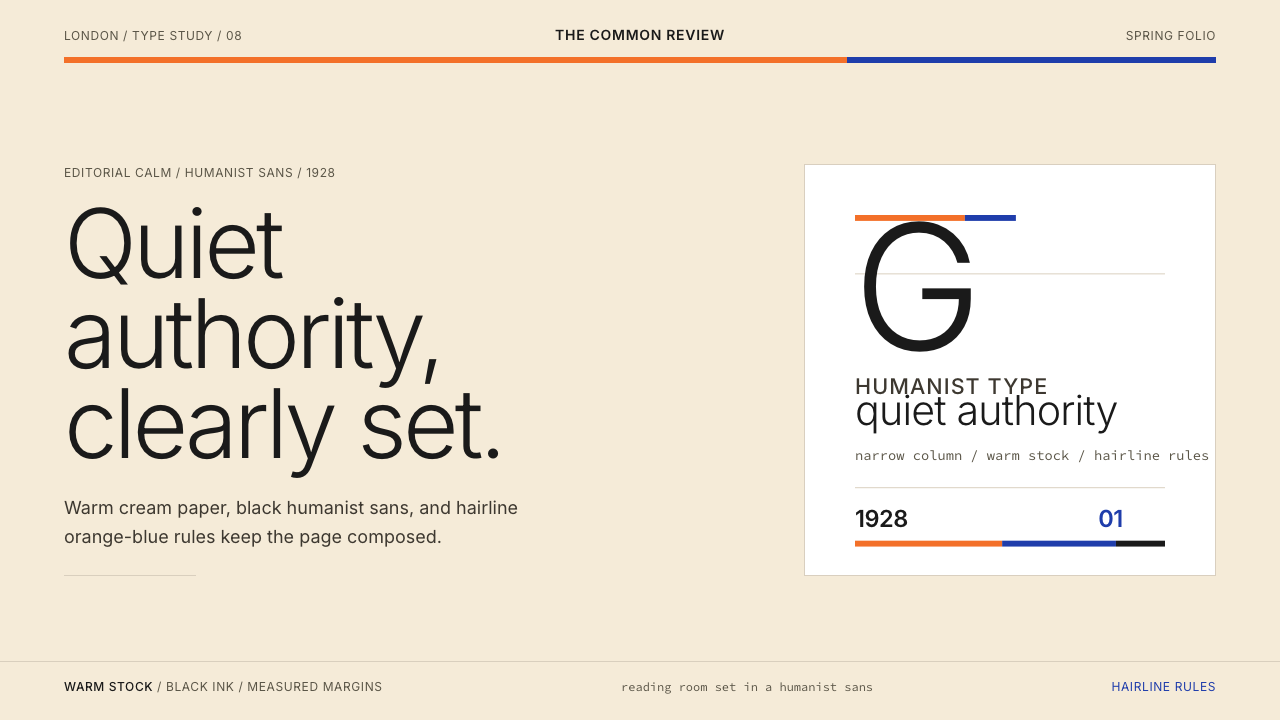 Gill Sans (BBC, 1928)Quiet authority, clearly set. Warm cream, black humanist sans, and hairline o…
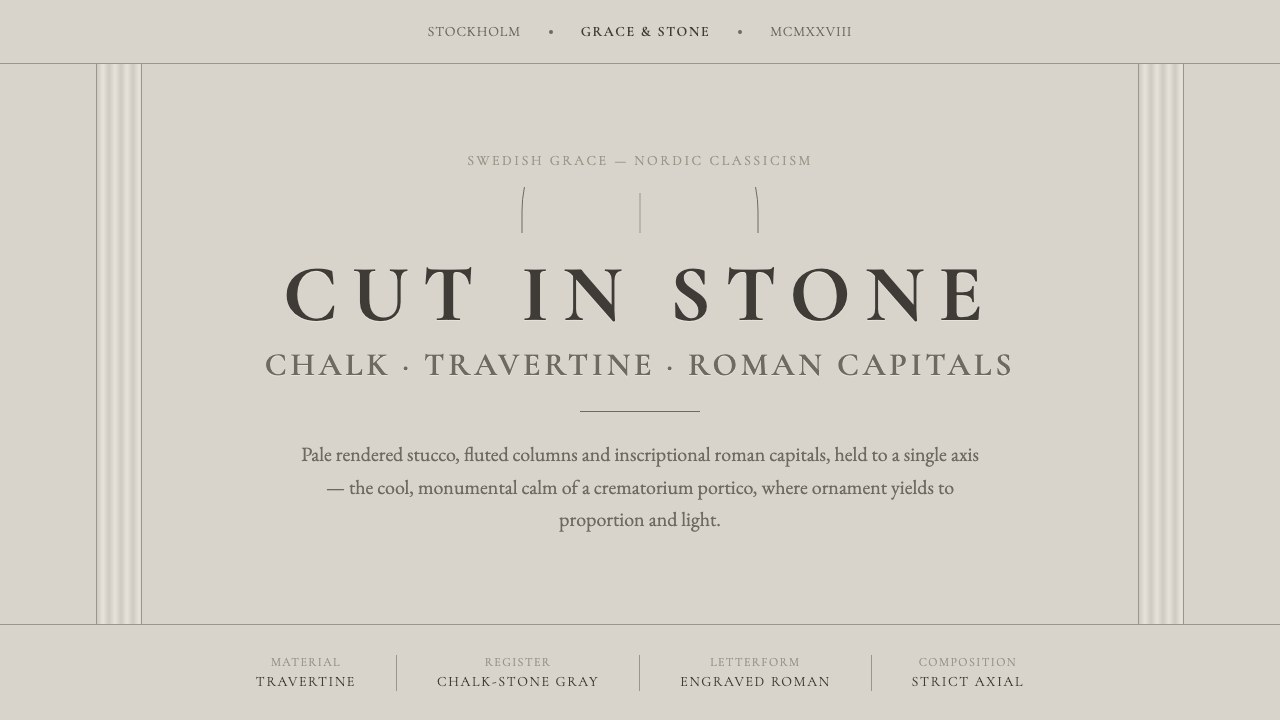 Nordic Classicism AsplundStone, not cream. Engraved Trajan capitals on cool chalk stucco, fluted colum…
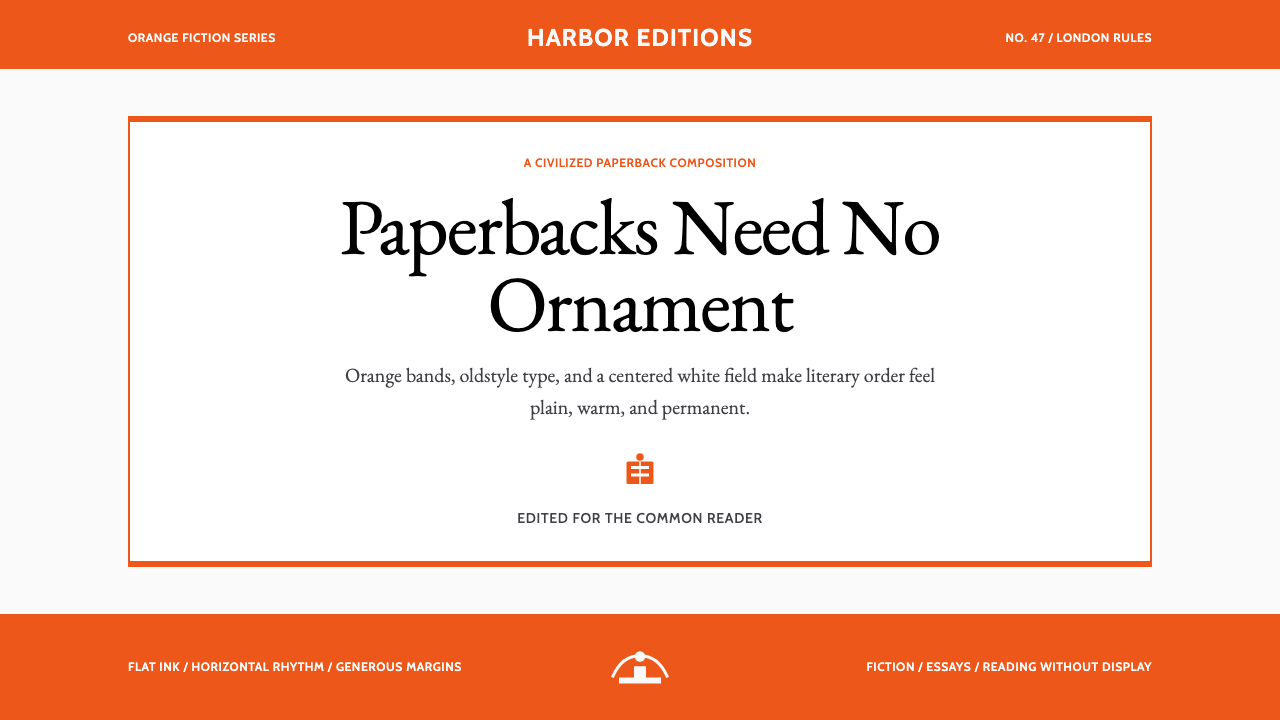 Penguin Classics OrangePaperback authority. Orange tri-bands, serif title panel, and flat ink enforc…