What is Vitsœ 606 Shelving?
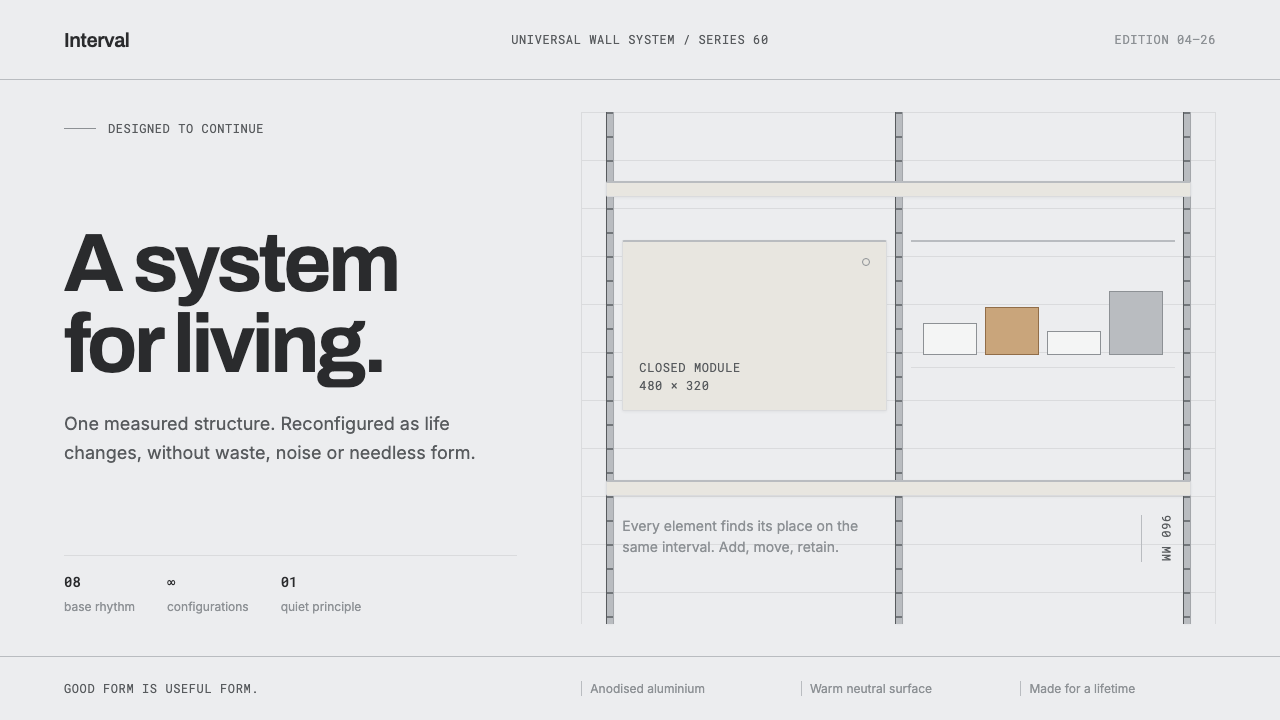
Vitsœ 606 turns storage into architecture: brushed aluminium, quiet walls, and a repeating rhythm in which every visible part has work to do.
Vitsœ 606 Shelving in brief
The Vitsœ 606 Universal Shelving System is a wall-mounted storage system designed by Dieter Rams in 1960 and produced continuously ever since. Its visual language is an archetype of functional modernism: anodised-aluminium E-tracks fixed to a plain plaster wall, carrying pins, shelves, and cabinets in a disciplined modular sequence. The system does not attempt to disguise its construction. Rails read as rails, shelves read as horizontal planes, and cabinets read as useful volumes suspended within a larger order.
Its distinctive quality is restraint rather than emptiness. Cool grey-whites, brushed silver structure, open wall area, and measured horizontal surfaces establish a calm field in which objects can be arranged without visual competition from the shelving itself. The system creates rhythm through repetition, but avoids spectacle. Storage is present, legible, and architectural without becoming a decorative feature wall.
Nothing in the 606 language is ornamental. Components float away from the wall, connect through a fixed interval, and earn their place through function. This makes the style less about reproducing a particular room and more about adopting a discipline: clear structure, honest materials, useful surfaces, and enough negative space for both the system and its contents to remain intelligible.
Where does Vitsœ 606 Shelving come from?
The 606 belongs to the period described by Vitsœ as extending from 1950 to 1990, and it was introduced in 1960. Its origins sit across Germany and the United Kingdom through Vitsœ, within the linked traditions of Braun and Ulm functionalism, Gute Form, and industrial modernism. These movements shared a preference for useful objects whose form could be understood through construction, purpose, and material rather than decorative styling.
Dieter Rams designed the system as a universal shelving structure rather than as a fixed piece of furniture. That distinction matters. A conventional cabinet arrives as a complete object with a settled outline; the 606 begins with wall-mounted tracks and gains shelves and cabinets as needed. Its identity is therefore carried by a repeatable structural rule, not by a single sculptural silhouette.
The E-track is central to that rule. Fixed vertically against a plain plaster wall, the anodised-aluminium rail establishes a visible rhythm and receives the pins that support the rest of the system. Shelves and cabinets appear to float because the wall, rail, and support mechanism are composed as one clear arrangement. The hardware is not hidden behind a decorative façade; it is the system's visual grammar.
Vitsœ identifies Niels Wiese Vitsœ and Mark Adams alongside Rams as key figures in the system's origin context. Their inclusion places 606 within a longer company and production history rather than treating it as an isolated historical object. Continuous production is significant here: the design has remained present not by changing its basic language, but by retaining a framework in which practical storage can be recomposed over time.
What defines the Vitsœ 606 Shelving look?
Visible Structure
Anodised-aluminium E-tracks are not concealed or softened into background decoration. Their vertical repetition makes support visible, gives the wall a measured cadence, and lets the system explain how it carries weight. The structural element is also the principal visual motif.
Modular Rhythm
Pins, shelves, and cabinets lock into a fixed interval, producing order through repetition rather than through symmetry or ornament. The rhythm is strict enough to feel architectural, yet open enough for storage to be rearranged without losing coherence.
Floating Planes
Shelves and cabinets sit away from the wall rather than reading as heavy built-in mass. The separation gives each surface a precise outline and leaves the wall visible as active negative space. The result is lightness achieved by construction, not by visual trickery.
Quiet Material Palette
Cool grey-white wall surfaces and brushed silver structure keep the palette subdued. The aluminium is valued for its own industrial character, while the plain plaster ground prevents the system from becoming visually noisy. Contrast comes from material and line, not decorative color.
Functional Surfaces
Every shelf, cabinet, pin, and rail has a practical role. This is not minimalism as visual reduction for its own sake; it is a system in which surfaces remain because they store, support, divide, or organize. Absence is as deliberate as presence.
Abundant Negative Space
Open wall area is not unused residue. It gives the rails room to register, prevents stored objects from merging into a continuous mass, and keeps the overall composition calm. The empty field makes function easier to see.
Form in Service of Function
The defining principle is that form is entirely in service of function. Visual decisions follow the needs of attachment, support, storage, and recomposition. The system feels quiet because it refuses to add a second, decorative story on top of its practical one.

Who shaped Vitsœ 606 Shelving?
Rams designed the Vitsœ 606 Universal Shelving System in 1960. The system's exposed aluminium tracks, modular support logic, restrained palette, and refusal of ornament make it a direct expression of the functional modernist context associated with his work.
Vitsœ identifies Niels Wiese Vitsœ as a key figure in the origin context of the 606 system. His presence in that account locates the shelving system within the history of Vitsœ rather than solely within the biography of its designer.
Mark Adams is also named by Vitsœ as a key figure in the system's origin context. Alongside Rams and Niels Wiese Vitsœ, this attribution frames 606 as a design sustained through an enduring relationship between a clear idea, a company, and continuous production.
How do you use Vitsœ 606 Shelving today?
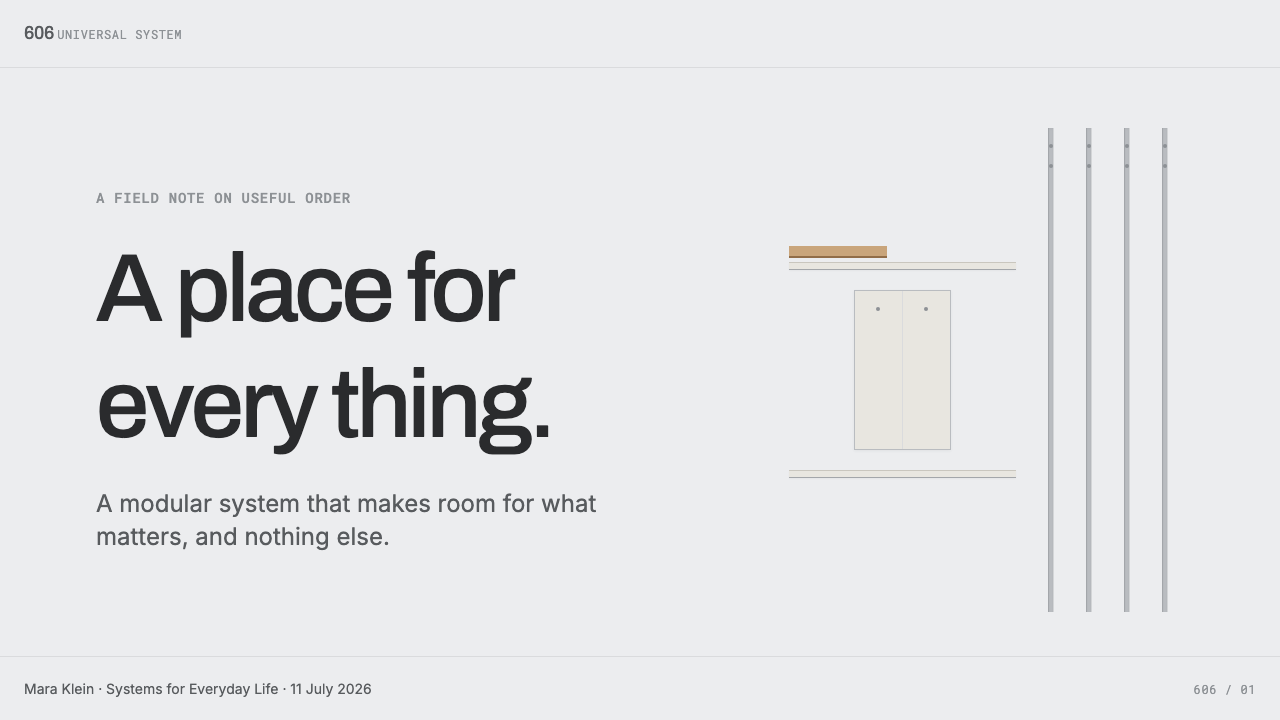
For presentation covers, use the 606 language to create a quiet architectural field: a pale wall-like ground, a slim vertical structural element, measured horizontal planes, and a title held in generous empty space. Avoid filling the slide with product imagery or decorative accents. Content slides should carry the same discipline through aligned text blocks, restrained dividers, and clear separation between headings, explanation, and supporting material.
Data slides benefit from the system's logic of support and interval. Treat chart axes, rules, and labels as visible structure rather than as technical clutter. Keep the data field open, use a subdued neutral ground, and let a limited set of stronger marks identify the comparison that matters. A cabinet-like solid block can represent a stable category, while shelf-like horizontal lines can organize sequences without turning the slide into an imitation of furniture.
For web interfaces, the style works especially well in dashboards, collections, account areas, and pricing pages where durable hierarchy matters. Use a calm light ground, a visible rail-like navigation or section structure, clear horizontal groupings, and ample breathing room around controls. Cards should feel like useful planes supported by a system, not like floating decorative tiles. In a pricing interface, tiers can be distinguished through placement and structural emphasis rather than loud promotional treatment.
For editorial and marketing work, 606-derived design suits product stories, catalogues, architecture pages, and brands that need to communicate longevity, precision, or thoughtful utility. Build pages around vertical anchors and horizontal rests; allow captions, specifications, and product names to occupy clearly assigned locations. Photography or objects should be given room to exist, not compressed into a dense collage. The common mistake is mistaking functional modernism for blankness: removing visual noise is not enough if the remaining elements do not reveal a real organizational purpose.
Vitsœ 606 Shelving — FAQ
Is Vitsœ 606 a decorative shelving style?
No. Its defining premise is that nothing is decorative. The tracks, pins, shelves, and cabinets are visible because they perform structural or storage functions. A successful 606-inspired composition may look spare, but its spareness comes from showing only what supports, stores, organizes, or communicates.
Why does the system feel light despite using shelves and cabinets?
The components are held away from the wall by an explicit rail-and-pin structure, so they read as suspended planes rather than as a continuous heavy mass. Visible wall area remains part of the composition, and the restrained material palette keeps attention on line, interval, and support.
Can this language work with objects that are visually busy?
Yes, provided the system remains calm enough to organize them. The neutral wall, brushed silver rails, and open space give stored objects a legible setting. The important decision is not to add competing decorative layers around the objects; let the rail rhythm and shelf planes do the organizational work.
How is 606 related to functional modernism?
The system is presented as an archetype of functional modernism and is associated with Braun and Ulm functionalism, Gute Form, and industrial modernism. Its form follows practical requirements: wall attachment, modular support, storage capacity, and the ability to rearrange components within a fixed structural rhythm.
What is the most common mistake in applying a 606-inspired aesthetic?
Treating brushed metal and pale walls as a surface look rather than as evidence of a functional system. If rails, lines, panels, or empty space do not clarify attachment, hierarchy, storage, or use, the result becomes a decorative imitation of restraint instead of a convincing expression of functional modernism.
Related design styles
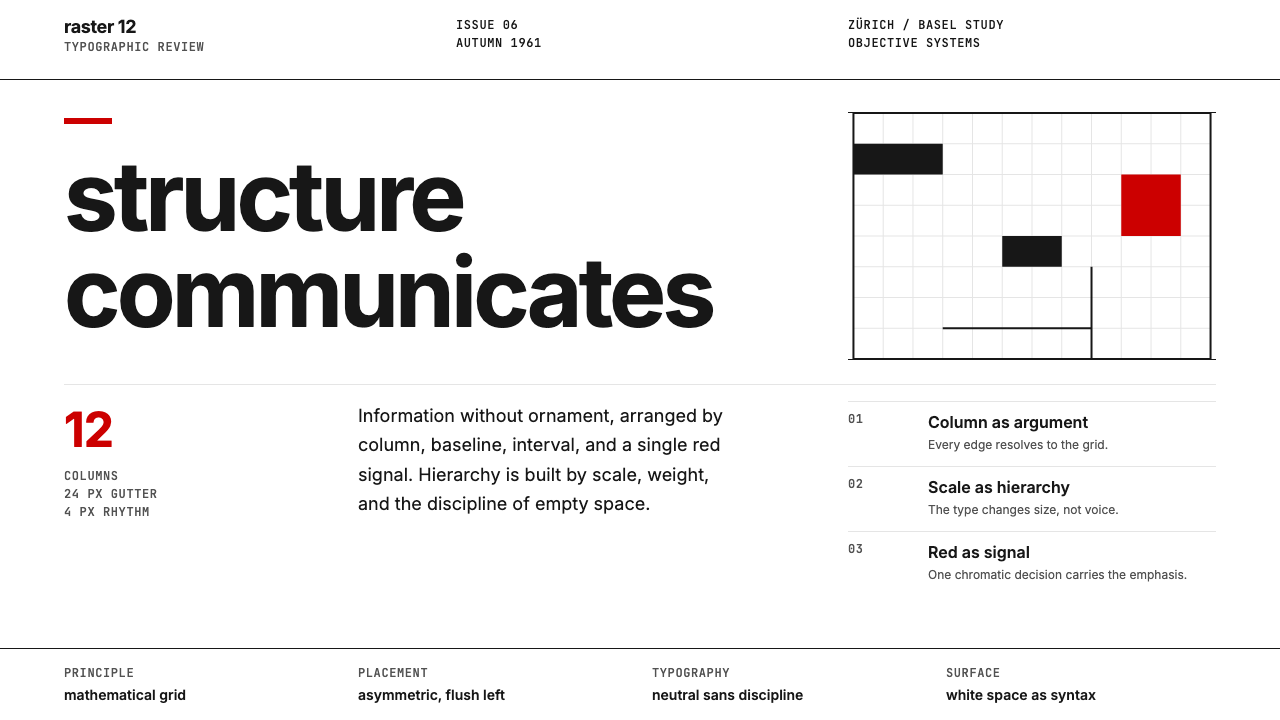 Swiss International StyleObjectivity made visible. Inter scale, white space, and one red block expose…
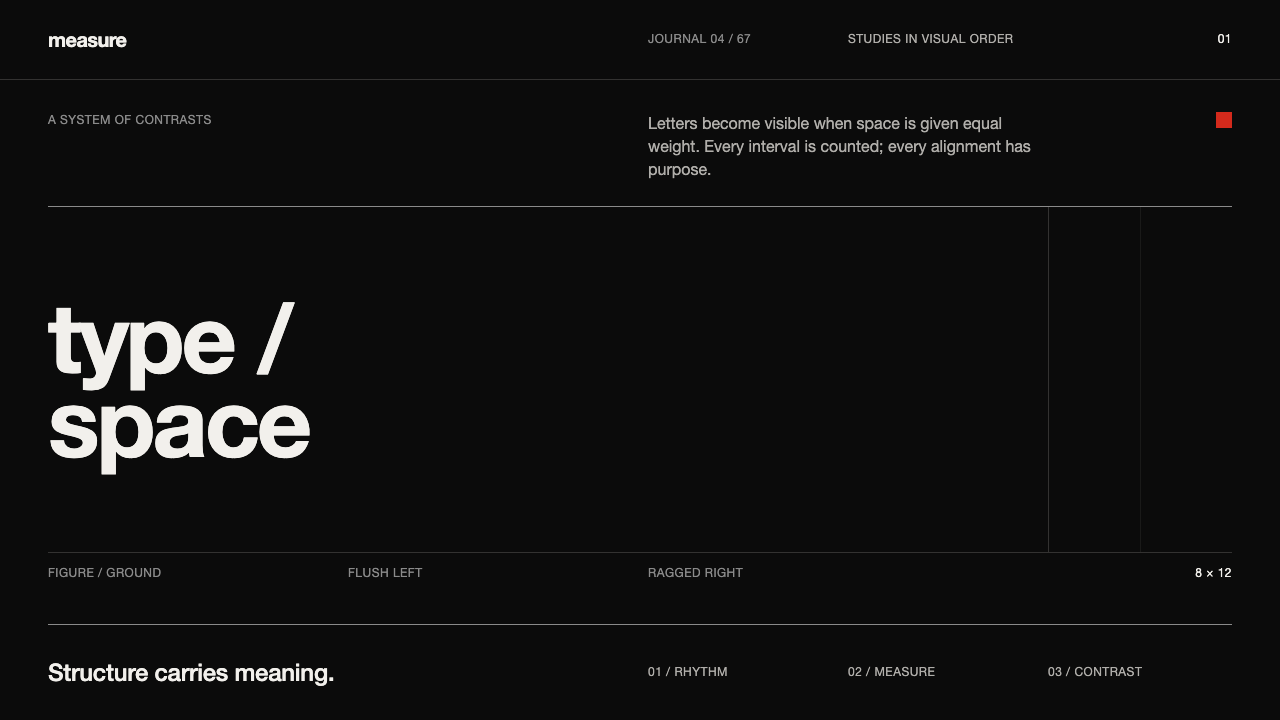 Emil Ruder TypografieDiscipline makes type visible. Near-white grotesque and measured space cut th…
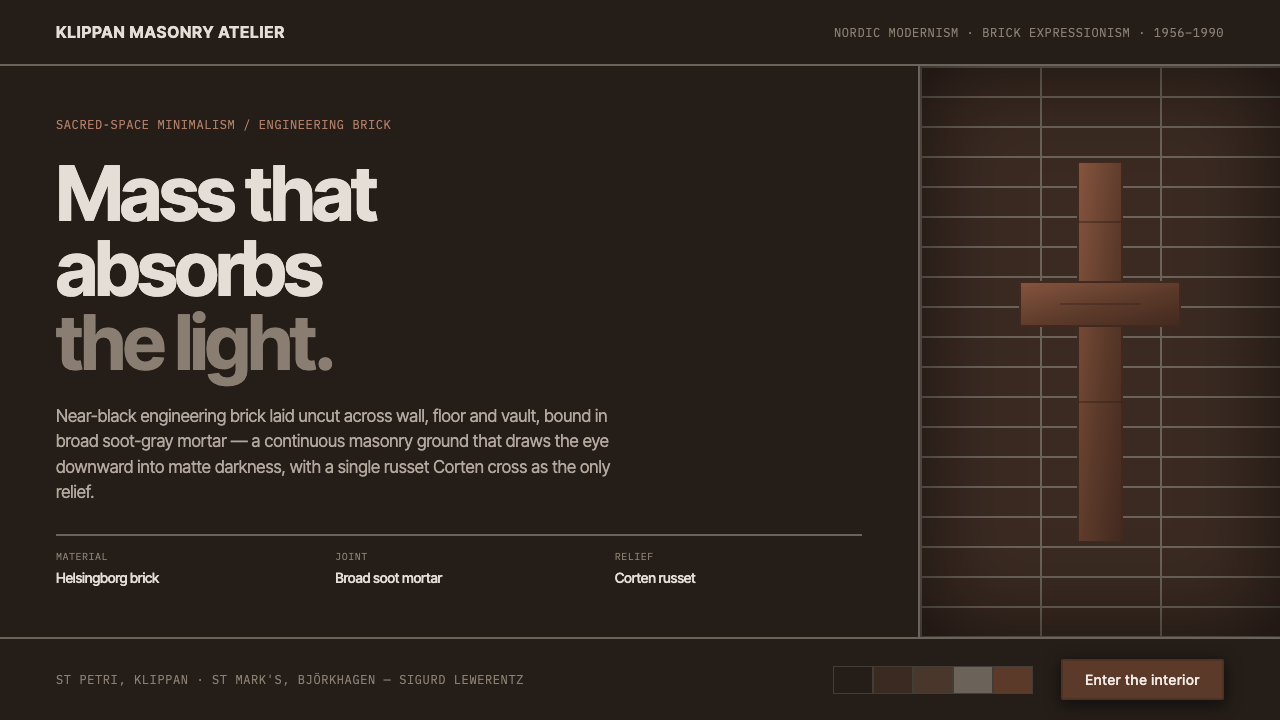 Lewerentz Dark BrickMass that absorbs light. Near-black engineering brick, broad soot mortar, one…
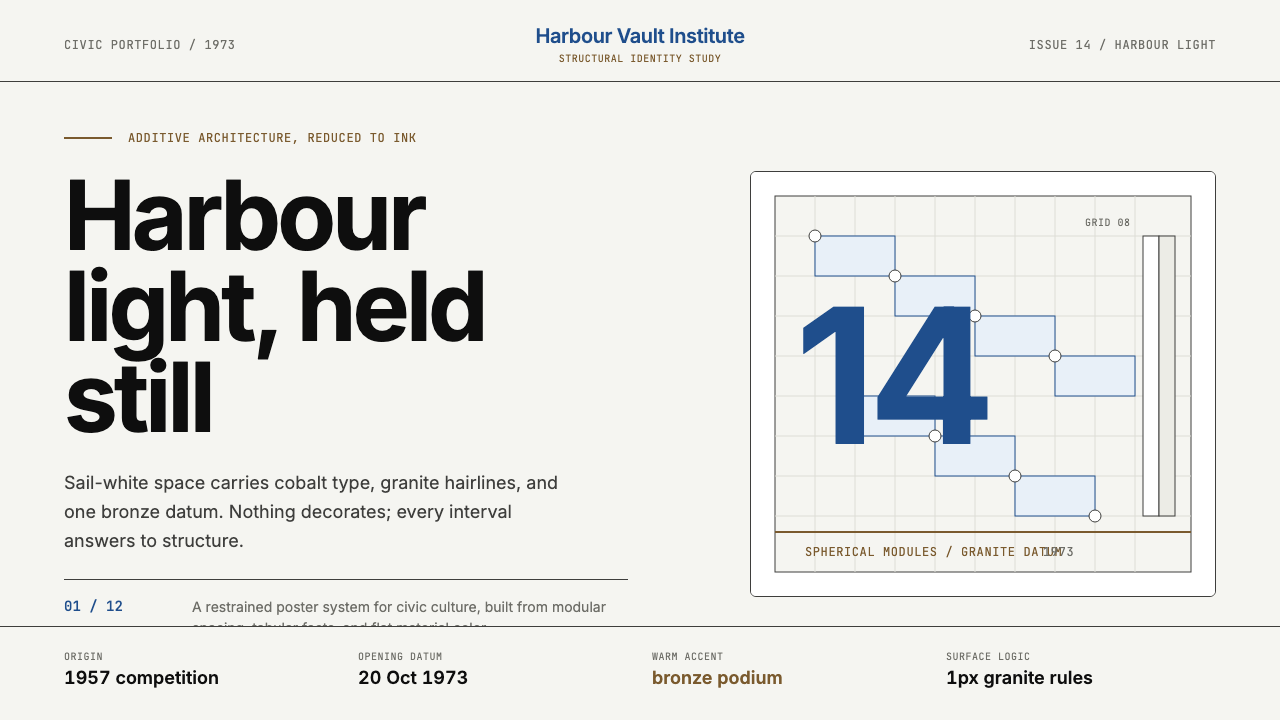 Sydney Opera House (Utzon, 1973)Civic restraint in harbour light. Sail-white space, cobalt type, bronze datum.
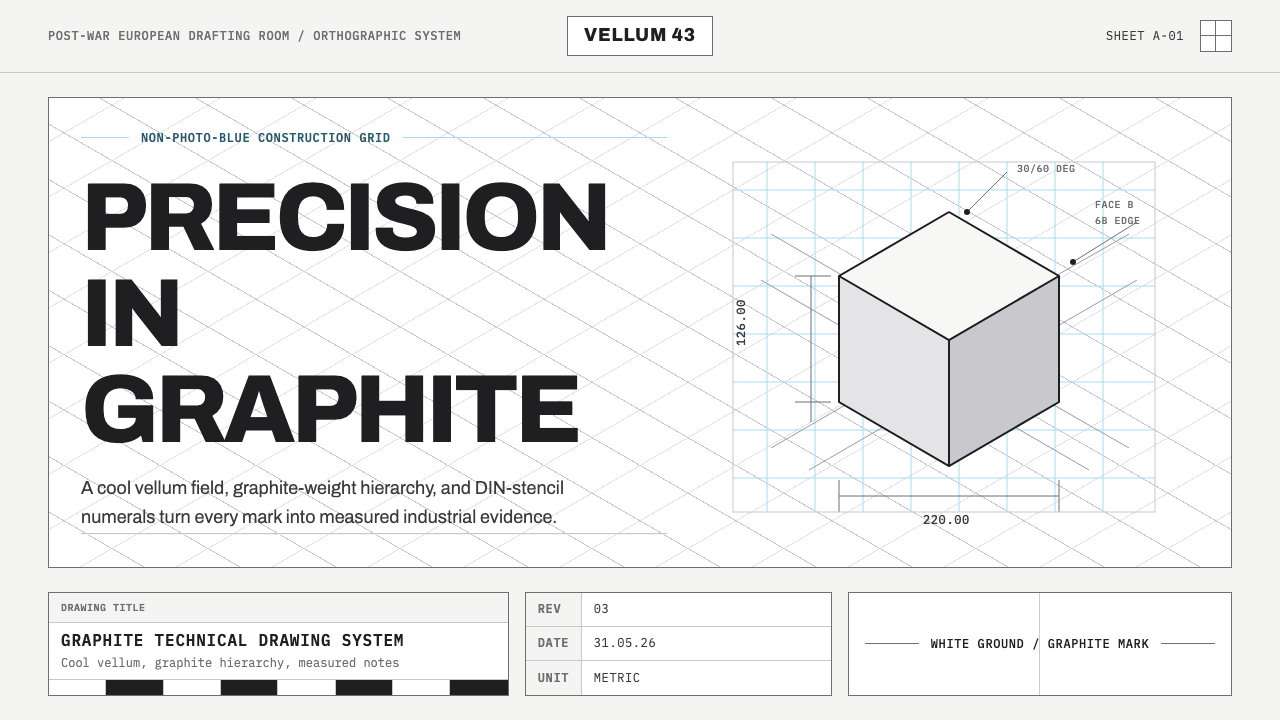 Graphite Technical DrawingDrafting-room precision. Non-photo-blue grid and graphite DIN lettering do th…
 Swiss Railway ClockEverything exact, one thing live. Black hands on cool enamel white — one red…