What is Vietnamese Đông Hồ Woodblock?
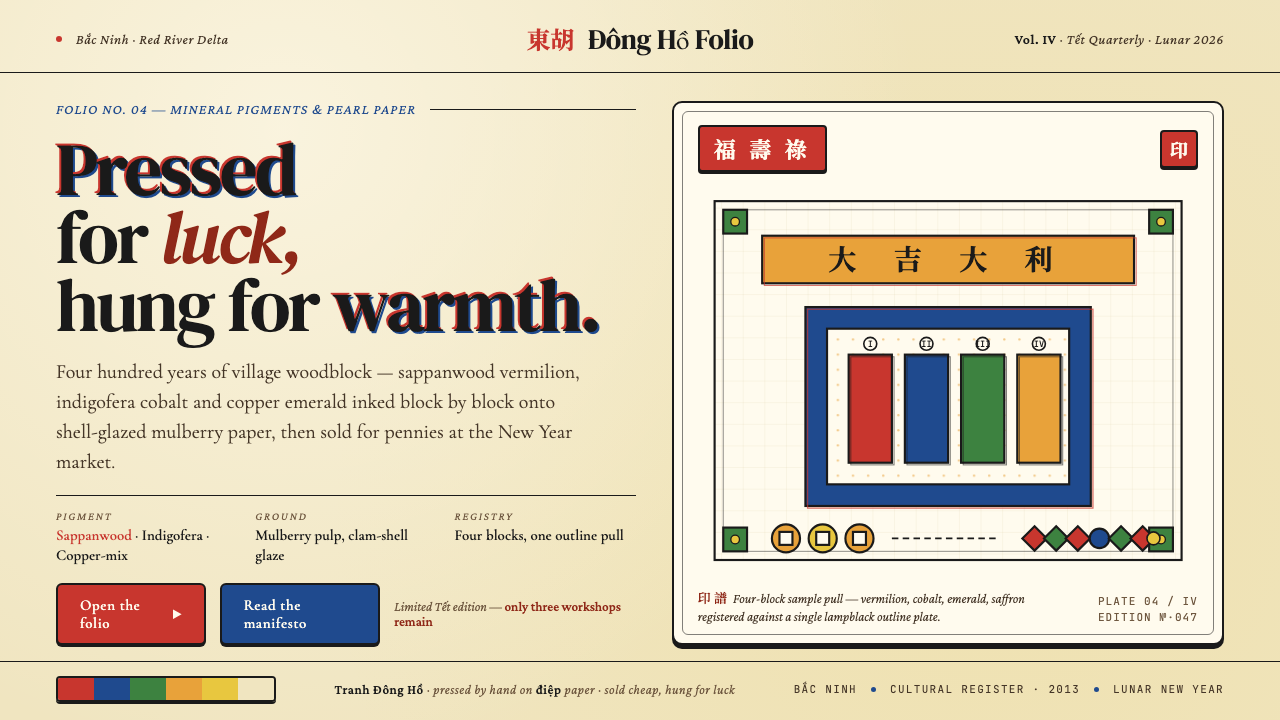
Four mineral pigments pressed onto pearl-shell paper — Đông Hồ's four-hundred-year tradition of folk woodblock prints turned luck, laughter, and Lunar New Year warmth into a visual language that is as saturated and unashamed today as it was in any Bắc Ninh village workshop.
Vietnamese Đông Hồ Woodblock in brief
Đông Hồ painting — Tranh Đông Hồ — is Vietnam's oldest and most beloved folk woodblock-print tradition, produced in Đông Hồ village, Bắc Ninh province, north of Hanoi. For four centuries these prints were the wallpaper of the Vietnamese Tết festival: bright, naïve, gently satirical images of fat roosters announcing the new year, mother pigs surrounded by piglets, mice staging an elaborate wedding procession, and national heroes riding war elephants. They were cheap to buy, cheerful to hang, and understood by everyone from the scholar to the farmer.
The visual character of Đông Hồ work is immediately distinctive. Color is applied in flat, saturated mineral-pigment blocks — a deep brick vermilion, a rich indigo cobalt, a warm copper emerald, a glowing saffron yellow — separated and bounded by crisp lampblack outlines printed last to unify the composition. The background is not plain paper but điệp paper: mulberry-bark sheets sized with a glaze of crushed river-mussel shell, giving the surface a soft pearlescent luminosity that makes every color appear lit from within. Chinese-character cartouches carrying good-luck phrases or titles float above the main figures, and the composition is always anchored, centered, and generously open — never crowded.
What distinguishes Đông Hồ from other East Asian woodblock traditions — Chinese niánhuà New Year prints, Japanese ukiyo-e, Korean minhwa — is its irreverent folk humor. The mouse-wedding satires, for instance, were gentle jibes at Confucian ceremony; the fertility-pig images were not merely decorative but carried specific wishes for large and prosperous families. The prints were not fine art hung in galleries but vernacular objects made to be replaced each Tết, which gave the craftsmen freedom to be witty, warm, and direct in a way that court or commercial art rarely permitted.

Where does Vietnamese Đông Hồ Woodblock come from?
The precise founding of Đông Hồ's woodblock-printing industry is difficult to pin to a single year, but historical records and craft genealogies suggest the village workshops were producing New Year prints by at least the sixteenth century, with the tradition likely maturing through the seventeenth century as Lê dynasty patronage of folk craft expanded. The village of Đông Hồ — formally part of Thuận Thành district, Bắc Ninh province — sits on the Đuống River, a tributary of the Red River, giving it easy access to the paper, pigments, and timber that the industry required. By the eighteenth century, the Đông Hồ market, held six times a year in the months leading up to Tết, had become the primary distribution point for New Year prints across the Red River Delta.
The craft is organized around a system of wooden relief blocks, one for each color plus one for the final outline. A single print might require four or five separate pressings, each perfectly registered to the last. The pigments were traditionally derived from natural mineral and plant sources: vermilion from cinnabar ore, cobalt from indigo plants and mineral sources, the warm green from copper compounds, saffron from botanical dyes, and the deep lampblack outline from burned bamboo or rice straw. The điệp paper was made locally, with mussel shells collected from the river and ground to a fine paste mixed with tapioca starch as a sizing medium. The entire production chain — paper making, pigment grinding, block carving, printing — took place within the village, making Đông Hồ one of the most self-contained craft economies in Vietnamese history.
The tradition reached its commercial peak in the late nineteenth and early twentieth centuries, when some villages in the Đông Hồ area had dozens of workshop families each printing hundreds of sheets per season. French colonial ethnographer Maurice Durand documented the prints extensively in the mid-twentieth century, producing one of the earliest systematic scholarly records of the imagery, themes, and production methods. His work helped bring Đông Hồ art to international attention outside Vietnam. During the First and Second Indochina Wars, the village workshops were severely disrupted, and many of the older woodblocks — some of which represented centuries of accumulated carving — were lost or destroyed.
The postwar decades brought near-extinction. By the 1980s, cheap factory-produced decorations and printed calendars had displaced the traditional Tết market almost entirely. At the nadir, fewer than five workshop families remained active. A sustained revival effort, led principally by craftsmen Nguyễn Đăng Chế and Nguyễn Hữu Sam, began in the 1990s and gathered momentum into the 2000s. Nguyễn Đăng Chế in particular committed to reconstructing lost blocks from archival photographs and museum specimens, re-establishing the full traditional supply chain, and opening the Đông Hồ workshop to visitors and researchers. UNESCO added Đông Hồ painting to its List of Intangible Cultural Heritage in Need of Urgent Safeguarding in 2013, providing international recognition and some funding support. Today approximately three workshop families maintain full traditional production, with a wider circle of practitioners producing for the cultural tourism and art-collector markets.
What defines the Vietnamese Đông Hồ Woodblock look?
Saturated Flat Color
Đông Hồ's color is applied in solid, unmodulated blocks with no shading, no tonal graduation, and no blending at the edges. Each hue occupies its own territory and meets adjacent colors at a clean boundary reinforced by the final black outline. The palette is anchored by four dominant pigments — a warm brick vermilion, a deep blue-indigo, a copper-tinged green, and a warm golden saffron — with white preserved as the pearlescent ground. The effect is vivid and immediate, like a signal rather than a painting.
Điệp Paper Ground
The distinctive substrate of Đông Hồ prints is điệp paper — mulberry-bark sheets coated with a paste of finely ground river-mussel shell mixed with a natural binder. When dry, this shell-glaze gives the paper surface a warm, off-white luminosity with a faint iridescent shimmer, quite unlike the flat matte of European printing papers. Every color laid over this ground picks up a slight inner glow. In digital applications that reference Đông Hồ, this quality translates as a warm, slightly warm neutral background — never a stark cold white — that makes saturated foreground colors feel richer and more grounded.
Lampblack Outline
The final printing pass lays down a crisp black outline in lampblack ink — traditionally made from burned bamboo or rice straw — that simultaneously defines form, separates colors, and gives the composition its graphic authority. This outline is not a timid contour but a confident, slightly variable line that thickens at corners and junctions. It performs the same structural role as the lead lines in stained glass: holding disparate color fields together into a coherent whole. Without it, the flat color blocks would risk reading as chaotic; with it, the composition is instantly readable.
Centered, Open Composition
Đông Hồ compositions are typically frontal and centered, with the principal subject — a rooster, a pair of pigs, a wedding procession — placed at or near the visual center of the sheet and surrounded by generous negative space. There is no complex spatial recession, no overlapping depth illusion: figures occupy the same flat plane. This directness gives the prints an emblematic quality, like seals or icons, that reads clearly even at small scale. Chinese-character text cartouches above the central figure complete the composition without crowding it.
Folk Humor and Narrative
Unlike decorative prints that exist purely as pattern or surface, Đông Hồ images carry stories. The mouse-wedding scene depicts a procession in which mice carry gifts to a cat — widely read as satire of corvée obligations to local officials. Jealousy scenes, hero tales, and fertility wishes are all rendered with a warmth and playfulness entirely absent from court or religious art. This narrative dimension means individual figures are not generic symbols but particular characters in legible situations, giving the prints a kind of folk-illustrated-narrative quality that still communicates across language barriers.
Warm Mineral Palette, No Cool Neutrals
Every color in the Đông Hồ system carries warmth. Even the blue-indigo, which in other contexts might read as cool, is a deep fermented indigo with underlying warmth rather than a cool sky blue or icy cyan. The greens tend toward warm copper-tinged emerald rather than cool lime or mint. White is the warm pearl of the shell-glaze ground. The overall thermal register of the palette is consistently warm, which contributes to the emotional character — festive, welcoming, auspicious — that distinguishes the tradition from the more austere palette of East Asian literati painting.
Multi-Block Registration
Each color in a Đông Hồ print is printed from its own carved wooden block, with every successive block precisely registered to the previous impression. The number of blocks required — typically four color blocks plus one outline block — determines the maximum color complexity of the image. Slight registration shifts, which appear as thin halos of one color peeking out from behind another, are a characteristic feature of authentic hand-printed work and are considered part of the print's visual texture rather than defects. This layered-impression quality, visible in original prints as a slight embossed relief, distinguishes woodblock printing from flat digital reproduction.

Who shaped Vietnamese Đông Hồ Woodblock?
The single most important figure in the contemporary survival of Đông Hồ painting, Nguyễn Đăng Chế dedicated decades to reconstructing lost woodblocks from archival photographs, museum specimens, and collective memory. He transformed his family compound into an open workshop-museum, rebuilt the entire production chain from điệp paper to final print, and trained apprentices at a time when the tradition had nearly disappeared entirely. His insistence on using only historically accurate natural pigments and shell-glaze paper — rather than the synthetic substitutes that cheaper revival workshops sometimes adopted — preserved the visual character of the tradition rather than merely its outward forms.
Nguyễn Hữu Sam was among the last craftsmen to have learned the full Đông Hồ process during the tradition's mid-century flowering, before the disruptions of war and economic change. His workshops served as a living archive of technique — the correct consistency of shell-glaze paste, the proper carving angle for relief blocks, the sequence and pressure of multi-block printing — at a time when these methods existed only in the hands of a few aging practitioners. His documentation of process, carried out in cooperation with cultural researchers and filmmakers, became foundational reference material for the revival movement.
A French colonial-era scholar and administrator who devoted much of his career to documenting Vietnamese folk art, Maurice Durand produced in the mid-twentieth century the most comprehensive early Western scholarly account of Đông Hồ painting. His field surveys, photographic documentation, and systematic cataloguing of imagery, themes, and iconographic programs gave both Vietnamese cultural authorities and international researchers a baseline record that proved invaluable when revival efforts began decades later. Durand's work represents an instance of colonial-era scholarship that, whatever its political context, produced genuinely useful preservation documentation.
Trưng Trắc and Trưng Nhị — the Trưng Sisters — are Vietnam's most revered historical heroines, who led the first major revolt against Chinese Han dynasty rule in 40 CE and briefly established an independent Vietnamese kingdom before being defeated in 43 CE. They appear in Đông Hồ prints as recurring subjects: typically depicted riding war elephants, commanding troops, or enthroned as queens. Their appearance in New Year prints was not purely patriotic decoration but carried a specific symbolic function — invoking female courage, national continuity, and ancestral protection at the threshold of the new year. Their iconography in Đông Hồ work represents the tradition's capacity to hold together the festive, the historical, and the spiritual simultaneously.
General Trần Hưng Đạo is Vietnam's most celebrated military commander, credited with defeating the Mongol invasions of the thirteenth century three times and regarded as a near-divine protector figure in Vietnamese folk religion. His appearance in Đông Hồ prints typically shows him in full military regalia, often with divine or supernatural attributes. Like the Trưng Sisters, he functions in the New Year print context not merely as a historical portrait but as a protective talisman: hanging his image at the beginning of the year was understood as inviting his guardianship over the household for the months ahead. His Đông Hồ iconography demonstrates how the tradition served simultaneously as popular history, religious practice, and seasonal decoration.
How do you use Vietnamese Đông Hồ Woodblock today?
Đông Hồ's visual system is built on a small number of very strong moves: saturated flat color on a warm neutral ground, bold black outline, centered composition, and an overall warmth that reads as welcoming rather than aggressive. Applying the style successfully means committing to all of these simultaneously — the palette without the outline becomes garish, the outline without the warm ground becomes stark, the warmth without the saturation becomes muddy. The system only fully coheres when its components work together.
For presentation slides, Đông Hồ works most powerfully on cover and section-break pages where a single bold image can carry the full visual weight. A cover built in this style uses the warm pearl ground as the base, places one or two primary-palette color shapes as the dominant visual, and uses a strong black rule or outlined typographic treatment for the title. Content slides should be simpler: the palette reduced to one accent color against the warm neutral, with body text in near-black rather than pure black to maintain the warm temperature of the system. Data slides benefit from treating charts as flat color-block compositions — bars and segments in the four core hues, no gradients, no drop shadows.
For web interfaces, Đông Hồ translates best into contexts with festive, cultural, or artisan positioning: landing pages for cultural platforms, event sites, craft marketplaces, or heritage brands. The approach is to reserve the full saturated palette for hero sections and calls to action, keeping interior pages on the warm neutral ground with black text and a single accent color for links and interactive elements. Navigation and card components can use the lampblack-outline approach — visible borders rather than shadows, giving UI elements a woodblock-printed feel without being literally illustrative. Dashboard contexts are more challenging: the palette's warmth works, but the illustrative quality of the tradition should be dialed back in favor of typographic clarity.
For editorial and marketing work, Đông Hồ's poster-like boldness suits campaign imagery, event promotion, and cultural storytelling. A full-page spread in this mode uses the warm pearl as the background, a single large figure or motif rendered in the four-color flat style as the dominant visual, and the title or headline in a style that references the Chinese-character cartouche tradition — bold, centered above the image, with significant scale contrast between headline and subhead. Marketing pages can alternate between warm-ground sections and sections where one of the primary colors becomes the full background, keeping the rest of the palette as foreground elements.
A common mistake when applying Đông Hồ outside its original context is treating it as a 'folk pattern' style — using the color palette to create repeating surface textures or decorative borders while ignoring the tradition's compositional logic. Authentic Đông Hồ work is not about pattern repetition; it is about a centered, emblematic image with narrative content. A second common error is using the palette at reduced saturation in an attempt to make it more refined or modern — the system loses its character when the colors become pastel or muted. If the full saturation reads as too intense for a given context, the better solution is to restrict the palette to one or two of the four hues rather than desaturating all of them.

Vietnamese Đông Hồ Woodblock — FAQ
How does Đông Hồ differ from Chinese New Year prints (niánhuà)?
The two traditions share a common ancestor in the broader East Asian New Year woodblock print culture and likely developed in parallel influence, but they diverged significantly in palette, substrate, and subject matter. Chinese niánhuà — particularly the Yangliuqing and Mianzhu varieties — typically uses a broader color range including pinks, purples, and gold; portrays gods, door gods, and mythological subjects with formal frontality; and often employs more complex spatial recession. Đông Hồ is more restricted in palette (four core hues), more grounded in folk humor and social satire, and uniquely identified by the điệp shell-glaze paper. The two look related at a glance but feel quite different in register: Chinese niánhuà tends toward the ceremonial, Đông Hồ toward the vernacular and playful.
Can Đông Hồ work in a dark-background digital design?
With care, yes — but it requires rethinking the system's logic rather than simply inverting it. The điệp ground is intrinsic to the tradition's warmth; a dark inversion loses this immediately. If a dark variant is needed, the most coherent approach is to use a very deep warm charcoal or near-black with brown undertones as the ground (never a cold blue-black), to preserve the four saturated hues as foreground elements, and to allow the black outline to become a slightly lighter dark rule rather than disappearing entirely. The palette's four core hues — vermilion, indigo, green, and saffron — all have enough intrinsic warmth to read well against a warm dark ground. What tends to fail is importing the style into a cold, desaturated dark environment: the palette loses its festive character and looks merely antique.
Is the black outline strictly necessary, or can Đông Hồ work without it?
The black outline is structurally load-bearing in the Đông Hồ system, not decorative. Without it, the flat saturated color blocks float against each other without a unifying structure, and the composition risks reading as chaotic or naïve in the wrong way. In the original craft, the outline is always the final block pressed — it is what locks the image together. In digital applications, this principle translates as: every distinct color region should have a visible boundary, either a literal dark stroke or a background that creates sufficient contrast. Eliminating outline entirely and relying on color-field adjacency alone produces a result that looks like a failed attempt at Matisse rather than Đông Hồ. The outline can be made slightly softer or vary in weight to suit a contemporary context, but removing it fundamentally changes the tradition's visual character.
How do I avoid making Đông Hồ-inspired design look like generic 'Asian folk art'?
The risk of generic 'Asian folk art' aesthetics arises when only the surface features — red and gold color, decorative patterns, vague 'oriental' motifs — are borrowed without engagement with the specific tradition's logic. Đông Hồ has a precise visual grammar: warm pearl ground (not red, not gold), four specific hues (not any saturated colors), lampblack outline (not decorative flourishes), centered emblematic composition (not repeating pattern). Working within these specific constraints rather than freely mixing 'folk' signals produces work that is culturally specific rather than generic. It also helps to engage with the tradition's narrative and humorous dimensions — Đông Hồ's humor and social commentary are as distinctive as its palette, and design that references them, even abstractly, reads differently from surface borrowing.
Is Đông Hồ suitable for brands that need to project modernity or technological sophistication?
Not as a primary visual system. Đông Hồ's power comes from its folk warmth, handcraft legibility, and festive cultural specificity — qualities that actively conflict with the cool precision that technology brands typically seek. Forcing the style into a fintech dashboard or SaaS interface tends to produce confusion: the palette and composition language signal 'traditional and warm' while the product context demands 'efficient and trustworthy.' Where Đông Hồ does work in proximity to technology is in cultural platforms, creative tools, or heritage-focused applications where the technology is positioned as serving human creativity and cultural continuity rather than automation or efficiency. In these contexts, the style's warmth becomes a differentiator rather than a liability.
Related design styles
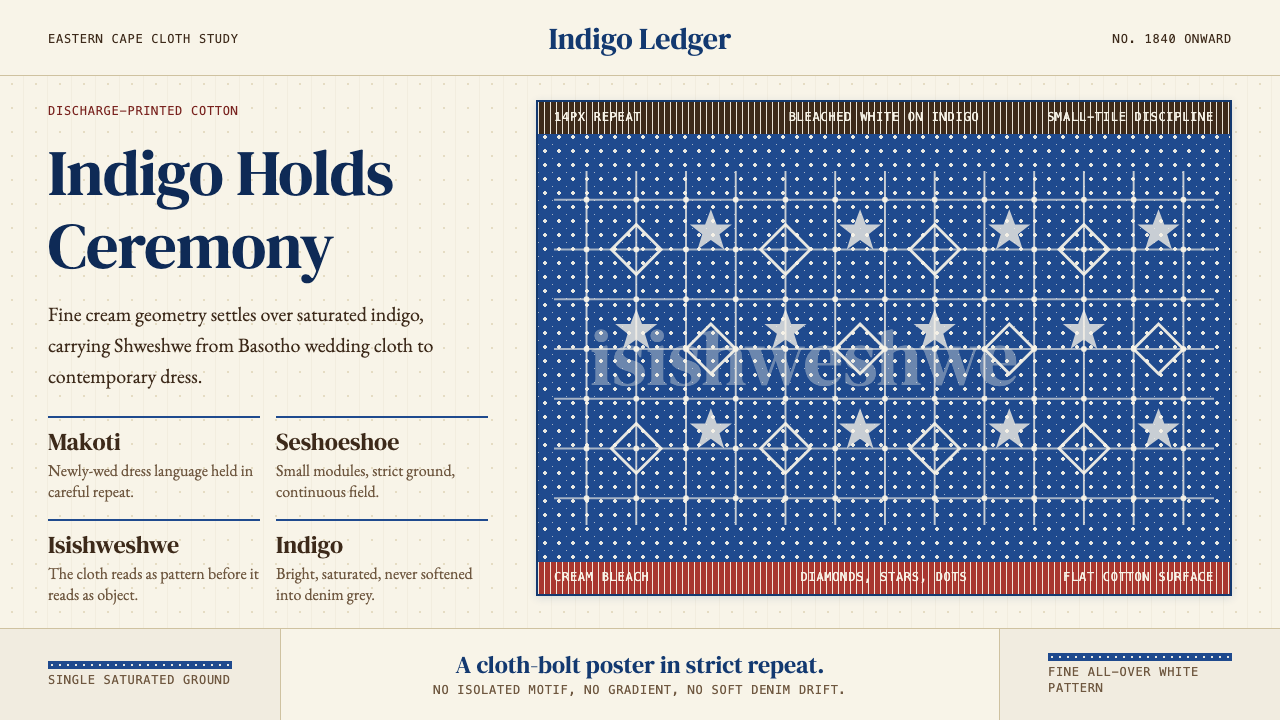 South African Shweshwe IndigoCeremony in indigo. Cream serif type and tiny bleached repeats tile a saturat…
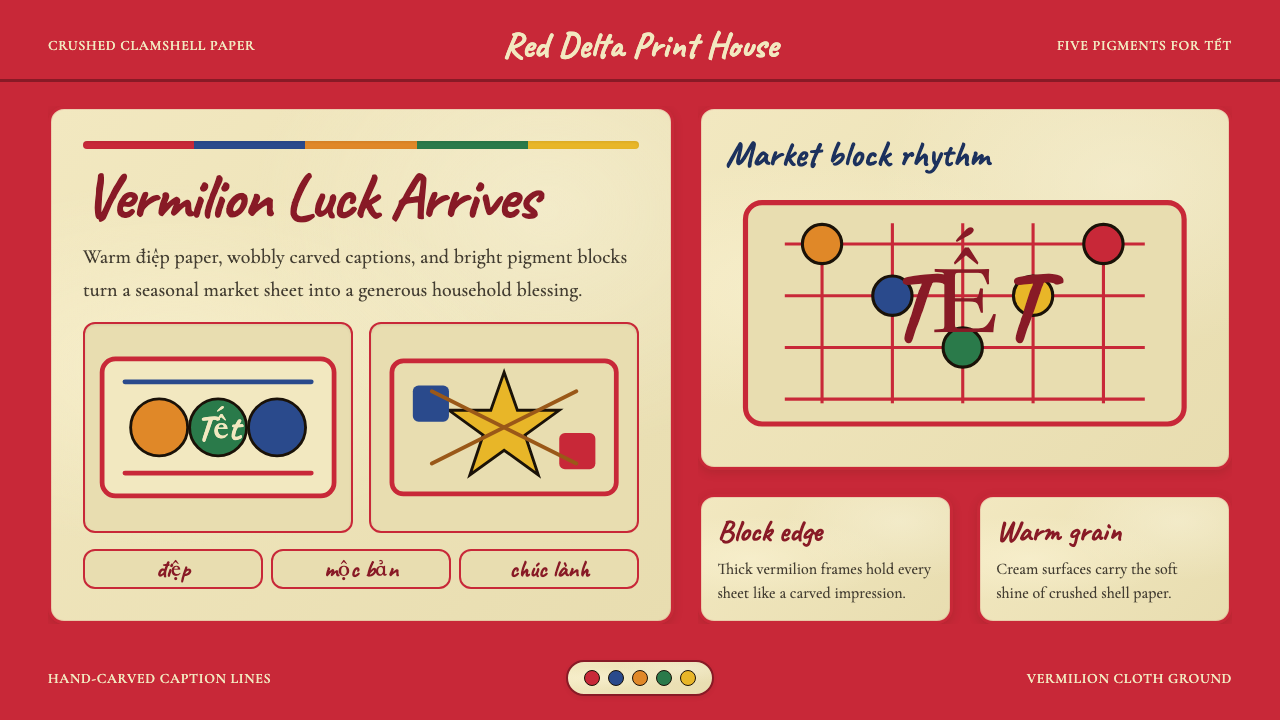 Vietnamese Đông Hồ Folk PrintFestive craft stays handmade. Vermilion frames, Caveat captions, cream paper…
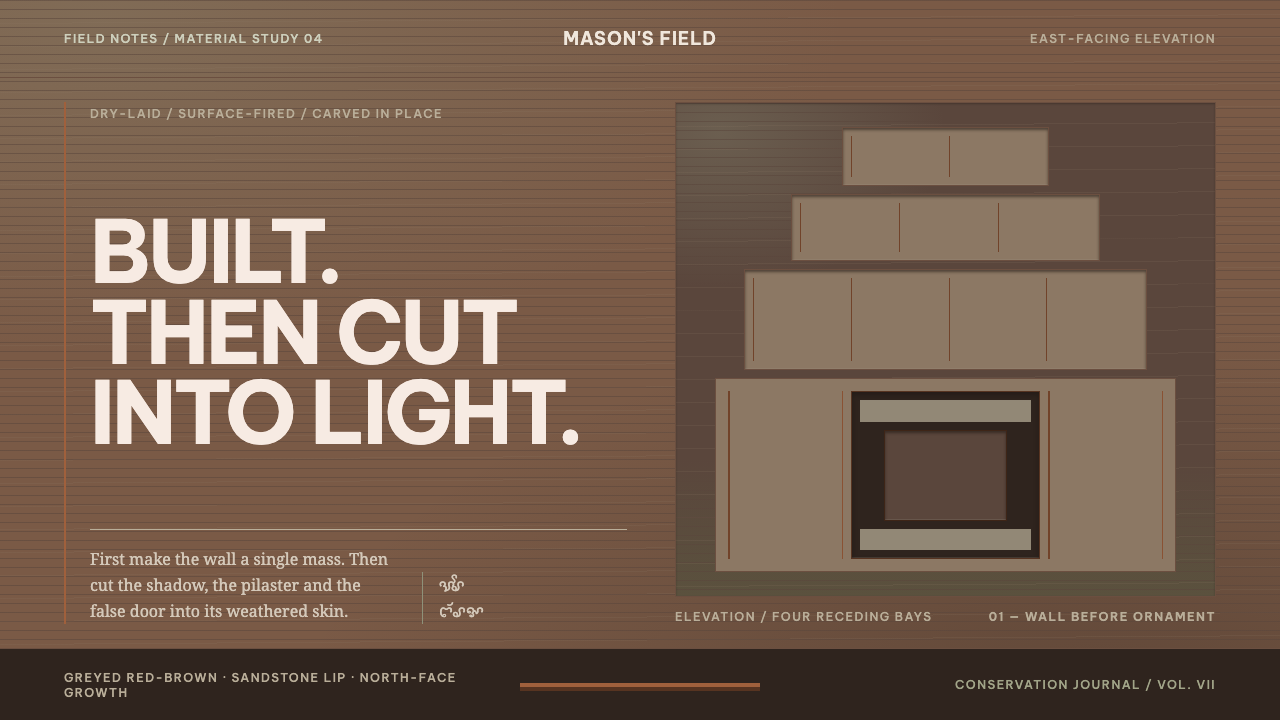 Cham My Son TowersWall before ornament. Greyed brick bays recede around cut shadows and sandsto…
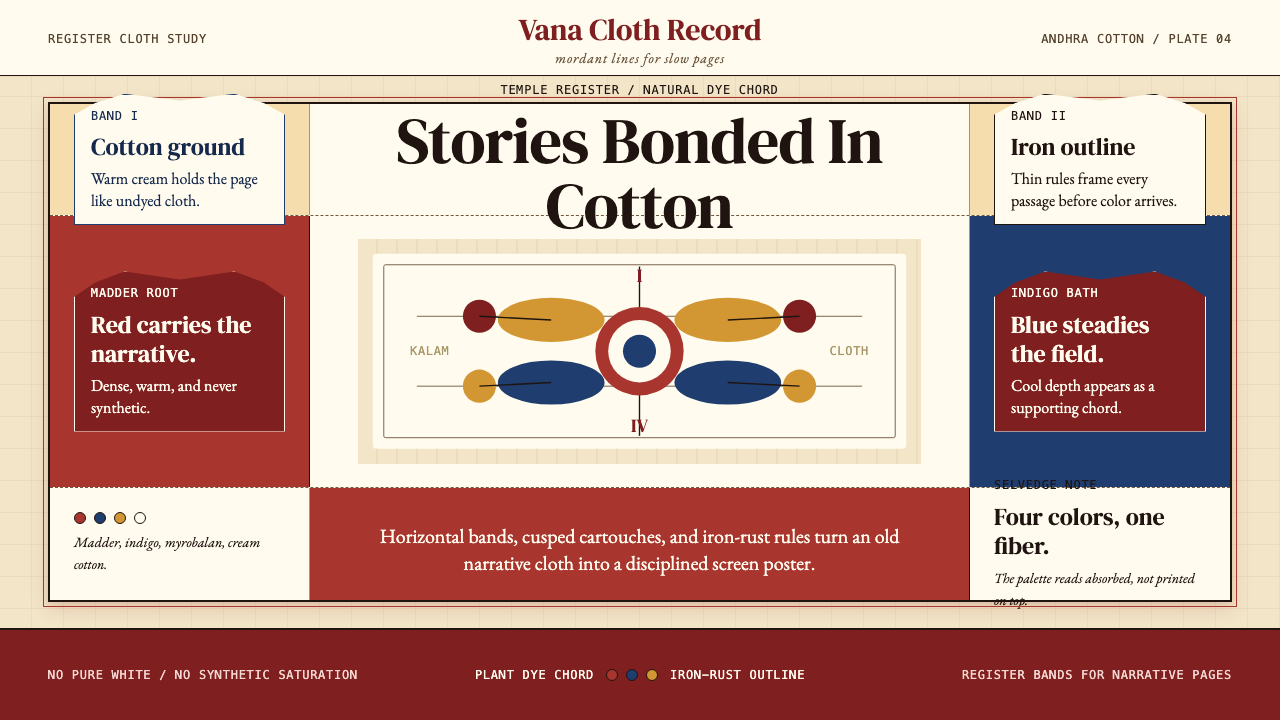 Kalamkari (Andhra Pradesh)Cloth becomes narrative. Madder bands, indigo panels, and iron rules stack li…
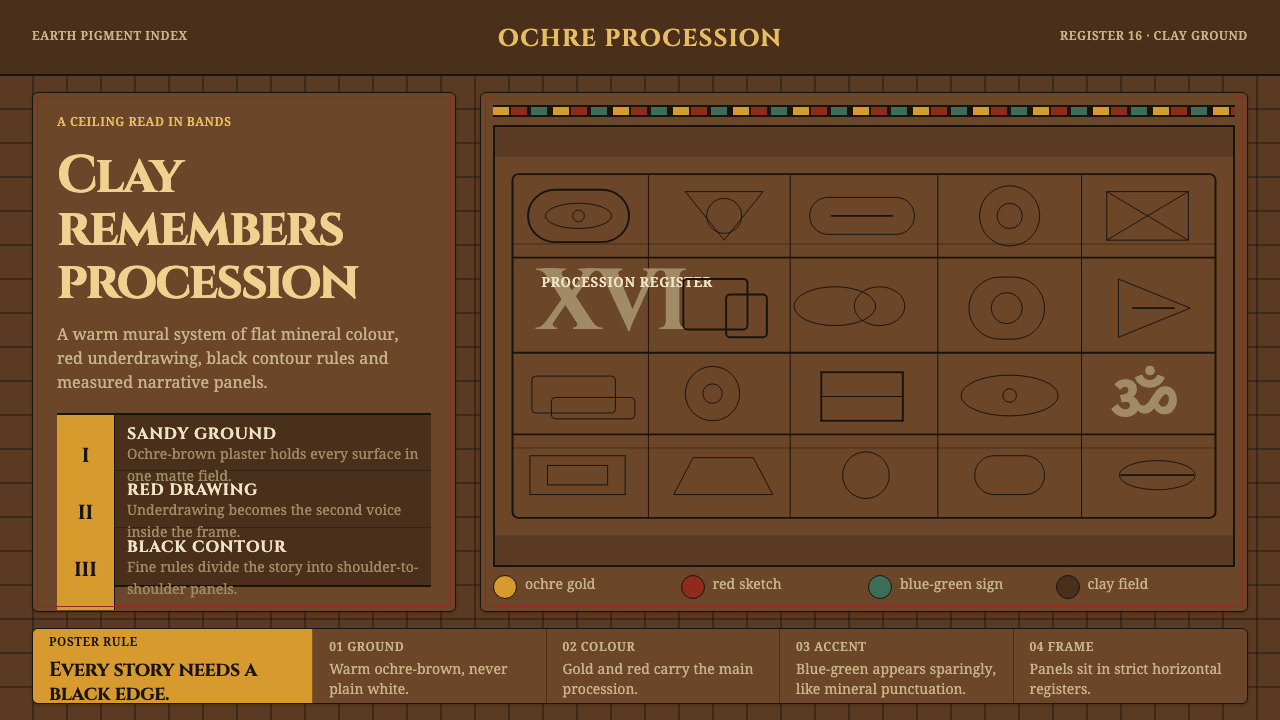 Lepakshi Vijayanagara CeilingEarth remembers in registers. Ochre gold, red underdrawing and black rules ma…
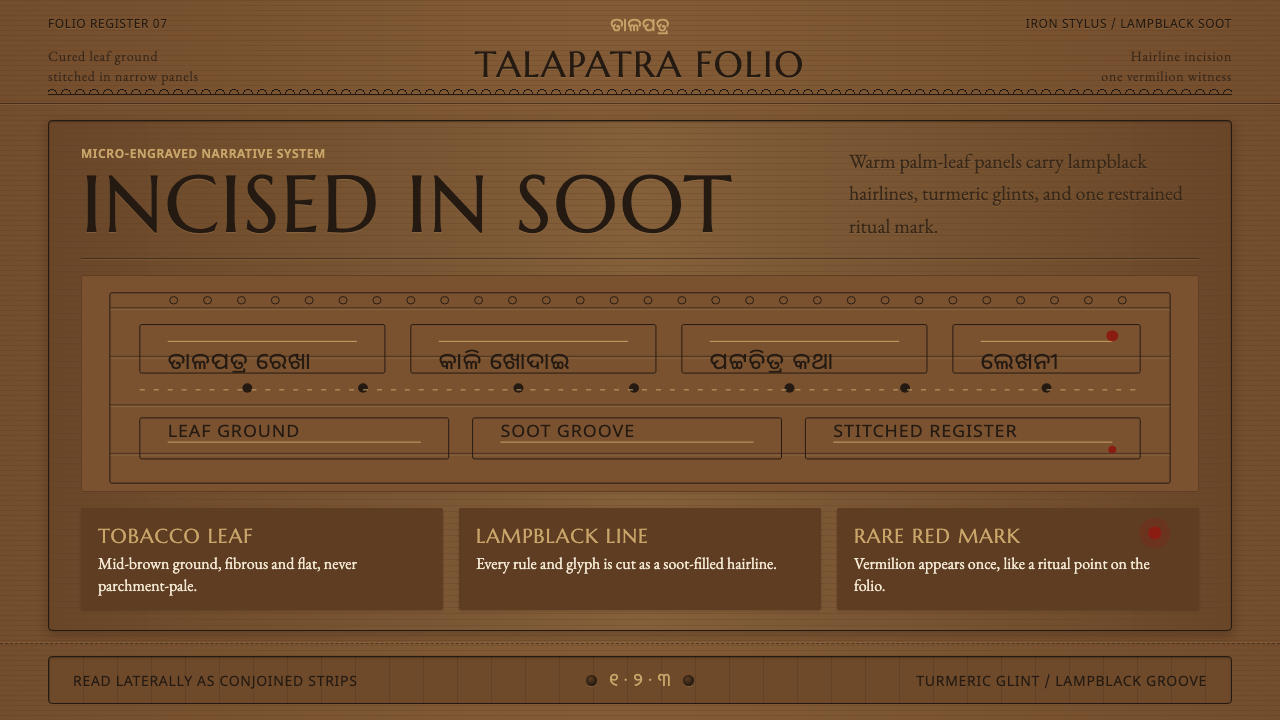 Odisha Palm-Leaf EtchingSacred narrative goes microscopic. Lampblack hairlines cut tobacco-brown leaf…