What is South African Shweshwe Indigo?
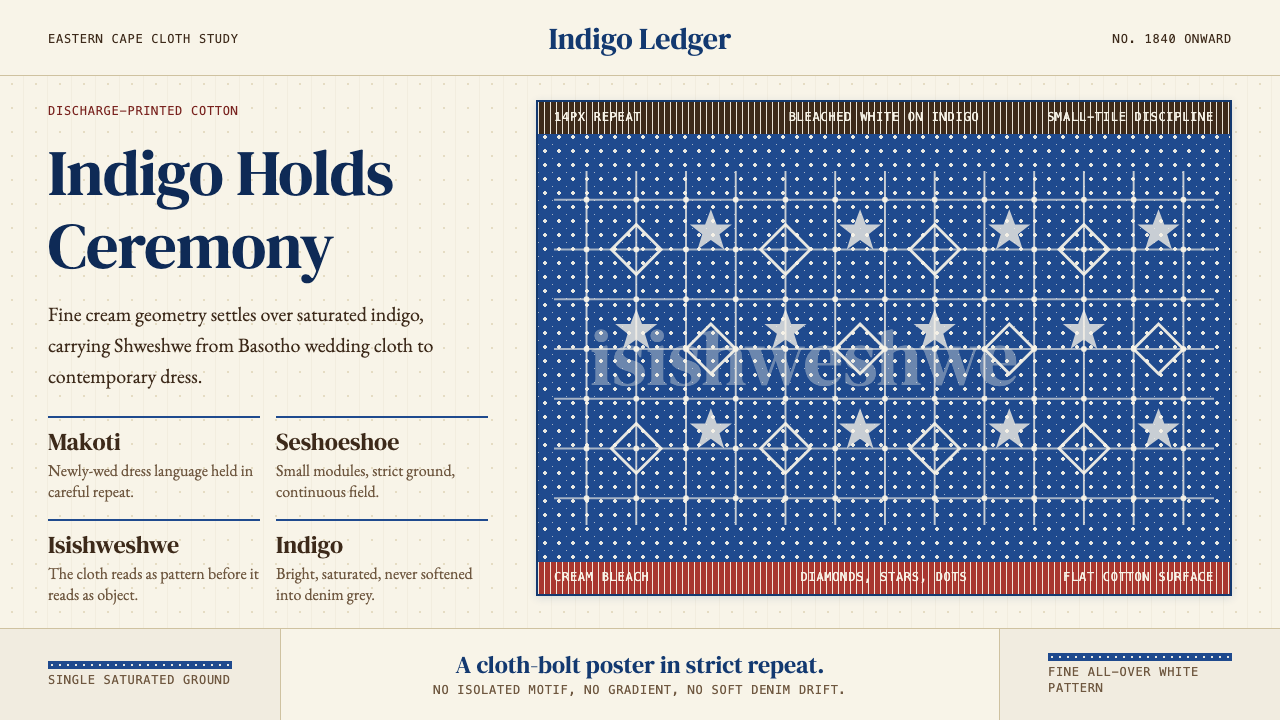
South African Shweshwe cloth turns a single saturated ground and a field of bleached geometric repeats into one of the most disciplined and ceremonially charged textile aesthetics in the world.
South African Shweshwe Indigo in brief
Shweshwe is South Africa's discharge-printed indigo cotton — a textile defined by a single deep-saturated ground, typically indigo blue, chocolate brown, or iron-rust red, onto which fine all-over geometric patterns have been bleached or printed in white or cream. The motifs — stars, diamonds, paisleys, leaf-vines, interlocking lozenges — are small and relentlessly repeated, so that the eye reads the fabric not as a collection of individual shapes but as a continuous, shimmering field. From a distance, a bolt of Shweshwe looks almost like a woven texture; up close it reveals an intricate hand-drawn geometry.
The discipline of the aesthetic is precise and unyielding: one saturated ground, one fine pattern field, small tile modules, no isolated large motif, no competing colors. This is not minimalism in the contemporary sense but rather a form of textile grammar — every rule serves the cloth's ceremonial purpose. Shweshwe is worn at weddings, initiation rites, and community celebrations, and its visual density communicates importance, belonging, and cultural continuity. The cloth is meant to be read by communities who know the codes, and its restraint is a form of richness.
Translated into graphic design and digital interfaces, the Shweshwe aesthetic offers a rare combination: bold chromatic presence through the saturated ground, intricate visual texture through the repeating pattern, and an underlying sense of order through the grid. It is a style that rewards attention — layouts built in this language reveal more detail the closer a viewer looks, which makes it particularly effective for contexts where sustained engagement matters.

Where does South African Shweshwe Indigo come from?
The story of Shweshwe begins not in South Africa but in Europe. In the early nineteenth century, European textile mills — particularly those in Germany, Alsace, and Britain — were producing discharge-printed cotton fabrics for export to colonial markets across Africa and Asia. These cloths used an acid or bleach printing process to remove dye from a pre-dyed ground, leaving fine geometric patterns in the original or treated color. The technique produced a distinctive visual effect that could not easily be achieved by conventional block or screen printing: the pattern appears to emerge from within the cloth itself rather than being applied on top.
These printed cottons reached the Cape Colony and the interior of southern Africa by the 1840s, arriving via missionary and trading networks. Among the Basotho people of what is now Lesotho and the eastern Free State, the cloth was rapidly adopted for ceremonial dress and became associated with the court of King Moshoeshoe I — the founder and paramount chief of the Basotho nation. The cloth took its name from him: in some accounts, the stiff, starched rustle of the cotton was said to sound like 'shweshwe,' an onomatopoeic rendering of the king's name as pronounced by his subjects. Other southern African communities — the Xhosa, Sotho, and Tswana — also adopted the cloth, each developing regional conventions for how it was worn, folded, and combined.
For much of the twentieth century, Shweshwe fabric was imported from European mills, making it both culturally central and economically dependent on foreign production. This changed in 1992 when Da Gama Textiles, a South African textile manufacturer operating in Zwelitsha in the Eastern Cape, began producing the cloth domestically under the Three Cats brand mark — named after the three cats on its logo. Da Gama's production became the only authentic local source of Shweshwe, and its Three Cats branding became a mark of quality and cultural legitimacy recognized across southern Africa.
In the post-apartheid decades, Shweshwe underwent a significant cultural reappraisal. What had been worn primarily in rural and ceremonial contexts began appearing on fashion runways and in contemporary design. Designers like Bongiwe Walaza and Laduma Ngxokolo of MaXhosa Africa brought the fabric into international fashion, working with its visual grammar — the dense geometric field, the saturated ground, the white repeat — as a sophisticated design language rather than a historical artifact. This elevation did not sever the cloth from its ceremonial roots; rather, it extended those roots into new soil, establishing Shweshwe as a living textile tradition with both deep historical grounding and ongoing creative evolution.
What defines the South African Shweshwe Indigo look?
Saturated Ground
The foundation of every Shweshwe composition is a single deep-saturated ground color — most canonically a rich indigo that reads almost as a dark, luminous blue, but also produced in chocolate brown and iron rust. The ground is never neutral or pastel; its depth is what gives the fine white pattern its visual punch. The saturation is structural: it creates the contrast ratio that allows tiny geometric details to remain legible even in small tiles. Lightening or softening the ground immediately weakens the entire system.
All-Over Geometric Repeat
The pattern field covers the entire ground without margin or interruption. Motifs — stars, diamonds, paisleys, interlocking lozenges, leaf-vine tracery — are arranged in strict tile repeats, each unit small enough that the individual shape nearly dissolves into texture when viewed at a normal distance. There are no focal points, no central medallion, no isolated large motif. The visual experience is one of total surface animation: the cloth moves as a whole rather than directing the eye to any particular element.
Bleached White Line Work
The pattern is not printed on top of the ground but discharged out of it — acid or bleach removes dye from selected areas, leaving the geometric forms in a clean cream or white that is almost luminous against the deep ground. This discharge technique means the pattern and ground share the same fiber; there is no surface layer that can crack or peel. The white reads as an internal light source within the cloth, giving Shweshwe its characteristic glow. In digital applications, replicating this quality requires treating the light elements as slightly warm rather than pure cool white.
Single-Color Discipline
Authentic Shweshwe uses exactly two values: the saturated ground and the bleached pattern. There is no second accent color, no gradient, no color variation within the pattern field. This strict two-value system is what makes the fabric legible at scale — worn in gathered folds, the pattern reads consistently because there are no competing colors to create visual confusion. In design work that draws on this aesthetic, introducing a third color is possible but should be treated as an expansion of the system rather than an addition, used only when it serves a specific communicative function.
Ceremonial Density
The density of the Shweshwe pattern — the fact that no area of ground is left undecorated — is not arbitrary; it is an expression of the cloth's ceremonial weight. In the cultural contexts where Shweshwe is worn, visual fullness communicates investment, care, and significance. Empty space in such a context would read as unfinished or unworthy. For design applications, this means the aesthetic is inherently generous with visual information: it suits contexts where richness and detail signal quality, and it resists applications that require large areas of visual rest.
Textile Grid Rhythm
Beneath the variety of Shweshwe motifs lies an invariant tile grid. The repeat unit is small and consistent, creating a rhythmic regularity that unifies the surface regardless of which motif is used. This grid quality is one of the aesthetic's most transferable properties: layouts built on a strict modular grid, where the column and row system is as important as the content it organizes, share the same underlying logic. The pattern's geometry may vary; the underlying beat does not.
Starch and Structure
Traditional Shweshwe is heavily starched, giving the cloth a crisp, architectural quality — garments hold their form, pleats stay sharp, edges remain defined. This physical property has an aesthetic analogue: Shweshwe compositions are not soft or fluid. Lines are hard, edges are clean, shapes are decisive. In digital contexts, this translates to a preference for sharp boundaries over blurred edges, defined shapes over amorphous forms, and consistent line weights over expressive variation.

Who shaped South African Shweshwe Indigo?
Founder and paramount chief of the Basotho nation, Moshoeshoe I ruled from approximately 1822 until his death in 1870, consolidating Basotho identity and sovereignty during a period of intense regional upheaval. His court's adoption of the imported discharge-printed cotton gave the cloth its name and elevated it from a trade commodity to a marker of political and cultural prestige. The association between Shweshwe and Moshoeshoe transformed the fabric into something that carried genealogical and national meaning, a significance that has persisted through subsequent generations of Basotho and other southern African communities.
The Eastern Cape manufacturer Da Gama Textiles became, from 1992, the sole domestic producer of authentic Shweshwe cloth in South Africa, operating under its Three Cats brand mark from its Zwelitsha facility. Da Gama's production was significant not only economically but culturally: it transferred ownership of the textile tradition from European mills to South African manufacturing at a moment of post-apartheid national reconstruction. The Three Cats label is recognized as a mark of quality and authenticity across southern Africa, and the company's ongoing production sustains both the commercial availability and the cultural continuity of the cloth.
The founder of MaXhosa Africa, Laduma Ngxokolo is one of the most internationally recognized South African fashion designers to have built a sustained body of work around Xhosa textile traditions. His collections draw on Shweshwe's geometric visual language alongside beadwork, initiation symbolism, and Xhosa color traditions, translating them into knitwear and garments worn on global runways. Ngxokolo's work demonstrates that Shweshwe's visual grammar is expansive enough to support contemporary innovation while remaining anchored to specific cultural meanings — a model for how historically grounded design languages can evolve without being diluted.
One of the pioneering South African designers to bring Shweshwe fabric into high fashion contexts, Bongiwe Walaza worked extensively with the cloth's geometric language in her Cape Town-based practice. Her designs used Shweshwe not as a surface decoration applied to conventional garment shapes but as the formal and structural logic of the garments themselves — allowing the cloth's visual rhythm to drive silhouette and cut. Walaza's approach helped establish the principle that Shweshwe is not costume or cultural pastiche but a living design language capable of generating original contemporary forms.
How do you use South African Shweshwe Indigo today?
Applying Shweshwe Indigo in design work requires understanding that its power comes from the relationship between ground and pattern, not from either element alone. The deep saturated field creates presence and gravity; the fine white geometric repeat creates life and movement. Strip away either and you are left with something that looks like a reference to Shweshwe rather than a genuine application of its logic. The first decision — choosing which ground color to lead with, and ensuring it is deep enough to do its job — sets the entire direction of a composition.
For presentation slides, the Shweshwe aesthetic produces memorable covers and section dividers. A cover slide works well with the full pattern treatment: a rich indigo or chocolate ground tiled with a fine geometric repeat, title text set in clean cream or white serif type that sits within the pattern field rather than fighting it. The key is scale — the tile repeat should be small enough that it reads as texture at the slide's viewing distance, allowing the type to dominate while the pattern provides depth. Content slides should transition to a near-white or cream ground with only a fragment of the pattern used as a border strip or corner element, preserving the aesthetic language without competing with data or text. Data visualization benefits from the style's geometry: charts, timelines, and tables can adopt the Shweshwe grid as an organizational armature, with the saturated ground color used for highlighted or primary data series.
For web interfaces, the style is most effective in contexts that benefit from a sense of occasion — brand landing pages, cultural institution sites, heritage product pages, and portfolio headers. A full-bleed hero section with the pattern at an appropriately fine repeat scale establishes the aesthetic register immediately. For dashboard or application interfaces, the pattern is best used as a structural element — a sidebar background, a header band, a card accent — rather than as the primary surface, which would create visual fatigue over extended use. The saturated ground color can be used consistently for primary calls to action, active navigation states, and key data highlights, creating a clear hierarchy while honoring the source aesthetic. Pricing pages work well with the style's sense of weight and ceremony: tiered cards that use the ground color for the recommended tier communicate value through chromatic depth rather than simple labels.
For editorial and marketing work, Shweshwe's visual grammar supports richly layered compositions. Magazine spreads and feature headers can use the pattern as a full-bleed background with the text treatment adjusted for legibility — cream or white type at generous scale, with the pattern's intricate geometry providing a sense of texture and craft that stock photography rarely achieves. Marketing materials aimed at cultural, luxury, or artisan audiences particularly benefit from the style's ceremonial register: the density and precision of the geometric field signals care and intentionality. Print applications can lean into the discharge-print quality — designs that treat light elements as emerging from a deep ground, rather than being placed on top of it, will feel more authentic to the source material.
A common mistake when working with Shweshwe-inspired design is scaling the tile repeat too large. The aesthetic's power depends on the individual motif reading as texture rather than isolated ornament — when tiles are enlarged to the point where individual diamonds or stars become the dominant visual elements, the cloth-like continuity breaks down and the result looks more like a geometric pattern library than a textile tradition. Similarly, desaturating the ground to make the style feel more neutral or contemporary undermines the entire contrast logic on which the system depends. Shweshwe at half-saturation is not a quieter version of itself; it is a broken version. Work within the discipline or choose a different aesthetic — the style does not reward half-measures.

South African Shweshwe Indigo — FAQ
Is Shweshwe Indigo appropriate for non-African brands and contexts?
The aesthetic can be used thoughtfully outside its origin culture, but it requires genuine engagement with what the style represents rather than superficial borrowing. Shweshwe is a living textile tradition connected to specific communities and ceremonies — not a neutral historical pattern. The most effective cross-cultural applications tend to be those that acknowledge the source explicitly, use the aesthetic's genuine visual logic rather than a simplified approximation, and have a clear reason why Shweshwe's particular qualities — its ceremonial weight, its geometric discipline, its deep chromatic presence — serve the project's actual communication goals. Contexts of cultural exchange, heritage celebration, and design education are natural fits. Consumer product work that applies the pattern as surface decoration without engaging its underlying logic risks reducing a cultural practice to a trend.
How does Shweshwe differ from other African geometric textile traditions?
While many African textile traditions use geometric pattern and repetition — Kente's woven color bands, Kanga's bordered pictorial fields, Bogolan's earth-tone resist dyeing, Ndebele's painted wall geometry — Shweshwe has a distinctive combination of properties. Its discharge-print technique produces a pattern that appears to emerge from within the cloth rather than sitting on top, creating a particular luminosity. Its extremely fine tile repeat and all-over coverage without borders or framing bands are characteristic. And its strict two-value palette — deep saturated ground plus white — is more disciplined than many comparable traditions that incorporate multiple colors. Shweshwe is also unusual in having a specific documented origin moment and named historical association, giving it a traceable genealogy that informs how it is used in contemporary design.
Can the style work in light-background or white-ground layouts?
Light-ground inversion is possible but requires careful handling. The canonical Shweshwe experience is dark ground plus light pattern — the luminous effect depends on high contrast between a deep saturated field and fine bleached details. Inverting this to a cream or white ground with dark geometric repeats produces a legible result but loses the characteristic glow and ceremonial weight of the original. Such an inversion works better in contexts where the style's presence needs to be quieter — editorial body pages, interface backgrounds where sustained readability matters — but designers should be aware that it represents a significant departure from the source aesthetic. A hybrid approach — alternating deep-ground feature sections with light-ground content sections — preserves the full-saturation experience where it matters most while providing visual rest elsewhere.
What typography works best with Shweshwe Indigo?
Typography set against Shweshwe's pattern field must be legible without being so dominant that it kills the pattern's visual life. Serif typefaces — particularly those with high contrast between thick and thin strokes — work well because they carry their own visual rhythm that complements rather than fights the geometric repeat. The serifs echo the cloth's fine line work. Type should be set large enough to hold its own against the pattern, in cream or white that relates to the bleached pattern color. For display headings, generous scale and open tracking allow the pattern to breathe around the letters. For body text, the pattern should be suppressed or eliminated — reading long passages against a busy geometric field is fatiguing regardless of typeface. Sans-serif type is not incompatible with the style but requires more care with scale and contrast to avoid competing with the geometric pattern at similar visual weights.
Does Shweshwe Indigo suit digital dark-mode interfaces?
Shweshwe is by nature a dark-mode aesthetic — the deep indigo ground is its canonical state, not an inversion of a light original. This makes it one of the few historical design languages that translates naturally into dark-mode digital interfaces without requiring the kind of careful adaptation that light-ground styles demand. The deep saturated ground serves the same function as a dark interface background, and the fine white pattern creates texture and life without disrupting readability. The main adjustment required for screen contexts is ensuring the white pattern elements carry slightly warm undertones rather than cool blue-white, which can read as harsh against deep blue grounds at screen brightness. Interface components — cards, modals, input fields — can use slightly lighter values of the ground color to create depth hierarchy while remaining within the saturated color family.
Related design styles
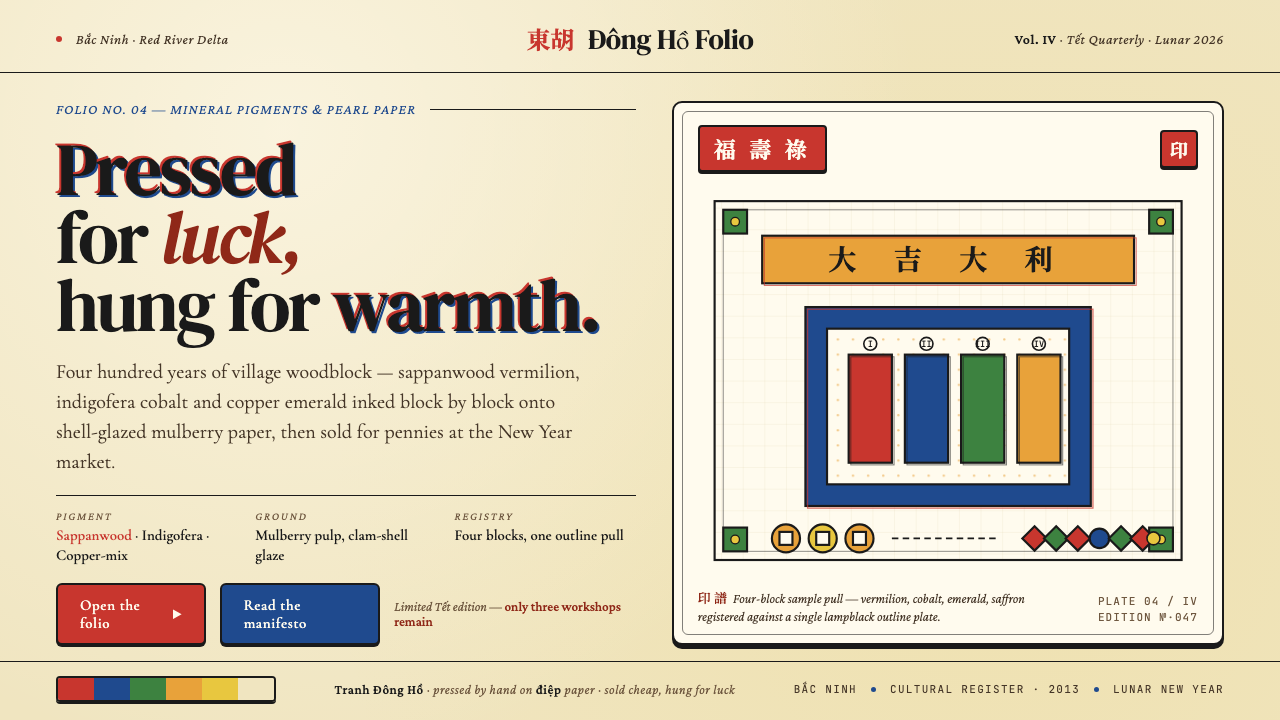 Vietnamese Đông Hồ WoodblockPressed for luck. Vermilion, cobalt, emerald and saffron blocks on pearl-shel…
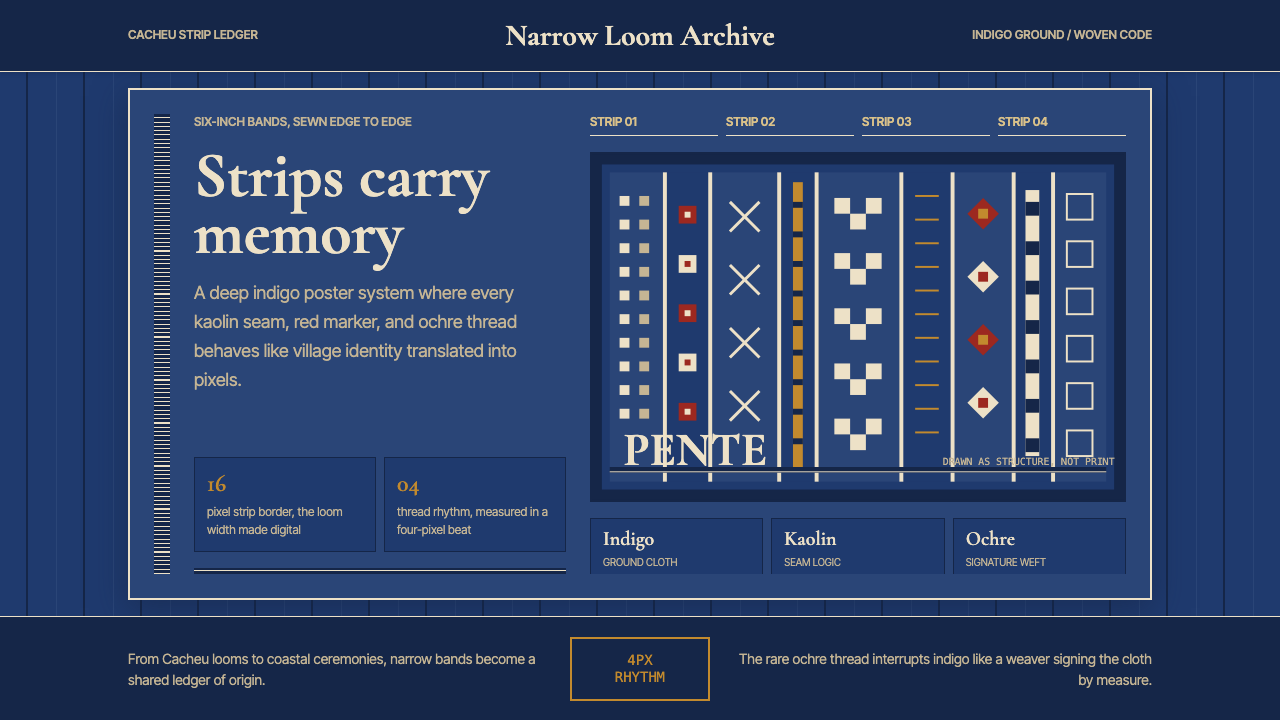 Bissau-Guinean Pano de PenteIndigo remembers. Narrow bands and kaolin seams turn weave grammar into pixel…
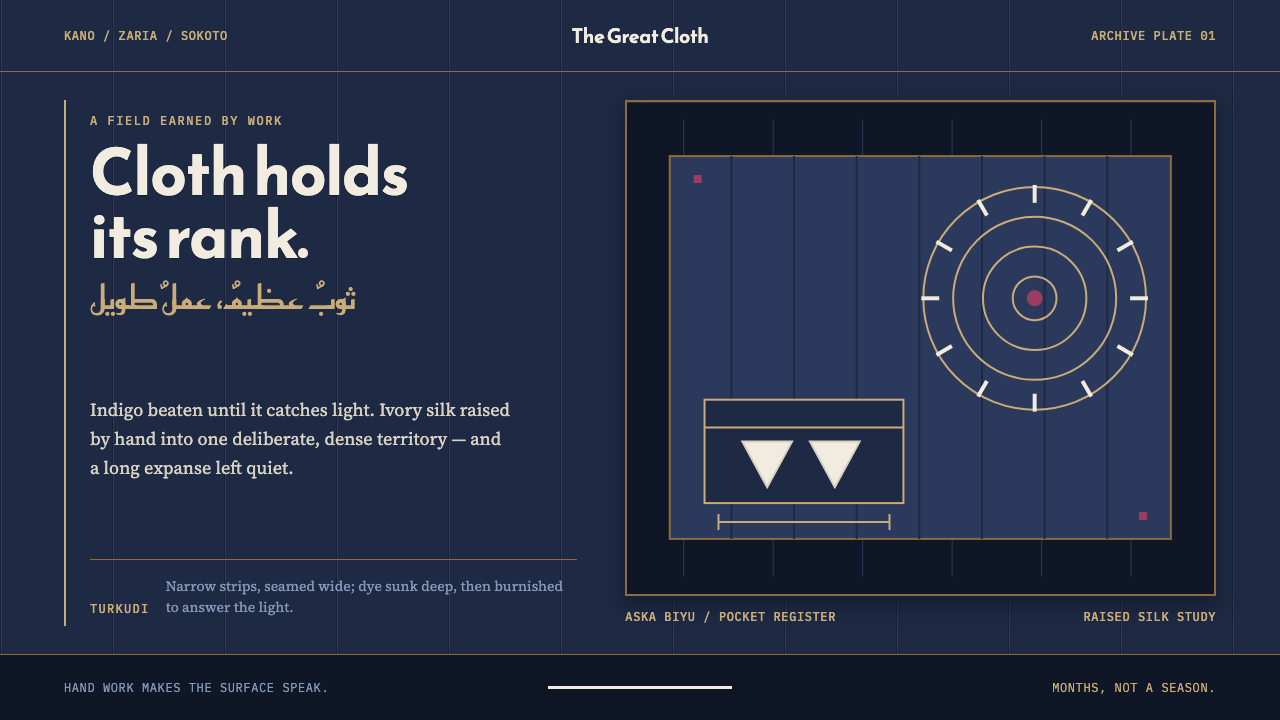 Hausa Babban RigaRank is worked, not announced. Burnished indigo holds raised ivory geometry i…
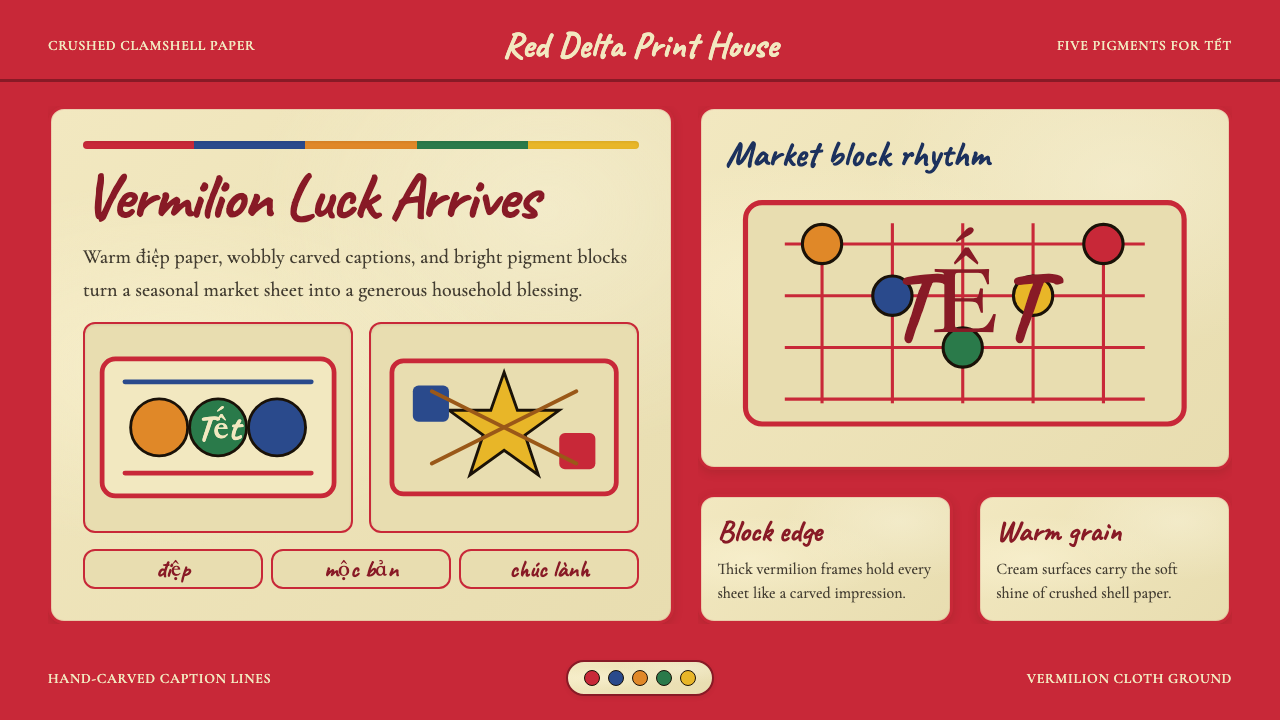 Vietnamese Đông Hồ Folk PrintFestive craft stays handmade. Vermilion frames, Caveat captions, cream paper…
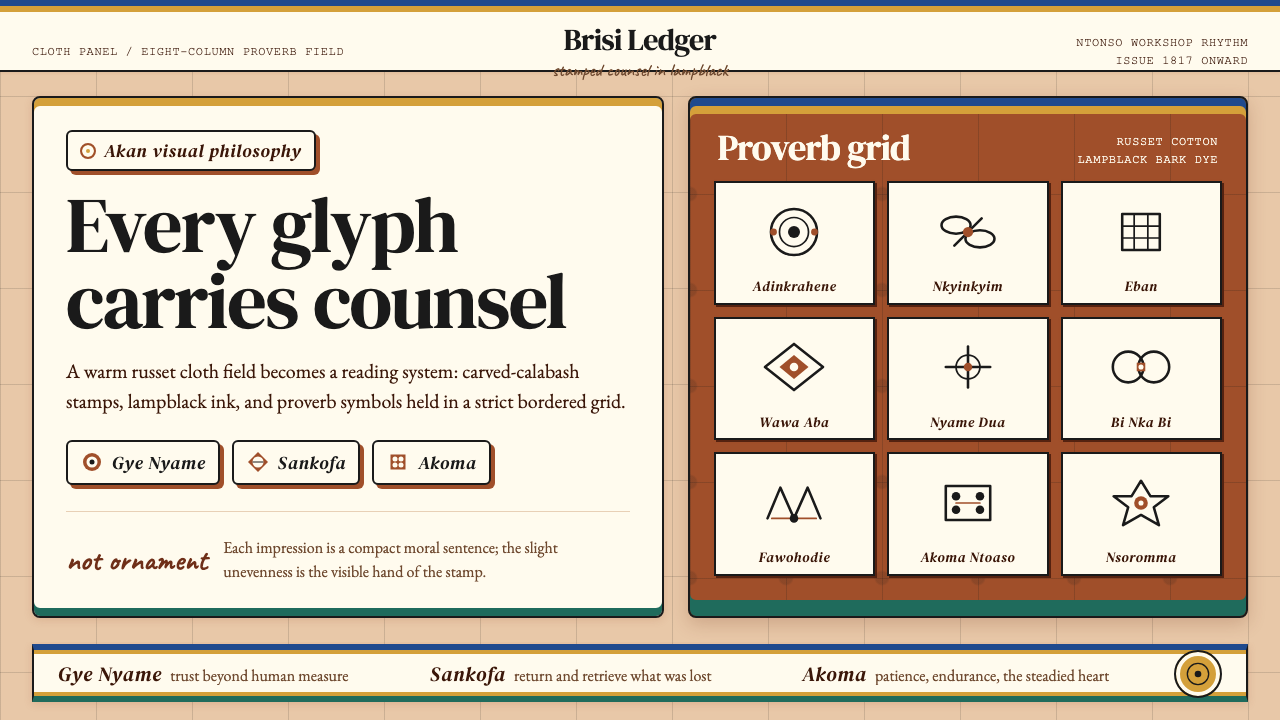 Akan Adinkra (Ghana)Proverbs become cloth. Russet grids, lampblack serif marks, and gold-edge ban…
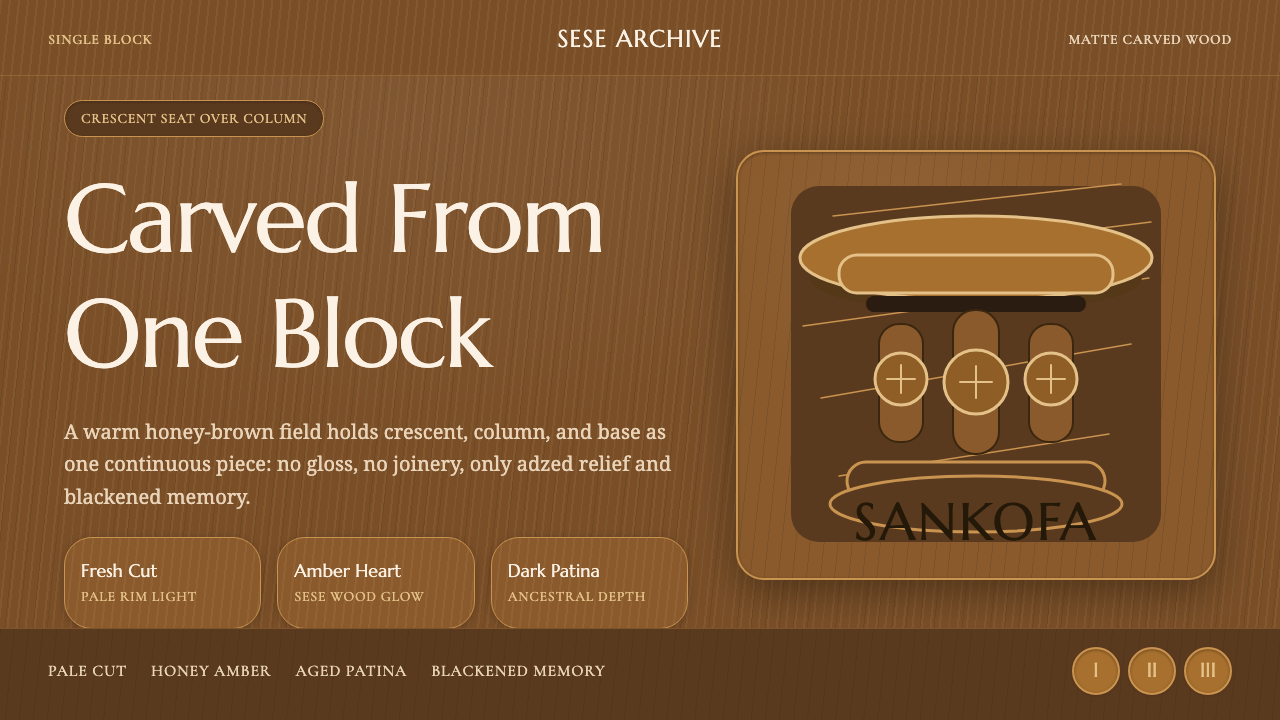 Akan Carved StoolMatte wood carries memory. Honey amber, Marcellus type, and crescent-column r…