What is Vanuatu Sand Drawing?
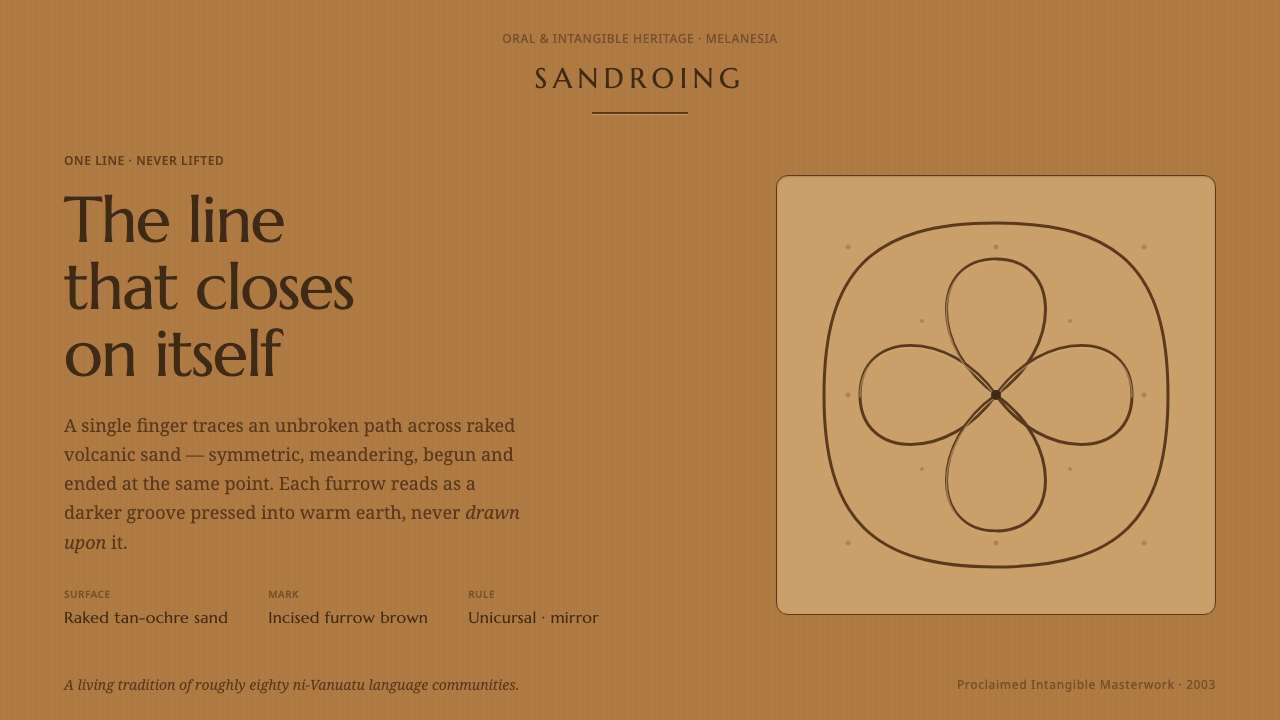
Vanuatu sand drawing turns a single unbroken finger-line into a shared geometry of memory, story, and ritual.
Vanuatu Sand Drawing in brief
Ni-Vanuatu sand drawing, often called sandroing, is a living tradition of tracing a single continuous unicursal line with one finger across raked beach sand, volcanic ash, or clay. The line is not treated as a quick sketch or a decorative motif. It follows an imagined grid, moving through turns, crossings, loops, and mirrored passages without lifting the finger, so the finished drawing reads as both path and pattern.
Across roughly 80 ni-Vanuatu language communities, these symmetric, meandering lattices function as memory aids, stories, and ritual records. Their meaning lives not only in the final image but also in the act of drawing: the maker knows where the line begins, how it travels, and how a dense visual form can hold knowledge for others to recognize and recount.
As a design language, the tradition suggests a warm raked-sand ground interrupted by darker grooves that resemble shadowed furrows. Its visual authority comes from continuity, mirror symmetry, and earthy restraint. Everything should feel flat, matte, tactile, and made in a natural surface rather than assembled from polished synthetic parts.
Where does Vanuatu Sand Drawing come from?
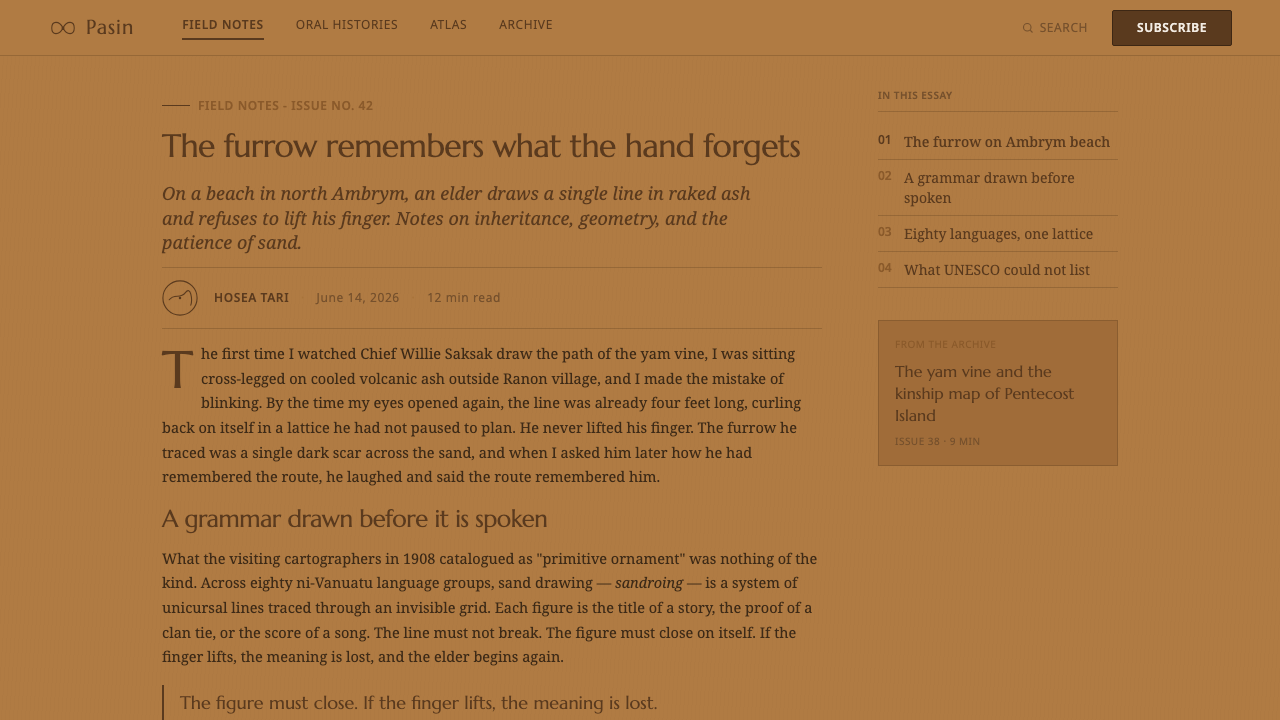
Sand drawing belongs to the living cultural traditions of Vanuatu in Melanesia, particularly the country’s central and northern islands. Its history reaches back before 1900, yet it should not be framed as a relic from a finished past. It remains a practice held by communities, custodians, and masters whose knowledge includes both visual form and the cultural contexts in which a drawing is made.
The materials are inseparable from the practice. Raked sand, volcanic ash, and clay provide temporary grounds on which a finger can leave a clear furrow. This impermanence is meaningful: the drawing can be made, read, shared, and erased, while the method of constructing it remains with the people who know the path.
The underlying system is unicursal. A maker constructs an intricate lattice through one unbroken route rather than joining isolated segments afterward. Symmetry gives the drawing visual stability, while the meander of the line gives it sequence. The result can preserve an idea in a form that is at once geometric, performative, and oral.
In 2003, Vanuatu sand drawing was proclaimed a UNESCO Masterpiece. That recognition identifies its importance as oral and intangible heritage, but it does not make the tradition an anonymous visual resource. Any contemporary use should acknowledge its ni-Vanuatu roots and treat the source practice as culturally specific knowledge, not merely a convenient pattern library.
What defines the Vanuatu Sand Drawing look?
Unbroken Line
The defining gesture is one continuous finger-line. In a visual adaptation, paths should read as intentional routes with no arbitrary breaks, dangling ends, or disconnected decorative fragments. Continuity is the structure, not an effect added after the layout is complete.
Raked Ground
The field should evoke sand, ash, or clay that has been prepared for drawing. It is warm, earthen, and matte, with a sense of broad quiet surface. A pale cream ground or glossy synthetic finish breaks the material logic of the style.
Incised Furrow
The darker line should behave like an incision in the ground rather than ink placed on top of it. It carries the visual weight of a shallow shadowed groove: direct, tactile, and slightly embedded in the field without becoming dimensional illustration.
Mirror Symmetry
Symmetry organizes the lattice and makes its density legible. Mirrored halves, repeated turns, and balanced enclosures create composure even when the route is elaborate. The aim is not mechanical repetition, but a stable field through which the line can travel.
Meandering Geometry
The geometry is not a rigid diagram of isolated cells. It is a meandering route through an imagined grid, where loops and crossings accumulate into a lattice. Forms should feel discovered by movement, as though the pattern emerged from following a rule.
Earthen Flatness
The system is flat and matte. It does not rely on glowing highlights, polished materials, atmospheric haze, or decorative gradients. Its depth comes from the implied furrow and from the mind following the line, not from simulated light or elaborate surface effects.
Who shaped Vanuatu Sand Drawing?
Sand-drawing masters hold the practical knowledge of constructing continuous paths and the cultural knowledge that gives a drawing purpose. Their role makes clear that sandroing is not reducible to a surface appearance: the route, its telling, and its setting belong together.
Village custodians sustain the conditions under which sandroing is remembered, practiced, and passed on. They represent the community dimension of a tradition whose value lies in shared knowledge rather than in a single fixed artifact.
Roughly 80 ni-Vanuatu language communities share sand-drawing forms as memory aids, stories, and ritual records. This breadth shows that the tradition is both widely connected and culturally situated; its patterns travel across communities without becoming detached from people.
How do you use Vanuatu Sand Drawing today?
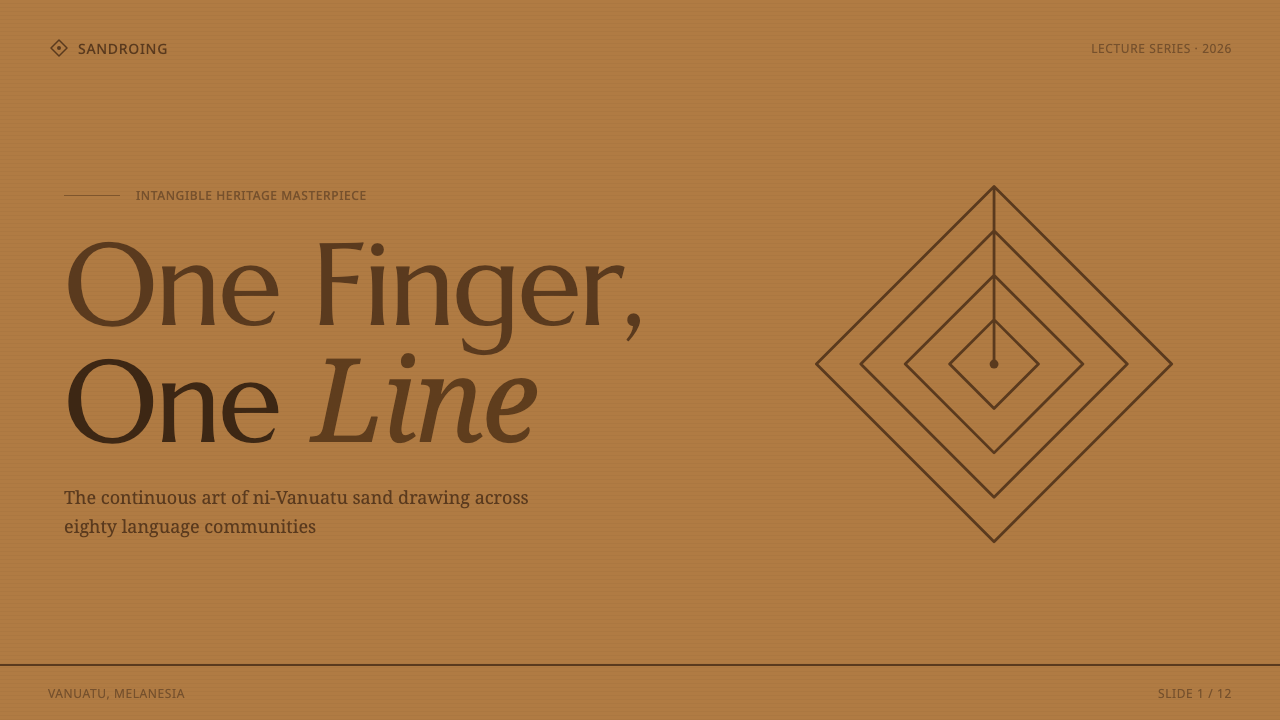
For presentation covers, use the drawing as a single focal route rather than a full decorative backdrop. Let a warm sand-like field carry an unbroken dark path, with the title placed where the composition can breathe. Content slides should retain the same ground and use line fragments only as structural dividers or quiet wayfinding devices. On data slides, the lattice can frame a comparison or organize categories, but it should never compete with the data itself.
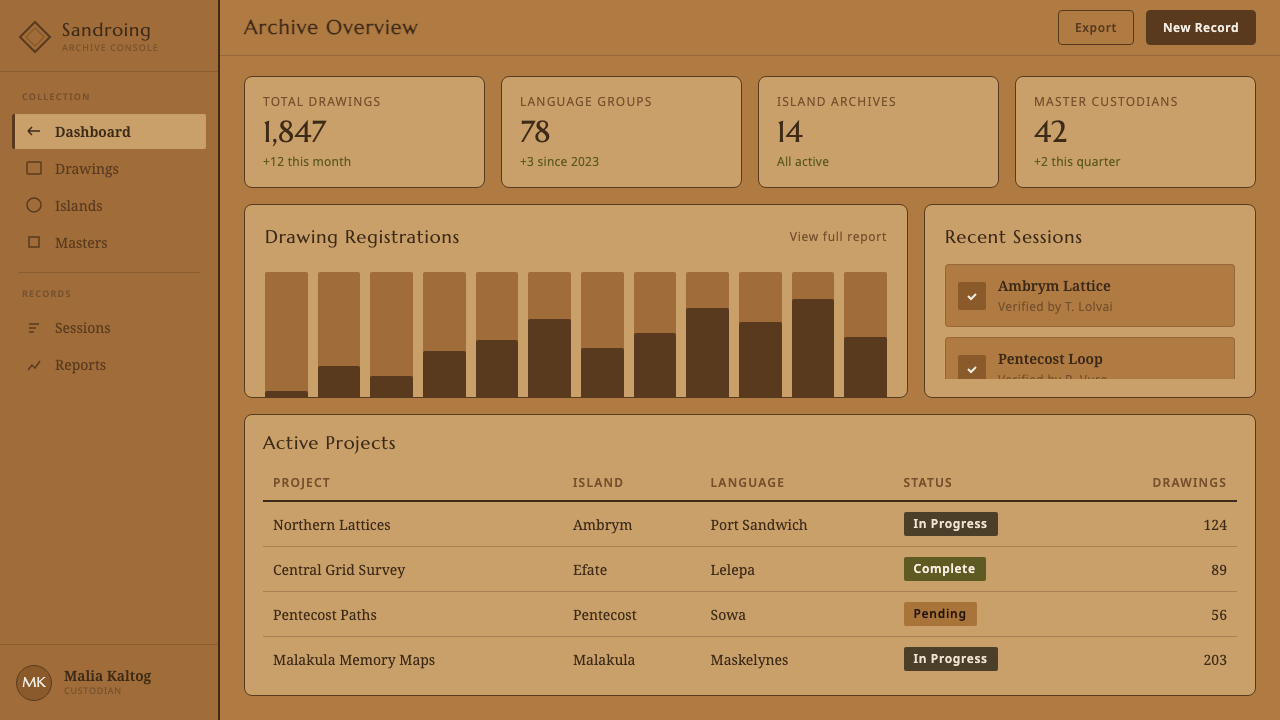
For web interfaces, this language works best where calm attention, cultural context, or reflective navigation matters more than speed-driven visual noise. A dashboard can use continuous paths to connect related sections and a pricing page can use mirrored enclosures to distinguish plans, provided conventional labels and controls remain immediately legible. The sand drawing should guide relationships, not replace usability.
For editorial and marketing work, give the pattern room. A feature page can begin with a complete path beside a short contextual statement, then use cropped portions of the lattice to mark chapter transitions, pull quotations, or metadata. The strongest compositions preserve the contrast between broad quiet ground and one dark, deliberate route rather than filling every empty area with ornament.
The common mistake is to treat sand drawing as a generic tribal pattern or to break it into interchangeable decorative strokes. That loses the unicursal principle and strips away its ni-Vanuatu cultural context. Avoid synthetic palettes, glossy effects, and random symmetry; acknowledge the tradition, keep the line continuous where it is presented as sandroing, and do not imply that a contemporary pattern carries a specific story or ritual meaning unless that meaning is known and appropriately authorized.
Vanuatu Sand Drawing — FAQ
Is Vanuatu sand drawing simply a geometric pattern style?
No. Its visible lattice is inseparable from an act of drawing, a continuous route, and shared cultural uses as memory aids, stories, and ritual records. A contemporary design can be inspired by its formal principles, but a pattern alone does not reproduce the knowledge held within sandroing.
Why must the line remain unbroken?
The unbroken line is the tradition’s defining formal condition. It turns the image into a route that can be followed, remembered, and performed. Breaking it into separate ornamental marks changes the underlying logic from a unicursal drawing into ordinary surface decoration.
Can the style use texture or visual depth?
It can suggest the tactile difference between raked ground and an incised furrow, but the result should remain restrained and matte. The intended depth is the quiet impression of a groove in sand, ash, or clay, not a glossy simulation of material or dramatic lighting.
How should a contemporary designer credit the tradition?
Name the source clearly as ni-Vanuatu sand drawing or sandroing, identify Vanuatu where context allows, and avoid presenting the work as an anonymous global motif. Most importantly, do not invent stories, ritual meanings, or community claims for a design adaptation. Attribution is a starting point for respect, not a substitute for cultural understanding.
Related design styles
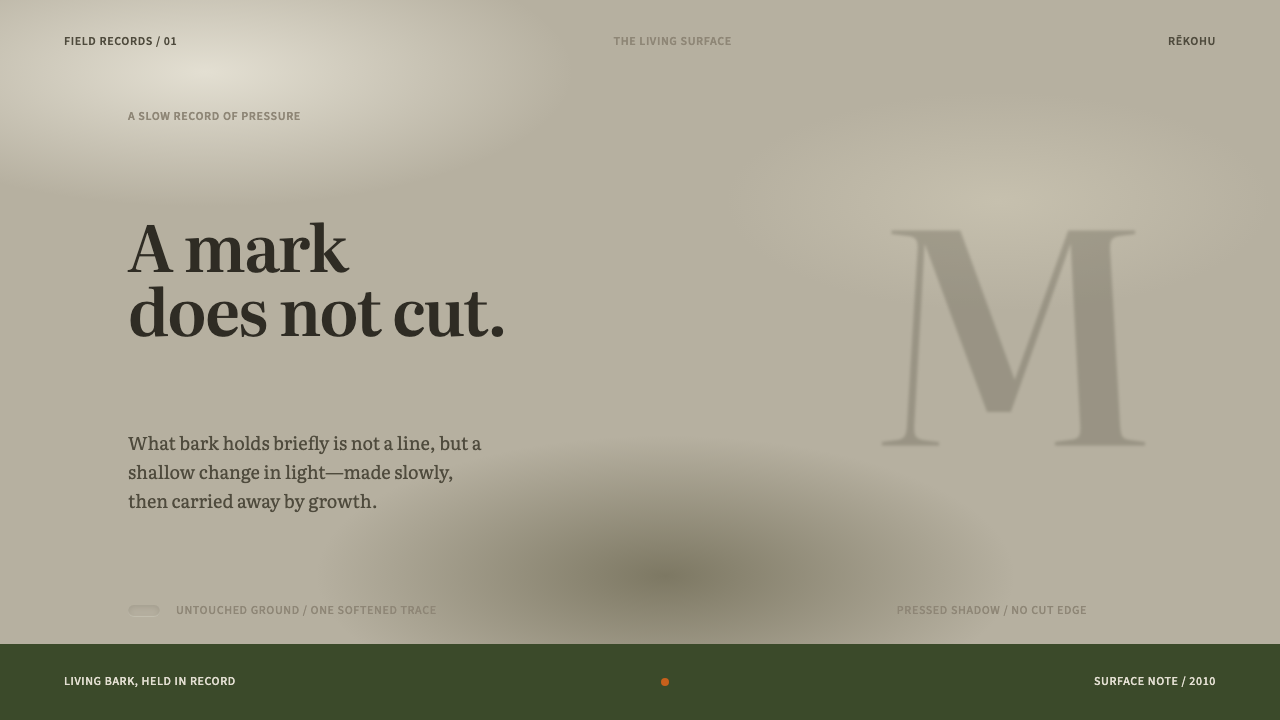 Moriori Rakau MomoriPressure, not incision. Literata shadows sink softly into pale, lichened bark.
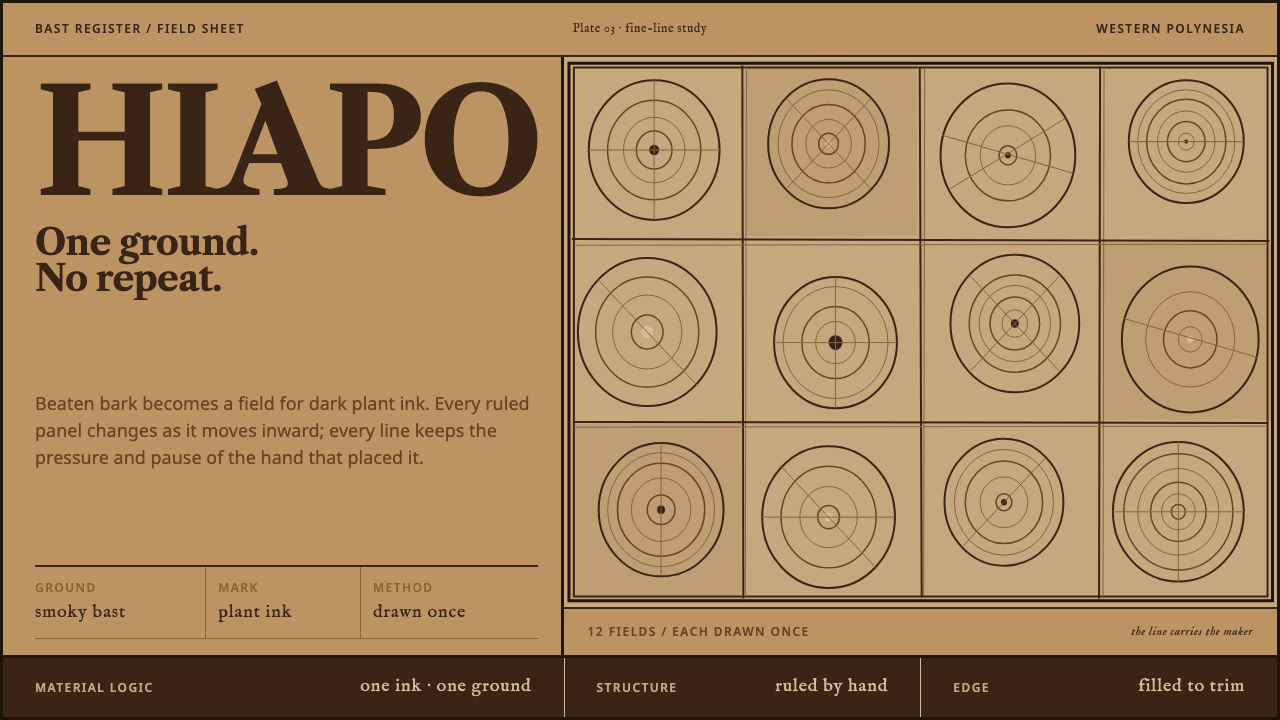 Niuean HiapoEvery line keeps its maker. Dark plant ink fills smoky barkcloth in hand-rule…
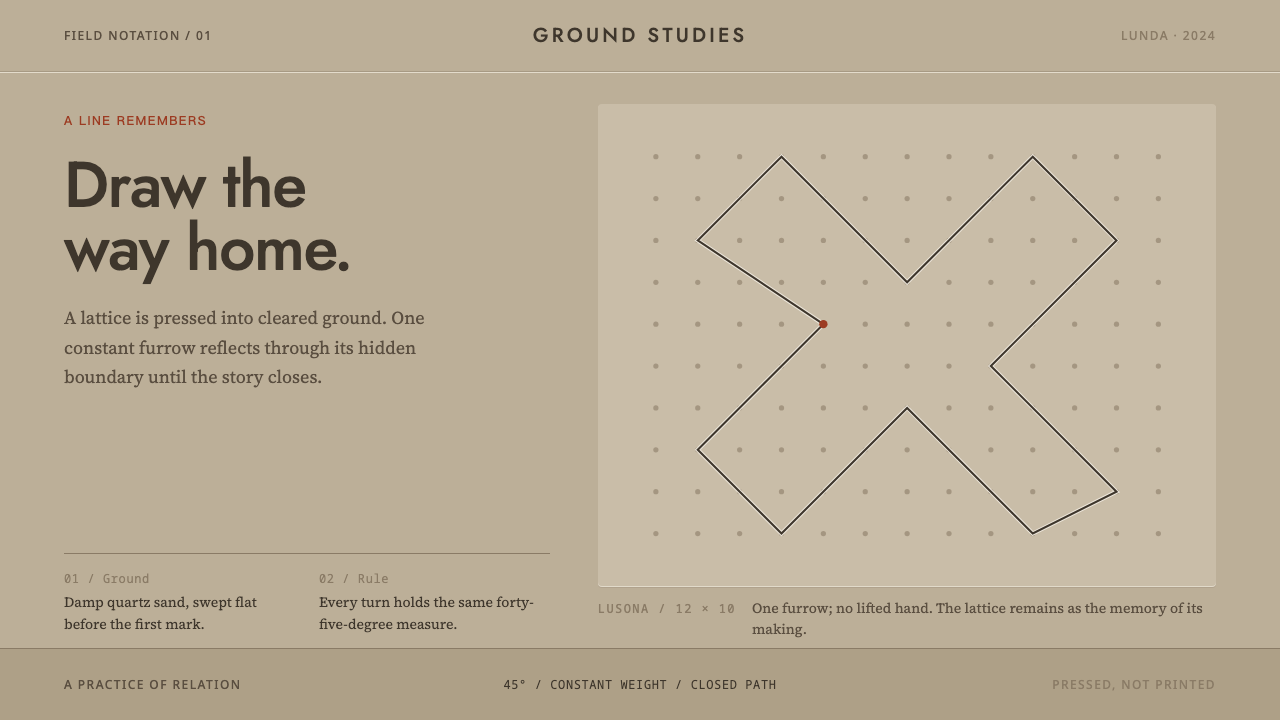 Angolan SonaA story closes in one stroke. A 45° furrow crosses visible dots on damp sand.
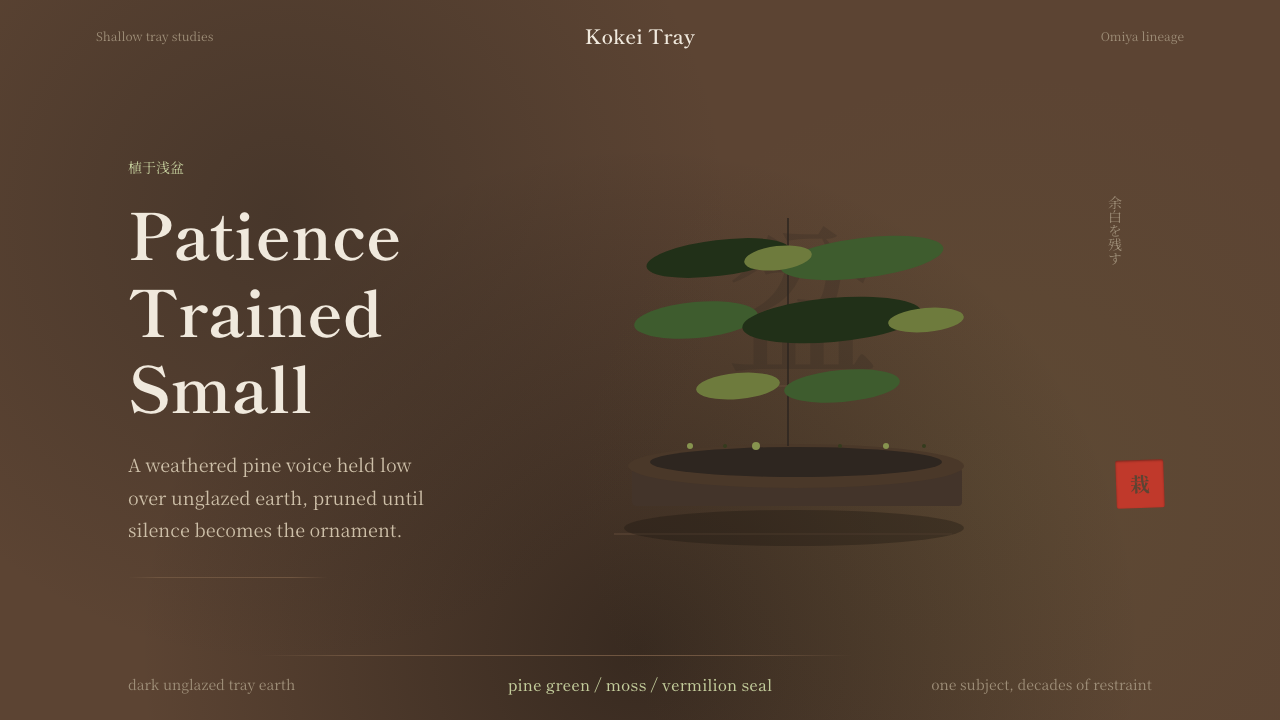 Bonsai CultivationQuiet asymmetry. Pine green rests on dark tray earth, sealed by one vermilion…
 Chadian Toubou Saharan RouteRadical emptiness holds. Sandstone ochre, indigo serif, and one vertical mark…
 Chancay Gauze TextileQuiet woven dignity. Tan silhouettes float through a dark open cotton mesh.