What is Angolan Sona?
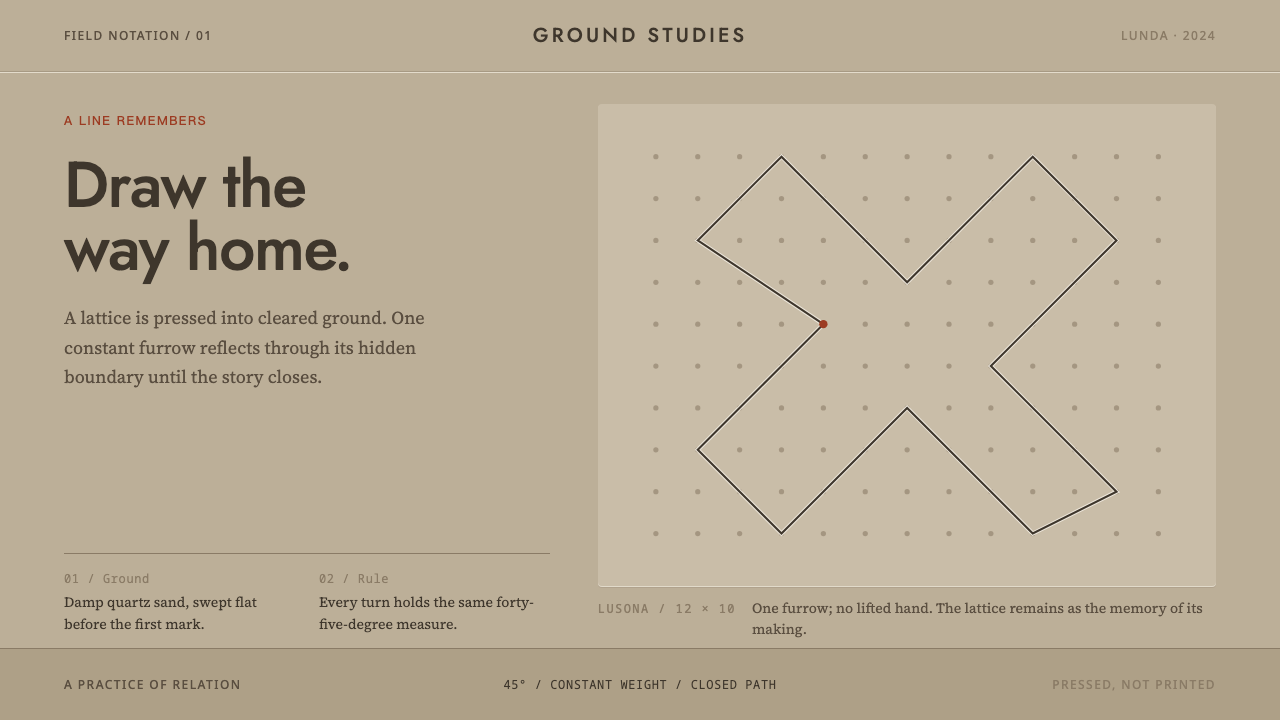
Angolan Sona closes a whole story in one unbroken stroke: a furrow at forty-five degrees that crosses a visible lattice of dots on damp sand and returns to where it began.
Angolan Sona in brief
Angolan Sona is a design style drawn from sona, the sand drawings of the Chokwe and Luchazi peoples of eastern Angola. A master clears a patch of damp, pale sand, presses a lattice of dots into it with his fingertips, and then drags a single continuous furrow through that lattice. The line always runs at forty-five degrees, bounces off walls that nobody can see, and finally closes on itself at its starting point.
The style is monolinear in the strictest sense. Stroke weight is constant, nothing is filled, there is no calligraphic swell, and the dot lattice is always laid first and always left visible. A drawing here is not decoration placed on a surface. It is the trace of one movement through a grid, and the grid is part of the picture.
Sona are drawn, not written, and each one stands for something: a proverb, a fable or a riddle. They are memory devices used in storytelling and in the teaching that accompanies initiation. A design system built from them inherits a visual rule and a conceptual one at once. A figure must close, and a form must mean something.
Where does Angolan Sona come from?
Sona belong to the Chokwe and Luchazi graphic tradition of eastern Angola, in the provinces of Lunda Norte, Lunda Sul and Moxico, and to the neighbouring regions of north-western Zambia and southern DR Congo. The source dates the practice to before 1900 and records that it is still practised. In 2024 it was placed on UNESCO's Representative List, a recognition of a living practice rather than a historic relic.
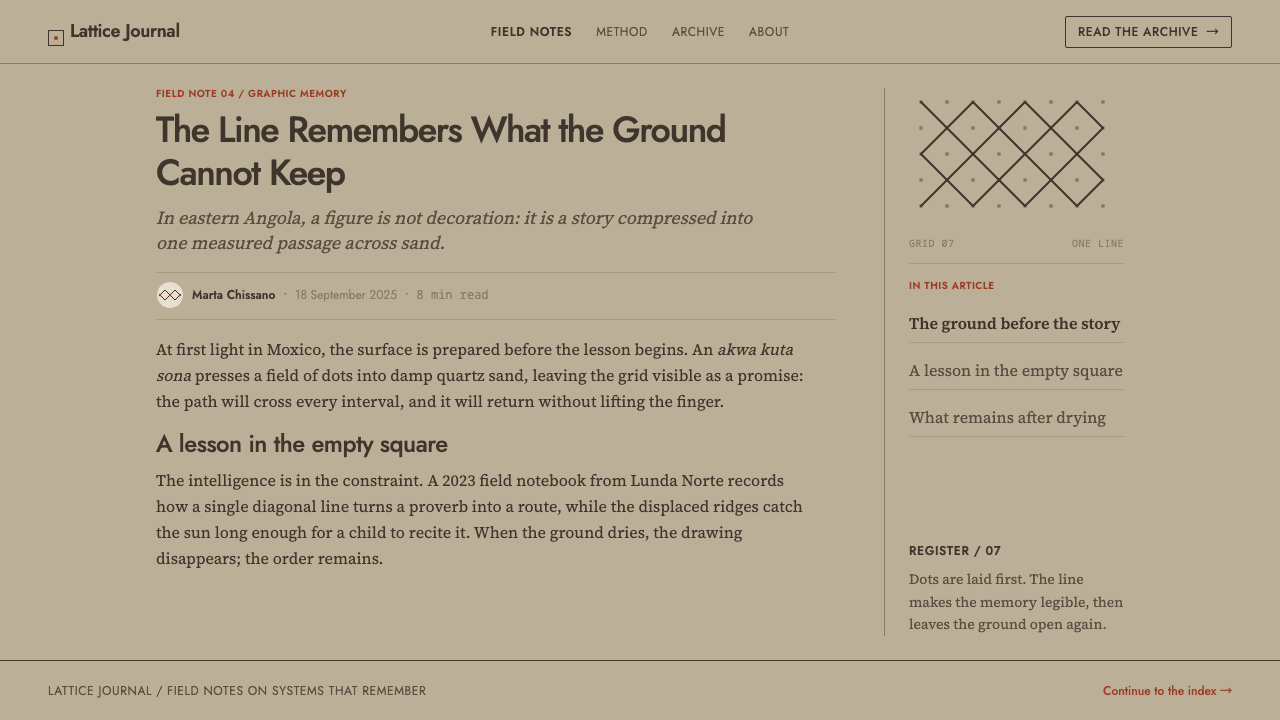
The drawing masters are known as akwa kuta sona, the initiated people who are trusted with the tradition. The work is done on a patch of damp Kalahari quartz sand, swept flat. Fingertips press the points of the lattice, and the same finger then pulls the line. That physical fact is effectively the design brief. A line made by a finger in sand has no pen to lift and no brush to swell, so it is even, unhurried and continuous.
What makes sona remarkable beyond their looks is their mathematics. How many strokes a figure needs is decided by the greatest common divisor of the grid, so the number of times the hand must start again is fixed by arithmetic before any line is drawn. This is why sona are studied under the headings of ethnomathematics, African geometry and graph theory, and why Paulus Gerdes is the key figure the source names for the mathematical study of the tradition.
In design terms the origin hands over three inherited rules: the line is monolinear, the grid is visible, and the figure closes. The system adds a material reading of light and dark. The dark tone is the shadow in the groove the fingertip pressed, and the light tone is the ridge of displaced sand that dries pale and catches light along the lower edge of each line. The page itself is the swept sand, not a container with a border.
What defines the Angolan Sona look?
Monolinear Line
Every line has the same weight from start to finish. There are no fills, no calligraphic swelling and thinning, and no outlines that change thickness. When a figure needs emphasis, it gets a longer route rather than a heavier mark.
Visible Dot Lattice
The grid of dots is laid first and stays on the page. It is the scaffold of the figure and also its evidence, since viewers can see the rules by which the construction was made. Wiping the grid away to get a cleaner image would erase the point of the style.
Forty-Five-Degree Travel
The line moves only along the diagonal, turning back when it meets an edge of the lattice that nobody can see. Angles are therefore strict, and the geometry reads as reflections rather than curves. The fixed diagonal gives layouts their characteristic criss-cross rhythm.
Closure
A sona is finished when the line returns to where it began. In layout terms a figure should be a closed loop, and an open end reads as unfinished. Closure is this style's version of a resolved composition: the story ends when the stroke does.
Sand Ground
The surface is pale sand, swept flat, never a framed container. Dark tones describe the shadow in the groove of a finger-pressed line, and light tones describe the dried ridge of displaced grain catching light along the lower edge. Depth is small, physical and directional rather than atmospheric.
One Figure, One Meaning
Each figure answers to a proverb, a fable or a riddle. In design terms every graphic should be a mnemonic for something specific: an icon of a concept, a diagram of a relationship. Sona-like patterns that say nothing would miss the function of the tradition entirely.
Colour From the Ground
The palette comes from the material: pale sand for the field, a darker earth tone for lines and the shadow of the groove, and nothing else. No accent hue is needed, because the interest lies in the path of the line. Contrast is a matter of line against ground, not of colour against colour.
Who shaped Angolan Sona?
The initiated drawing masters of the Chokwe and Luchazi, whose title can be read as those who draw sona. They are the tradition's custodians: they carry the repertoire of figures, the proverbs and fables each one encodes, and the physical knowledge of how a line is dragged through damp sand. A design system built on sona should credit them as its source.
The key figure named in the source for the mathematical study of sona, working within the field of ethnomathematics. His interest is the geometry behind the figures: how the dimensions of the lattice determine the number of strokes, and how the drawings relate to African geometry and graph theory. He is a reminder that these drawings are mathematical objects as well as stories.
The two communities whose graphic tradition the source identifies as the home of sona, living across Lunda Norte, Lunda Sul and Moxico in eastern Angola, and in neighbouring regions of Zambia and the DR Congo. Sona drawn in their sand are tied to proverbs, fables and riddles, and to the teaching of initiates, so any use of the style carries a cultural debt.
The source records that sona were added to UNESCO's Representative List in 2024. The listing places the drawings among practices that are actively kept alive, which is the context a designer should keep in mind: this is not an extinct ornament repertoire, but a tradition still passed on by living masters.
How do you use Angolan Sona today?
Angolan Sona is a style for projects that want precision, calm and a sense of narrative closure. It suits education, mathematics and data subjects, heritage and storytelling projects, knowledge tools, and brands whose message is that an answer is reached by following a path. It is less suited to heavy, high-impact marketing, where a single continuous thin line may feel too quiet.
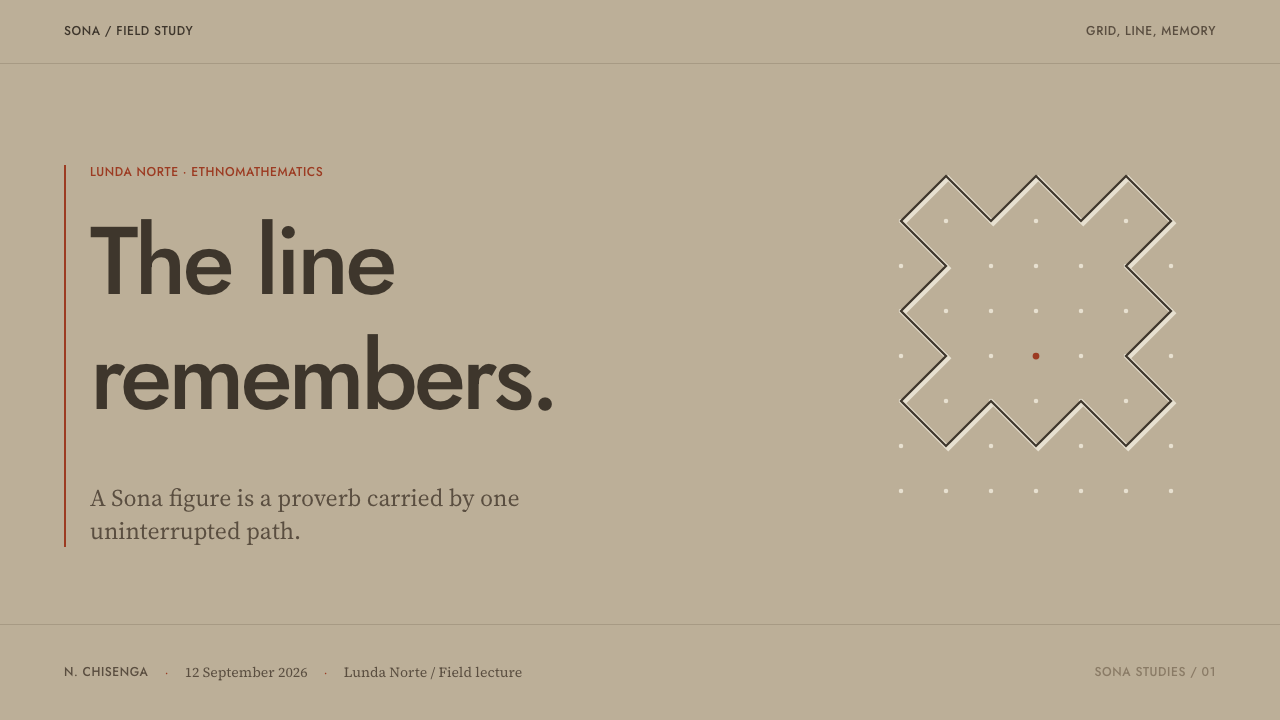
In presentation slides, a cover can show a pale sand field with a dot lattice and one closed figure drawn across it, with the title set in a plain, light sans-serif beside it. Content slides can place a small closed figure as a section marker, with the dot grid left visible behind it. Data slides suit the style when they show paths and flows: a single line that visits every node before returning home is a natural diagram for a process or a journey, much better than a stack of filled bars.
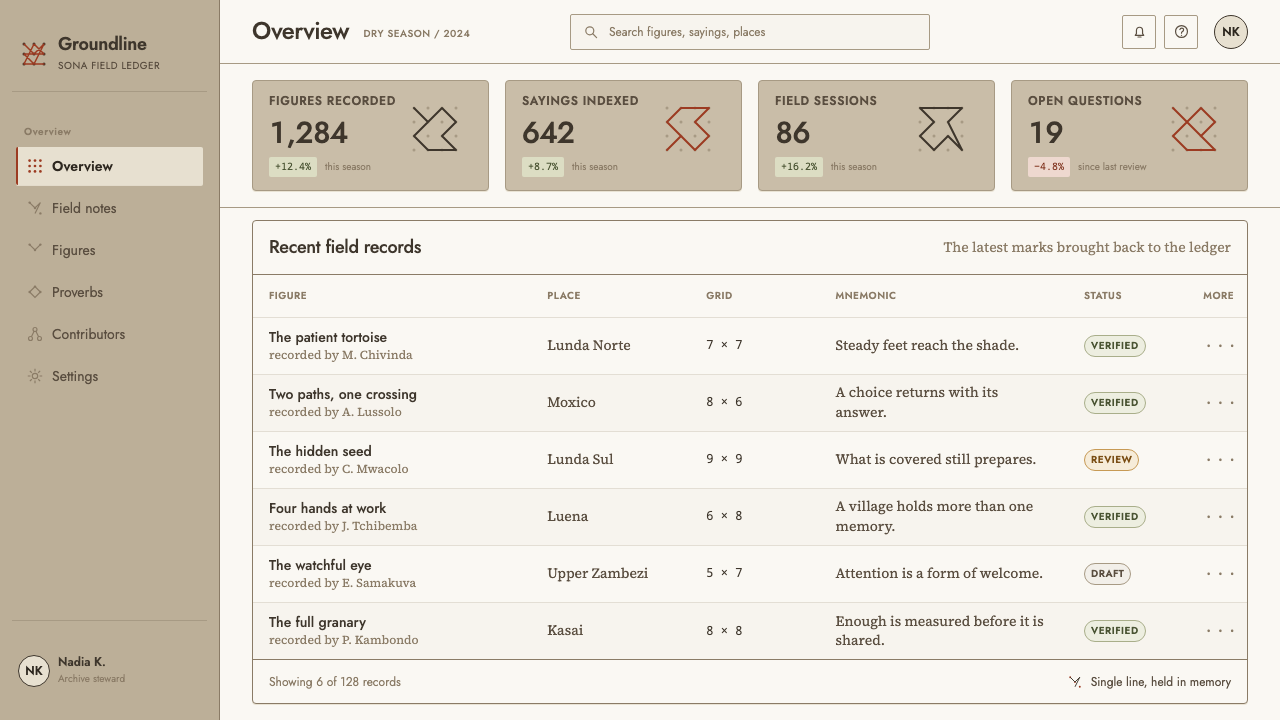
For web interfaces, the style fits onboarding flows, learning platforms, puzzle and game screens, and progress indicators. A progress path that draws itself along the diagonals of a dot grid and closes on completion is the style at its most literal. Buttons and cards should be flat, unfilled outlines on a sand ground, with the same line weight as the figures. Pricing and settings pages can use the dot lattice as a quiet background structure, not as decoration.
For editorial and marketing work, the style supports illustrated essays, book covers, museum and exhibition identities, and campaign graphics that pair a figure with a short proverb or riddle. Treat each figure as an answer to a specific line of text. Photography should be soft, natural and close to the material, sand, hands and shadows, and should never be dramatised.
A common mistake is to fill the figures with colour or vary the stroke weight to make them look more expressive. Either change removes the monolinear rule and leaves only a decorative geometric pattern. A second mistake is to hide the dot lattice, which discards the evidence of construction. A third is to scatter unrelated sona-like figures across a page as ornament, when each figure is supposed to stand for one specific thing.
Angolan Sona — FAQ
What exactly is a sona?
A sona is a drawing made in sand by the Chokwe and Luchazi peoples of eastern Angola. The drawer sweeps damp sand flat, presses a lattice of dots with the fingertips, then drags one continuous line at forty-five degrees through the lattice until it closes on itself. Each figure corresponds to a proverb, a fable or a riddle, and the drawings serve as memory devices in storytelling and in teaching initiates.
Why must the dots stay visible?
Because the lattice is part of the drawing, not scaffolding to be removed. In the tradition it is laid first and the line bounces off its invisible edges, so the visible dots tell the viewer the rules under which the figure was made. In the design system they also provide the structural rhythm of the layout. Removing them would leave a thin line without the context that makes it legible.
Does the style depend on the forty-five-degree rule?
Yes. The diagonal is what makes the line behave like a reflection bouncing off walls, and it produces the closed, interwoven figures the tradition is known for. Using other angles would turn the drawings into generic geometric ornament. In layouts you can still place straight horizontals and verticals for type and structure, but the line figures themselves should respect the diagonal travel.
Can I use the figures as pure decoration?
It is better not to. In the tradition every figure stands for a proverb, a fable or a riddle, and the practice was added to UNESCO's Representative List in 2024 as a living cultural tradition. A respectful use ties each figure to a specific idea in your content, credits the Chokwe and Luchazi tradition, and avoids scattering figures purely for exotic effect.
How does it handle emphasis without bold strokes or colour?
Through structure instead of weight. A longer, more intricate route draws more attention than a short one, and a closed figure placed alone on a clear patch of sand stands out more than any heavier line would. You can also change the scale of the lattice, or give a figure more empty ground around it. Emphasis comes from space, route and closure, in keeping with the single constant line.
Related design styles
 Bogolanfini MudclothAbsence becomes language. Warm iron-black bands hold uneven bleached-cotton s…
 Bonsai CultivationQuiet asymmetry. Pine green rests on dark tray earth, sealed by one vermilion…
 Chancay Gauze TextileQuiet woven dignity. Tan silhouettes float through a dark open cotton mesh.
 Hindu Widow White SariRestraint carries the weight. Ash-toned khadi, quiet serif type, and vertical…
 Igbo Uli Painting NigeriaSpare line carries the wall. Near-black curves breathe on dark earth with kao…
 Kalmyk Todo Bichig Clear ScriptRestraint becomes script. Soot columns on grey rag paper, touched by cinnabar…