What is Niuean Hiapo?
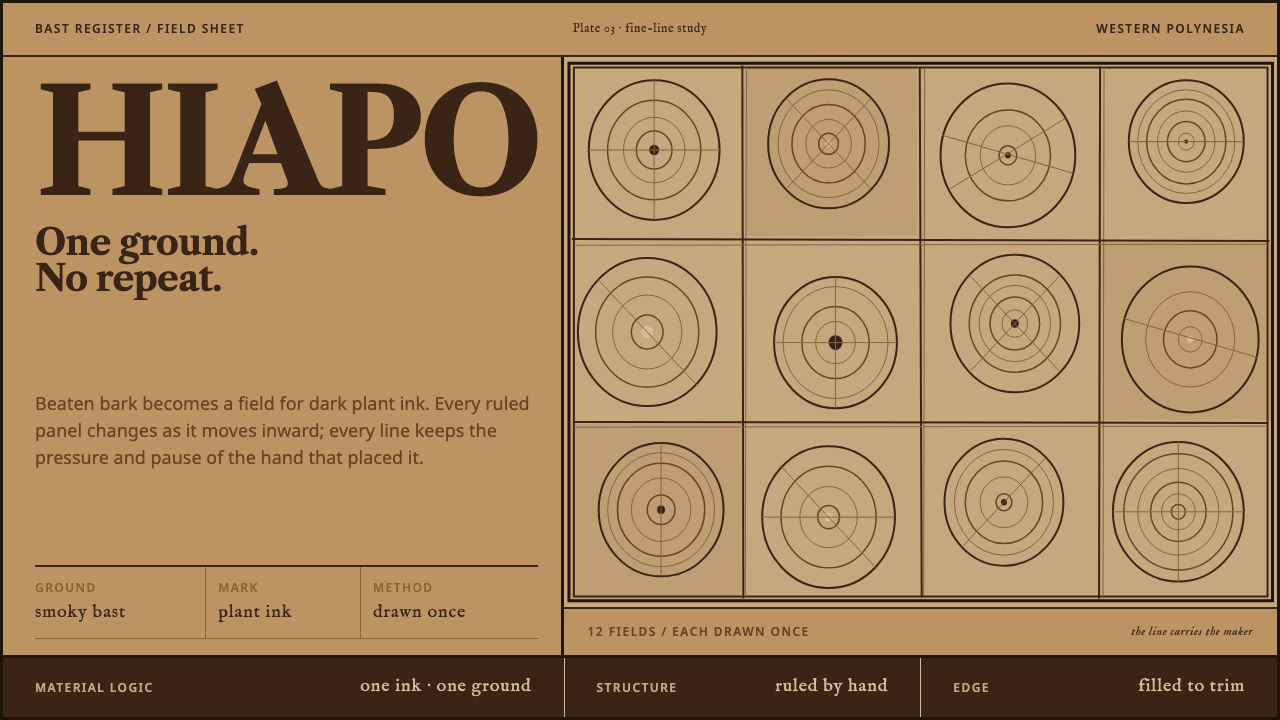
Niuean hiapo is barkcloth drawn freehand rather than stamped from a carved board, so no two sheets ever repeat — and the finest examples carry something almost no other Pacific barkcloth does: the name of the woman who made it.
Niuean Hiapo in brief
Hiapo is made from the inner bark of the paper mulberry tree, beaten thin, left to age into a smoky tan surface, then drawn on freehand with a single dark plant-based ink. That last word, freehand, is the whole distinction. Across most of Polynesia, barkcloth patterning is applied by rubbing the sheet over a carved wooden board, a method that produces exact repeats — the same motif appearing again and again down the length of the cloth. Niuean makers instead worked directly with a hand-held tool and ink, so every hiapo sheet is a one-off drawing rather than an impression of a template. The result looks, and is, categorically different from the mechanically patterned tapa produced everywhere else in the region.
That difference in method shows up immediately in the line itself. A rubbed pattern has uniform, mechanical edges because the board dictates them. A hiapo line has weight that varies — thickening where the hand pressed, thinning where it lifted, occasionally wavering — because it was drawn, not transferred. The surface underneath, that aged tan barkcloth ground, is never left bare for long: hiapo compositions push outward to the very edge of the sheet, filling the field almost completely rather than leaving open margin around a central motif. Where a rubbed tapa might repeat one motif in orderly rows, a hiapo composition reads as a single continuous field of related but non-identical marks.
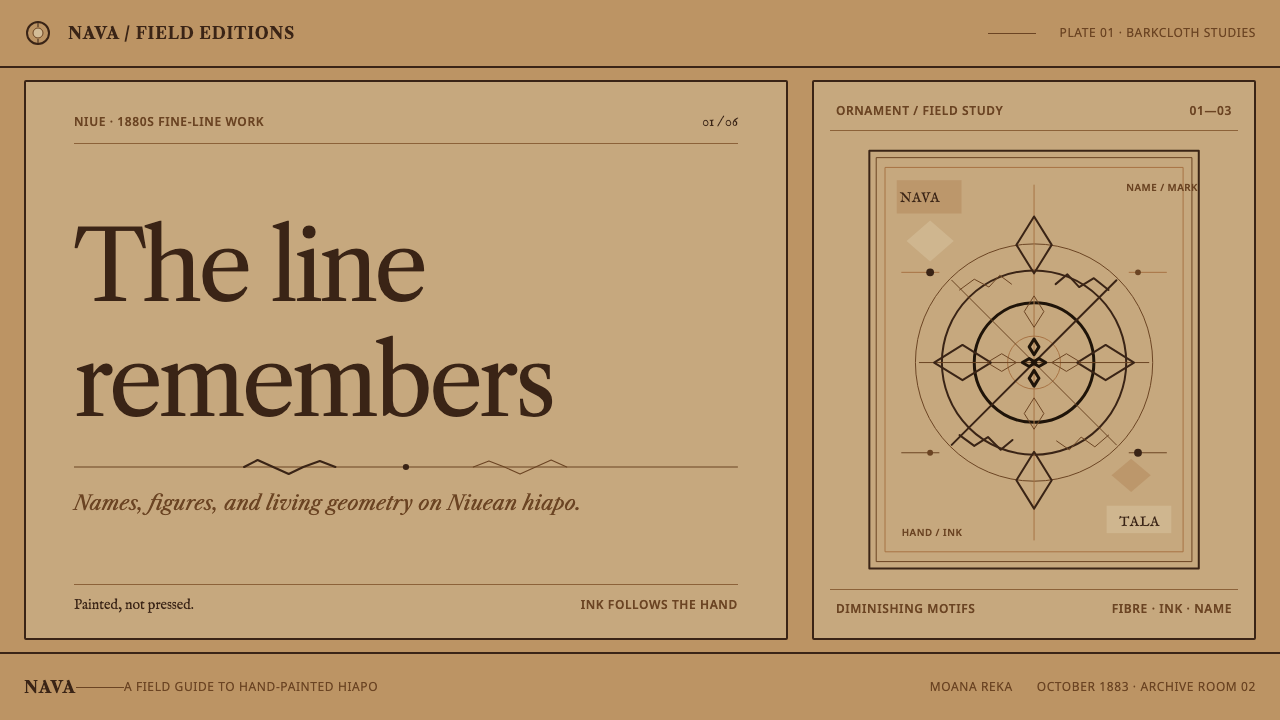
The most celebrated sheets, made in the 1880s, went further than line and density. They introduced two things that set Niuean hiapo apart within the wider tapa tradition: the human figure, rendered directly within the pattern rather than avoided in favour of purely geometric or botanical motifs, and inscribed names, worked into the design as design elements in their own right rather than added as an afterthought. A barkcloth tradition that is elsewhere anonymous and repeating becomes, in these sheets, personal and singular — closer to a signed drawing than to a bolt of patterned cloth.
Where does Niuean Hiapo come from?
The technique reached Niue in the 1830s, a period when Samoan missionary teachers were active across the island as part of a broader exchange of craft, literacy, and Christian instruction moving between Pacific islands. Barkcloth-making itself belongs to a much older Polynesian tradition shared with Samoa and Tonga, but the specific freehand approach that came to define Niuean hiapo took shape within this particular moment of island-to-island contact rather than arriving as a finished style. The technology of beating bark into cloth was already ancient across the region; what Niue did with that base material once it arrived is the origin story that matters for the visual system.
Over the following decades, Niuean makers pushed the freehand method toward increasing fineness of line and density of composition, culminating in the 1880s sheets now regarded as the tradition's high point. These are the works that carry human figures directly within the pattern and inscribe the names of their makers — a pairing of features not documented in Samoan or Tongan tapa of the same period, and one that marks these sheets as deliberate personal statements rather than purely decorative cloth. By the 1880s, the freehand line had become fine enough, and the fill dense enough, that a single sheet could carry a genuinely intricate composition from edge to edge.
That act of naming is itself significant within a craft tradition that, across most of Polynesia, does not attach individual authorship to its barkcloth. The Niuean women who made and signed these fine-line sheets were asserting a form of authorship that the rubbed-board method used elsewhere structurally could not support — a repeated pattern from a shared board has no single author to name, while a freehand drawing plainly does. Seen this way, the inscribed name is not decoration added to an existing pattern; it is evidence that the drawing method itself made a new kind of claim possible.
Hiapo production ceased by the late nineteenth century. The tradition remained dormant for a long period afterward, but it has since become the subject of a contemporary Niuean textile revival, in which present-day makers and researchers have returned to the surviving fine-line sheets — many held in overseas museum collections — as source material for reviving the freehand drawing practice on the island today. That revival treats the nineteenth-century sheets not as static museum pieces but as working reference material, in keeping with a tradition that was always defined by the hand actively drawing rather than by a fixed template.
What defines the Niuean Hiapo look?
Ground
The surface is beaten paper-mulberry inner bark, aged to a smoky tan rather than left pale or bleached. That warm, uneven aged tone is the field every composition sits on.
Ink and Line
A single dark plant-based ink is used throughout, drawn by hand rather than stamped, so line weight varies with the pressure and movement of the artist's hand rather than staying mechanically uniform.
Density and Fill
Composition pushes to the very edge of the sheet, leaving no empty margin anywhere. Density, rather than open space, carries the sense of richness.
Non-Repetition
Because each sheet is drawn rather than rubbed from a board, no two hiapo compositions are identical — a direct contrast to the exact, repeating patterning typical of stamped Polynesian barkcloth elsewhere.
Figural Content
Human figures appear directly within the pattern, drawn with the same freehand line as the surrounding geometric and botanical motifs, rather than being avoided as they typically are elsewhere in the tapa tradition.
Inscribed Names
Text — specifically the maker's name — is worked into the finest sheets as a design element in its own right, integrated with the surrounding pattern rather than set apart from it.
Who shaped Niuean Hiapo?
The individual makers behind hiapo are not recorded by personal name in the surviving accounts, but their practice of signing their own fine-line sheets in the 1880s is itself the tradition's defining act — an assertion of individual authorship unusual within Polynesian barkcloth as a whole.
Active on Niue from the 1830s as part of a wider mission-era exchange, Samoan missionary teachers were present at the moment the barkcloth technique took hold on the island, situating hiapo's origins within a period of active craft and literacy exchange across the Pacific.
Hiapo belongs to the broader Polynesian tapa tradition shared with Samoa and Tonga, and it defines itself precisely by departing from that tradition's dominant rubbed-board method in favour of freehand drawing.
A present-day revival movement has returned to the surviving nineteenth-century fine-line sheets as source material, working to bring freehand hiapo drawing back into active practice on Niue after a long period of dormancy.
How do you use Niuean Hiapo today?
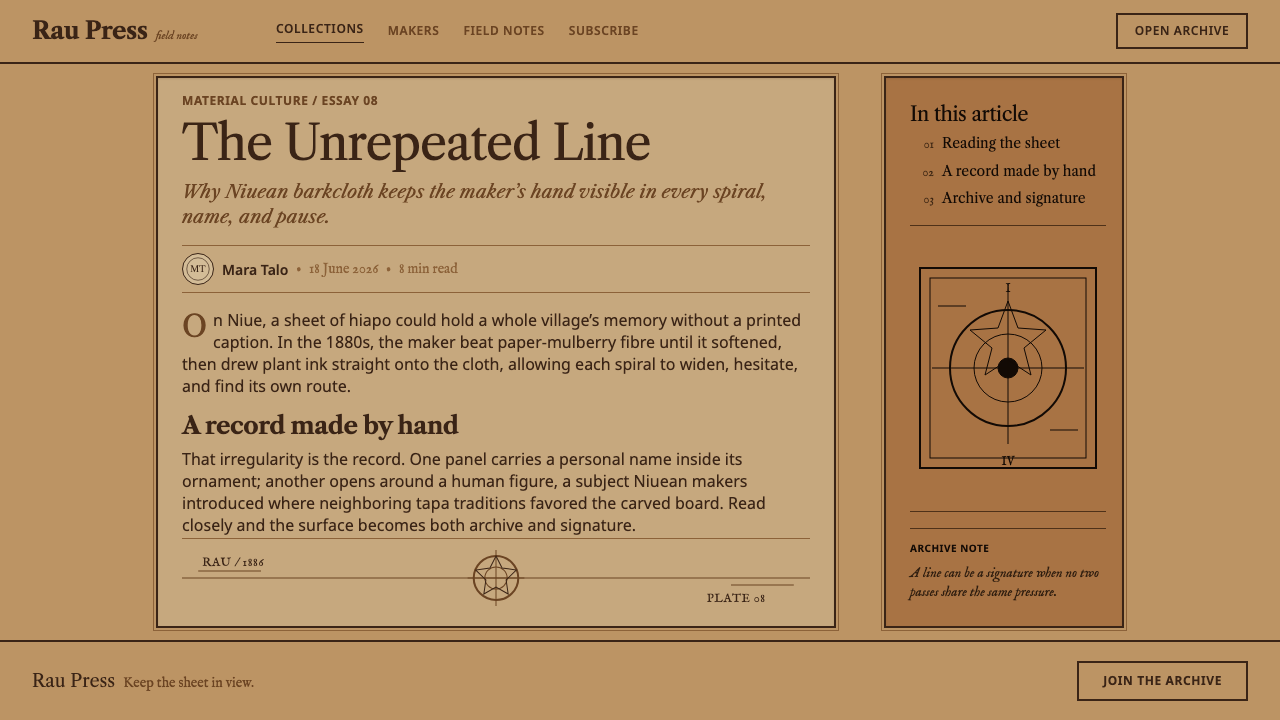
Hiapo's defining strength — a fully filled field with no empty margin — makes it a strong choice for poster-style slide covers and full-bleed editorial spreads, where a dense, hand-drawn all-over pattern can carry a page on its own with minimal added text. The aged tan ground and single dark ink line translate well into a warm, textured background that reads as crafted rather than printed, and works especially well behind a short title set in generous negative space of its own, since the pattern supplies all the visual richness the page needs.
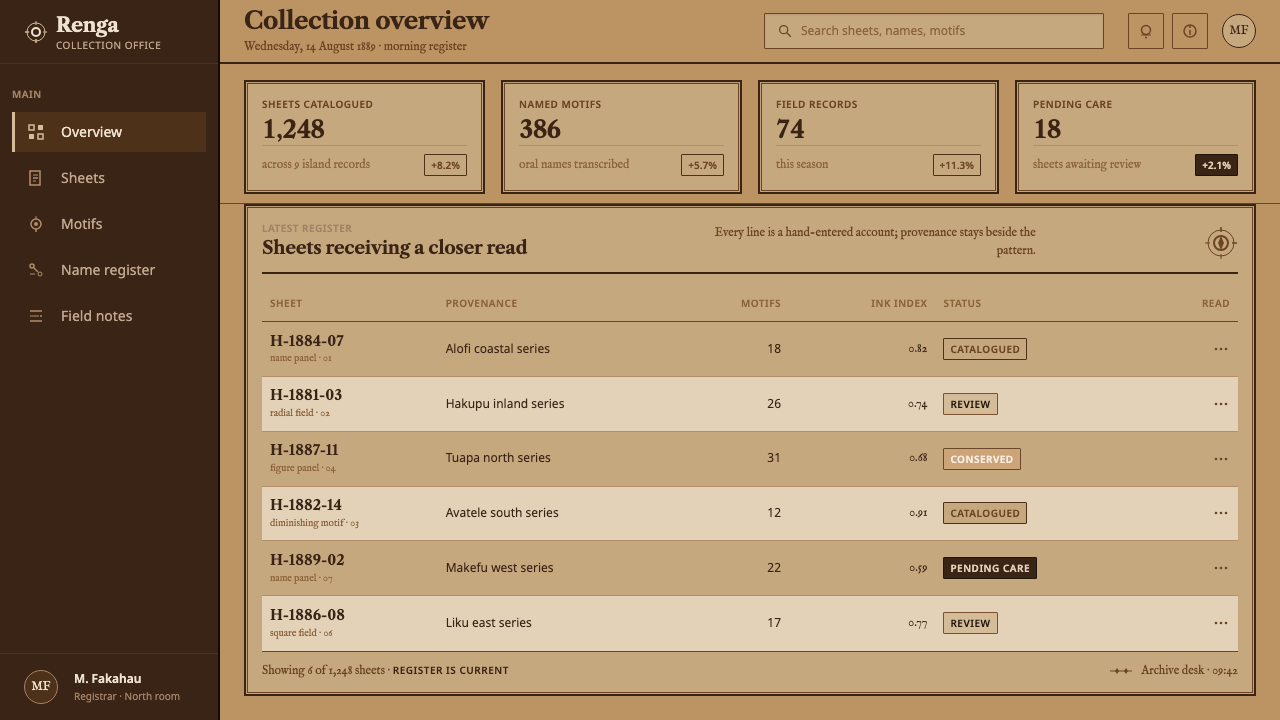
The same density that makes hiapo work as a background is exactly what makes it a poor fit for data-dense web interfaces. A dashboard depends on open space to establish hierarchy — what to look at first, what can wait — and a fully filled hiapo-style field actively works against that. If the style is used in a product interface at all, it belongs on marketing or about pages, not on screens where a user needs to scan numbers quickly; confine it to a hero banner or a section break rather than letting it spread across functional screens.
For editorial and long-form content, hiapo's line quality is well suited to section dividers, pull-quote borders, or chapter-opening illustrations drawn with the same varying line weight — thick where emphasis is needed, thin where it recedes — rather than a uniform vector stroke. Because authentic hiapo carries the name of its maker within the design, editorial applications can borrow that logic legitimately by integrating a byline or credit directly into a similarly hand-drawn typographic treatment, rather than setting it apart in a conventional caption.
In marketing contexts built around craft, heritage, or cultural specificity, hiapo's non-repeating quality is worth preserving rather than flattening: if a pattern is generated to evoke the style, it should avoid looking like a single motif copied and pasted across a surface, since exact repetition is precisely what Niuean freehand drawing was invented to avoid.
The most common mistake is treating hiapo as a generic "tribal pattern" and rendering it with uniform, mechanically repeated vector lines. That approach recreates the rubbed-board method hiapo deliberately departed from. A faithful application needs visible variation in line weight and a composition that reads as drawn once, by hand, rather than tiled.
Niuean Hiapo — FAQ
How is hiapo different from other Pacific barkcloth like Samoan siapo or Tongan ngatu?
Most Polynesian barkcloth, including Samoan and Tongan tapa, is patterned by rubbing the sheet over a carved wooden board, which produces exact, repeating motifs. Niuean hiapo is instead drawn freehand, so its line weight varies and no two sheets repeat exactly.
Why do some hiapo sheets include names?
The finest sheets, made in the 1880s, inscribe the maker's name as part of the design — an assertion of individual authorship that the anonymous, repeating rubbed-board method used elsewhere in Polynesia does not support.
Is hiapo still made today?
Production had ceased by the late nineteenth century, but the tradition is the subject of a contemporary Niuean textile revival, in which present-day makers work from surviving fine-line sheets to bring the freehand practice back into use.
Can a hiapo-style pattern be used in an interface that needs a lot of white space?
Not comfortably. Hiapo is defined by filling the entire field with no empty margin, which works against the open space a data-dense interface depends on for hierarchy. It is far better suited to marketing pages, covers, and editorial backgrounds than to functional dashboards.
What materials were traditionally used to make hiapo?
The cloth itself is beaten inner bark from the paper mulberry tree, aged to a smoky tan surface, and the pattern is applied with a single dark ink derived from plants — no carved board and no second colour are used.
Related design styles
 Kakadu Rock Shelter CharcoalDarkness carries memory. Charcoal stencils and haematite dust sit on weathere…
 Igbo Uli Painting NigeriaSpare line carries the wall. Near-black curves breathe on dark earth with kao…
 Chilean Rapa Nui Toromiro (Easter Island)Ancient weight, dusk-lit. Toromiro brown, Cinzel capitals, rib bands, obsidia…
 Fijian Masi (Tapa Cloth)Ceremony hits in black. Tan bark ground carries diamonds, zigzags and flame-b…
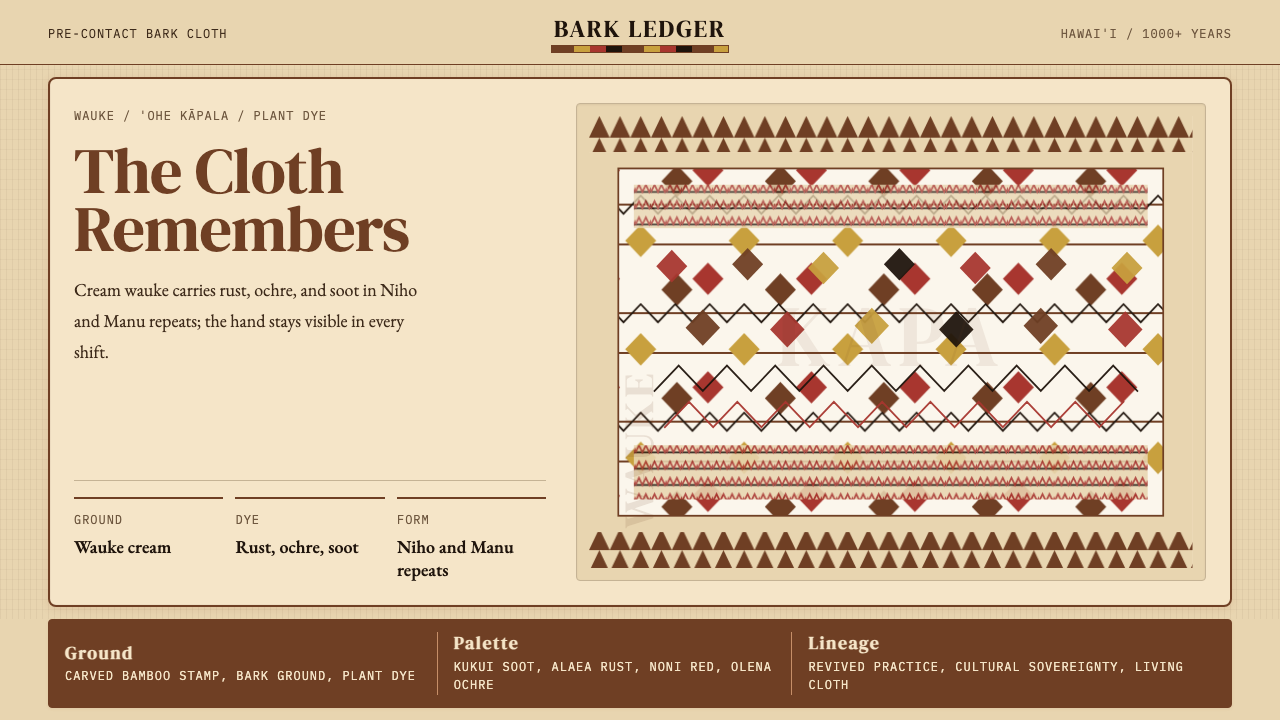 Hawaiian Kapa (Bark Cloth)Ceremonial geometry. Cream wauke, rust, ochre, and soot stamped in repeat.
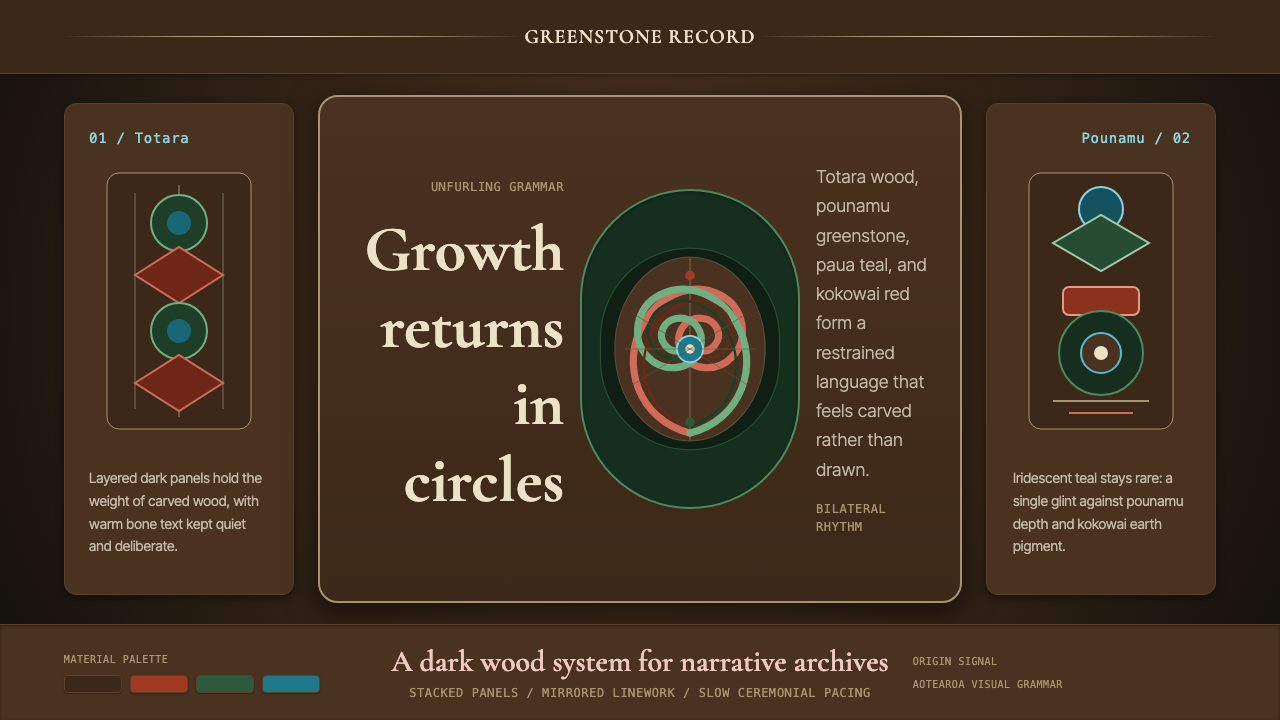 Māori Koru Spiral (Aotearoa)Carved, not drawn. Totara brown, pounamu green, and mirrored koru geometry ca…