What is Igbo Uli Painting Nigeria?
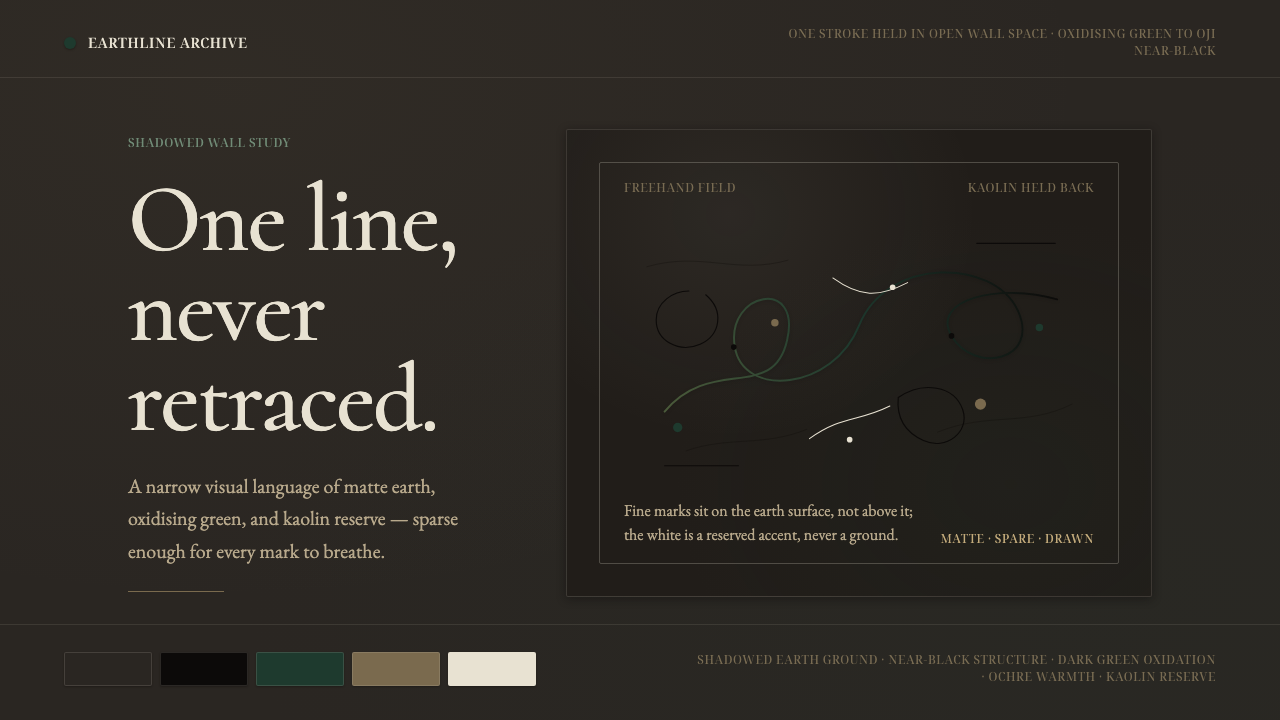
Uli lets the wall remain dark, making a single near-black curve carry the rhythm, memory, and presence of the entire surface.
Igbo Uli Painting Nigeria in brief
Uli is the Igbo women’s tradition of curvilinear line art, practiced on the body and across the mud walls of the house. Its visual power comes from restraint: the line is fine, flowing, and drawn freehand, while the dark earth surface remains visibly present around it. The design does not depend on dense filling or repeated correction. It allows a spare mark to hold the eye and lets surrounding space become part of the composition.
The material process gives the tradition its distinctive tonal character. Uli dye is pressed from the berries of the uli plant. It first appears as a wood-ash green, then oxidises with body heat into a line approaching black. That transformation is central to the digital interpretation: the page begins in shadowed earth, structure is drawn in near-black oji, and oxidising uli-green is retained as an accent rather than treated as a decorative background.
White is deliberately scarce. Ivory nzu kaolin is held in reserve for the strongest marks, never spread across the whole surface as a neutral ground. The result is an earthy, nocturnal system organized by line, curve, oxidation, and negative space. It feels handmade without becoming rustic, and minimal without becoming empty, because every omission protects the authority of the remaining stroke.

Where does Igbo Uli Painting Nigeria come from?
Uli belongs to a pre-1900 Igbo design tradition rooted in Igboland, in southeastern Nigeria, West Africa. Its makers were Igbo women who painted both bodies and mud, or banco, house walls. The tradition therefore joins ornament and surface together: the body and the wall are not treated as blank containers waiting to be covered, but as dark, material grounds that participate in the final image.
The line begins with a plant-derived dye rather than an abstract color choice. Uli berries produce a mark that arrives in wood-ash green and changes through oxidation with body heat. This gives the practice a built-in sense of time: the line is not only placed on a surface but also observed as it develops. Its near-black finish feels earned by transformation, not applied as a ready-made solid.
The wall-painting language is defined by curvilinear movement and generous reserve. Lines flow without retracing, while nzu kaolin appears as ivory-white emphasis rather than as a universal ground. The contrast between dark earth, near-black line, selective white, and restrained earth ochres creates a visual order in which absence is active. Empty surface is not unfinished space; it is the condition that lets the line breathe.
The tradition was revived in the twentieth century through the Nsukka uli school, with Uche Okeke and the Nsukka group identified as key figures in that renewal. The revival did not erase the older practice’s material identity. Instead, it carried forward its central discipline: curvilinear line, earth-bound color, selective reserve, and a surface whose darkness remains part of the work. This design system follows that same direction by translating the logic rather than copying a single historical wall.
What defines the Igbo Uli Painting Nigeria look?
Curvilinear Line
The primary vocabulary is the freehand curve. Lines should feel continuous, supple, and deliberate, with no visible retracing or mechanical hesitation. In a digital layout, curves can define dividers, borders, illustration-like marks, or pathways through information, but they should remain spare. The line is not a container for decoration; it is the structure itself.
Shadowed Earth Ground
The surface begins in dark earth rather than white. It should suggest a mud wall held in shadow: dense, warm, and materially present. The ground is not a flat black screen and not a photographic texture. Its role is to give the uli line somewhere to live while keeping the page’s atmosphere grounded in banco earth.
Reserved Kaolin
Nzu kaolin-white is an accent of scarcity. It belongs to the highest-contrast marks: a signal, a focal point, a small interruption in the dark field. Treating it as the page background would reverse the system’s hierarchy. White should arrive with purpose and remain visually precious.
Oxidising Green
Uli-green should feel transitional rather than synthetic. It recalls the dye’s wood-ash beginning before it deepens toward near-black. Use it to mark change, secondary emphasis, or a living trace within the earth palette. Its presence should imply process, not brightness for its own sake.
Generous Negative Space
Uli designs live through reserve. Large areas of untouched ground prevent the curves from becoming pattern noise and give each mark room to register. Negative space should be composed with the same care as the line: its shape, interruption, and distance determine the rhythm of the whole page.
Material Transformation
The most distinctive depth comes from change over time: a plant dye begins green and oxidises toward black with body heat. Digital expression should preserve that idea through tonal transitions, layered states, or restrained color shifts, while keeping the final image quiet. The system is about transformation made visible, not effects piled onto a surface.

Who shaped Igbo Uli Painting Nigeria?
Igbo women are the living makers at the centre of the tradition described here. Their practice moves between skin and banco wall, joining bodily adornment with the architecture of the house. The design language is therefore grounded in direct hand movement, material knowledge, and the ability to let a surface remain visible. Their work establishes the authority of the curve and the discipline of restraint that the digital system seeks to carry forward.
Uche Okeke is named among the key figures in the twentieth-century revival of Uli through the Nsukka uli school. His place in this history connects the older women’s wall-and-body painting tradition with a renewed design vocabulary. In the context of this system, that connection matters because revival is treated as continuation: the aim is to preserve the logic of line, earth, reserve, and transformation rather than reproduce a historical surface literally.
The Nsukka group represents the collective dimension of the revival. Together with the Nsukka uli school, it provides the modern historical bridge through which Uli remains legible as a design tradition rather than a loose collection of earthy motifs. Its relevance to the digital system lies in carrying forward a coherent visual discipline: curvilinear drawing, material restraint, and the active use of unpainted ground.
How do you use Igbo Uli Painting Nigeria today?
For presentation covers, let the dark earth ground occupy the full field and give the title a single decisive curve or near-black structural mark to follow. The cover should feel like a wall carrying a few intentional gestures, not like a collage of motifs. Content slides can use the same logic: keep the reading field quiet, place headings beside restrained uli-green or earth-ochre accents, and use nzu-white only where a key statement must command immediate attention.
Data slides should behave like composed surfaces rather than conventional dashboards. A curve can guide the eye through a sequence, while sparse marks distinguish categories and generous ground prevents the information from becoming dense. The palette should remain earthy and selective. A chart does not need every element highlighted; reserve the strongest contrast for the conclusion, exception, or decisive comparison.
For web interfaces, the system suits dashboards, analytical tools, and pricing pages that need a grounded, distinctive atmosphere. Use the shadowed earth surface as the page field, near-black oji for structure and primary text, uli-green for active or changing states, and earth ochres for secondary emphasis. Cards should feel embedded in the wall rather than floating above it. Pricing tiers can be separated by line, curve, or tonal distinction instead of bright badges and excessive borders.
Editorial and marketing layouts can use Uli as a language of quiet authority. A feature article may pair a broad dark field with a narrow column of text and a single sweeping line that marks the section’s movement. Campaign pages can alternate between near-black structure and earth-colored expanses, using nzu-white for the central promise or call to action. The result should feel tactile and intentional, with the surface carrying as much identity as the words.
The common mistake is to treat Uli as a generic dark organic theme: add random flourishes, cover the page in curves, or use ivory-white as a universal background. That loses the tradition’s discipline. The line must remain sparse and un-retraced; the earth ground must stay visible; uli-green should suggest oxidation rather than neon brightness; and nzu-white should remain reserved. Without those relationships, the result borrows a mood while abandoning the system.

Igbo Uli Painting Nigeria — FAQ
What is Uli painting?
Uli is the Igbo women’s tradition of freehand curvilinear line art, drawn on the body and painted across mud, or banco, house walls. Its defining qualities are flowing lines, earth-bound surfaces, generous negative space, and a plant dye that begins wood-ash green before oxidising toward near-black with body heat.
Why does this design system use a dark ground instead of a white background?
The dark ground reflects the shadowed earth of the mud-wall tradition and allows the near-black oji line to function as structure. It also protects the hierarchy of nzu kaolin-white, which is meant to be held in reserve for the strongest marks rather than spread across the entire page.
Why should Uli lines not be retraced?
The source tradition is defined by a line that is fine, flowing, freehand, and never retraced. Keeping that discipline preserves the sense of direct gesture and prevents the digital version from becoming mechanically ornamental. A line may be expressive and controlled at the same time; its authority comes from decisiveness.
Can nzu kaolin-white be used as the main page color?
It should not be the main page color in this system. Nzu is described as a reserve color: ivory-white appears where the highest contrast or clearest signal is needed. Making it the ground would remove the tension between dark earth and selective light that gives the system its identity.
How is this different from a generic earthy or handmade style?
The distinction lies in the relationships, not merely the palette. Uli depends on curvilinear structure, untouched ground, plant-derived transformation, near-black oji lines, restrained earth ochres, and scarce kaolin-white emphasis. Remove those relationships and the result may still feel natural or handmade, but it is no longer expressing the specific logic of Igbo Uli painting.
Related design styles
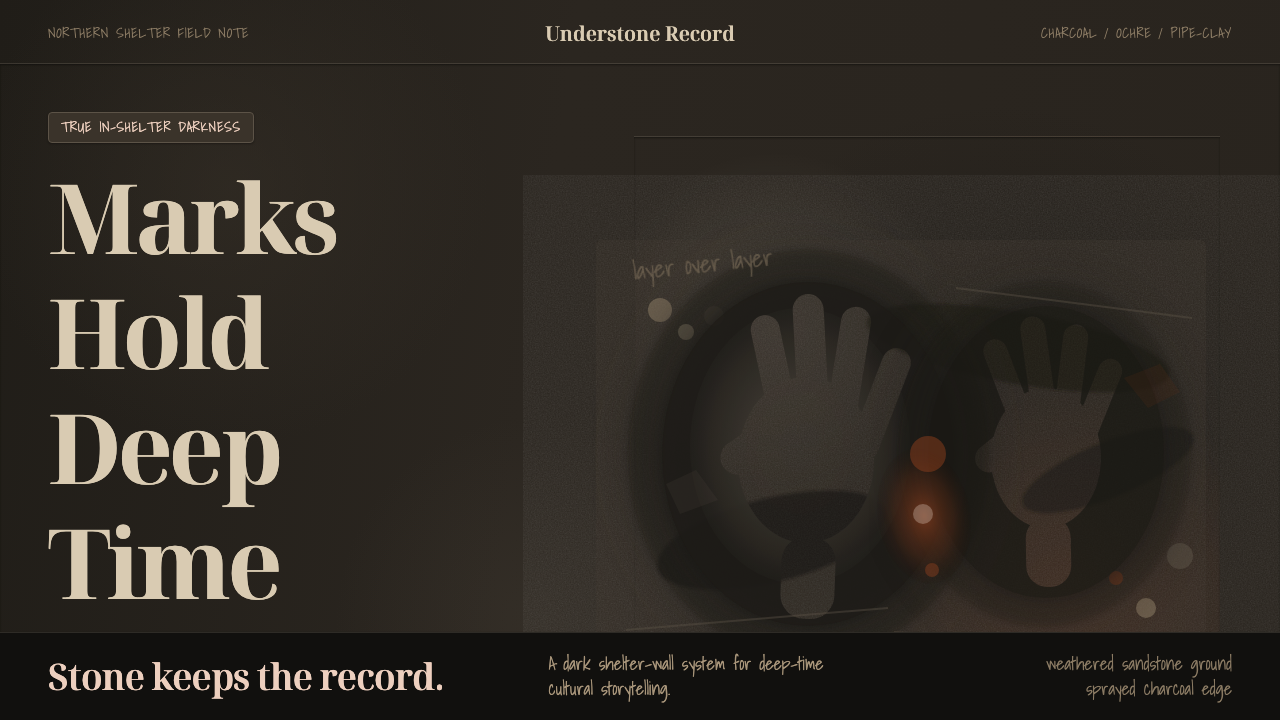 Kakadu Rock Shelter CharcoalDarkness carries memory. Charcoal stencils and haematite dust sit on weathere…
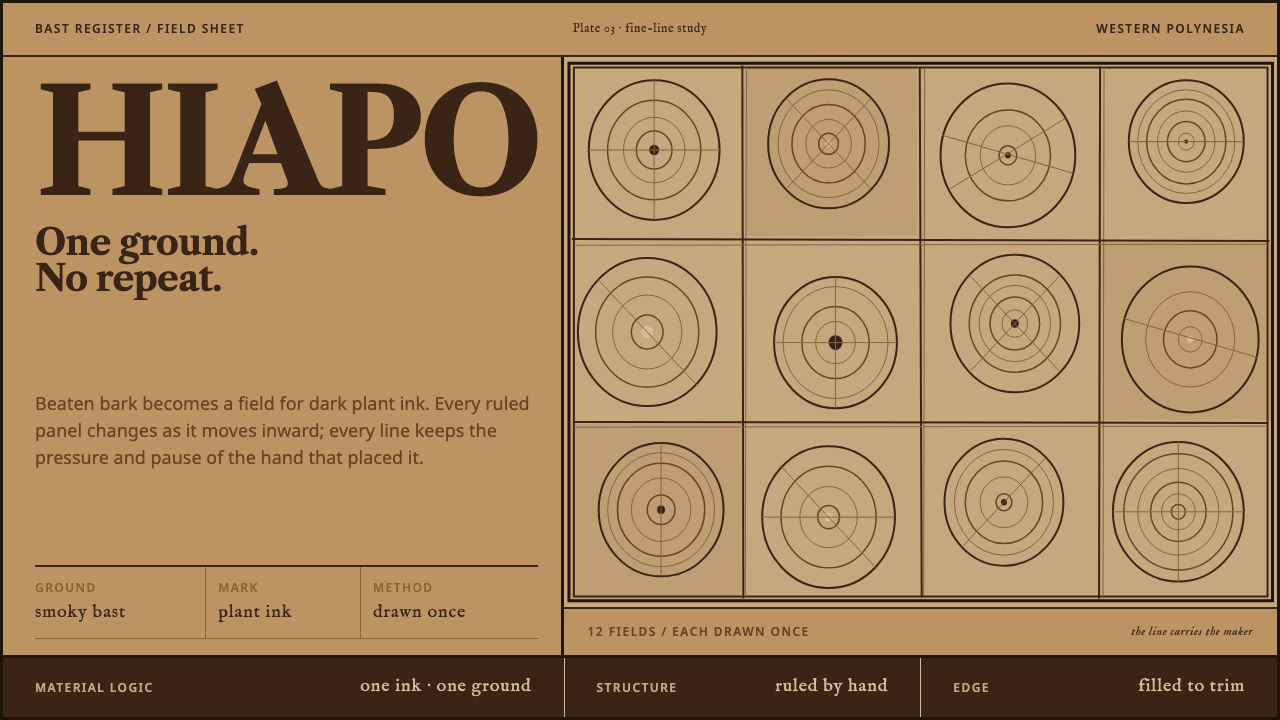 Niuean HiapoEvery line keeps its maker. Dark plant ink fills smoky barkcloth in hand-rule…
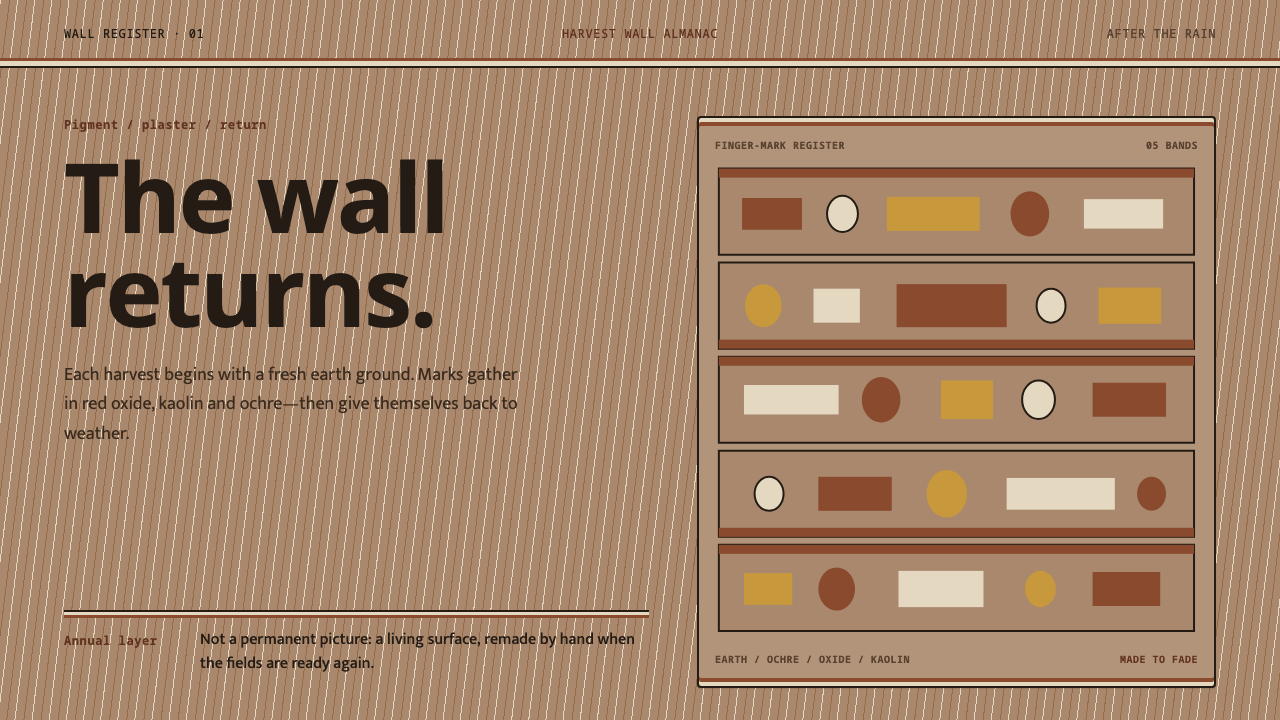 Santhal Sohrai MuralA wall that renews itself. Red oxide bands and Ol Chiki type ride warm mud pl…
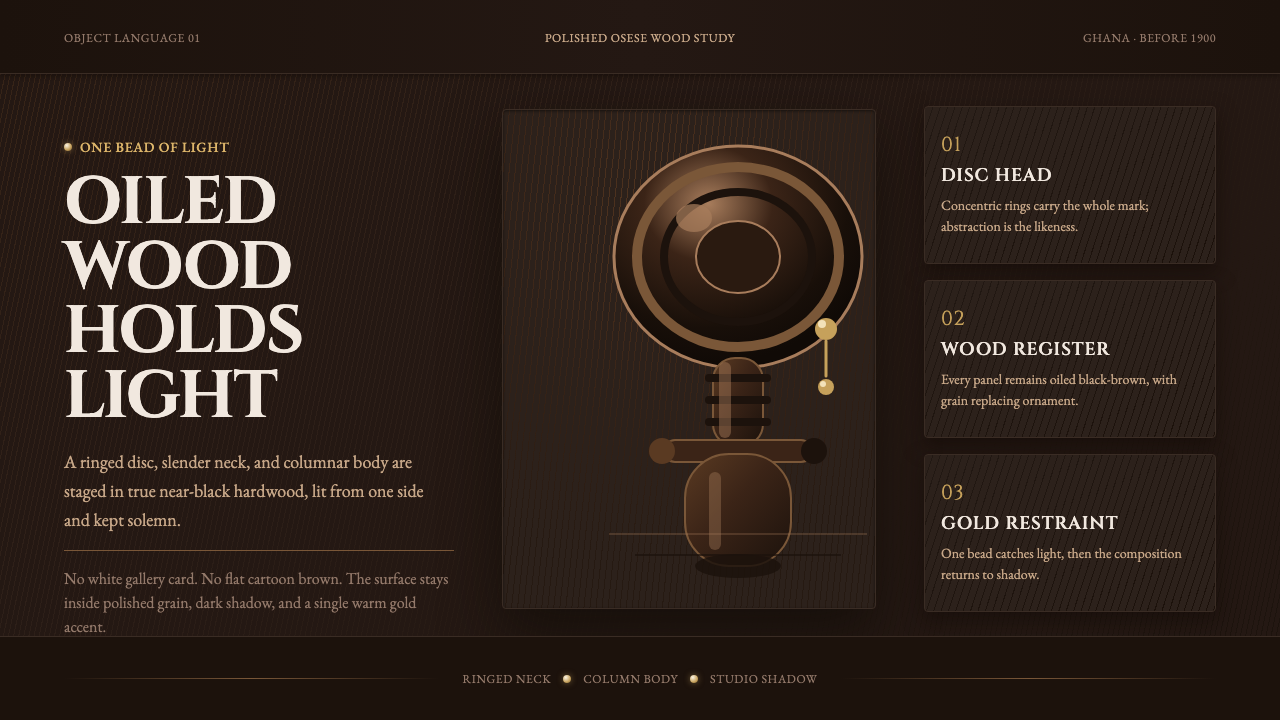 Akuaba Akan Fertility DollDarkness becomes sculpture. Near-black wood, ringed geometry, and one gold be…
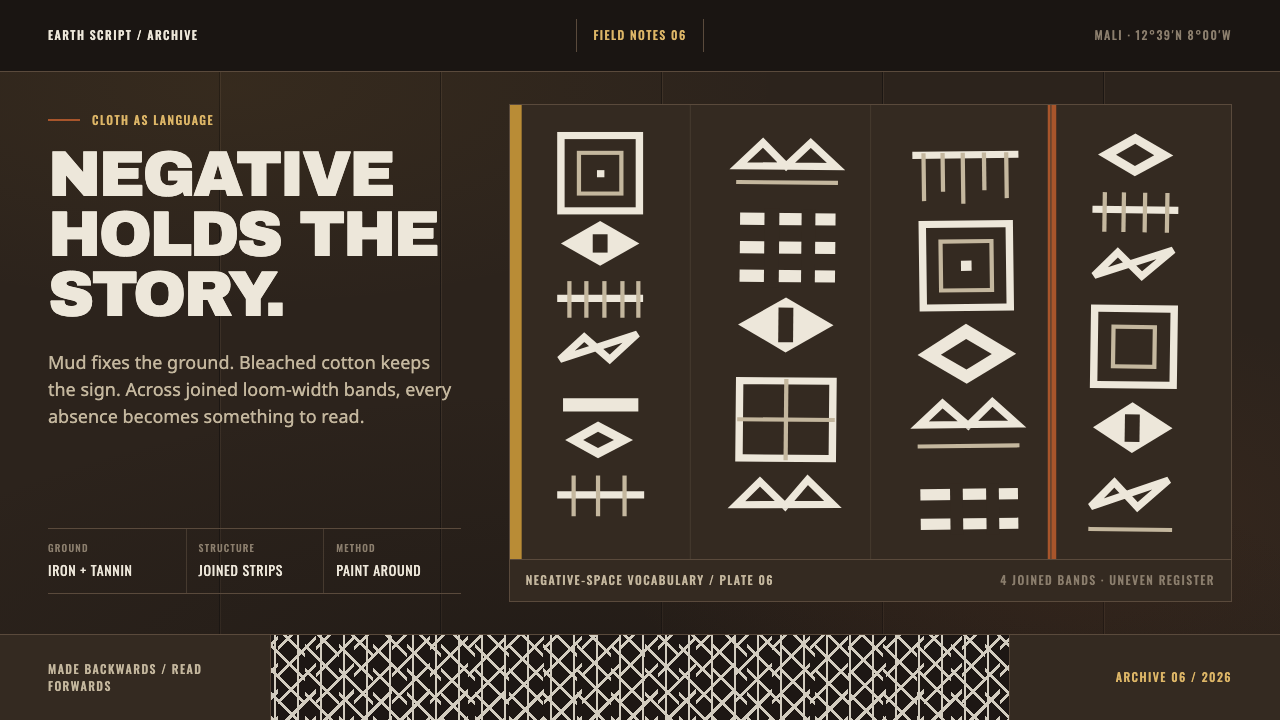 Bogolanfini MudclothAbsence becomes language. Warm iron-black bands hold uneven bleached-cotton s…
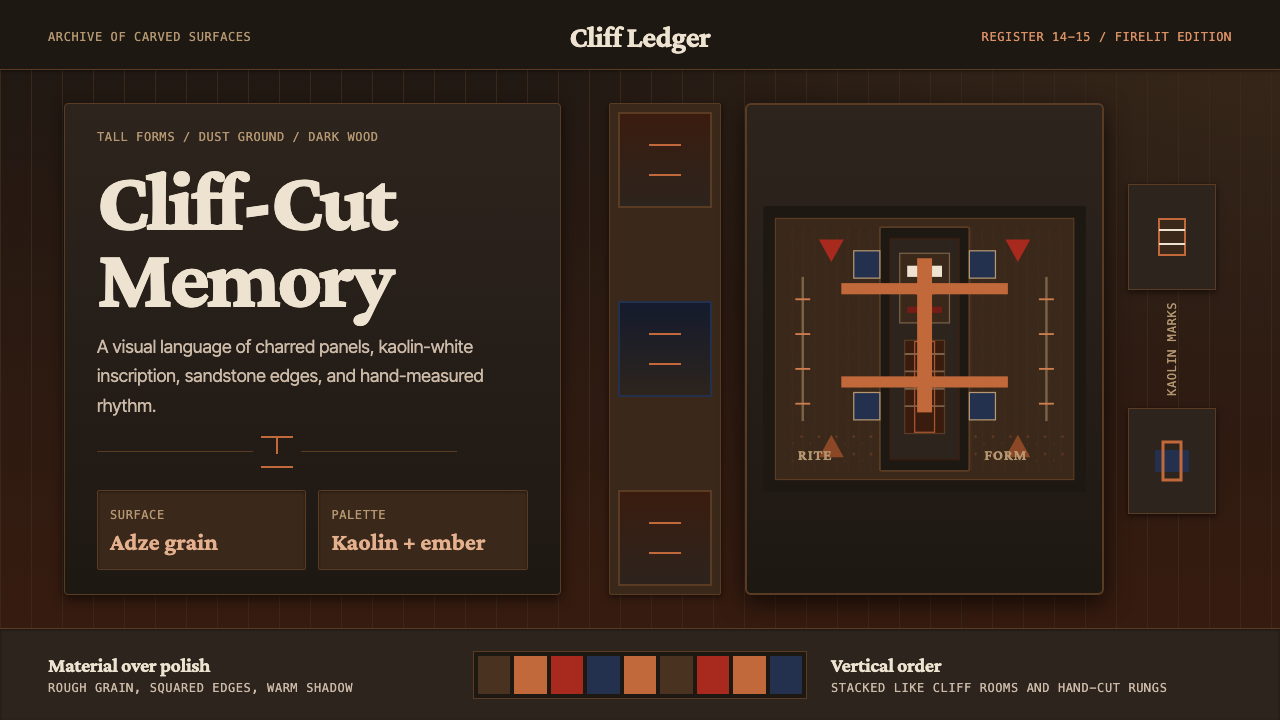 Dogon Bandiagara Cliff MaskHand-hewn gravity. Charred wood, kaolin type, and sandstone geometry stack li…