What is Santhal Sohrai Mural?
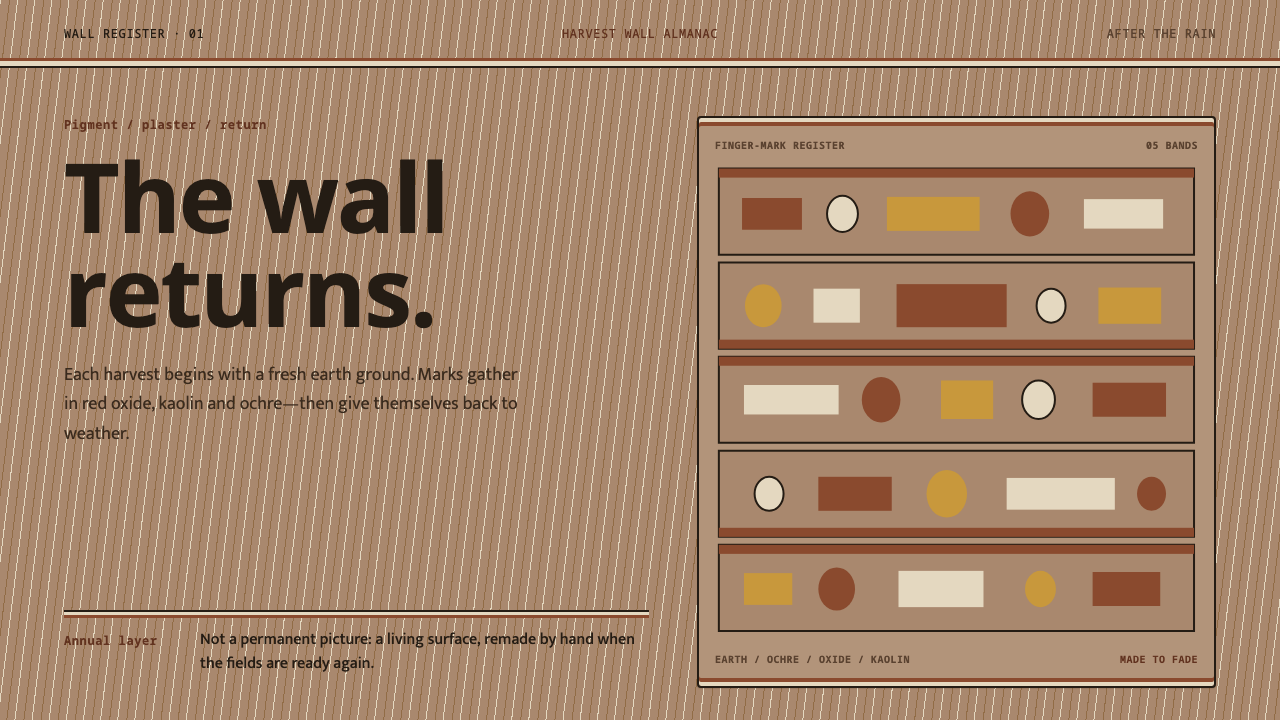
Every year the women of Jharkhand paint their house walls anew; this design language takes that renewable wall as its page and the tremor of the hand as its line.
Santhal Sohrai Mural in brief
The Santhal Sohrai Mural style is a warm, light-ground design language drawn from the wall paintings made for Sohrai, the harvest and cattle festival of the Santhal and their neighbours in Jharkhand, India. Its look is distinctive: a warm mud-plaster ground, bands of red iron-oxide pigment, black and white drawing in loose, hand-made contours, and type rendered in Ol Chiki, the script written for the Santhal language, so that letters and images sit in the same earthy world. It is a style that looks made by a person, and means to.
The festival explains the aesthetic. Before Sohrai every house is re-plastered in mud and dung, and the women then paint the walls again, drawing cattle, birds and climbing vine in locally dug pigment with their fingers, a cloth swab and a chewed twig. The mural is a seasonal layer: made once a year, weathered away once a year and never copied twice. The design system takes the plaster as the page and the pigment as the drawing, and asks every contour to carry the tremor of the hand that laid it.
In practice that means a style defined by imperfection with a purpose. Lines vary in thickness and break where the twig lifted. Pigment is thin and hair-like where the swab was dragged and thick and solid where it pooled. The figures in a band, such as a row of cattle, are each drawn separately and differ from one another. This is the most important difference between a Sohrai wall and a printed pattern, and it is the one that digital reproduction most easily destroys.
Where does Santhal Sohrai Mural come from?
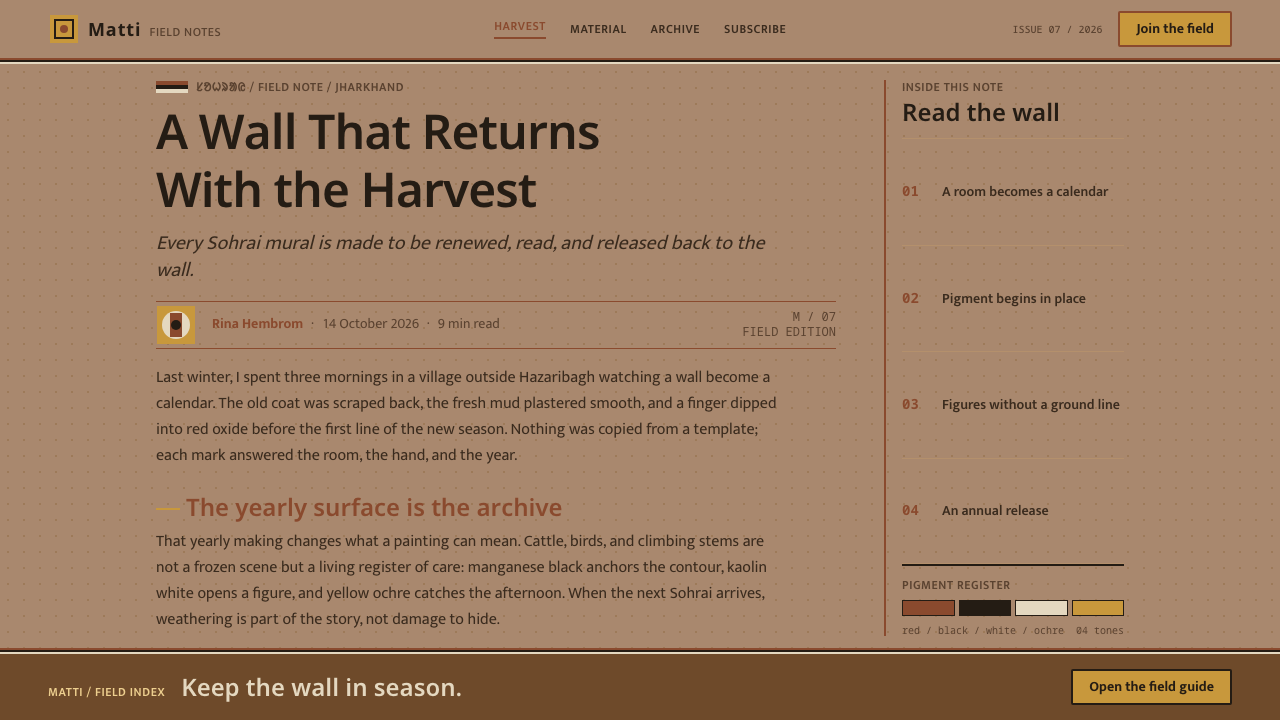
Sohrai belongs to an agricultural calendar. It marks the harvest and honors cattle, and the whole household prepares for it. The preparation is physical: each house is re-plastered in mud and dung, which gives the exterior wall a fresh, warm, slightly rough surface. Only then is it painted. The source tradition places this practice among the Santhal and their neighbours across the Jharkhand plateau, with the Hazaribagh district named as its home ground. The painting is therefore inseparable from the act of renewing a home, and the wall's cycle of replastering and repainting is the cycle of the year.
The materials are local and few. The pigments are dug from the ground nearby: a manganese black, a kaolin white, a red iron oxide and a yellow ochre. The tools are as simple as the colors: fingers, a cloth swab and a chewed twig, which serves as a brush. These limits explain the style's character. Four earth colors produce a palette that is immediately coherent, and tools of this kind produce lines that cannot be mechanically even. The painted subjects, cattle, birds and climbing vine, come straight from the purpose of the festival and the world around the house.
The deeper roots are older than any single wall. The source record traces the motif vocabulary of the paintings to the Hazaribagh rock shelters, linking a seasonal household art to a much longer history of image-making in the same landscape. Its time frame is given as before 1900 and continuous, meaning the practice has never stopped. In 2020 Sohrai Khovar painting was granted a Geographical Indication, a formal recognition that ties the tradition to its place of origin. The source material catalogues the tradition under three headings: Sohrai and Khovar mural painting, Indian tribal wall art, and the 2020 Geographical Indication itself.
To translate this into design means keeping what the wall does, not only what it shows. The system keeps the warm earth ground, the short palette of earth pigments with red oxide bands as the main structural device, the loose and breaking contour, the variable density of pigment and the insistence on variation between figures. It does not try to reproduce any specific motif sheet. An honest use of the style asks for the same renewal the wall receives: draw new things each time, acknowledge the source, and avoid cloning a single stamp across a page.
What defines the Santhal Sohrai Mural look?
Mud Plaster Ground
The page is a freshly plastered mud wall: warm, earthy, matte and slightly uneven, as if the surface had been smoothed by hand a few days earlier. It is a light ground with a clear warm cast, never a clinical white. Subtle variation in tone and a hint of surface irregularity are expected, and because the ground renews itself every year, it should look fresh rather than aged.
Four Earth Pigments
The palette is limited to colors that can be dug from the ground nearby: a deep manganese black, a soft kaolin white, a rich red iron oxide and a warm yellow ochre. All four are earthy and slightly chalky. There are no cool blues, no neon and no gradients. The restricted set is the reason the whole composition hangs together, and it should be kept restricted.
Red Oxide Bands
Bands of red oxide organize the wall. Like friezes, they run horizontally and give the composition its structure, framing rows of cattle or vine without the use of boxes or rules. In a layout, a red band can act as a header, a divider or a base line. Because it is hand-laid, its edges are slightly uneven and its density varies along its length.
Trembling Contour
Outlines are drawn by hand with a twig, so they vary in thickness and sometimes break. The tremor is not an error; it is the signature of the maker. A digital version keeps this by avoiding perfect strokes, using variable weight and allowing gaps. Vector-precise, uniformly weighted outlines immediately turn the style into a generic ethnic pattern.
Swab and Pool
Where the cloth swab was dragged, pigment is thin and hair-like, and the plaster shows through. Where it pooled, color is thick and solid. This variation of density is the style's equivalent of shading, and it replaces gradients and shadows entirely. Texture is made by the pigment itself, never added as a filter.
Every Figure Drawn Once
In a band of cattle, each animal is drawn separately and none is identical to its neighbor. This is the clearest separation between Sohrai and printed pattern. For designers it means no copy-and-paste repetition, no tiled motifs and no mirrored symmetry produced by duplication. If a motif repeats, it should repeat the way a person repeats a gesture: recognizably, but never exactly.
Ol Chiki Type on the Wall
Lettering belongs to the same hand-made world. The system pairs the mural with Ol Chiki, the script written for the Santhal language, so that type sits on the plaster as another layer of pigment. Text should feel painted or printed on rough ground, with moderate contrast and none of the glossy sharpness of interface type, while staying legible enough to read at ordinary size.
Who shaped Santhal Sohrai Mural?
Women are the painters of Sohrai. Each year, after the walls are re-plastered, they paint cattle, birds and climbing vine, working with fingers, a cloth swab and a chewed twig. They are the authors of the tradition, the source of its variation and the reason the style insists that no two figures be identical. A designer working in the style borrows their method of working: draw by hand, once, in the moment.
Bulu Imam is the name the reference record attaches to the documentation and public championing of Hazaribagh's painted traditions, including the link between the house walls and the region's rock shelters. His place in the record is a reminder that this was a living practice that needed attention in order to be recognized, and that the 2020 Geographical Indication is part of that longer story of recognition.
The rock shelters of the Hazaribagh district are where the source record traces the motif vocabulary of the paintings. They matter as a reminder that the style's visual language is rooted in a landscape and a long record of image-making, which is why the system treats cattle, birds and vine as an inherited vocabulary rather than as decoration.
How do you use Santhal Sohrai Mural today?
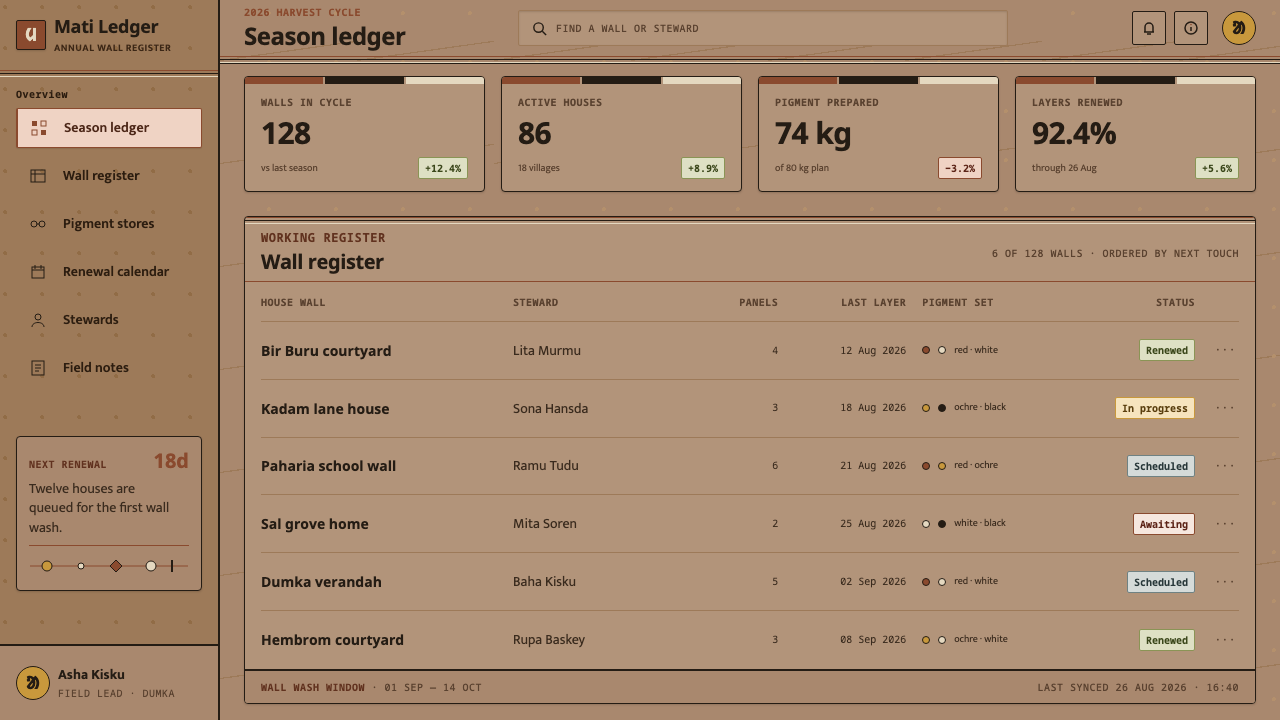
The Santhal Sohrai Mural style is warm and human in scale. It works best where the message is about craft, land, food, community and renewal, and where the design wants to feel handmade without drifting into rustic kitsch. It is less suited to products whose personality is cold precision, such as trading terminals or security dashboards, where a trembling hand would read as unreliability.
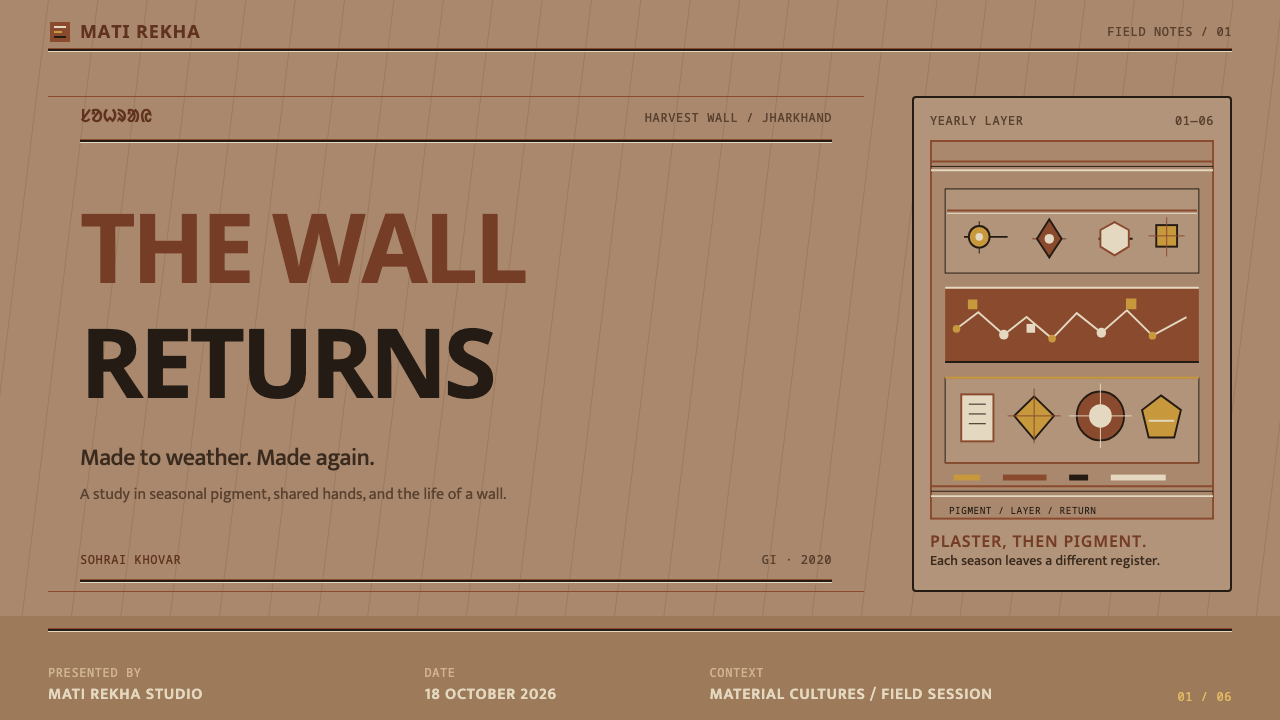
For presentation slides, the cover is strongest as a plaster-colored field with a red oxide band running across the lower third and a single hand-drawn animal or vine in black and white above it. Content slides can use a band as a header and keep text in a hand-weight face with generous spacing. Data slides should avoid precision graphics; if accuracy matters, keep the chart clean and put the style in the surrounding frame, with labels written directly beside the figures.
For web interfaces, the style suits community platforms, food and agriculture products, craft marketplaces, nonprofit and cultural sites, and seasonal campaign pages. Use the warm plaster as the page background, red oxide bands as section headers, and hand-drawn illustrations as dividers instead of lines. Buttons can be flat blocks of pigment with slightly irregular edges; avoid glossy states and drop shadows. Keep interactive controls obvious, since decorative irregularity should never reduce clarity.
For editorial and marketing work, the style gives stories about harvest, farming, craft traditions and place a natural visual home. A long-form article can alternate text sections with painted bands, and illustrations can be made new for every piece in keeping with the principle that a mural is never copied twice. Campaign pages can renew their illustration each season, mirroring the annual cycle of the wall. Photography is best cropped warm and left unfiltered, so that it does not fight the hand-made ground.
The most common mistake is making it too clean: perfect circles, even strokes and cloned motifs reduce the style to wallpaper. The second is treating the motifs as generic decoration, dropping cattle or vine onto products where they have no meaning, which empties the tradition of its purpose. The third is adding colors beyond the four earth pigments, especially cool or neon ones, which break the coherence of the palette. And since the tradition carries a formal Geographical Indication, it is better to credit it clearly than to present it as an anonymous folk pattern.
Santhal Sohrai Mural — FAQ
What is Sohrai?
Sohrai is the harvest and cattle festival of the Santhal and their neighbours in Jharkhand, India. Before it, houses are re-plastered in mud and dung and the walls are painted again with cattle, birds and climbing vine. The paintings are made once a year and weather away over the following months, so each festival gets a new wall.
Why should lines be irregular in this style?
Because the original lines are made by hand with fingers, a cloth swab and a chewed twig, so they vary in thickness and break in places. The irregularity is the evidence that a person made the image, and the style is built around that evidence. Perfectly even strokes turn it into a generic motif pattern, which is the opposite of what the wall is.
What colors does the style use?
Four earth pigments dug locally: a manganese black, a kaolin white, a red iron oxide and a yellow ochre, set on a warm mud-plaster ground. Red oxide is the main structural color, used for bands. The palette is deliberately short, and adding cool or neon colors breaks its coherence.
Can I use this style on a data-heavy product?
With care. The style is built on tremor and variation, which is the opposite of the precision that data interfaces require. A workable approach is to keep tables, charts and forms clean and legible, and apply the style to the frame around them: the ground, bands, headers, illustrations and empty states. Never let hand-drawn irregularity reduce the readability of numbers.
Is it appropriate to borrow this tradition for commercial design?
The 2020 Geographical Indication ties Sohrai Khovar painting to its place of origin, so it is good practice to credit the source and not to present your work as authentic Sohrai. Using the underlying logic, which is a warm ground, restricted earth pigments, bands and hand variation, is different from copying specific motifs. For specific legal questions, consult a professional.
Related design styles
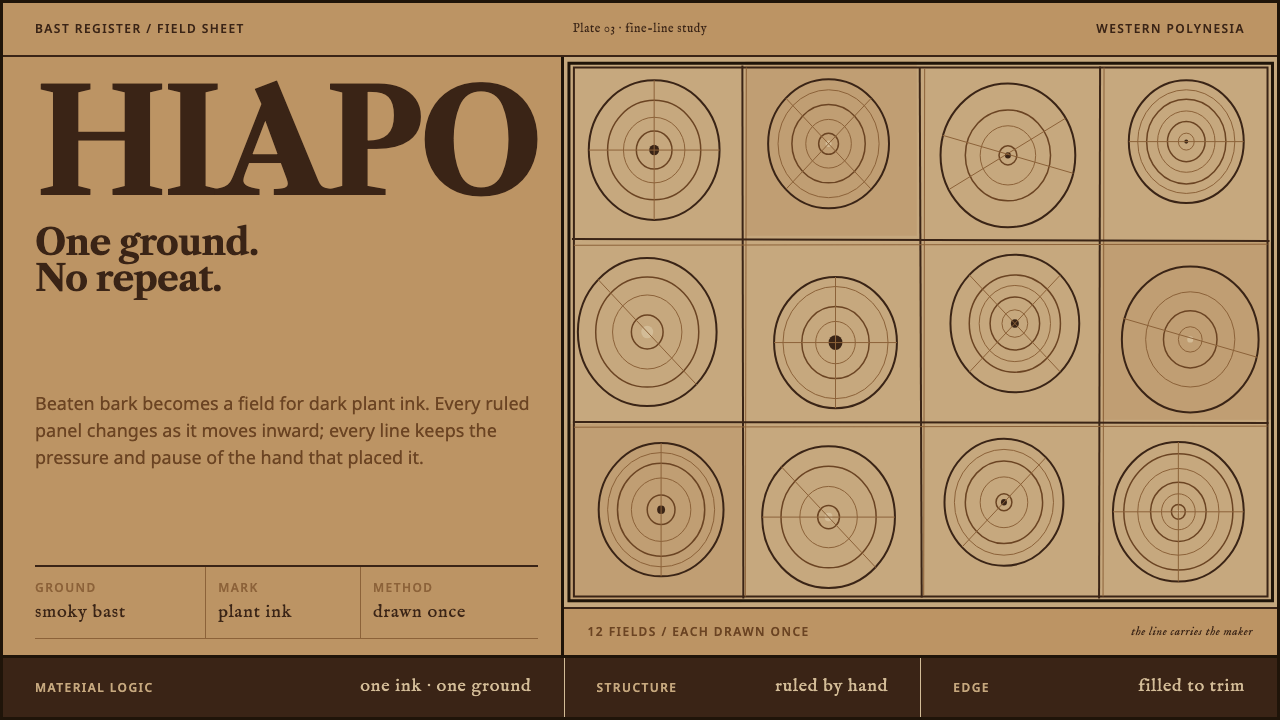 Niuean HiapoEvery line keeps its maker. Dark plant ink fills smoky barkcloth in hand-rule…
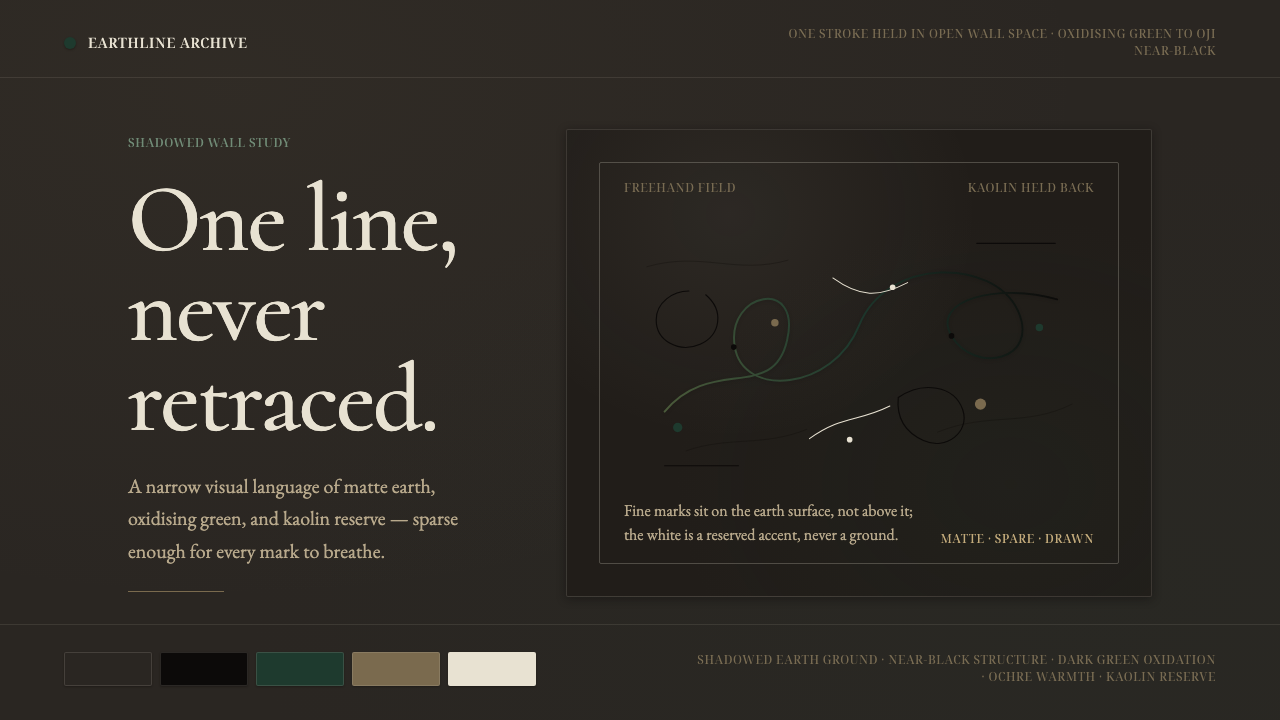 Igbo Uli Painting NigeriaSpare line carries the wall. Near-black curves breathe on dark earth with kao…
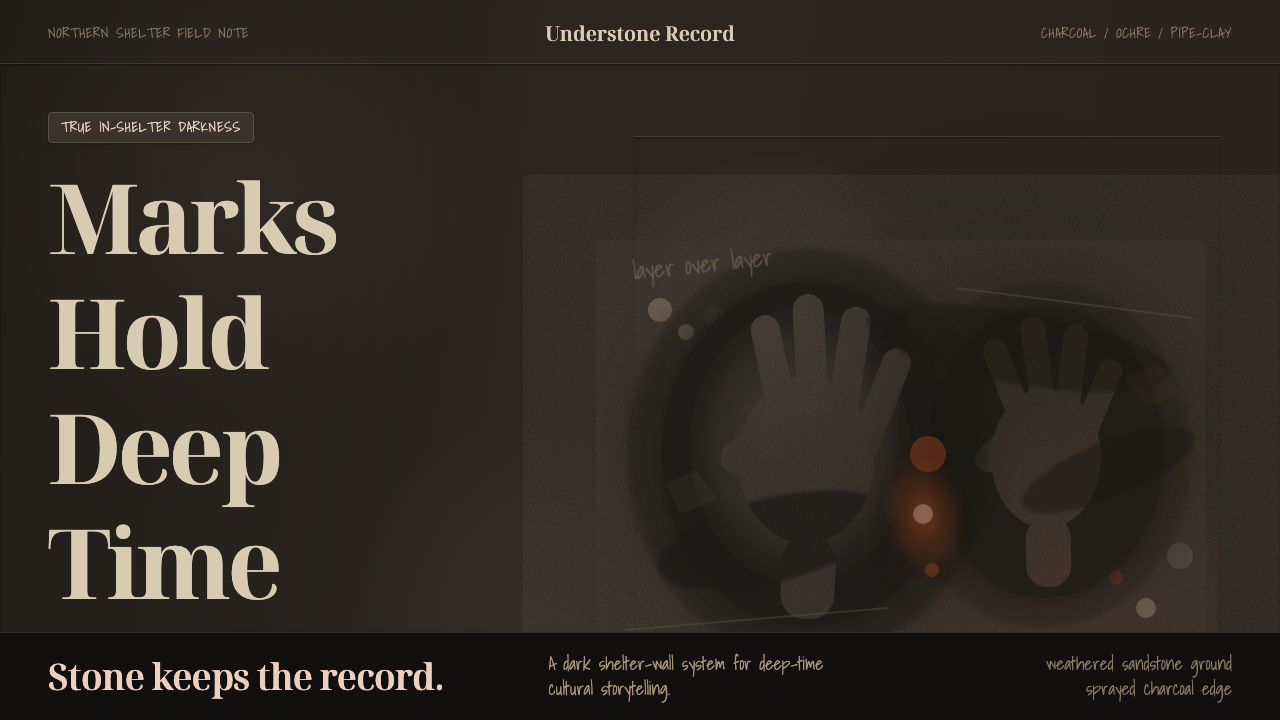 Kakadu Rock Shelter CharcoalDarkness carries memory. Charcoal stencils and haematite dust sit on weathere…
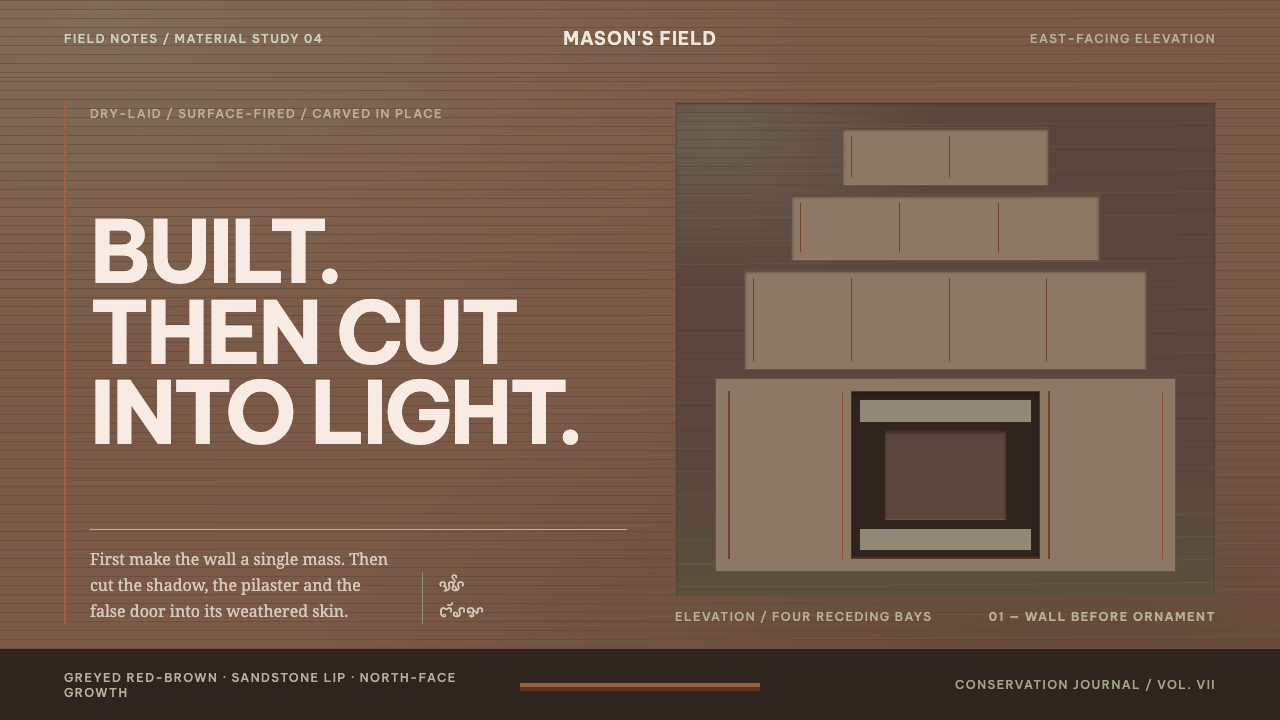 Cham My Son TowersWall before ornament. Greyed brick bays recede around cut shadows and sandsto…
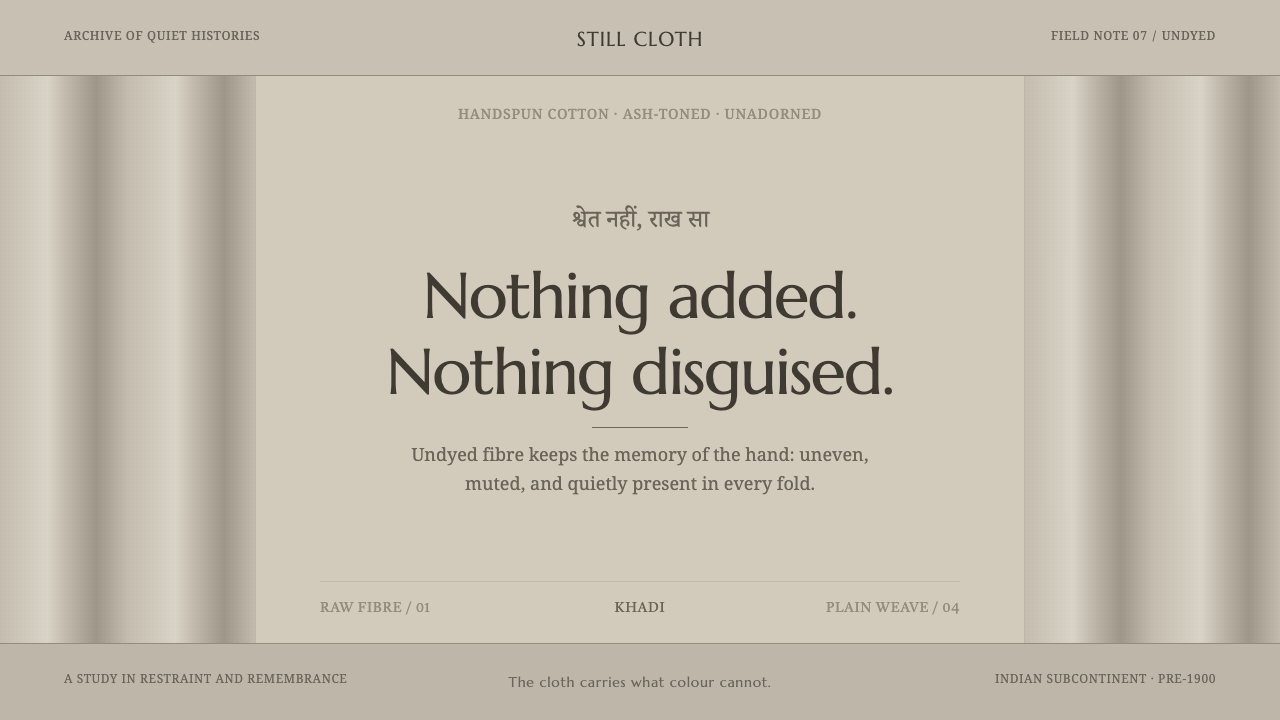 Hindu Widow White SariRestraint carries the weight. Ash-toned khadi, quiet serif type, and vertical…
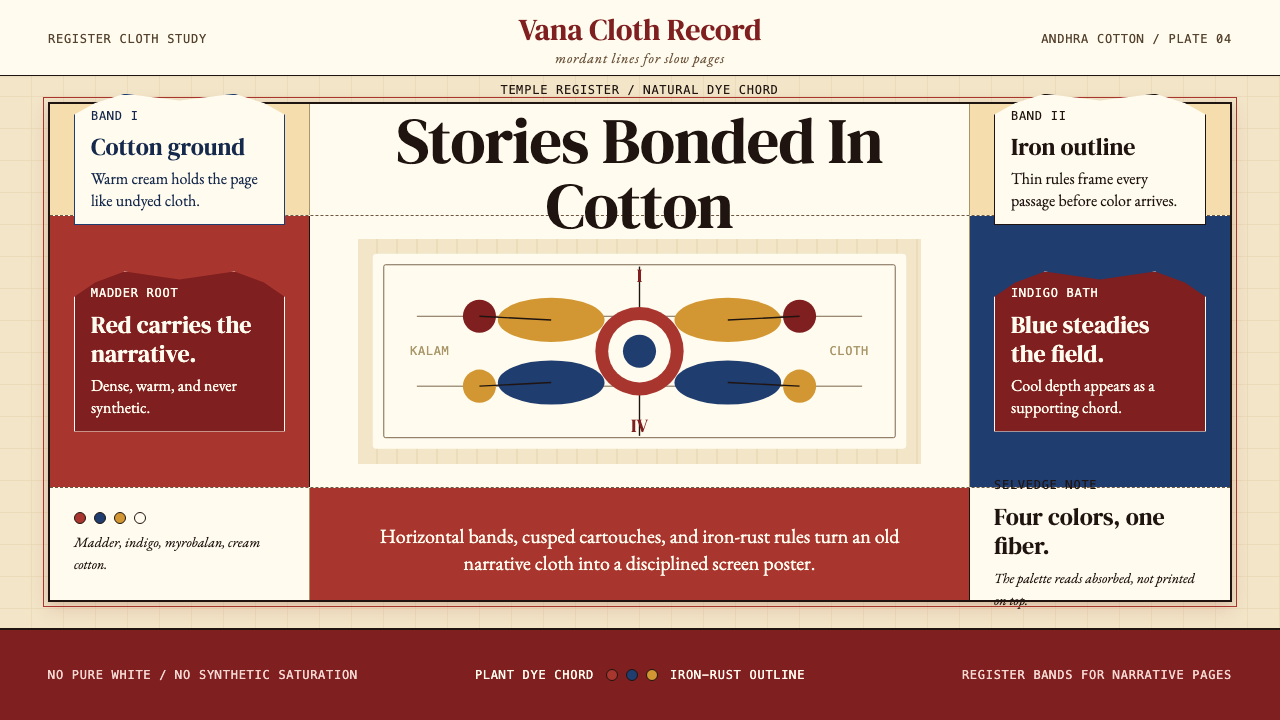 Kalamkari (Andhra Pradesh)Cloth becomes narrative. Madder bands, indigo panels, and iron rules stack li…