What is Bonbibi Shrine Painting?
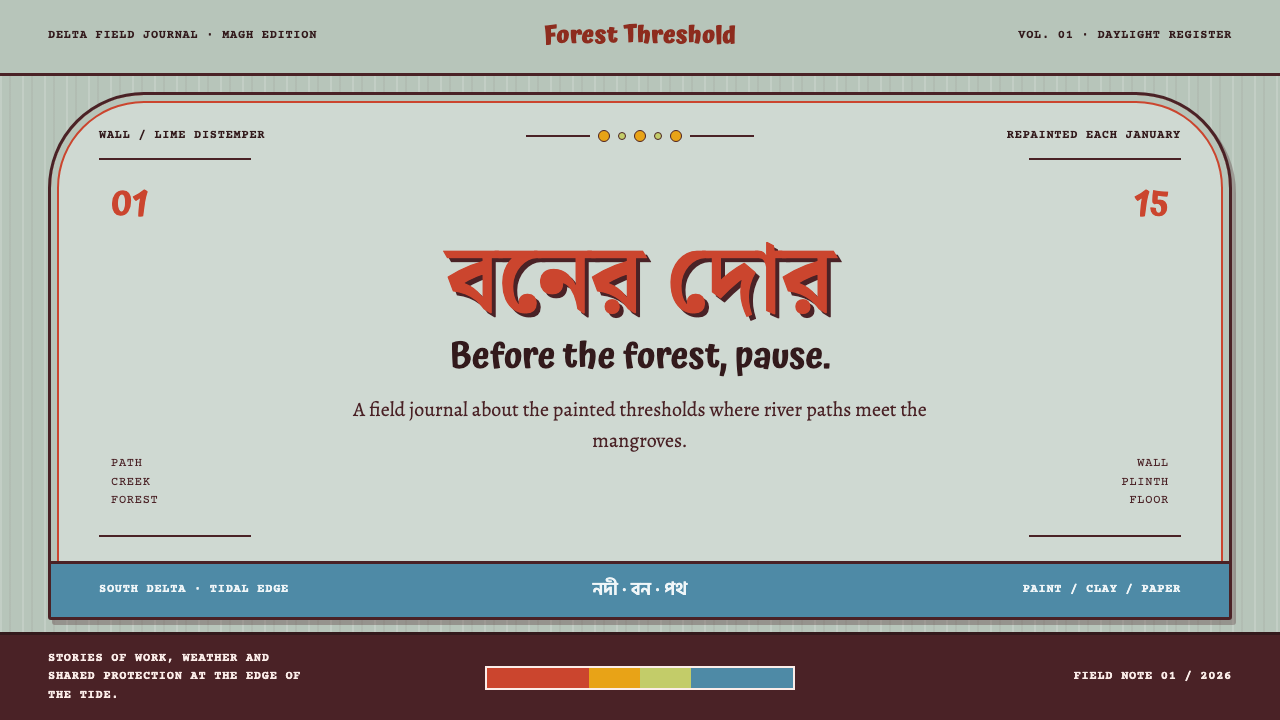
A Bonbibi shrine is a wall that holds the forest back — vermilion lettering on green-grey distemper, set between sky-blue bands and an oxblood floor.
Bonbibi Shrine Painting in brief
Before a honey-collector walks into the mangroves of the Sundarbans, he stops at a than, a small open masonry shrine to Bonbibi, the forest woman who holds back the tiger-god Dakshin Rai. The shrine is the design. Pale green-grey distemper covers the back wall, the floor is painted oxblood, the plinths are sky-blue, and unfired figures of river clay stand in front, repainted every January. Over all of it, vermilion hand-lettering and painted forest imagery do the talking.
Visually the style is flat, chalky and frontal. The paint is distemper, which dries to a soft matte, and it takes stains, damp patches and the marks of hands as part of its surface. The colours are not the result of a palette meeting. They are whatever paint the sign-painters and clay-modellers had at hand, and that is part of why the combination feels so confident: nobody was trying to make it harmonious, so it simply is. Large vermilion type rises off the wall like a shop sign, and sky-blue bands run across it like a horizon.
Behind the idols, many shrines carry a painted mural of the forest itself: sundari trees, a tidal creek, the spikes of breathing roots rising from the mud. The little building therefore holds a small flat picture of the place it protects you from. That idea, a threshold that contains a picture of what lies beyond it, is the heart of the style, and it is why a layout in this spirit feels like a doorway rather than a page.

Where does Bonbibi Shrine Painting come from?
The shrines belong to the Sundarbans, the tidal mangrove delta that spans South 24 Parganas in West Bengal, India, and the Khulna division of Bangladesh. This is a landscape of creeks and mud, where people who go into the forest for honey or crabs go in knowing that the tiger lives there. The source describes the cult of Bonbibi as a folk practice older than 1900 and still observed today, and the than at a village edge or a forest landing is where that practice becomes visible. People stop at it before they enter, much as one stops at a gate.
The figures of the story are named in the source. Bonbibi is the forest woman, the protector. Dakshin Rai is the tiger-god she holds back. Shah Jongoli appears beside her, usually described as her brother, and Dukhe is the boy whom, in the tale, she saves. In the story as it is told in the delta, the forest is a place of real danger, and the shrine marks the line where a bargain with that danger is renewed. The cult is syncretic, drawing on both Hindu and Muslim traditions, and its shrines are shared by people from both communities.
The craft is as much a part of the origin as the story. The idols are modelled from unfired river clay and renewed each year around the Bonbibi Mela, which falls in the month of Magh in mid-January. Repainting is therefore a seasonal act, not a restoration: the surface is always a few weeks or months old, and the palette is always whatever paint is available that year. The walls are masonry finished with distemper, and the people who do the work are the sign-painters and clay-modellers of the villages. The source lists Bengali folk shrine painting and clay idol-making among the movements behind the style.
The same hands also write the lettering. The source lists hand-painted village signage as one of the traditions behind the shrine, and the writing is Bengali script in vermilion, carried on to the craftsman's name and even his telephone number. Together with the red flags, the paper garlands and the stains on the damp wall, these details make the shrine feel like an inhabited building rather than an exhibit. The painted forest mural completes it: a flat portrait of the place beyond the threshold, kept inside the threshold.
What defines the Bonbibi Shrine Painting look?
Green-Grey Distemper Wall
The back wall is a pale green-grey, a chalky, cool tone that is neither green nor grey but the shade between them that limewash-type paint settles into. It dries matte and unevenly, shows the hand that applied it and takes damp stains without complaint. As a ground it is restful and slightly damp-looking, which lets stronger colours hold their own without competing for attention.
Banded Architecture
The shrine is a stack of horizontal bands: a sky-blue plinth, an oxblood floor, a pale wall above. These bands are the layout. They divide the space into a base, a stage and a field, and they run the full width of the wall without interruption. Sky-blue is bright and cool against the warmer oxblood below, and the contrast reads as ground and sky, which gives a small structure a surprising sense of landscape.
Vermilion Sign Lettering
The lettering is hand-painted, large and vermilion, in the manner of village signage. It rises off the green-grey wall with strong contrast and is not afraid of irregularity: letters vary in width, baselines drift, and spacing is decided by the painter's eye. The writing is Bengali, and it extends to the craftsman's own name and telephone number, so the type is both heading and signature.
A Picture of the Forest
Behind the idols, many shrines carry a mural of sundari trees, a tidal creek and the spikes of breathing roots. It is drawn flat, with simple shapes and little shading, and it sits behind the main figures as a backdrop. In design terms this is a layered illustration that tells you where you are, and it sets up the logic of a threshold: the safe space in front, the wild space painted behind.
Paint at Hand
The palette is not the product of a design process. It is the paint the sign-painters and clay-modellers already had, applied without a swatch. This produces a distinctive result: a small set of flat, saturated, confidently chosen colours that do not try to match one another and therefore do not try to hide. The lesson is that a limited, unmatched palette can look more authoritative than a carefully balanced one.
Wear, Flags and Garlands
Red flags, paper garlands and stains on the damp wall are not defects. They are evidence of use, of renewal and of the people who come here. A shrine in this style is never pristine; it is lived in. Small accretions around the main surface, such as tags, stickers and hand-lettered notes, keep the composition humane and prevent the strong colours from reading as a branded environment.

Who shaped Bonbibi Shrine Painting?
Bonbibi is the forest woman at the centre of the cult, the protector who holds back Dakshin Rai. She is both the subject of the shrine and the reason people stop before entering the forest. In the visual system she is the figure who defines the threshold: the idea that something stands between a person and danger, and that this deserves a bright, well-kept place on the edge of the village.
Shah Jongoli is named in the source as a key figure and appears alongside Bonbibi in the tradition, usually as her brother. His presence shows that the shrine is a place of several characters, not a single icon, and that the story involves companions and relationships as well as a lone protector. In a layout, that translates into groups of figures arranged in a row, each with a role in the same scene.
Dakshin Rai is the tiger-god whom Bonbibi holds back, and he is the reason for the shrine's existence. He is not simply a villain: in the story the forest is his domain, and the cult turns on a relationship of restraint and respect between him and the woman who contains him. For design, he stands for the pressure at the edge of the frame, the thing that a protective structure exists to hold back.
Dukhe is the boy named in the source and, in the tale as it is told in the delta, the one whom Bonbibi saves. He is the human figure in the story: small, vulnerable and in need. Including him in the tradition keeps the cult close to the ordinary people who use it, honey-collectors and crab-catchers, and reminds designers that a protective system is justified by the people it protects.
How do you use Bonbibi Shrine Painting today?
The Bonbibi shrine style is useful because it shows how a few flat colours, a strict banding of space and big hand-made lettering can carry real authority without any polish. The structure is transferable even where the subject matter should be handled with care.
For presentation slides, the cover can be a pale green-grey field with a large vermilion title across it, a sky-blue band running below and a dark oxblood strip at the base. Content slides can keep the same banding as a repeated frame, with the title in the vermilion lettering and text in a plain dark tone. Data slides suit horizontal bands: tide-like bar charts, stacked ranges and timeline strips with the blue band as the reference line, and flat colours for categories.
For web interfaces, the style fits landing pages, community and local-service sites, notices and campaign pages that want warmth and authority without corporate gloss. Build the page from stacked horizontal bands, use the pale ground for most content and keep the vermilion for headings and key actions. Cards should be flat, with no shadow and no gradient, and a small hand-lettered credit line, such as a maker's name, can sit at the foot. Dashboards should stay sober, using the oxblood and blue bands as navigation and status.
For editorial and marketing work, the style is well-suited to conservation, ecology, travel, folk culture and community storytelling, particularly anything about wild places and the people who live next to them. A poster can place a large vermilion line on a green-grey wall with a flat illustration of the landscape behind it. Include real marks of use if the project permits: a flag, a garland, a hand-written note. Credit the craftspeople and the region honestly.
The most common mistake is to polish it. Perfect gradients, soft shadows, evenly balanced palettes and tidy type remove the quality that makes the shrine feel inhabited. A second mistake is to treat the subject as exotic decoration: the deities are real figures in a living cult shared by Hindu and Muslim communities, so avoid using the idols or their names as casual ornament, and prefer the structure of bands, lettering and the painted forest. A third is to dilute the vermilion with extra accent colours; one strong red on a quiet wall is the point.

Bonbibi Shrine Painting — FAQ
What is a than?
A than is a small open shrine, here a masonry one, that stands at a village edge or forest entrance and is dedicated to Bonbibi. Honey-collectors and others who work in the Sundarbans stop at it before going into the mangroves. In the design system it is the unit of composition: a wall, a plinth, a floor and a few figures in front, treated as a single picture that defines a threshold.
Was the colour scheme designed?
Not in the usual sense. The source says the combination comes from the paint that the sign-painters and clay-modellers already had, rather than from a planned palette. The result is a small set of flat, saturated colours that do not try to blend: green-grey wall, oxblood floor, sky-blue plinths and vermilion lettering. Its authority comes from that lack of fuss, so resist the urge to rebalance or soften it.
Why does a shrine contain a picture of the forest?
Because the shrine marks the line between the village and the forest, and the mural turns the forest into something that can be looked at from the safe side. The sundari trees, the tidal creek and the breathing roots are shown flat and small, behind the idols. For designers, it is a model of layering: a foreground that protects and a background that tells you what is being protected against.
Why is the lettering hand-painted, with names and phone numbers?
Because the same people who paint signs for the village also paint the shrine, and hand-painted village signage is one of the traditions the style comes from. The craftsman's name and number are part of the work, like a maker's mark. In a layout this suggests that credit lines, contact details and signatures can be part of the visual design rather than an afterthought at the bottom.
How should I treat the religious subject matter?
With respect. Bonbibi, Shah Jongoli, Dakshin Rai and Dukhe are figures in a living cult, practised by both Hindu and Muslim communities of the delta. The visual structure of bands, lettering and painted landscape can be borrowed freely, but avoid using the idols or their names as casual decoration. If a project is about the Sundarbans, work from the sources, name the region and the craft, and let the community's own voices lead.
Related design styles
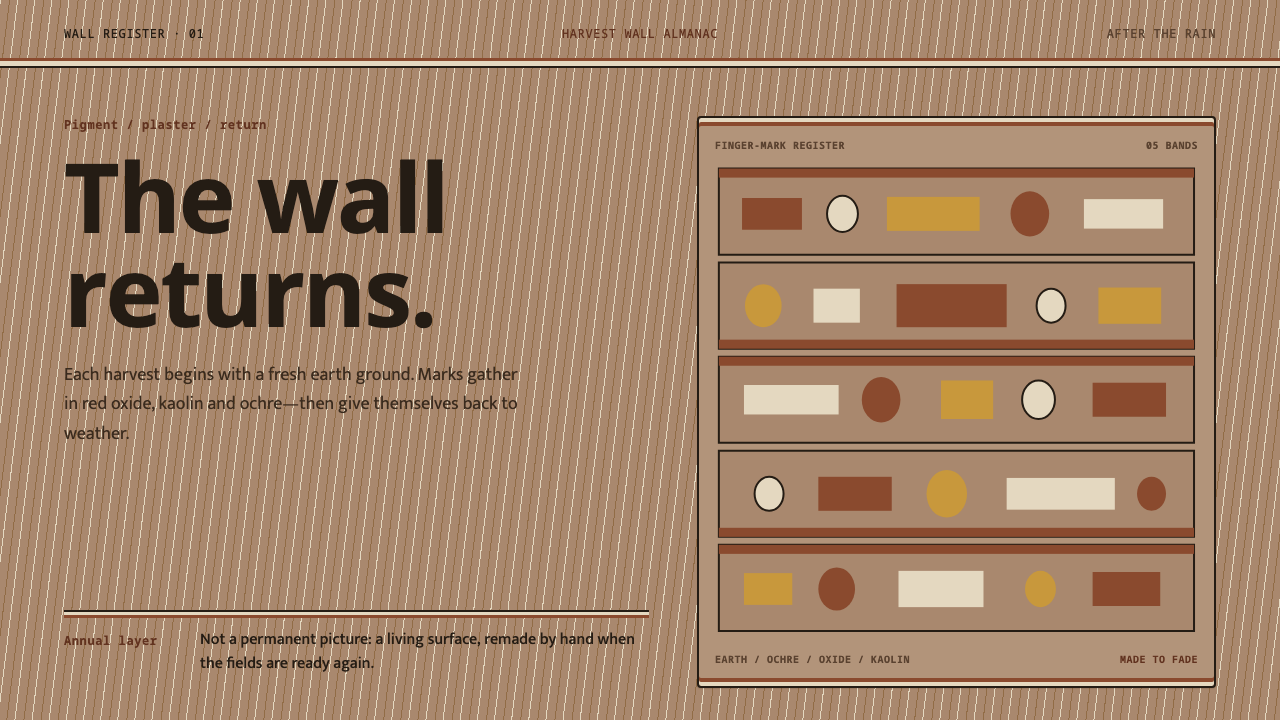 Santhal Sohrai MuralA wall that renews itself. Red oxide bands and Ol Chiki type ride warm mud pl…
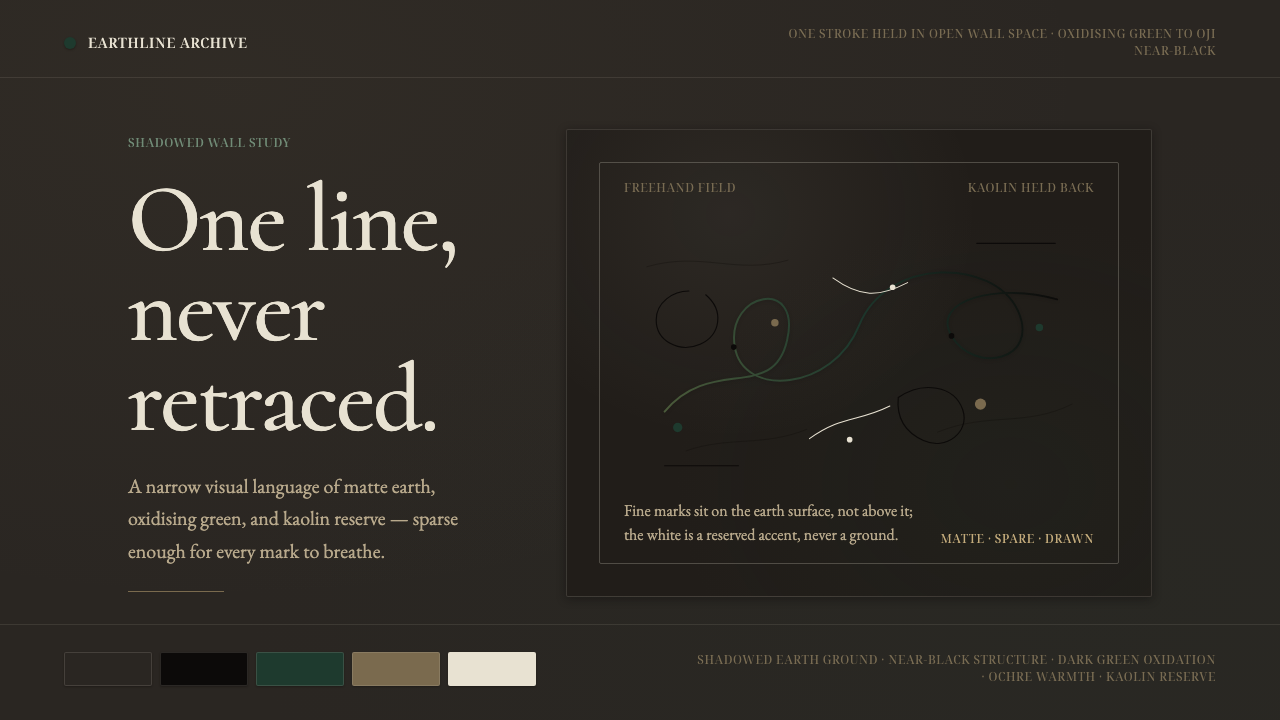 Igbo Uli Painting NigeriaSpare line carries the wall. Near-black curves breathe on dark earth with kao…
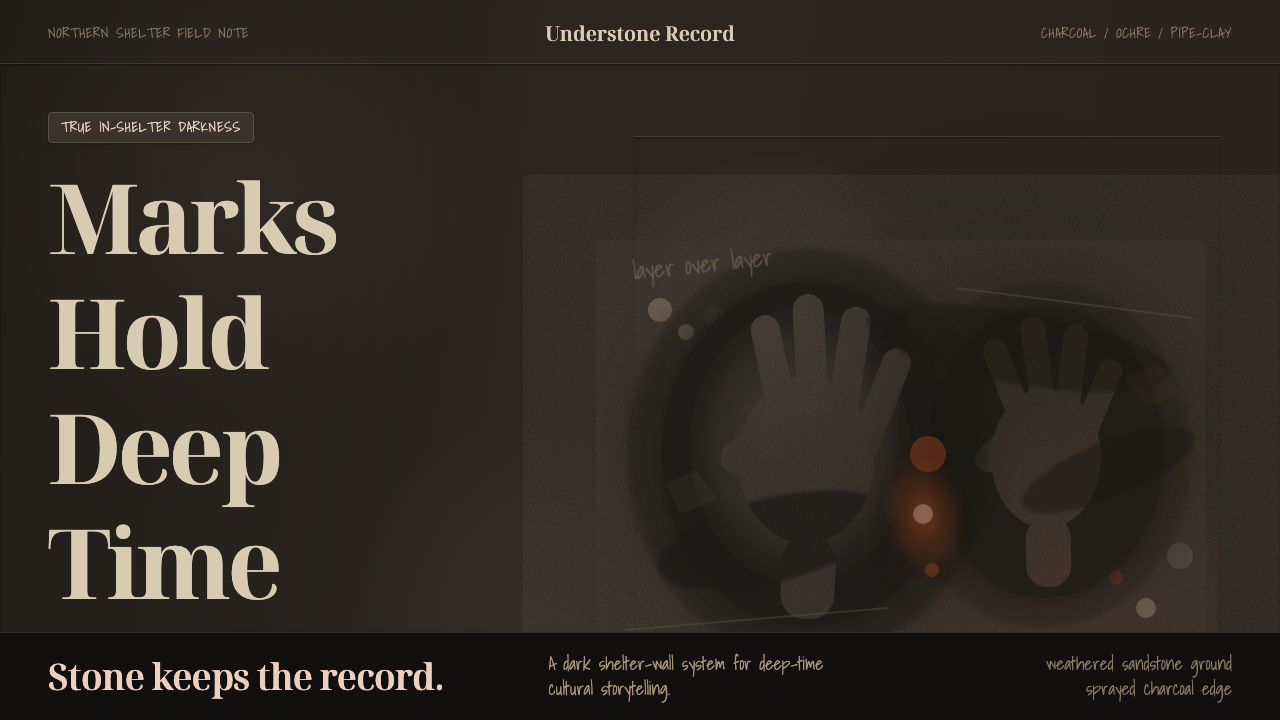 Kakadu Rock Shelter CharcoalDarkness carries memory. Charcoal stencils and haematite dust sit on weathere…
 Niuean HiapoEvery line keeps its maker. Dark plant ink fills smoky barkcloth in hand-rule…
 Khasi Living Root BridgeStill growing, never finished. Moss-green serif and layered dark decks carry…
 Sangkhalok CeladonQuietly shaped by fire. Grey-green concentric glaze holds a fine crackle net…