What is Sangkhalok Celadon?
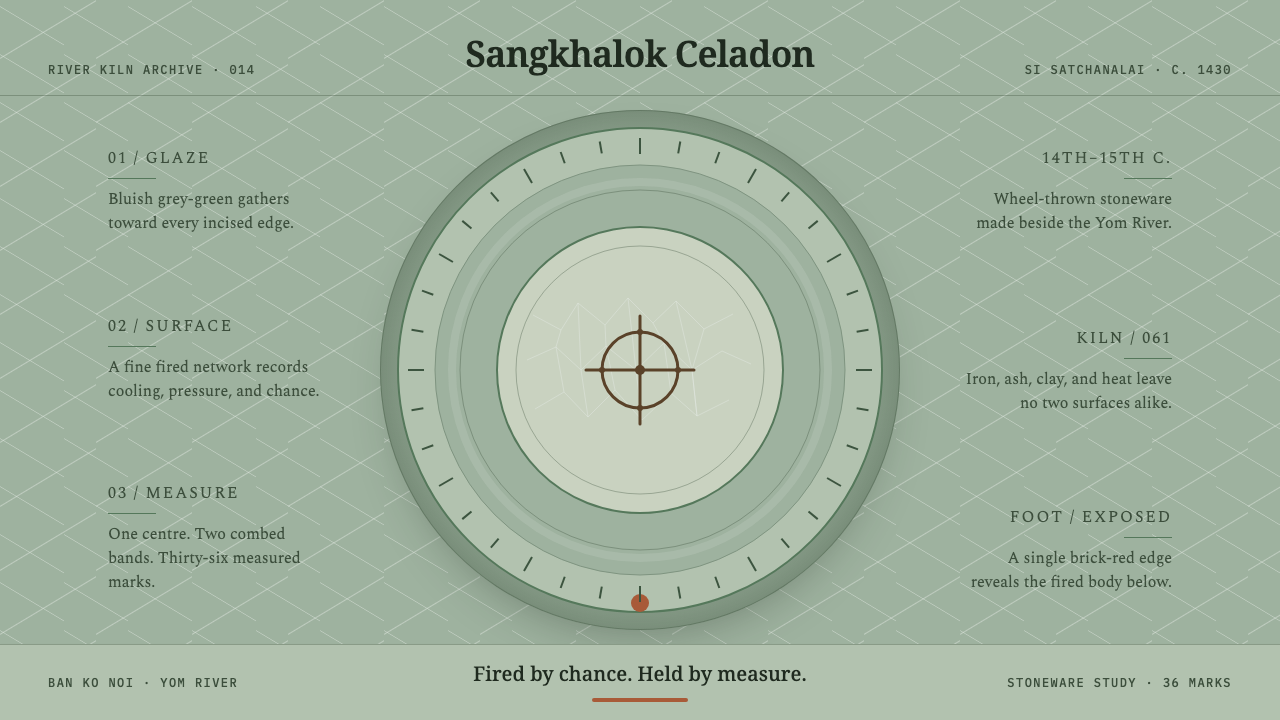
Sangkhalok celadon is a design shaped by fire and gravity: a grey-green glaze, a net of crackle, one quickly drawn fish, and a ring of brick-red clay at the foot.
Sangkhalok Celadon in brief
Sangkhalok is the name given to the glazed stoneware made at the Si Satchanalai kilns of northern central Thailand, a region also written Sawankhalok. The kilns sent their wares down the Yom river and out across the maritime trade of Southeast Asia. The classic form is a shallow dish under a bluish grey-green glaze, its surface crazed with a fine, pale net of crackles that no potter planned.
The decoration inside the dish is deliberately minimal. A fish curled into the well in iron brown, or a flower centred in the base, is drawn quickly and with a confident line, and then there is nothing. Most of the dish is plain glazed surface. The tension between one tiny drawn event and a large quiet field is the heart of the style.
Everything is concentric and slightly off-round, because the form came off a wheel and the glaze ran where gravity took it. The colour of the glaze deepens toward the edges, and the footring is left unglazed so that it fires brick-red, a warm ring beneath the cool green. Curio's Sangkhalok Celadon system organises its layouts the same way, with composition drawn toward the centre, soft depth at the edges and a single warm accent at the base.

Where does Sangkhalok Celadon come from?
The kilns clustered around Si Satchanalai, in what is now Sukhothai province, and the work is remembered by the kiln villages of Ban Ko Noi and Ban Pa Yang. It belongs to the Sukhothai period and was made largely for export. From the fourteenth century these kilns were producing dishes, bowls, covered boxes, bottles and jars that went by boat to markets across Southeast Asia.
The dates in the record give a rough chronology. Dishes painted in iron under the glaze appear from about 1370, and the classic celadon phase runs from about 1430 to 1487. Curio's system draws on both modes: celadon glaze as the field, and the iron-brown fish or flower as the drawing set into it. The two belong together in the visual memory of the ware, and the design keeps them together.
The tradition is described as Thai stoneware made after Longquan celadon, the Chinese celadon whose grey-green wares set a standard for the type across Asia. The Thai potters did not simply copy it. The fish and the flower in the well, the unglazed footring that fires warm red, and the casual off-round forms all give their celadon a character of its own.
No individual potters are recorded. The makers are the kiln communities of Ban Ko Noi and Ban Pa Yang, and the work comes to us as objects in collections. As with other trade ceramics, the object is the document: its glaze, crackle, footring and drawing are the evidence. That is why a design derived from it should lean on careful observation of the object, not on the story of a famous master.
What defines the Sangkhalok Celadon look?
A Grey-Green Glaze
The glaze is a bluish grey-green, translucent and deep rather than bright. It reads as a mineral colour more than a pigment, calm and a little cool, and it gathers into a deeper tone toward the edges where the glaze lies thicker. The colour never shouts. It is the quiet field on which the rest of the dish depends.
The Crackle Net
A fine, pale net of crackles runs across the glaze, and no potter planned it. It arises as glaze and clay cool and contract at different rates, and no two dishes crack alike. In design it is a hairline texture at low contrast, irregular in its spacing, a surface that rewards close looking without ever competing with the content.
Concentric Composition
Well, base, rim and footring all arrange themselves in rings around a single centre. The eye is drawn inward, and the composition rests there. Layouts derived from the dish gather toward one point, using circular and radial forms and wide empty margins, instead of spreading across a rectangular grid.
The Quick Iron-Brown Line
The drawing inside is made fast, in iron brown: a fish curled into the well, or a flower centred in the base. The lines start and stop with a flick, and nothing is added once the drawing is done. It is a single drawn event in a large quiet field, and its value comes from how little there is of it.
The Brick-Red Footring
The footring is left unglazed, and the exposed clay fires brick-red. That produces a single warm accent at the base of a cool green object, and it is a quiet reminder of the material under the glaze. As a design principle it means one warm note, placed low and small, to set off a large cool field.
Off-Round Honesty
The form came off a wheel, and the glaze ran where gravity took it, so nothing is mathematically perfect. Rims drift slightly and rings do not quite close. This honesty about process is part of the style's calm, and perfect geometry, drawn with a compass, would contradict it.
Quiet Space as Material
Most of the dish is simply glaze. The empty field around the fish or flower is not a lack of decoration but the main material of the design: it gives the small drawing its weight, lets the crackle be seen, and makes the unglazed ring at the foot feel like a deliberate full stop. In layout terms, white space here is not leftover; it is the largest and most important element on the page.

Who shaped Sangkhalok Celadon?
One of the two kiln villages around Si Satchanalai associated with the ware. The potters of Ban Ko Noi are remembered as a community rather than as individuals, and what they left is the dishes, bowls and jars themselves. Their work is a core reference for the underglaze iron dishes and celadon wares that define Sangkhalok.
The second kiln village named with the tradition. Together with Ban Ko Noi, Ban Pa Yang represents the Si Satchanalai kilns' fourteenth- and fifteenth-century output for the maritime trade. Like its neighbour, it is a collective author: the evidence of its work lies in the glaze, crackle and drawing of surviving pieces.
Not a Thai maker but the model the Thai potters worked after. Longquan, in China, set the standard for grey-green celadon across Asia, and Sangkhalok is described as Thai stoneware made in its wake. Understanding the relationship clarifies what Thai potters took and what they changed.
How do you use Sangkhalok Celadon today?
Sangkhalok Celadon is a light, cool, restrained system. It rewards pages that have something small and precise to say inside a great deal of quiet space. It works best when the content can be reduced to one clear message and one clear action: the dish has only one drawing, and the page should have only one thing asking for attention.
For presentation slides, a cover can follow the dish: a pale grey-green field, composition drawn toward the centre, a single small iron-brown line drawing as the only illustration, and a thin warm band along the bottom edge for the footring. Content slides keep wide margins, with text sitting in the quiet field and a hairline crackle texture as an almost invisible background. Data slides suit soft, concentric or radial forms such as donut charts and ring diagrams in glaze tones, with a single brick-red emphasis.
In interfaces, the style suits dashboards with generous space and calm cards, soft depth, hairline borders, and rounded forms where the underlying object is round. A pricing page can lay its tiers out like plates in a row, with the recommended tier marked by a warm footring accent. A hero can centre one illustration. Buttons are grey-green with a subtly deepened edge, and focus states use brick-red.
In editorial and marketing work, the style suits tea, ceramics, wellness, hospitality, travel, slow-living brands and museum content. Set long reading with wide margins, use illustrations as single quick brush marks, and place captions beneath. The crackle works well as a hairline divider between sections, a quiet way to mark change without adding ornament.
The commonest mistake is over-decoration. Filling the dish with more drawings destroys the central tension between one small mark and a large quiet field. A second is making the crackle too regular or too high in contrast, which turns a natural accident into a pattern. A third is pushing the green toward mint or a saturated pop colour; the glaze is a muted mineral grey-green. Finally, perfect circles and symmetrical drop shadows contradict the off-round, gravity-shaped nature of the form.

Sangkhalok Celadon — FAQ
What is Sangkhalok ware?
Sangkhalok is the glazed stoneware made at the Si Satchanalai kilns of northern central Thailand, also written Sawankhalok. The kilns shipped dishes, bowls, covered boxes, bottles and jars across the maritime trade of Southeast Asia from the fourteenth century. The best-known form is a shallow dish under a grey-green glaze with a fine crackle and, often, a fish or flower drawn in iron brown.
Is Sangkhalok celadon the same as Chinese celadon?
They are related but distinct. Sangkhalok is described as Thai stoneware made after Longquan celadon, the Chinese tradition that set the standard for grey-green glazes. The Thai ware has its own character: the quickly drawn fish or flower in the well, the unglazed footring that fires brick-red, and the slightly off-round forms.
What is the crackle, and is it a flaw?
The crackle is a fine net of cracks in the glaze, produced as glaze and clay cool and contract at different rates. Nobody plans it, and no two pieces crack the same way. It is not treated as a flaw here but as part of the character of the ware, and the design system translates it as a hairline texture rather than a pattern.
Why is the footring red?
The footring is left unglazed, so the exposed clay is fired directly in the kiln and comes out brick-red. This makes a warm ring beneath the cool green glaze. In design it becomes a single small warm accent at the base of an otherwise cool composition.
Can the style work in dark mode?
It can be adapted, but the system is conceived as light and translucent, with a pale field and quiet space. A dark variant should use a deep celadon green rather than black, keep the crackle as a faint hairline texture, and preserve the single warm accent at the base. Going to pure black would lose the glaze's mineral calm.
Related design styles
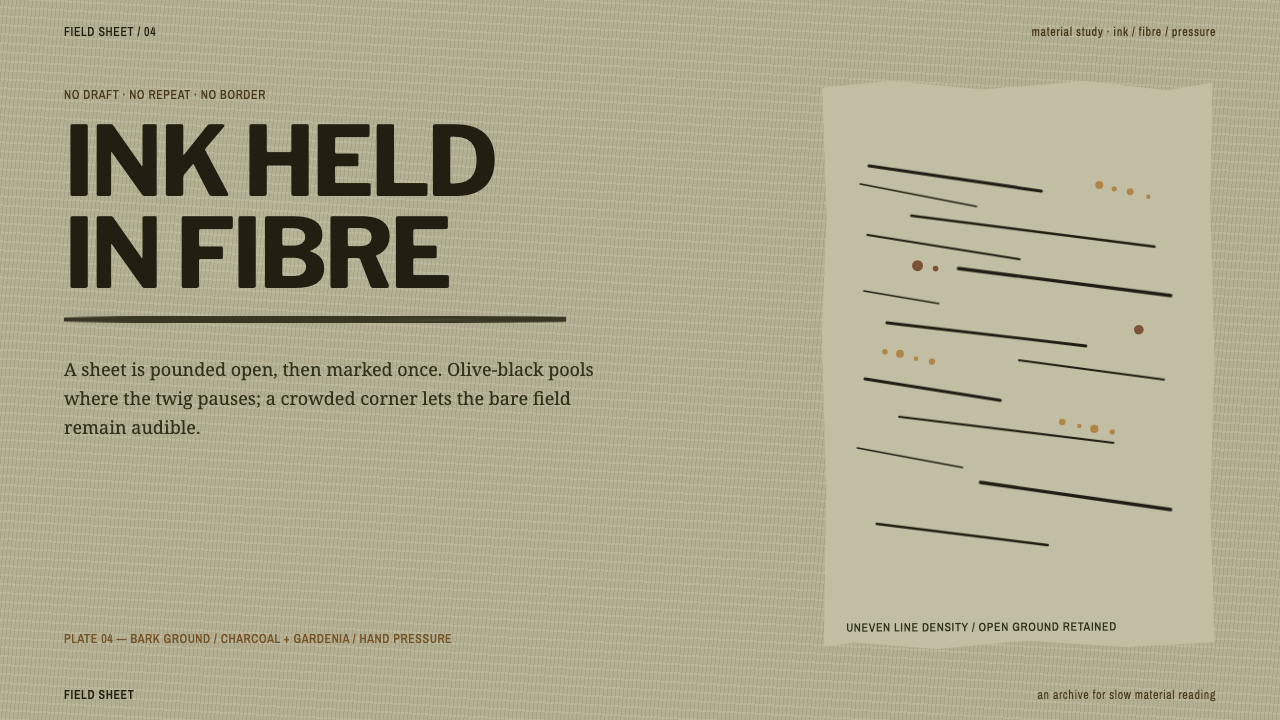 Mbuti BarkclothImprovisation stays visible. Olive-black marks bleed across a khaki fibre gro…
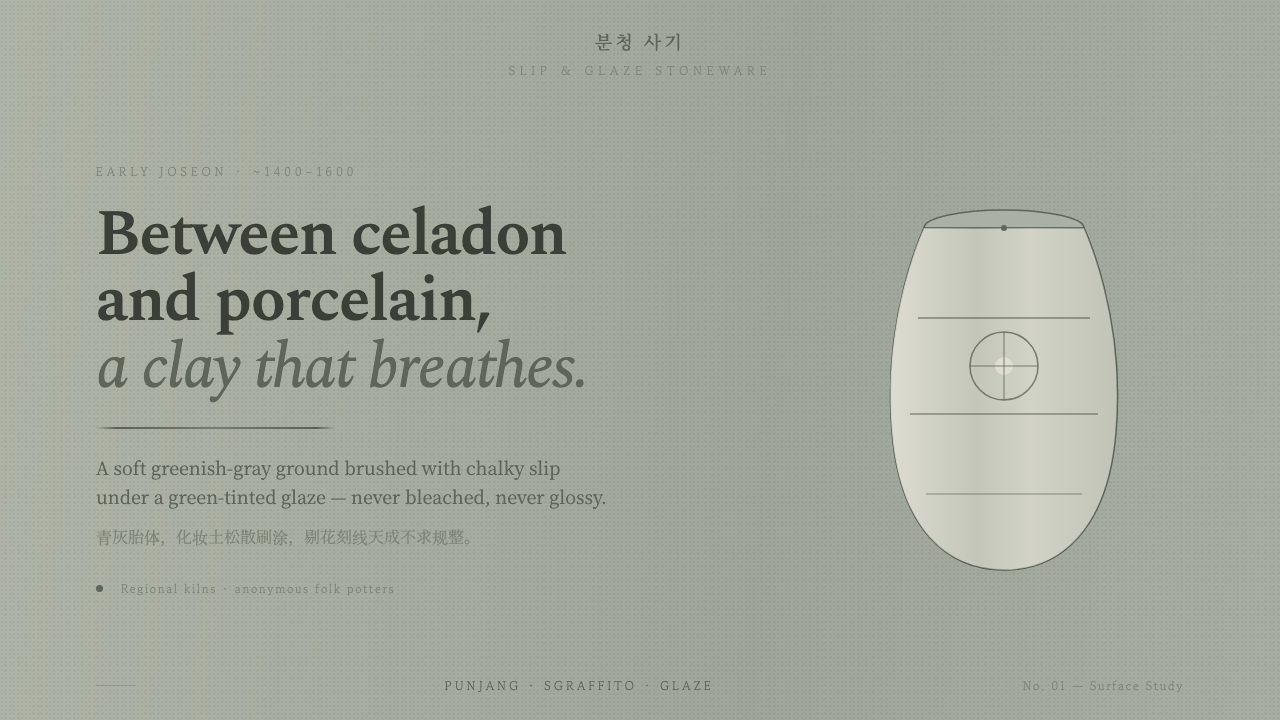 Buncheong Gray Slip WareBetween celadon and porcelain. Greenish-gray clay, chalky slip brushwork, dar…
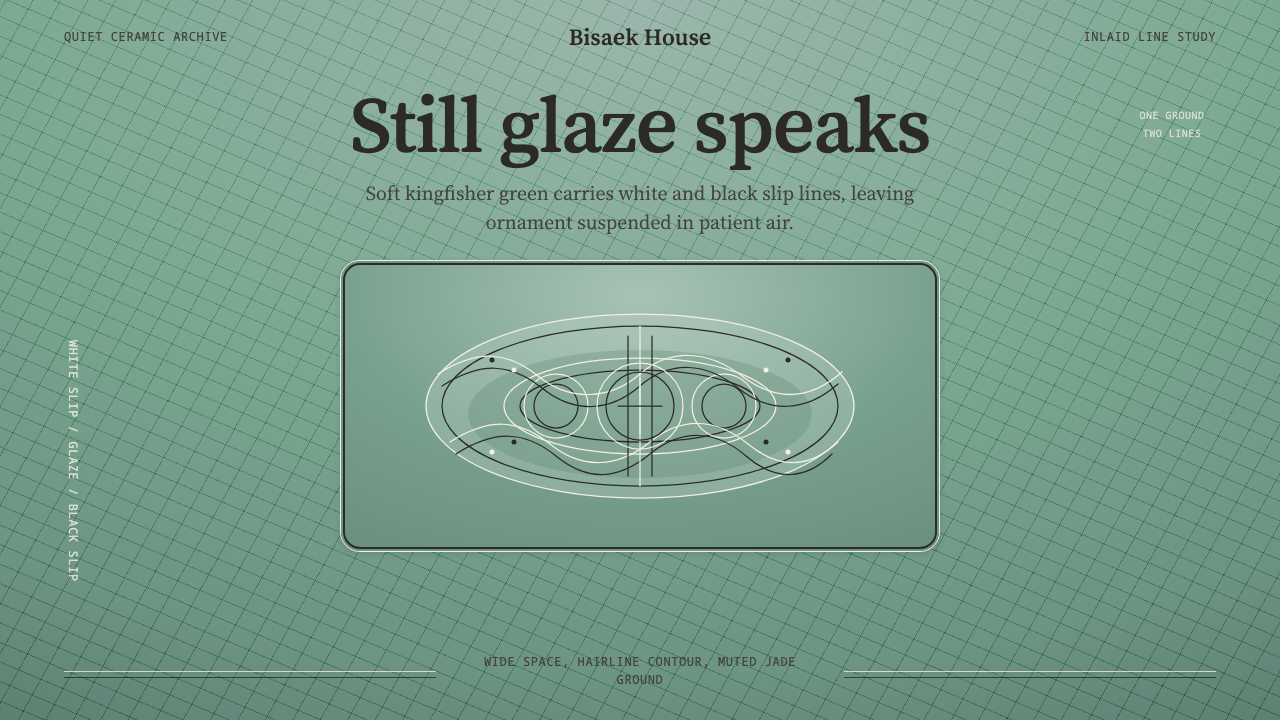 Goryeo Celadon 高麗青瓷Stillness carries ornament. Bisaek jade ground holds white and black hairline…
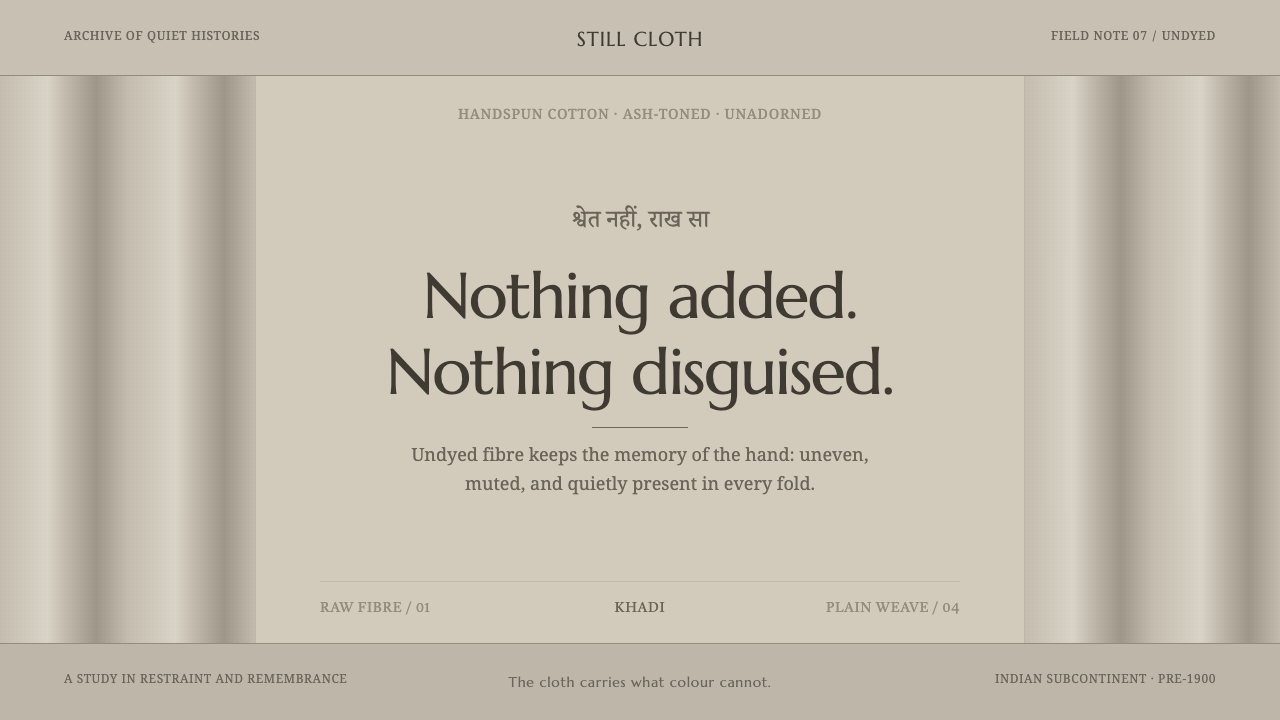 Hindu Widow White SariRestraint carries the weight. Ash-toned khadi, quiet serif type, and vertical…
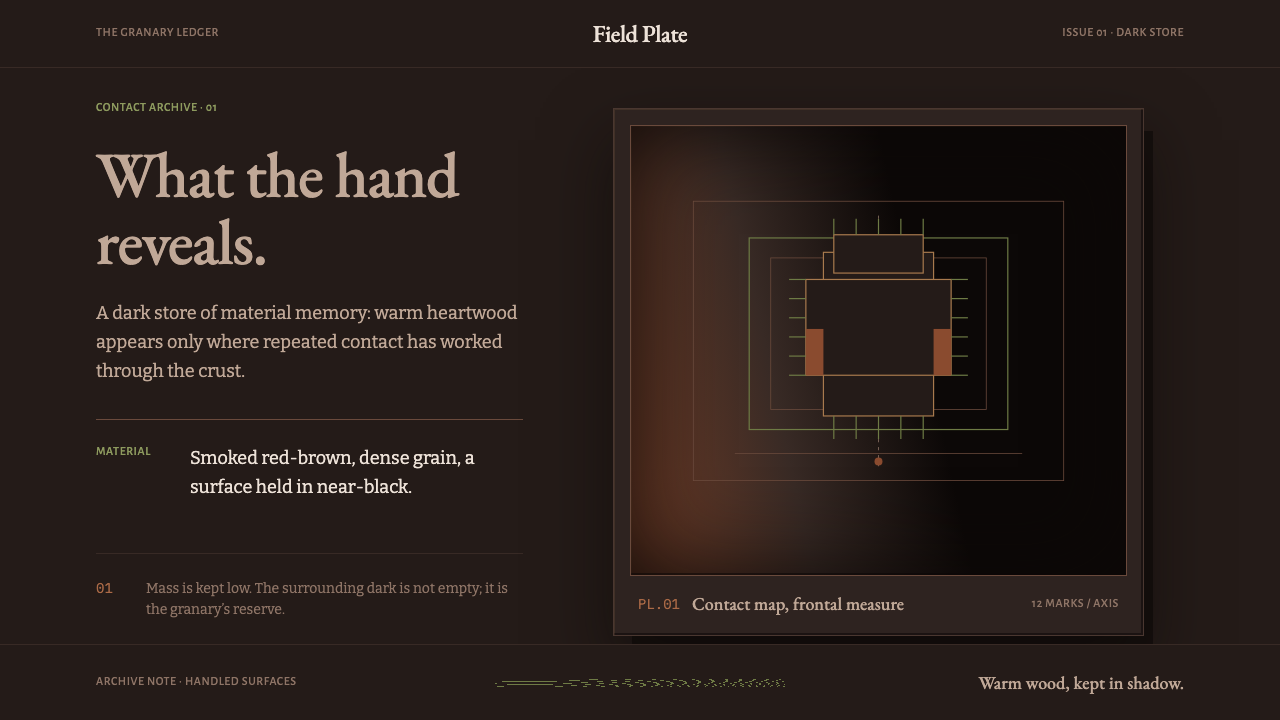 Ifugao BululTouch reveals the archive. Narra red breaks through near-black patina in a qu…
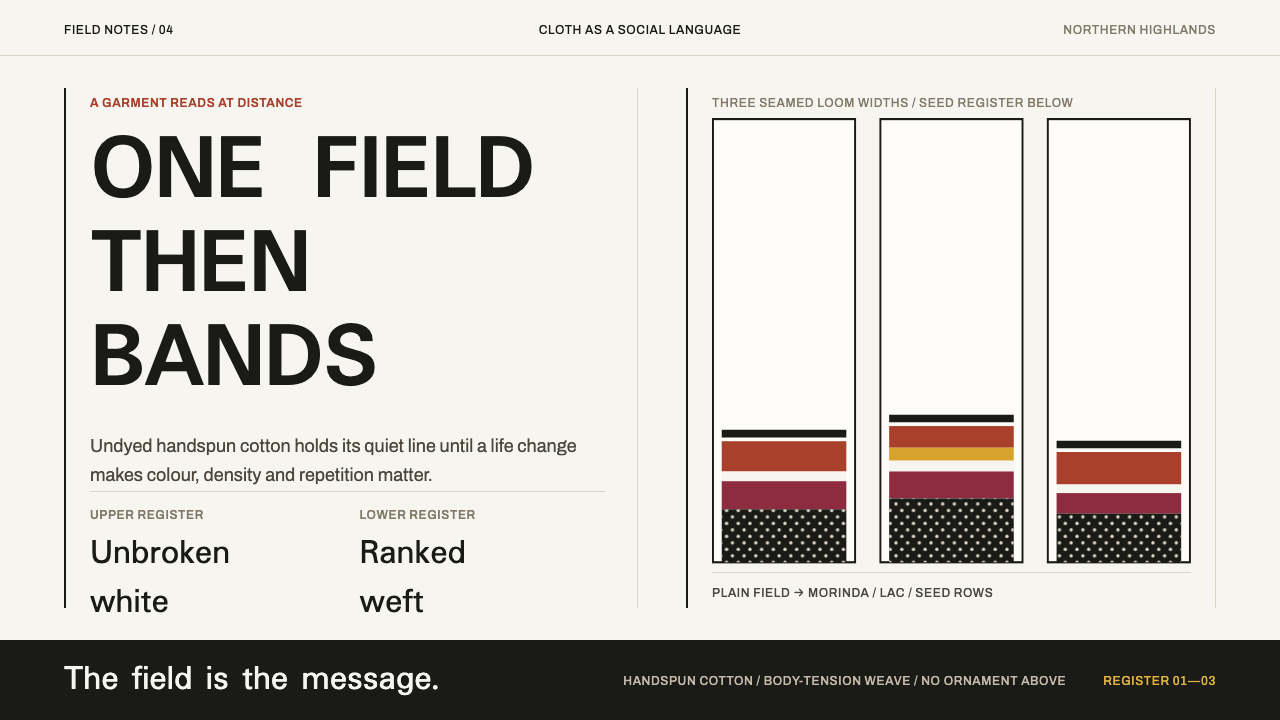 Karen Woven TunicOne field, then bands. Warm cotton white gives way to morinda registers and r…