What is Ifugao Bulul?
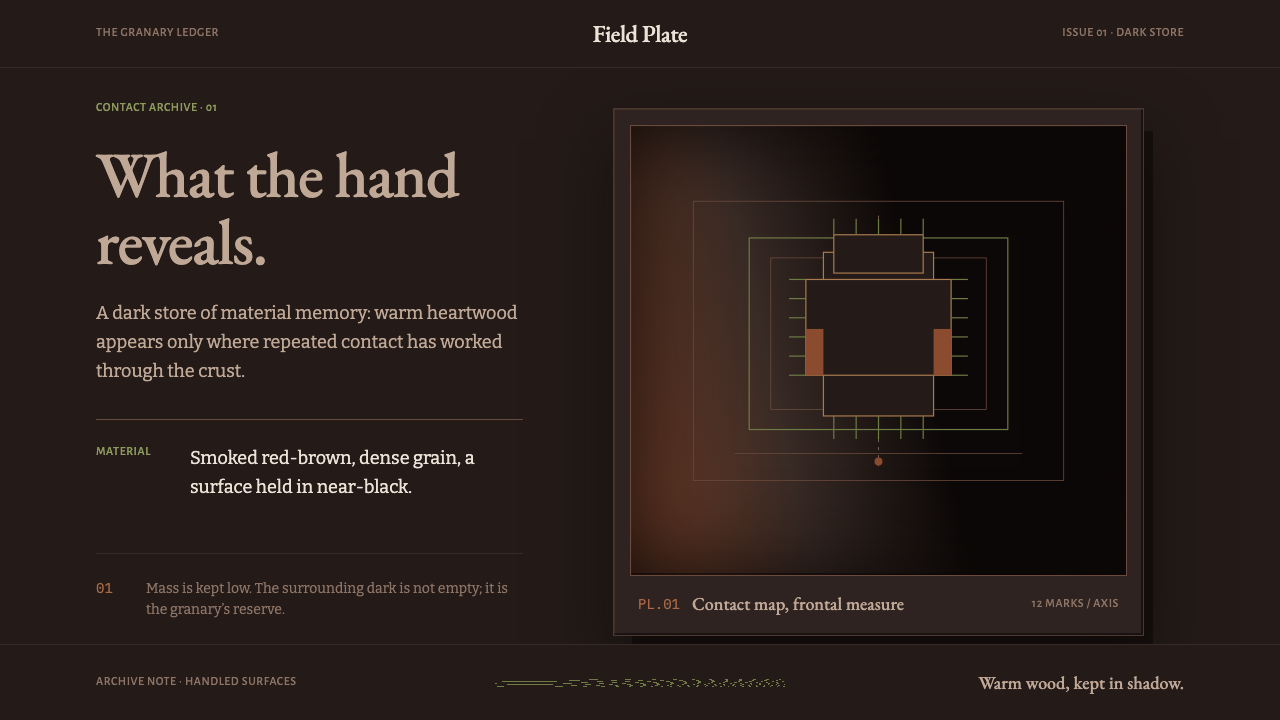
Ifugao Bulul is a dark design language built on touch — near-black patina with the warm red of narra wood breaking through where hands have worn it away, laid out in a quiet grid of plates.
Ifugao Bulul in brief
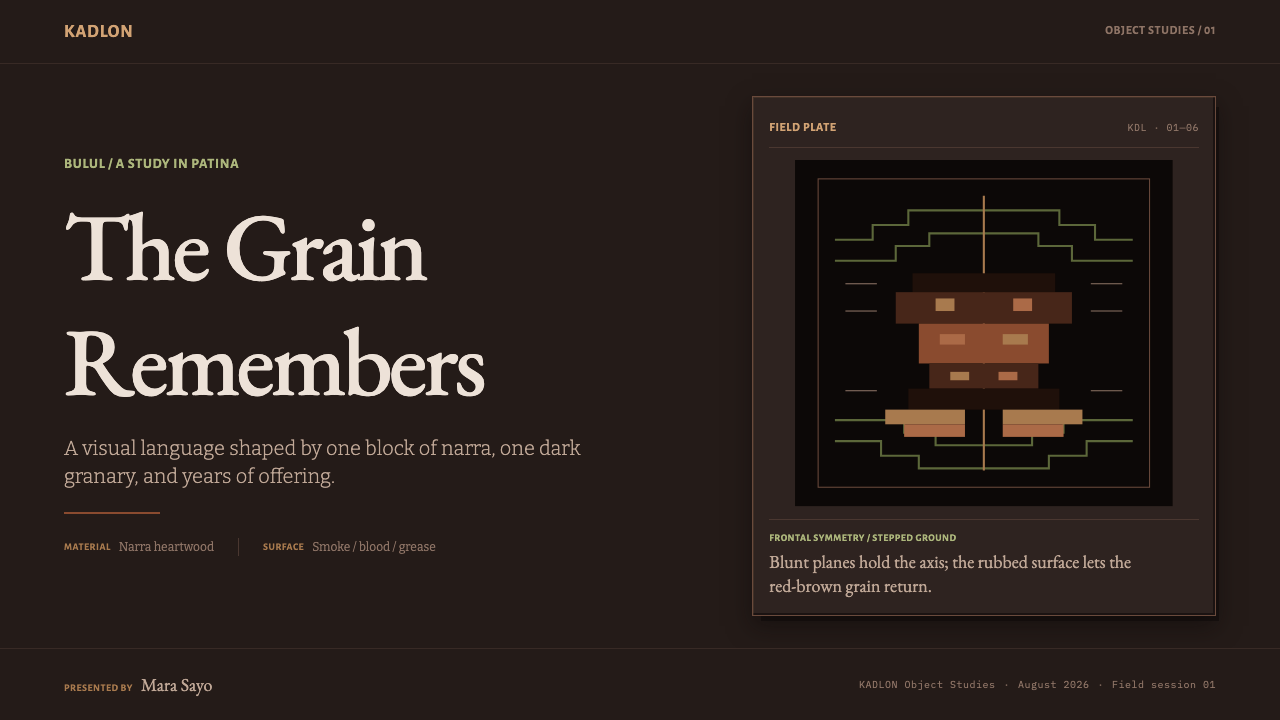
Ifugao Bulul is a design language drawn from the carved guardian figures of the Ifugao people of the Cordillera Central in northern Luzon, Philippines. A bulul is cut from a single block of narra heartwood and set inside the rice granary, the alang. It sits with knees drawn up and hands on the knees, its face pared back to a few blunt planes, frontal, symmetrical and low in its center of gravity. It is understood as a guardian of the harvest, and it is a working object in a living tradition.
What gives the style its character is what happens to the figure over time. In the tunod rite, hands wet with chicken or pig blood are laid on it. Over decades, blood, oil, rice wine, food offerings and cooking smoke build up into a thick, greasy crust. In the dark of the alang the figure reads almost black, and the red wood shows only where handling has worn the crust away. The design system is built on that contrast: mass against emptiness, warm red flashing out of near-black.
The result is a dark, quiet and heavy interface in which color is earned rather than applied. Most of the surface is depth. Where red appears, it appears because something has been touched, opened or used, and it never reads as decoration. The layout is a restrained grid of plates, like pages in a museum catalog, with generous darkness around each one.
Where does Ifugao Bulul come from?
The bulul belongs to the Cordillera woodcarving tradition of northern Luzon and to the agricultural world of the rice terraces, where the cycle of planting, harvest and storage is organized by ritual as much as by labor. Rice is kept in the alang, a raised granary, and the bulul stands guard over it. The figure is not an ornament added to the granary but part of how the granary works: a presence that is addressed, fed and touched at the right moments in the agricultural year.
Its form is as important as its function. A bulul is cut from one block, which means the carver works within the mass of a single block and keeps its weight low and centered. The knees come up, the hands rest on them, and the face is reduced to a handful of blunt planes. There is little incidental detail. This economy is what lets a figure remain recognizably itself after decades of use, when its surface has been buried under successive layers of offerings and smoke.
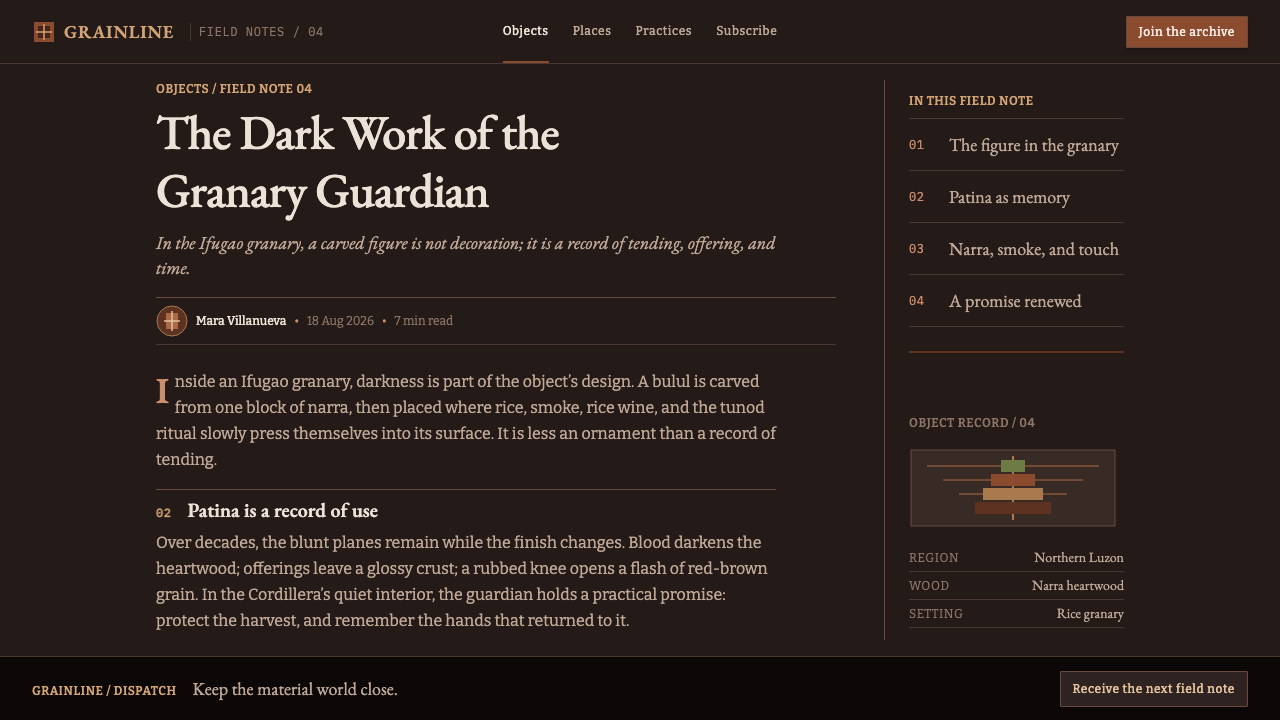
The patina is what the style takes as its central idea. During the tunod rite, hands wet with the blood of a chicken or pig are laid on the figure. Rice wine and food offerings, and the smoke of the cooking that goes on inside the granary, add their own layers. Over time the crust turns thick, greasy and dark, so that in the gloom of the alang the figure reads close to black. Where hands habitually touch, the crust thins and the red-brown wood shows through. The figure is an archive of its own handling.
Examples are dated from before 1900 onward, and museum holdings span the nineteenth century to the present, but the ritual itself is still practiced. That matters for any designer borrowing from it. The bulul is not a remote relic; it belongs to a community that continues to use such objects, and the institutions that keep examples, including the Ifugao Museum in Kiangan, the Honolulu Museum of Art and the Metropolitan Museum of Art, are stewards of a heritage rather than owners of a motif.
What defines the Ifugao Bulul look?
Near-Black Patina Ground
The base of the system is a deep, smoked near-black, the color of wood that has been handled, oiled and blackened by cooking smoke. It is not a flat digital black but a dark with depth and slight warmth, and it occupies most of the composition. Everything else is placed against it. Contrast comes from the one warm hue that survives, not from adding more light sources.
Narra Red from Wear
The accent is the red-brown of narra heartwood, and it appears only where something has worn the dark surface away. In an interface that means touched, hovered, opened, completed or selected states; in a layout, edges, corners and focal points that look handled. Red is never sprayed across a surface for emphasis. Its scarcity is what lets a small area of it feel like a reveal.
Blunt Planes, Frontal Symmetry
Forms are reduced to a few blunt planes, centered and symmetrical, with weight low in the composition like a seated figure with its knees drawn up. There are no delicate curves, no thin ornaments and no fussy detail. The effect is stability: elements look as if they have been placed in a granary and left there, and they feel as though they are going nowhere.
Chiseled Block Cards
Cards read as cut blocks of timber, retaining the facets of axe and chisel and casting one deep, offset shadow rather than a soft ambient glow. Edges are firm and slightly irregular in spirit, even where the geometry is exact. The cards do not float; they sit heavily, as objects with mass on a surface in the dark.
Terrace Contour Dividers
Dividing lines borrow the logic of rice-terrace contours: long, level lines that mark change of height in the landscape. Section breaks, table rules and separators are slim and quiet, and they step or curve gently rather than behaving like hard office rules. They give the dark ground a sense of strata without adding decoration.
Darkness as Whitespace
Empty space is not decoration but the dark inside the granary. Plates are arranged in a quiet grid, like catalog pages, with generous margins of black around each. Captions are small and plain. The rhythm is slow and deliberate, and it asks the viewer to approach one object at a time, as one would in a dim room with a single figure in it.
Who shaped Ifugao Bulul?
The Ifugao Museum in Kiangan sits in Ifugao province, in the same landscape of terraces and granaries that produced the bulul. As a local institution it stands for the idea that these objects are best understood near their place of origin and in relation to the practices that give them meaning, rather than only as pieces in a distant collection. It is named among the references for this style for that reason.
The Honolulu Museum of Art is among the institutions whose examples of Ifugao carving serve as references for the style. Seen in museum light, a bulul shows its structure plainly: the blunt planes, the seated stance, the crust and the places where the wood shows through. Collections like this make that visual information available to people who cannot visit the alang, with the caution that a museum plate is not the object's original setting.
The Metropolitan Museum of Art is likewise named among the reference collections. Its documented examples help show how consistently the bulul form recurs and how varied the patina can be from object to object. For designers, collections like this are a reminder to treat the figure as a documented cultural object, with provenance and context, rather than as a generic image of the exotic.
How do you use Ifugao Bulul today?
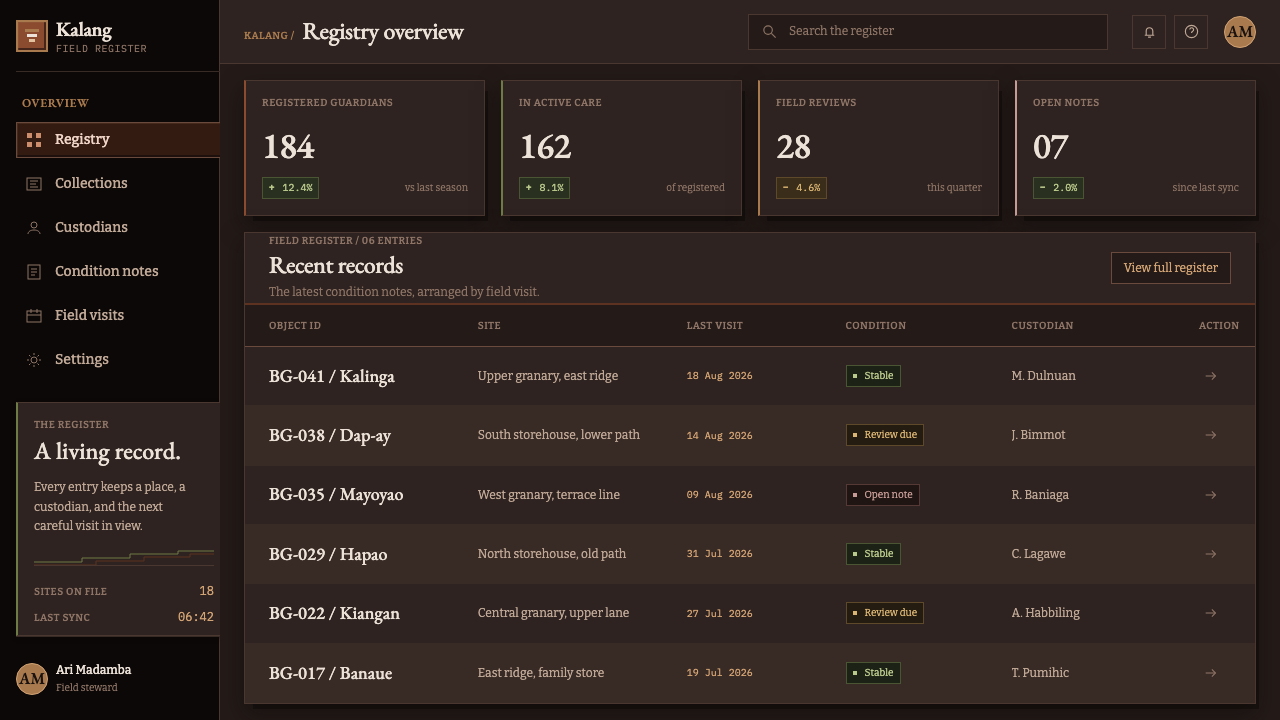
Ifugao Bulul is best used for dark, contemplative, archive-like projects: collections, museums, heritage documentation, long-form editorial, quiet products where interaction is meant to feel physical, and any experience built around discovery by touch. It works because it makes color rare and interaction meaningful.
On slides, the cover can be a dark field with a single plate-like block of text and one small area of narra red, perhaps along an edge. Content slides should be treated as catalog plates, one object or idea at a time, with a small caption. Data slides work as quiet charts on the dark ground in which only the focused series, the one you want the audience to touch, shows red, while everything else stays in muted tones.
On the web, the style suits portfolios, archives, knowledge bases and content-heavy products. Use the near-black ground, plate-like cards with a single deep shadow, and long, slim dividers. Make red an interaction color: hover, focus, selection and completion reveal it, like handled wood. Dashboards should keep most of the screen dark and calm and let red mark only what needs attention. Pricing pages can present plans as heavy blocks, with the selected one worn through to red.
For editorial and marketing work, it fits stories about craft, ritual, memory, place and objects that carry history. Long articles can use a narrow column of light text on dark, plate-like images with small captions, and contour-style rules between sections. Marketing pages work when they let one object or claim stand in a lot of darkness and trust the viewer to approach it. The tone should be slow, specific and grounded.
A common mistake is to turn the style into generic tribal decoration: patterns, textures or carved-looking icons that have nothing to do with the logic of wear. The borrowed idea is patina and touch, not a motif. Another is to flood the surface with red, which destroys the reveal, or to add glow, gradients or soft shadows that fight the heavy, matte feel. Because the bulul belongs to a living ritual tradition, avoid using the figure itself as a mascot or icon, and credit sources and collections when you reference real objects.
Ifugao Bulul — FAQ
What is a bulul?
A bulul is a carved guardian figure of the Ifugao people of northern Luzon, cut from a single block of narra heartwood and placed in the rice granary. It sits with knees drawn up and hands on the knees, with a face reduced to a few blunt planes. It is a working object in a living tradition, touched in rites such as tunod, and not simply a decorative sculpture.
Why is the style almost black, with red only in certain places?
Because that is how the figure looks. Decades of blood, oil, rice wine, food offerings and cooking smoke build a thick crust that reads near black in the dark of the granary. The red wood shows only where handling has worn the crust away. The style turns that into a rule: dark is the default, red is a reveal, and red appears only where something has been touched or opened.
Does the style require images of the figure itself?
No. The style borrows the logic of the object, which is mass, patina, wear and touch, not its image. If you do show real objects, use documented sources, such as museum collections, and credit them. A bulul is a ritual object of a living tradition, so avoid turning its likeness into a mascot, logo or decorative pattern.
Can it work on a light background?
Not really. The dark ground is the heart of the idea, because the whole system depends on red emerging from near black. On a light background you lose the relationship between crust and wood, and the red would simply be one more color. If you need a light surface for some reason, keep it small and treat it as a plate, a single inset on a dark page rather than a reversal of the system.
Where does this style struggle?
It struggles where speed, brightness or playfulness are the goal, such as promotional retail, children's products or high-energy consumer apps. Heavy dark surfaces can also be tiring in long reading sessions if contrast and spacing are not handled with care. And it should not be used lightly for subjects unrelated to its source; it is a good fit when the subject itself involves memory, craft, place or touch.
Related design styles
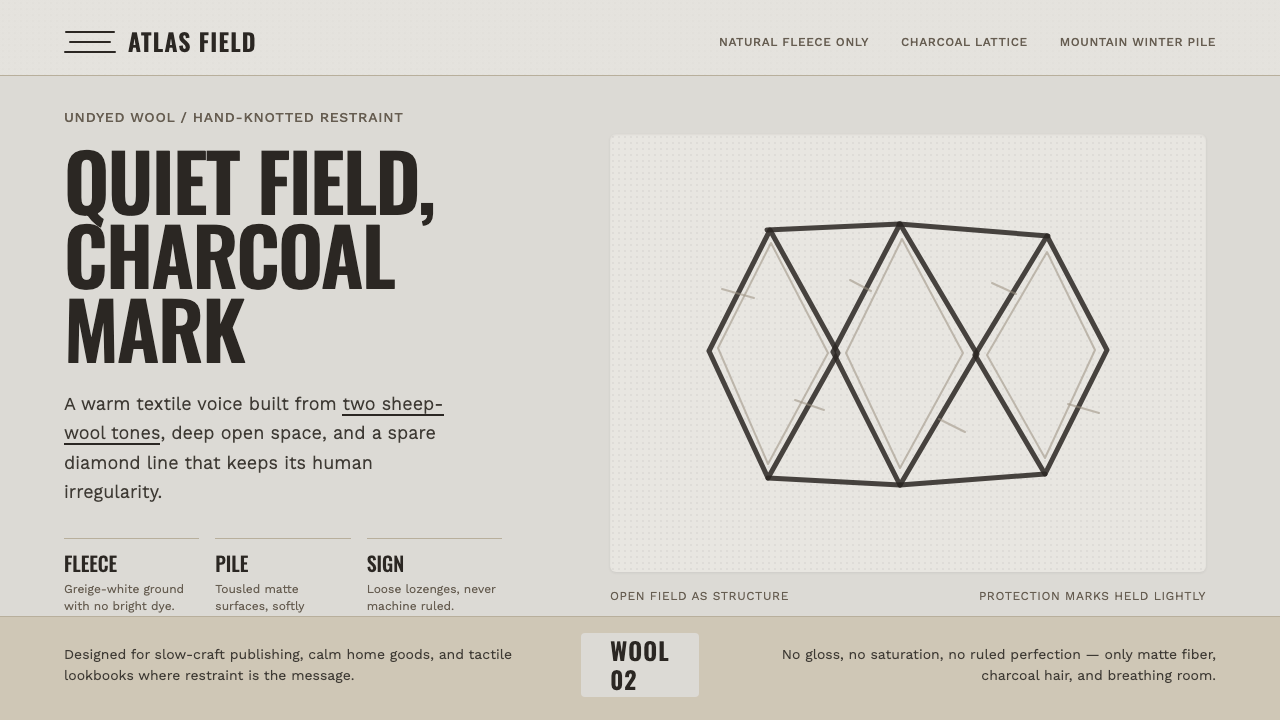 Beni Ourain Berber CarpetRestraint feels tactile. Greige wool field, Oswald type, and a loose charcoal…
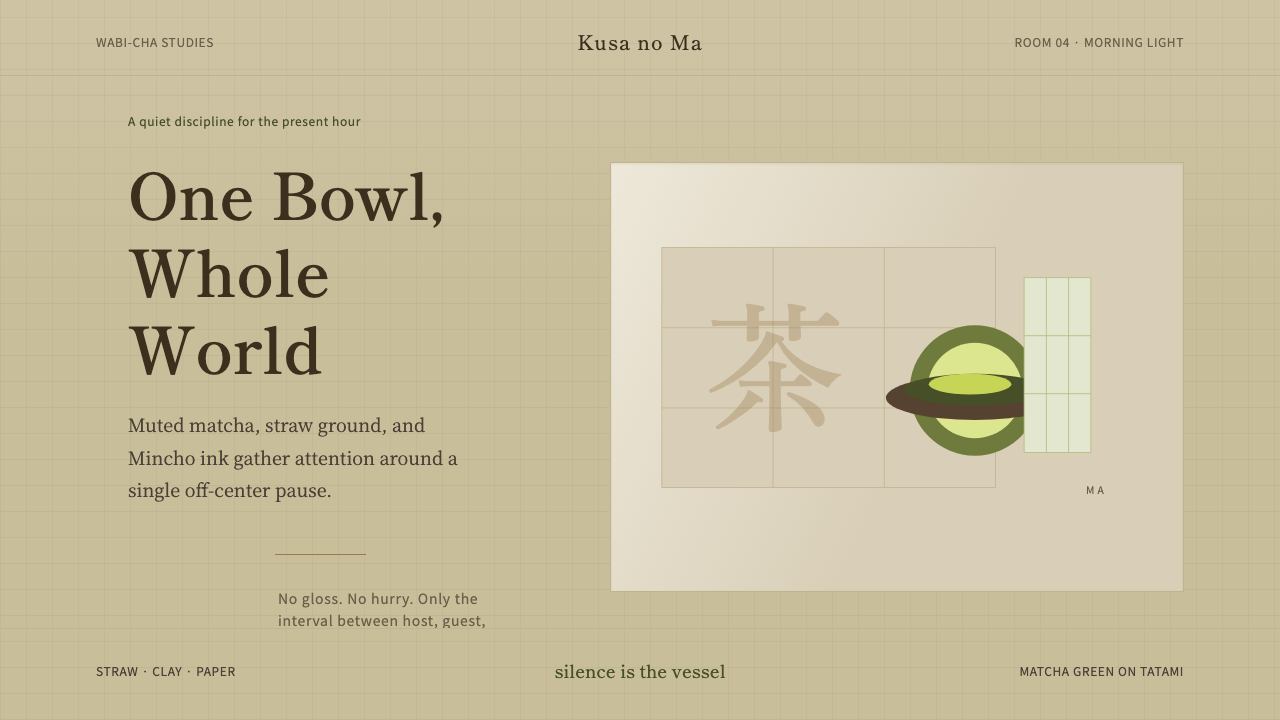 Japanese Tea CeremonyStillness has weight. Tatami straw, matcha green, and Mincho type leave room…
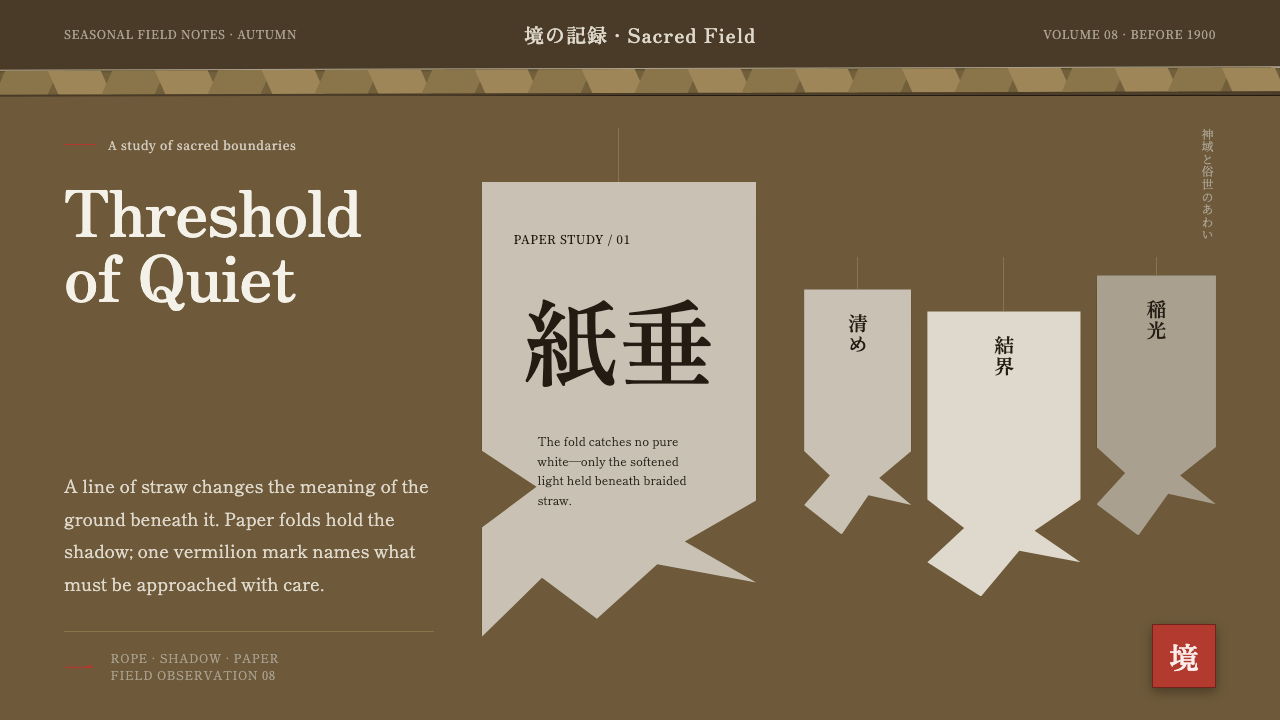 Shinto Shide Paper StreamerQuiet becomes sacred. Shadowed washi hangs from a straw-gold line, marked onc…
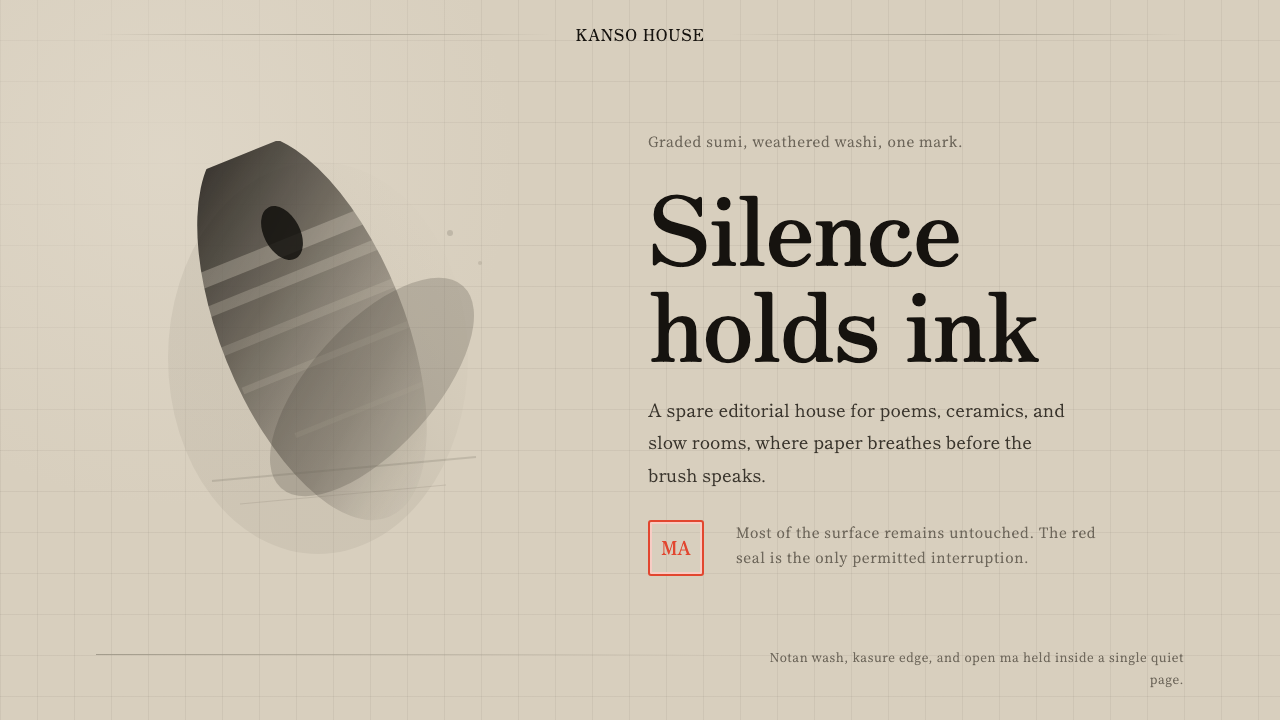 Sumi-e Ink WashRestraint carries weight. Washed black ink floats on oatmeal washi, anchored…
 Washi Paper MinimalQuiet is material. Warm kozo grain, sumi specks, and hairline rules hold the…
 Guérande Fleur de SelCrystal white is the exception. Mineral serif and hairline grids rise from we…