What is Uyghur Etles Silk?
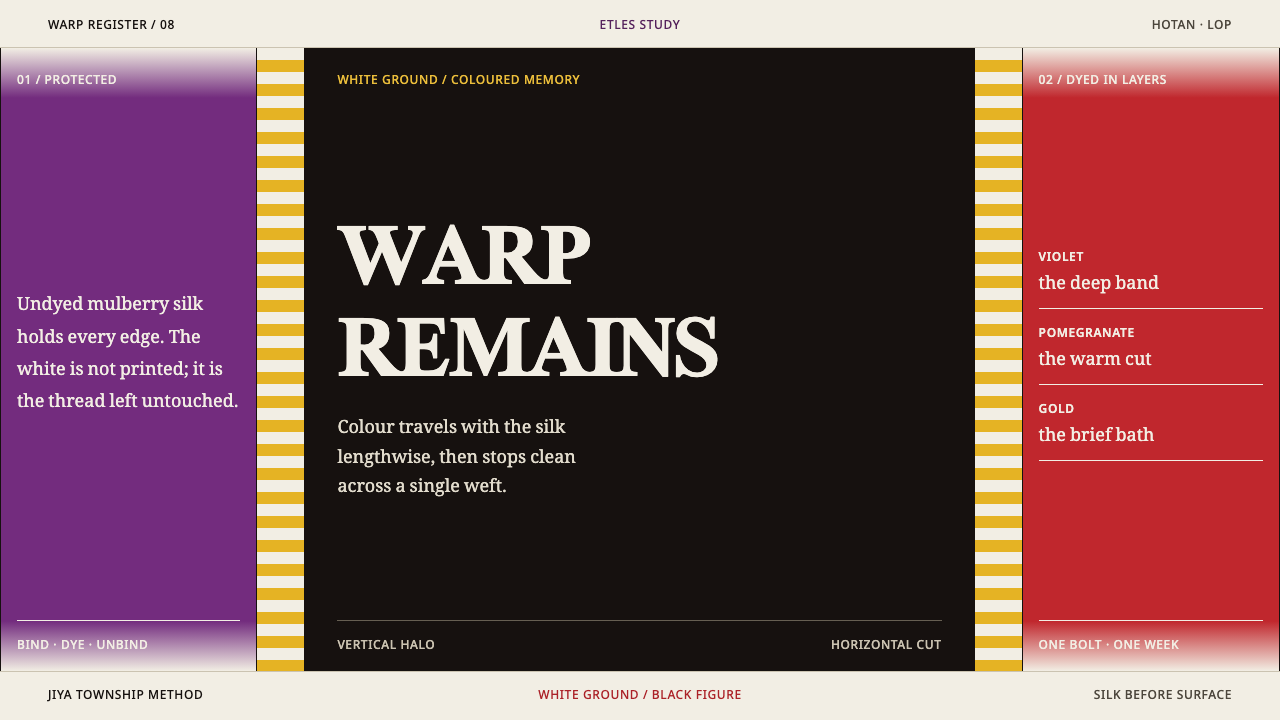
Etles is silk dyed before it is woven: colour that feathers along the warp, stays sharp across it, and lets undyed white silk draw every outline.
Uyghur Etles Silk in brief
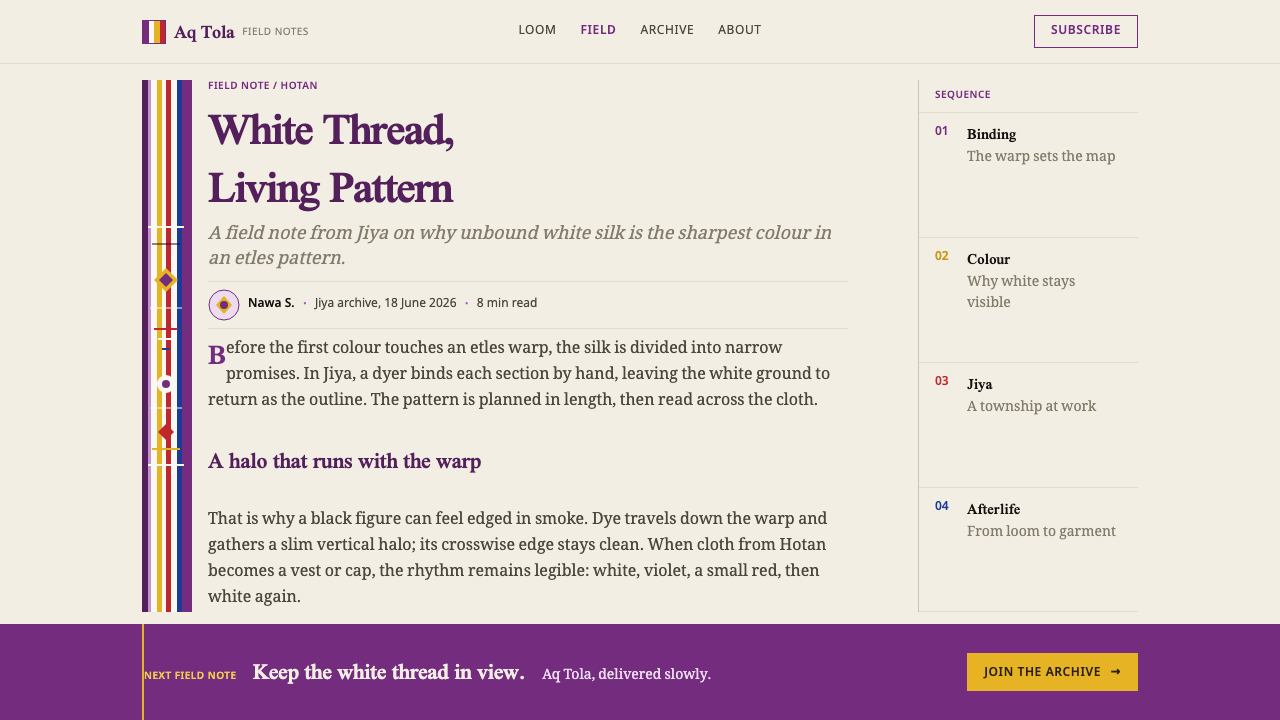
Uyghur Etles Silk is a design style based on etles, the warp-ikat silk of southern Xinjiang. In ikat, the threads are patterned before weaving rather than after: the mulberry-silk warp is bound in sections and dyed in layers before a single weft crosses it. The sections that were bound never take colour, so undyed white silk becomes at once the ground and the outline of every motif.
The look this produces is unmistakable. Every figure carries a soft, feathered halo along its vertical length while its edges across the cloth stay crisp. That difference between vertical bleed and horizontal precision is the entire grammar of the style, and it organises everything from single motifs to whole pages: bands run vertically, are mirrored about their axis, and are built from almond and comb silhouettes rather than generic icons.
Hotan and Lop cloth is prized above all for its black-and-white reading, worked either as a white ground with black motifs or a black ground with white motifs, with red-white and blue-white pairings and small hits of gold and sapphire. The design keeps that priority: a strong light-and-dark relationship first, then bands of violet and pomegranate that feather only along the length of the silk, and colour pairs held to a few chosen combinations.
Where does Uyghur Etles Silk come from?
Etles belongs to the old Central Asian tradition of warp ikat, known by the term abrbandi, often glossed as cloud-binding, a name that suits the way dye drifts into soft edges along the thread. Hotan, Lop and Jiya township in southern Xinjiang, China, are its centres. Jiya township is the main place of production, and households of dyer-weavers there carry the craft, while the Hotan and Lop workshops are the other reference points for the cloth the style imitates.
Making etles is a staged process. The warp threads are laid out and sections are bound tightly according to the pattern, so the dye cannot reach them. The warp is then dyed, bound again in different places and dyed in another colour, building the design layer by layer. Only when this is finished does the weaver put the warp on the loom and pass the weft across it. At Jiya a craftsperson weaves one bolt a week using eight colours, and the colours must be planned in advance, because the pattern is fixed in the threads before weaving begins.
The tradition recognises four classes of etles, called black, red, yellow and the Shache style. For a designer the point is that etles is not one fixed colour scheme but a family with its own internal logic: a strong black-and-white reading at the base, red-white and blue-white pairings as familiar variants, and small hits of gold and sapphire as accents. Choosing within that family is a matter of restraint, not abundance.
In 2008 etles was added to China's national list of intangible cultural heritage, a recognition of both the technique and the households that keep it alive. That status matters for how the style should be used: it points at a living craft rather than a historical pastiche, and a design that borrows its logic should respect where the logic comes from. The warp, the binding and the dye are the craft; everything else, including this interface vocabulary, is translation.
What defines the Uyghur Etles Silk look?
Vertical Feathering, Horizontal Precision
Dye travels along the warp, so every figure has a soft, feathered halo running down its length while its edges across the cloth stay clean. Translated into design, blur or fade is allowed in one direction only, along the vertical, and edges that run vertically stay crisp at the sides. This single asymmetry is the signature of the style and the quickest way to recognise it.
Undyed White as Ground and Outline
Because the bound sections never take dye, the white of the silk is not a background added later. It is both the ground and the outline of every motif, a thin line of unpainted silk between one colour and the next. In layout, white acts as the separating line between colour fields, and each colour band is bordered by a quiet strip of white rather than by a drawn stroke.
Black-and-White Reading
The cloth of Hotan and Lop is prized for how it reads in black and white, worked either as white ground with black motifs or black ground with white motifs. Light and dark come first, and colour second. A page in this style should still hold its structure if it were reduced to two tones, with colour added only afterward as a refinement.
Paired Colour Bands
Colour arrives in pairs: red with white, blue with white, and bands of violet and pomegranate that feather only along the silk. Gold and sapphire appear as small hits, never as fields. The palette is rich but disciplined, and each band has a partner and a limit, which keeps the whole from becoming a rainbow.
Mirrored Narrow Bands
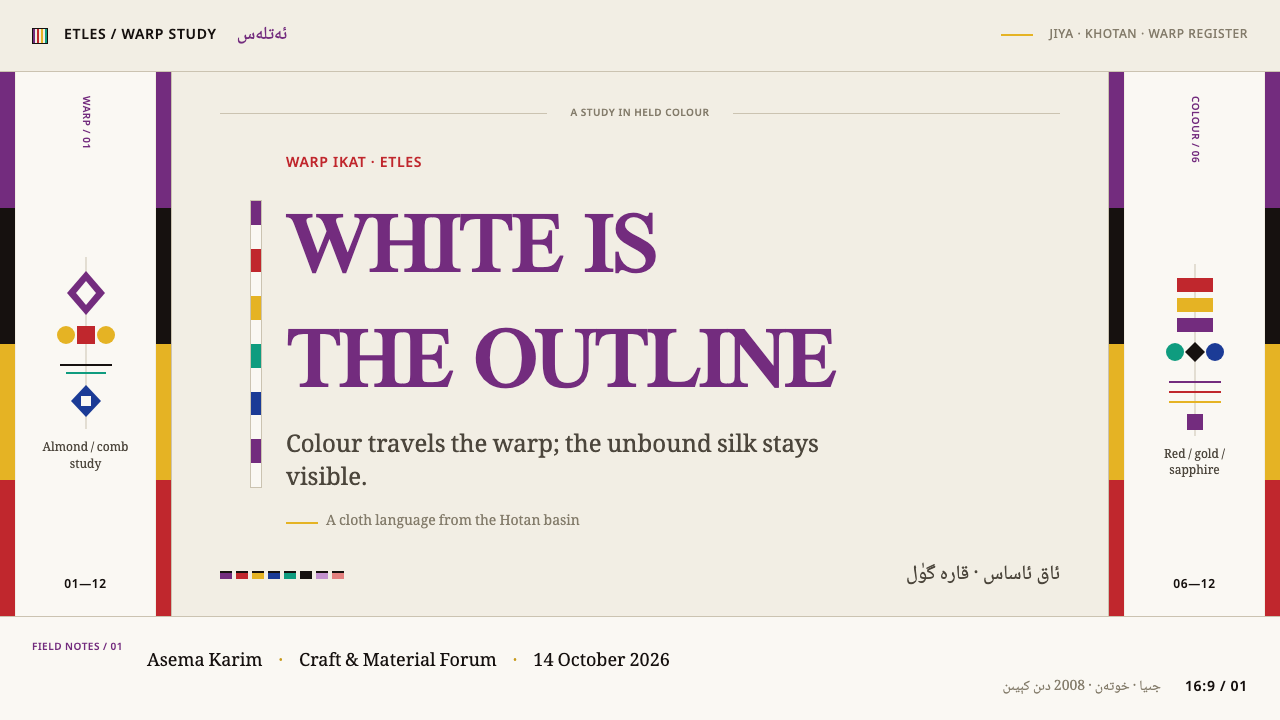
Compositions are built from narrow vertical bands, mirrored about their axis. The pattern reads as a series of upright stripes, each a small symmetrical world, repeated across the width of the cloth. In layout this suggests columns and sidebars that are symmetrical in themselves, with a clear central axis, rather than a freely scattered arrangement.
Almond and Comb Silhouettes
Motifs are silhouettes, not icons: an almond shape, a comb shape, reduced to the outline the dye leaves behind. They carry no inner detail beyond what the tying could produce. When illustrating in this style, use these plain shapes as the vocabulary and resist drawing small realistic pictograms, which would be foreign to the cloth's logic.
Who shaped Uyghur Etles Silk?
Jiya township is the main place of etles production, and its dyer-weaver households are the living centre of the craft. A craftsperson there weaves one bolt a week using eight colours, tying and dyeing the warp long before the loom is touched. The style's patience and its insistence on planning ahead come from this household rhythm: a design has to be decided before it can be made.
The workshops of Hotan and Lop are where the cloth's black-and-white reading is most prized. Their work sets the standard for how white ground, black motif, and the red-white and blue-white pairs should look, with small hits of gold and sapphire. For a designer they are the reference: a strong two-tone structure, then colour in measured pairs.
Abrbandi is the Central Asian tradition of warp ikat that etles belongs to, and the four traditional classes of etles, black, red, yellow and the Shache style, sit inside it. It is a shared craft language across a wide region, not a single maker's invention. A design borrowing from it should speak the language correctly, with bound-and-dyed logic intact, rather than imitating only the surface.
How do you use Uyghur Etles Silk today?
Uyghur Etles Silk suits subjects that value craft, process and measured richness: textiles and fashion, heritage and cultural publishing, tea and food brands with a story, jewellery, travel and craft marketplaces. It is a light-first style with a strong black-and-white reading, and its liveliness comes from structure rather than from busy colour.
On slides, a cover can be a pale ground with narrow vertical bands down one side, mirrored about their own axis, and the title set beside them in plain type. Content slides organise information into vertical columns separated by thin white gaps; data slides suit vertical bars whose tops fade softly while their sides stay crisp, a direct echo of the warp. Keep colour to one pair, such as red with white.
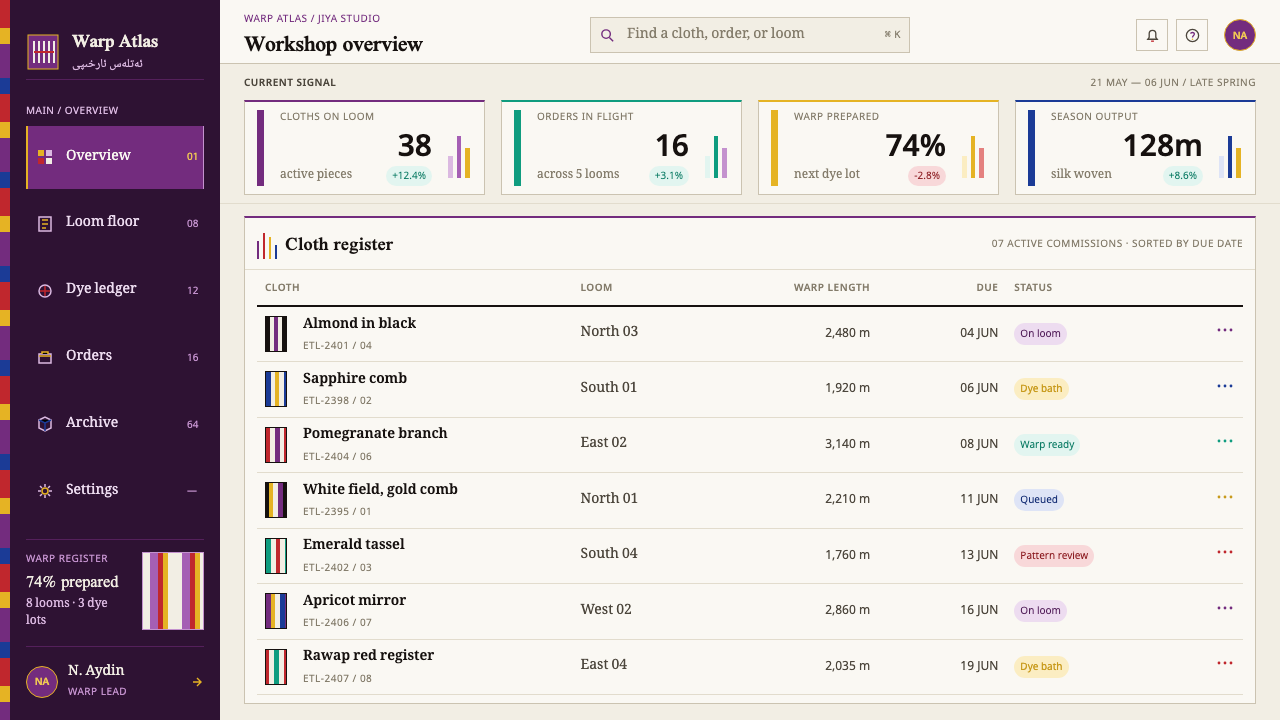
For web interfaces, vertical band dividers, narrow sidebars and symmetrical hero strips work well, as do product pages for textiles and crafts. Allow soft fades along the vertical axis only: a feathered edge on the top or bottom of an element, never on its left and right. Let white act as the separating gap between cards and bands, and reserve the richer colours for a single accent band.
In editorial and marketing work, a cultural feature, a craft profile or a collection catalogue can use mirrored almond and comb silhouettes as dividers and section markers. Pair a strong two-tone headline with a narrow colour band that echoes the cloth, and credit the craft and its place of origin plainly in the copy. The style rewards a few well-chosen pairs far more than a full palette.
A common mistake is to feather in every direction. Blurring all four sides of a shape produces generic soft gradients and loses the crisp-against-feathered asymmetry that defines the style. Others include using every colour at once, filling the page with small realistic icons instead of almond and comb silhouettes, and treating the pattern as exotic wallpaper. Used well, the style should feel like a precise craft, not a costume.
Uyghur Etles Silk — FAQ
What is etles, and what is ikat?
Etles is the warp-ikat silk of southern Xinjiang, made in Hotan, Lop and above all Jiya township. In ikat the threads are patterned before weaving: the warp is bound in sections and dyed in layers, and only then is the weft passed across it. The bound parts stay undyed, which is why white silk both grounds and outlines every motif.
Why are the edges soft vertically but sharp horizontally?
Because dye migrates along the warp. Colour bleeds slightly down the length of each thread, which feathers every figure vertically, while across the cloth the threads are side by side and each one keeps its own colour, so horizontal edges stay clean. In design, this means blur on the vertical axis only, never on both.
How many colours should I use?
Far fewer than a full palette. A craftsperson at Jiya works with eight colours in a bolt, but the style reads through a black-and-white structure, one or two chosen pairs such as red-white or blue-white, and small hits of gold and sapphire. If your layout looks like a rainbow, the pairs have been lost.
Can this style work on a dark ground?
Yes. The tradition itself works both ways, with white ground and black motifs or black ground and white motifs, so a dark version is faithful rather than a compromise. Keep the same grammar: feathering only along the vertical, crisp horizontal edges, white as the outline between colours, and a few chosen colour pairs.
How should I treat the cultural origin of this style?
As a living craft, not a decorative resource. Etles was added to China's national list of intangible cultural heritage in 2008, and it is made today by dyer-weaver households in places such as Jiya township. Name the craft and its place of origin in your copy, borrow its logic correctly, and avoid using the pattern as exotic wallpaper.
Related design styles
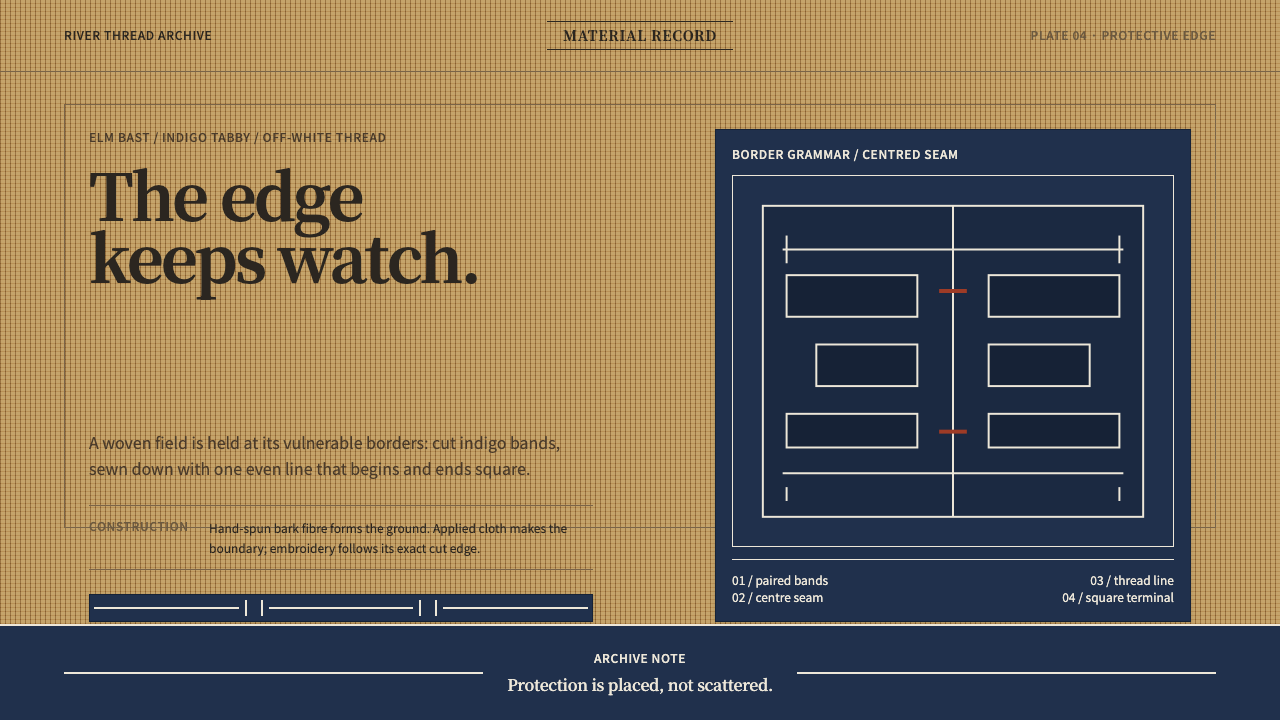 Ainu Attus RobeProtection is cut, not painted. Indigo bands and square-ended thread hold elm…
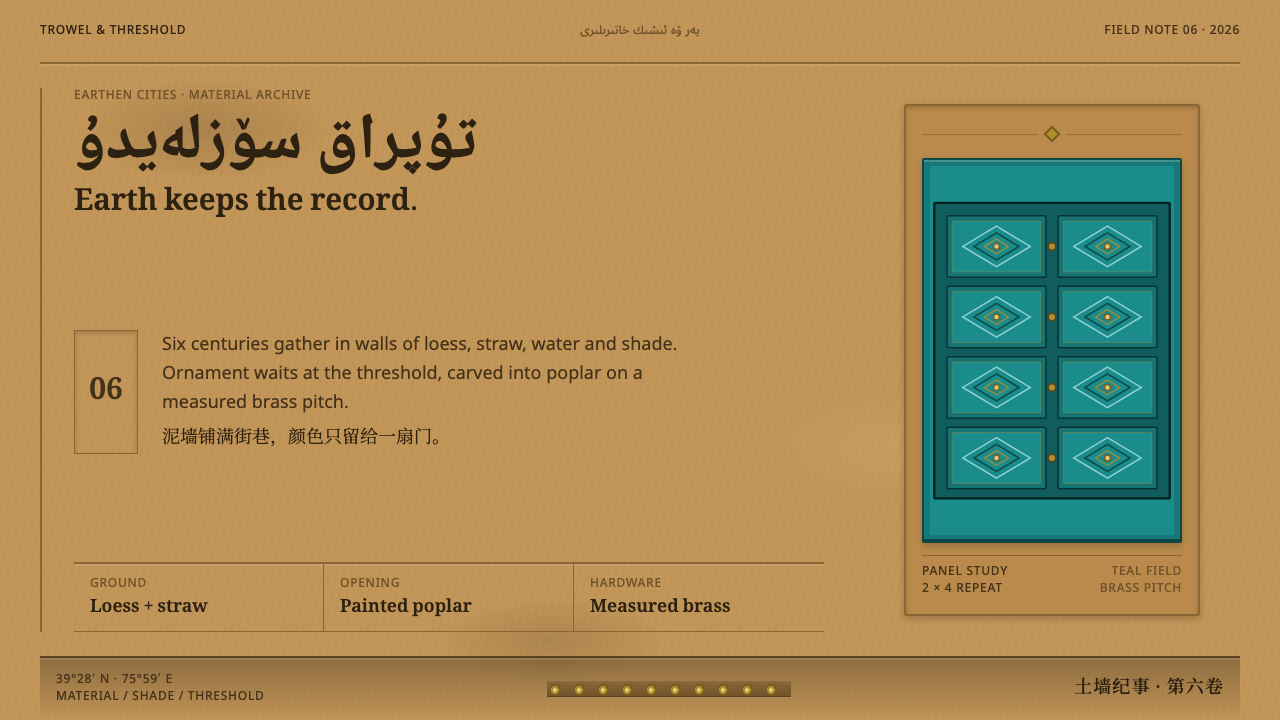 Kashgar Old TownEarth holds the field; ornament waits at one teal door, cut in a strict brass…
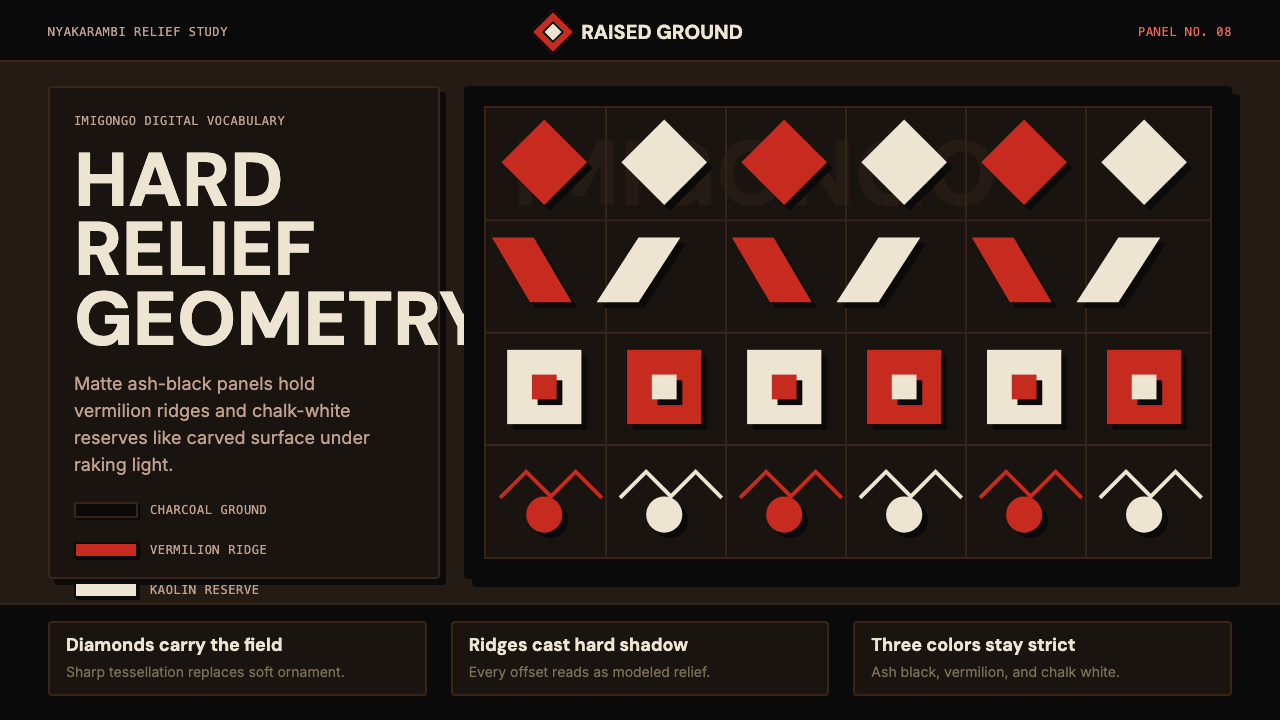 Rwandan Imigongo Cow-Dung ReliefRelief becomes digital. Ash-black grids, vermilion ridges, chalk-white reserv…
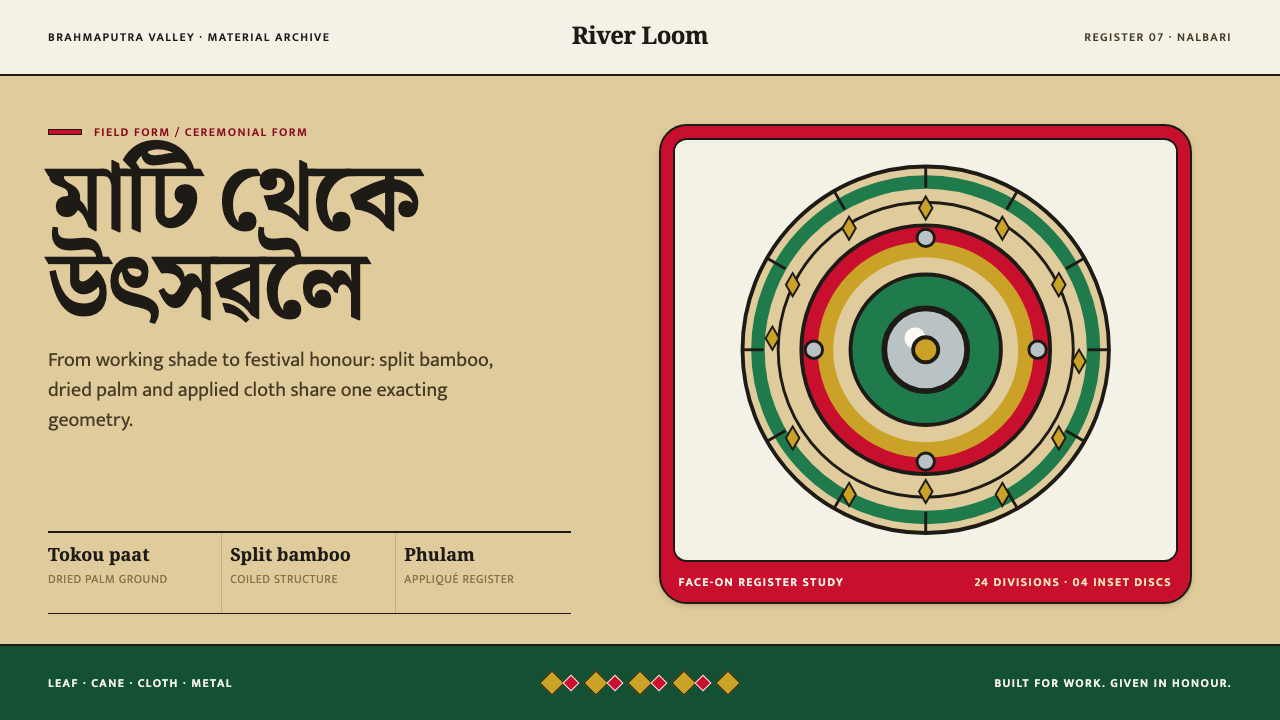 Assamese JapiWork becomes ceremony. Straw-gold rings carry green appliqué, festival red an…
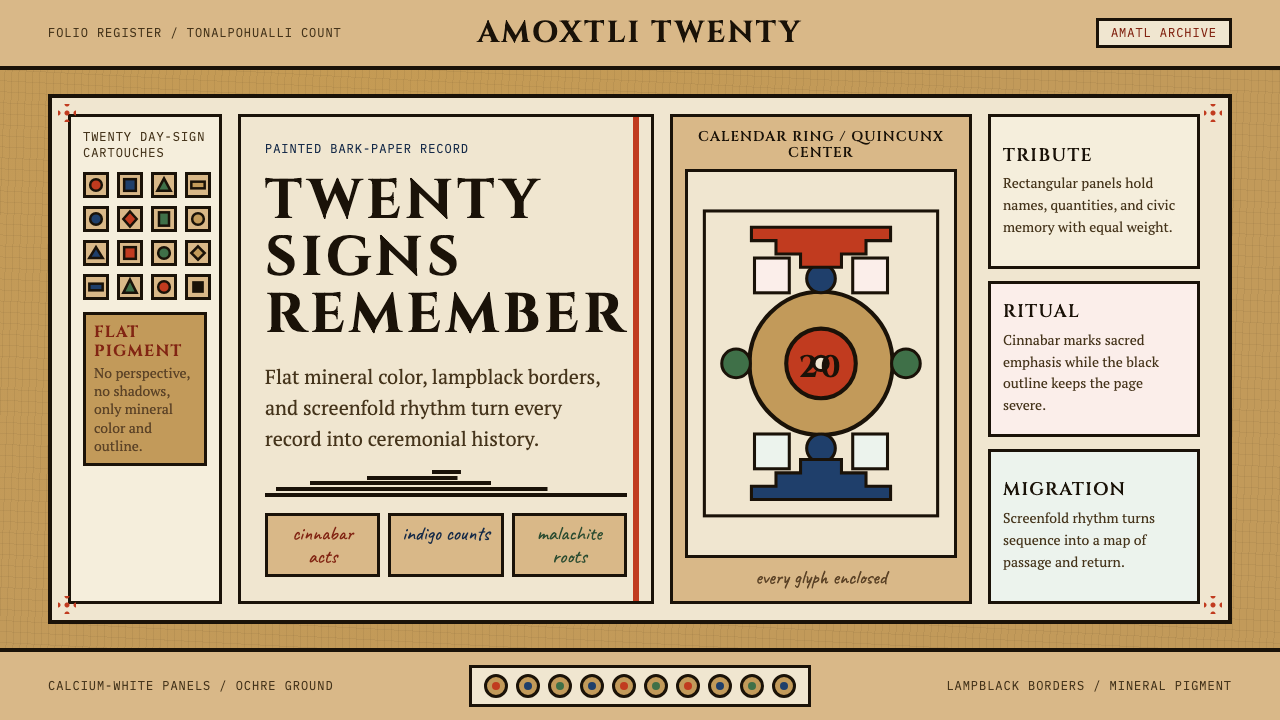 Aztec CodexSacred records stay severe. Ochre amatl ground, Cinzel capitals, black cartou…
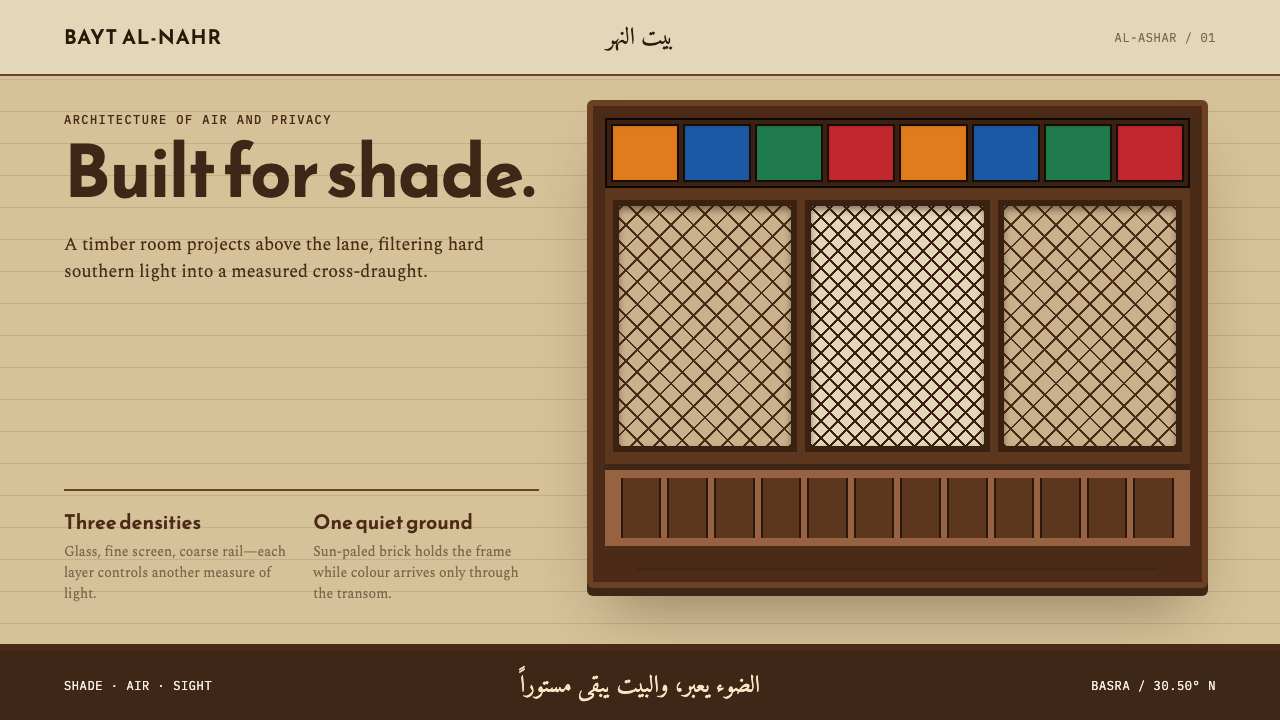 Basra ShanasheelClimate craft becomes ornament. Dark timber lattice projects over sun-paled I…