What is Assamese Japi?
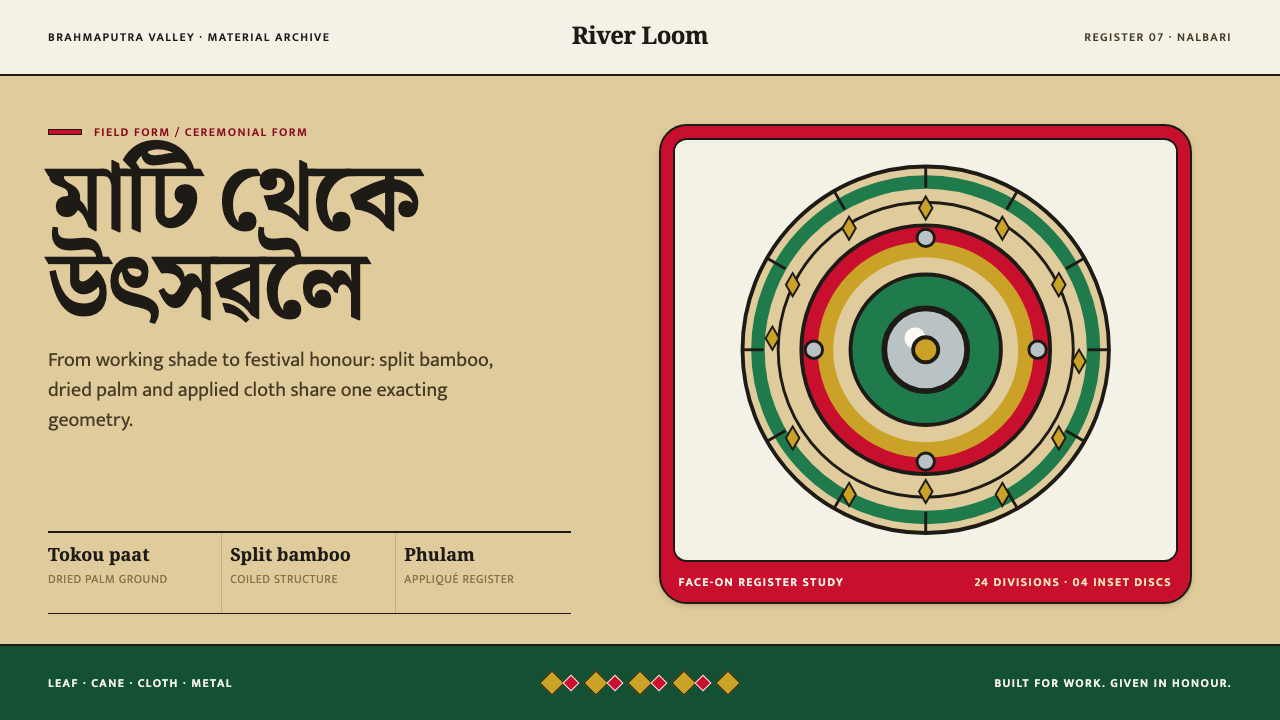
The japi lives two lives — a plain bamboo shade in the field, and, dressed in red cloth and mirror glints, the honour handed over at a festival — and a design system built on it learns when to work and when to celebrate.
Assamese Japi in brief
Assamese Japi is a style drawn from the japi, the conical hat of Assam in north-east India. A japi is made of split bamboo woven over tokou paat, the dried leaf of the Trachycarpus martianus palm, into a low cone that sheds sun and rain. Seen from above, as a layout invites you to see it, the hat is a set of concentric rings spreading outward from a single point at the apex. That geometry, together with the double life of the object, is the foundation of the visual system.
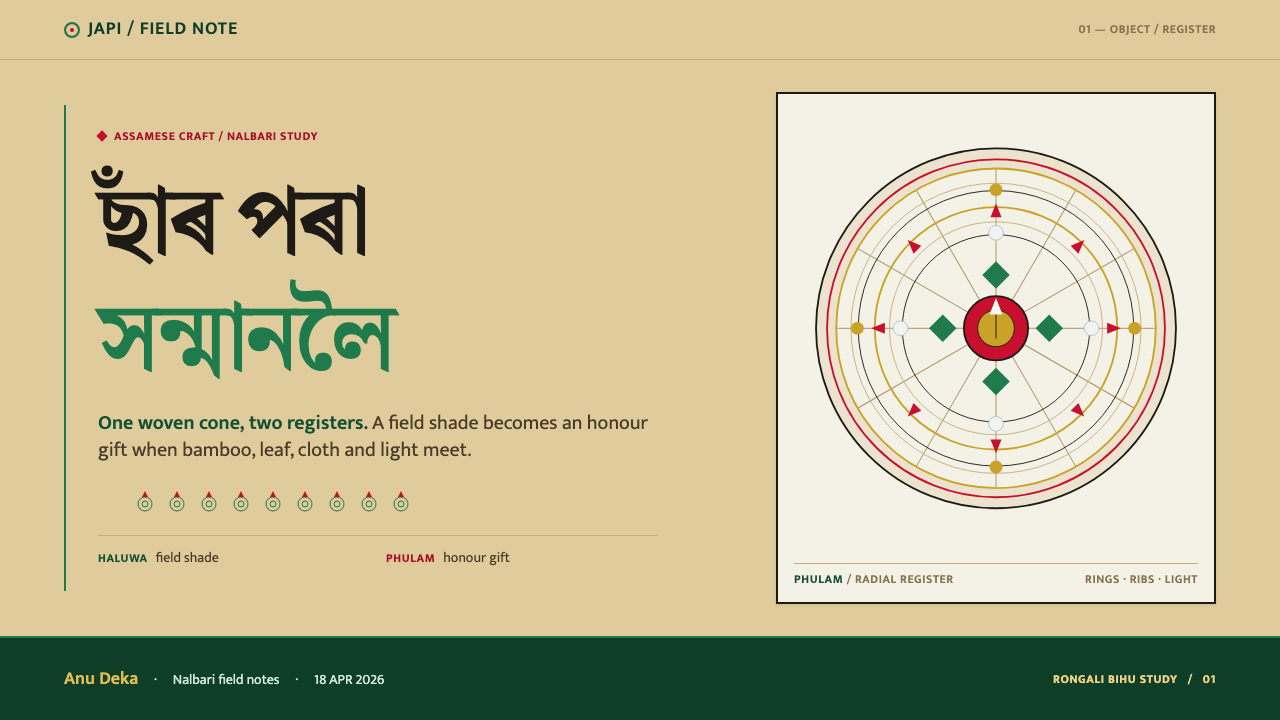
The style keeps both of the japi's forms. The plain haluwa is a cultivator's shade, undecorated straw and cane, worn until it stains and splits. The phulam form, made most famously at Nalbari, covers the same cone with cloth appliqué against a bright red ground. One hat works in the field; the other is handed over at felicitations and at Rongali Bihu. In design terms this becomes two registers, a quiet working one and a ceremonial one, living in the same system and sharing the same structure.
Visually the system is warm and built from rings. Straw gold supplies the ground and the woven texture of everyday surfaces. Festival red, green appliqué shapes and a single gold finial supply the ceremonial register. Motifs are flat cut-cloth shapes: spiked double rings, crescent moons, butterflies set inside circles, small round mirror discs. Surfaces are matte and handmade, edges are cut rather than blurred, and a good deal of the page is left as plain weave.
Where does Assamese Japi come from?
The japi is older than any record that can fix its date; the source material places it as pre-1900 and much older. It is made across the Brahmaputra valley, the long river plain that runs through Assam. Its name comes from jaap, a bundle of the palm leaves over which the bamboo is laid. Construction is plain: split bamboo is woven into a framework, and the dried leaves, known as tokou paat, are laid in so that the cone stays light and sheds water. A plain japi is therefore a piece of agricultural equipment first, a shade against sun and rain for people who spend the day bent over a field.
That plain form is known as haluwa, or gorokhiya after the cultivators who wear it, and it carries no decoration at all. It is used hard, until it stains and splits, and nobody pretends otherwise. The decorated form, the phulam japi, developed alongside it, and its current Nalbari form dates from roughly the nineteenth century onward. Nalbari is the centre for phulam japi, and the work there is done by hereditary japi-making households, families in which the craft passes from one generation to the next. The decorated hat is therefore not a factory souvenir but the specialised product of a place and its people.
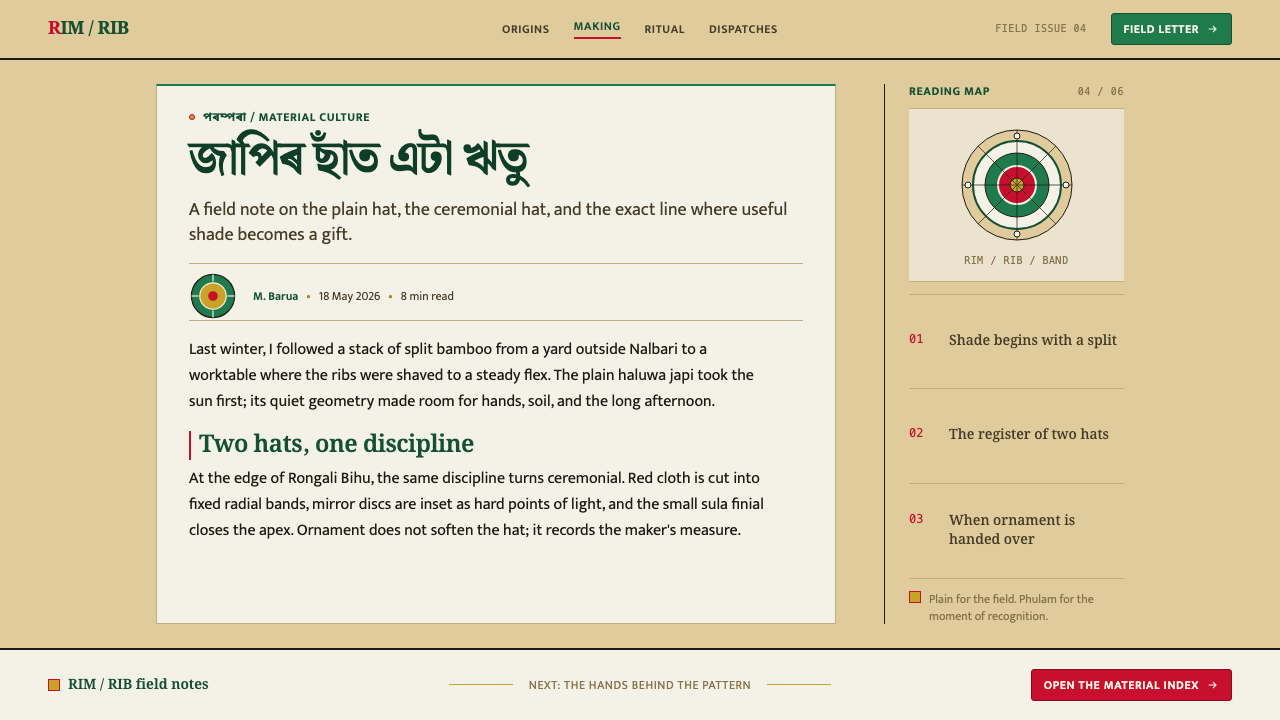
On the phulam hat the same cone is covered in cloth against a bright red ground. Appliqué shapes — spiked double bamboo-split circles, crescent moons, butterflies set in circles — are stitched on, small mirror discs are set in, and a metal sula finial in silver or gold caps the apex. Rank and ceremony were part of the story from early on: the Ahom nobility wore the bordoi japi, a form of the hat worn by that ruling class, and the Chinese pilgrim-monk Xuanzang, also written Hiuen Tsang, is listed among the figures associated with the hat's long history. How much of that history can be documented is a different question from how old the tradition is felt to be, and this style treats it as a sign of depth rather than a claim of proof.
The source material places the japi where three traditions meet: Assamese bamboo and cane craft, cloth-appliqué and mirror-work decoration, and the material culture of the Bihu festivals. Rongali Bihu is one of the occasions at which the decorated hat is handed over. For a design system, the lesson is that the object never stopped being useful while it became symbolic. The plain hat and the decorated hat share a cone, a weave and a purpose. That is why this style keeps both of them: the plain register for everyday interface, the ceremonial register for the one screen that matters.
What defines the Assamese Japi look?
Concentric Ring Structure
The cone viewed from above becomes a set of rings around one centre, and the style uses that as its basic layout figure. Compositions radiate from a single point, whether that is a title, a badge or a hero number, and bands of colour or texture step outward in rings. Radial symmetry is the default, but a ring system can be anchored to a corner or edge so that only part of it shows, which keeps layouts from feeling static.
Straw-Gold Weave Ground
The everyday register rests on the colour and texture of split bamboo and palm leaf: a warm, yellowed straw gold with a fine woven grain. Surfaces are matte, lightly textured and slightly irregular, like a hat that has been worn. Text is set in a deep dark ink so that it holds against the warm field. The ground should feel used and honest, as the haluwa does, never polished.
Festival Red Ground
In the ceremonial register the ground turns to a bright, saturated red, the field on which the phulam hat is dressed. Red here is not an accent but a surface, large enough to change the mood of a whole screen from work to occasion. Because it is so strong, it appears only in selected places, and it is paired with straw and gold tones rather than with cool colours.
Green Appliqué and Cut-Cloth Shapes
Green appliqué and the other cut-cloth shapes sit on the red ground as flat, hard-edged pieces. Nothing is graded or shadowed; each shape looks stitched down. Appliqué colour is used for pattern rather than for text, and the shapes are simple enough to read at small sizes: rings, crescents, butterflies. Think of them as stamps cut from fabric, not as drawn illustration.
Spiked Double Rings and Motifs
The signature motif is the double ring with spikes: two concentric bamboo-split circles whose edge radiates short points like a sunburst. Crescent moons and butterflies enclosed in circles complete the vocabulary. Motifs repeat in rhythm around the ring rather than scattering, so the pattern behaves like a border or a dial. A small repertoire used consistently is more convincing than a large one used loosely.
Mirror Discs and the Gold Finial
Small inset mirror discs add tiny points of glint to the red ground, and a metal sula finial caps the apex with a single bright point. In an interface these translate into small, flat, round highlights and one deliberate focal accent, not into glossy effects. They work as punctuation. Use a few mirror discs near a key element and one finial-like gold point at the centre, and keep the rest of the surface matte.
Two Registers
The hardest idea in the system is that it deliberately holds two modes: the plain haluwa register for everyday work and the phulam register for moments that deserve ceremony. The registers share geometry, weave and proportion, so the move between them feels like putting on the festival version of the same hat, not like switching brands. Deciding which screen gets which register is the real design work.

Who shaped Assamese Japi?
Nalbari is the centre for the decorated phulam japi, and the families who make it are the keepers of this style's most elaborate vocabulary: spiked double rings, crescents, butterflies, mirror discs and the finial. Their current form of the hat dates from roughly the nineteenth century onward. For designers they stand for a principle of craft honesty: ornament that is cut, stitched and set by hand, and repeated with discipline.
The gorokhiya are the cultivators who wear the plain haluwa japi in the field, and they define the first half of the system. Their hat is undecorated straw and cane, worn until it stains and splits. They are the reason the everyday register is calm, matte, unadorned and unselfconscious, and the reason the ceremonial register means something by contrast.
The Ahom nobility wore the bordoi japi, a form of the hat worn by that ruling class, and their presence in the story shows that the japi has long carried questions of rank as well as shelter. In design terms, the bordoi tradition justifies the idea that the same basic object can scale up in ceremony: more finish, more ornament, more weight of occasion, without changing its underlying shape.
Xuanzang, also written Hiuen Tsang, was a Chinese Buddhist pilgrim-monk who travelled in India and left written accounts of the places he visited. The source material lists him among the figures associated with the hat's long history. The safest reading is as a marker of how old the Assamese material tradition is felt to be; links between particular hats and his travels belong to tradition and interpretation rather than settled documentation.
How do you use Assamese Japi today?
Assamese Japi is best used by people willing to treat the two registers as a real decision, not a colour option. The system is at its strongest when an interface has an ordinary working mode and a small number of moments of occasion, and it lets the design say which is which. Its geometry is radial, its surfaces are warm and matte, and its ornament is rationed.
For presentation slides, give the cover the ceremonial register: a red ground, a ring system spreading from a corner or the centre, a few cut-cloth motifs and a single gold point as a finial. Content slides should drop to the plain register with a straw-gold ground, dark text and quiet woven texture, so the audience feels the shift between occasion and work. Data slides suit radial forms such as donuts, sunbursts and radial bars, which echo the rings; use straw tones for baselines, green for positive change and red only for the figure that needs ceremony.
For web interfaces, apply the plain register to the dashboard, settings and everyday tools, and reserve the ceremonial register for milestone screens: completion, onboarding success, awards, annual summaries. In pricing, the recommended plan can be dressed in the festival register with a finial-like gold badge, while the other plans stay in the plain weave. Buttons are flat, cut-edge shapes, navigation is calm, and mirror discs appear as tiny round highlights on key controls.
For editorial and marketing work, the style suits cultural festivals, craft marketplaces, hospitality, tea and food brands, heritage storytelling and anything that wants to honour handmade work. Hero blocks can use a ring composition with the headline at its centre, and long articles can keep the plain register for body text while using the festival register for section openers. Credit the craft: name Assam, Nalbari and the makers where the context allows, and let the design speak with the people it comes from.
The common mistake is to wear the ceremonial register all the time. A hat that is always festive stops being a ceremony, so red, appliqué and gold should be earned by the moment. A second mistake is to scatter motifs as generic ethnic decoration, with no ring logic and no reference to the real japi. A third is to turn the mirror discs and finial into shiny gradients or sparkles; they are small, flat and matte, and their restraint is what keeps the surface believable.
Assamese Japi — FAQ
What is a japi, and what is the difference between haluwa and phulam?
A japi is a conical hat from Assam, made of split bamboo woven over tokou paat, the dried leaf of the Trachycarpus martianus palm. The haluwa, also called gorokhiya, is the plain form: undecorated straw and cane, worn in the field for shade against sun and rain until it stains and splits. The phulam is the decorated form, made most famously at Nalbari, in which the same cone is covered in cloth appliqué on a bright red ground, with spiked double rings, crescents, butterflies, mirror discs and a metal finial at the apex.
Why does the system keep two registers instead of one?
Because the object itself has two lives, and because interfaces do too. Most screens are everyday tools that should be calm, readable and unadorned. A few are moments of occasion: a goal reached, an achievement shown, a key plan presented. A single register would either make the whole product too festive to work in or too plain for the moments that matter. Two registers that share geometry and weave let the design change gear without changing identity.
Can Assamese Japi work on a dark background?
This theme is a light one, and its everyday register depends on the warm straw ground that the plain hat provides. A dark treatment is possible mainly for the ceremonial register, where a deep red can act as a night-time festival ground and gold and straw tones carry the rings and text. The plain register loses its meaning on a dark field, because without the straw ground there is no longer a hat to wear, only a pattern.
Is it appropriate to use these motifs in unrelated commercial work?
The motifs belong to a living craft and a specific community, so the respectful route is to use them with reference rather than as generic pattern. Keep the structure real: rings, spiked double circles, crescents and butterflies as they appear on the hat. Credit Assam and Nalbari where possible, and avoid casual use that strips the object of its meaning, such as treating the ceremonial register as a decorative skin for anything that needs to look festive.
How do I translate the weave, appliqué and mirror discs to screen without relying on images?
Treat them as flat geometry. The weave becomes a restrained, low-contrast grain on the ground; appliqué becomes hard-edged cut shapes in solid colours; mirror discs become small round highlights; the finial becomes a single bright point. Build rings from simple circles and concentric bands rather than from photographic texture. If a texture is used, keep it fine and quiet so text remains readable, and keep it off any area where users must read or enter data.
Related design styles
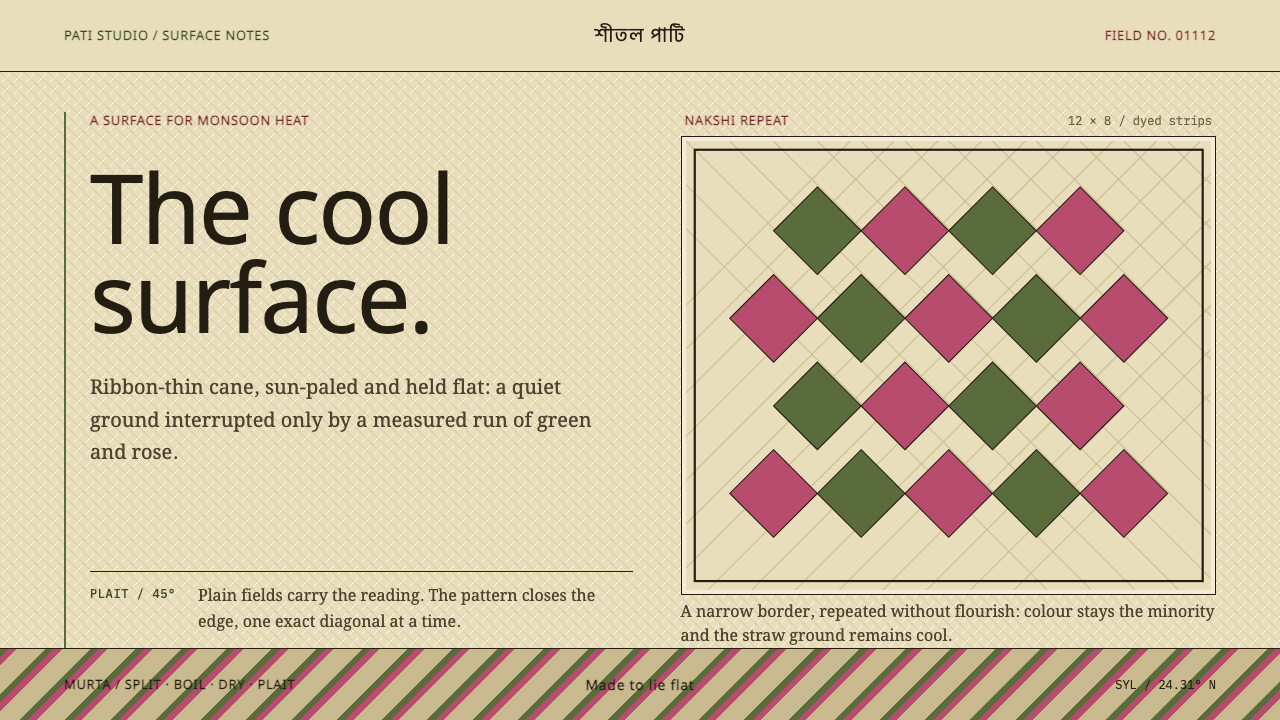 Sylheti Shital PatiCoolness lies flat. Pale straw fields hold cane-green and rose diamond repeat…
 Ainu Attus RobeProtection is cut, not painted. Indigo bands and square-ended thread hold elm…
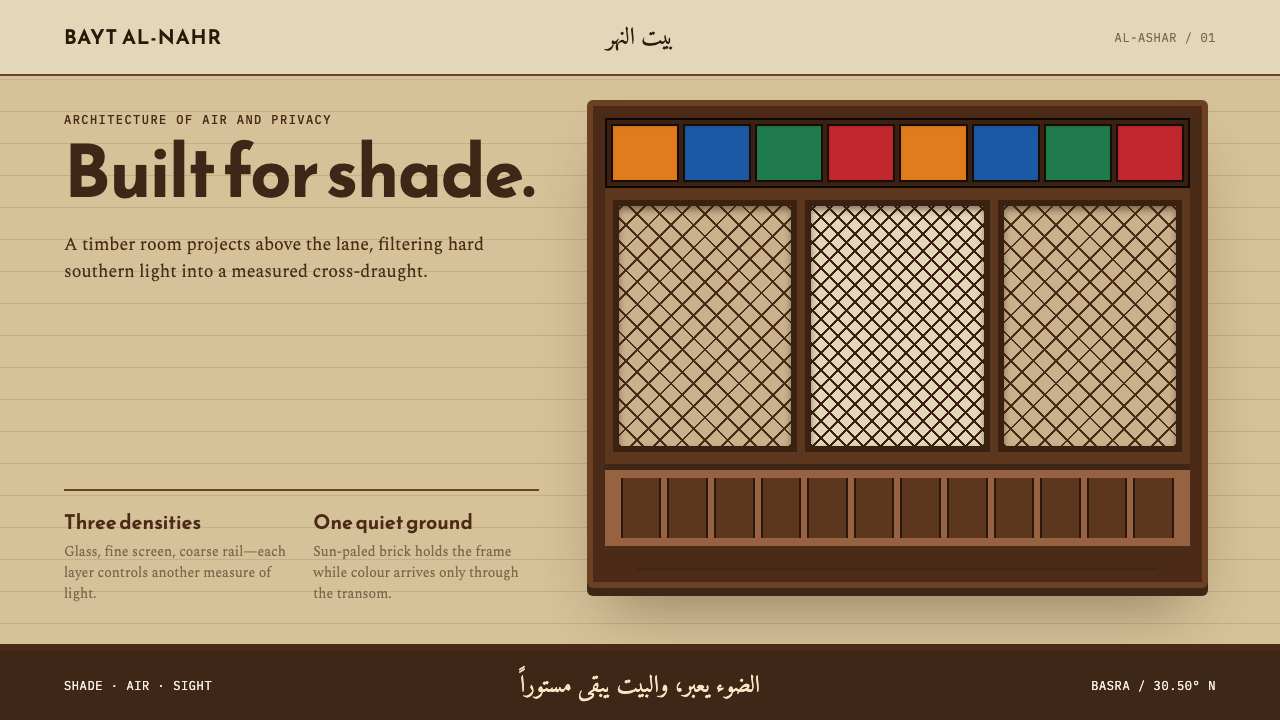 Basra ShanasheelClimate craft becomes ornament. Dark timber lattice projects over sun-paled I…
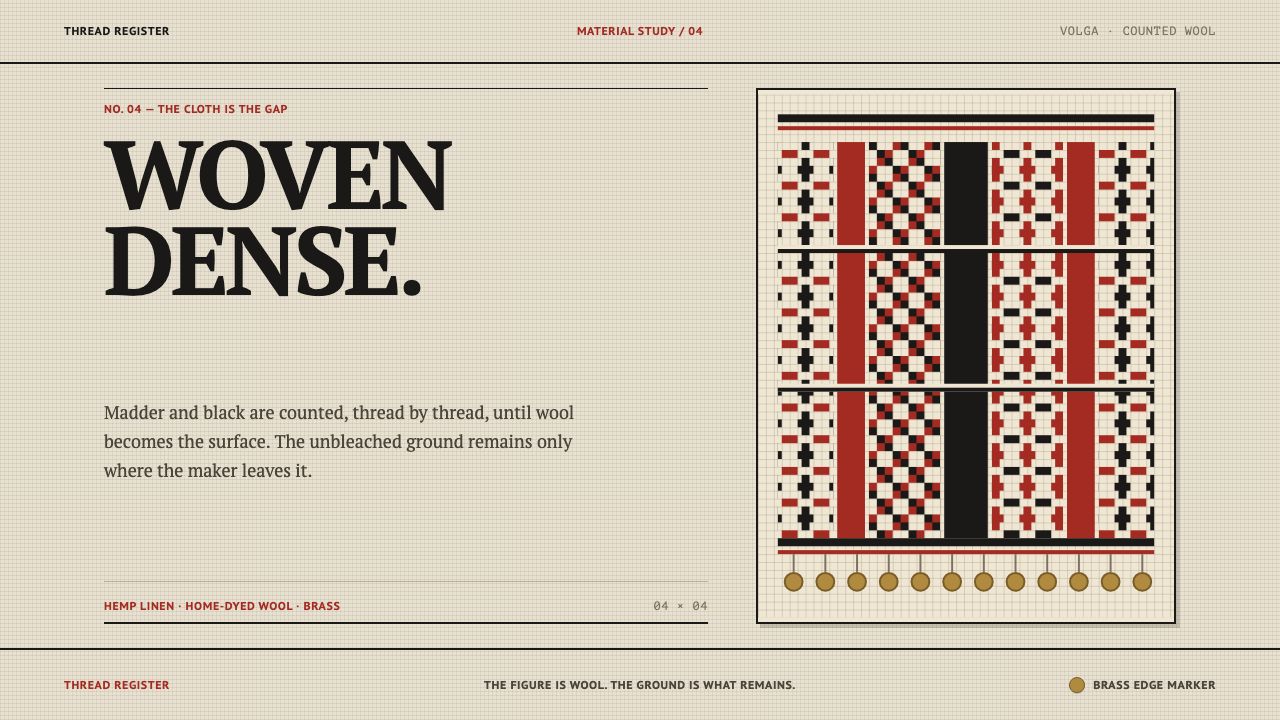 Erzya PangaDensity is the ornament. Madder and black stepped stitches crowd unbleached l…
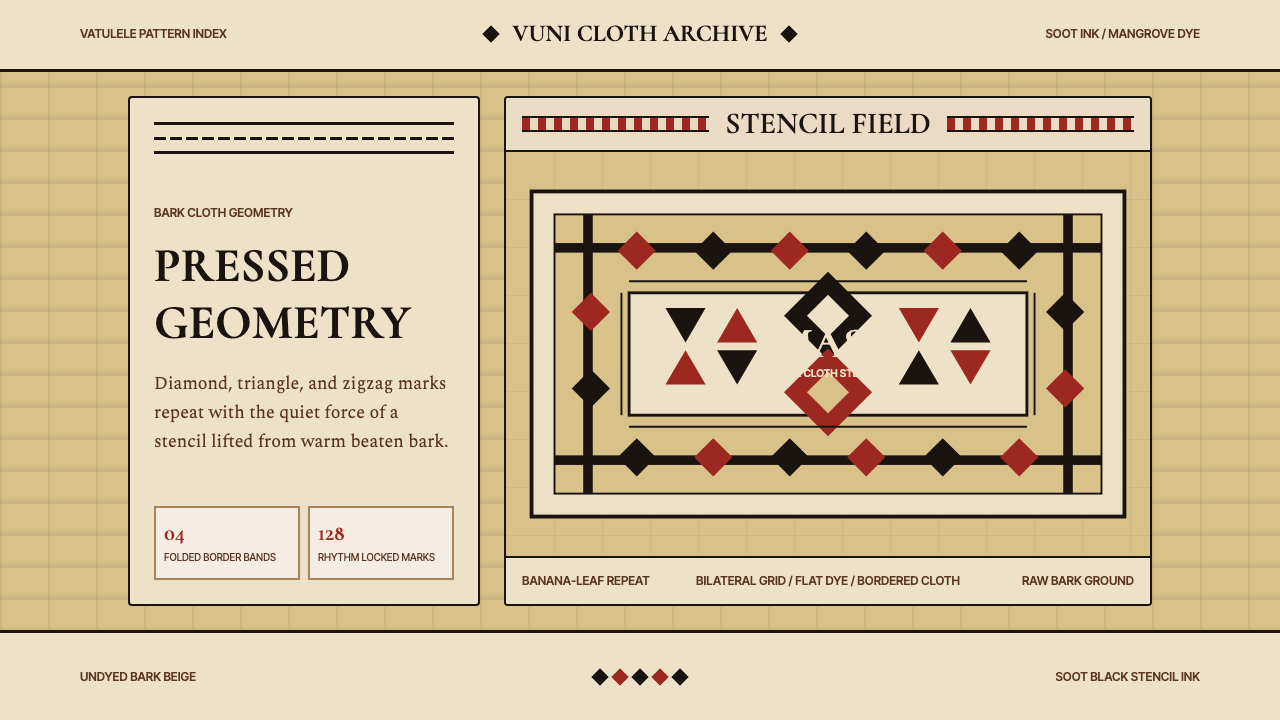 Fijian Masi Tapa StencilGeometry keeps ceremony. Soot-black diamonds repeat on bark beige with rust-r…
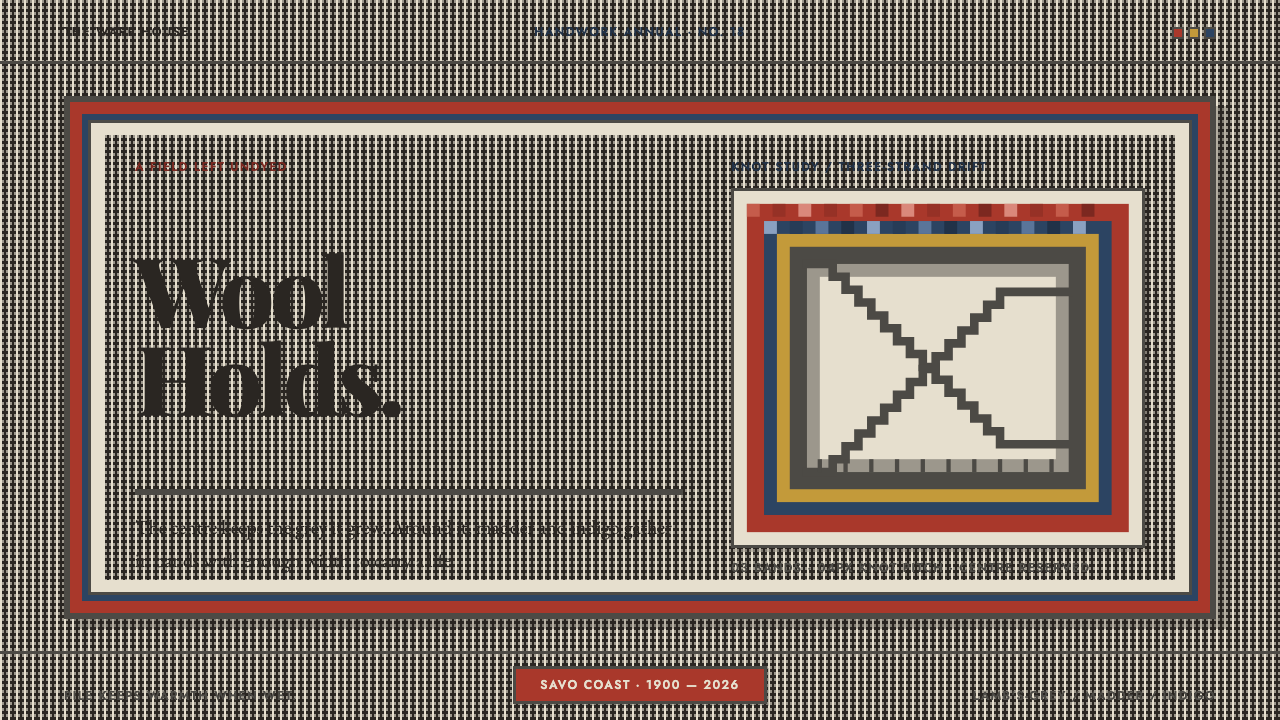 Finnish RyijyWool holds its ground. Lamb's-grey centres meet stepped madder and indigo ban…