What is Swat Carved Doors?
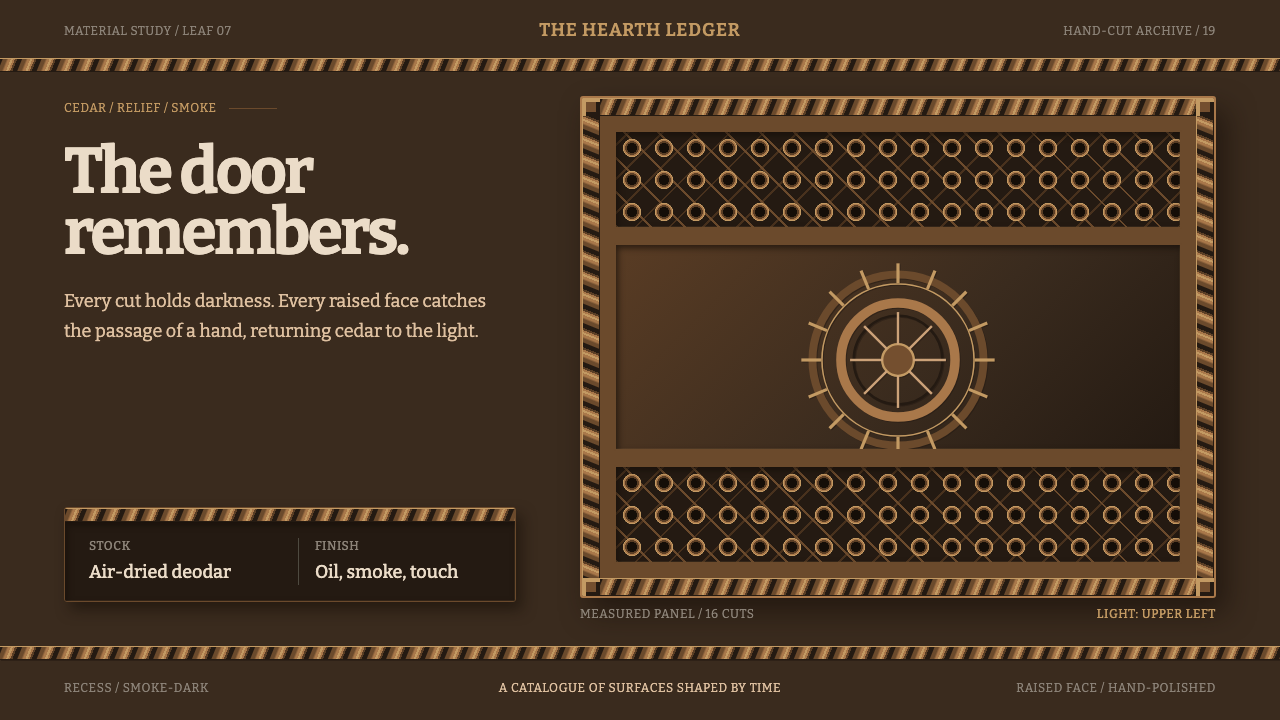
Swat Carved Doors borrows the look of deodar cedar cut in deep relief, left unpainted and darkened by generations of hearth smoke — a surface where the ornament is carved rather than drawn.
Swat Carved Doors in brief
Swat Carved Doors is a dark, wood-grained design language drawn from the woodwork of the Swat valley and the neighbouring Shangla district of Khyber Pakhtunkhwa, in northern Pakistan. Its sources are door leaves, door frames, mosque columns and the open window lattices known as jaali, all cut from Himalayan deodar cedar — dayyar in the local speech — and left bare. The surviving pieces that define the style date from the eighteenth and nineteenth centuries, while the ornament inside them reaches back far earlier.
What distinguishes the style is that it is a surface of depth rather than a surface of decoration. Every container is a recessed panel set inside a carved frame. Light is imagined as arriving from the upper left, so each panel is shadowed along its lower right, and a page built this way reads like a door seen in a dim room. Corners stay square because a chisel leaves square shoulders. Borders are built from rope-twist and chevron runs, and the motifs — rosettes, sun wheels, lotus — are cut into the material instead of printed on top of it.
Colour in this style is a consequence of material and time, not a palette chosen from a swatch book. Fresh cedar is pale, but wood that is never painted and sits near a hearth darkens in its cuts until the recesses are close to black, while the raised carving, polished by hands passing over it, wears back to a lighter cedar brown. That slow contrast between deep shadow and warm highlight is nearly the whole colour story. Typography plays a deliberately modest part: the wood carries the ornament, and the lettering is there only to make the message clear.

Where does Swat Carved Doors come from?
The craft begins with the timber. Swat carvers work in Himalayan deodar cedar, a wood valued for resisting insects and for its fragrance. The planks are air-dried for two or three years before a chisel touches them — a waiting period that is part of the technique, because a seasoned board is what makes it sensible to commit to deep relief. The carving that follows is cut deep, with the background cleared away in a shallower pass, and then the piece is left alone: never painted, oiled at most. Whatever colour it has afterwards is colour that time and use give it.
The objects that carry the style are architectural. Door leaves and their frames, the columns of mosques, and the lattice screens that fill windows are where Swati carving survives. The examples that anchor this system are doors and mosque woodwork from the eighteenth and nineteenth centuries, found in the Swat valley and in the Shangla district. Because these pieces were built into houses and religious buildings, they lived with their users: they were opened and touched every day and, in homes with a hearth, slowly smoked. The darkened recesses and the hand-polished high points that give the style its two-tone look are therefore not a finish applied by a maker but a record of use.
The ornament is much older than the buildings that carry it. The motifs — rosettes, sun wheels, lotus, geometric borders — can be traced back to the floral and geometric decoration of Gandhara, the ancient culture of the region, whose output is dated from roughly the first to the fifth century CE. That a mosque in Swat should be decorated with pre-Islamic flower patterns is not regarded as unusual there. The carvers inherited a repertoire and kept applying it to new buildings, so the style's lineage is layered: Gandharan ornament underneath, Swati woodcarving as the working tradition, and the architecture of the present-day valley as the setting in which the pieces still stand.
As a design system, the style takes that surface literally and keeps the construction logic of a door. A central axis organises the composition, and everything mirrors around it. The frame is divided into stiles (the vertical members), rails (the horizontal ones) and panels, each clearly distinct from the others. Containers are not cards floating above a background but recessed fields inside moulded frames. Because the wood already carries all the ornament, the system asks type to stay plain, and it asks every other element to stay in its place within the frame.
What defines the Swat Carved Doors look?
Unpainted cedar
The surface is wood, and it behaves like wood: grain and tone do the work that applied colour does elsewhere. Nothing is glossed, lacquered or sealed under a bright coat, and where a finish exists it is the thin sheen of oil, not a film. For a digital layout this means warm, earthy browns carry the page, no gradient fills pretend to be polish, and texture appears only where it can be justified as grain rather than pasted on as a wallpaper image.
Smoke and touch
The tonal logic has two poles. Recesses, where hearth smoke has settled for years, go close to black. Raised carving, rubbed by hands, wears back to a lighter cedar brown. The result is a polarity in which darkness means depth and the lighter tone means what has been reached and handled. In practice, interactive or important content takes the lighter, touched tone, and the deep ground between elements stays dark, so contrast comes from the carved depth itself instead of from bright accent colours.
Recessed panels
Every container is a panel sunk into a carved frame, never a card hovering above the background. Light arrives from the upper left and shadow falls to the lower right, consistently, on every component. The consistency matters more than the intensity: because one imagined light source governs the whole page, panels, inputs and tables all agree about where the depth is, and the layout reads as a single carved object instead of a collection of separate boxes.
Square corners and moulded frames
Corner rounding is close to zero, since a carved shoulder is cut square. Edges are not plain lines but moulding runs, built from rope-twist and chevron repeats that echo the twisted cords and zigzags found on the doors. These runs operate like borders in a carved frame: they separate the panel from its neighbour, mark where one level of the layout ends, and give the eye a rhythm to follow along the edges.
Carved ornament vocabulary
The ornament is a small, fixed vocabulary: rosettes, sun wheels, lotus, rope-twist and chevron. These motifs are cut in relief instead of drawn as outlines, so they read as raised forms with a lit side and a shadowed side. They appear at points of emphasis — the centre of a panel, the head of a column, the join between frame members — rather than scattered across the whole surface, and they are repeated, not invented anew for every component.
Central-axis symmetry
A door is built around its middle, and so is this layout. Compositions mirror around a central axis, with stiles, rails and panels clearly separated and aligned to it. The effect is formal and slightly ceremonial: a page reads from the centre outward, hierarchy is easy to see, and there is little room for asymmetry or casual offsets. It is a style for content that wants to feel settled and considered rather than dynamic.
Quiet typography
Because the wood carries the ornament, lettering is asked to do one job: say the thing plainly. Letterforms are legible and unadorned, set in generous, clearly separated blocks against the dark ground, and they do not compete with the carved motifs for attention. The system does not add decorative flourishes to type to match the carving, since doing so would double the ornament and muddy the hierarchy.

Who shaped Swat Carved Doors?
Reto Zehnder is the one individual named among the key figures attached to this style. The craft itself is collective work: the doors and columns that define the style come from workshops whose individual names the available record does not preserve. A named reference point therefore matters for anyone tracing the tradition back to its surviving objects, and his name stands in the record for the effort of looking at Swati woodwork as a body of work rather than as isolated curiosities.
The real authors of the style are the unnamed carvers of the Swat valley and the Shangla district. Their method is the style's method: work in dayyar that has been air-dried for two or three years, cut deep relief with a shallow cleared ground, and leave the result bare. Their square shoulders, their symmetrical layouts divided into stiles, rails and panels, and their refusal of paint are what the design system reproduces, which is why the system speaks of the carved surface rather than of any single maker.
Gandhara is the deepest layer in the style's lineage. Its floral and geometric decoration, dated roughly from the first to the fifth century CE, is the ancestor of the rosettes, sun wheels and lotus forms that Swati carvers still cut into doors and columns. It is not a person but a source tradition, and it explains why pre-Islamic motifs sit comfortably in later mosque woodwork: the repertoire was inherited, and it kept working.
How do you use Swat Carved Doors today?
Swat Carved Doors is best treated as an architecture of depth rather than a colour scheme. Its strength is that a page built on it feels carved, warm and settled, and the way to use it correctly is to keep the carving logic intact: one imagined light source, panels recessed into frames, ornament cut into the surface at points of emphasis, and a dark ground that does most of the work of contrast. It suits subjects with a sense of heritage, craft and weight, and it rewards restraint more than elaboration.
For presentation slides, the cover works best as a single framed panel on the central axis. Place one ornament — a rosette or a sun wheel — at the head of the panel, set the title in plain, high-contrast type on the dark ground, and let a moulded rule mark the edge. Content slides should repeat the frame: each content area sits in a recessed panel with clear margins, and stiles and rails divide the slide into regions that line up from slide to slide. Data slides can place charts inside recessed panels, using warm cedar tones for marks against the near-black ground and reserving the rope-twist or chevron run as the single decorative element.
For web interfaces, dashboards are a natural fit because the system already thinks in panels. Make each widget a recessed field, keep the lighting direction identical from component to component, and let the navigation read as a vertical frame member at the edge of the page. On a pricing page, treat the tiers as adjacent door panels: the recommended tier takes the lighter, hand-worn tone to look raised, the others stay recessed and dark, and inputs and toggles are sunken fields with a clear carved edge. Square corners and moulded borders should stay consistent throughout.
For editorial and marketing work, the style suits stories about craft, heritage, hospitality, furniture, cultural institutions and travel, where the reader is meant to feel the weight of a material. A long essay can use a chevron run to separate sections and a carved frame to hold a pull quote, with body text set plainly in generous blocks. A landing page can open with a large central panel and a single carved motif, and keep calls to action as raised, lighter elements against the dark ground so they read as the thing a hand would reach for.
The most common mistake is to treat the ornament as wallpaper or the wood as a photograph. Scattering rosettes across every surface, rounding the corners, adding glossy highlights or soft glows, or tiling a realistic wood-grain image behind everything all work against a style whose warmth comes from the contrast between smoked recesses and hand-worn highs. A second mistake is to let the light direction change from one component to the next, which breaks the sense of a single carved object. Keep the ornament sparing, the corners square, and the light consistent.

Swat Carved Doors — FAQ
What is dayyar, and why does the style depend on it?
Dayyar is the local name for Himalayan deodar cedar, the timber Swat carvers use for door leaves, frames, mosque columns and window lattices. It is valued for resisting insects and for its fragrance, and it is air-dried for two or three years before carving. The style depends on it because the whole look is the look of this wood left unpainted: the grain, the way hearth smoke darkens the cuts, and the way hands wear the raised carving back to a lighter brown. Remove the material and what is left is only a dark theme with some ornament.
Why is the style dark, and can it work on a light background?
The darkness is historical, not decorative. Hearth smoke settles into the carved recesses over the years until they are close to black, and the contrast with the lighter, hand-worn high points is what gives the surface its depth. A light version is possible, but it needs care: if the ground is pale, the recesses can no longer go near-black without making the page look heavy, and the carved-depth effect can flatten. A better route is to keep a dark ground for the main structure and use lighter, cedar-brown tones only for raised content.
Is this an Islamic design style or a Gandharan one?
It is better described as a Swati woodcarving style with more than one layer of heritage. The pieces that define it are doors and mosque woodwork from the eighteenth and nineteenth centuries, so they sit in an Islamic architectural setting. The motifs they carry — rosettes, sun wheels, lotus — trace back to Gandharan floral and geometric decoration of the first to fifth century CE. In Swat, pre-Islamic patterns inside Islamic buildings are not regarded as unusual, so the sensible label is the regional craft tradition that holds both.
How does the lighting rule work in practice?
The rule is simple: light comes from the upper left, so shadow gathers along the lower right of each recessed panel and each raised element. It is not a simulation of natural light but a carving convention, like the one a carver follows when reading the shape of a relief. Apply it identically to cards, inputs, tables and ornaments, and the layout holds together as one object. Apply it differently from component to component and the sense of depth falls apart even if every individual shadow looks fine.
What subjects does Swat Carved Doors suit, and where does it struggle?
It suits subjects that benefit from weight, warmth and a sense of heritage: craft and furniture brands, hospitality, museums and cultural institutions, travel stories, and any product that wants to feel settled and considered. It struggles in contexts that call for lightness, speed or playfulness, such as a bright consumer app, a fast-moving promotion or a children's product. Its formal central axis and square, dark construction can also feel heavy on very small screens if the frames and moulded borders are not simplified.
Related design styles
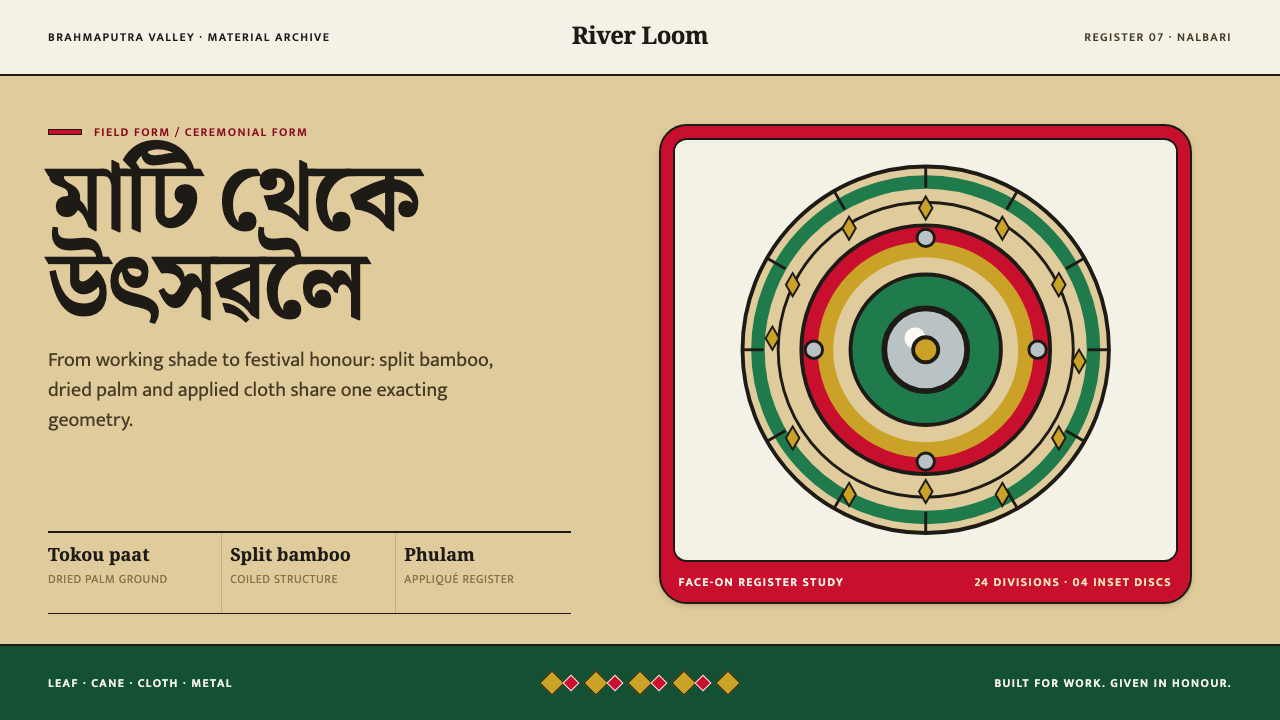 Assamese JapiWork becomes ceremony. Straw-gold rings carry green appliqué, festival red an…
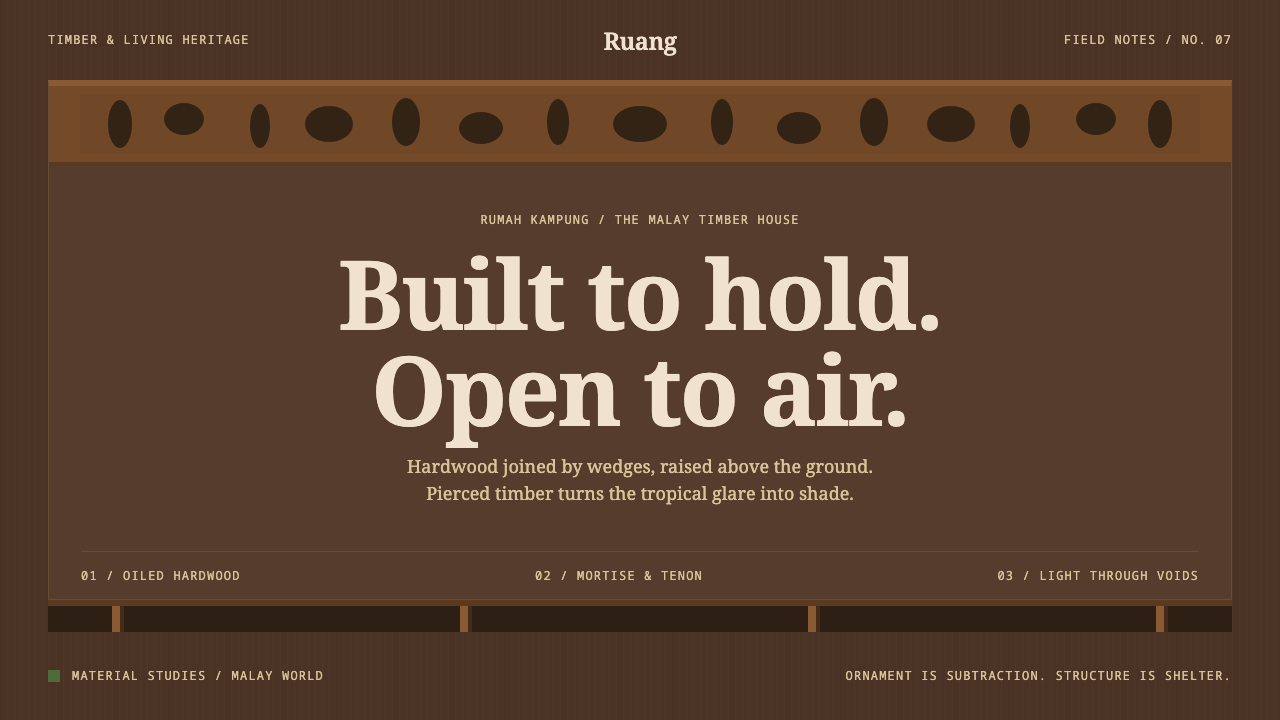 Malay Kampung HouseOrnament is subtraction. Oiled timber tones, pierced voids and serif type res…
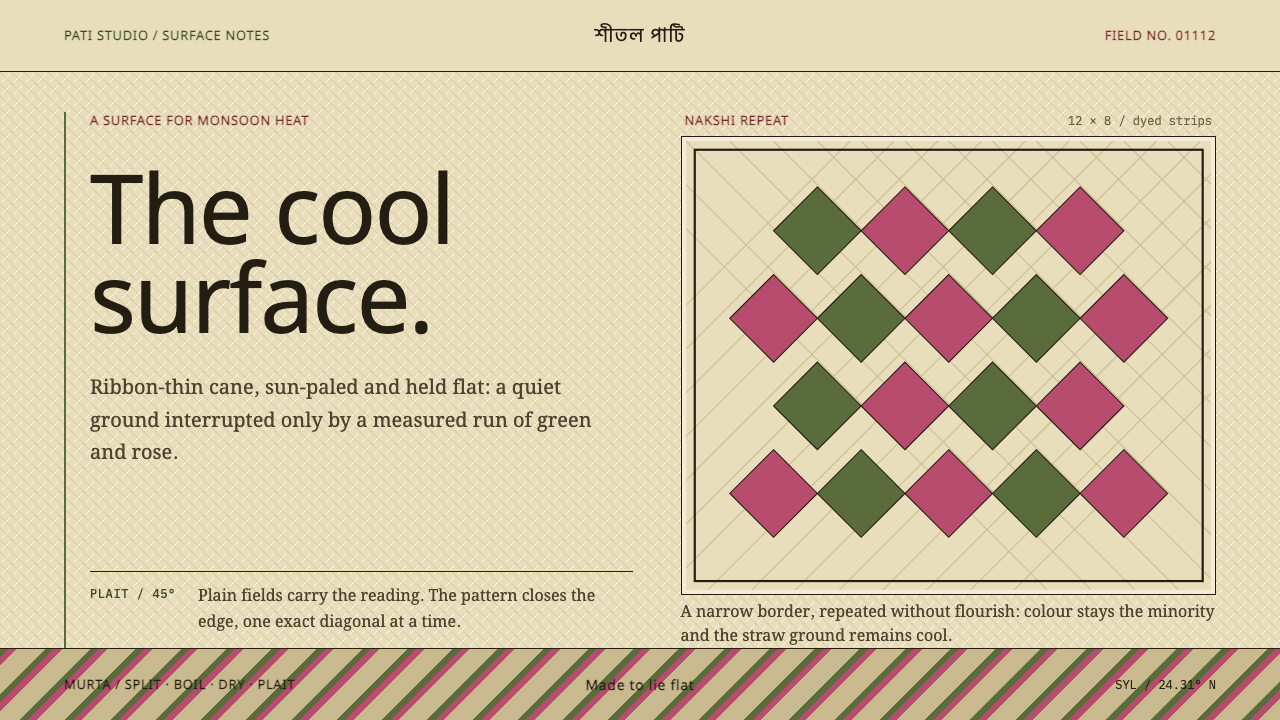 Sylheti Shital PatiCoolness lies flat. Pale straw fields hold cane-green and rose diamond repeat…
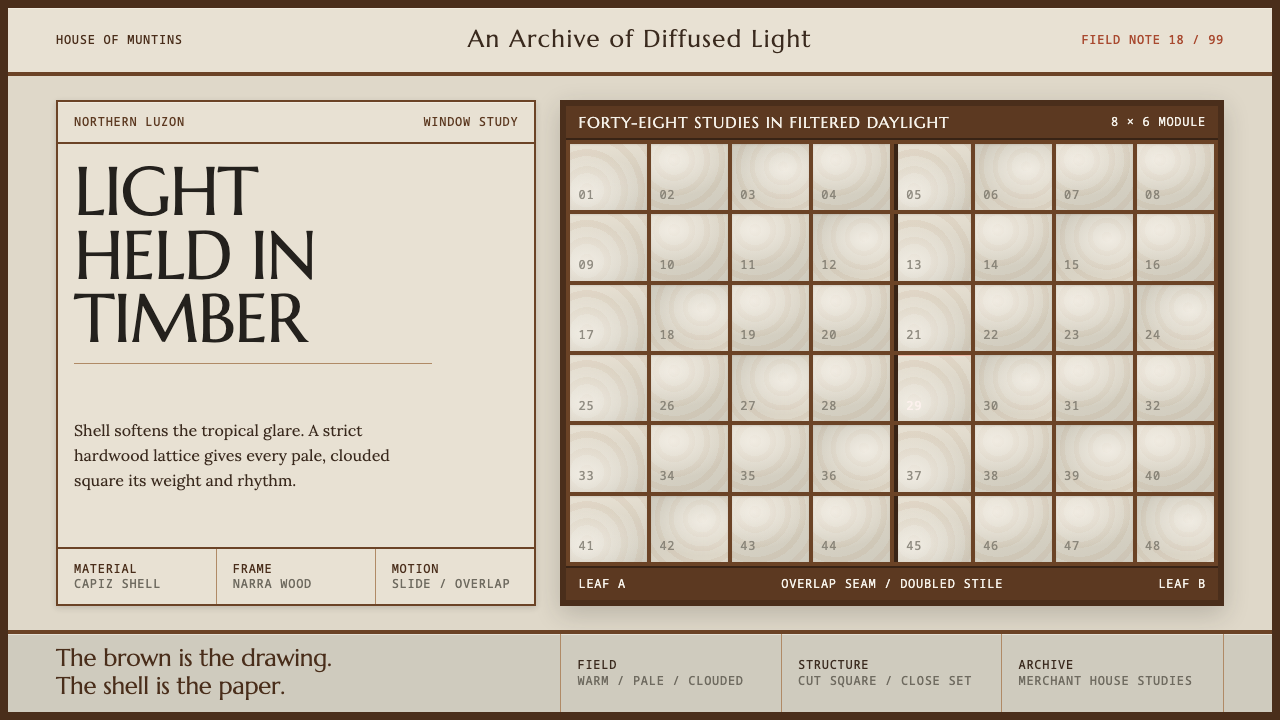 Vigan Bahay na BatoLight held in timber. Clouded capiz panes repeat inside a deep narra lattice.
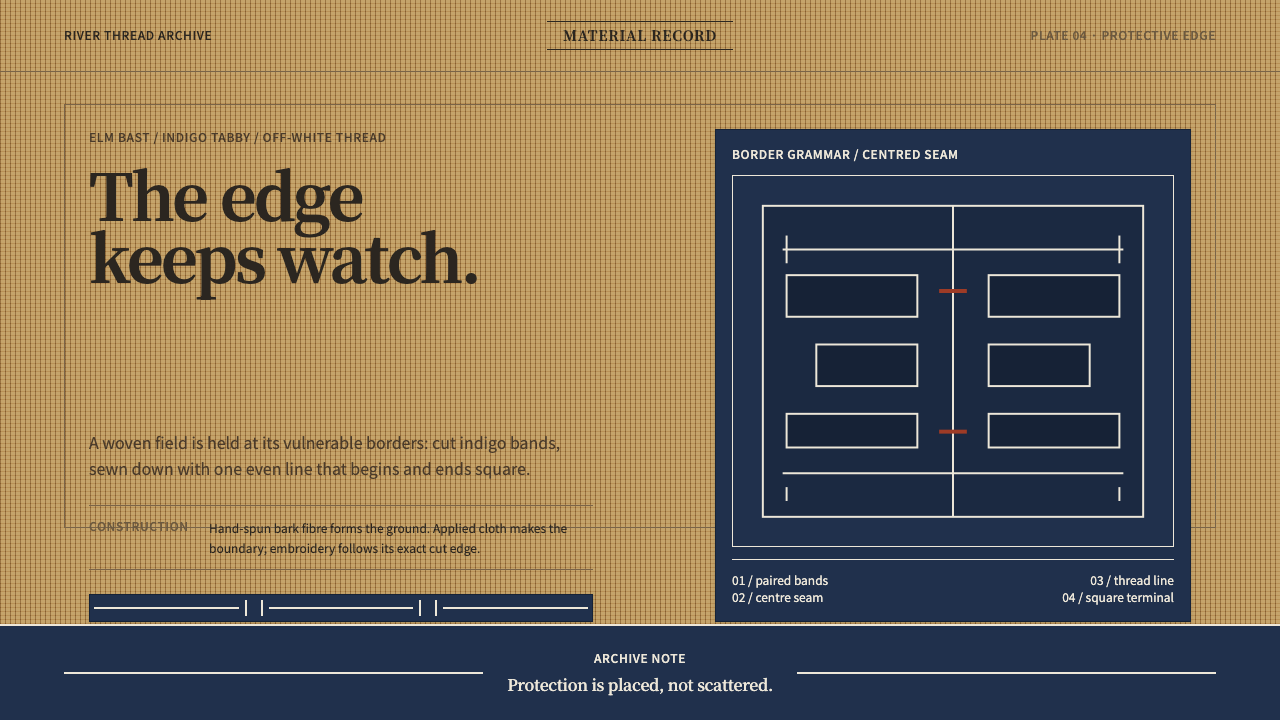 Ainu Attus RobeProtection is cut, not painted. Indigo bands and square-ended thread hold elm…
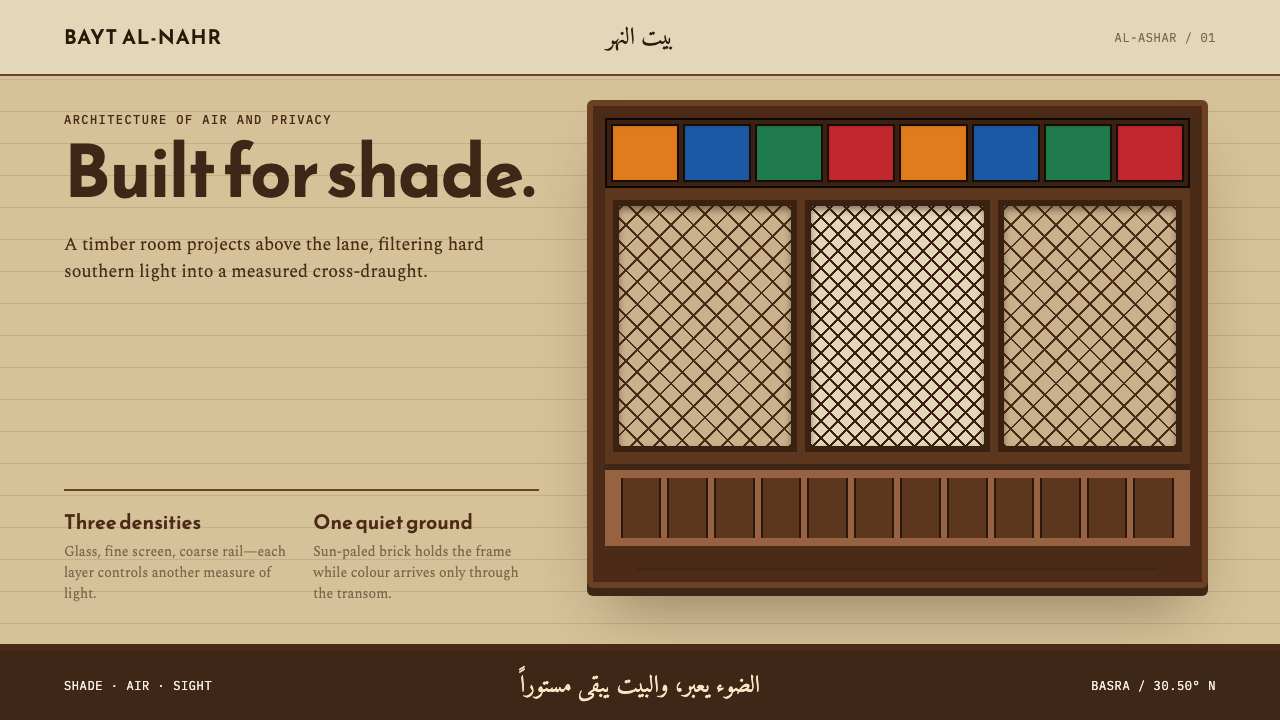 Basra ShanasheelClimate craft becomes ornament. Dark timber lattice projects over sun-paled I…