What is Ainu Attus Robe?
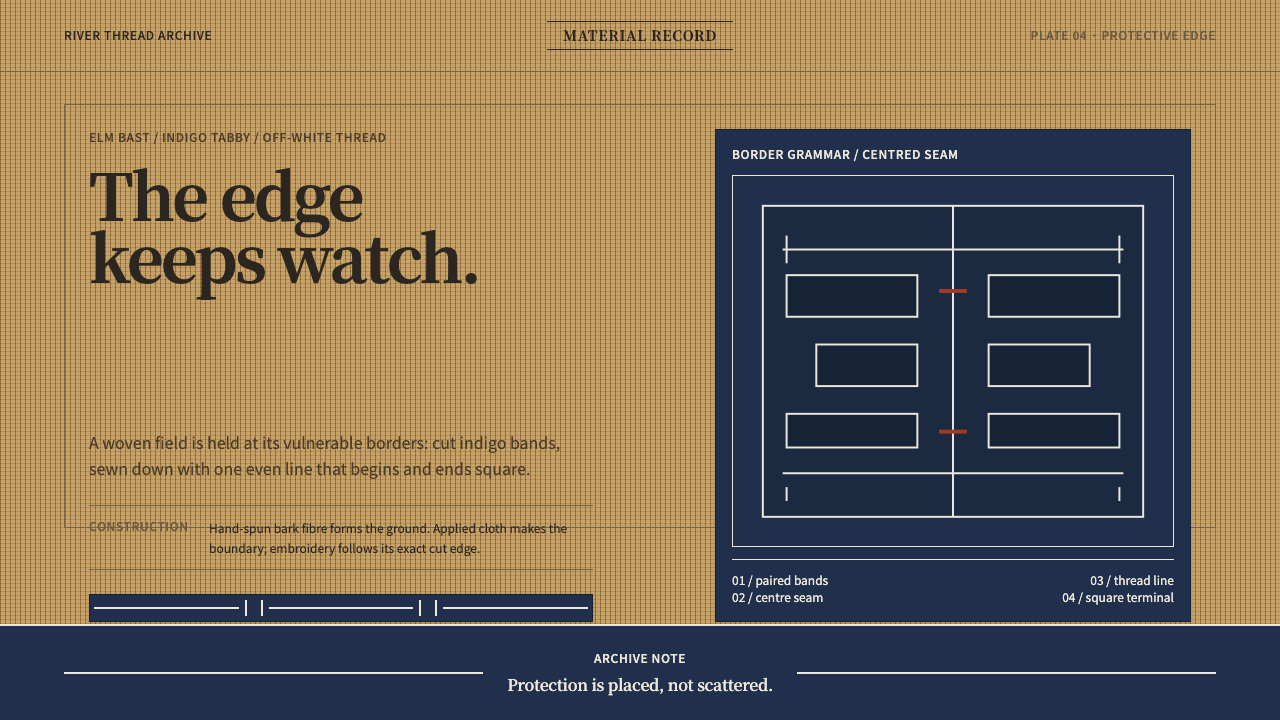
In the Ainu attus robe, protection is cut and not painted: indigo bands and square-ended thread sit on a field of woven elm bark.
Ainu Attus Robe in brief
The Ainu Attus Robe is a design language drawn from attus, the cloth the Ainu make from the inner bark of the ohyo elm, and from the robes on which Ainu women laid bands of indigo cotton and worked off-white thread over the edges. Its palette is simple and earthy: a mid tan-brown ground with visible slub, deep indigo bands, and thread of a soft, near-white tone.
The cloth matters as much as the pattern. Attus is made by boiling the bark, stripping it to bast, hand-spinning it into uneven yarn and weaving it on a backstrap loom. The result is light and water-shedding, with a rough, slubbed surface, and it is the field of the design, not a backdrop to it. Everything else on the robe is placed onto this ground with evident care.
The motifs are protective, and they obey a single rule: every drawn line begins and ends squared off. There are no points and no tapering strokes, and the marks look as if they have been cut with a blade. Pattern is arranged symmetrically about the centre seam, and it is set only where the body is most vulnerable. The result is an ornament that is economical, structural and quietly powerful.
Where does Ainu Attus Robe come from?
Attus is an Ainu craft from Ainu Mosir, the Ainu homeland that covers Hokkaido, Sakhalin and the Kurils. The record places the tradition before 1900, with attus in common use since the seventeenth century, and singles out Nibutani and the valley of the Saru river as a place associated with it. The cloth belongs to a long-established way of living from the forest and the river.
The cloth begins with a tree. The ohyo elm is boiled, its inner bark is stripped to bast, and the fibres are hand-spun into uneven yarn that is woven on a backstrap loom. What comes off the loom is a mid tan-brown fabric with visible slub, light enough to wear and water-shedding enough to keep the wearer dry. That this single piece of cloth can serve as both a working garment and the field for ornament is part of what makes the style coherent.
Onto that ground Ainu women laid bands of indigo-dyed cotton tabby. The cotton was obtained through trade with the Japanese, the wajin, so the robe records a historical exchange: a bark cloth made on Ainu terms, joined to a cloth that came from outside. The cotton was cut into long strips and appliquéd at the collar, cuffs, hem and back centre seam, and off-white cotton thread was worked along the edge of each appliqué. These are the places a robe is most exposed, which is also where the decoration was concentrated.
The motifs are known as morew, the spiral, and aiushi, the thorn. They are amuletic, meaning they are meant to protect, and every line is begun and ended squared off. Kayano Shigeru is the key figure the record names for this tradition. The design system inherits all of this: the tan ground as the field, indigo bands at structural edges, thread of an off-white tone, and strokes that begin and end square, so that nothing looks drawn with a brush when it could look cut.
What defines the Ainu Attus Robe look?
Elm-Bast Ground
The field is a mid tan-brown with a coarse, slubbed surface, the colour and texture of woven elm bast. It is neither light nor dark but a warm middle value, and it is the ground of the design rather than a background to it. A page built on this idea should feel woven and slightly uneven, with the ground visibly present between and around every other element.
Indigo Bands
Bands of indigo-dyed cotton tabby run at the collar, cuffs, hem and back centre seam. They are long, narrow and placed at structural edges, so they work like frames and thresholds rather than as spots of pattern. Indigo is the one deep, cool colour in a warm field, and it gives the design its structure and its contrast.
Off-White Thread
Thread of a soft off-white is worked over the appliqué edge, outlining each band and carrying the motifs. It is a gentle contrast to both the tan ground and the indigo, never a stark white. The stitched line has a handmade quality: it reads as a line drawn with a needle, which gives the ornament its slightly irregular, human rhythm.
Squared Strokes
The governing rule is that every drawn line begins and ends squared off. There are no sharp points and no tapering. Strokes look as if they have been cut with a blade, with ends that are blunt and decisive. This is the clearest visual signature of the style, and it extends to every stroke in a layout: rules, chart lines, icons and bars should all have square ends.
Spiral and Thorn
The two recurring motifs are morew, the spiral, and aiushi, the thorn. Both are protective, and both are built from squared strokes, so the spiral becomes a stepped, blocky coil and the thorn a bold angular hook. They are used sparingly and in bands, and they carry meaning, which is why they should not be scattered as surface texture.
Symmetry and Protection
The design is arranged symmetrically about the centre seam, and decoration is placed only where the body is most vulnerable. This is economy with a purpose: ornament appears at thresholds such as neck, wrists, hem and back, and the rest of the surface is left plain. The restraint is part of the protection, and the plain areas are as much a decision as the decorated ones.
Who shaped Ainu Attus Robe?
Kayano Shigeru is the key figure the record names for the Ainu attus tradition, and his name is linked with Nibutani in the valley of the Saru river, the place the record identifies with it. He stands in the record for the living continuity of Ainu craft: cloth, pattern and the knowledge of how they are made, not as museum relics but as practices with a future.
The robes were made by Ainu women, who prepared the bark, spun the yarn, wove the cloth, laid the indigo bands and worked the off-white thread over their edges. The design system is, in effect, a record of their decisions: where to place a band, how to square a stroke, how much to leave plain. Their work is the real origin of every rule in the style.
The indigo-dyed cotton on the robes was obtained through trade with the Japanese, the wajin. The record lists the Japan–Ainu cotton trade as part of the tradition, and the cotton bands show how an imported cloth was absorbed into an Ainu design on Ainu terms: cut into strips, positioned at structural edges and stitched around with thread.
Nibutani and the valley of the Saru river are the places the record associates with this tradition. They represent the community of makers in a particular region of Ainu Mosir, and they remind a designer that this is a regional, living craft with its own vocabulary, not a generic pattern language to be borrowed without attribution.
How do you use Ainu Attus Robe today?
This style suits work that wants warmth, craft and a sense of material, and it asks for restraint in return. Use the tan ground as a real field, place indigo bands at structural edges, keep a soft off-white for lines and lettering, and make every stroke begin and end square. Because the motifs are protective and specific to Ainu culture, use the vocabulary with respect and credit its source.
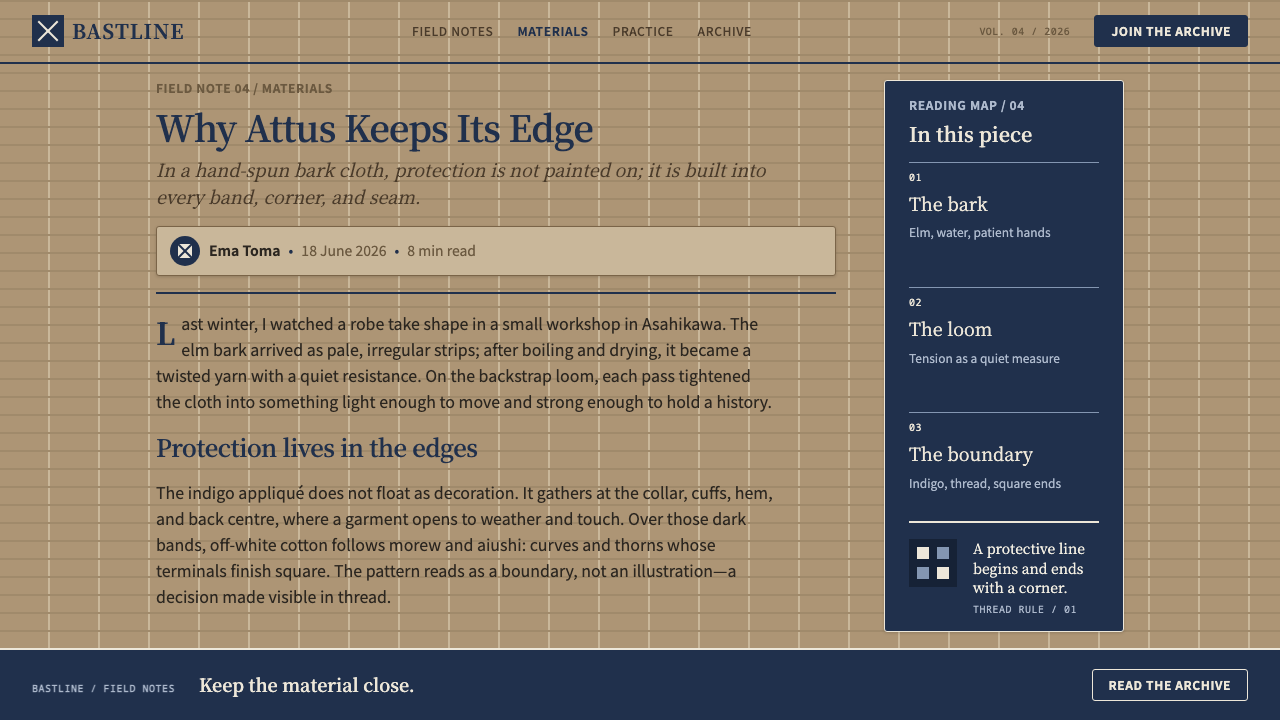
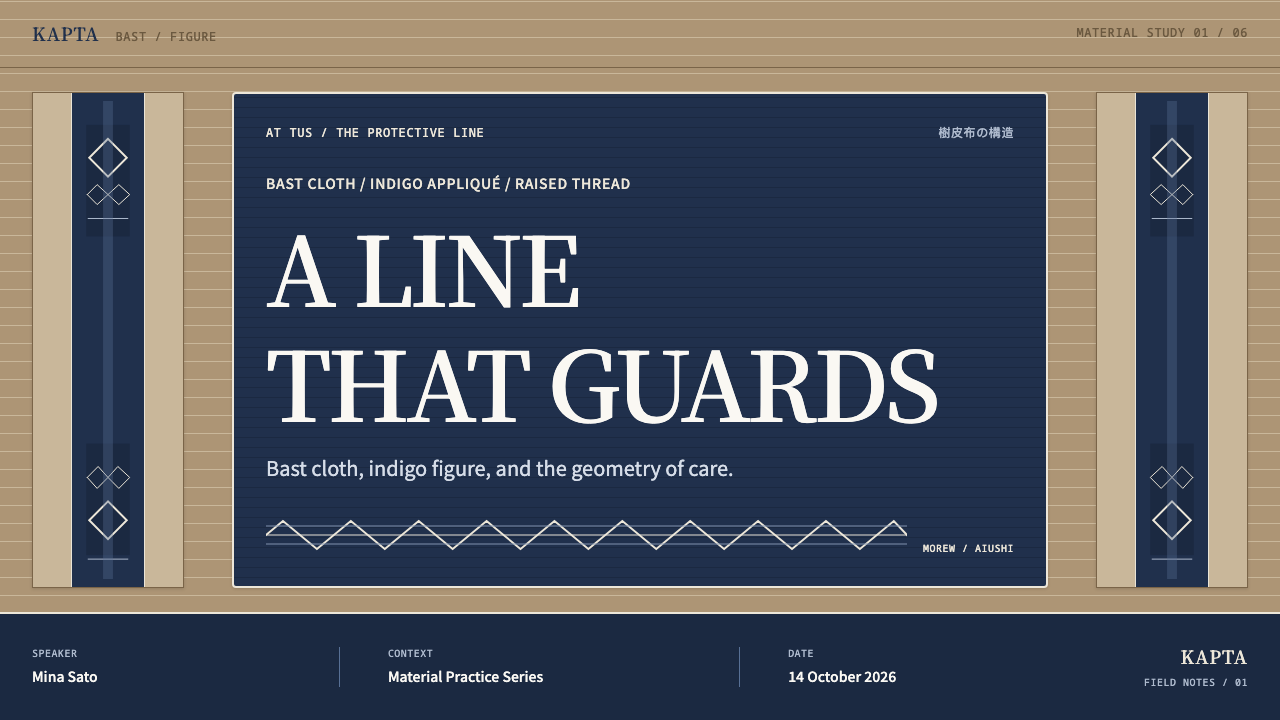
For presentation slides, a cover can be a tan field with a narrow indigo band at the top and bottom, a title in a plain, sturdy face and a single square-ended off-white rule. Content slides should be symmetrical about a central axis, with bands marking the head and foot like a collar and a hem. Data slides work with indigo and off-white as primary series colours on the tan ground, with bars and lines that have blunt, square ends and no rounded caps or soft gradients.
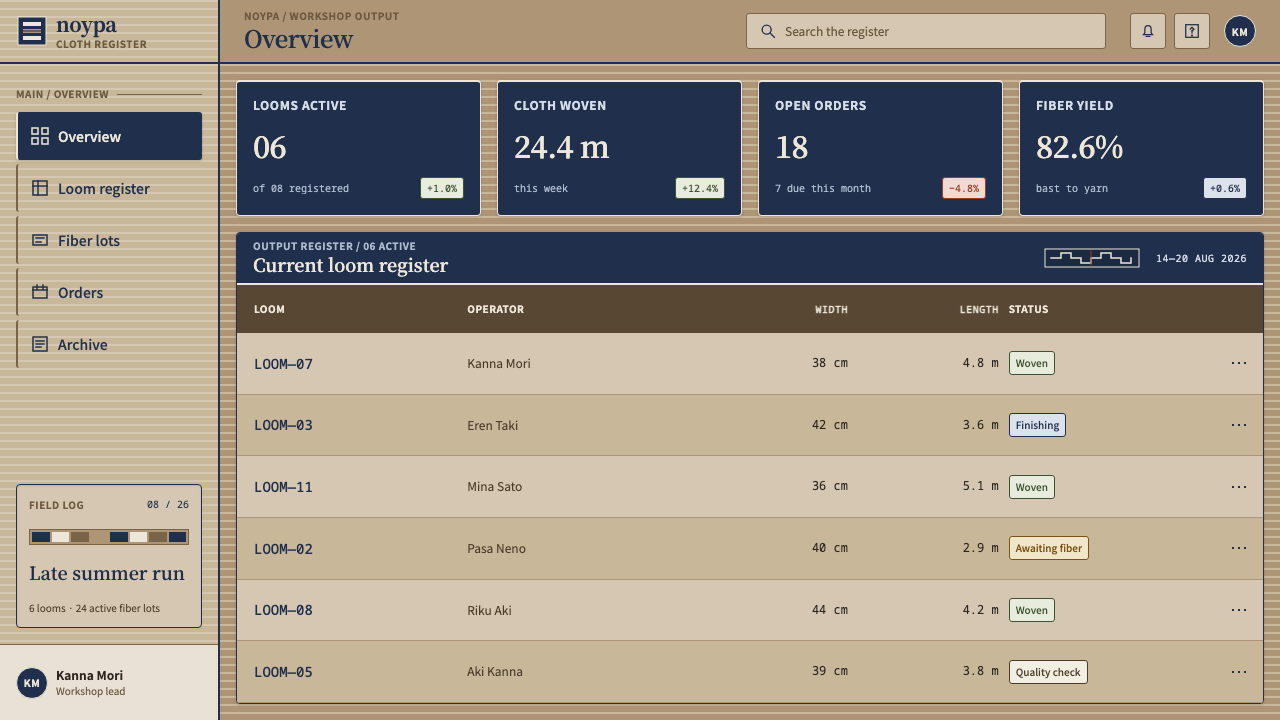
For web interfaces, the style suits craft marketplaces, cultural and museum sites, and tools that want a grounded and human tone. A warm tan page background, an indigo header band and square-cornered buttons give the structure. Pricing tiers can be arranged symmetrically about the centre, with a band marking each tier's top edge. Avoid rounded line caps in icons and charts, and keep decorative motifs at the thresholds of a layout, such as header, footer and card edges, rather than across the whole page.
For editorial and marketing work, bands can function as section markers, much as they trim the collar and hem of a robe. A long-form article might use an indigo band to open each chapter, with the text on a calm tan ground and pull-quotes set between square-ended rules. Marketing pages can alternate plain tan fields with single bands of indigo, keeping most of the surface quiet so the few decorated edges carry weight.
The most common mistake is treating the motifs as a generic tribal pattern and filling a whole page with them. In this tradition, ornament is concentrated at thresholds and everything else is left plain. Other errors are using tapered brush strokes or rounded line caps, replacing the soft off-white with a stark white, or swapping the mid tan ground for a dark or pure white background, which loses the sense of woven bark. Keep the strokes square and the ornament sparing.
Ainu Attus Robe — FAQ
What exactly is attus?
Attus is cloth made by the Ainu from the inner bark of the ohyo elm. The bark is boiled, stripped to bast, hand-spun into uneven yarn and woven on a backstrap loom. The result is a mid tan-brown fabric with visible slub that is light and water-shedding. The record notes that it was in common use since the seventeenth century, and the robes made from it carried bands of indigo cotton and off-white stitching.
Why must every stroke end squared off?
It is the single governing rule of the motifs, which are protective. Lines in this system begin and end squared, with no points and no tapering, so they look cut and not painted. The rule gives the style its identity and makes it easy to apply consistently: if a stroke is pointed, tapered or round-capped, it does not belong to this vocabulary.
What are morew and aiushi?
They are the two recurring motifs of the style: morew is the spiral and aiushi is the thorn. Both are protective, and in this system both are built from squared strokes, so the spiral appears as a stepped coil and the thorn as a blunt angular hook. They are placed in bands at structural edges and not scattered across the surface.
Why is the cotton indigo, and where did it come from?
The cotton on attus robes came through trade with the Japanese, the wajin, and it was indigo-dyed tabby. The record lists the Japan–Ainu cotton trade as part of the tradition. Ainu women cut it into long strips and appliquéd it onto the elm-bark cloth at the collar, cuffs, hem and back seam, so the indigo is both a colour and a trace of historical exchange.
Is this a light or a dark style, and can I use pure white or black backgrounds?
Neither, strictly. The ground is a mid tan-brown, a warm middle value that behaves like woven cloth. Pure white or pure black backgrounds work against that character and lose the sense of a bark-fibre field. Keep the tan as the real surface, use indigo for deep contrast and a soft off-white for line and lettering, and treat any lighter or darker panel as a band, not as the page itself.
Related design styles
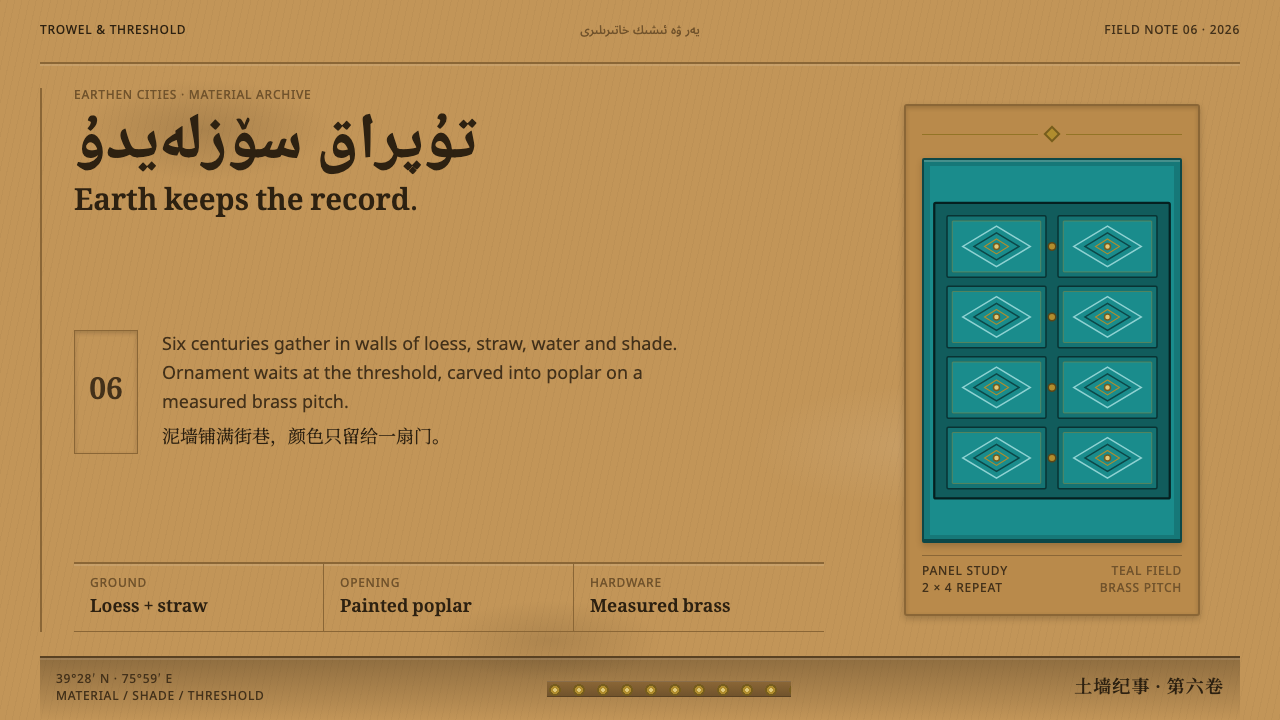 Kashgar Old TownEarth holds the field; ornament waits at one teal door, cut in a strict brass…
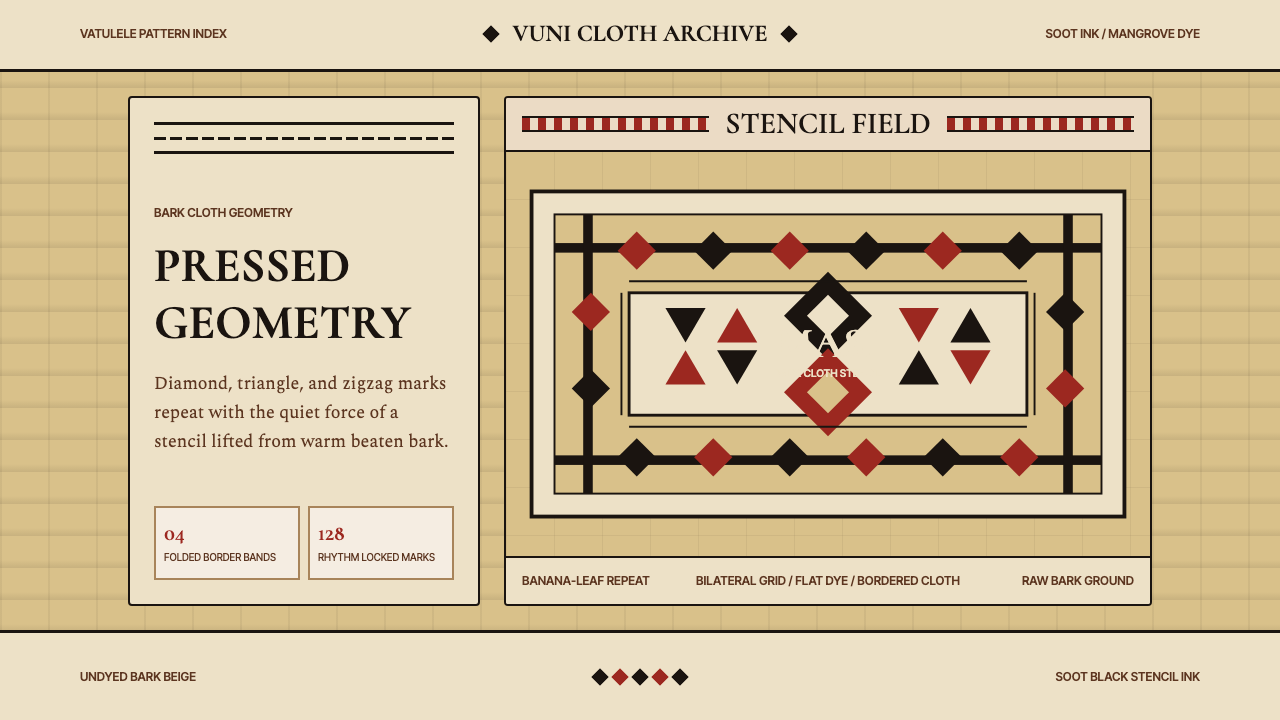 Fijian Masi Tapa StencilGeometry keeps ceremony. Soot-black diamonds repeat on bark beige with rust-r…
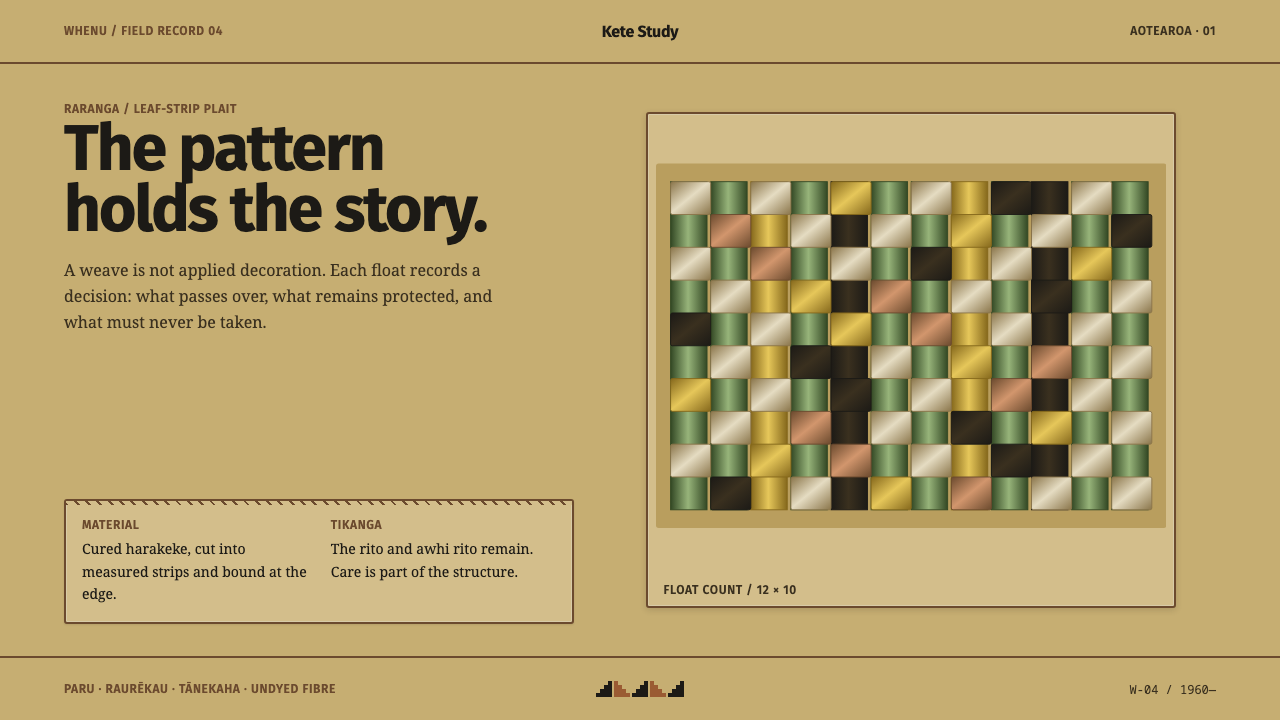 Harakeke Raranga WeavingStructure carries care. Honey-straw grids expose each green, bark and fibre s…
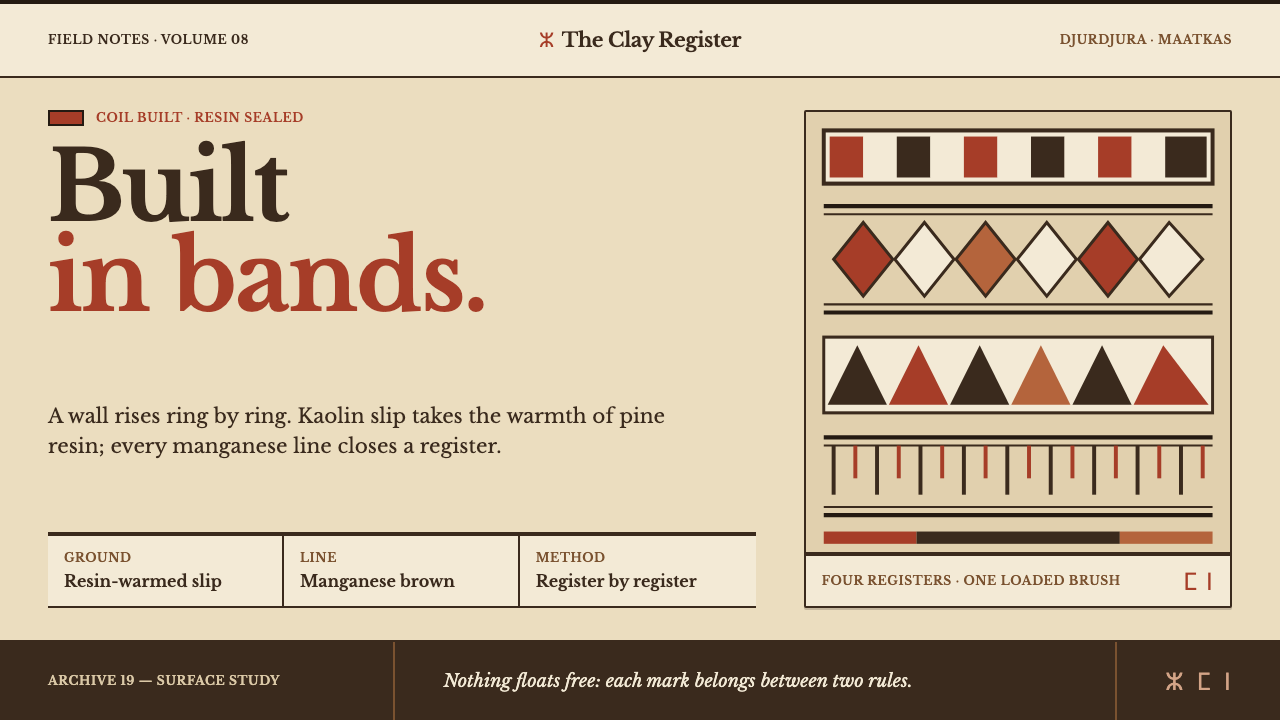 Kabyle PotteryBuilt band by band. Resin-warm kaolin carries manganese rules and iron-red ge…
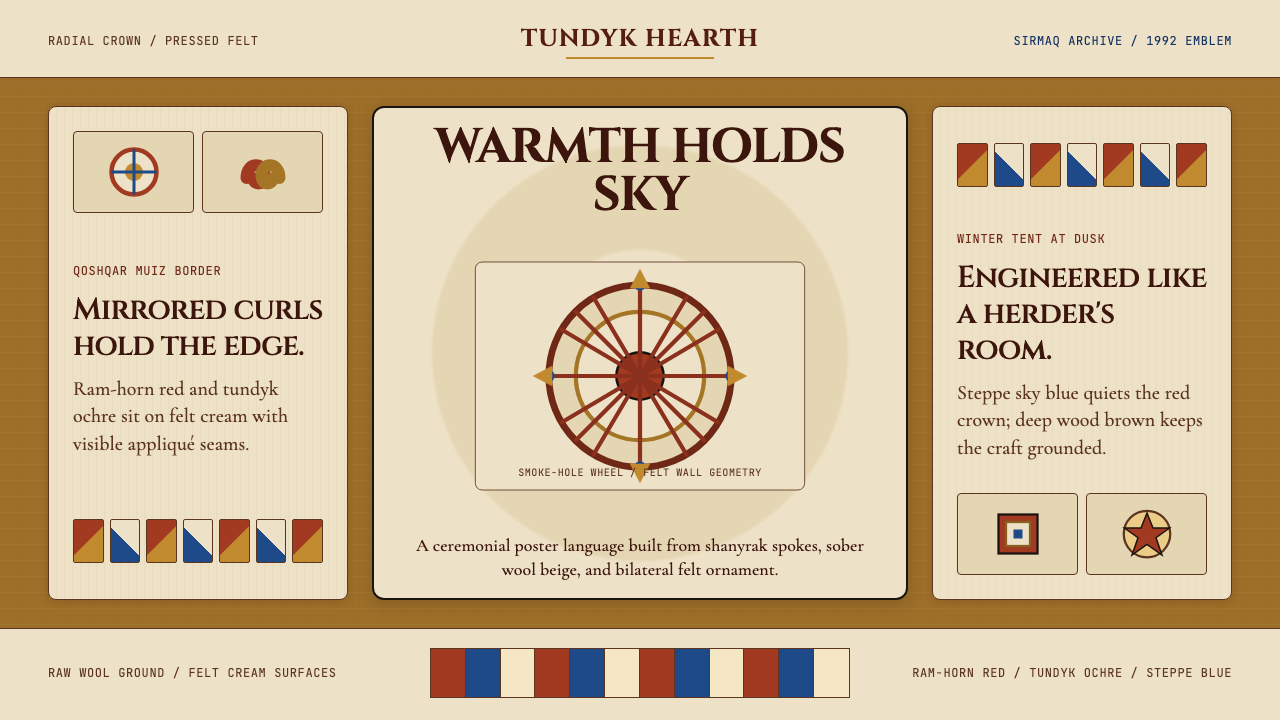 Kazakh Shanyrak Yurt FeltDomestic warmth, engineered. Ram-horn red felt curls around a radial shanyrak…
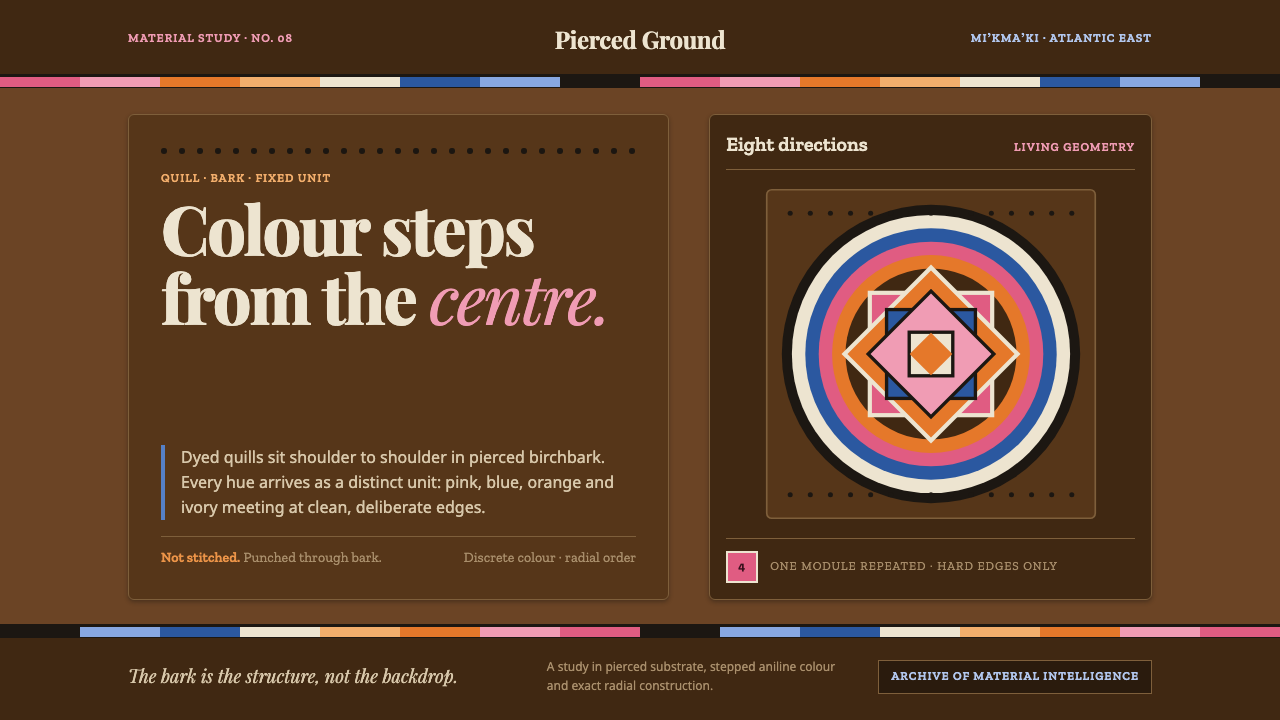 Miʼkmaq QuillworkColour never blends. Bright quill bands step across dark birchbark toward an…