What is Erzya Panga?
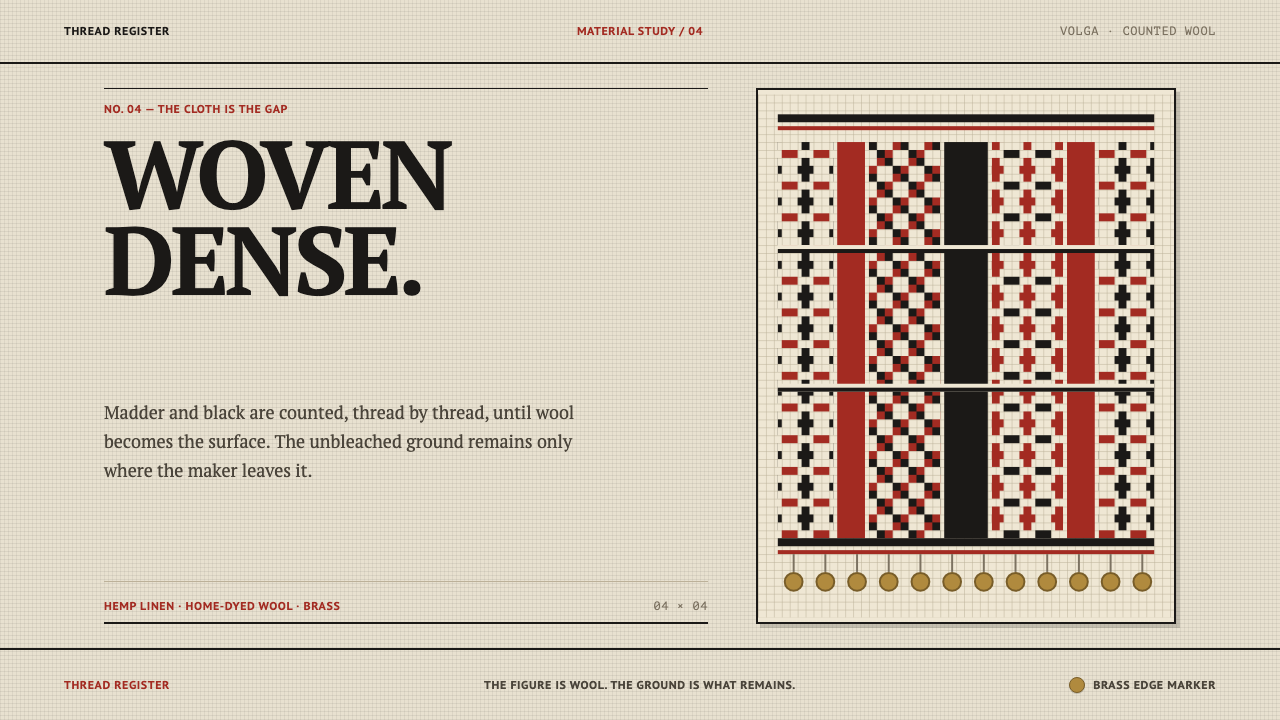
The Erzya panga turns density itself into ornament — madder-red and black wool counted thread by thread into stepped diamonds until the stitches become the surface and the linen is only the gap between them.
Erzya Panga in brief
The Erzya panga is the horned headdress of a married Erzya woman of the middle Volga, worn over a white linen tunic called the panar and embroidered in home-dyed red and black wool. As a design reference it is the clearest example of a style in which ornament is not a decoration added to a surface but the surface itself. The embroidery is worked so densely that the wool carries the whole image, and the unbleached hemp-linen beneath is perceived only as the thin gap between stitches.
The principle that organises everything else is counting. Nothing in this tradition is drawn freehand. Each motif is built thread by thread on the weave, so every edge climbs in steps and every diagonal is a staircase. The visual language that results is made of stepped diamonds, zigzags and hooked diamond-flowers, repeated in tight bands, in a restricted white, red and black colour scheme. Restraint here is not emptiness. It is a closed vocabulary used at full intensity.
Visually the style combines two textures that are normally kept apart. There is the flat, matte, grid-bound density of wool embroidery, and there is the loose, bright, moving metal of coins, cowries, buttons and braid at the edges. The first is for reading and structure; the second is for sway, sound and sparkle. Together they give a composition that is dense at its core and glittering at its borders.
Where does Erzya Panga come from?
The Erzya are a Mordvin people whose communities live in the middle Volga region, in Mordovia, Penza, Ulyanovsk and Chuvashia. The costume described here has pre-1900 origins and belongs to the broader family of Finno-Ugric Volga folk dress. Its white, red and black colour scheme is the identity marker most readily associated with the Volga Finno-Ugric peoples, which is why the system treats the three-colour palette as a statement of belonging, not a decorative option. It is not generic Slavic or Russian folk costume, and it should not be labelled as such.
What we know of the panga comes in large part through museum collections. The tradition is documented through nineteenth-century collections in Penza, Arzamas and Mordovia, and the source material names two institutions as anchors: the Arzamas Museum of Local Lore and the Mordovian Republican Museum of Local Lore in Saransk. It also points to Erzya village embroiderers of the Kochkurovo and Ardatov districts. The practical effect is that the style is learned from preserved objects: worn pieces whose stitch counts, colour proportions and trim can still be studied.
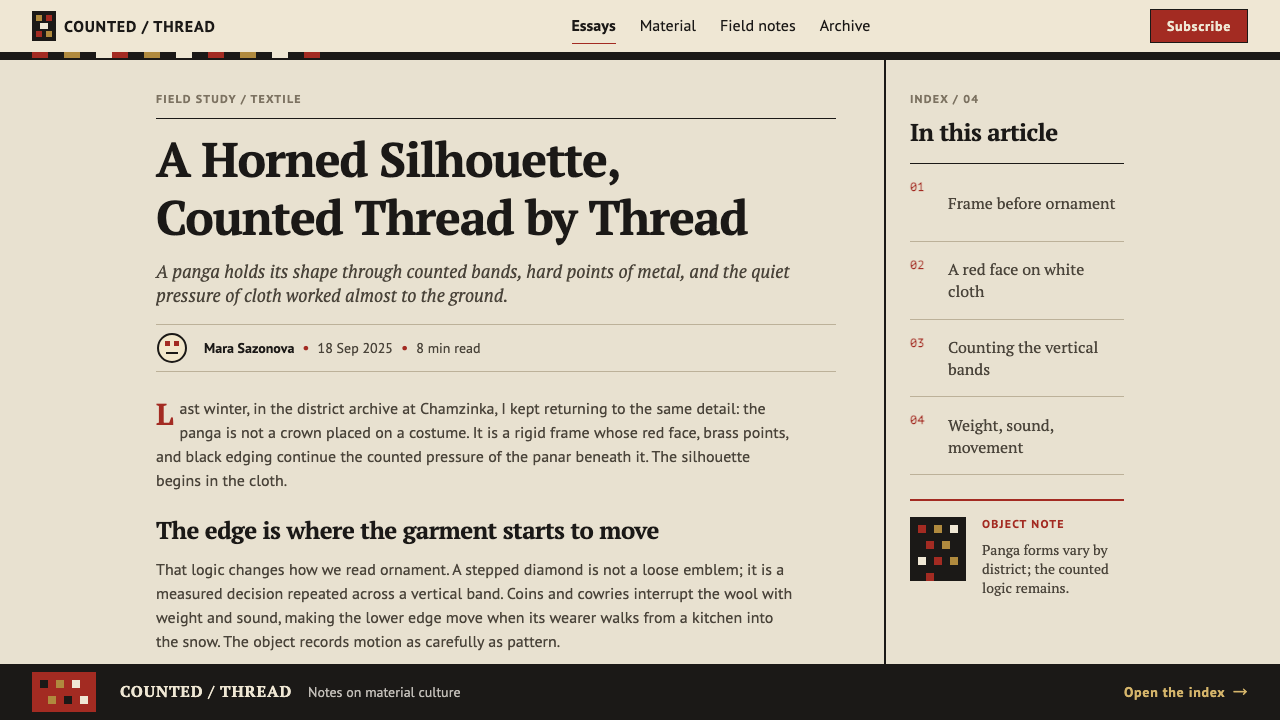
The garment is a stacked system. A married woman wore the panga, a frame of birch bark, up to about a third of a metre tall, covered in linen and faced with red cloth. Beads, bugles, buttons and galloon, a woven metallic braid, were fixed to it, and a soft embroidered tail hung down the back. Beneath the headdress went the white panar tunic. At its edges, coins and cowries hung and moved with the wearer, so the outfit sounded and flashed as she walked. The whole figure reads from the top down as crown, embroidered field and hem.
The embroidery is counted-thread wool work in red and black on unbleached hemp-linen. The wool is dyed at home, and the red is the one the style's summary calls madder. Because each stitch lies on a thread intersection, the design is quantised: there are no true curves, only stepped approximations, and the diamond is the natural shape because it is the form a grid produces most easily. The design system adopts this as a rule, not a limitation. Where a line must turn, it climbs a step.
What defines the Erzya Panga look?
Density as Ornament
The embroidered areas are filled almost completely, so that the pattern is the surface rather than something resting on it. In interface terms, ornamental regions are dense, continuous bands and blocks, not scattered motifs on an empty field. Density is concentrated where it frames the content, and the contrast between packed regions and open ones is what gives the page its structure.
White, Red and Black
The palette is three colours: the pale, unbleached tone of linen, a deep madder red from home-dyed wool, and black. This is the colour scheme that signals Mordvin and Volga Finno-Ugric identity. Red and black work together as the embroidery colours and never trade places arbitrarily; the pale linen is left to show as the gap. Additional hues are not introduced, and the discipline of three is part of the meaning.
Stepped Geometry
Stepped diamonds, zigzags and hooked diamond-flowers make up the whole repertoire. They are built on a thread grid, so each form grows by increments. A diamond is a pair of staircases that meet; a zigzag is a staircase that reverses; a flower is a diamond with small hooks. The family resemblance among these forms is what lets a dense page feel unified instead of busy.
Nothing Freehand
Every edge follows the weave. A shape that would be a curve elsewhere is a series of steps here, and a line never glides at an arbitrary angle. The consequence for design is a strict grid logic: borders, dividers, chart lines and icon outlines all move in whole steps. Rounded corners, soft ovals and smooth diagonals would break the rule and read as a different tradition altogether.
Wool Over Linen
Because the wool covers the ground, figure and ground invert: the pattern becomes the surface and the pale linen becomes the gap between stitches. In a layout, the lighter background appears as thin separators and small open cells inside the pattern rather than as a large neutral field. Reading areas, where long text must sit, are the exception and are kept as calm, pale linen-coloured fields next to the dense bands.
Brass and Coin Edges
The border is where metal lives: coins, cowries, buttons, galloon and the brass-coloured trim that closes off a field. These elements are small, bright, repeated and slightly loose, a contrast to the fixed grid of the wool. They are used at edges, hems and tips and never in the middle of the embroidered field, so the eye is guided outward, toward the point where the object meets the world.
Crown, Field and Hem
The wearer reads as three stacked tiers: the tall headdress above, the embroidered tunic as the main field, and the coin-hung hem below. The design analogue is a vertical hierarchy with a decorative crown at the top, a dense working field in the middle and a metallic closing edge at the bottom. The soft embroidered tail down the back suggests a trailing element, a quiet vertical accent beside the main column.
Who shaped Erzya Panga?
The source material names the village embroiderers of the Kochkurovo and Ardatov districts as the makers behind the work this style draws on. They are the counters of threads, and the wool they dyed at home is what the whole palette rests on. The source gives no individual names, which is part of the story: the style is the sum of a community's technique, not the signature of a single hand.
The Arzamas Museum of Local Lore holds collections that help document the Erzya costume tradition through the nineteenth century. For a design reference, collections of this kind are valuable because they let a viewer study the real object and see how the dense wool field, the metal edging and the pale linen relate to one another.
The Mordovian Republican Museum of Local Lore in Saransk is the second institutional anchor named in the source. Together with the Arzamas collection and holdings in Penza, it forms the museum record through which the nineteenth-century panga and its white, red and black scheme are known to us today.
The panga was worn by a married Erzya woman, which is why it carries social meaning as well as visual form. The garment tells others who she is. For designers, the wearer is a useful reminder that this style is a statement of identity, not a neutral pattern to be borrowed casually.
How do you use Erzya Panga today?
The Erzya panga style suits work that needs to feel rich, structured and unmistakably crafted, with a strict grid and a strong sense of identity. It rewards committing to the three-colour discipline and to stepped geometry throughout. Where a project is built around heritage, craft, textiles, music, regional culture or any context that values intensity of pattern, the style gives a clear and ready system. It asks for care in naming, because it is a specific Finno-Ugric tradition.
For presentation slides, a cover can use a dense embroidered band as a crown across the top or down one side, with the title on a calm pale field and a thin metallic-coloured edge closing the composition. Content slides keep the pattern at the margins and leave the centre for text. Data slides suit step charts and bar charts built on a clean grid, with bars coloured in the red and black pair and the pale linen colour showing through as the gaps between them.
For web interfaces, the style works for portfolios, cultural institutions and product pages that want a distinct visual identity. Use dense bands for the header and footer, a pale reading column for content, and thin metallic-toned accents for hover states and borders. Tables and dashboards fit the grid logic naturally, since stepped lines are already how a data grid draws itself. Pricing tiers can be separated by pattern bands, with the featured tier carrying the metallic edge.
For editorial and marketing work, a long article can open with a dense band, use red and black for section markers, and close with an edging that echoes the hem. A campaign page benefits from alternating dense and open sections, so the reader moves from stitched texture to calm text and back. Photography suits this system when it is simple and flat-lit, and it should sit inside a frame that follows the same stepped edge.
The most common mistake is to apply the pattern lightly and everywhere, as a sparse sprinkle of motifs, which loses the principle that density is the ornament. The next is to introduce curves, gradients or soft shadows, which contradict the counted-thread logic. A third is to use bright metallic accents in the middle of the field rather than at its edges. And finally, resist the temptation to call the whole thing generic Russian folk art; it belongs to the Erzya, a Mordvin people of the middle Volga.
Erzya Panga — FAQ
What exactly is a panga?
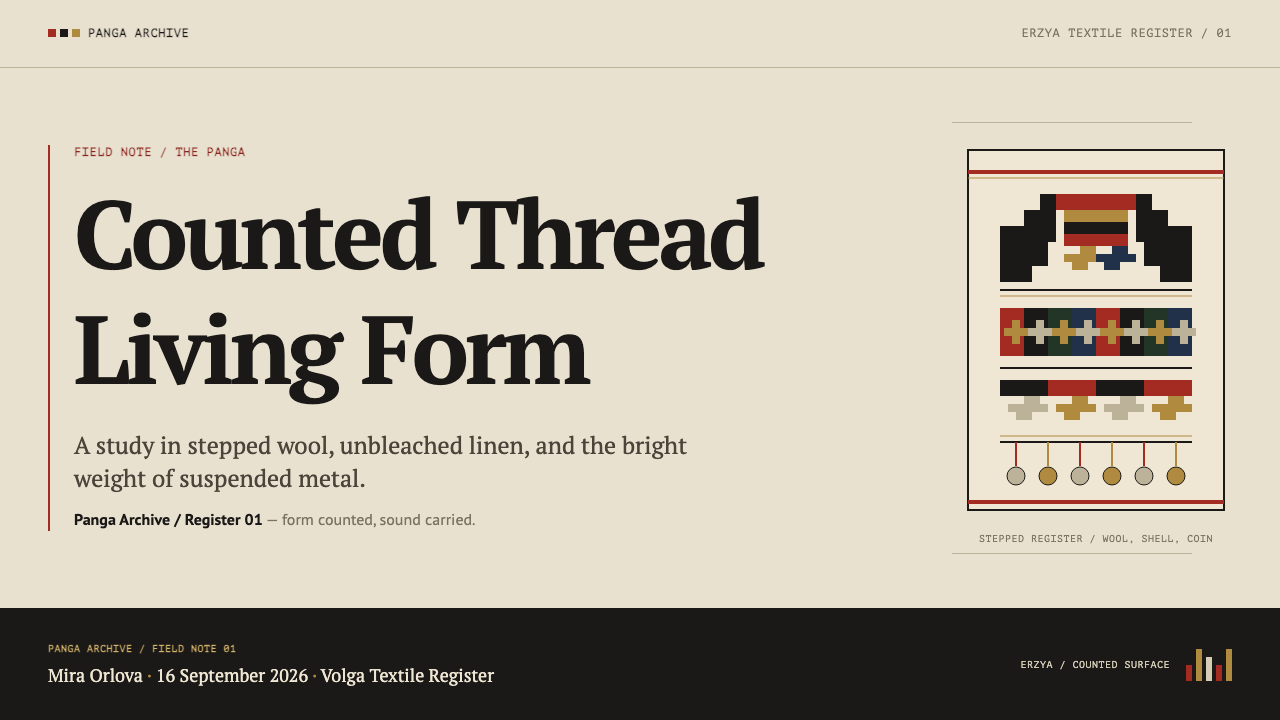
A panga is the tall headdress of a married Erzya woman. It has a frame of birch bark, covered in linen and faced with red cloth, and it is loaded with beads, bugles, buttons and galloon, with a soft embroidered tail hanging down the back. It is worn above a white panar tunic. In the design system, the name stands for a whole way of building a composition: a tall decorative crown, a dense embroidered field, and a hem of metal that moves.
Why does the style avoid curves and gradients?
Because the embroidery is counted thread by thread. Every stitch sits at a thread intersection, so every edge climbs in steps and every diagonal is a staircase. A gradient would need a continuous change in colour that wool dyed in two flat colours cannot give, and a curve would require a freehand line, which nothing in this tradition uses. The stepped form is not a limitation to work around; it is the identity of the style.
Doesn't such dense ornament hurt readability?
It can, if it is applied everywhere. The tradition itself separates the dense embroidered field from open linen, and the design system keeps that separation: dense bands frame the content, and reading areas stay as calm, pale fields. Long text should never sit on top of an embroidered pattern. If the page feels crowded, the fix is usually to reduce the number of dense regions, not to thin out the pattern inside them.
Why is the background unbleached linen rather than pure white?
The tradition uses unbleached hemp-linen, which has a soft, slightly warm pale tone. That tone is what shows in the gaps between the stitches, and it is the pale element of the white, red and black scheme. A pure, bright white would feel clinical beside deep red and black wool. Keeping the light colour slightly muted is what lets the red and black look hand-dyed instead of printed.
How do I use the coin and brass accents on a screen?
Treat them as edge details. Use a muted brass-toned colour for thin borders, small repeated dots along the bottom of a header, hover underlines and selected states, and avoid placing them inside the main pattern field. They should be small and repeated, not large and singular, so they feel like a row of coins rather than a single badge.
Related design styles
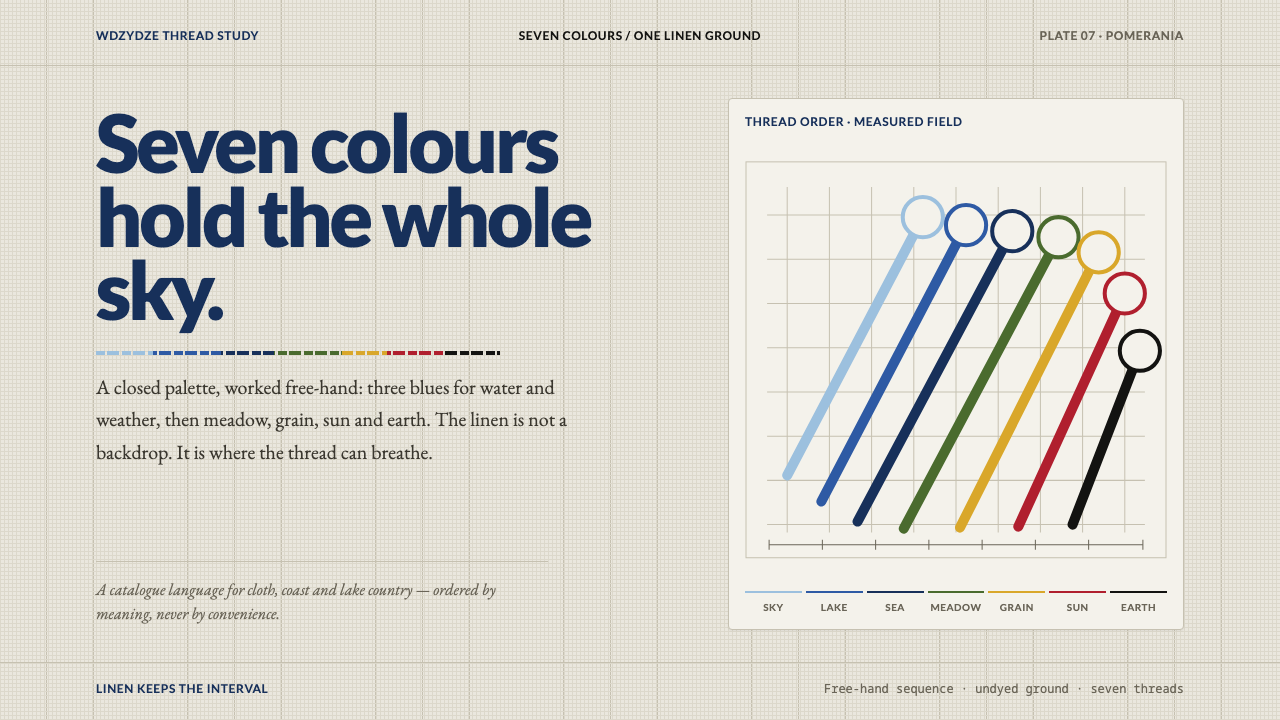 Kashubian Seven ColoursMeaning is stitched into the palette. Seven threads cross undyed linen in a m…
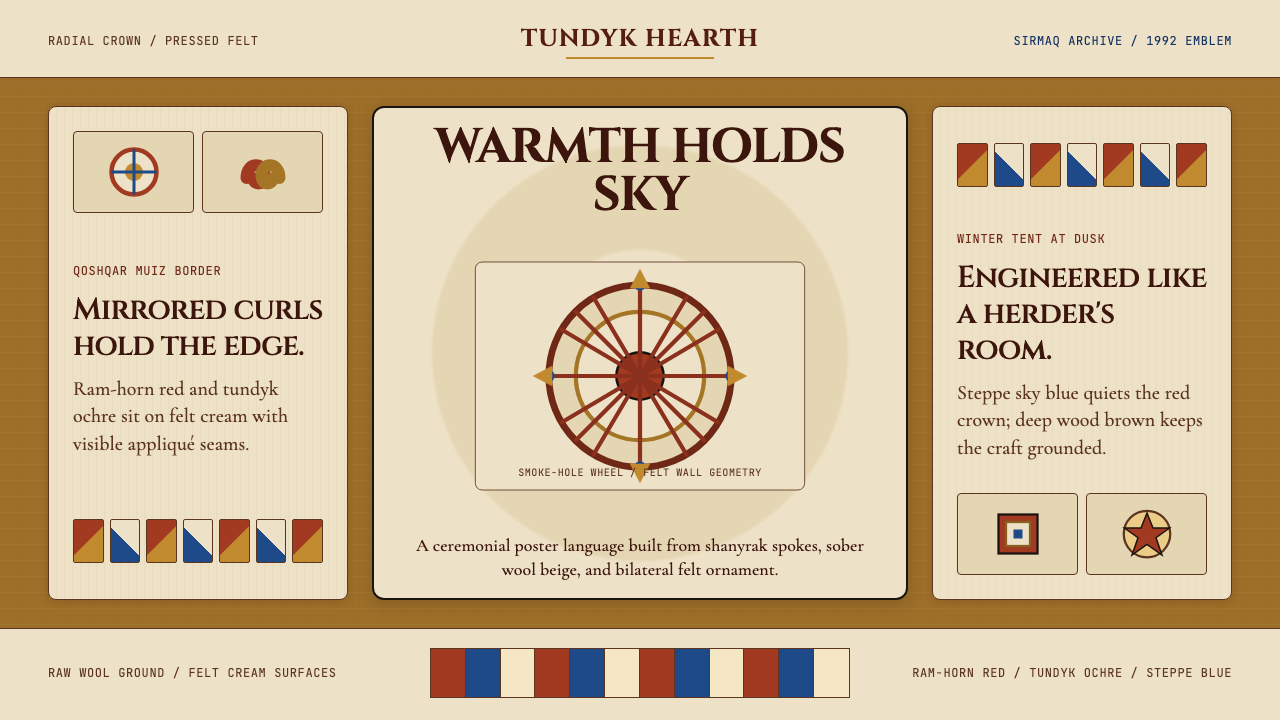 Kazakh Shanyrak Yurt FeltDomestic warmth, engineered. Ram-horn red felt curls around a radial shanyrak…
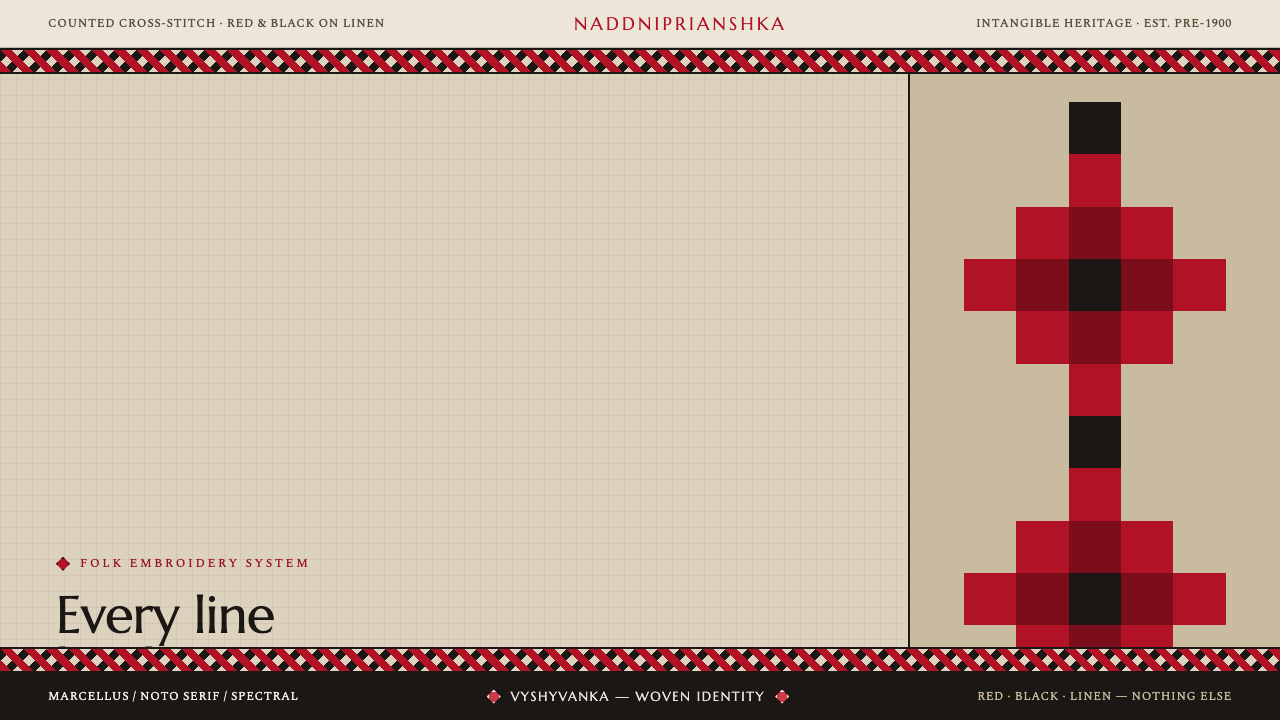 Ukrainian Vyshyvanka EmbroideryRed is life, black is protection. Stepped rhombus motifs counted thread by th…
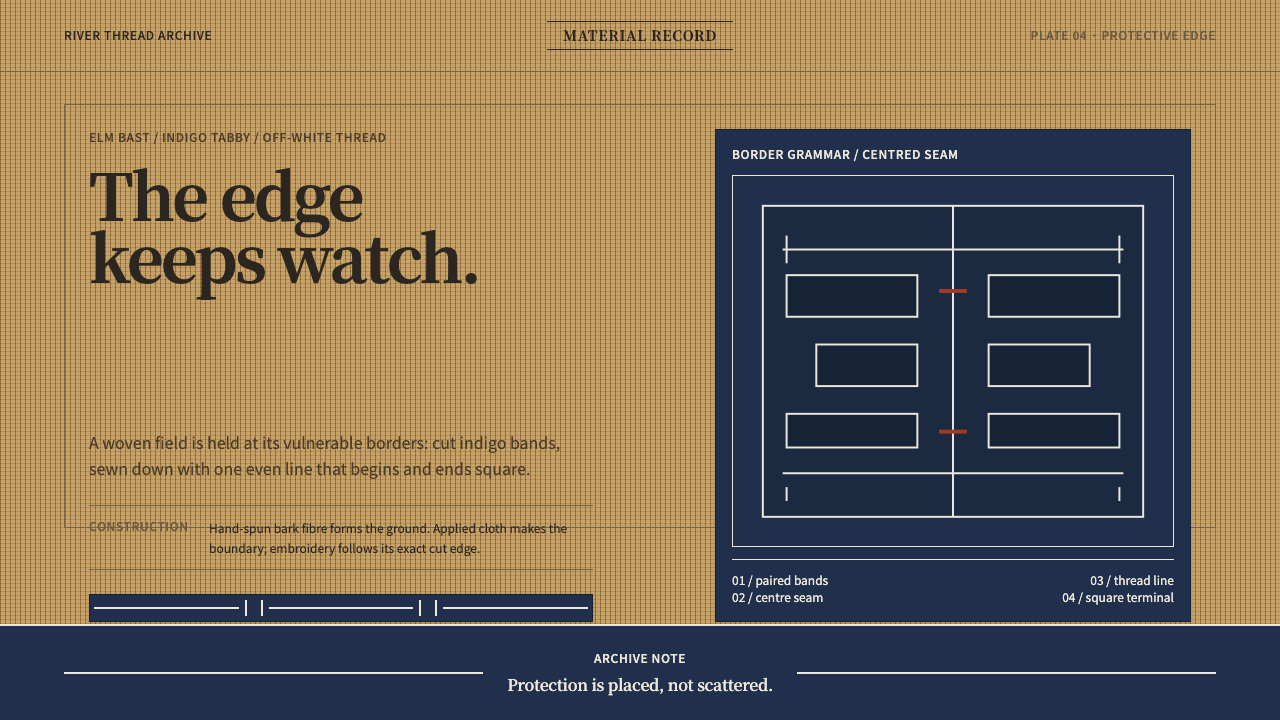 Ainu Attus RobeProtection is cut, not painted. Indigo bands and square-ended thread hold elm…
 Bashkir Honeycomb Felt OrnamentSteppe craft feels weighty. Umber felt holds blue honeycomb and raw-wool hook…
 Fijian Masi Tapa StencilGeometry keeps ceremony. Soot-black diamonds repeat on bark beige with rust-r…